
Judge, 1914-08-22 · page 12 of 24
Judge — August 22, 1914 — page 12: what you’re looking at
What you’re looking at
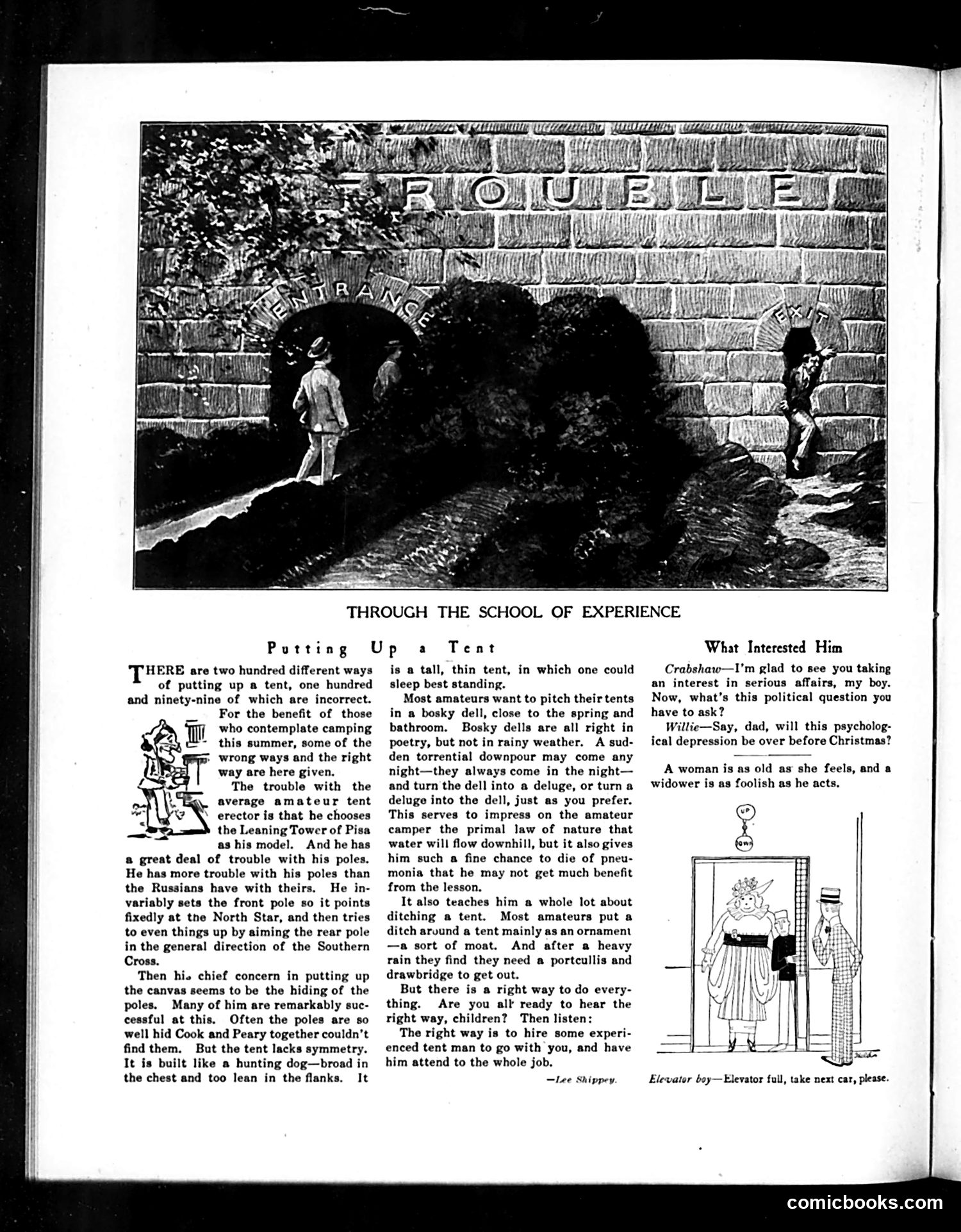
This page contains two distinct pieces of satirical humor: **"Putting Up a Tent"** is a comedic instructional article mocking amateur campers. The author (Lee Shippey) humorously catalogs the incompetent ways inexperienced people pitch tents—leaning structures (referencing the Leaning Tower of Pisa), poles pointed at wrong stars, poorly hidden supports. The satire culminates in the "right way": hire an experienced professional to do it for you. This gently mocks the overconfidence of amateur outdoorsmen attempting tasks beyond their skill. **The three smaller pieces** are brief jokes: "What Interested Him" jokes about a boy asking his father about "psychological depression" (the economic Great Depression), showing children's confusion about adult concerns. The other two are one-liners about women's age and an elevator attendant's quip. The "ROULETE" brick building visible in the illustration appears to be a venue or establishment, though its specific relevance is unclear from context. The overall tone is light domestic humor typical of 1920s-30s American satirical magazines.
📄 Transcribed text from this page (OCR, searchable)
Machine-transcribed from the original scan — historical spelling and the odd misread are preserved.
THROUGH THE SCHOOL OF EXPERIENCE Putting HERE are two hundred different ways of putting up a tent, one hundred and ninety-nine of which are incorrect. For the benefit of those who contemplate camping this summer, some of the ; wrong ways and the right way are here given. The trouble with the average amateur tent erector is that he chooses the Leaning Tower of Pisa as his model. And he has a great deal of trouble with his poles. He has more trouble with his poles than the Russians have with theirs. He in- variably sets the front pole so it points fixedly at tne North Star, and then tries to even things up by aiming the rear pole in the general direction of the Southern Cross. Then his chief concern in putting up the canvas seems to be the hiding of the poles. Many of him are remarkably suc- cessful at this. Often the poles are so well hid Cook and Peary together couldn't find them. But the tent lacks symmetry. It is built like a hunting dog—broad in the chest and too lean in the flanks. It Up a is a tall, sleep best standing. Most amateurs want to pitch their tents in a bosky dell, close to the spring and Tent thin tent, in which one could bathroom. Bosky dells are all right in poetry, but not in rainy weather. A sud- den torrential downpour may come any night—they always come in the night— and turn the dell into a deluge, or turn a deluge into the dell, just as you prefer. This serves to impress on the amateur camper the primal law of nature that water will flow downhill, but it also gives him such a fine chance to die of pneu- monia that he may not get much benefit from the lesson. It also teaches him a whole lot about ditching a tent. Most amateurs put a ditch around a tent mainly as an ornament —a sort of moat. And after a heavy rain they find they need a portcullis and drawbridge to get out. But there is a right way to do every- thing. Are you all ready to hear the right way, children? Then listen: The right way is to hire some experi- enced tent man to go with you, and have him attend to the whole job. —Lee Shippey. What Interested Him Crabshaw—I'm glad to see you taking an interest in serious affairs, my boy. Now, what's this political question you have to ask? Willie—Say, dad, will this psycholog- ical depression be over before Christmas? A woman is as old as she feels, and a widower is as foolish as he acts. Elevator boy—Elevator full, take next car, please. comicbooks.com