
A complete issue · 24 pages · 1914
Judge — May 16, 1914
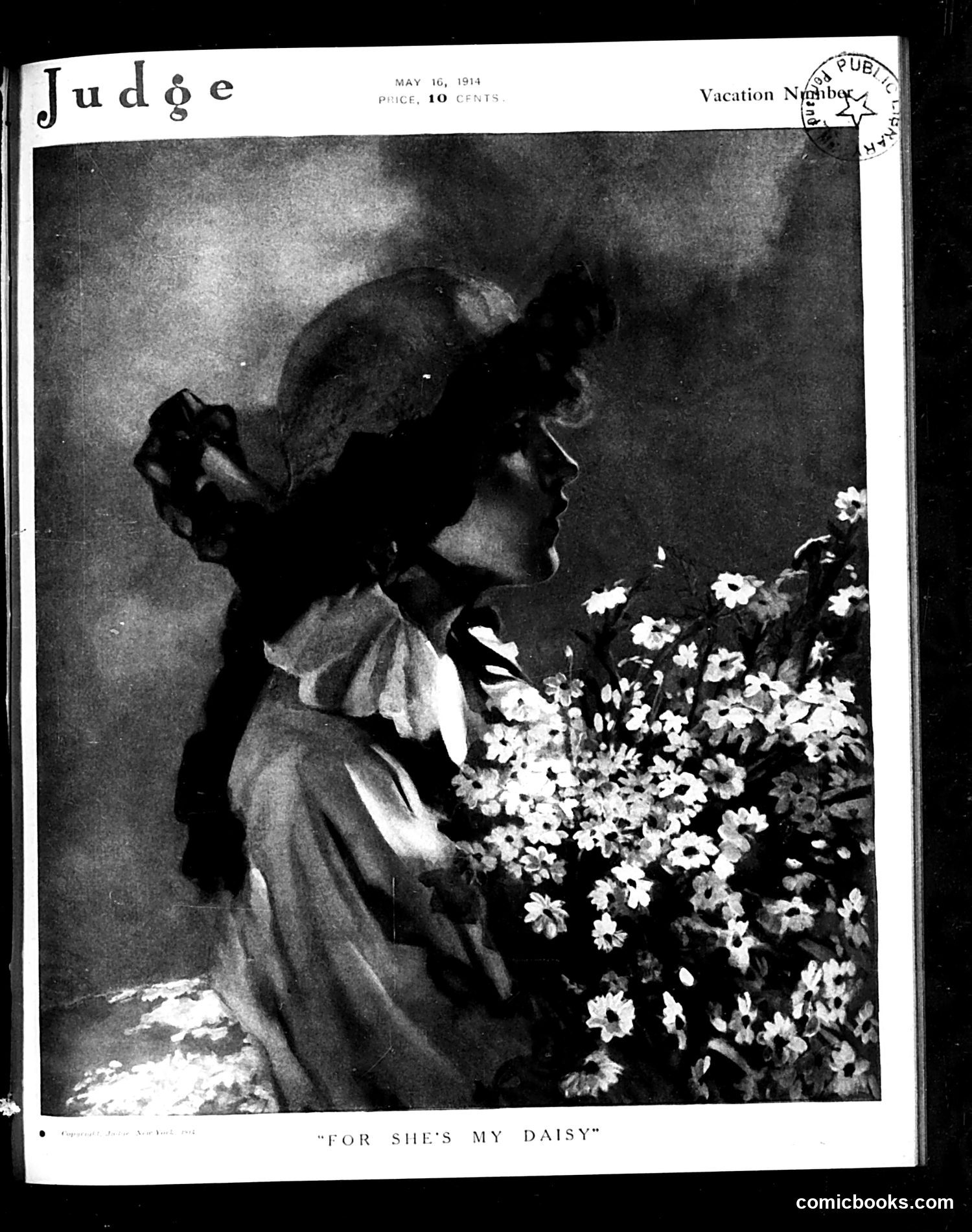
This page features a romantic illustration rather than political satire. The image shows a profile view of a woman with her hair up in a Gibson Girl style (fashionable circa 1914), gazing at daisies. The caption "For She's My Daisy" is a sentimental reference, likely playing on the popular song "Daisy Bell" ("A Bicycle Built for Two," 1892). The illustration appears to be a cover or feature promoting "Vacation Number" content. Rather than satirizing political figures or events, this represents Judge's lighter entertainment content—romantic imagery appealing to readers seeking leisure and sentimental humor during the spring/summer season.
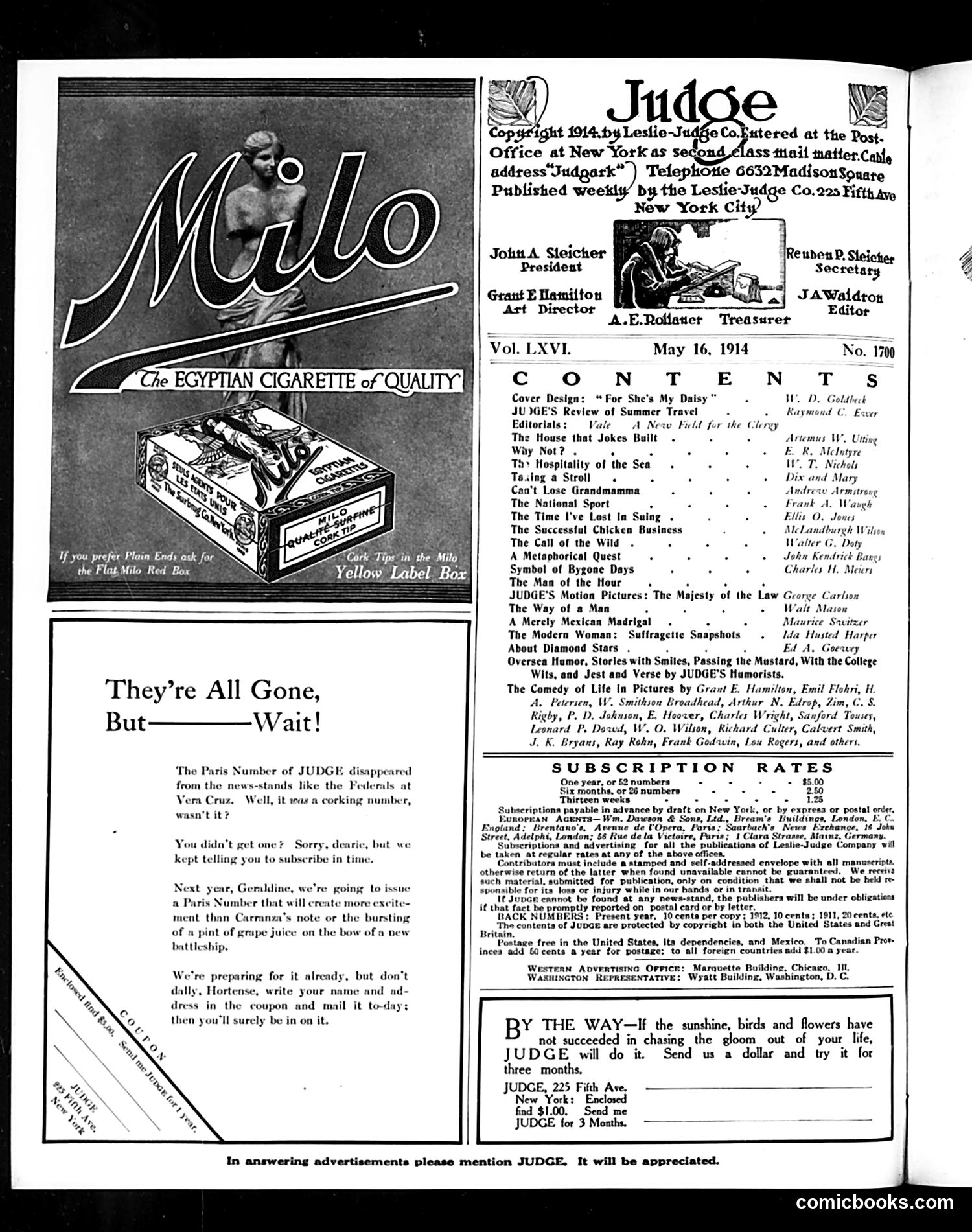
This page is primarily **advertising and editorial content** rather than political satire. The left side features a full-page Milo cigarette advertisement ("The Egyptian Cigarette of Quality"), showing product packaging and promoting both Plain and Yellow Label boxes. Below the ad is an announcement that a Paris-themed issue of Judge disappeared from newsstands—described as "a cooking number"—and promising an even more exciting Paris issue next year, inviting readers to subscribe. The right side contains standard magazine masthead information, table of contents, and subscription rates. The small "By the Way" box offers a tongue-in-cheek remedy for melancholy: subscribing to Judge for three months. There is no significant political or social satire on this particular page.
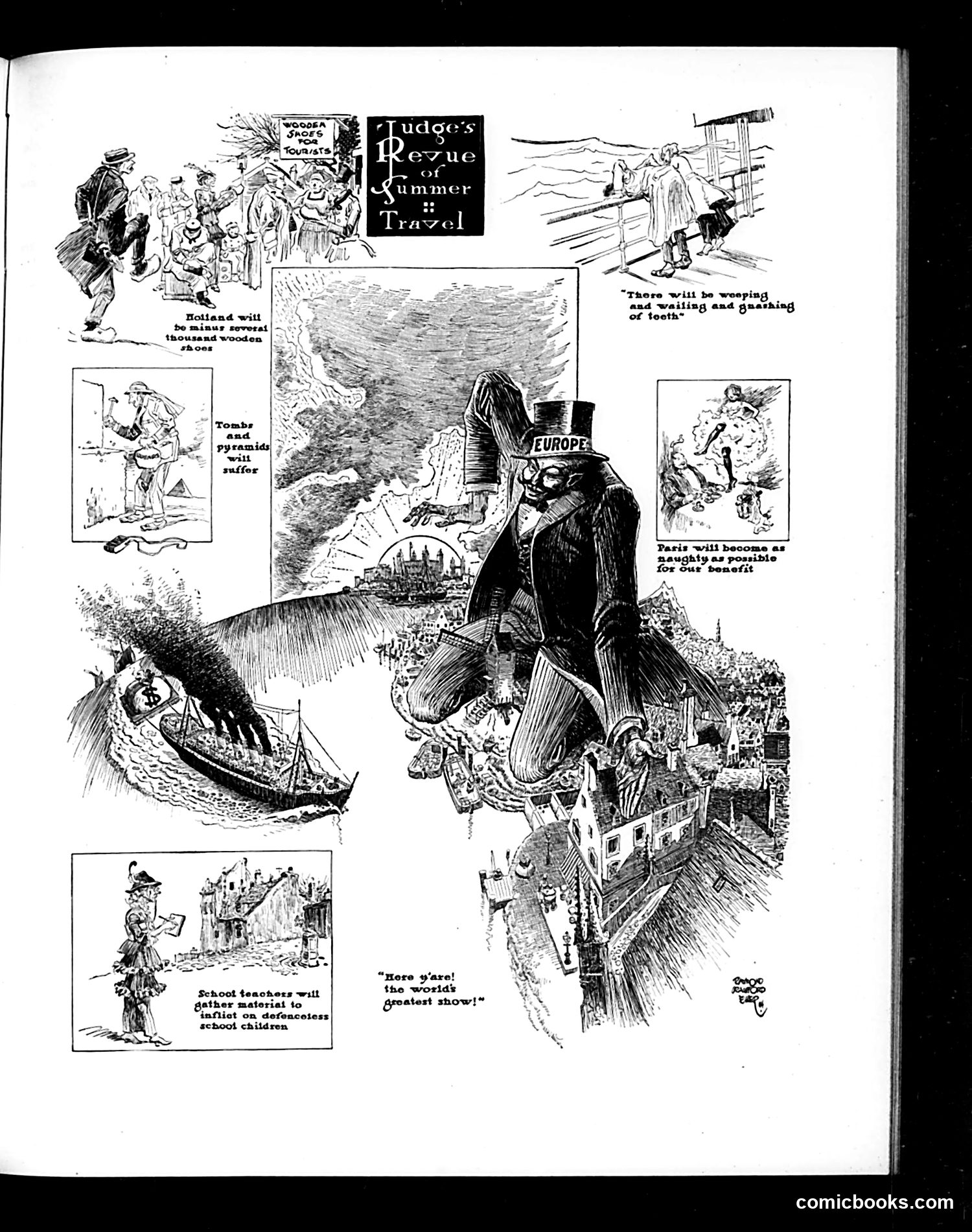
This is a satirical commentary on European summer tourism and its consequences. The central figure labeled "EUROPE" is depicted as a giant being overwhelmed or burdened by tourists and their impacts. The smaller vignettes mock various travel-related problems: - Holland will suffer "thousand wooden shoes" (tourist consumption) - Tombs in Egypt will "suffer" from looting/damage - Paris will become "as naughty as possible for one's benefit" (moral corruption) - School teachers will "inflict material to inflict on defenceless school children" (unwanted souvenirs) - There will be "weeping and gnashing of teeth" (general chaos) The cartoon criticizes how mass tourism damages European destinations and cultures while tourists collect vulgar memorabilia to bore others with upon returning home. It's fundamentally about tourism's destructive impacts on authentic places.
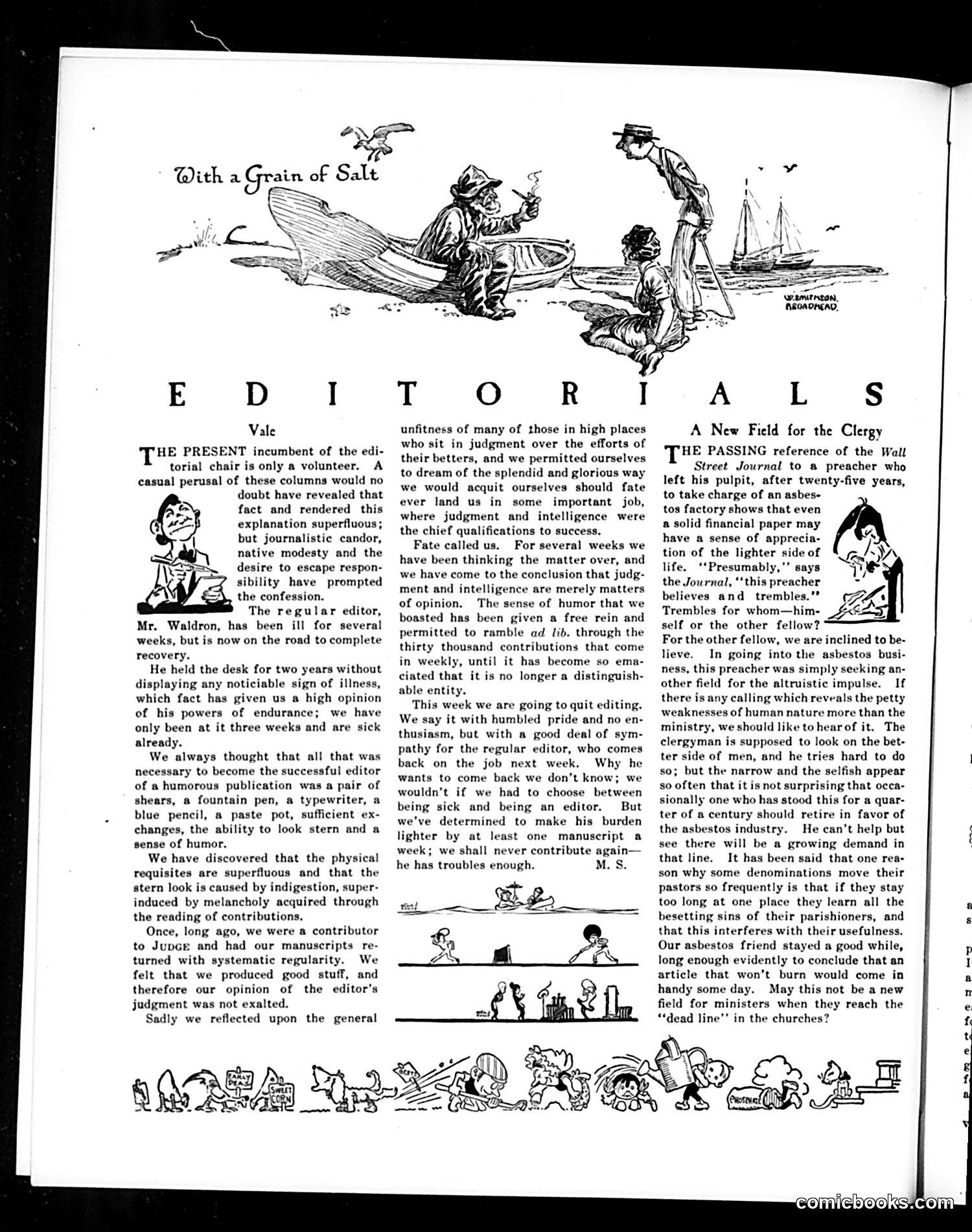
This page contains two editorial pieces. The main article discusses the magazine's editorial transition: the current editor is stepping down after being ill for weeks, and a new editor (Mr. Waldron) will take over. The outgoing editor humorously confesses that producing humor requires specific skills—a sharp pencil, paste pot, and sense of humor—but that physical health is surprisingly necessary. The second article, "A New Field for the Clergy," satirizes the asbestos industry, suggesting clergy should consider careers in asbestos manufacturing. This appears to be dark satire about the industry's disregard for health dangers, though the specific historical context of asbestos awareness in this era remains unclear from the text alone.
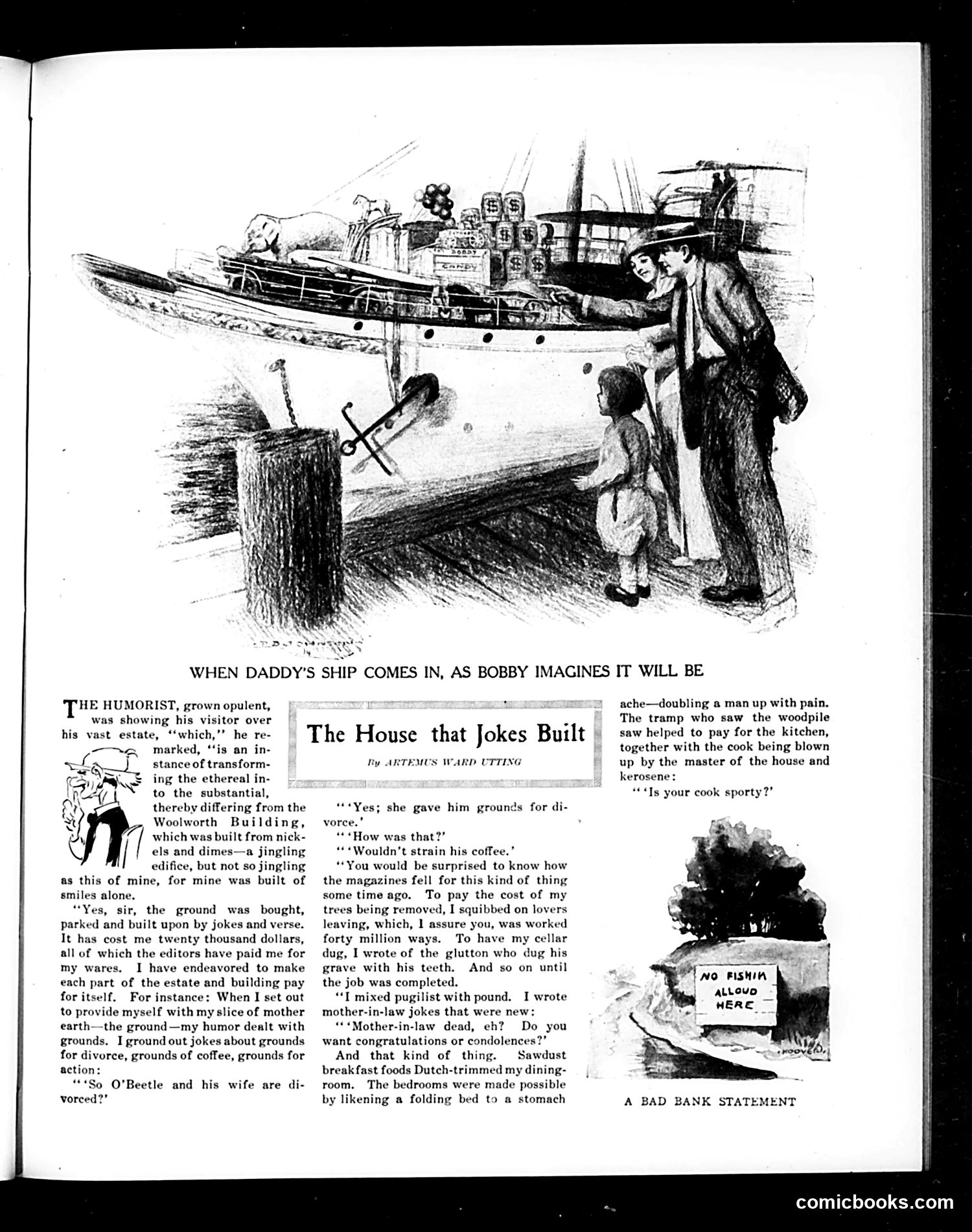
The page contains two satirical pieces: **"When Daddy's Ship Comes In"** (top cartoon): Shows a child and man gazing at a loaded cargo vessel, suggesting optimistic anticipation of wealth arriving by ship. **"The House that Jokes Built"** (main article by Artemus Ward Utting): A humorous essay describing how the author financed his estate through joke-writing. The piece details various schemes—using jokes about grounds to pay for removal costs, hiring workers through puns, and financing home improvements through humor publications. The tone is self-aware satire about monetizing humor itself. **"A Bad Bank Statement"** (bottom cartoon): Shows a sign reading "NO FISHIN ALLOUD HERE," appearing to mock financial statements or banking regulations through visual pun. The overall theme celebrates humor as an economic commodity, typical of Judge magazine's self-referential, witty approach to satire.
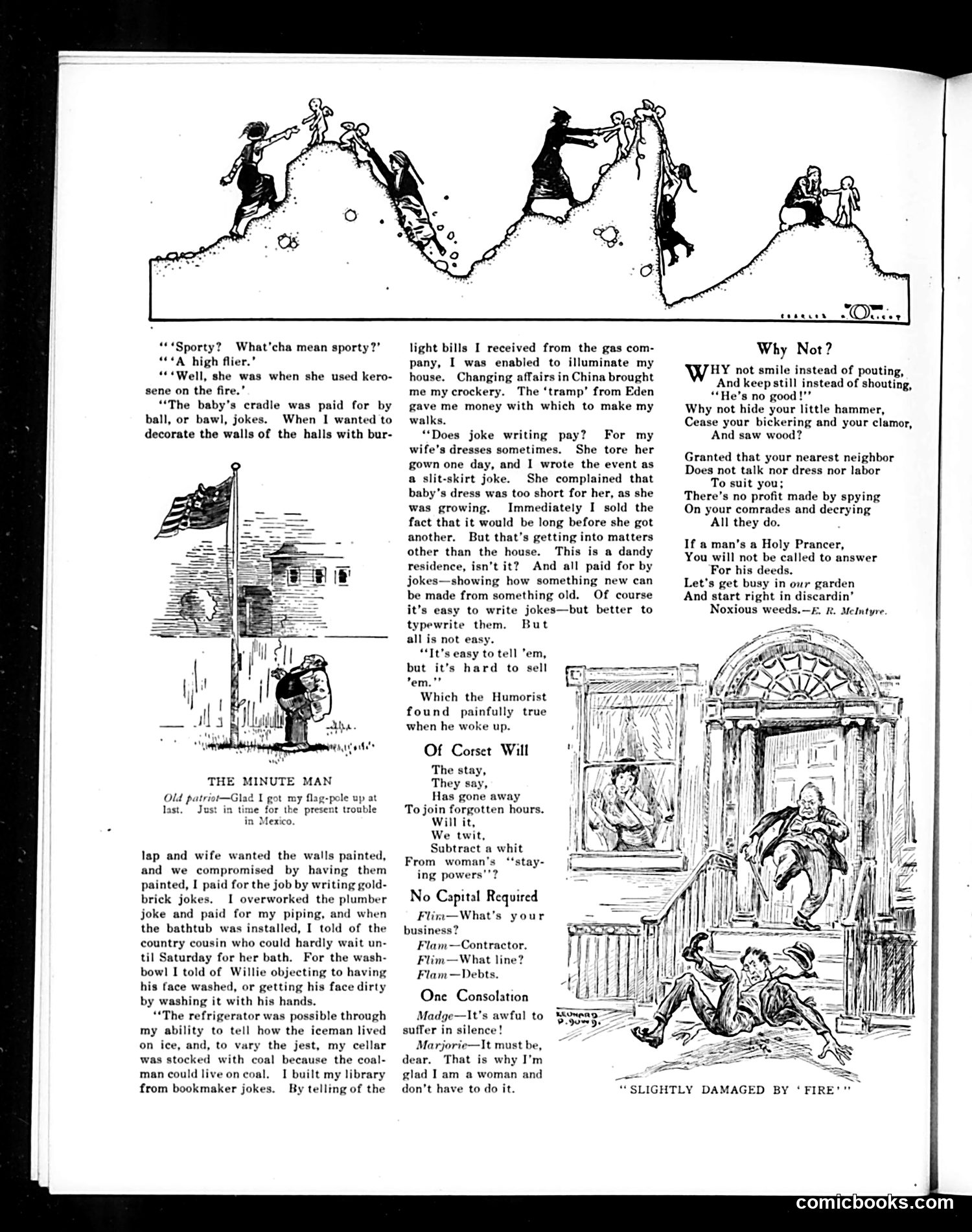
This page from Judge contains multiple humor pieces satirizing early 20th-century American life: **"The Minute Man"** depicts an older patriot proudly displaying his flagpole, likely referencing preparedness concerns about potential U.S. military intervention in Mexico (a recurring political anxiety of that era). **"The Minute Man" (main text)** is a lengthy joke about a struggling humorist who finances his entire house—furniture, utilities, everything—by writing jokes. The satire mocks both the precarious economics of joke-writing as a profession and the absurdity of extracting commercial value from everyday domestic situations. **"Why Not?"** is a moralizing poem advising against gossip, complaint, and judgment of neighbors—conventional Progressive-era civic virtue. The remaining pieces are brief gags about corsets, contracting, and marital dynamics. The illustration "Slightly Damaged by Fire" shows domestic chaos. Overall, this reflects Judge's blend of social commentary, domestic humor, and gentle moralizing typical of early 20th-century American satire.
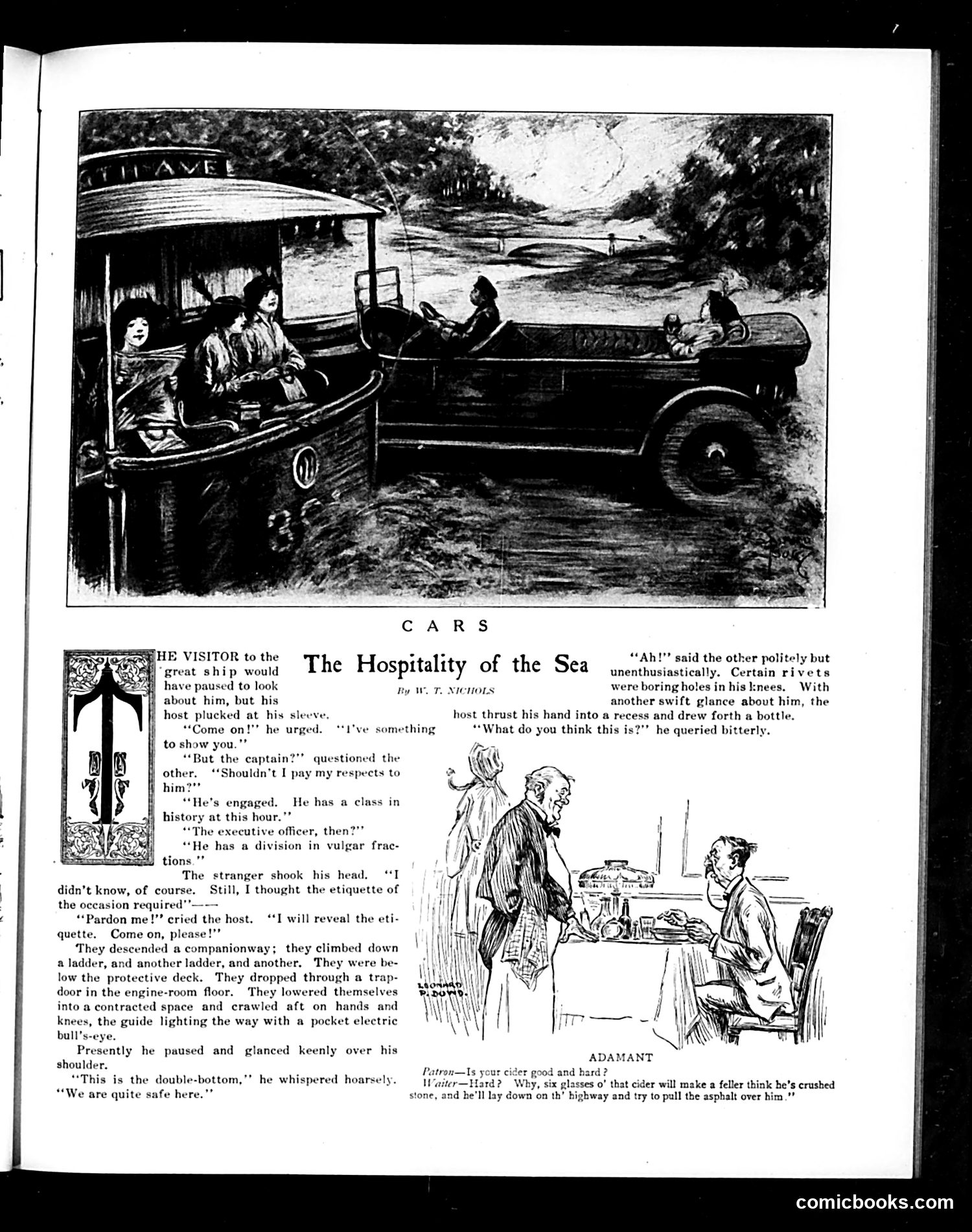
This is a humorous short story illustrated with a ship-board scenario. A visitor boards a ship and asks to pay respects to the captain and executive officer. The host dismisses this, claiming the captain teaches history and the executive officer teaches "vulgar fractions"—a satirical jab at what the author views as the incompetence or absurdity of naval officers. The joke escalates when the host leads the visitor through increasingly cramped passages into the ship's lowest compartments (the "double-bottom"), treating this claustrophobic descent as if it were proper nautical etiquette. The humor lies in subverting expectations of naval ceremony and "hospitality," replacing formality with absurdity. Below is an unrelated single-panel cartoon ("Adamant") about hard cider's potency.
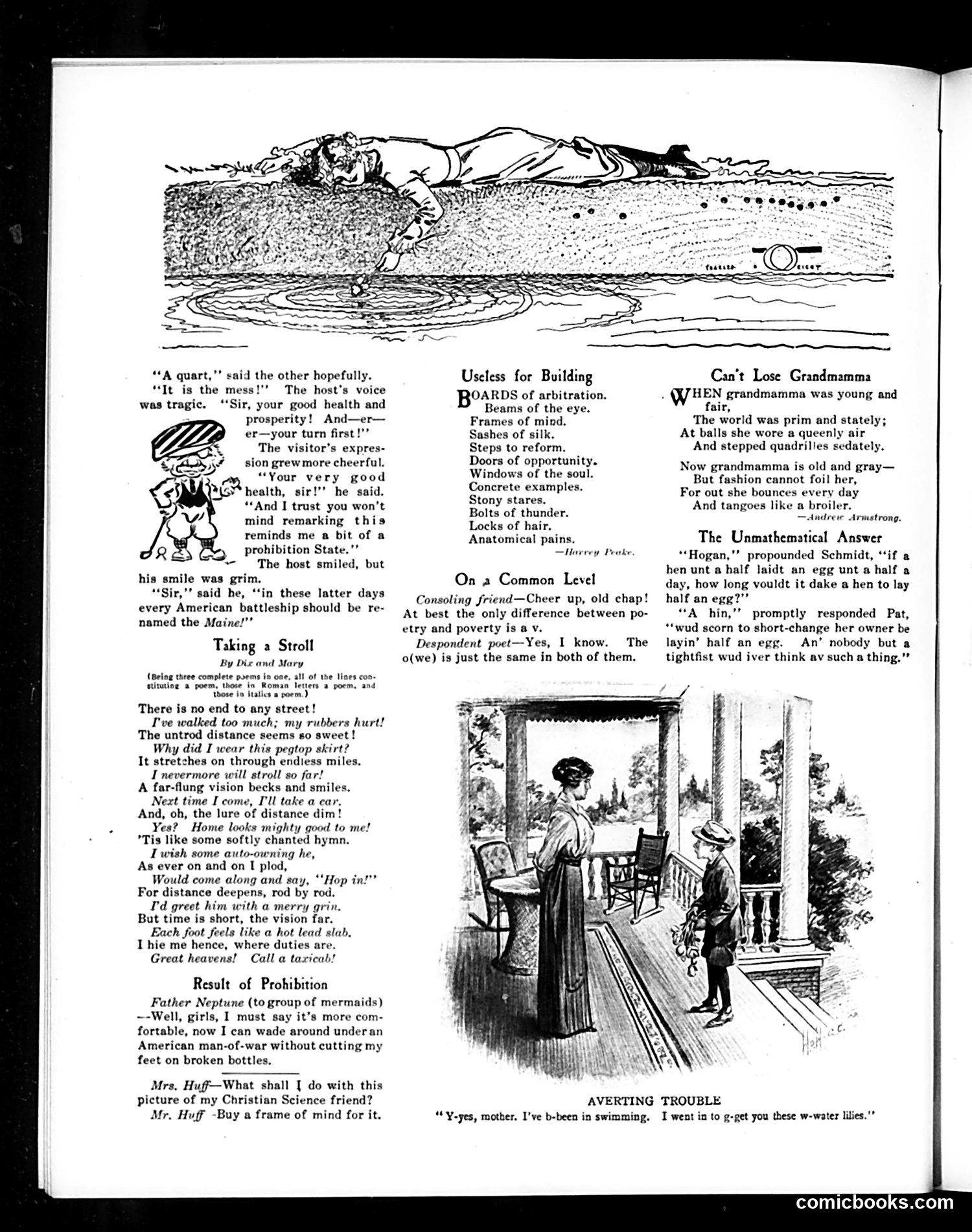
This page contains multiple short humorous pieces typical of Judge magazine's satirical style: **"Taking a Stroll"** presents a poem about a woman regretting a long walk in restrictive "pegtop" skirts (fashionable but impractical early 20th-century clothing), ultimately calling for a taxi. **"Result of Prohibition"** jokes about the 18th Amendment: Father Neptune quips that he can now wade near American warships without cutting his feet on broken bottles—implying that pre-Prohibition sailors discarded so many bottles that the seafloor was littered with glass. **"Can't Lose Grandmamma"** contrasts old-fashioned propriety ("quadrilles sedately") with modern dancing, as grandmother now "tangoes like a broiler" (vigorously)—poking fun at generational shifts in behavior. The remaining pieces are wordplay jokes ("Useless for Building," "On a Common Level," "The Unmathematical Answer," "Averting Trouble") with no clear political content—just light humor typical of the magazine's miscellaneous filler.
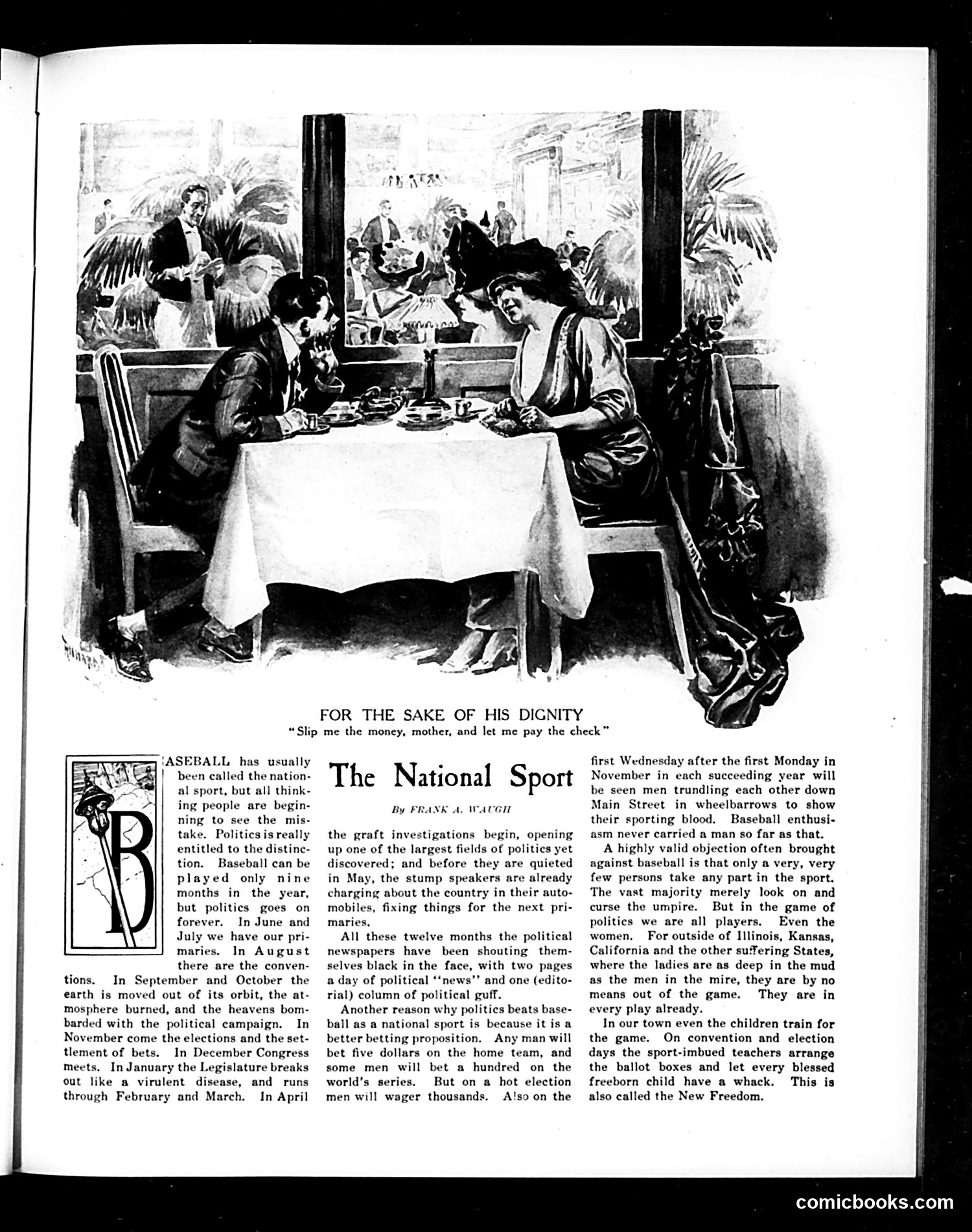
This article satirizes American politics by comparing it to baseball. The author argues politics is the "real" national sport because it runs year-round (primaries, conventions, campaigns, elections, legislative sessions, graft investigations) versus baseball's nine-month season. The cartoon illustrates the article's central joke: a man at a restaurant insists on paying the check himself to maintain dignity, despite clearly needing his mother's financial help. This visual metaphor represents political corruption—politicians claiming honorable motives while accepting bribes and graft. The article mocks how Americans obsessively gamble on politics, even wheelbarrowing losers down Main Street. It notes that unlike baseball (a spectator sport), "politics we are all players"—everyone participates, including women and children through voting. The satirical tone criticizes both widespread political corruption and Americans' enthusiasm for it, suggesting the "game" of politics is equally entertaining but far more consequential than sports.
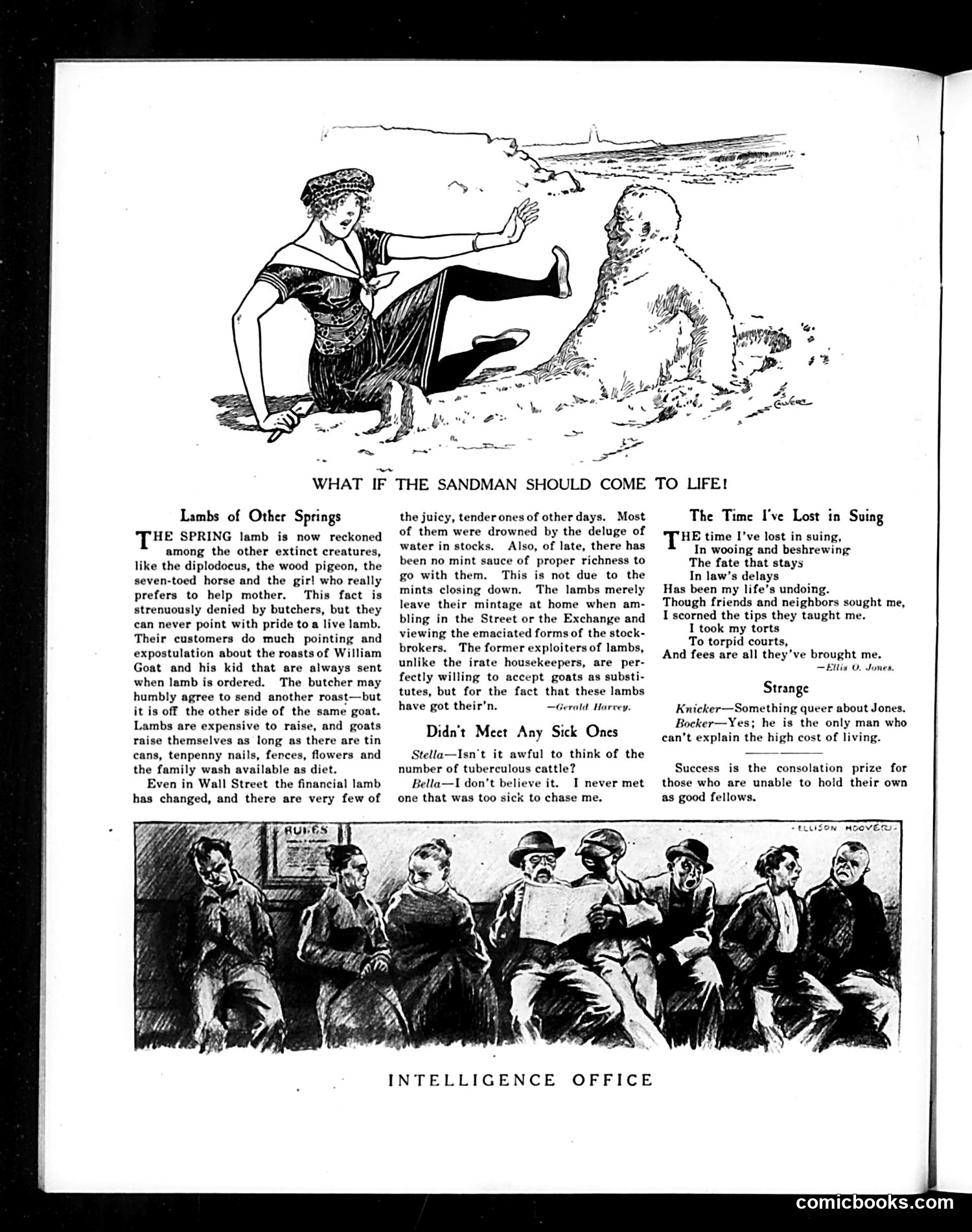
This *Judge* magazine page contains satirical commentary on early 20th-century economic concerns. **Top cartoon**: "What if the Sandman Should Come to Life!" depicts a fantastical scenario where the mythical sandman (who brings sleep) becomes real. The figure on the right appears to represent financial ruin or market collapse—likely referencing stock market crashes or financial instability of the era. **"Lambs of Other Springs"**: A metaphorical essay lamenting the disappearance of naive investors ("spring lambs"—inexperienced, easily exploited victims). The satire notes that butchers now substitute goats because actual lambs are extinct, paralleling how financial exploiters now prey on different targets since their traditional victims (gullible investors) no longer exist or have learned caution. Wall Street references suggest post-stock-market-crash cynicism. **"Didn't Meet Any Sick Ones"**: A brief joke about tuberculous cattle, suggesting disease is so prevalent that even sick animals remain active. **Bottom strip "Intelligence Office"**: Appears to be a separate satirical panel about job-seeking or employment. The overall theme critiques financial exploitation and market instability affecting ordinary people.
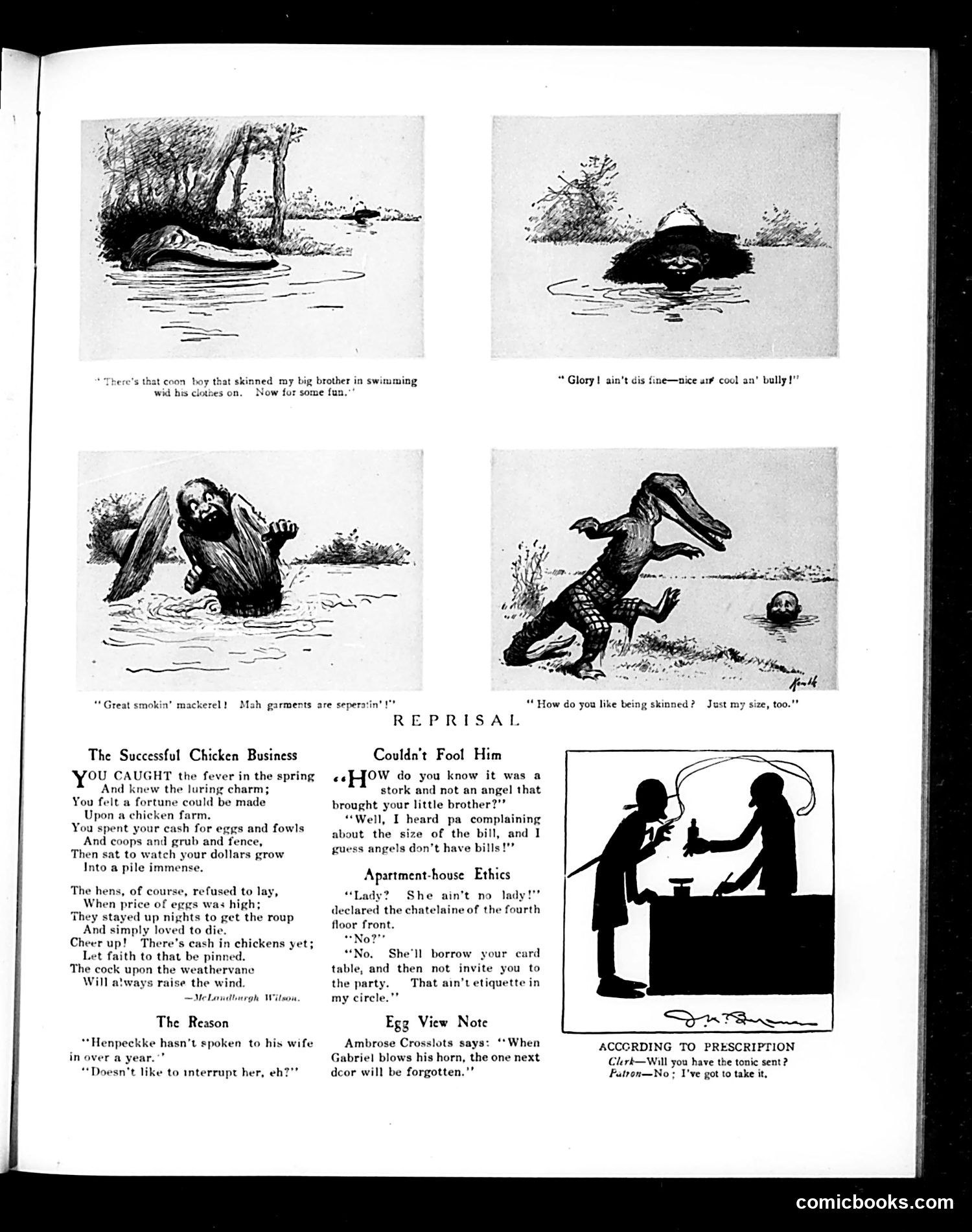
This page contains several short humor pieces typical of early 20th-century American satirical magazines: **Top cartoons**: Four panels depicting what appears to be a "coon" character (using period racist terminology) in water-related situations with minstrel-show dialect. The humor relies on crude stereotyping. **"The Successful Chicken Business"**: A poem mocking the back-to-the-land farming craze, where city people invested in chicken farms expecting easy profits but found hens refused to lay eggs and died constantly—a commentary on naive entrepreneurial optimism. **"Couldn't Fool Him"**: A brief joke about a child deducing a baby arrived via stork rather than angel because his father complained about "the bill"—a pun on hospital/delivery costs. **"Apartment-house Ethics"**: Satirizes urban apartment dwellers' social hypocrisy—borrowing neighbors' furniture without reciprocating invitations. **"According to Prescription"**: A joke about a patient who must consume bitter medicine immediately rather than have it delivered—implying the taste is so bad he won't survive waiting. The page reflects early 1900s middle-class anxieties and humor conventions.
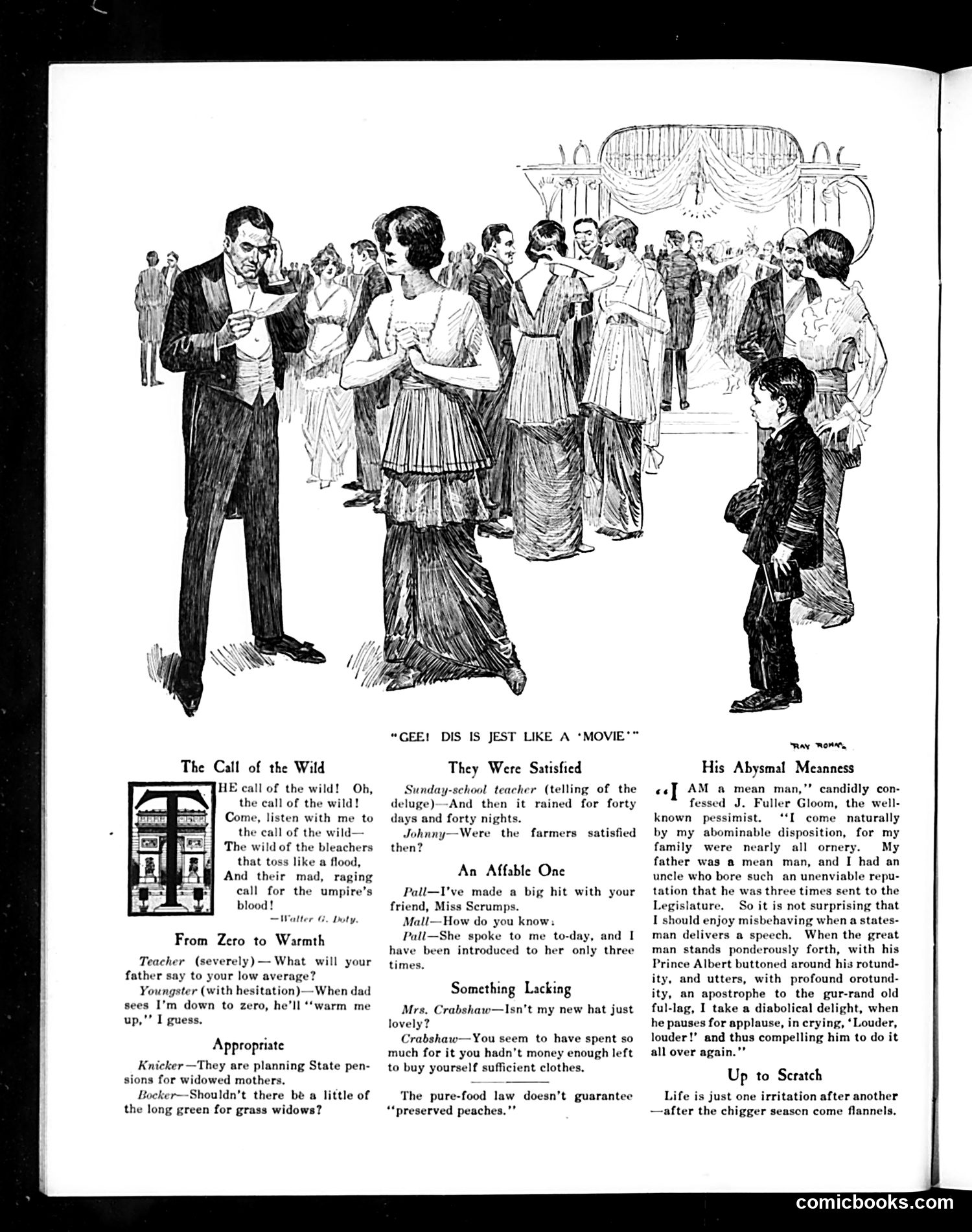
This page from *Judge* contains multiple brief humorous sketches mocking American social types and situations circa early 1900s. **Key pieces:** - **"The Call of the Wild"** parodies Jack London's famous novel by reducing "wild" to rowdy baseball fans demanding the umpire's death—satirizing sports mania. - **"From Zero to Warmth"** jokes about corporal punishment: a student expects his father will literally "warm him up" (beat him) for poor grades. - **"They Were Satisfied"** uses a child's naive logic: a Sunday-school student assumes farmers would be happy about Biblical flood rains—missing the agricultural catastrophe. - **"His Abysmal Meanness"** features a self-described pessimist who enjoys heckling political speeches, tracing his meanness through family history and legislative service (unclear which politician is referenced). - Minor bits mock fashion, widows' pensions, and food safety laws. The humor relies on wordplay, generational stereotypes, and everyday frustrations recognizable to the era's readers.
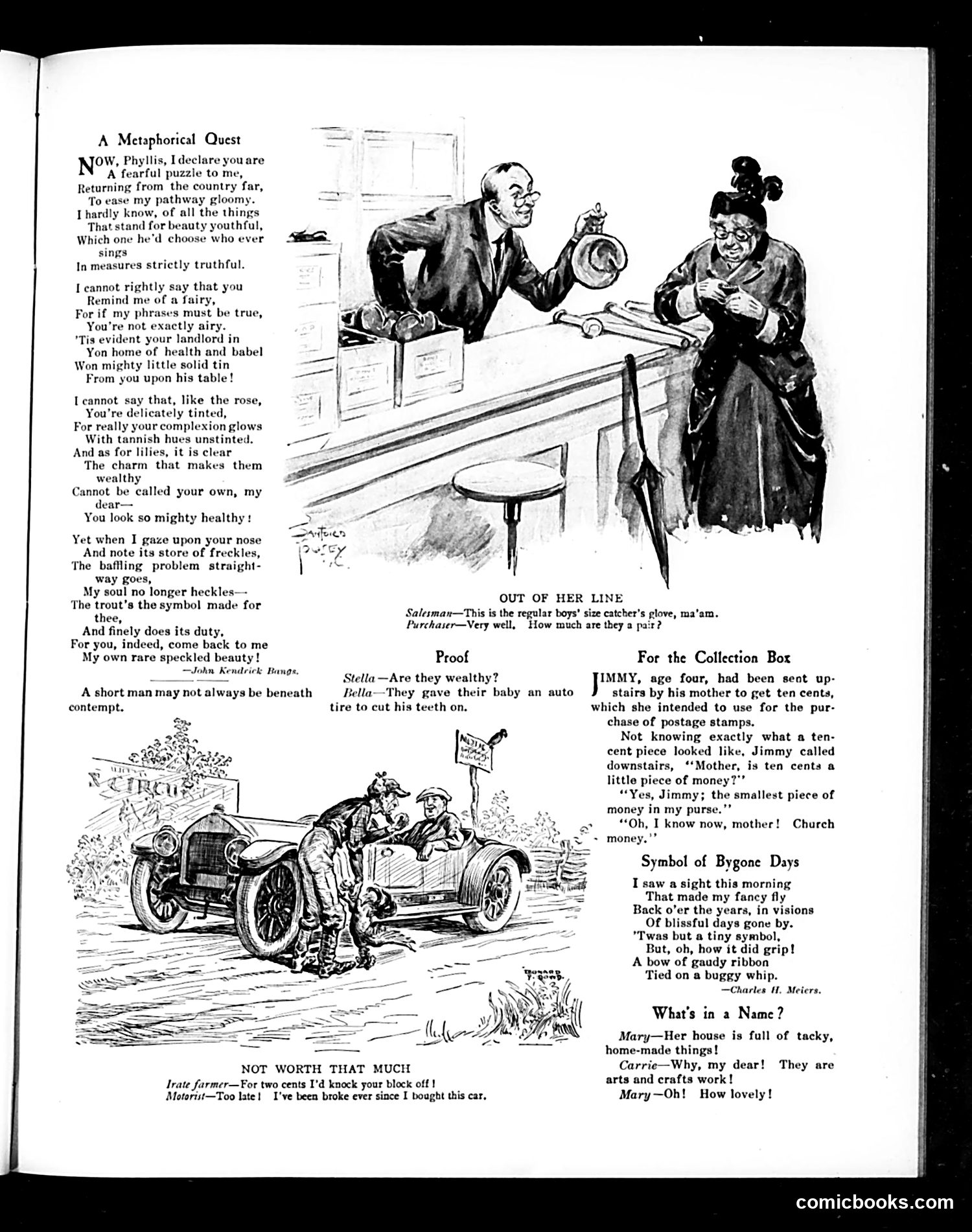
This page contains several satirical pieces typical of early 20th-century American humor: **"A Metaphorical Quest"** is a poem mocking romantic flattery. The speaker tries to compliment "Phyllis" but keeps failing—she's not fairy-like, her complexion is tan rather than delicate, she lacks lily-like charm. Finally, he settles on calling her a "speckled beauty" like a trout, comparing her freckles to fish spots. The satire ridicules flowery romantic language and how men stretch truth to compliment women. **"Out of Her Line"** shows a customer confused about buying a catcher's glove, asking "How much are they a pair?"—suggesting she doesn't understand baseball equipment terminology. **"Not Worth That Much"** depicts a motorist and angry farmer; the joke is the motorist claims bankruptcy from car ownership, making him judgment-proof. **"For the Collection Box"** and other brief pieces are simple jokes about children's misunderstandings and domestic life. The overall tone reflects genteel, family-friendly satire about courtship, automobiles, and everyday confusion.
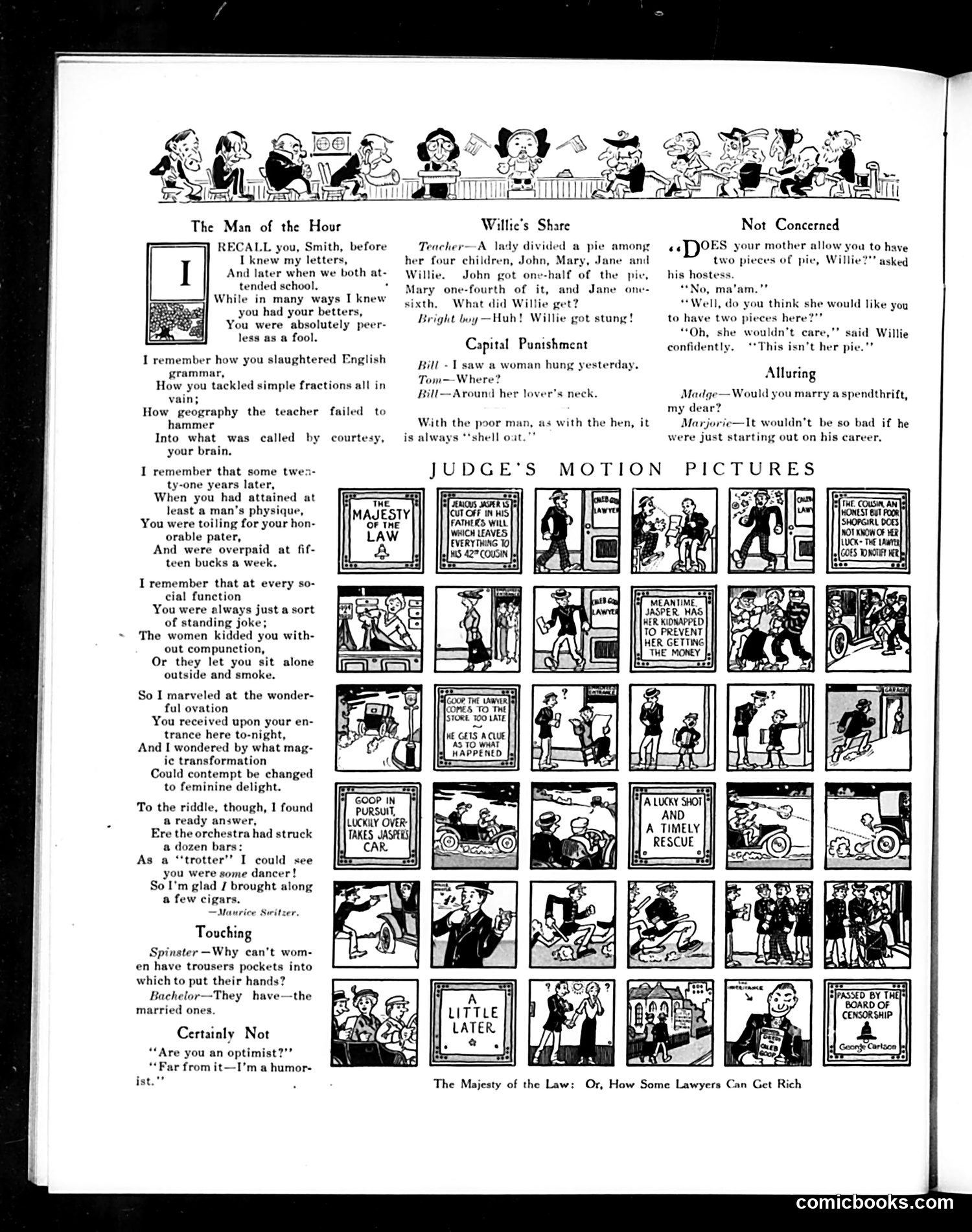
This page contains several brief satirical pieces and a comic strip series typical of early 20th-century American humor: **"The Man of the Hour"** — A poem mocking a formerly foolish schoolmate who has inexplicably become socially popular. The twist: he's now valued solely as a talented dancer ("trotter"), revealing shallow social values where athletic prowess trumps intelligence. **Short Jokes** — Quick satirical gags about gender relations ("Capital Punishment" mocks women's materialism), marital dynamics (the spinster/bachelor exchange jokes about married women's pockets), and a math riddle where "Willie got stung" — a child defrauded of pie, likely reflecting period class humor. **"Judge's Motion Pictures"** — A comic strip series depicting melodramatic legal scenarios ("The Majesty of the Law: Or, How Some Lawyers Can Get Rich"), featuring kidnapping plots and courtroom drama typical of silent-era film parodies. The overall tone satirizes contemporary American social pretensions, gender relations, and the legal profession's corruption—common Judge magazine targets of the era.
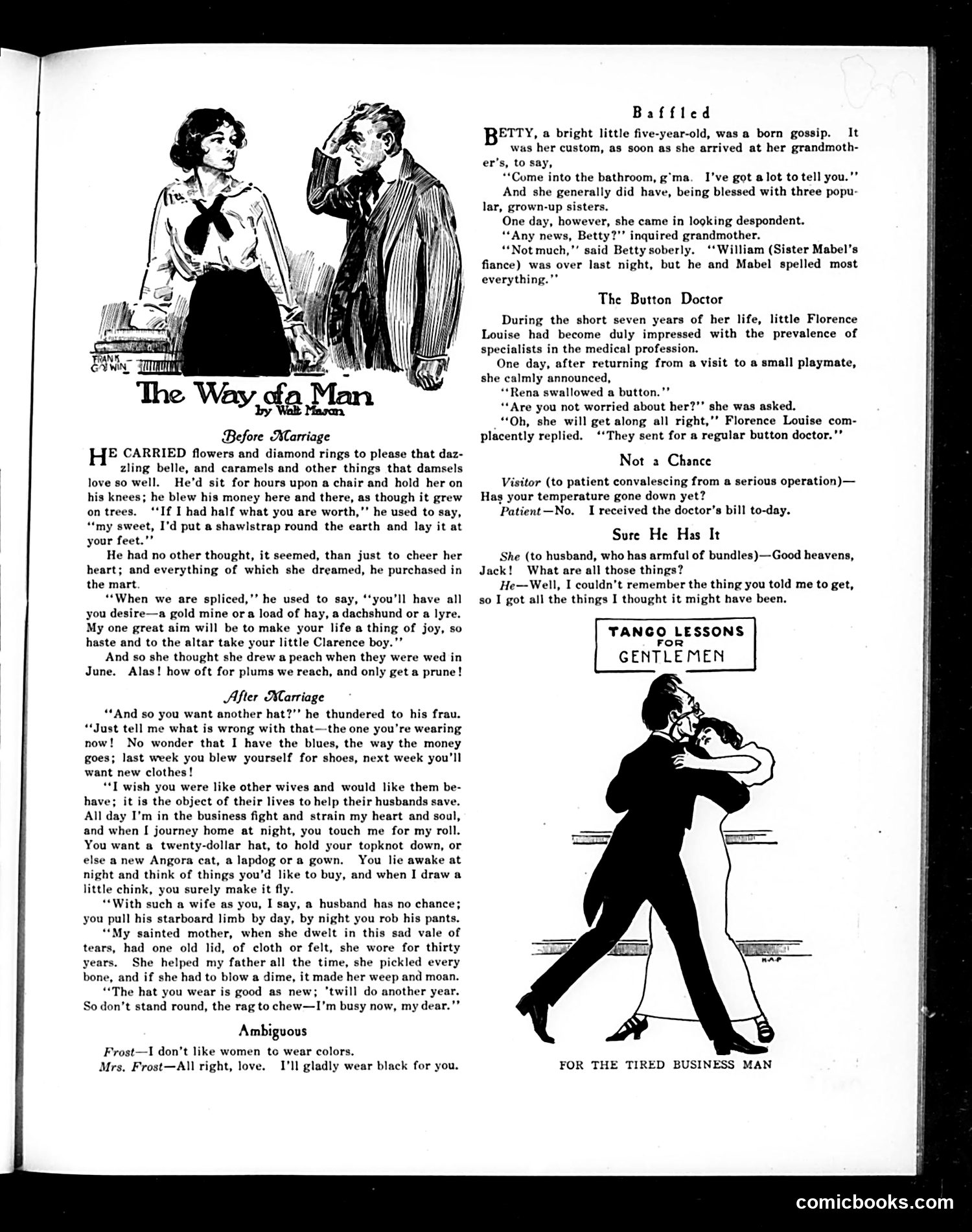
This page contains three satirical humor pieces typical of early 20th-century American magazines: **"The Way of a Man Before Marriage"** (top) contrasts romantic courtship with post-marital disappointment. A young man lavishes gifts and promises on his fiancée, but after marriage complains bitterly about her spending habits—shoes, hats, clothes, pets. He nostalgically references his self-sacrificing mother who wore one dress for thirty years. The satire mocks husbands' unrealistic expectations and their resentment of wives' independence with money. **Three brief comedic sketches** follow: "Baffled" jokes about a child's misunderstanding of "spelling"; "The Button Doctor" plays on children's literal interpretation of medical specialization; and "Not a Chance"/"Sure He Has It" deal with marital dynamics and forgetfulness. **"Tango Lessons for Gentlemen"** (right) advertises dancing instruction, targeting businessmen seeking leisure-time sophistication. The overall tone reflects period attitudes about gender roles, marriage friction, and consumerism, presented through domestic comedy.
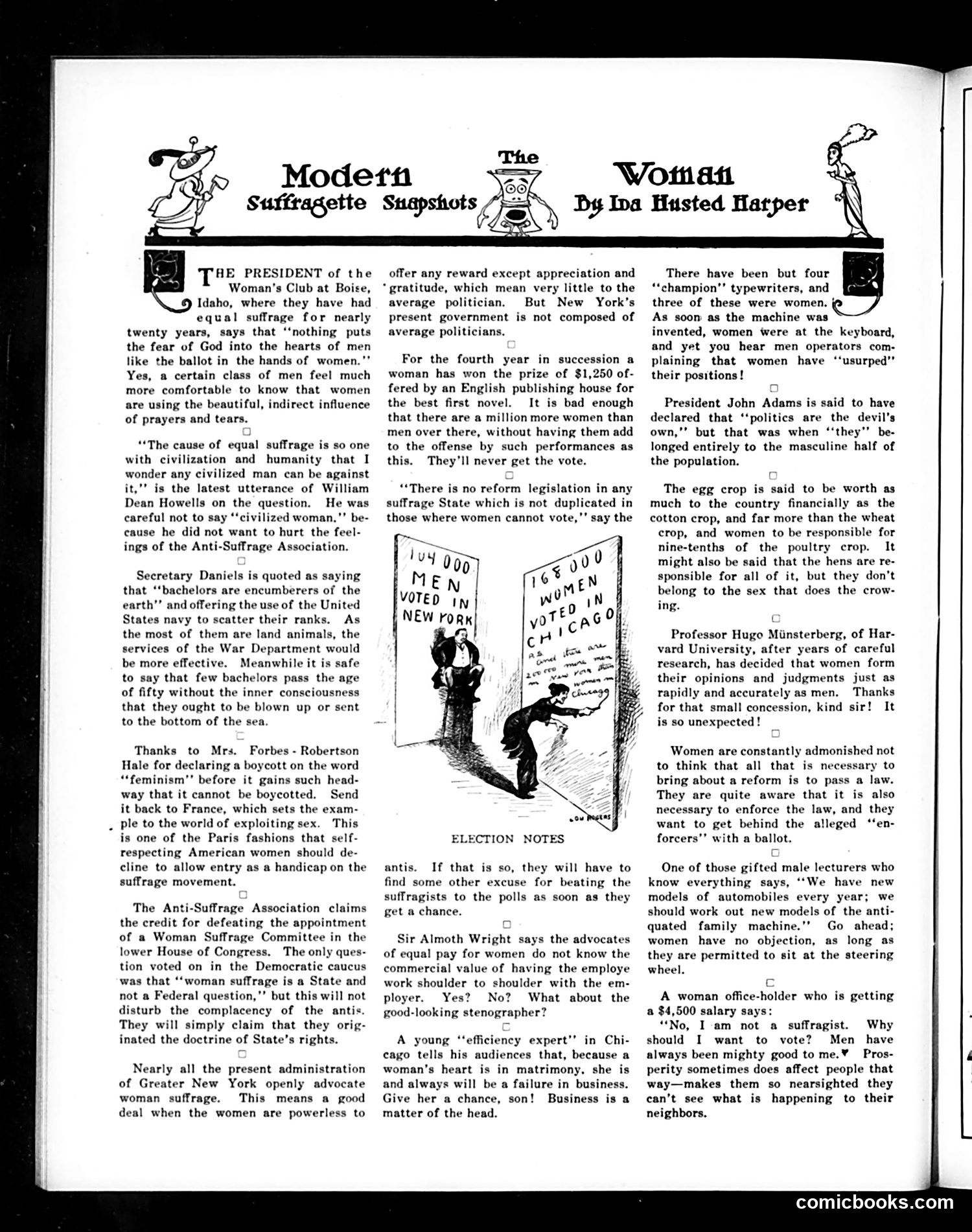
This page satirizes opposition to women's suffrage circa 1910s. The cartoon titled "Election Notes" (center) depicts two figures posting voting statistics—one showing "44,000 Men Voted in New York" versus "168,000 Women Voted in Chicago"—suggesting women's voting power when given the chance. The accompanying text mocks anti-suffrage arguments: a woman earning $4,500 questioning why she should vote when "men have always been mighty good to me"; claims that women's presence in traditionally male jobs like typewriter operation represents "usurping" positions; and the absurd assertion that women cannot succeed in business because their hearts belong to matrimony. Harper's satire targets the hypocrisy of anti-suffragists who simultaneously claim women lack competence while benefiting from their labor. The page presents suffrage as inevitable and opposition as unreasonable—mocking those who fear women's political power.
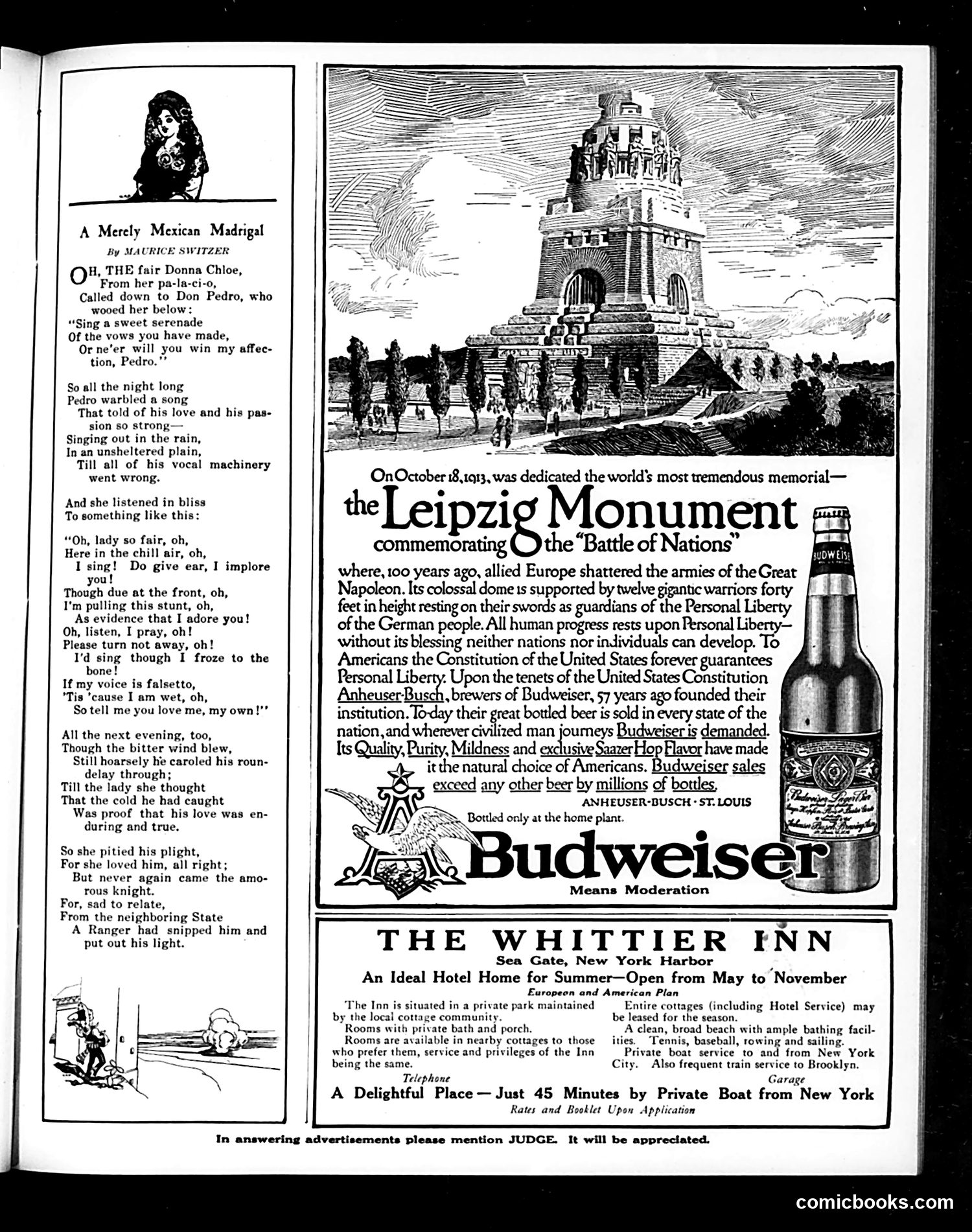
This is a satirical poem mocking Mexican romance and masculinity through ethnic stereotype. The narrative follows Don Pedro, who serenades his lady love (Donna Chloe) so persistently in rain and cold that he catches pneumonia—which she mistakes for proof of devotion. The joke's punchline: a "Ranger from the neighboring State" kills him, ending his romantic troubles. The satire appears to mock both excessive Latin sentimentality and the stereotype of the Mexican man as physically fragile and ultimately disposable. The reference to a "Ranger" likely invokes the Texas Rangers, playing on American frontier mythology. The poem relies on period ethnic caricature—exaggerated accents ("pa-la-ci-o"), romantic excess, and implied danger from American law enforcement—to generate humor at Mexican expense. The page is otherwise filled with period advertisements unrelated to the cartoon's content.
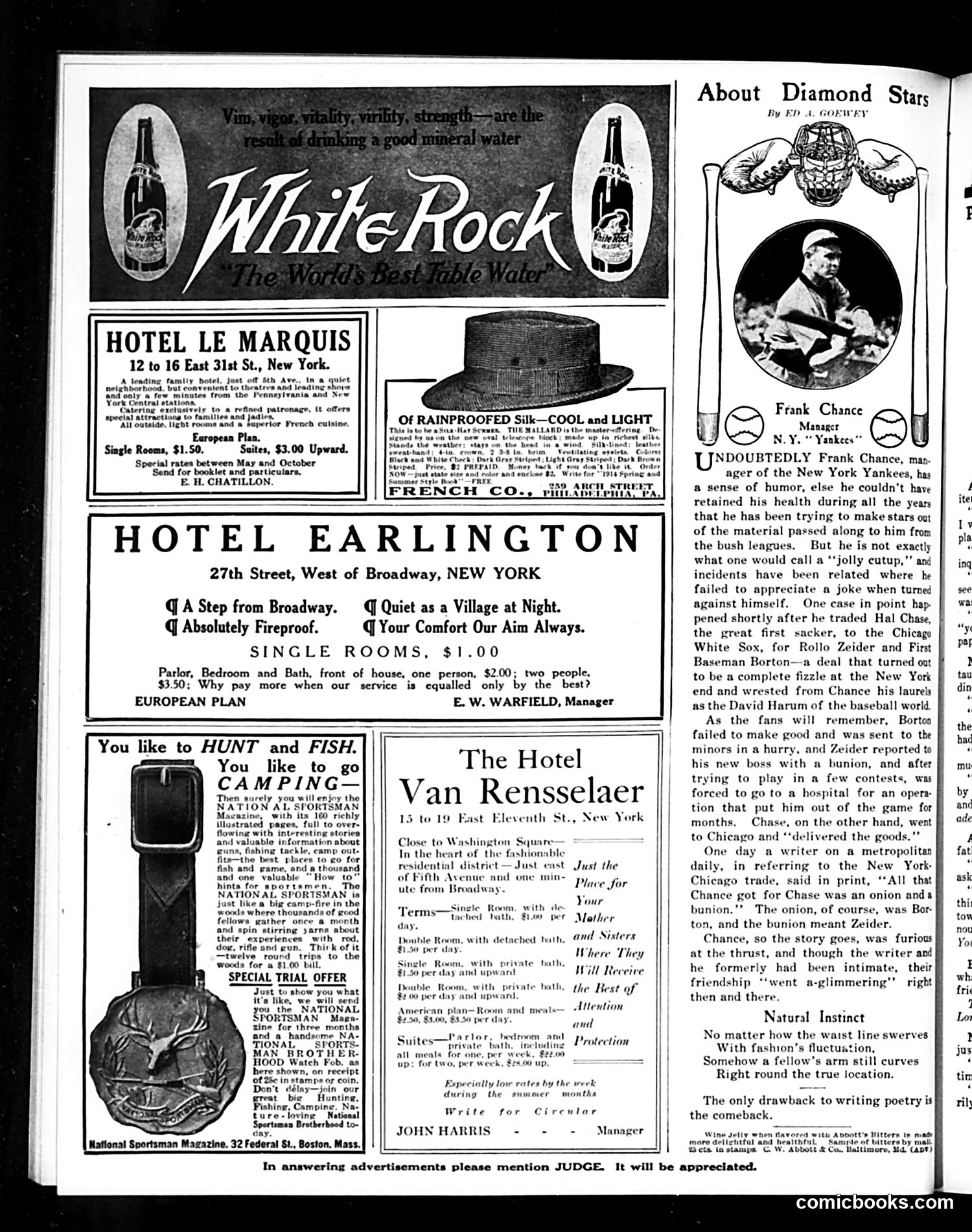
This page is primarily **advertising** for New York City hotels (Le Marquis, Earlington, Van Rensselaer) and magazines (National Sportsman). The one substantive content is "About Diamond Stars," a sports column by Ed A. Gorwey discussing **Frank Chance**, manager of the New York Yankees. The piece recounts a trade Chance made: he dealt **Hal Chase** to the Chicago White Sox for **Rollo Zeider** and **Borton**—a deal that backfired badly when Zeider arrived injured and Borton underperformed, while Chase thrived in Chicago. A sportswriter subsequently mocked Chance in print, saying all he got for Chase was "an onion and a bunion" (onion=Borton; bunion=Zeider's foot injury). Chance allegedly took offense and ended their friendship over the joke, illustrating his lack of humor about his own managerial failures. The brief poem at bottom about waistlines appears unrelated filler.
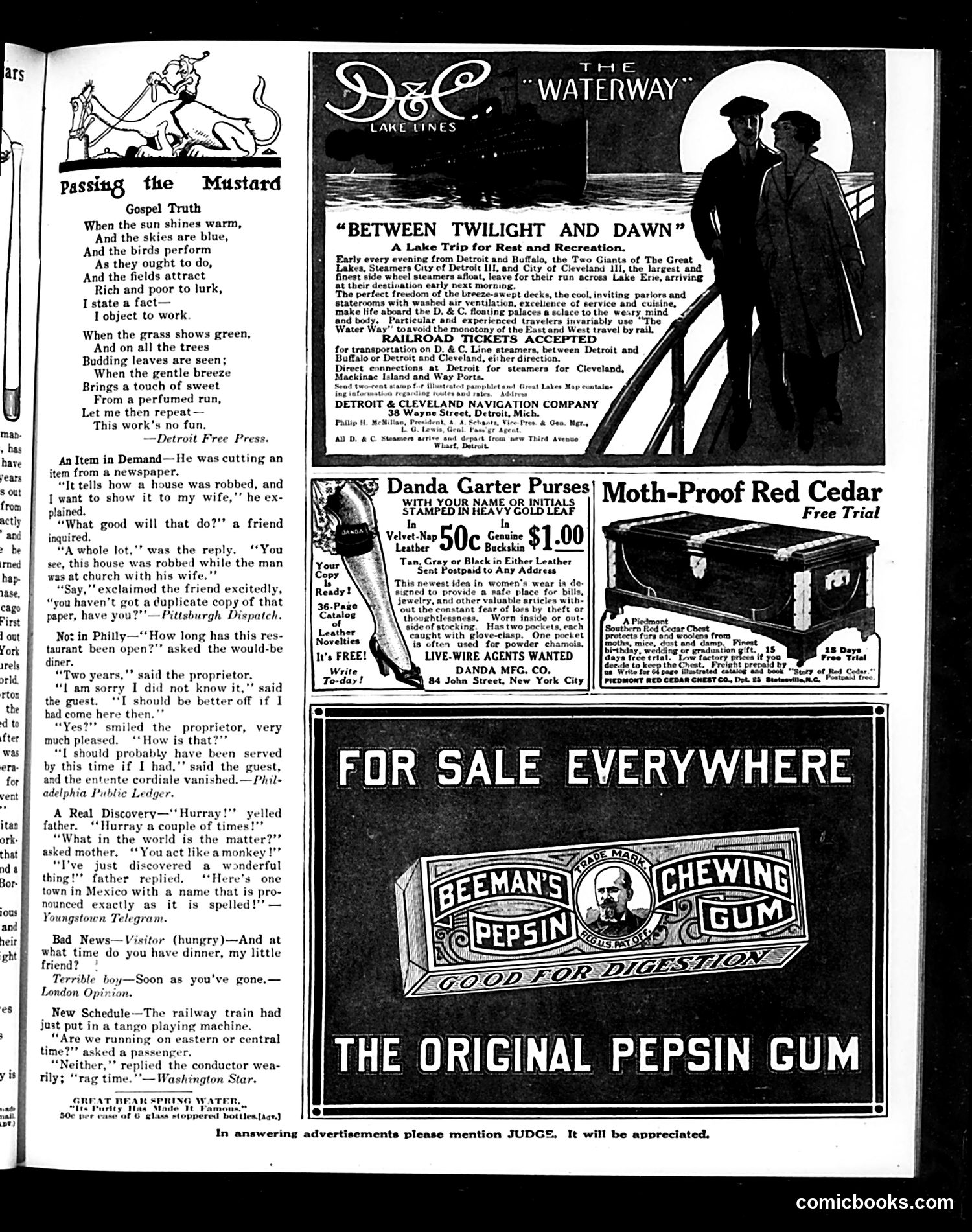
This page is primarily **advertising and filler content** rather than political satire. The main elements are: **Humorous Anecdotes:** Several brief jokes about domestic life, restaurants, and railroads—standard light humor for the era. These poke fun at everyday situations (a husband wanting to show his wife a burglary notice, a restaurant customer's complaint about the slow service) rather than political figures or events. **Advertisements:** The page features commercial pitches for lake cruises ("Between Twilight and Dawn"), Danda Carter Purses, Moth-Proof Red Cedar chests, and notably **Beeman's Pepsin Chewing Gum**—promoted as aiding digestion. **Notable Detail:** The gum ad emphasizes it's "the original," suggesting competition in the early chewing-gum market. The "Gospel Truth" poem about resisting work on pleasant days is gentle nature-versus-labor sentiment, not political commentary. Overall, this appears to be a typical Judge magazine filler page mixing light humor with revenue-generating advertisements rather than containing sharp political or social satire.
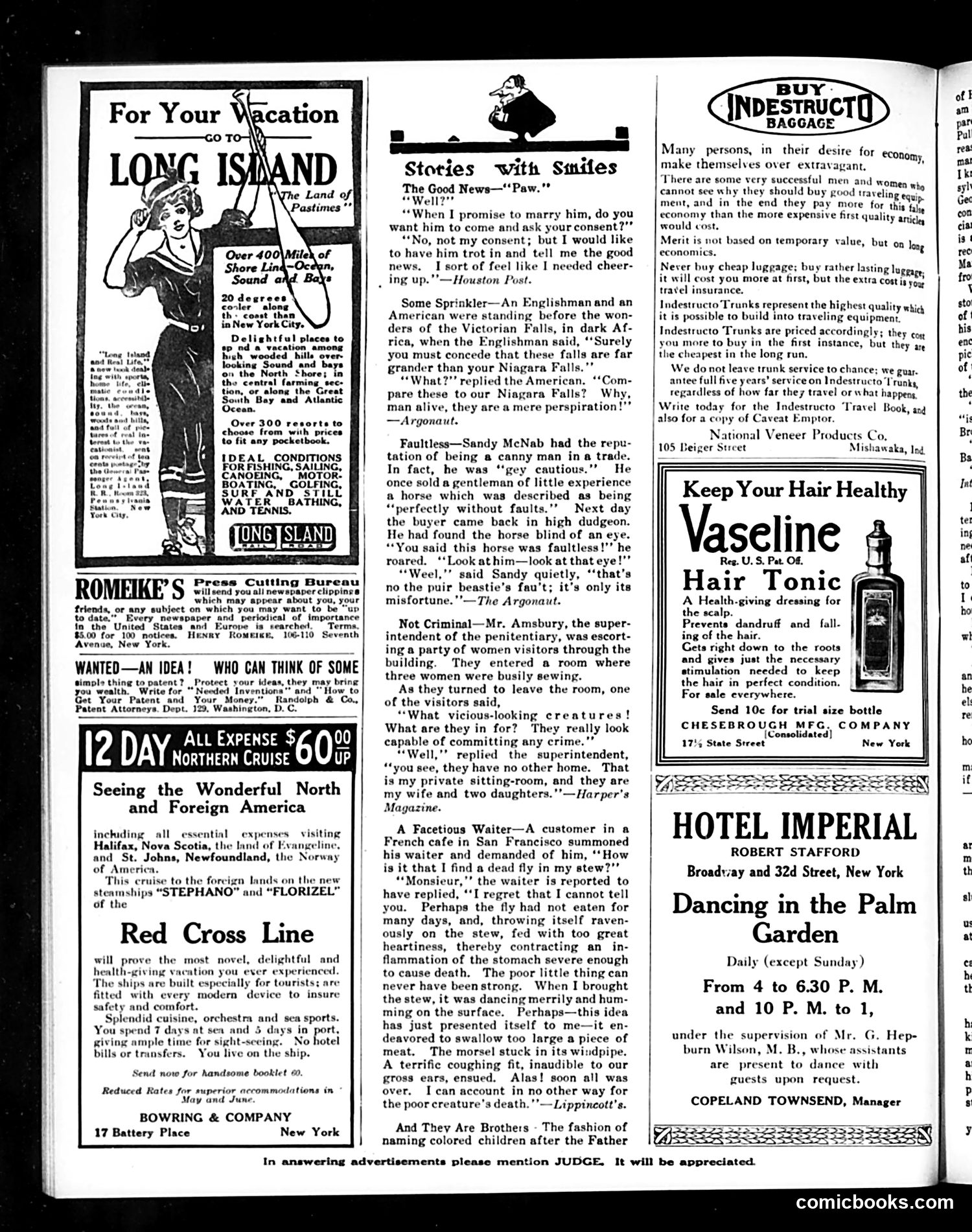
This page is primarily **advertising with some humor content**, typical of early 20th-century magazines. The main satirical elements are brief anecdotes ("Stories with Smiles") scattered among ads. These showcase period humor: - A father-daughter joke about marriage consent - An English-American comparison of Niagara Falls versus Victoria Falls, with the American dismissing the latter as mere "perspiration" - A Scottish horse trader's wordplay: selling a blind horse as "faultless," then claiming blindness is a "misfortune" not a fault - A prison superintendent's joke revealing three "vicious-looking" female inmates are actually his wife and daughters - A waiter's deadpan explanation for a dead fly in stew **The satire reflects:** - American boosterism and national pride - Scottish canny shrewdness/dishonesty (a common stereotype) - Class anxieties (prisoners, servants) - Gender assumptions (women criminals vs. respectable domesticity) The jokes rely on wordplay and ethnic/regional stereotypes common to the era. The advertisements (cruises, patents, hair tonic) indicate the magazine's middle-class audience.
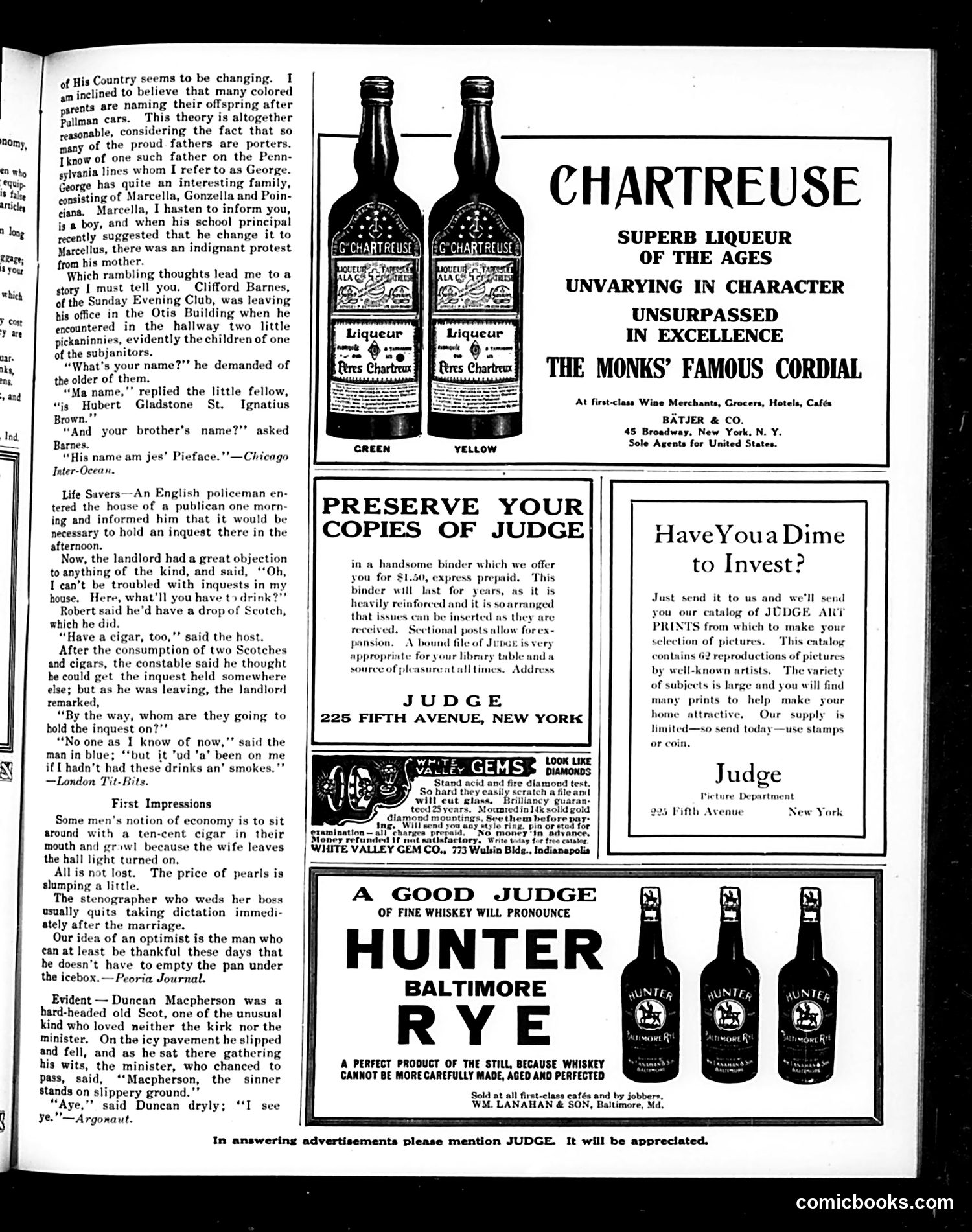
This page is **primarily advertisements** with some short humorous anecdotes interspersed. The main content includes racist humor typical of the era: a story about African American railroad porters naming children after Pullman cars, with caricatured dialogue using period racist language and dialect. The joke relies on stereotypes about Black workers and parents. Other brief anecdotes mock policemen, stenographers, and Scottish frugality—standard early-20th-century humor tropes. The advertisements promote Chartreuse liqueur, Judge magazine binders, White Gems (diamonds), and Hunter Baltimore Rye whiskey. These ads reflect the magazine's audience: affluent, urban consumers interested in luxury goods and reading material. The page contains **no political cartoons**—it's a typical interior magazine page mixing advertising revenue with light satirical prose pieces. The racist content reflects widespread attitudes in American popular media of this period, not any specific political message.
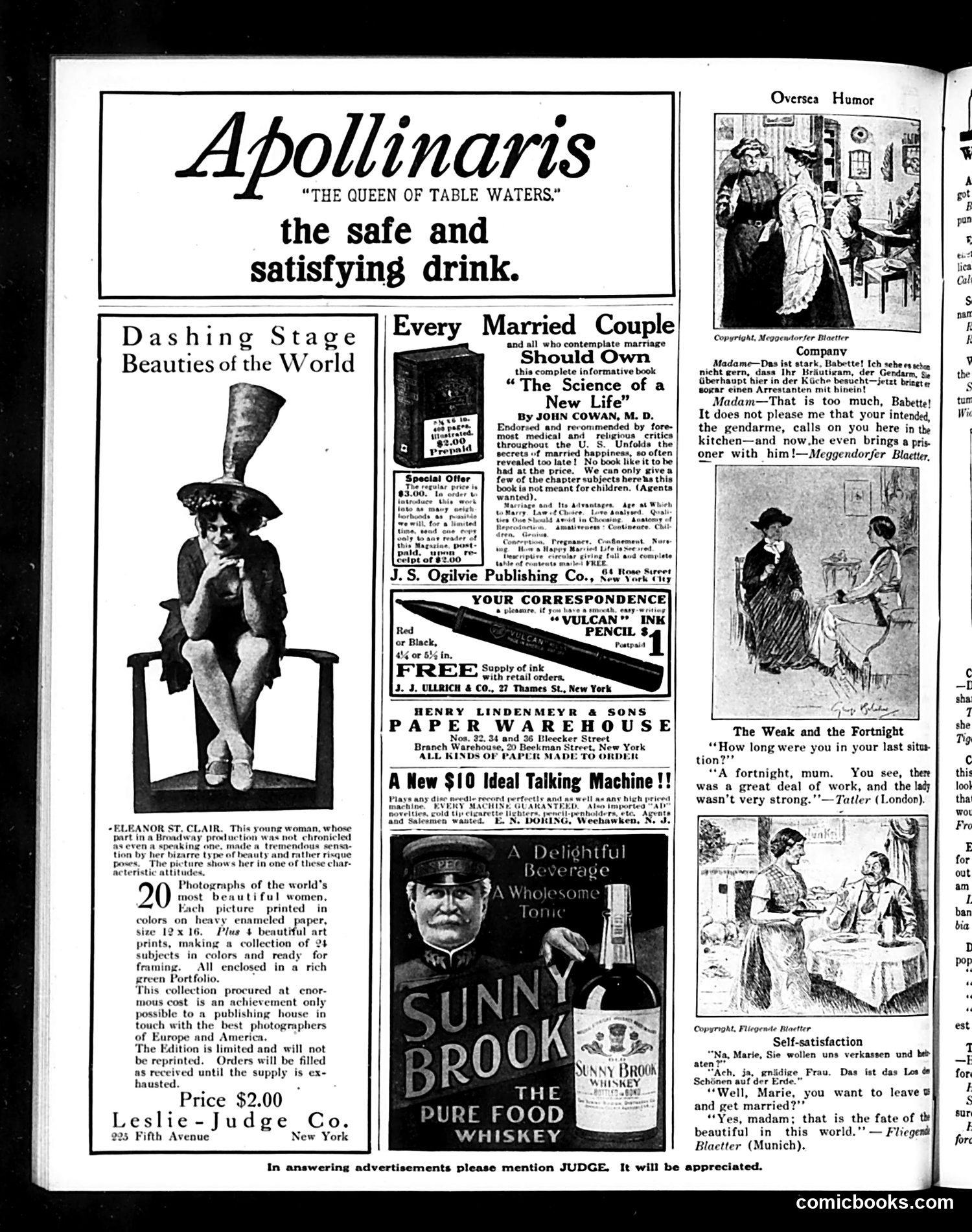
This page is primarily **advertisements and filler content** rather than political satire. The main elements are: **Central Content:** - Multiple product ads (Apollinaris water, whiskey, paper warehouse, ink pencils, a book on marital science) - A "Dashing Stage Beauties" photo collection advertisement - A "Talking Machine" ad (early phonograph technology) **Right-side cartoons** labeled "Overseas Humor" (reprinted European jokes): - Three brief comedic vignettes from German publications (*Meggendorfer Blätter*, *Tatler*, *Flieger Blätter*) - These depict domestic/servant scenarios with punchlines about relationships, employment, and social class - No identifiable political figures or specific contemporary references **Social context:** The humor reflects early 20th-century class attitudes toward servants and relationships, with mild double-entendre about marriage and employment duration. This appears to be a typical Judge issue page mixing advertising revenue with light European humor reprints—not satirical political content.
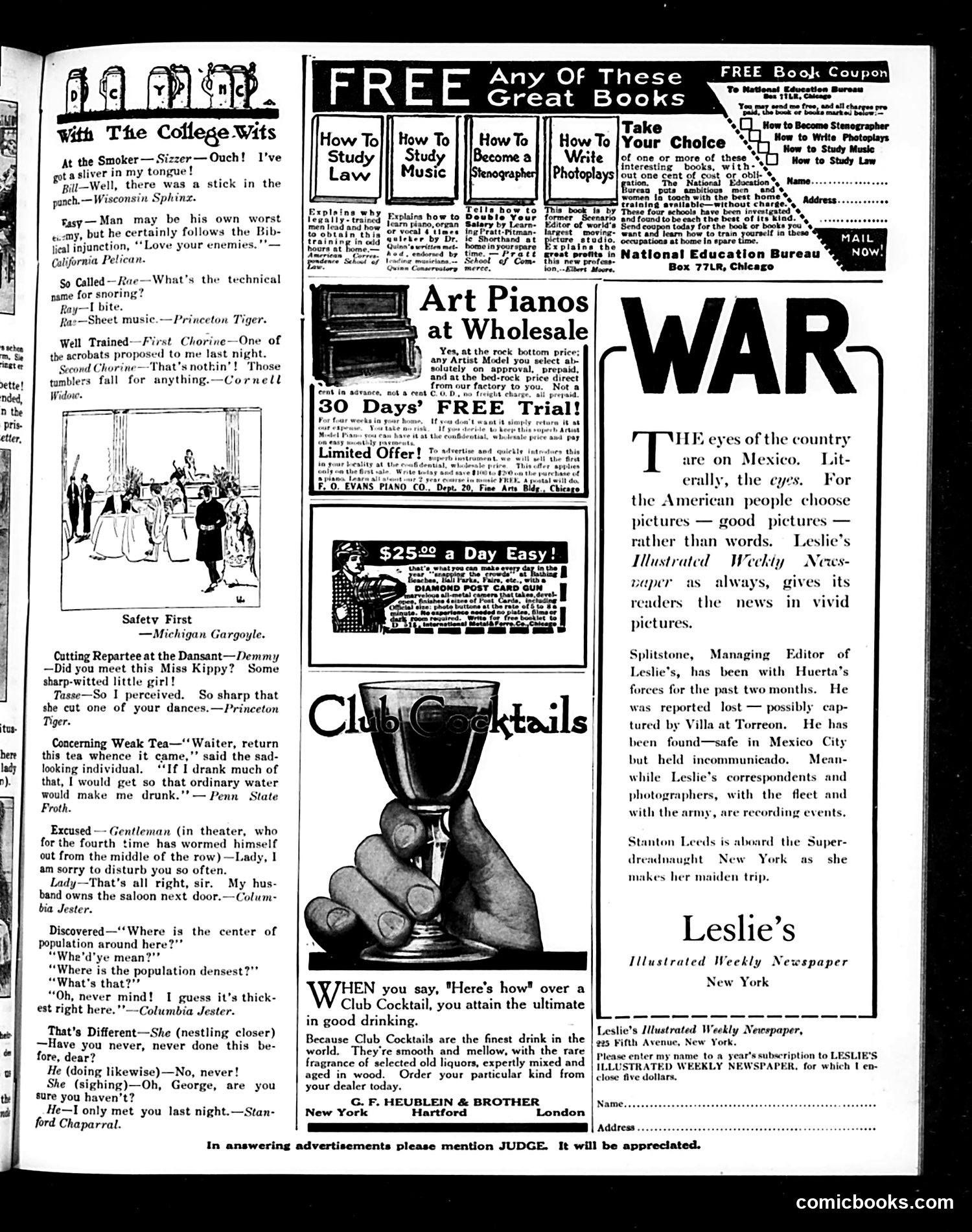
This is primarily an **advertising and humor page** from Judge magazine (an American satirical weekly). The content includes: **"College Wits" Section**: Brief jokes from university humor magazines (Wisconsin Sphinx, Princeton Tiger, etc.), mostly crude puns about romance, drinking, and social awkwardness—typical college humor of the era. **Main Editorial Content**: A section titled "WAR" discussing Mexico. It notes that American readers prefer "pictures—good pictures—rather than words," explaining that Leslie's Illustrated Weekly Newspaper covers the Mexican conflict (likely the Mexican Revolution, circa 1910s) with on-the-ground photographers and correspondents. It mentions managing editor Splitstone was with "Huerta's forces" but went missing—possibly captured by Villa at Torreon—before being found in Mexico City. **Advertisements**: Including art pianos, self-improvement books, and Club Cocktails. The page reflects early 20th-century American media priorities: sensational visual journalism over substantive reporting, and advertising-heavy magazine economics.

This page is primarily a **product advertisement**, not political satire. It promotes the J.B. Williams Company's "Holder-Top Stick" shaving soap, which features a metal holder allowing users to utilize every last bit of soap without waste. The advertisement emphasizes convenience and economy—key selling points for early 20th-century consumers. The metal holder represents a practical innovation: holding the diminishing soap stick by the metal sleeve rather than fingers keeps hands clean and lets you use the product completely. The page also advertises related Williams products: shaving powder, cream (in tubes), and a stick form. Trial packages cost 4 cents in stamps. The company, based in Glastonbury, Connecticut, positions their soap as offering "absolute purity," "creamy, lasting, abundant lather"—standard marketing language for the era. There is **no cartoon or satire** present on this page—it's straightforward commercial promotion targeting male consumers concerned with waste and value.