
Judge, 1914-05-16 · page 5 of 24
Judge — May 16, 1914 — page 5: what you’re looking at
What you’re looking at
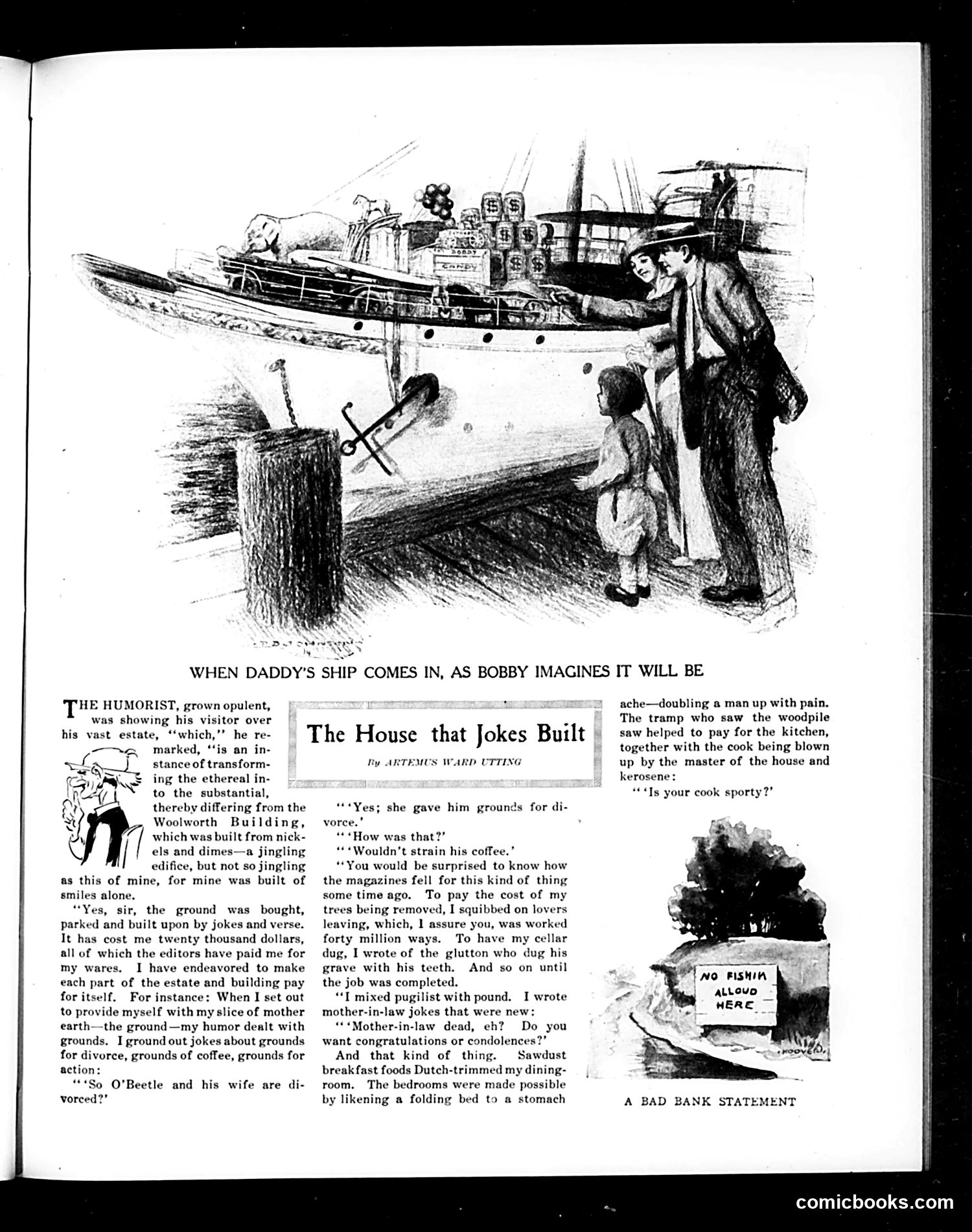
The page contains two satirical pieces: **"When Daddy's Ship Comes In"** (top cartoon): Shows a child and man gazing at a loaded cargo vessel, suggesting optimistic anticipation of wealth arriving by ship. **"The House that Jokes Built"** (main article by Artemus Ward Utting): A humorous essay describing how the author financed his estate through joke-writing. The piece details various schemes—using jokes about grounds to pay for removal costs, hiring workers through puns, and financing home improvements through humor publications. The tone is self-aware satire about monetizing humor itself. **"A Bad Bank Statement"** (bottom cartoon): Shows a sign reading "NO FISHIN ALLOUD HERE," appearing to mock financial statements or banking regulations through visual pun. The overall theme celebrates humor as an economic commodity, typical of Judge magazine's self-referential, witty approach to satire.
📄 Transcribed text from this page (OCR, searchable)
Machine-transcribed from the original scan — historical spelling and the odd misread are preserved.
WHEN DADDY'S SHIP COMES IN, AS BOBBY IMAGINES IT WILL BE HE HUMORIST, grown opulent, was showing his visitor over his vast estate, ‘‘which,’’ he re- marked, ‘‘is an in- stance of transform- ing the ethereal in- to the substantial, thereby differing from the Woolworth Building, which was built from nick- els and dimes—a jingling edifice, but not so jingling as this of mine, for mine was built of smiles alone. “Yes, sir, the ground was bought, parked and built upon by jokes and verse. It has cost me twenty thousand dollars, all of which the editors have paid me for my wares. I have endeavored to make each part of the estate and building pay for itself. For instance: When I set out to provide myself with my slice of mother earth—the ground—my humor dealt with grounds. I ground out jokes about grounds for divorce, grounds of coffee, grounds for action: “*So O’Beetle and his wife are di- vorced?’ The House that Jokes Built Ry ARTEMUS WARD UTTING “*Yes; she gave him grounds for di- voree.’ “**How was that?’ “**Wouldn’t strain his coffee.’ “You would be surprised to know how the magazines fell for this kind of thing some time ago. To pay the cost of my trees being removed, I squibbed on lovers leaving, which, 1 assure you, was worked forty million ways. To have my cellar dug, I wrote of the glutton who dug his grave with his teeth, And so on until the job was completed. “T mixed pugilist with pound. I wrote mother-in-law jokes that were new: ‘**Mother-in-law dead, eh? Do you want congratulations or condolences?’ And that kind of thing. Sawdust breakfast foods Dutch-trimmed my dining- room. The bedrooms were made possible by likening a folding bed to a stomach ache—doubling a man up with pain. The tramp who saw the woodpile saw helped to pay for the kitchen, together with the cook being blown up by the master of the house and kerosene: “Is your cook sporty?” No FISHIN alLovo A BAD BANK STATEMENT comicbooks.com