
Judge, 1914-05-16 · page 4 of 24
Judge — May 16, 1914 — page 4: what you’re looking at
What you’re looking at
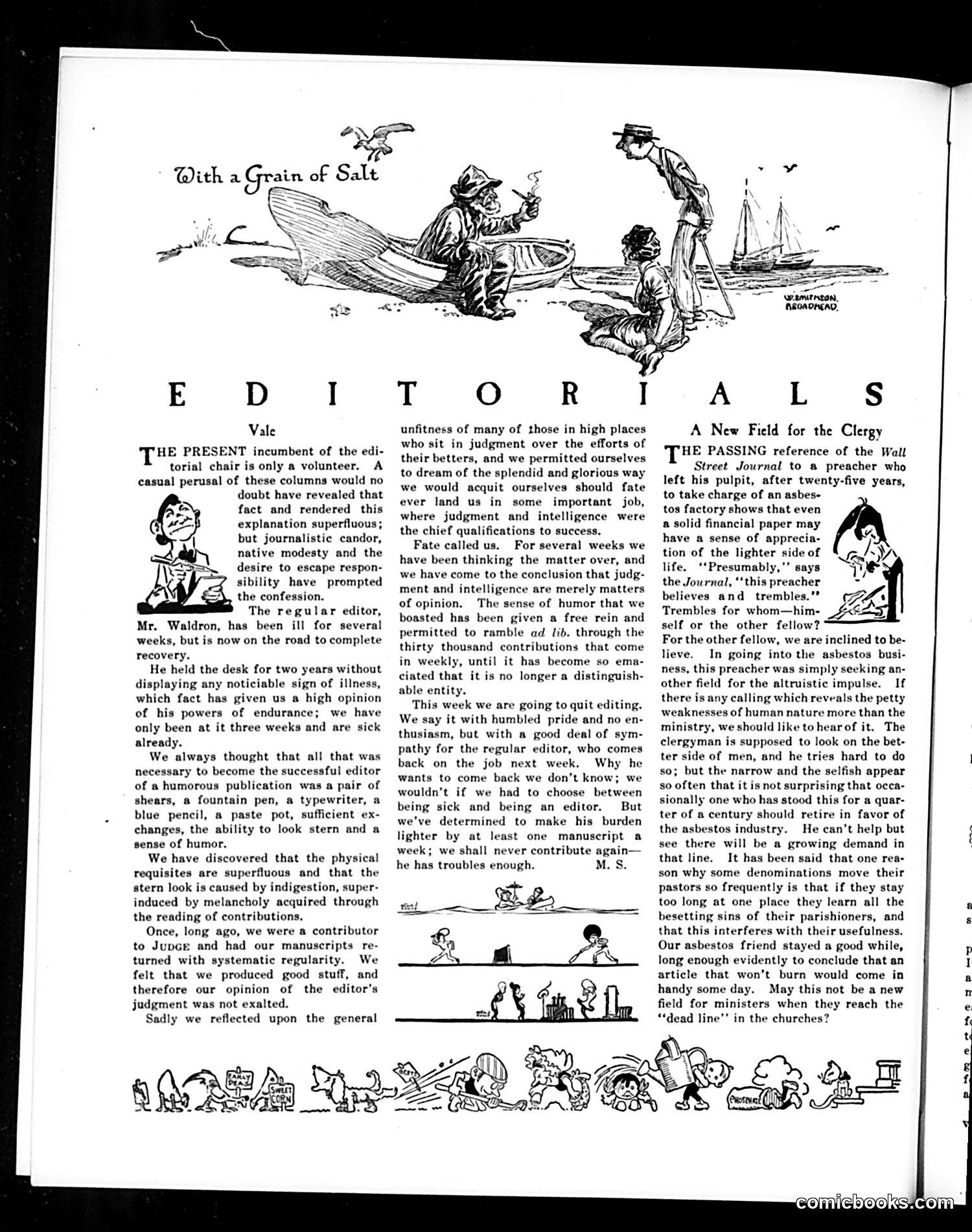
This page contains two editorial pieces. The main article discusses the magazine's editorial transition: the current editor is stepping down after being ill for weeks, and a new editor (Mr. Waldron) will take over. The outgoing editor humorously confesses that producing humor requires specific skills—a sharp pencil, paste pot, and sense of humor—but that physical health is surprisingly necessary. The second article, "A New Field for the Clergy," satirizes the asbestos industry, suggesting clergy should consider careers in asbestos manufacturing. This appears to be dark satire about the industry's disregard for health dangers, though the specific historical context of asbestos awareness in this era remains unclear from the text alone.
📄 Transcribed text from this page (OCR, searchable)
Machine-transcribed from the original scan — historical spelling and the odd misread are preserved.
FONG ao @ith a ain of Salt Vale THE PRESENT incumbent of the edi- torial chair is only a volunteer. A casual perusal of these columns would no doubt have revealed that i fact and rendered this a) explanation superfluous; - 1 but journalistic candor, ae native modesty and the ws desire to escape respon- sibility have prompted the confession. The regular editor, Mr. Waldron, has been ill for several weeks, but is now on the road to complete recovery. He held the desk for two years without displaying any noticiable sign of illness, which fact has given us a high opinion of his powers of endurance; we have only been at it three weeks and are sick already. We always thought that all that was necessary to become the successful editor of a humorous publication was a pair of shears, a fountain pen, a typewriter, a blue pencil, a paste pot, sufficient ex- changes, the ability to look stern and a sense of humor. We have discovered that the physical requisites are superfluous and that the stern look is caused by indigestion, super- induced by melancholy acquired through the reading of contributions. Once, long ago, we were a contributor to JupGe and had our manuscripts re- turned with systematic regularity. We felt that we produced good stuff, and therefore our opinion of the editor's judgment was not exalted. Sadly we reflected upon the general unfitness of many of those in high places who sit in judgment over the efforts of their betters, and we permitted ourselves to dream of the splendid and glorious way we would acquit ourselves should fate ever land us in some important job, where judgment and intelligence were the chief qualifications to success. Fate called us. For several weeks we have been thinking the matter over, and we have come to the conclusion that judg- ment and intelligence are merely matters of opinion. The sense of humor that we boasted has been given a free rein and permitted to ramble ad lib. through the thirty thousand contributions that come in weekly, until it has become so ema- ciated that it is no longer a distinguish- able ent This week we are going to quit editing. We say it with humbled pride and no en- thusiasm, but with a good deal of sym- pathy for the regular editor, who comes back on the job next week. Why he wants to come back we don’t know; we wouldn’t if we had to choose between being sick and being an editor. But we've determined to make his burden lighter by at least one manuscript a week; we shall never contribute again— he has troubles enough. M. S. A New Field for the Clergy THE PASSING reference of the Wall Street Journal to @ preacher who left his pulpit, after twenty-five years, to take charge of an asbes- tos factory shows that even a solid financial paper may have a sense of apprecia- tion of the lighter side of life. ‘*Presumably,"’ says the Journal, ‘‘this preacher believes and trembles.” Trembles for whom—him- self or the other fellow? For the other fellow, we are inclined to be- lieve. In going into the asbestos busi- ness, this preacher was simply seeking an- other field for the altruistic impulse. If there is any calling which reveals the petty weaknesses of human nature more than the ministry, we should like to hear of it. The clergyman is supposed to look on the bet- ter side of men, and he tries hard to do so; but the narrow and the selfish appear so often that it is not surprising that occa- sionally one who has stood this for a quar- ter of a century should retire in favor of the asbestos industry. He can’t help but see there will be a growing demand in that line. It has been said that one rea- son why some denominations move their pastors so frequently is that if they stay too long at one place they learn all the besetting sins of their parishioners, and that this interferes with their usefulness. Our asbestos friend stayed a good while, long enough evidently to conclude that an article that won’t burn would come in handy some day. May this not be a new field for ministers when they reach the i n the churches?