
A complete issue · 41 pages · 1914
Judge — May 2, 1914
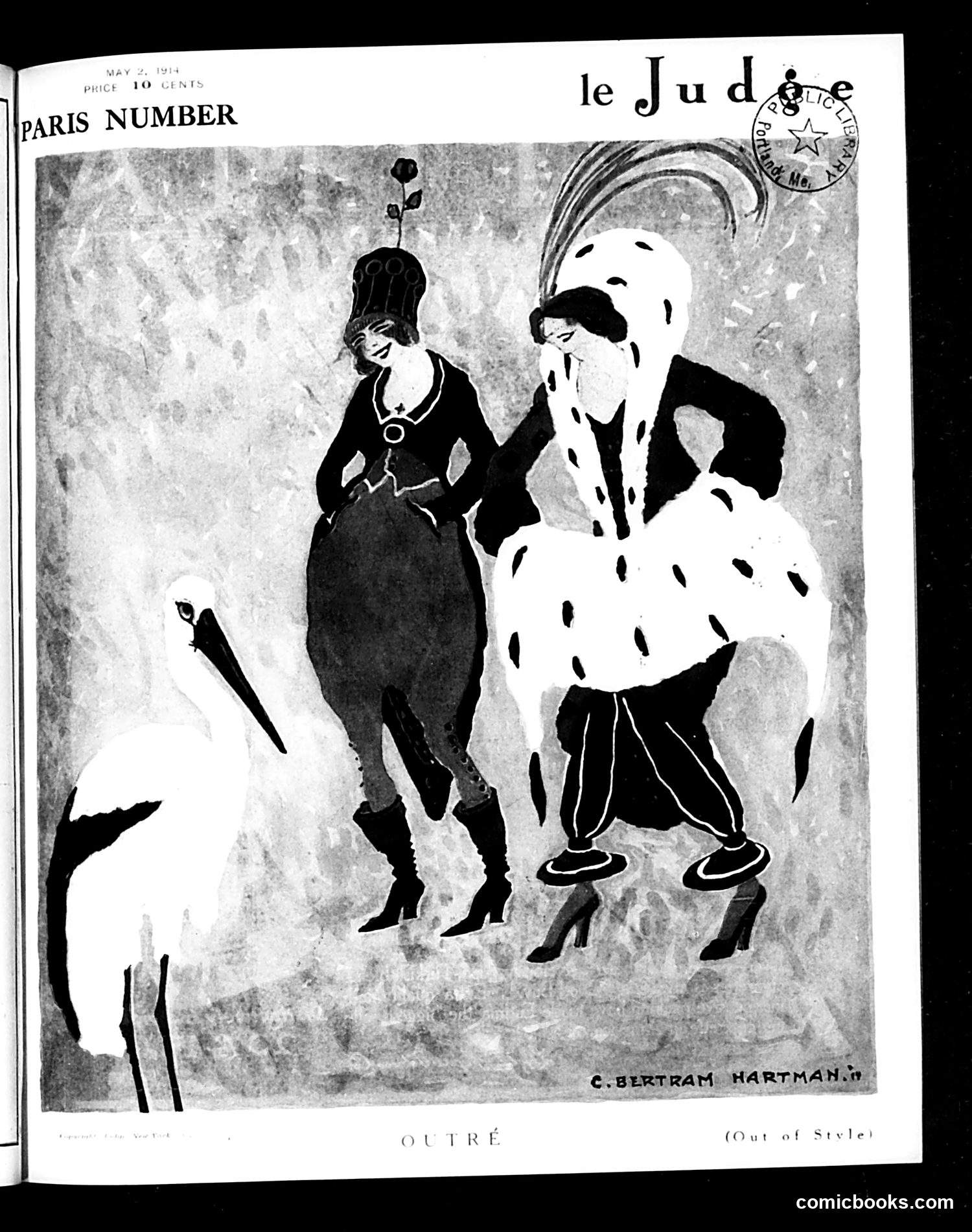
This is the "Paris Number" of Judge magazine (priced at 10 cents), featuring a cartoon titled "Outré" (Out of Style) by C. Bertram Hartman. The illustration depicts three fashionable Parisian women in exaggerated haute couture. The figure on the right wears a dramatically spotted or dalmatian-patterned coat—likely satirizing an absurdly extreme fashion trend. The woman in the center appears more conservatively dressed, suggesting a contrast between outrageous and conventional style. The cartoon mocks Parisian high fashion's increasingly ridiculous excesses in 1914. By depicting women in wildly impractical or aesthetically questionable garments, Hartman pokes fun at the extravagance and poor taste of elite fashion circles, a common theme in American satirical magazines of the era.
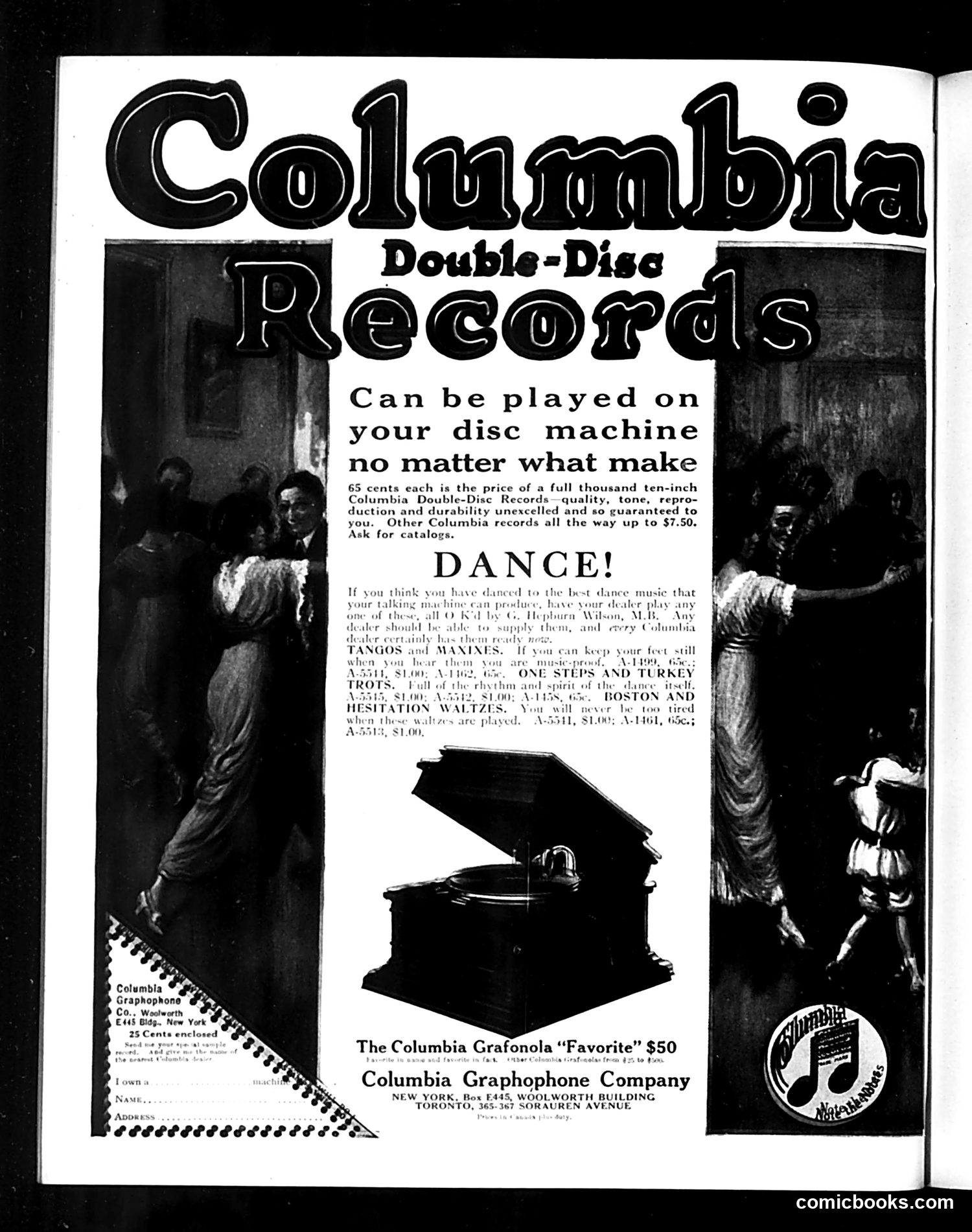
This page is primarily **advertising, not editorial content or satire**. It promotes Columbia Double-Disc Records and the Columbia Grafonola phonograph. The advertisement emphasizes that Columbia records play on any disc machine regardless of manufacturer—a significant selling point in the early phonograph era when format compatibility was uncertain. The "DANCE!" section lists specific dance recordings available (tangos, waltzes, one-steps), appealing to the social dancing craze of the 1920s. The images of dancing couples flanking the text reinforce this leisure activity angle. The Columbia Graphophone "Favorite" model ($50) is prominently featured as the recommended player. There is **no political satire or cartoon commentary** visible on this page—it's purely commercial content advertising early recorded music technology.
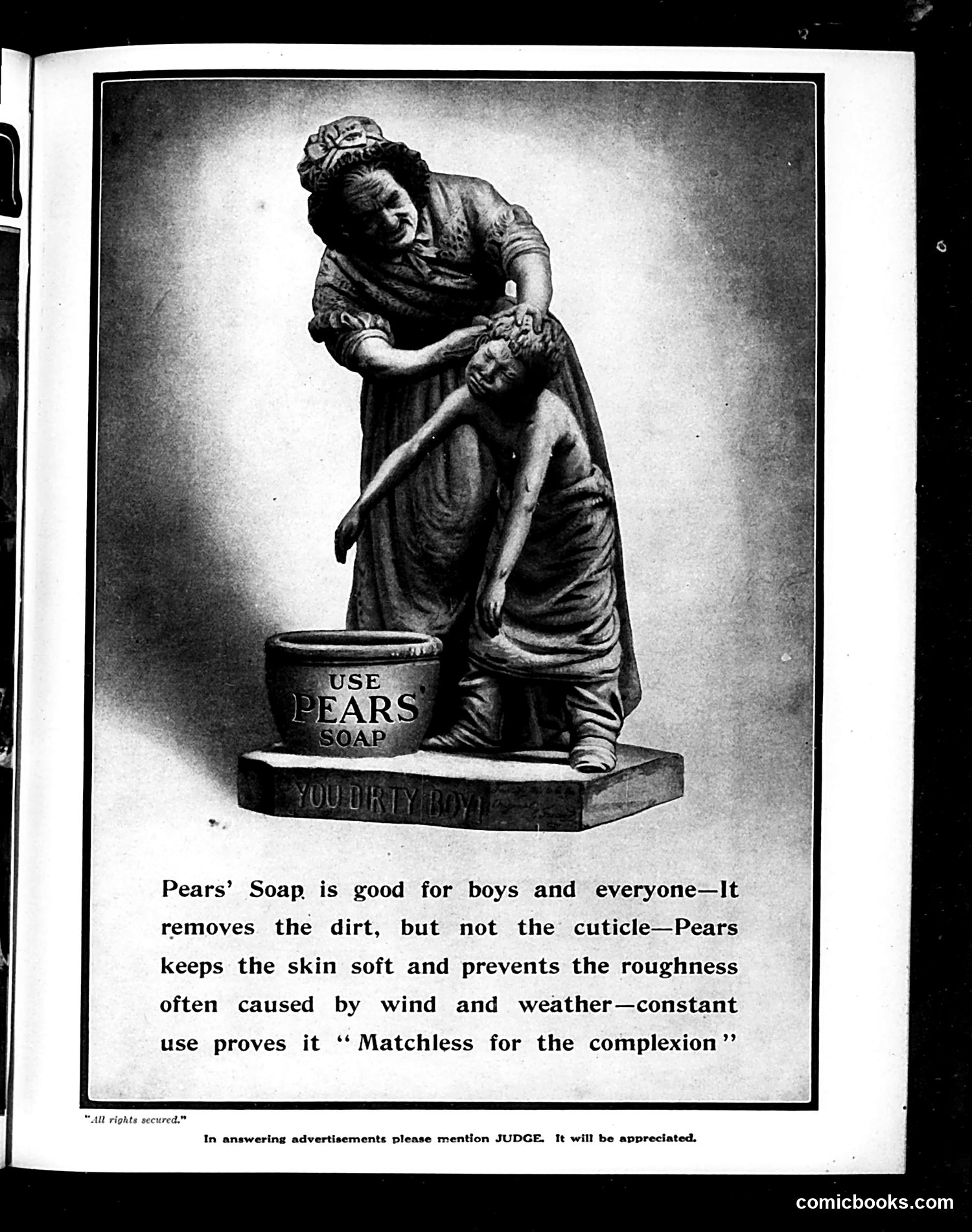
This is a **commercial advertisement**, not satire or political commentary. It depicts a mother washing a young child with Pears' Soap, with the product prominently displayed. The ad's copy claims the soap "removes the dirt, but not the cuticle" and "keeps the skin soft and prevents the roughness often caused by wind and weather," concluding it's "Matchless for the complexion." This reflects early 20th-century advertising conventions emphasizing soap's skincare benefits beyond mere cleansing. The maternal imagery was common in product marketing of this era, positioning soap as essential for family hygiene and children's health. The page is primarily commercial rather than editorial content.
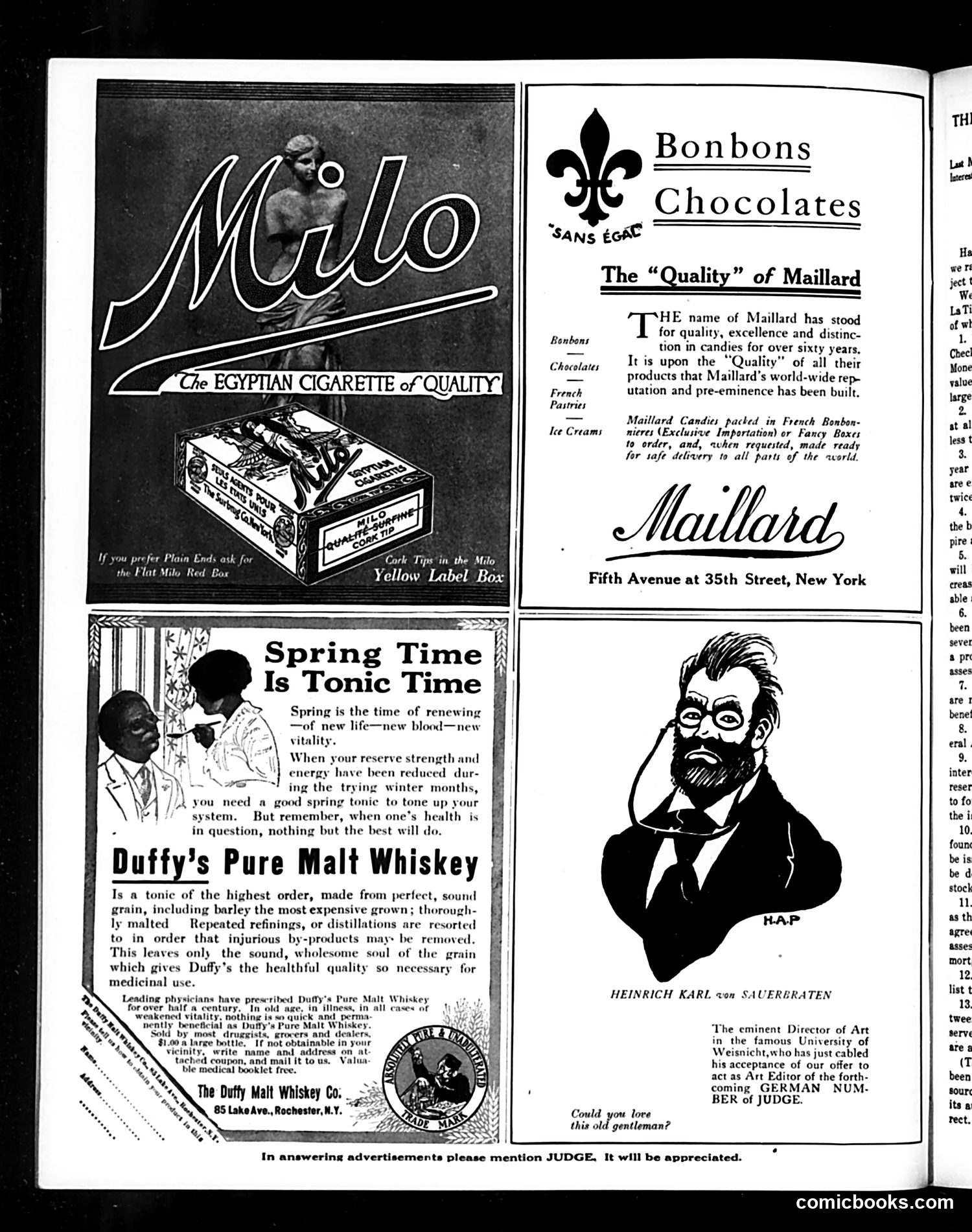
This page is primarily **advertising rather than satire or political commentary**. It contains four vintage advertisements: 1. **Milo cigarettes** - Egyptian brand marketed as high-quality 2. **Maillard chocolates and bonbons** - Luxury candies from a New York Fifth Avenue retailer 3. **Duffy's Pure Malt Whiskey** - Marketed as a medicinal spring tonic (reflecting early-1900s patent medicine practices) 4. **Heinrich Karl von Sauergraten** - A caricature portrait identified as "Art Director of the famous University of Wesenich," with text asking "Could you love this old gentleman?" The final item's purpose is unclear—it may be promotional or satirical, but lacks sufficient context to determine intent. Overall, the page reflects early-20th-century advertising practices and consumer goods marketing typical of *Judge* magazine.
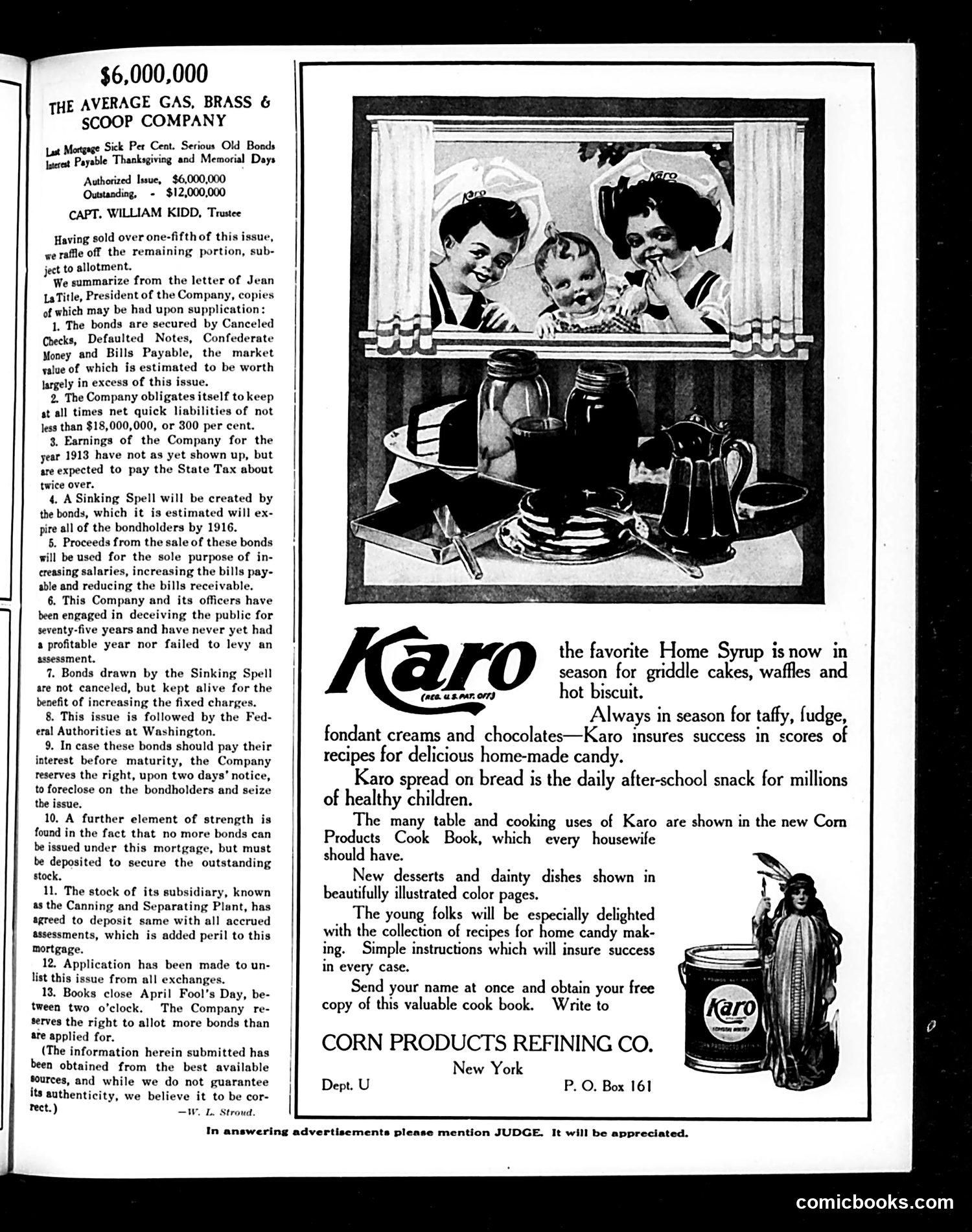
This page combines financial satire with period advertising. The left column attacks **The Average Gas, Brass & Scoop Company**, listing ten damning points about its bond offerings—alleging deception of the public for 75 years, failed profitability, and improper financial practices. The satire suggests this is a fraudulent or incompetently-managed enterprise using bonds as a scam. The right side features a **Karo syrup advertisement** showing a family enjoying homemade sweets, with marketing copy emphasizing the product's reliability for cooking and candy-making. The juxtaposition is typical of Judge's approach: exposing corporate fraud while surrounding it with advertisements for trustworthy consumer products—creating implicit contrast between dishonest financial schemes and legitimate household goods.
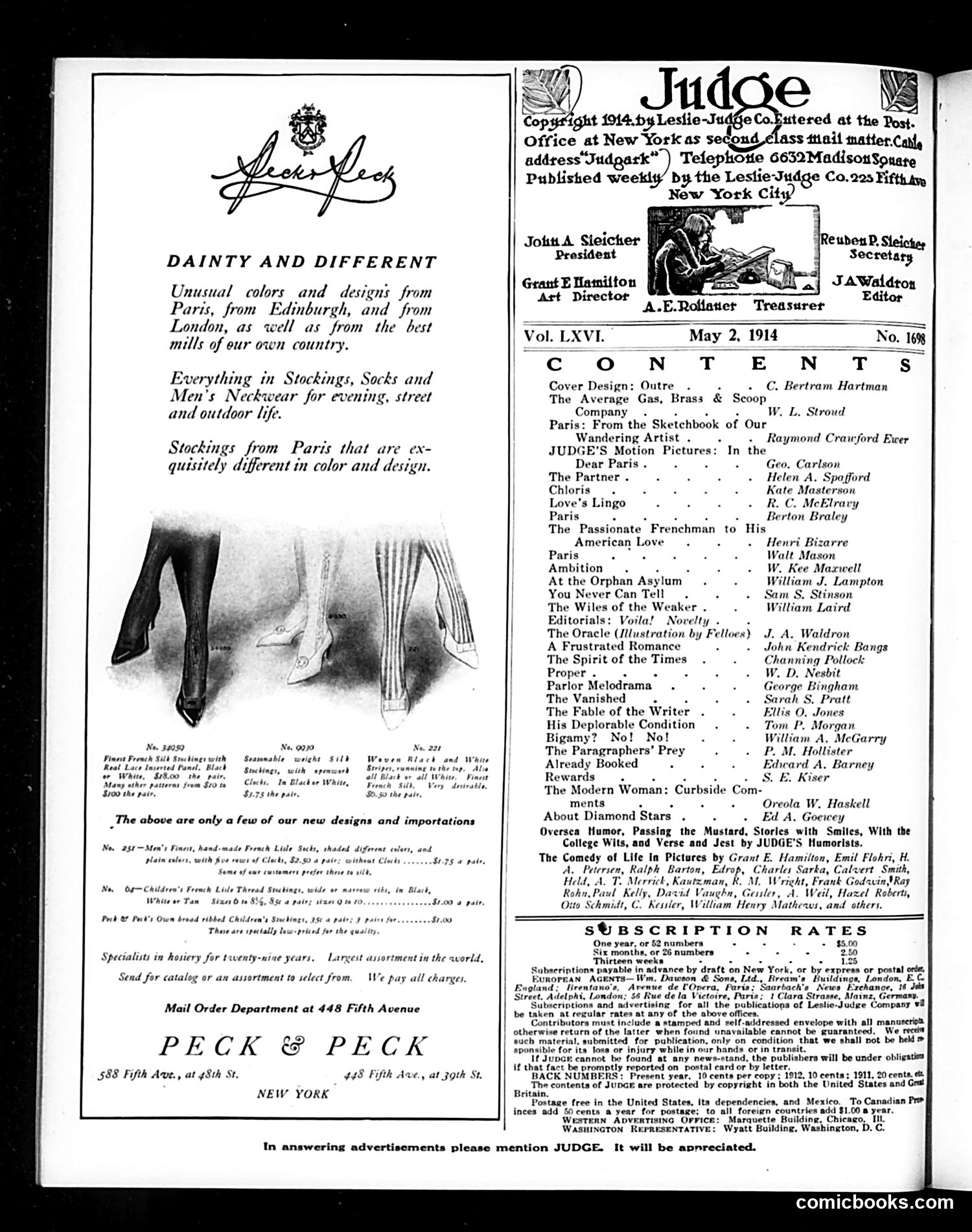
This page is primarily **advertising and masthead information** for Judge magazine's May 2, 1914 issue (Vol. LXVI, No. 1689). The left side features a **Peck & Peck hosiery advertisement** showcasing women's stockings with elegant leg illustrations—typical early 20th-century fashion marketing emphasizing "dainty and different" imported designs from Paris, Edinburgh, and London. The right side contains the magazine's **table of contents and publication details**. Articles listed include satirical pieces like "Bigamy? No! No!!", motion pictures reviews, editorials, and humor pieces—characteristic of Judge's comedic social commentary. Contributors include established humorists like John Kendrick Bangs. **No specific political cartoons or caricatures are clearly identifiable** on this particular page. It functions primarily as a publishing/advertising document rather than presenting satirical commentary that would require historical context to decode.
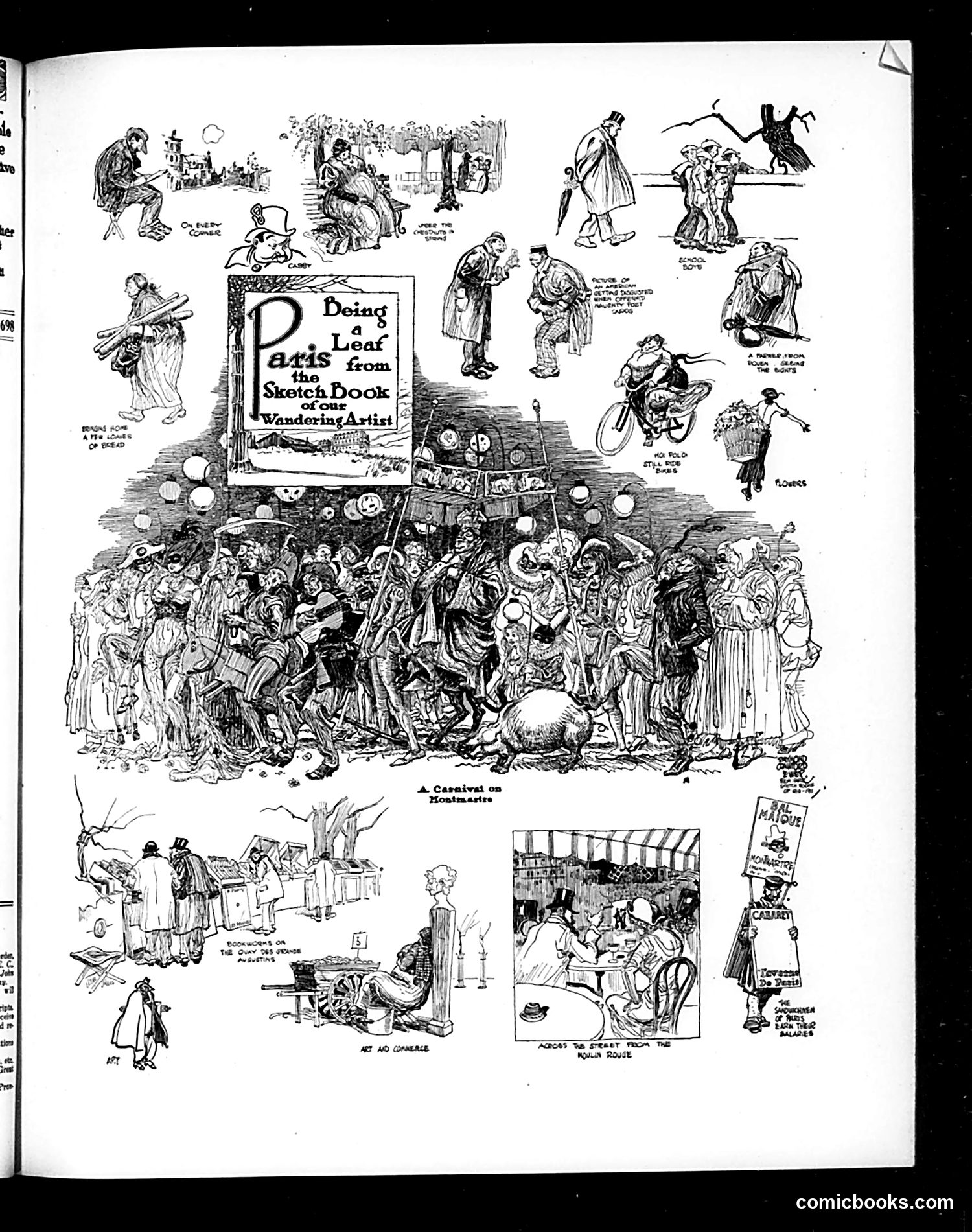
This page presents "Being a Leaf from the Sketch Book of our Wandering Artist"—a collection of ink sketches depicting Parisian street life and scenes. The central image shows a crowded carnival on Montmartre, the bohemian district in Paris known for entertainment and artistic activity. The surrounding vignettes capture typical urban characters and situations: flower sellers, cyclists, street musicians, café scenes, and various working-class Parisians. The style mimics a traveling artist's observational notebook, documenting everyday Parisian society. The satire appears gentle—celebrating Parisian culture and street-level human activity rather than targeting specific political figures or events. For Judge's American audience, these sketches offered romanticized glimpses of Paris as a center of bohemian life and artistic inspiration, a popular subject for late-19th/early-20th-century American periodicals fascinated with European cosmopolitan culture.
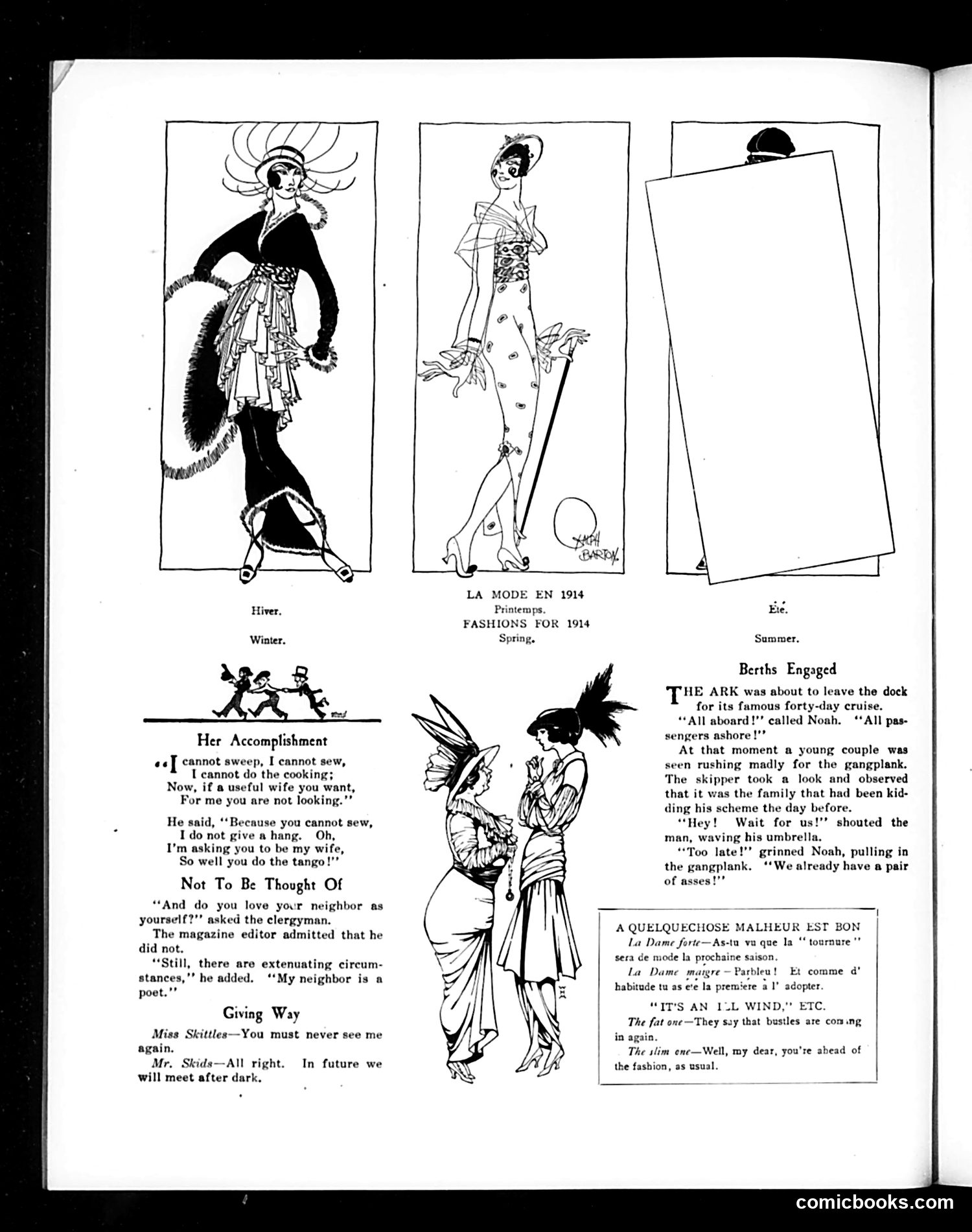
This page from Judge (circa 1914) contains fashion illustrations and several brief humorous pieces reflecting early 20th-century social attitudes. **Fashion Section:** The top shows spring and summer 1914 fashions—women in elaborate hats, high-waisted dresses, and fur stoles typical of the era. **The Humor Pieces:** - "Her Accomplishment" and "Not To Be Thought Of" mock women who lack domestic skills (sweeping, sewing, cooking) but excel at dancing—suggesting modern women prioritize frivolous pleasures over housewifery. - "Berths Engaged" uses the Noah's Ark legend as a punchline: a young couple trying to board is refused because Noah already has "a pair of asses"—crude humor about their foolishness in mocking his scheme earlier. - "A Quelquechose Malheur Est Bon" (French section) jokes about a thin woman adopting the returning bustle fashion before heavier women—implying bustles flatter only certain figures. The satire reflects period anxieties about changing women's roles and fashion's absurdities.
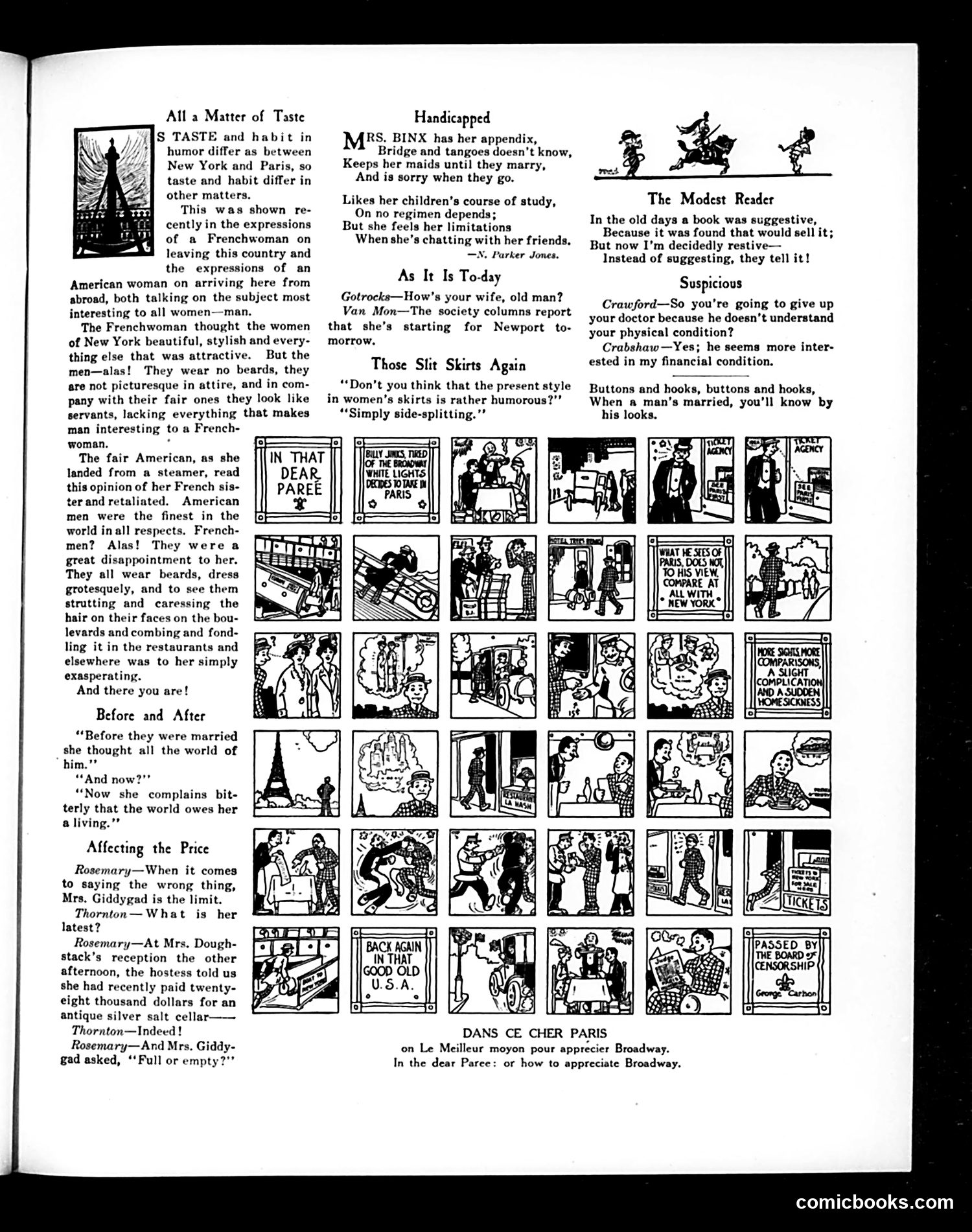
This page contains several short satirical pieces typical of early 20th-century American humor magazines: **"All a Matter of Taste"**: Contrasts French and American aesthetic preferences. A Frenchwoman finds American men unattractive (no beards, lack style), while an American woman finds Frenchmen grotesque—particularly their obsessive grooming of facial hair in public. The joke mocks both cultures' differing standards of masculinity. **"Before and After"**: A brief marital joke about changed expectations—a wife once admired her husband but now resents financial dependency. **"Those Slit Skirts Again"**: Puns on women's controversial shorter skirts of the era as humorous/scandalous fashion. The remaining pieces mock wealthy society women, medical consultants more interested in fees than health, and publishing trends toward explicit rather than suggestive content. **"Dans ce cher Paris"** (bottom) references appreciating Broadway through a Parisian lens, likely continuing the Franco-American comparison theme. These are light social satires on fashion, marriage, class, and transatlantic differences—typical Judge magazine fare.
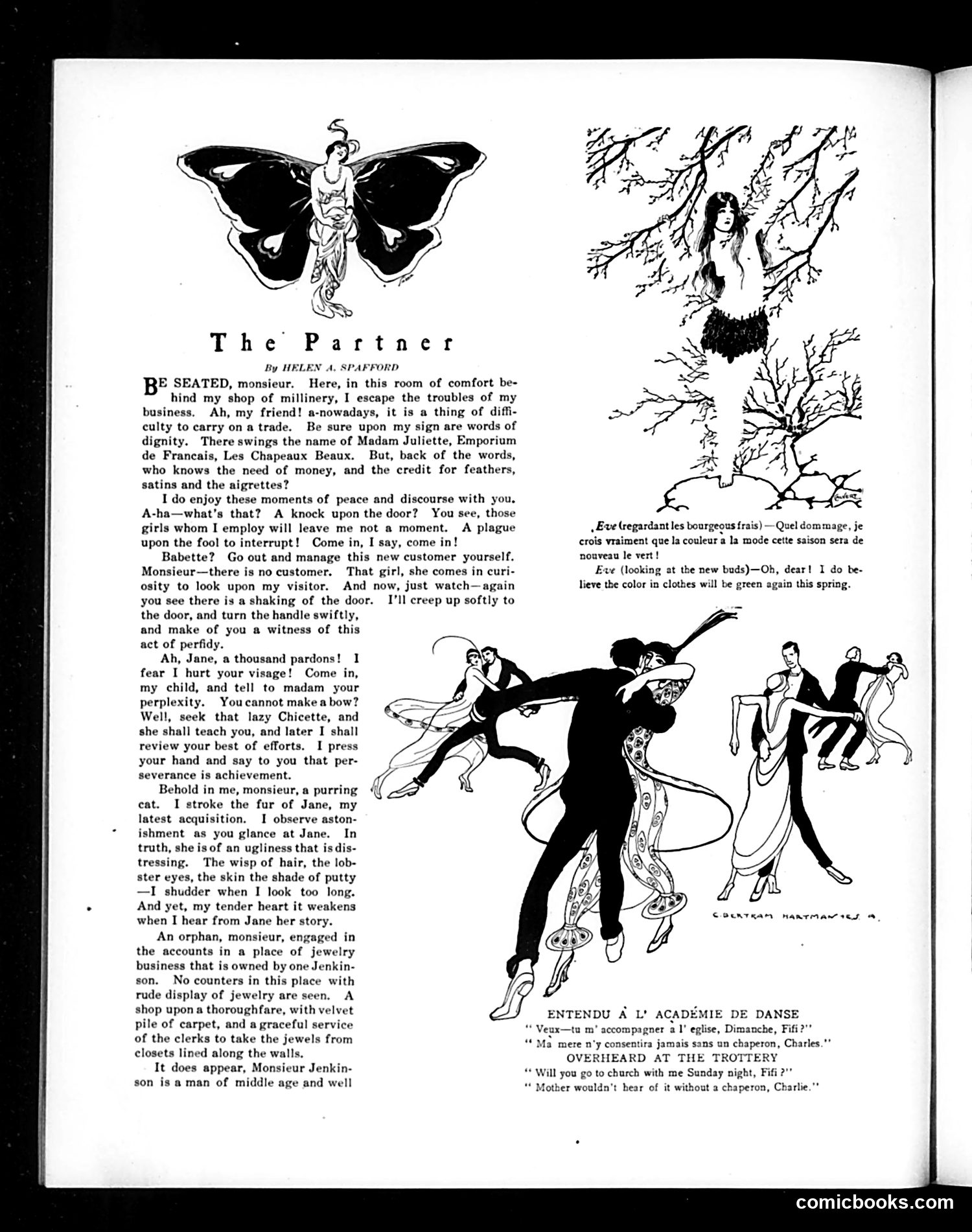
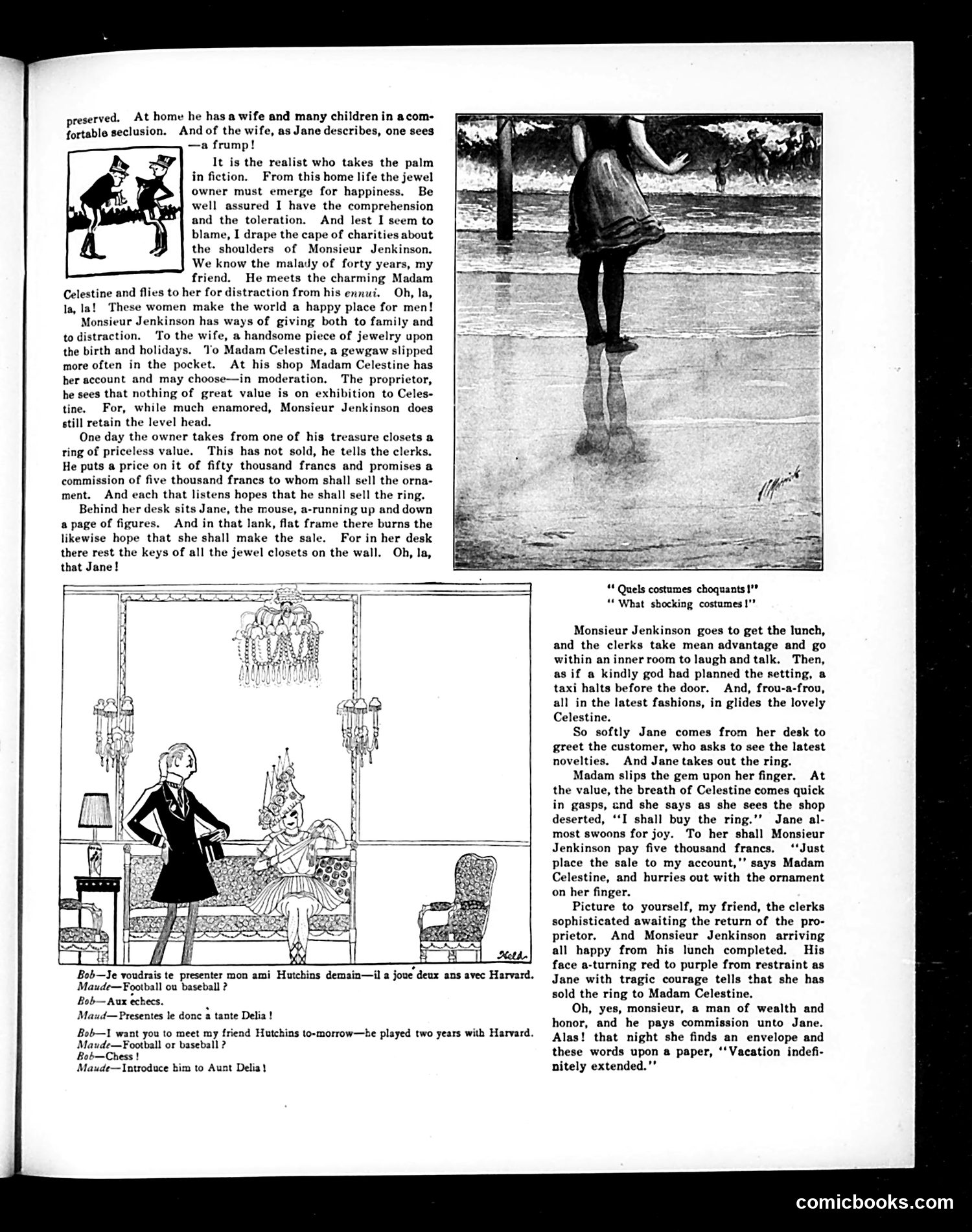
This is a short story illustration by Helen A. Spafford, not political satire. The narrative follows a French millinery shop owner (Madam Juliette) who employs a homely orphan girl named Jane. The owner describes Jane's pitiful background: she worked keeping accounts at a jewelry business owned by "Monsieur Jenkinson," a middle-aged man. The accompanying illustrations show dancers at an "Académie de Danse" and dialogue about spring fashion and church attendance with chaperones—suggesting the story involves seduction or impropriety. The satire targets late 19th/early 20th-century French fashion commerce and social hypocrisy: the genteel façade of respectable businesses masking exploitation of vulnerable young women, particularly orphans. The emphasis on Madam Juliette's pretentious French shop name contrasts with her ruthless business practices and schadenfreude toward her employees' misfortunes.
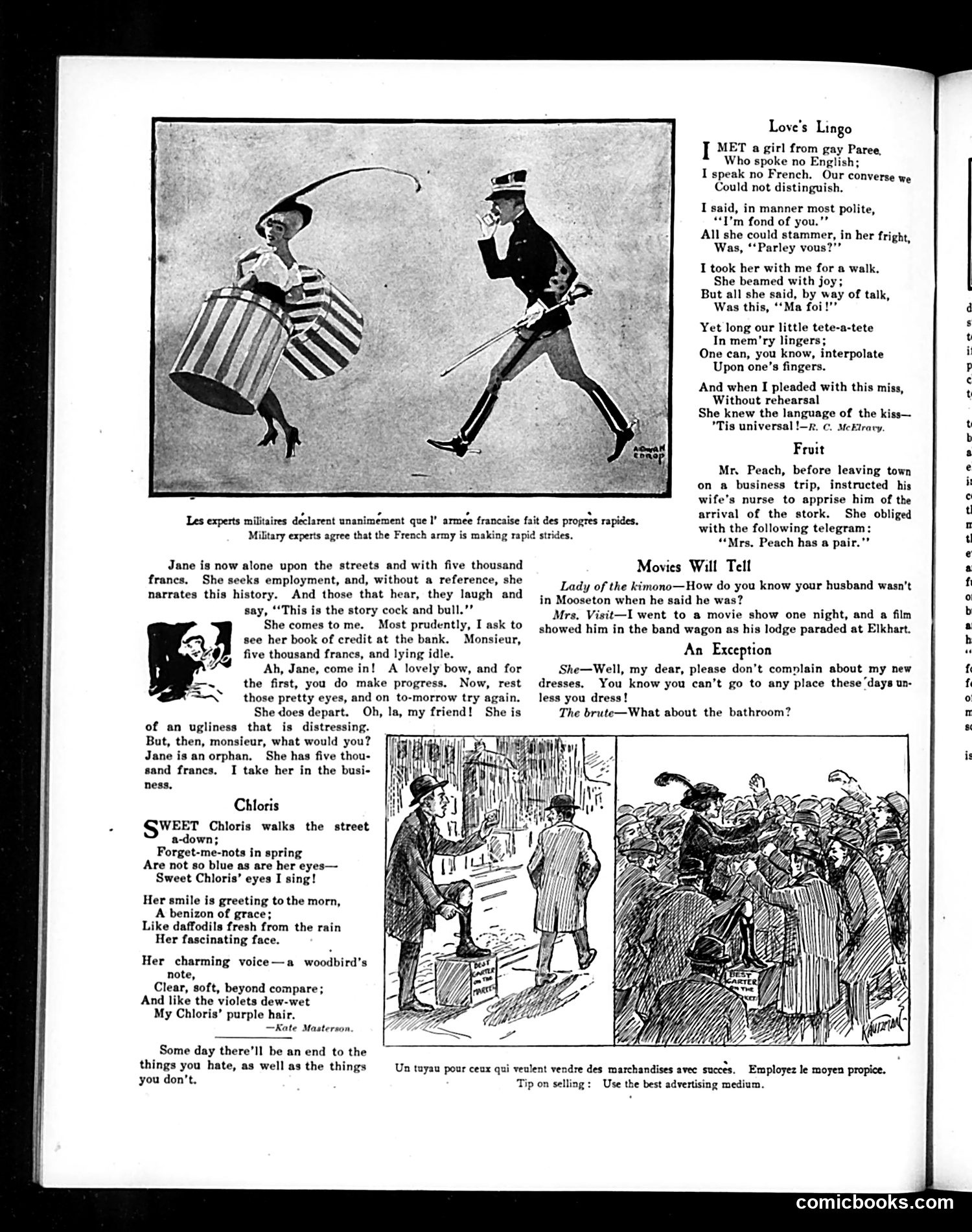
This page from *Judge* contains several unrelated humorous pieces typical of early 20th-century American satirical magazines: **Top Cartoon**: Shows a couple dancing, captioned with French military commentary. The visual joke appears to be a pun on "rapid strides" (military progress) versus literal dancing strides. **"Jane" Story**: A sarcastic narrative about hiring an unemployed orphan with savings. The humor lies in the employer's mercenary calculation—he helps her not from charity but because she has "five thousand francs...lying idle," which he can use for his business. **"Chloris" & "Love's Lingo"**: Romantic poems poking fun at courtship, particularly the absurdity of a language barrier with a French girl where neither speaks the other's language, yet they communicate through physical attraction and "the language of the kiss." **Bottom Cartoons**: Illustrate domestic humor—a wife's excuse about new dresses and a husband's retort about the bathroom. The page emphasizes romantic/marital comedy and petty financial self-interest, reflecting period attitudes toward courtship, immigration, and gender relations.
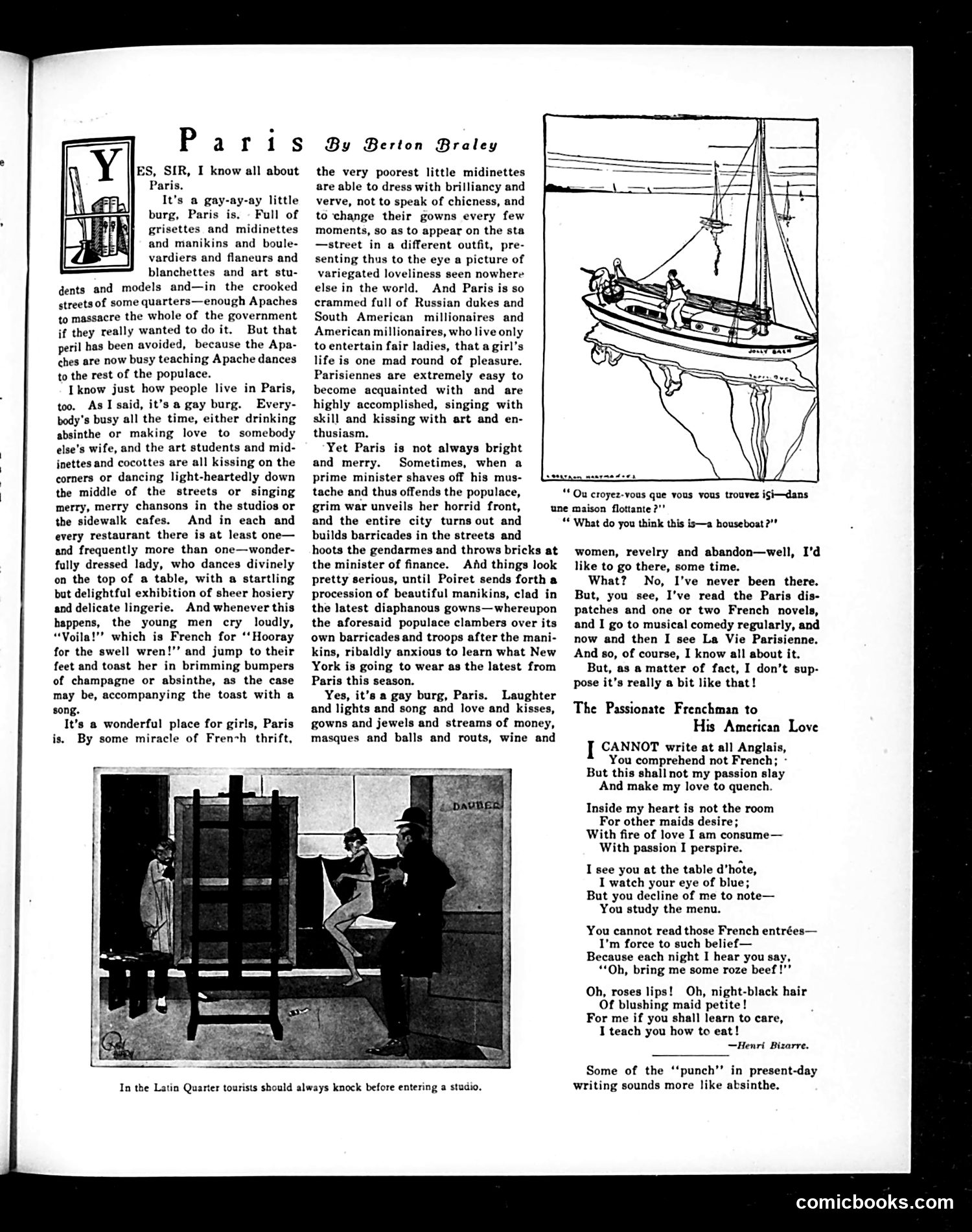
This page satirizes stereotypical American perceptions of Paris. The main article by Berton Braley is a tongue-in-cheek monologue from someone claiming expertise about Paris based entirely on secondhand sources—dispatches, French novels, and musical comedies—while admitting he's never actually been there. The satire targets American tourists' clichéd views: Paris as a hedonistic wonderland of perpetually dancing showgirls, wealthy foreign suitors, romantic intrigue, and political instability resolved by fashion parades. Braley mocks this fantasyland by exaggerating stereotypes (Apaches teaching dances, tables in restaurants where women perform, ministers' mustaches causing revolutions distracted by couture). The photograph showing a studio scene and the French-language caption ("Do you think this is a houseboat?") reinforce the joke about tourist misunderstandings. The poem "The Passionate Frenchman to His American Love" continues the theme of romantic/cultural cross-purposes between Americans and the French. Together, the page ridicules American Francophilia based on imagination rather than reality.
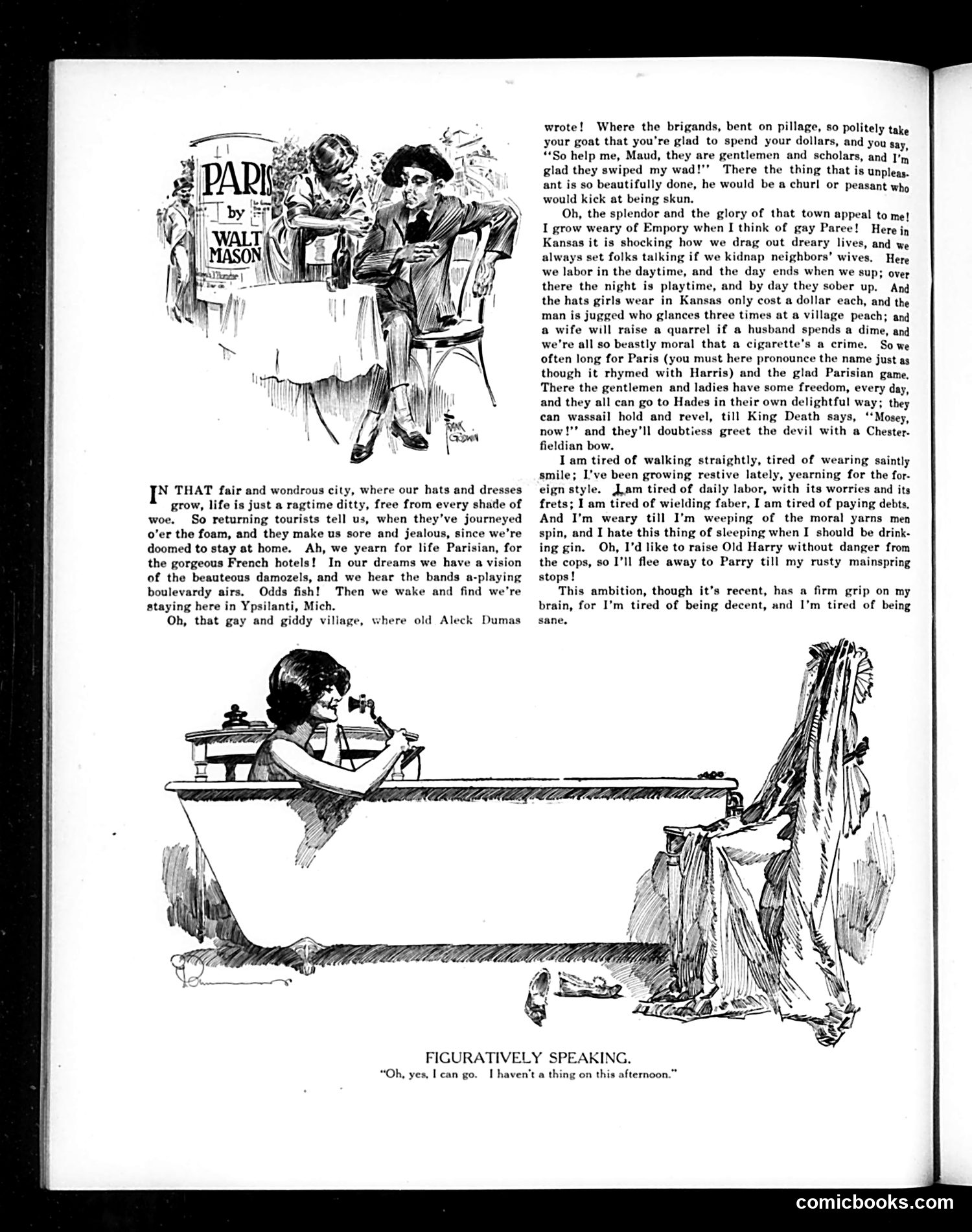
This satirical piece mocks American small-town morality and the romantic fantasy of Paris. The narrator, stuck in provincial Michigan or Kansas, contrasts dreary American life—where moral codes are rigid, divorce gossip spreads instantly, and even cigarettes are scandalous—with an idealized Paris where people enjoy freedom, pleasure, and vice without judgment. The satire cuts two ways: it ridicules Americans' puritanical hypocrisy and their naïve yearning for European decadence. The accompanying cartoon ("Figuratively Speaking") shows a woman making excuses to escape her domestic routine, reinforcing the theme of small-town constraint. Mason suggests that respectable Americans secretly crave the liberation they associate with Paris, even as their society condemns such desires.
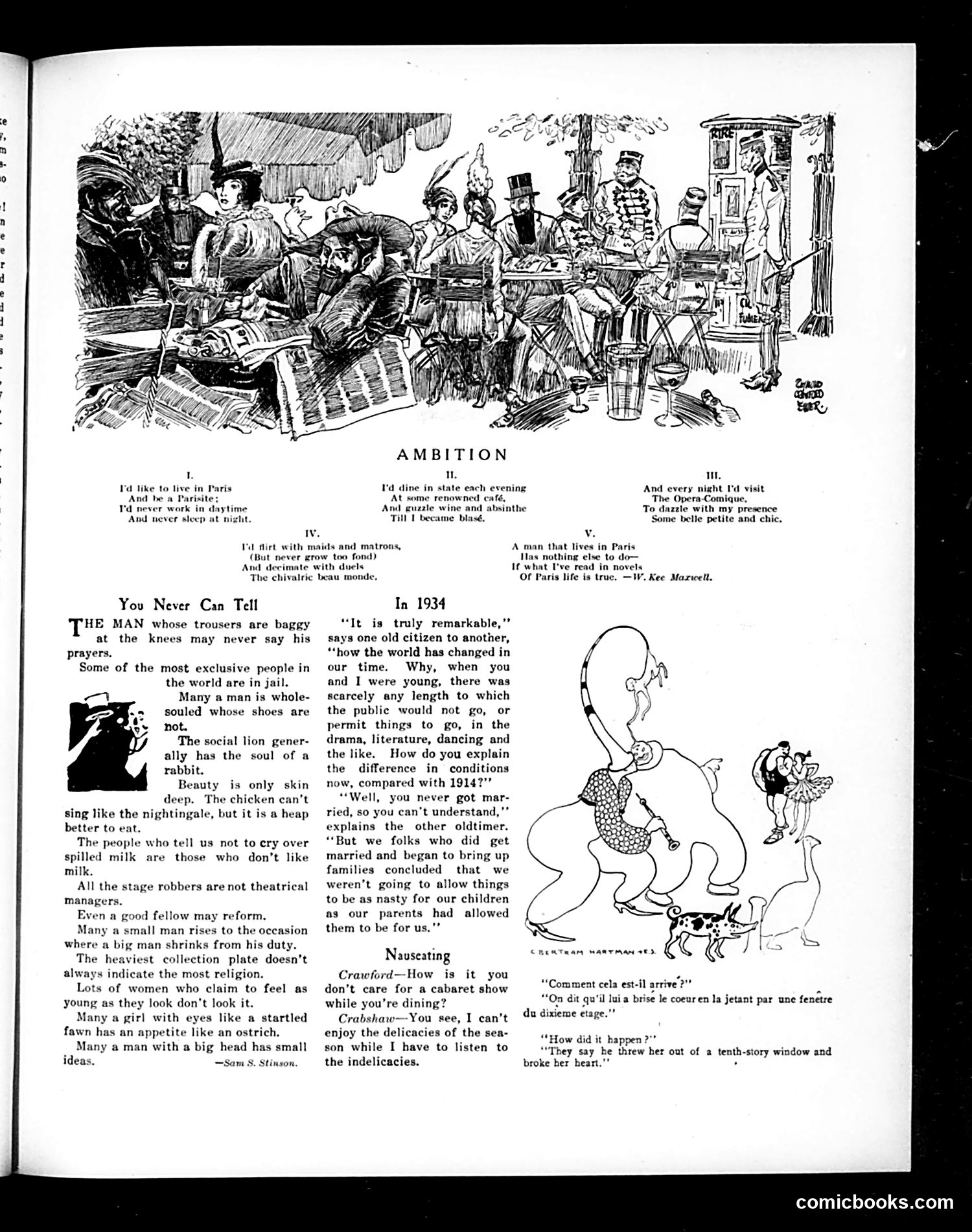
This Judge magazine page contains three satirical pieces: **"Ambition"** mocks romantic fantasies about Parisian bohemian life—living without work, drinking absinthe at cafés, attending operas, and engaging in romantic duels. The verse by W. Kee Maxwell satirizes Americans' idealized notions of Paris based on novels, suggesting the reality differs vastly. **"You Never Can Tell"** by Sam S. Stinson offers aphoristic observations deflating social pretensions: that outward respectability masks inner emptiness (exclusive people in jail, baggy-trousered men, social lions with rabbit souls). It's social commentary through paradox. **"In 1934"** presents elderly men discussing changed morality. One attributes stricter standards to married men with children protecting their families from the permissiveness their parents tolerated in 1914. The satire critiques how domesticity enforces conservatism. The French caption and illustration appear to joke darkly about romantic tragedy—throwing someone from a window "breaks her heart" literally and figuratively.
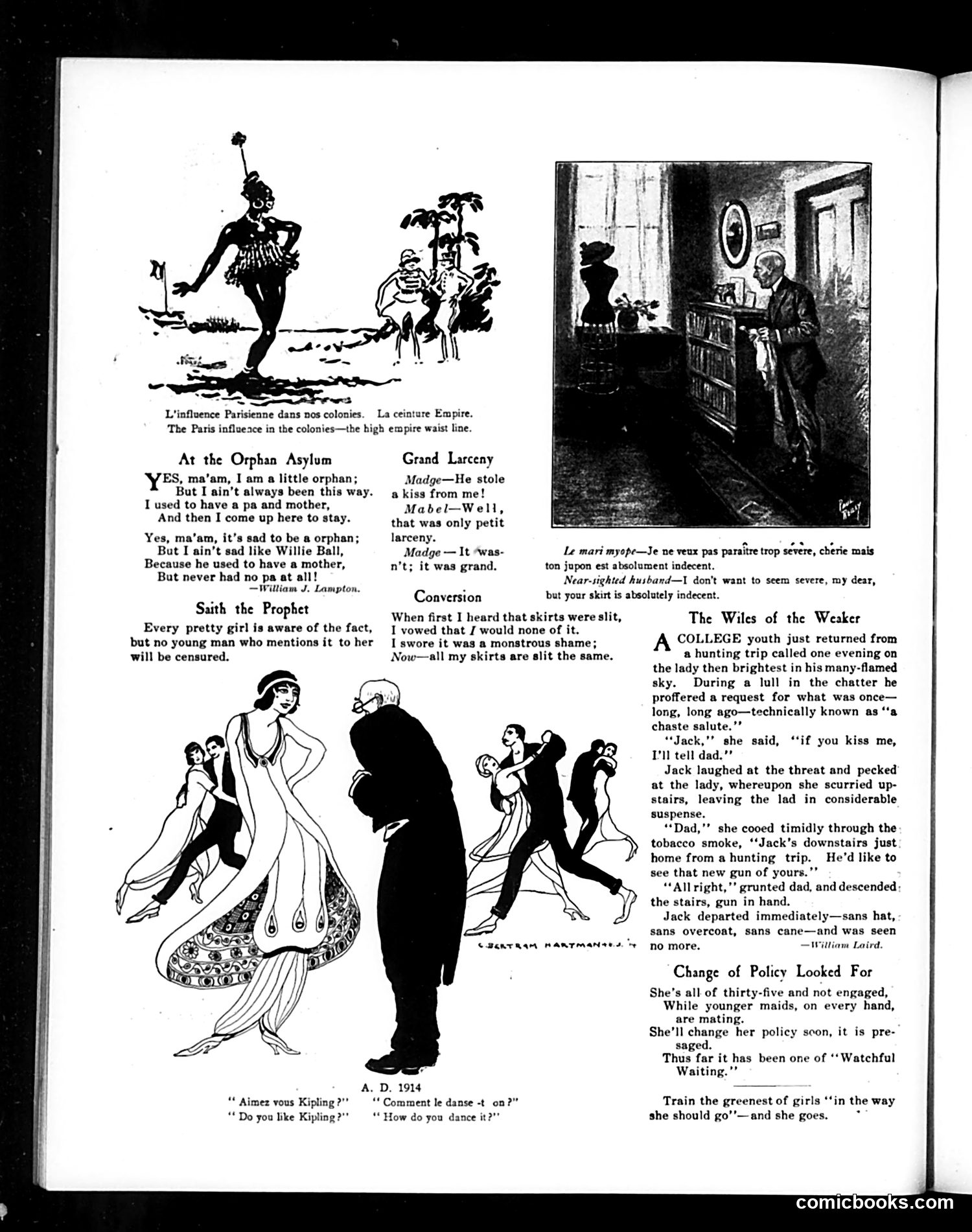
This 1914 satirical page mocks contemporary fashion and social trends through multiple cartoons and verses. **Top cartoon**: "Paris Influence in the Colonies" ridicules the high-waisted "Empire" silhouette fashionable among colonists, depicted as an absurdly exaggerated corset line on a woman. **"Saith the Prophet"**: Satirizes female hypocrisy about clothing. A woman initially denounces slit skirts as shameful, then adopts them herself—mocking the rapid acceptance of scandalous fashions once they become trendy. **Other pieces** include humorous domestic dialogues: a "Grand Larceny" about stolen kisses, a "near-sighted husband" complaining about indecent skirts, and "The Wiles of the Weaker" (women manipulating men). **"Change of Policy Looked For"** sardonically suggests a thirty-five-year-old unmarried woman should abandon her "Watchful Waiting" approach and adopt aggressive dating tactics to find a husband. The overall message: Judge critiques women's fashion obsession, moral flexibility, and romantic scheming as foolish or duplicitous.
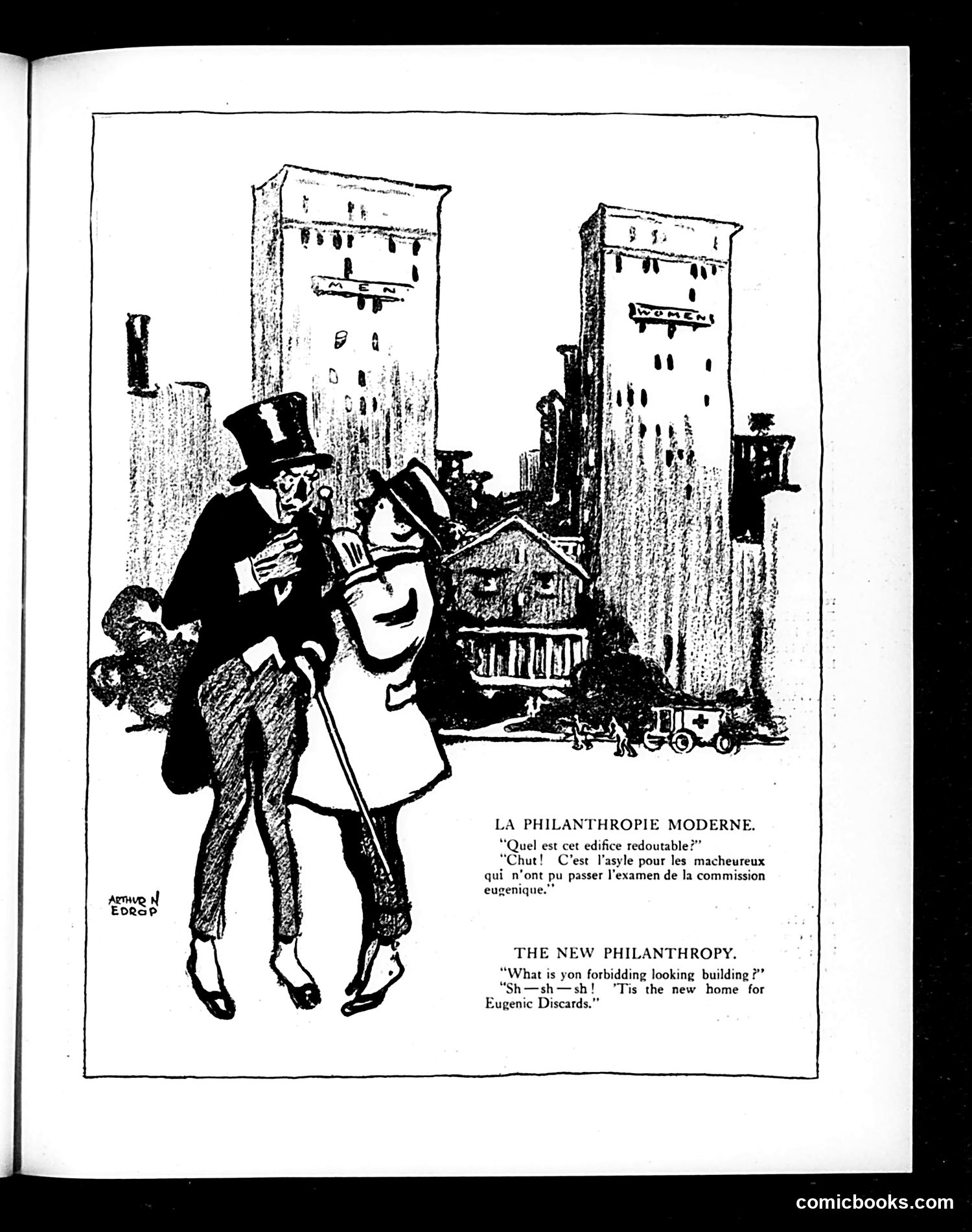
This satirical cartoon critiques early 20th-century eugenics ideology. Two well-dressed figures in top hats stand before a forbidding institutional building, discussing it in hushed, embarrassed tones. The joke exposes the cruel logic of eugenics: the building houses people deemed "unfit" by eugenic commission examinations—those who "failed" pseudo-scientific evaluations. The phrase "Eugenic Discards" reveals the cartoon's bitter irony: modern philanthropy supposedly helps society, yet now it merely warehouses those deemed genetically undesirable. The conspiratorial whisper ("Sh—sh—sh!") suggests shame about this new "charitable" purpose. The cartoon mocks both eugenics pseudoscience and the era's wealthy philanthropists who might embrace it as progressive social policy. Judge magazine uses satire to condemn this dehumanizing ideology as fundamentally incompatible with genuine benevolence.
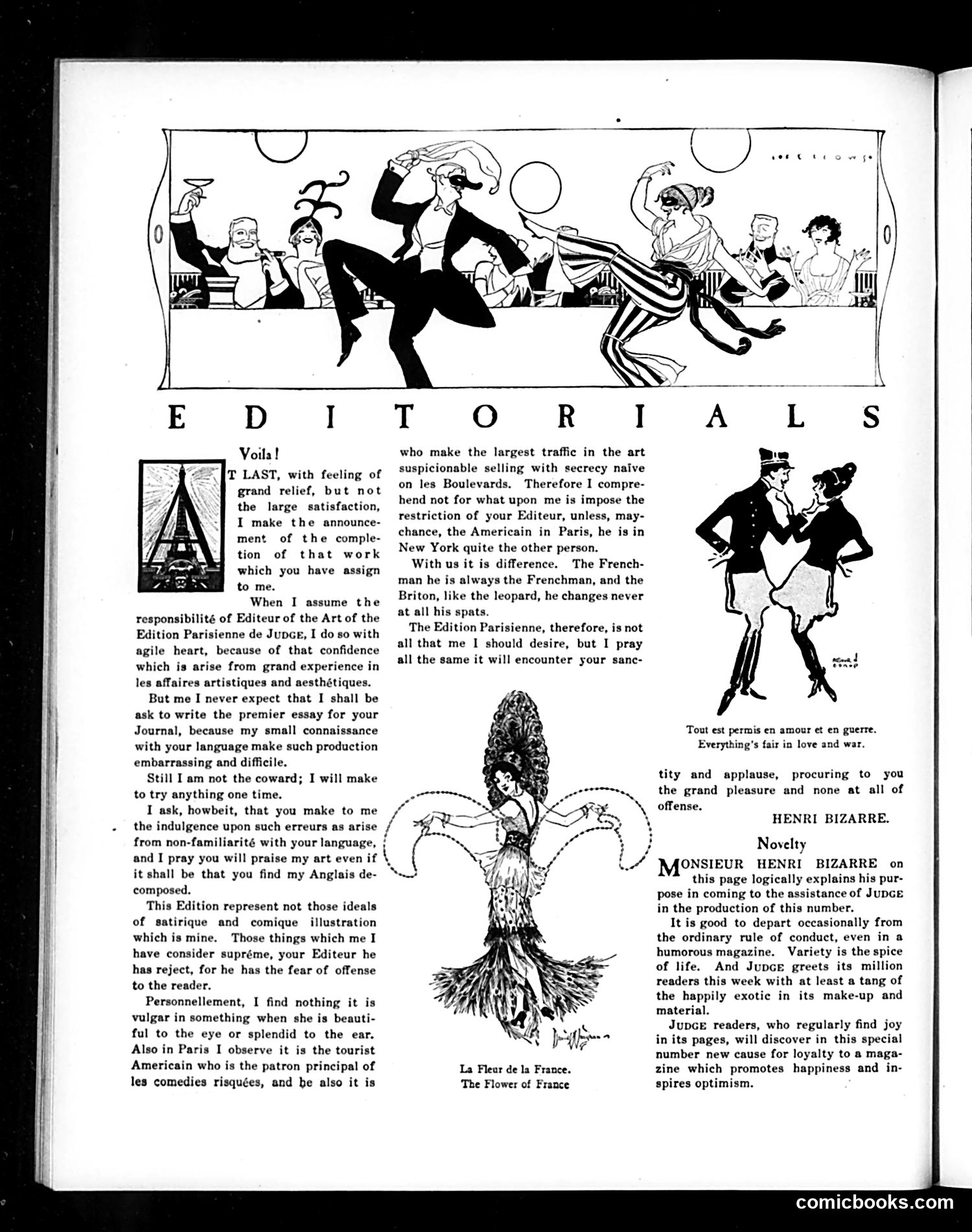
This page features a guest editorial by "Henri Bizarre," a French artist whom Judge has hired to contribute artwork. The humor lies in Bizarre's deliberately broken English and affected French mannerisms—he writes in a comically stilted, malapropism-laden style ("me I make," "connaissance," "Anglais decomposed"). The satire targets two things: 1. **Pretentious European artists**: Bizarre complains that Judge's American editors censored his work out of fear of offending readers, while defending French artistic freedom. He notes Americans in Paris embrace risqué content that "respectable" Americans reject at home—mocking American hypocrisy about morality. 2. **Cultural stereotypes**: Bizarre claims Frenchmen never change ("like the leopard"), while Americans constantly shift values depending on geography. The broken English reinforces the "absurd foreigner" trope. The illustrations (top banner and "Flower of France" figure) show theatrical, exaggerated dancers—fitting an issue celebrating exotic continental variety. The editorial positions Judge as cosmopolitan enough to occasionally feature such continental material.
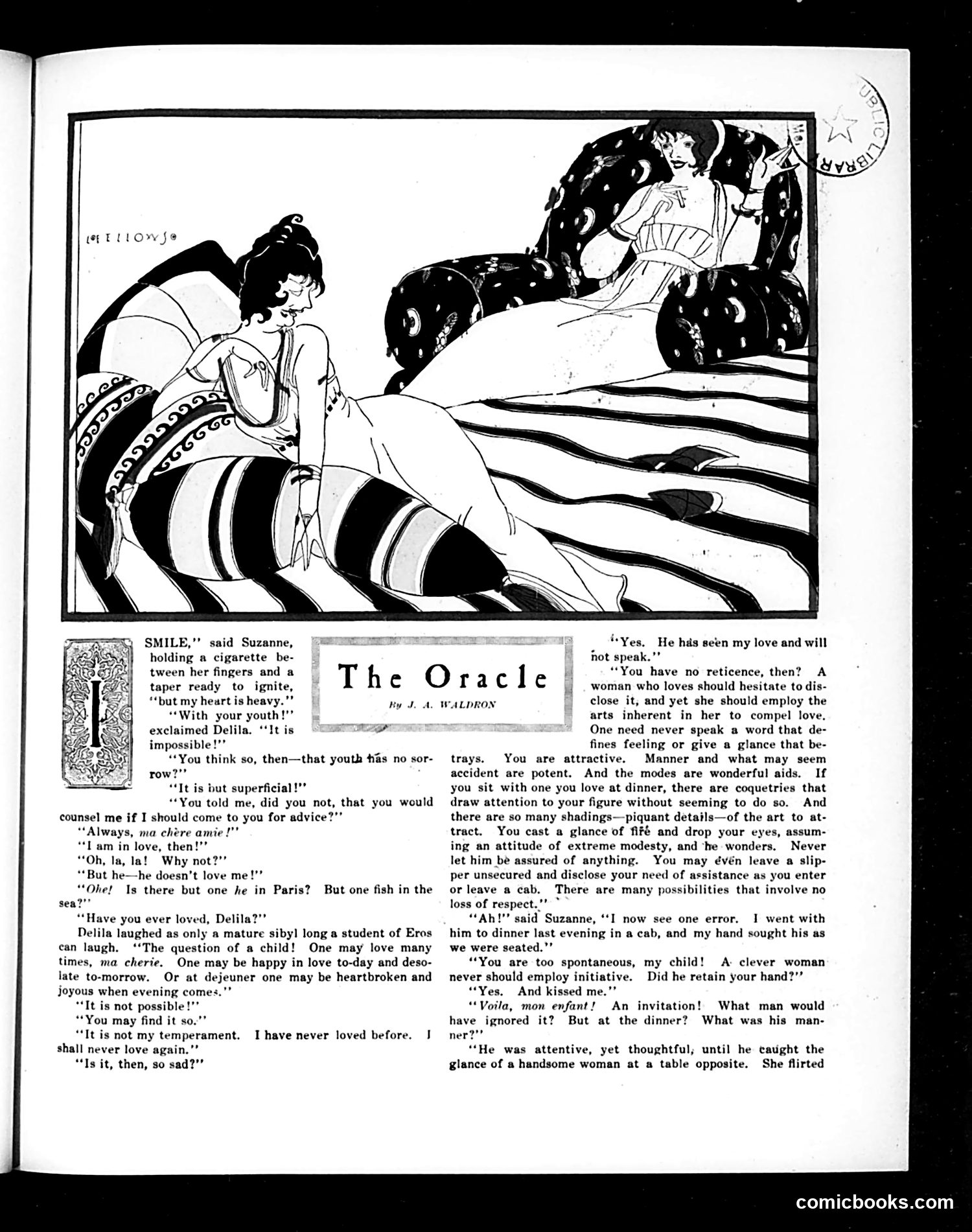
This is a prose fiction piece rather than a political cartoon. "The Oracle," by J.A. Waldron, depicts a romantic advice column scenario presented as dialogue between two women: Suzanne, a young woman in love, and Delila, an older, experienced woman offering cynical romantic counsel. The satire targets early 20th-century courtship rituals and female manipulation tactics. Delila advises Suzanne to employ calculated "coquetries"—strategic displays of vulnerability, mysterious glances, and physical cues—rather than direct emotional honesty. She recommends deliberately "unsecuring" a slipper to appear helpless, or feigning modesty while subtly drawing attention to one's figure. The humor lies in exposing the elaborate artifice expected of women pursuing romance: authentic feeling is dismissed as "superficial," while theatrical performance is prescribed as sophisticated strategy. The illustration shows voluptuous women in intimate domestic settings, reinforcing the story's focus on feminine wiles and seduction techniques.
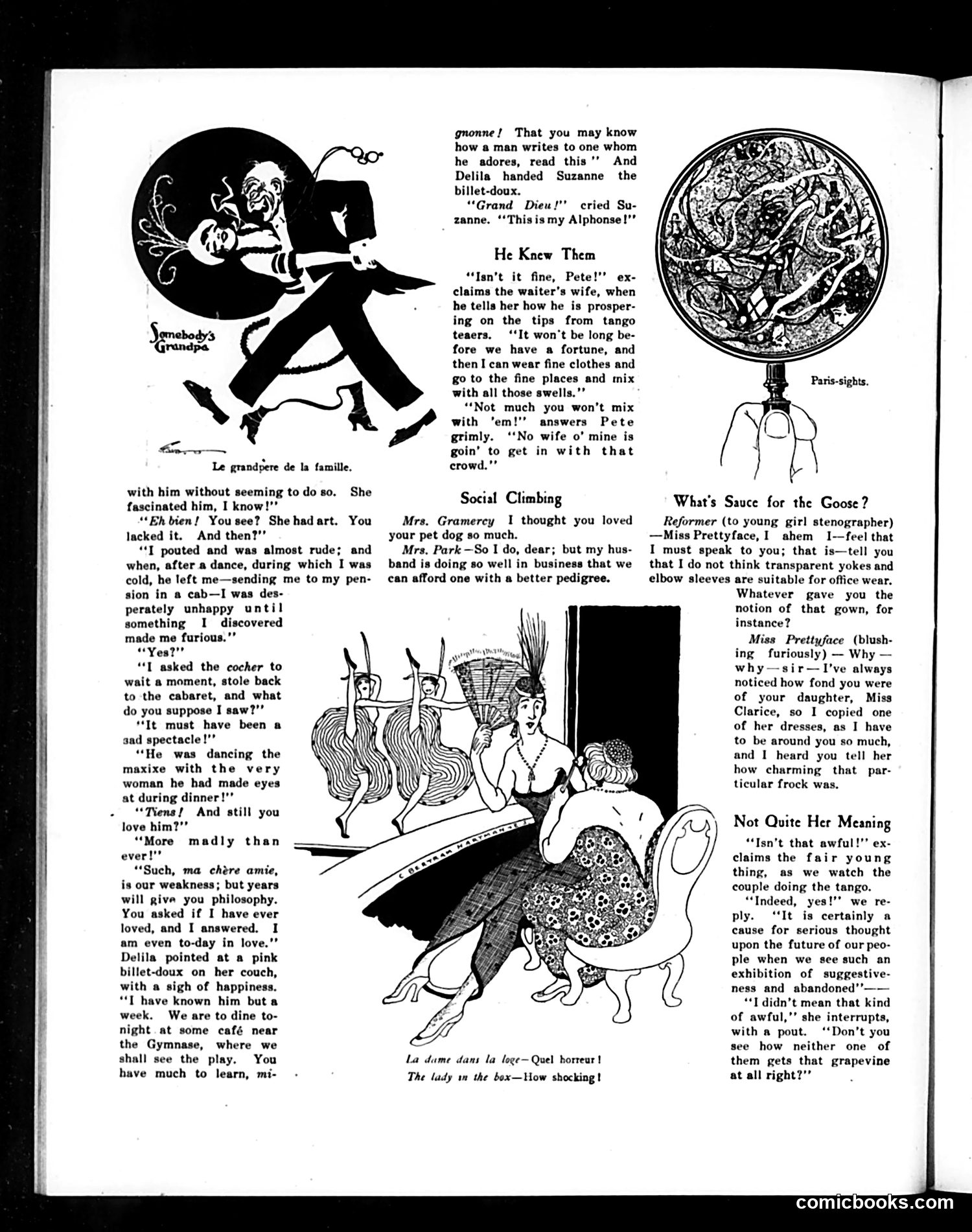
This page contains multiple satirical vignettes mocking early 20th-century social pretensions and romantic/gender dynamics: **"Le grandpère de la famille"** (left): A French-styled anecdote about a woman who discovers her lover dancing the maxixe (a scandalous Brazilian dance) with another woman at a cabaret, yet loves him "more madly than ever." The satire targets women's illogical romantic devotion and the fashionable tango/maxixe dance craze. **"Social Climbing"**: Mrs. Park abandons her beloved pet dog for one with "better pedigree" now that her husband's successful—mocking nouveau riche social climbing and shallow materialism. **"What's Sauce for the Goose?"**: A hypocritical reformer criticizes a stenographer's transparent blouse as immodest, but the girl reveals she copied it from his own daughter's dress. The satire exposes male hypocrisy regarding women's fashion. **"Not Quite Her Meaning"** (right): Young woman finds tango dancing morally shocking—but clarifies she means the dancers' poor *technique*, not the dance's suggestiveness. Light mockery of youth's priorities. All pieces satirize contemporary manners, class anxieties, and gender relations.
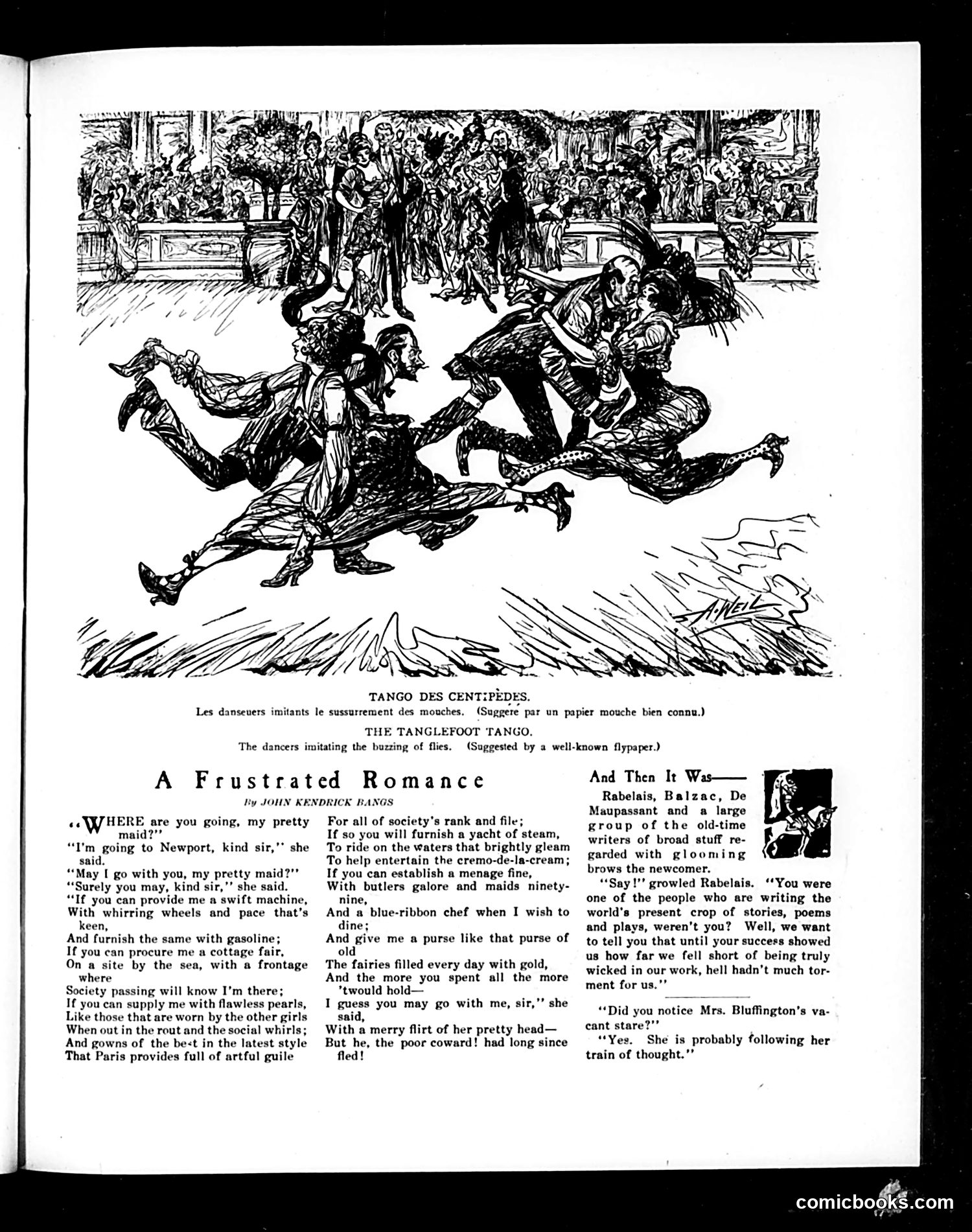
**Top Illustration: "The Tanglefoot Tango"** A satirical cartoon mocking the "tango craze" sweeping early 1900s society. The frenzied dancers performing an exaggerated, ungainly dance are compared to centipedes—the "tanglefoot" being a humorous reference to both the dance's chaotic leg movements and a brand of flypaper. The joke: fashionable people are acting like insects caught on sticky paper, slavishly following a ridiculous trend. **"A Frustrated Romance" (poem by John Kendrick Bangs)** A satirical commentary on nouveau riche materialism and women's mercenary attitudes. A suitor asks a young woman to accompany him; she agrees—but only if he provides: an automobile, beach cottage, pearls, expensive Parisian gowns, yacht, mansion staff, and endless money. The punchline: the "poor coward" flees rather than commit to such demands. The satire targets both female greed and male cowardice, reflecting anxieties about modern courtship and wealth-obsession in upper-class society.
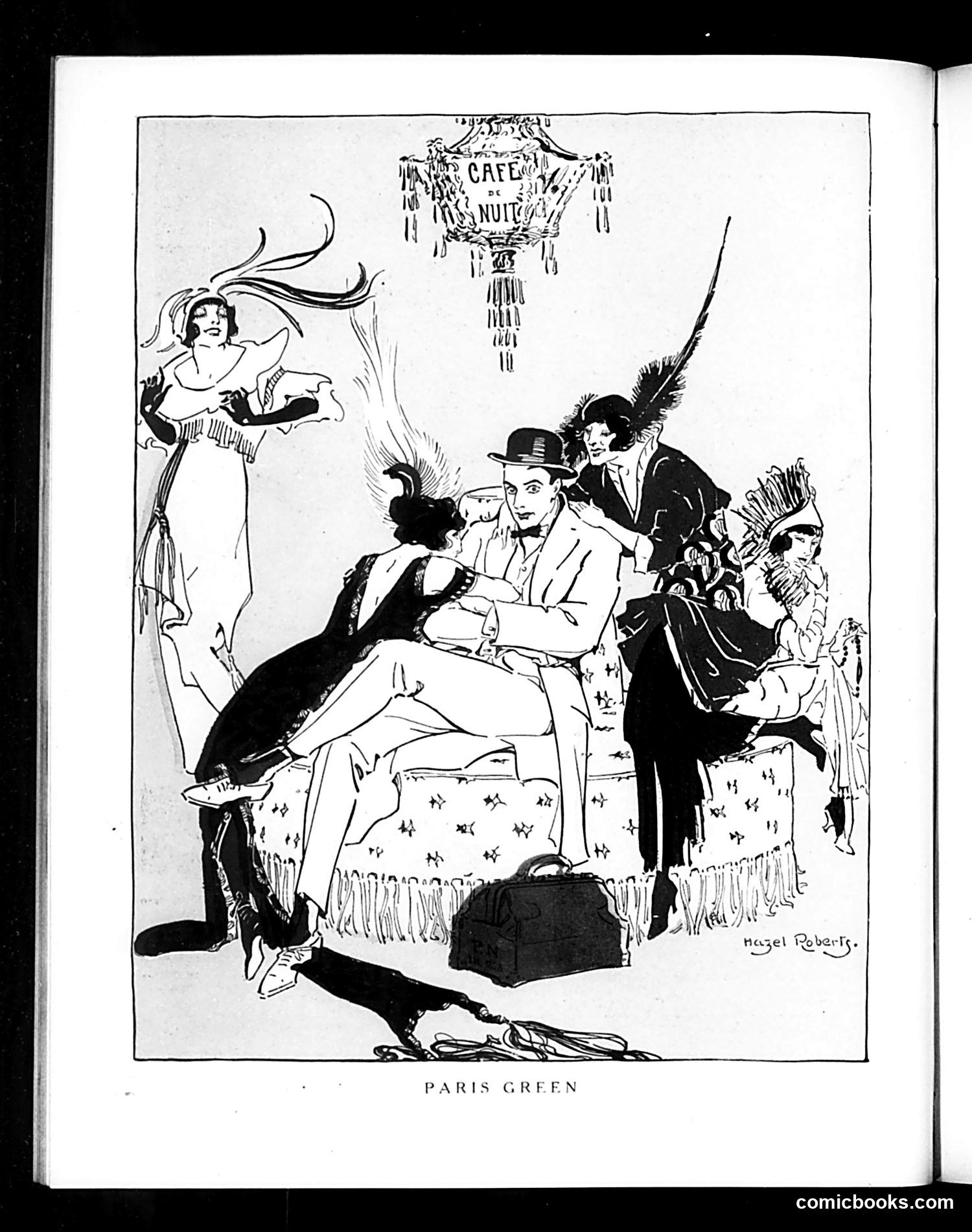
This cartoon by Hezel Roberts depicts a scene at the "Café de Nuit" (Nightclub). The title "Paris Green" appears to be a pun on both the French nightlife setting and "Paris green," a toxic arsenic-based pesticide popular in the early 20th century. The satire likely mocks the decadence and moral dangers of Parisian nightclub culture—showing well-dressed patrons (including what appear to be wealthy men and women in elaborate dress) engaged in frivolous entertainment. The pesticide reference suggests the cartoon views such establishments as spiritually or morally "poisonous" to visitors. The exaggerated character poses and fashionable attire emphasize the superficiality and excess of the scene, typical of Judge magazine's social commentary on urban indulgence.
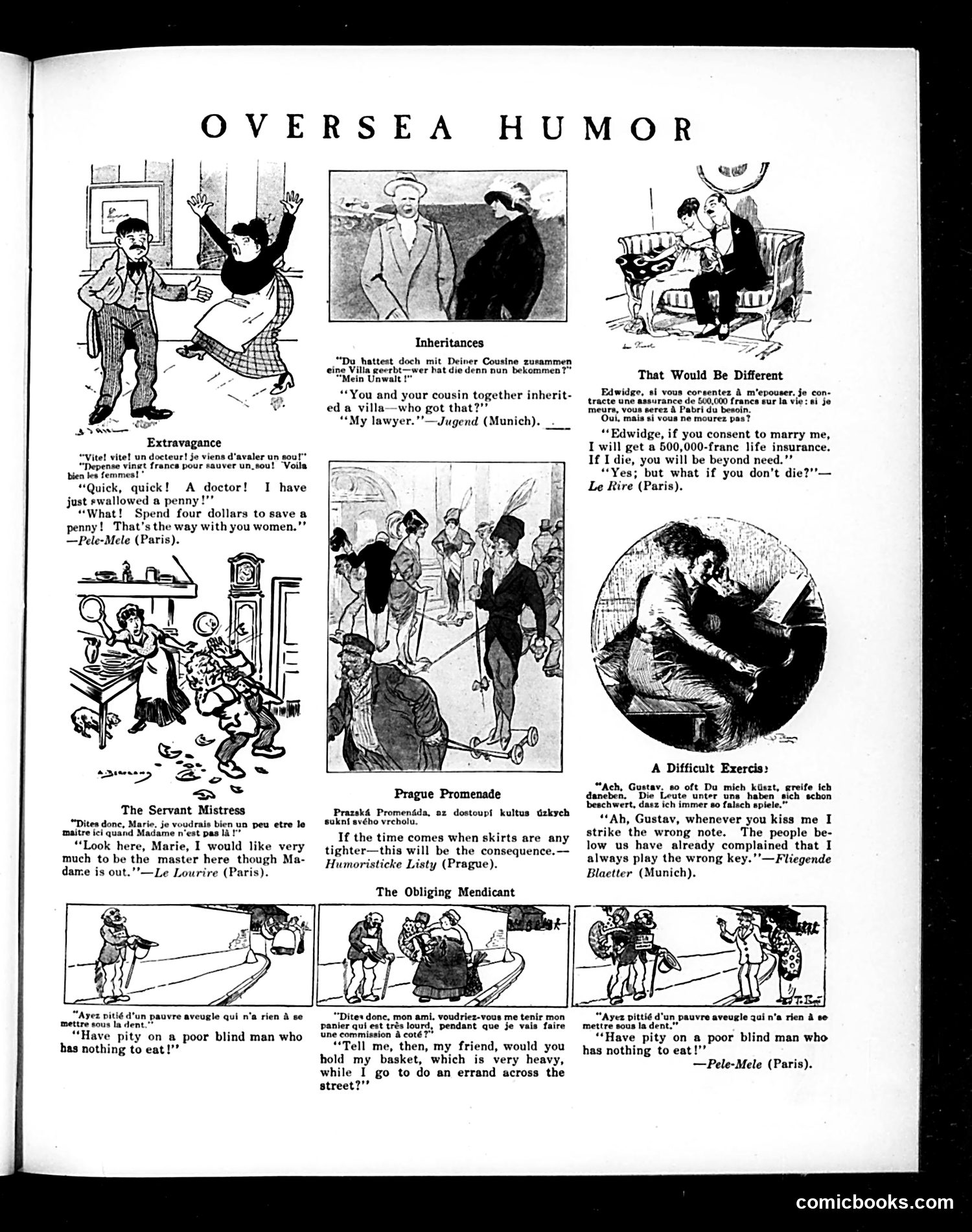
This page collects satirical comics from European publications, translated for American readers. The humor reflects early 20th-century social attitudes: **"Extravagance"** mocks women's perceived financial irresponsibility—spending money disproportionately (four dollars to save one penny). **"Inheritances"** jokes that lawyers are the real beneficiaries of estates, not heirs—a jab at the legal profession's fees. **"The Obliging Mendicant"** presents a beggar exploiting charity through manipulation, suggesting street panhandlers are con artists. **"That Would Be Different"** satirizes mercenary marriage, where a woman's interest in a husband depends on life insurance rather than love—cynical commentary on women's economic dependence. **"Prague Promenade"** jokes that excessively tight skirts (fashionable at the time) create physical consequences, likely intended as social criticism of women's fashion constraints. The page reflects period attitudes toward women, class, and professions while presenting "foreign" humor as exotic entertainment for American audiences.
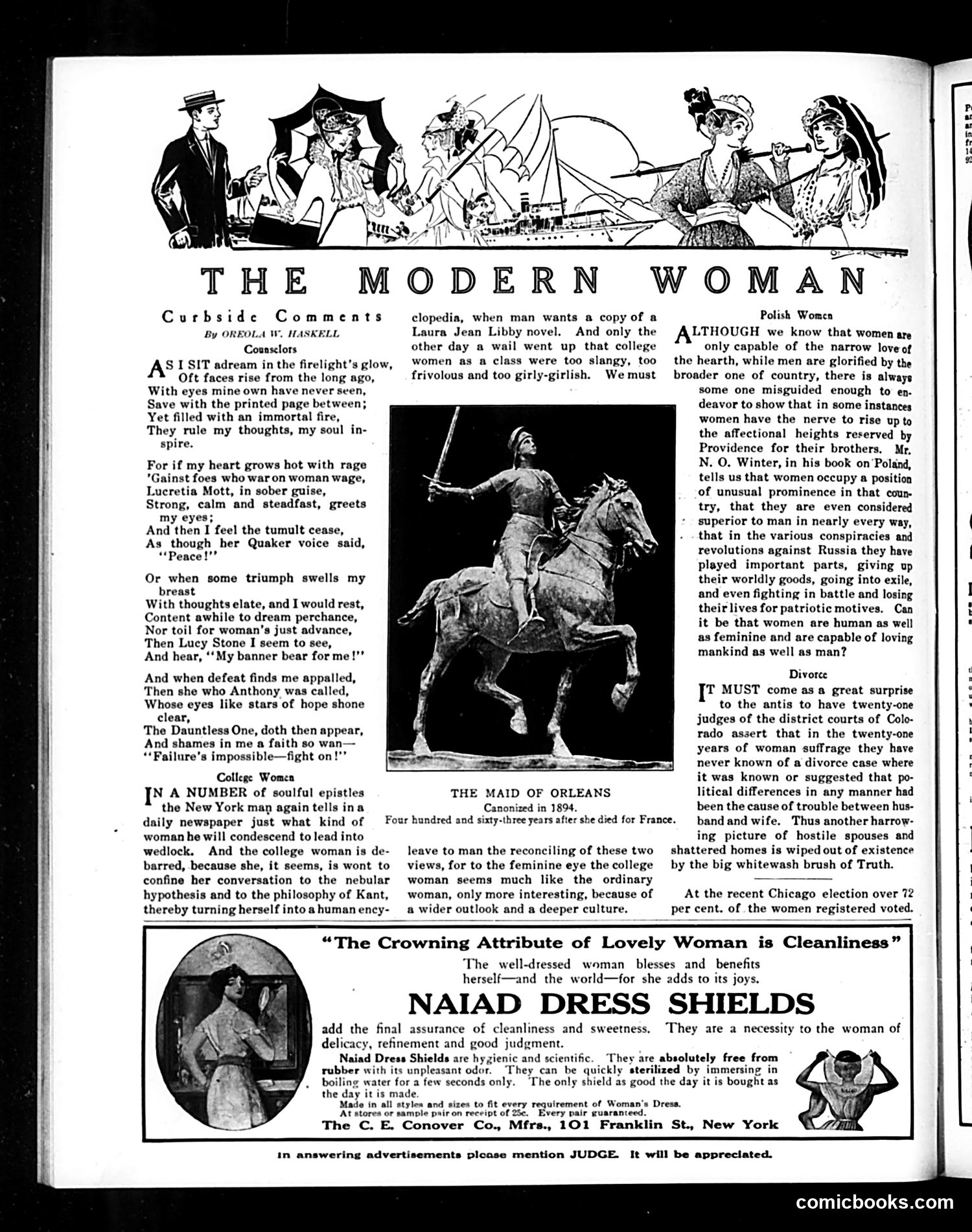
This Judge magazine page satirizes contemporary debates about women's roles through multiple lenses: **The Poetry Section** invokes historical women's suffrage pioneers—Lucretia Mott, Lucy Stone, and Susan B. Anthony—to shame men opposing women's advancement. The satire targets male hypocrisy by referencing their contradictory complaints about college women being simultaneously too intellectual and too frivolous. **The Commentary Sections** employ heavy irony to mock anti-feminist arguments: - **College Women**: Ridicules men's impossible standards for educated women - **Polish Women**: Sarcastically questions whether women can actually love country as broadly as men, citing examples proving they can - **Divorce**: Notes that Colorado judges found no political disagreements caused divorces during women's suffrage, undermining the "suffrage destroys marriage" argument **The Joan of Arc Image** (canonized 1894) reinforces the theme of women's patriotic capacity and spiritual significance. The overall message: women deserve equal respect and opportunity; male objections are logically inconsistent and empirically false.
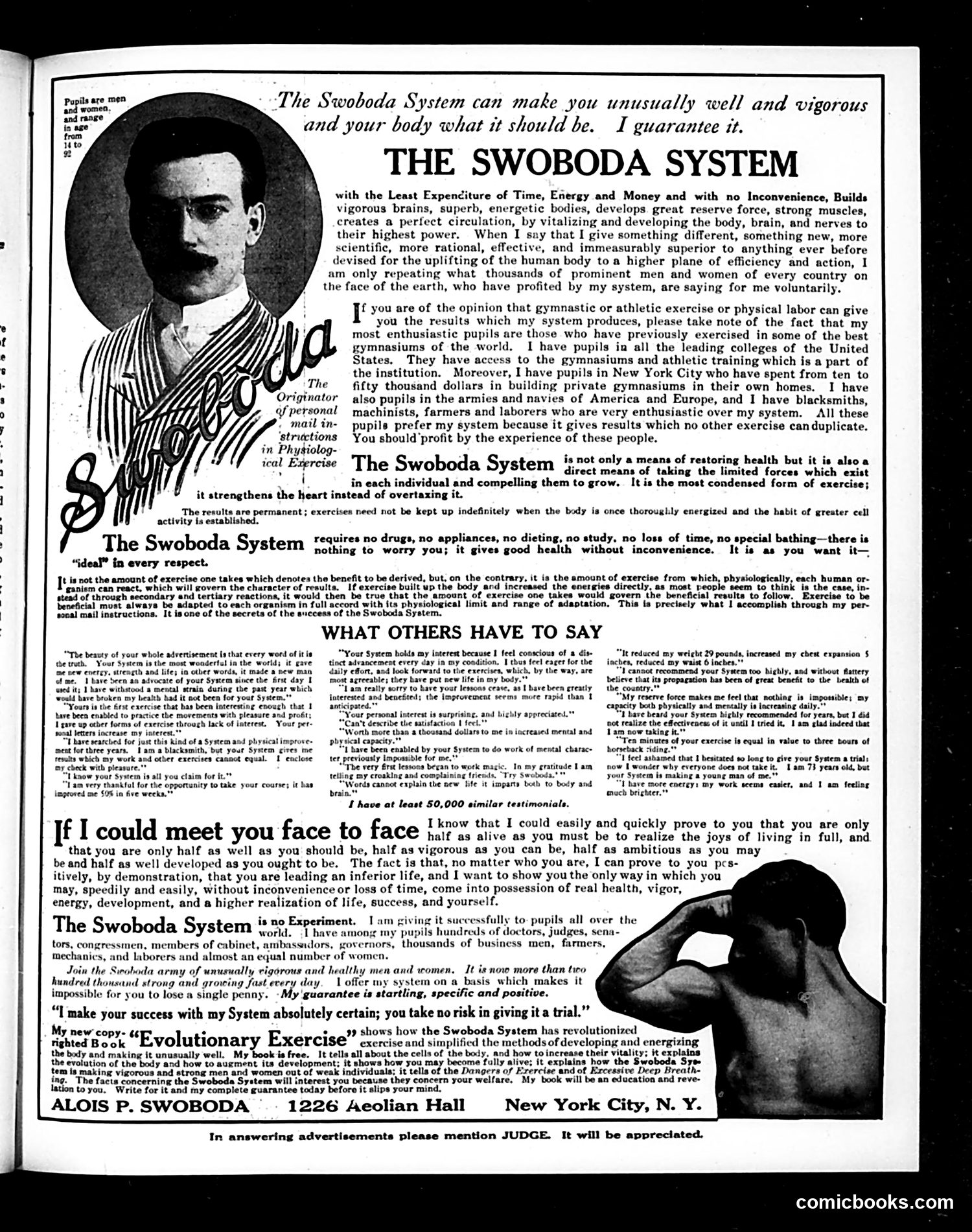
This is primarily a **full-page advertisement**, not a satirical cartoon, though it appeared in *Judge*, a satirical magazine. The ad promotes the Swoboda System—a physical exercise method claiming to build vigor, strength, and health with minimal time or effort. **The pitch:** Alois P. Swoboda (identified as "Originator of personal mail instructions in Physiological Exercise") markets his system as superior to traditional gymnastics, requiring no drugs, diets, or special equipment. He claims thousands of prominent clients, including college students, wealthy New Yorkers, soldiers, and laborers. **Why it's notable in *Judge*:** This exemplifies early 1900s **pseudoscientific wellness marketing**—making grandiose health claims with testimonials but vague methodology. The ad's breathless tone ("I guarantee it") and emphasis on effortless results reflect common fitness-industry hype that satirical magazines like *Judge* would have mocked, even while accepting its advertising revenue. **Modern parallel:** Similar to contemporary fitness influencer marketing promising quick results.
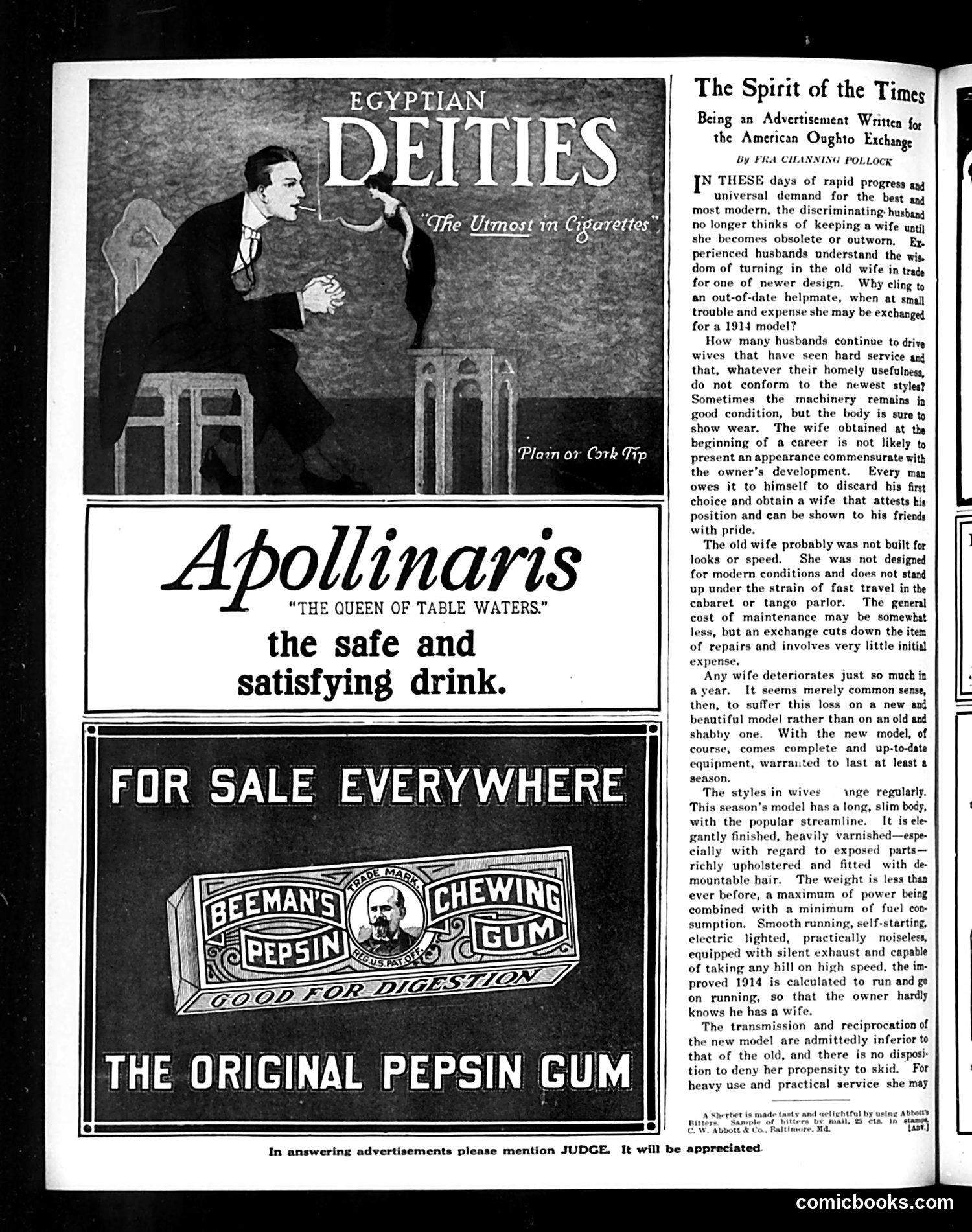
This is a satirical advertisement mocking early 1900s consumer culture and changing attitudes toward marriage. The piece uses automotive language to describe wives as replaceable commodities—comparing a "1914 model" wife to trading in an old car. The satire targets wealthy husbands who discard aging first wives for newer, fashionable models to display their success. The anonymous author ("Fra Channing Pollock") employs absurdist humor: describing wives' "depreciation," "maintenance costs," and features like "mountable hair" and "propensity to skid." The joke exposes the dehumanization of women in materialistic society and the era's disturbing practice of discarding spouses. By treating matrimony as consumer goods exchange, the piece criticizes both shallow modernism and men who value appearance and status over loyalty or genuine partnership. The accompanying advertisements (Egyptian cigarettes, Apollinaris water, Pepsin gum) underscore the page's consumerist themes—everything is for sale, including, satirically, wives.
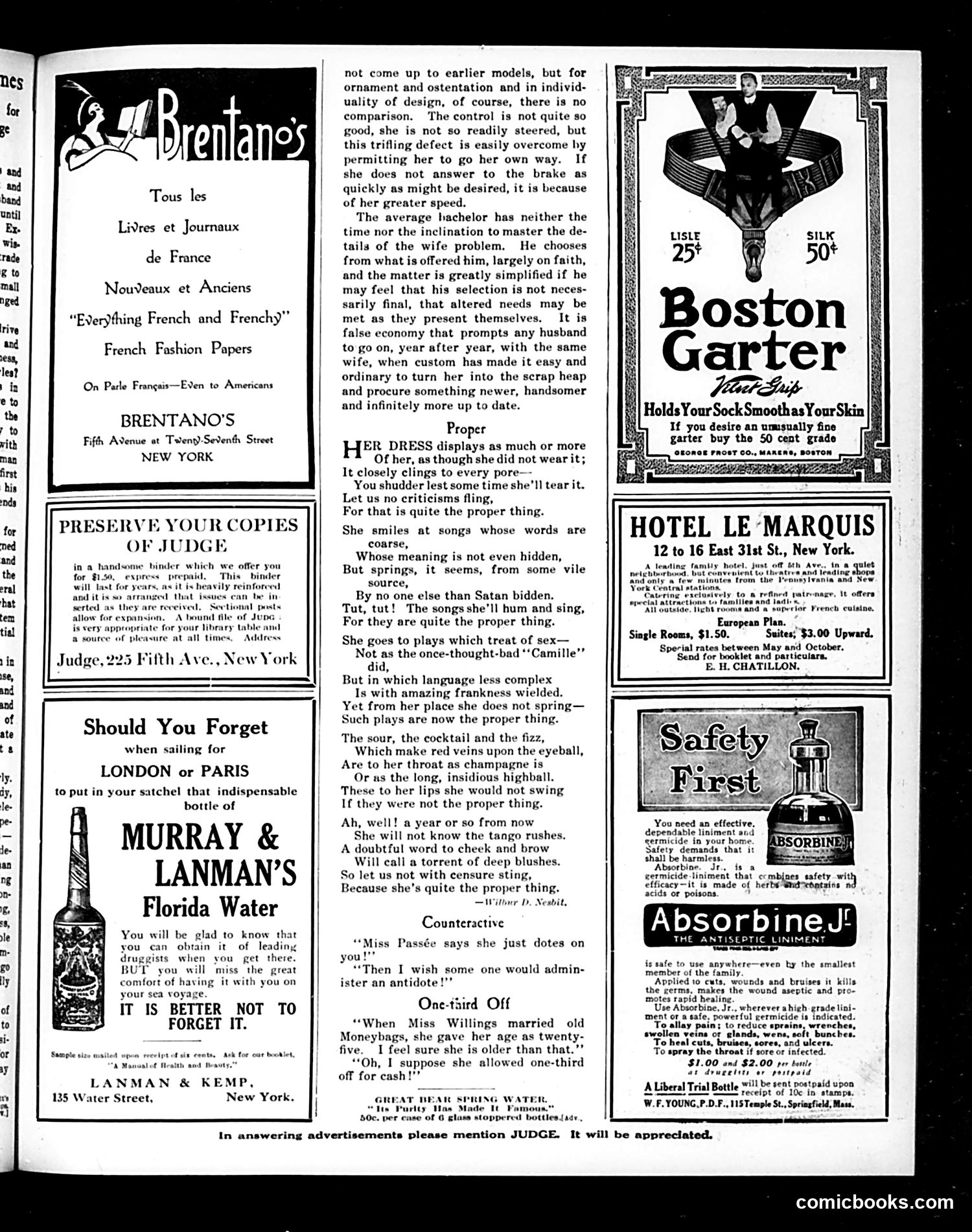
This page is primarily **advertisements and light humor** rather than political satire. The main content includes: **The Poem "Proper"** (by Wilbur D. Nesbit): A satirical critique of modern women's hypocrisy. It mocks women who dress provocatively, enjoy risqué entertainment (coarse songs, sexually suggestive plays), drink cocktails, and dance the tango—yet maintain an air of propriety. The irony is that these "improper" behaviors have become socially "proper" through normalization. The poem suggests this permissiveness is fleeting: within a year, she'll deny these interests and blush at mild language. **The humor pieces below** mock courtship and marriage: one about a husband viewing his wife as replaceable machinery (outdated, requiring trading in for a newer model), and another as a joke about a woman discounting her age "one-third off for cash" when marrying a wealthy man. **The advertisements** for Brentano's books, Judge magazine bindings, Murray & Lanman's Florida Water, Boston Garter, Hotel Le Marquis, and Absorbine comprise the page's bulk. The satire reflects early 20th-century anxieties about changing women's social roles and behavior.
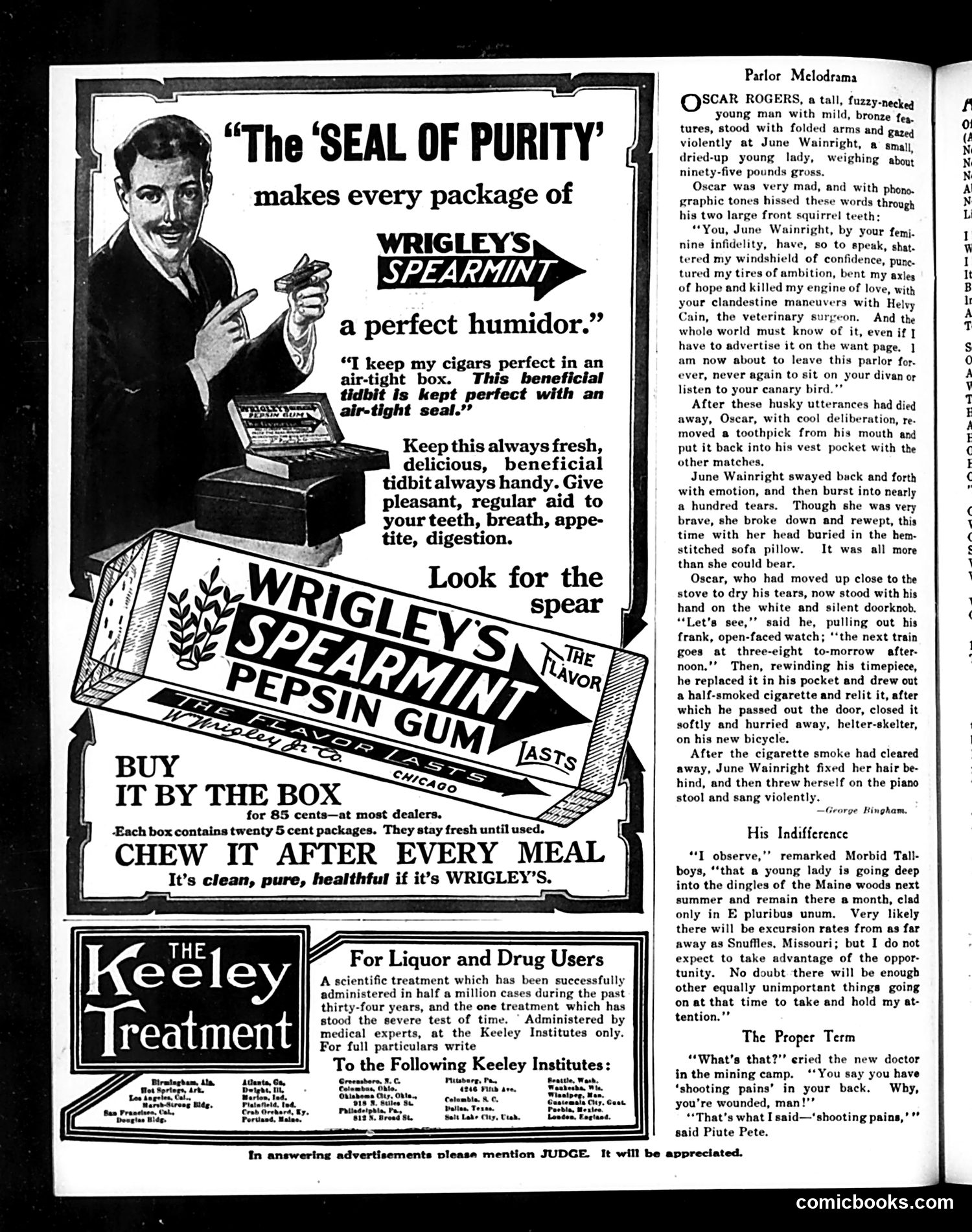
This page is primarily **advertisements** for Wrigley's Spearmint gum and the Keeley Institute, interspersed with three brief humorous pieces. The main ad features a man endorsing Wrigley's as a "perfect humidor" for keeping cigars fresh—a health claim typical of early 20th-century advertising that conflates chewing gum with digestive and respiratory benefits. Below are three comedic sketches: "Parlor Melodrama" parodies overwrought Victorian drama, with a character delivering hilariously overwrought breakup lines ("shattered my windshield of confidence, punctured my tires of ambition") before exiting on a bicycle—deflating the theatrical moment with mundane actions. "His Indifference" mocks affected intellectual pretension. "The Proper Term" plays on a mining camp character's literal interpretation of "shooting pains." The Keeley Institute ad addresses addiction treatment, reflecting historical concerns about alcohol and drug abuse. The humor relies on contemporary conventions of melodrama and social types that modern readers would largely miss.
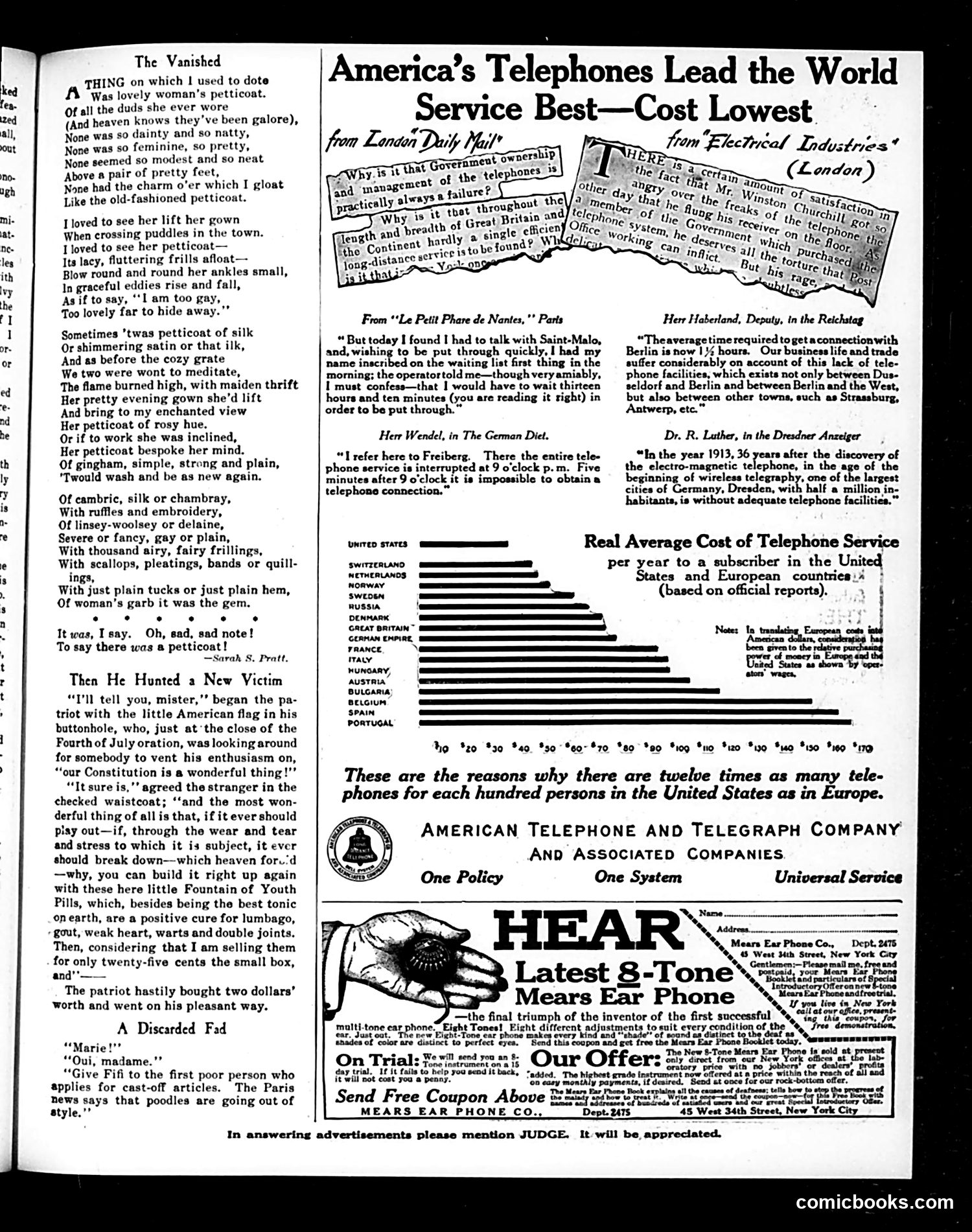
This Judge magazine page contains three distinct sections: **Left Column - Poetry ("The Vanished"):** A nostalgic poem lamenting the disappearance of women's petticoats, which the author viewed as charming and feminine garments. This reflects early-20th-century anxiety about changing women's fashion—hemlines were rising, and traditional undergarments were becoming less visible, representing broader cultural shifts in women's dress and social roles. **Middle Section - Comic Anecdote ("Then He Hunted a New Victim"):** A short satirical piece mocking a patriotic man who exploits Fourth of July enthusiasm by pitching a fraudulent patent medicine ("Fountain of Youth Pills") to a gullible stranger. The joke targets both naive patriotism and widespread mail-order medical scams common in that era. **Right Column - Advertisement:** AT&T promoting American telephone superiority with comparative cost charts showing U.S. service as cheapest and most accessible globally, featuring testimonials from European sources acknowledging American telephone infrastructure's advantages. The page demonstrates Judge's mix of social satire, nostalgia, and commercial content typical of the period.
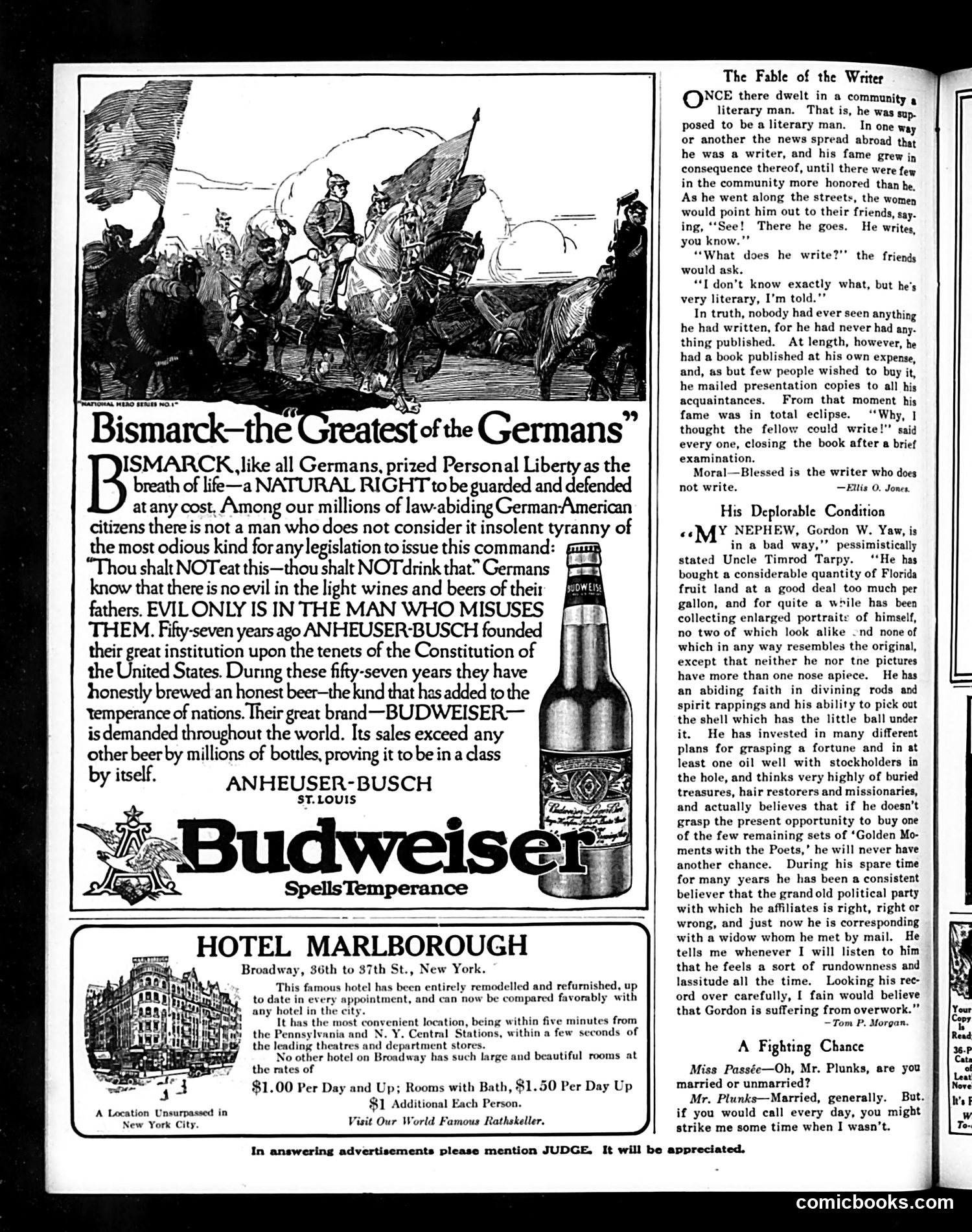
This page contains a **Budweiser beer advertisement** disguised as political commentary, alongside unrelated short humor pieces. The main advertisement argues against Prohibition by invoking Bismarck and German-American identity. It claims that Personal Liberty—framed as a constitutional right—protects the right to drink beer. The ad argues Germans traditionally view beer as temperance-promoting ("honestly brewed an honest beer"), positioning alcohol consumption as morally defensible. This reflects pre-Prohibition era debates when the temperance movement was gaining political strength. The cartoon depicts Bismarck on horseback, likely representing German strength and tradition, legitimizing beer-drinking through association with respected historical authority. The other content consists of brief satirical pieces: "The Fable of the Writer" mocks pretentious literary poseurs, and "His Deplorable Condition" ridicules a foolish nephew making bad investments. The **Hotel Marlborough advertisement** rounds out the page.
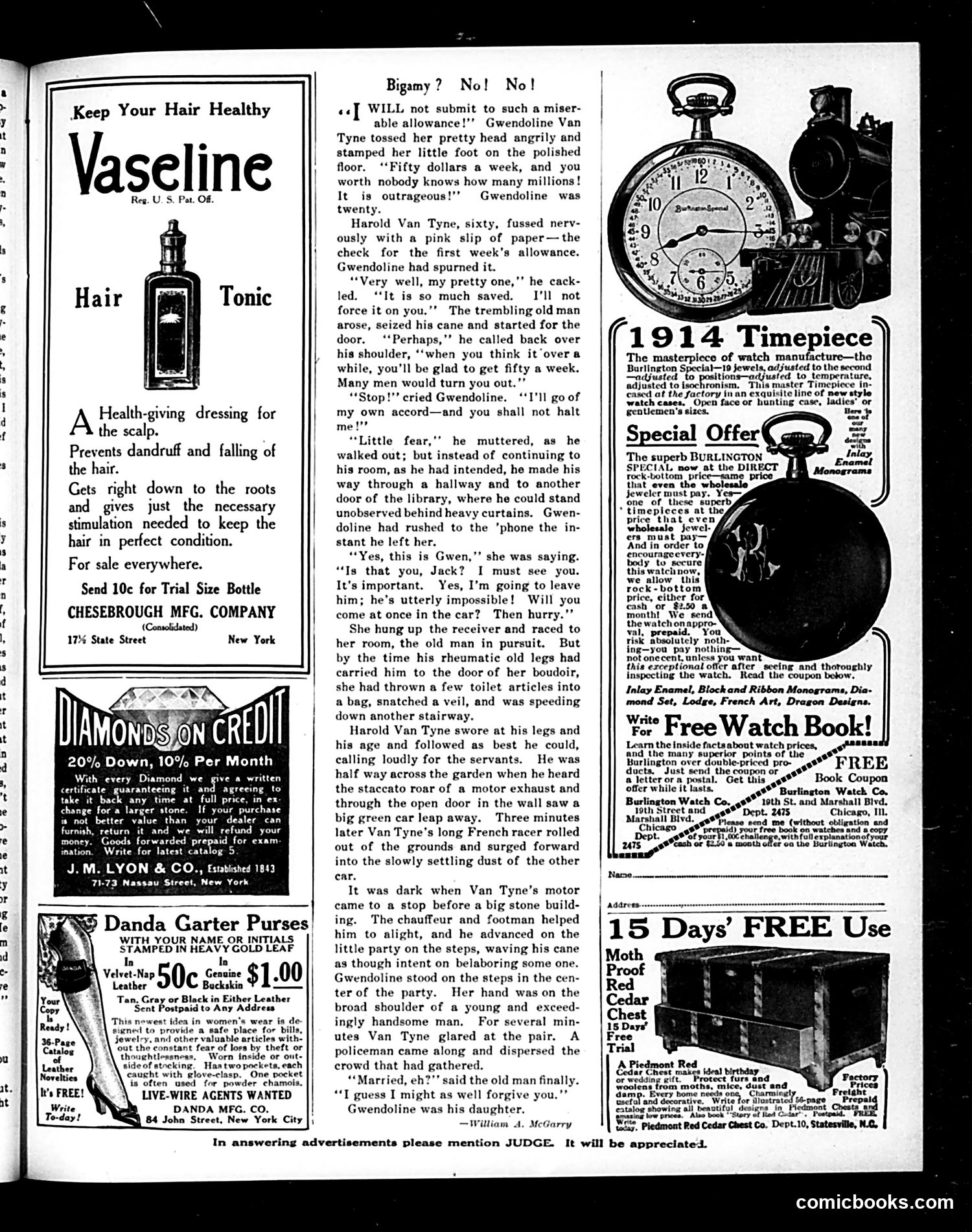
This page is primarily **advertisements** with an embedded serialized story titled "Bigamy? No! No!" by William A. McInerny. The story concerns a domestic conflict between elderly wealthy Harold Van Tyne (sixty) and his young wife Gwendoline (twenty). She demands a larger weekly allowance than the $50 he offers. When he refuses, she threatens to leave him and immediately calls someone named "Jack" to pick her up in a car. Harold pursues her in his own automobile. The narrative setup appears to satirize **May-December marriages** and the financial tensions they create—a common theme in early 20th-century American humor. Gwendoline's dramatic escape and the title's reference to "bigamy" suggest the story will involve infidelity or some marital scandal. The bulk of the page consists of period advertisements for Vaseline hair tonic, diamond rings, a "1914 Timepiece" watch, credit jewelry, and leather purses—typical commercial content for a magazine of this era.
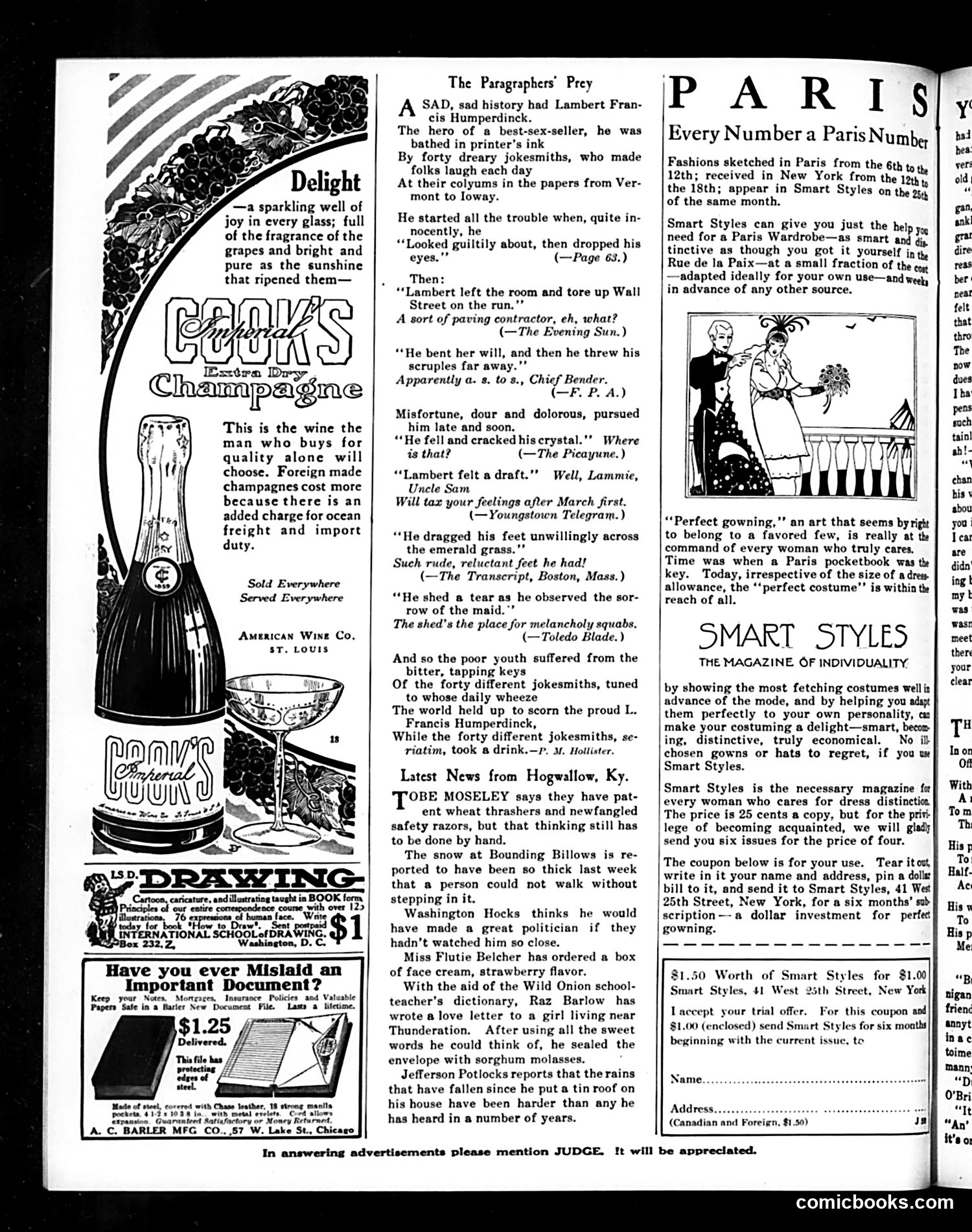
This page is primarily **advertising and filler content** rather than political satire. The main feature is "The Paragraphers' Prey," a humorous poem mocking **newspaper columnists** who relentlessly make jokes from a single source—in this case, a best-selling novel's protagonist, "Lambert Francis Humperdinck." The satire targets how forty different newspaper jokesmith columnists (identified by bylines like F.P.A. and P.A. Hollister) mechanically extract puns and quips from the same material daily, working it to death for their readers across America. The remainder consists of **commercial advertisements**: Cook's Champagne, a drawing school, a document-filing system, and Smart Styles magazine promoting Paris fashions. The "Latest News from Hogwallow, Ky." section offers gentle rural humor—folksy anecdotes about country life and unsophisticated locals—typical filler for magazines of this era.
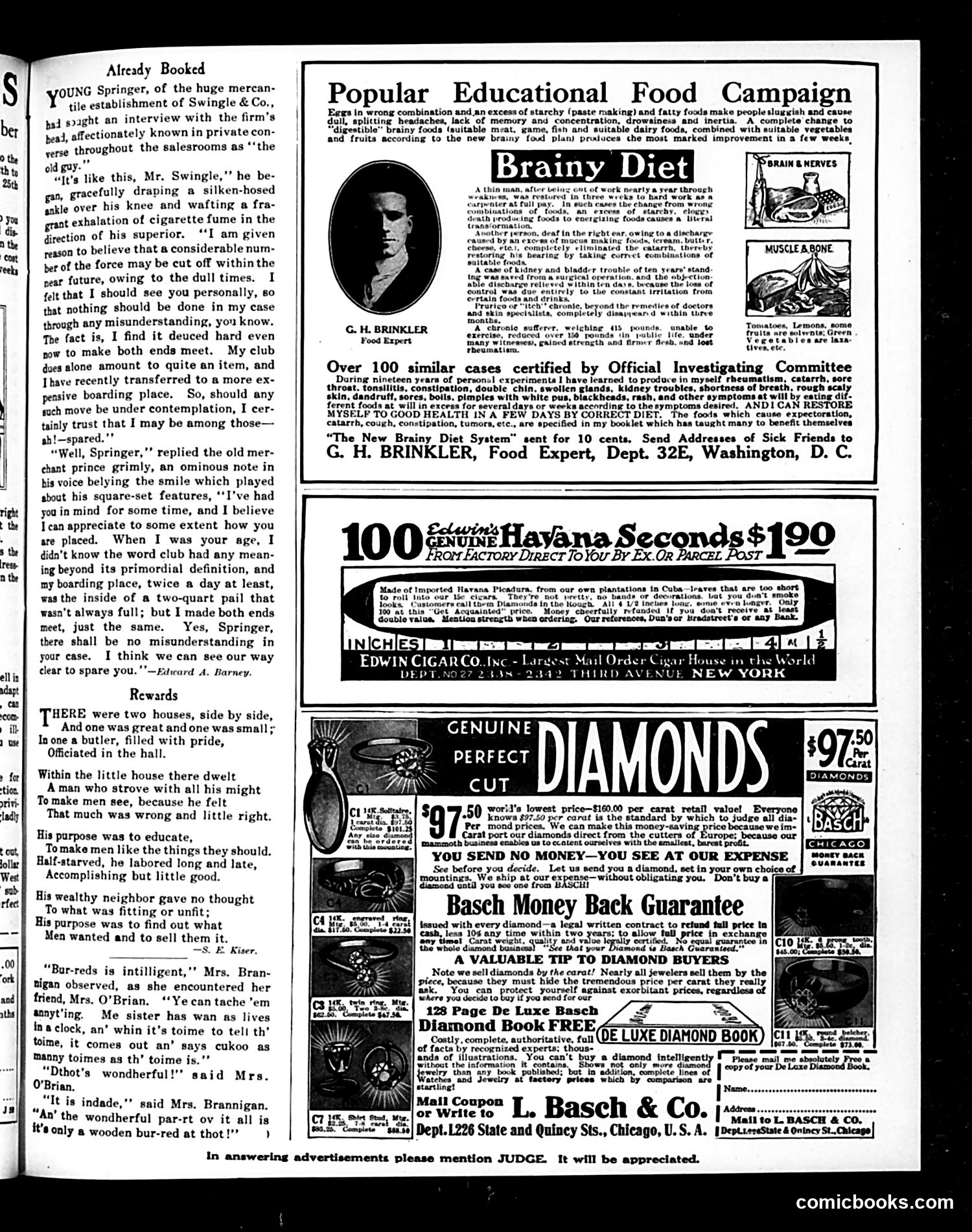
This page contains primarily **advertisements** rather than political cartoons. The main content includes: **Text Stories:** Two short pieces—"Already Booked" (a humorous dialogue between a nervous employee and his boss about potential layoffs) and "Rewards" (a poem contrasting a wealthy, idle neighbor with a struggling educator). **Advertisements:** The page is dominated by ads for: - "Brainy Diet" food campaign (promoting specific foods for mental clarity) - Havana cigars ($1.90 for 100) - Genuine diamonds and jewelry from L. Basch & Co. **Minor Content:** A brief humorous dialogue between two Irish women discussing a cuckoo clock. There are **no political cartoons** on this page. The satirical content is limited to the two short stories, which use gentle humor rather than sharp political commentary. The page primarily serves as a vehicle for advertisements, which was standard for Judge magazine of this era.
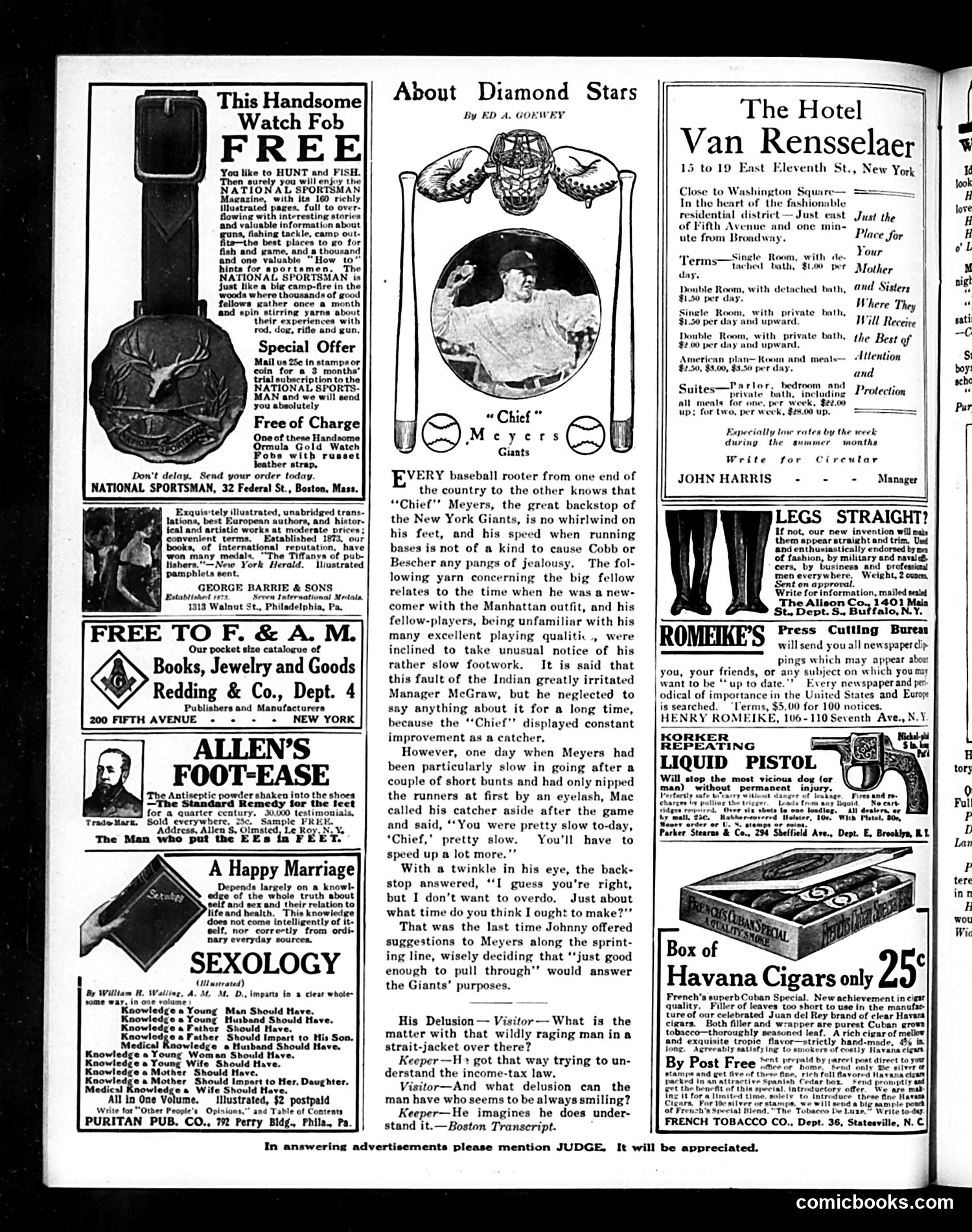
This page features a humorous anecdote about **Chief Meyers**, catcher for the New York Giants baseball team. The story satirizes slow baserunning through a joke about managerial authority. **The Setup:** Manager John McGraw criticizes Meyers for his sluggish speed on the bases. When McGraw tells him to "speed up," Meyers cheekily asks what time he *should* arrive at the next base—implying the manager's complaint is absurdly specific. **The Point:** The humor lies in Meyers's witty deflection, which silences McGraw's further criticism. The anecdote suggests that sometimes a player's confident sass beats legitimate coaching. Meyers, described as "Indian" (likely referring to his Native American heritage), is portrayed sympathetically as cleverly outsmarting his manager through humor rather than athletic improvement. The rest of the page contains period advertisements (watch fobs, foot powder, books on sexuality).
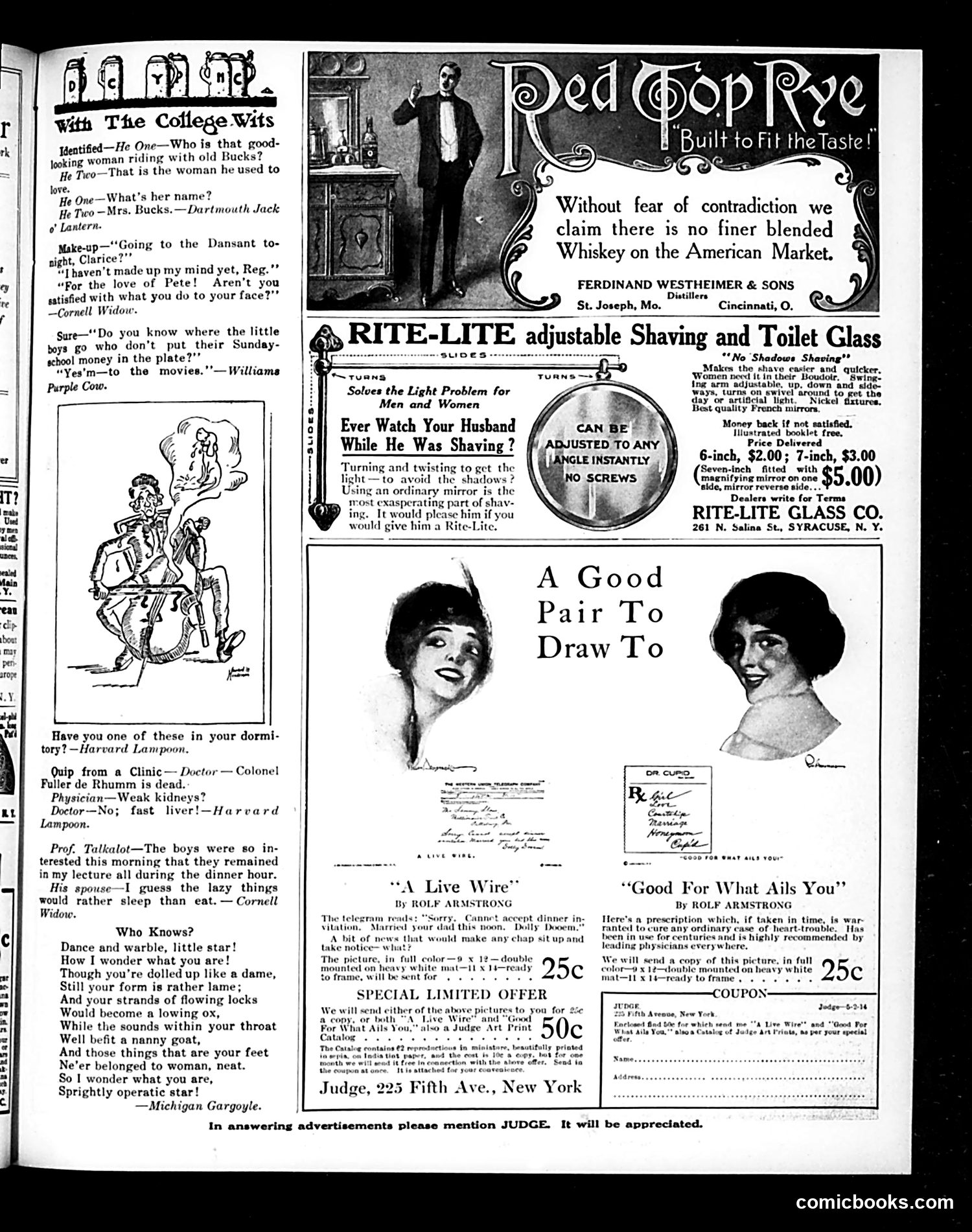
This page is primarily **advertising and light humor** rather than political satire. The top section features **college humor** — jokes submitted by university publications (Dartmouth, Cornell, Harvard, Michigan). These mock campus romance, student behavior, and theatrical performers, reflecting Jazz Age collegiate culture. The main content consists of **product advertisements**: Red Top Rye whiskey (claiming superiority), a Rite-Lite adjustable shaving mirror (solving "shadows" while shaving), and art prints by Rolf Armstrong featuring women's portraits. The Armstrong drawings labeled "A Live Wire" and "Good For What Ails You" are **commercial pin-up style art** — attractive women's faces marketed as decorative prints for 25 cents. The somewhat crude caricature in the lower left ("operatic star") mocks a theatrical performer, though the specific target is unclear. Overall, this is a **typical Judge magazine page blending light collegiate satire with consumer advertising** — reflecting 1920s American commercial culture and humor rather than serious political commentary.
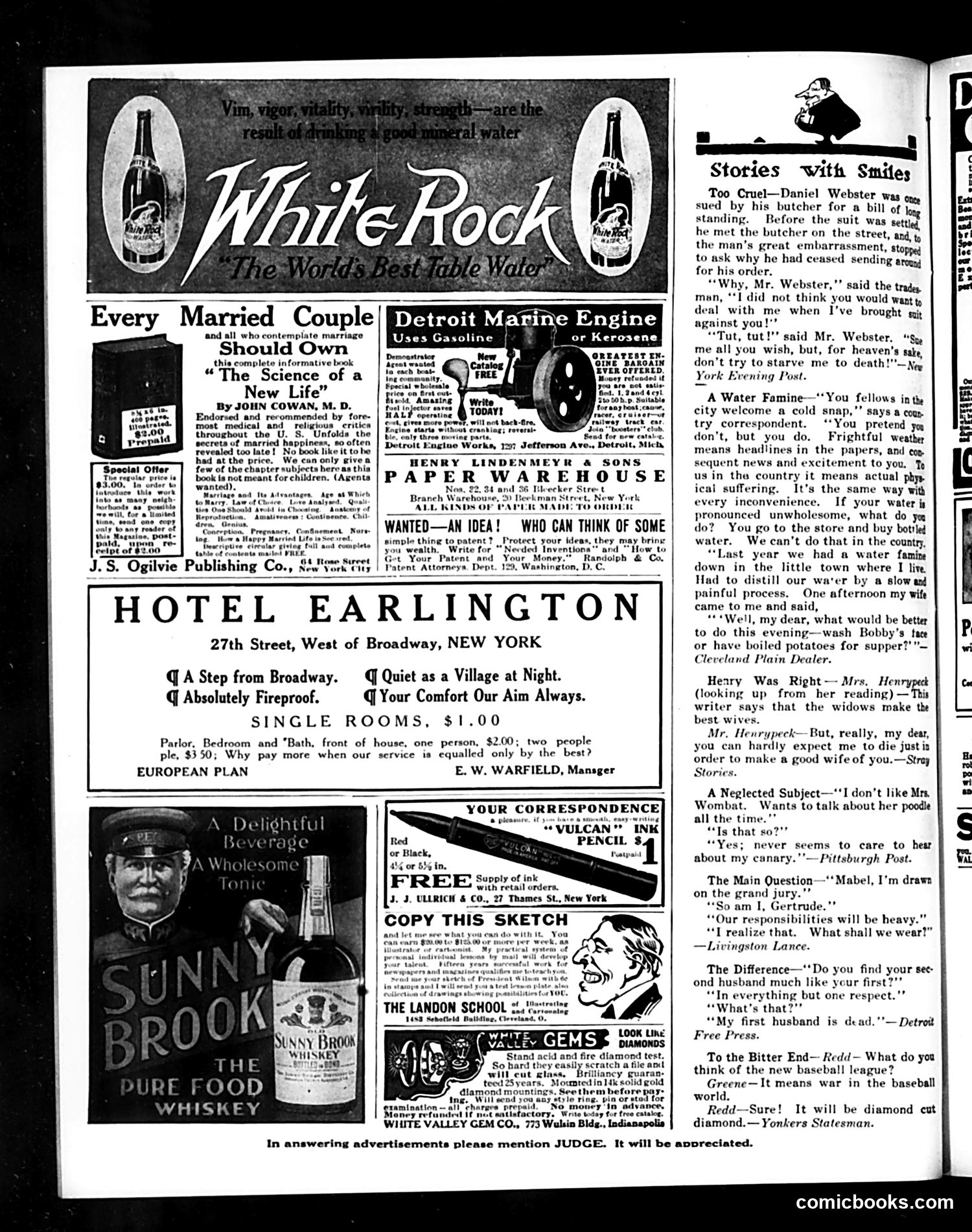
This page is primarily **advertising**, not political satire. It features commercial advertisements interspersed with a "Stories with Smiles" humor column. The advertisements include: - White Rock mineral water ("The World's Best Table Water") - Marriage advice books - Hotel Earlington - Detroit Marine Engines - Paper warehouse services - Vulcan Ink and pencils - The Landon School - White Valley Gem Company (synthetic diamonds) - Sunny Brook whiskey The humor column contains brief anecdotes about married couples and social situations, including a reference to **Daniel Webster** (19th-century statesman), used as a historical figure for comedic effect rather than political commentary. The jokes are domestic in nature—marital bickering, water shortages, and social awkwardness—reflecting early-20th-century American middle-class concerns. This appears to be a typical Judge magazine page mixing advertising revenue with light entertainment, rather than the sharp political satire the magazine was known for.
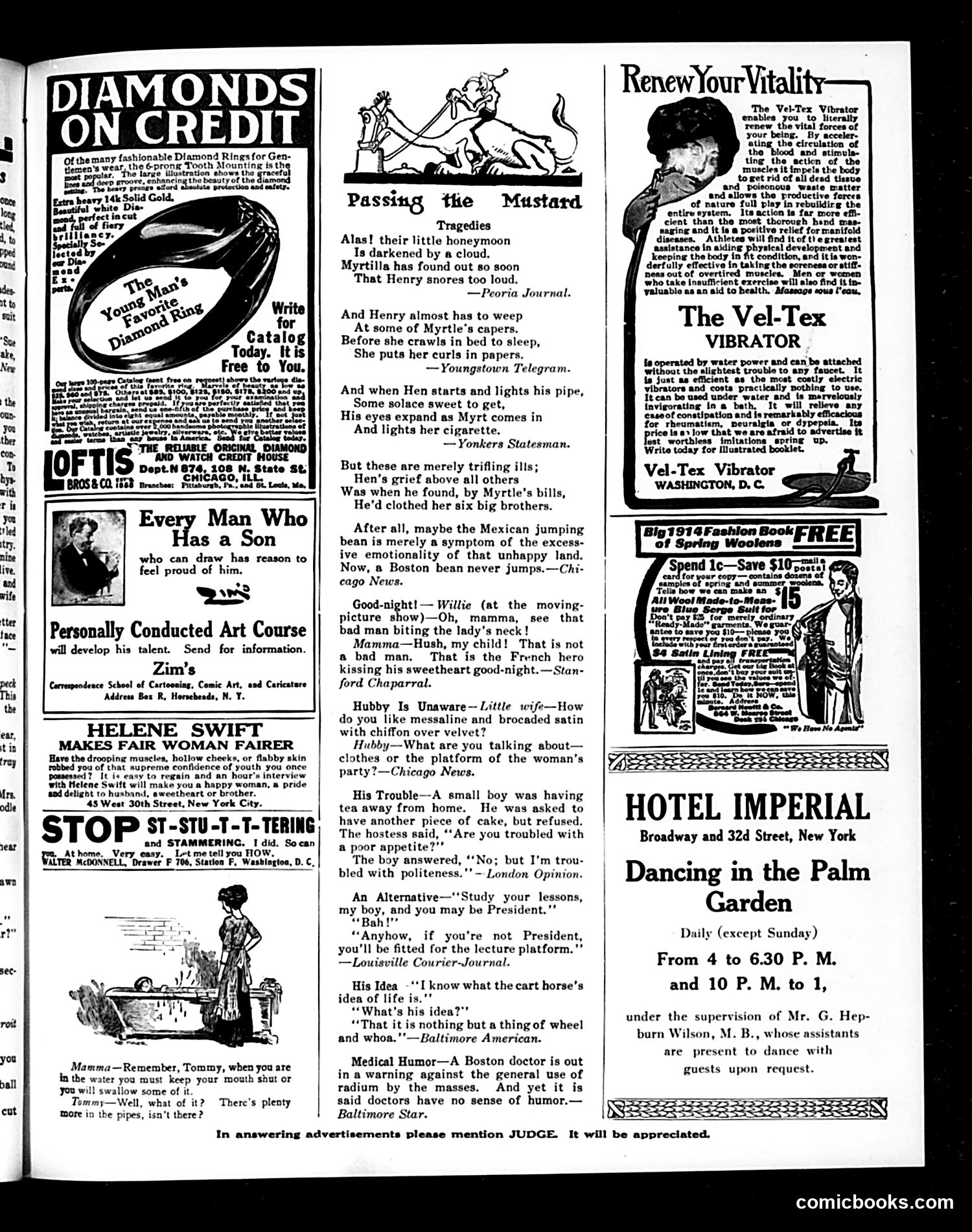
This page from Judge magazine (appears early 20th century) contains primarily **advertisements and humorous anecdotes** rather than political cartoons. The major content includes: **"Passing the Mustard" section**: A series of brief, satirical jokes about newlyweds Henry and Myrtle, poking fun at domestic annoyances—snoring, sleeping in curlers, smoking, and the husband discovering he's unknowingly paid for his wife's six brothers' clothing. The humor targets marital disillusionment and domestic friction. **Advertisements** dominate: diamonds on credit, art correspondence courses, beauty treatments (Helene Swift), speech correction, and notably the **Vel-Tex Vibrator**—a water-powered massage device marketed for muscle development and general health (a common product of the era). **Brief comedic anecdotes** throughout mock child logic, French kissing customs, women's fashion debates, and social politeness. The satire is gentle domestic humor reflecting early 1900s concerns: marriage disappointments, gender roles, children's innocence, and consumer culture. Nothing specifically political appears on this page.
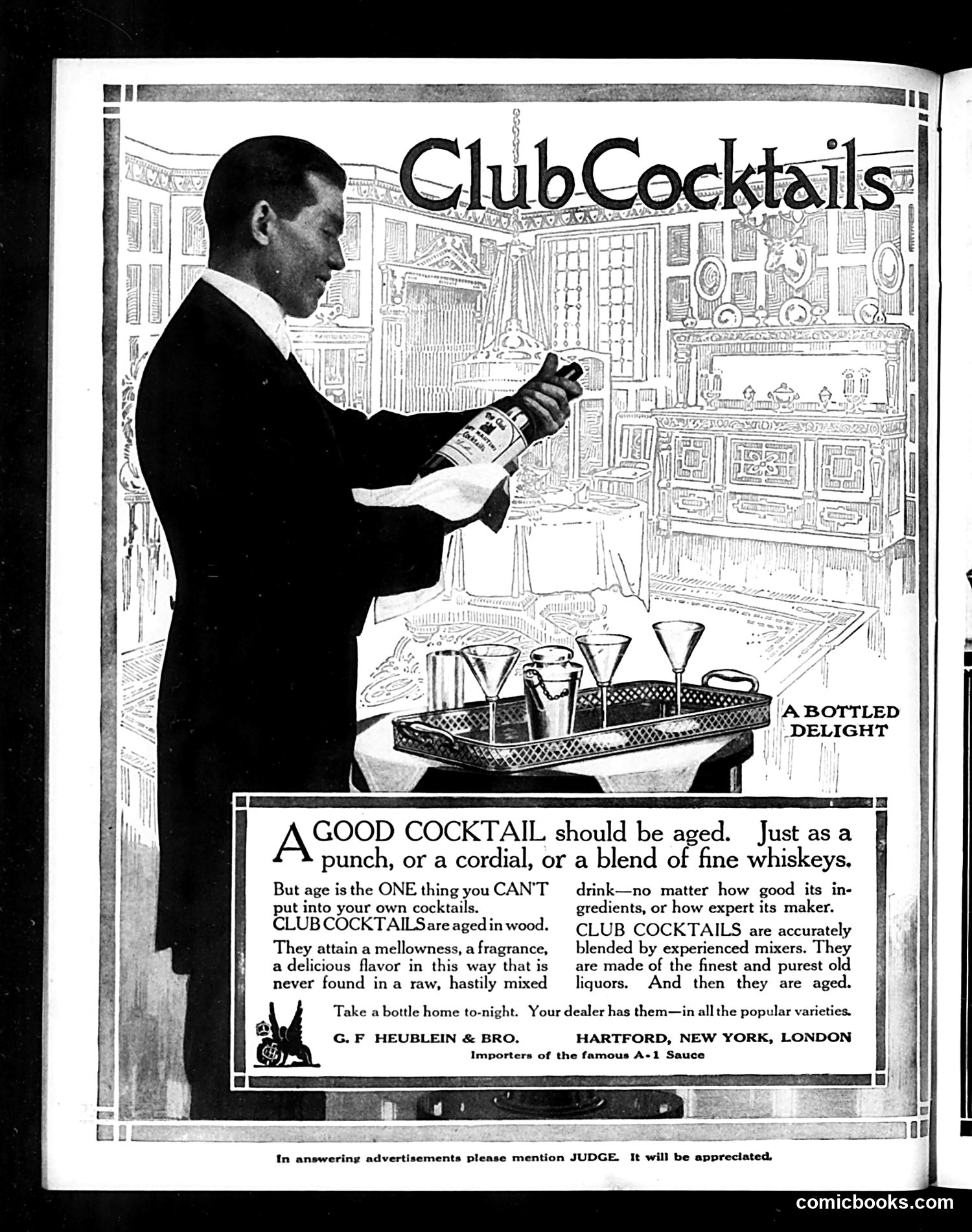
This is a **full-page advertisement**, not satirical content. It promotes Club Cocktails by G. F. Heublein & Bro., a real spirits company known for A-1 Sauce. The ad features a well-dressed man in formal attire presenting a bottle to an elegantly furnished interior, with the tagline "A Bottled Delight." The visual and text emphasize **aging as a mark of quality**—the central sales pitch is that premixed, bottled cocktails achieve a maturity and refinement impossible to achieve through home mixing, no matter how skilled the bartender. This appears to be from the Prohibition era or its immediate aftermath (based on the emphasis on legitimacy and quality). The ad targets affluent consumers who valued sophistication and convenience, positioning bottled cocktails as a premium alternative to hastily made drinks. There is **no political satire here**—just vintage advertising in Judge magazine's pages.
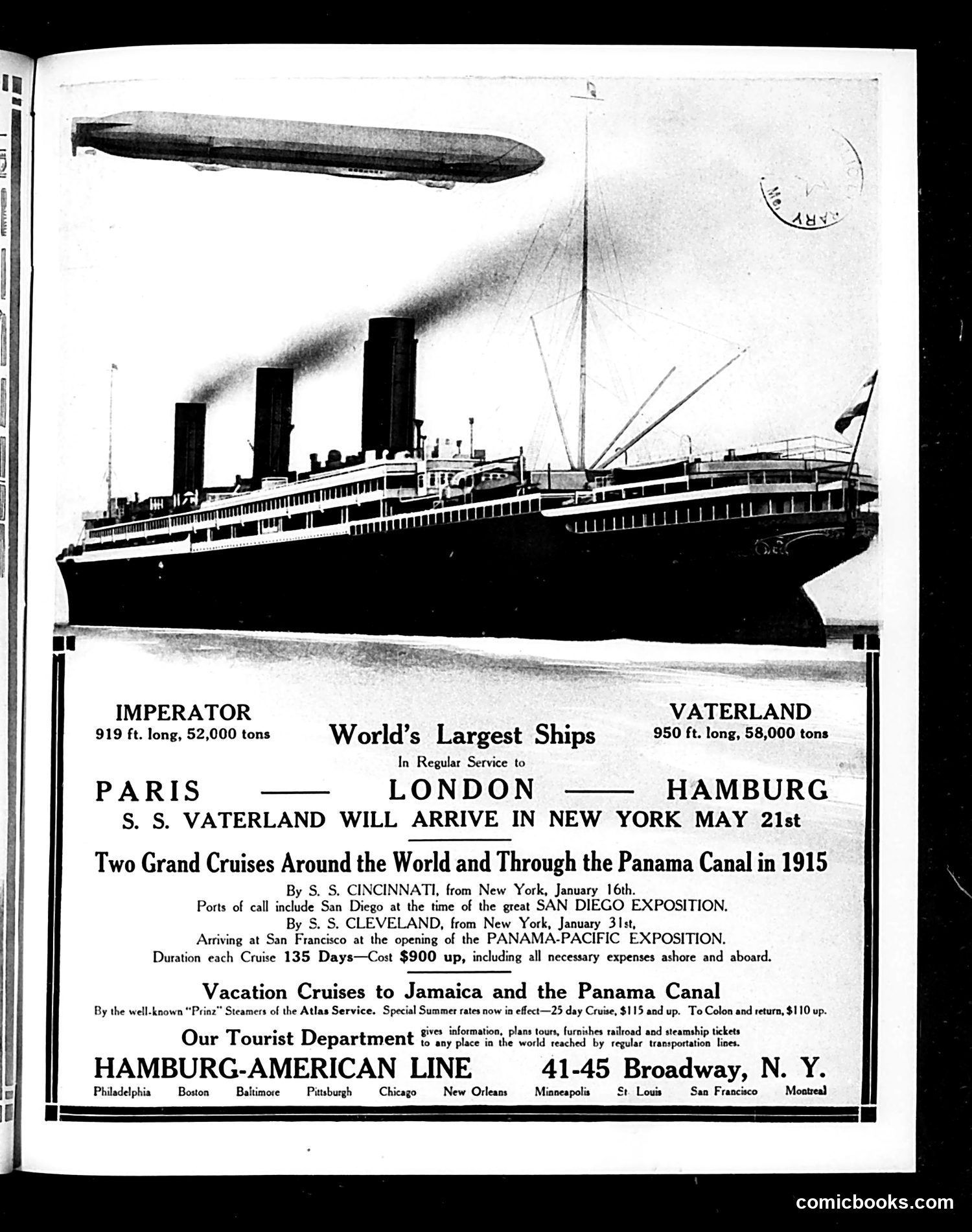
This page is primarily **advertising, not satire or cartoon content**. It's a Hamburg-American Line cruise ship advertisement from Judge magazine, circa 1915. The ad promotes luxury ocean liners—the S.S. Vaterland and S.S. Imperator—as "World's Largest Ships" offering transatlantic service and around-the-world cruises. The small airship illustration at top appears decorative rather than satirical. **Historical context**: This ad is notable for its **timing**. The Vaterland (a German ship with a German name meaning "fatherland") was advertised just before or during early WWI (1914-1918). Germany and Britain were already at war, making German passenger service to New York historically significant—the ad may reflect pre-war passenger normalcy or lingering peacetime commerce before American involvement. The page reflects early-20th-century luxury tourism marketing to wealthy Americans, with competitive ship comparisons and exotic destination promises typical of the era's travel advertising.
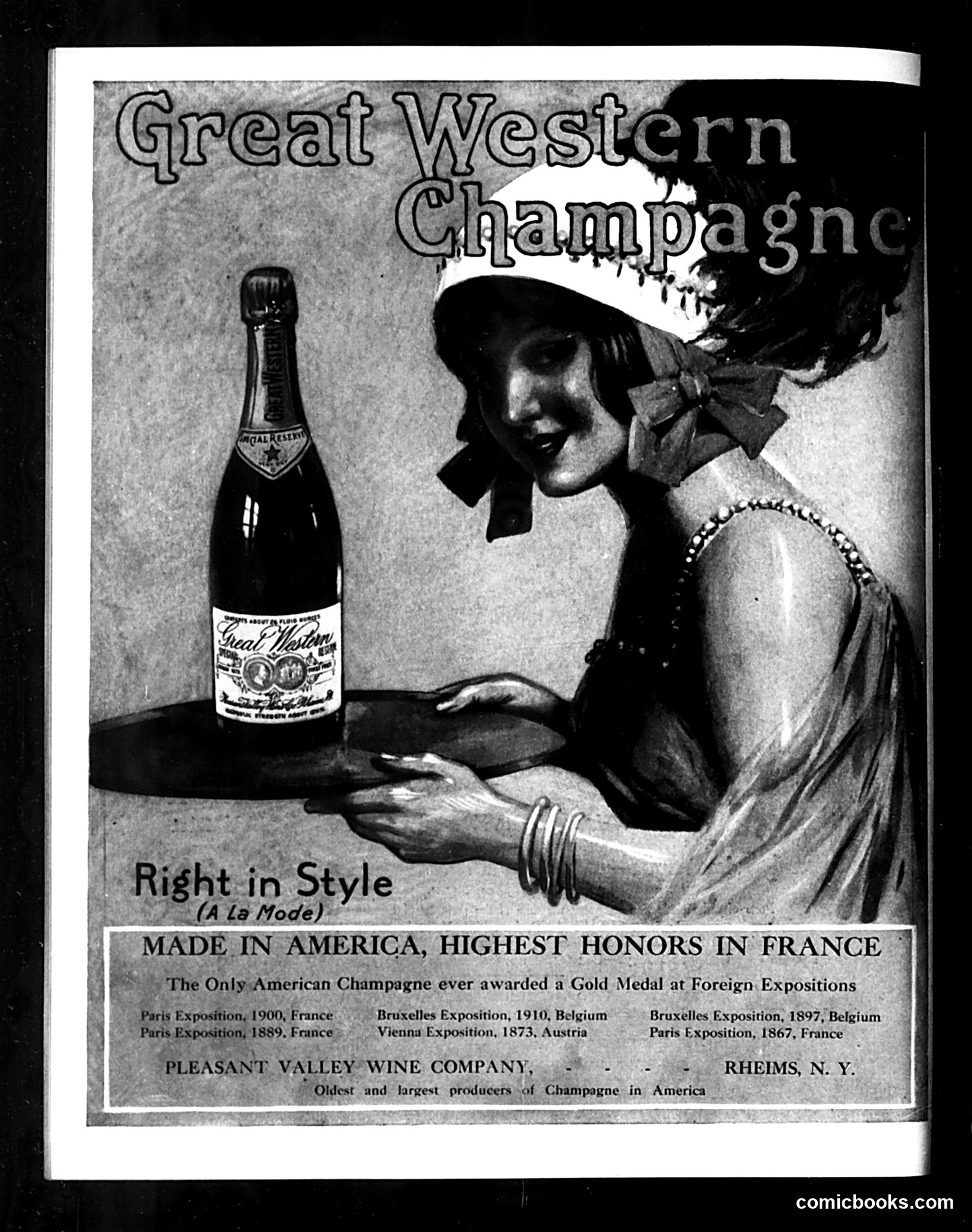
This is primarily a **product advertisement**, not a political cartoon. It promotes Pleasant Valley Wine Company's champagne, produced in Rheims, New York. The ad features a stylishly dressed woman in 1920s fashion (cloche hat, pearl necklace, elegant dress) presenting a champagne bottle labeled "Great Western Champagne." The tagline "Right in Style (A la Mode)" emphasizes fashionable sophistication. The advertisement's central claim—"The Only American Champagne ever awarded a Gold Medal at Foreign Expositions"—lists prestigious international awards (Paris 1867-1900, Vienna 1873, Brussels 1897-1910) to position American-made champagne as competing with French imports. This reflects early 20th-century American commercial pride: domestic products could achieve European-standard quality and recognition. The image appeals to aspirational consumers wanting refined, fashionable leisure—typical advertising strategy of the Jazz Age era.
I can see this is a very dark, heavily degraded scan from Judge magazine with minimal visible content. The image shows what appears to be some faint linear marks or sketches against an almost entirely black background, along with significant aging artifacts and damage to the page. The OCR text only yields "comicbooks.com," which is a modern website watermark rather than original magazine content. Given the image quality and lack of legible cartoon artwork, text, or identifying features, I cannot reliably identify specific figures, political references, or the satirical intent of any content that may have originally appeared on this page. The page is essentially illegible in its current state.