
Judge, 1914-05-02 · page 19 of 41
Judge — May 2, 1914 — page 19: what you’re looking at
What you’re looking at
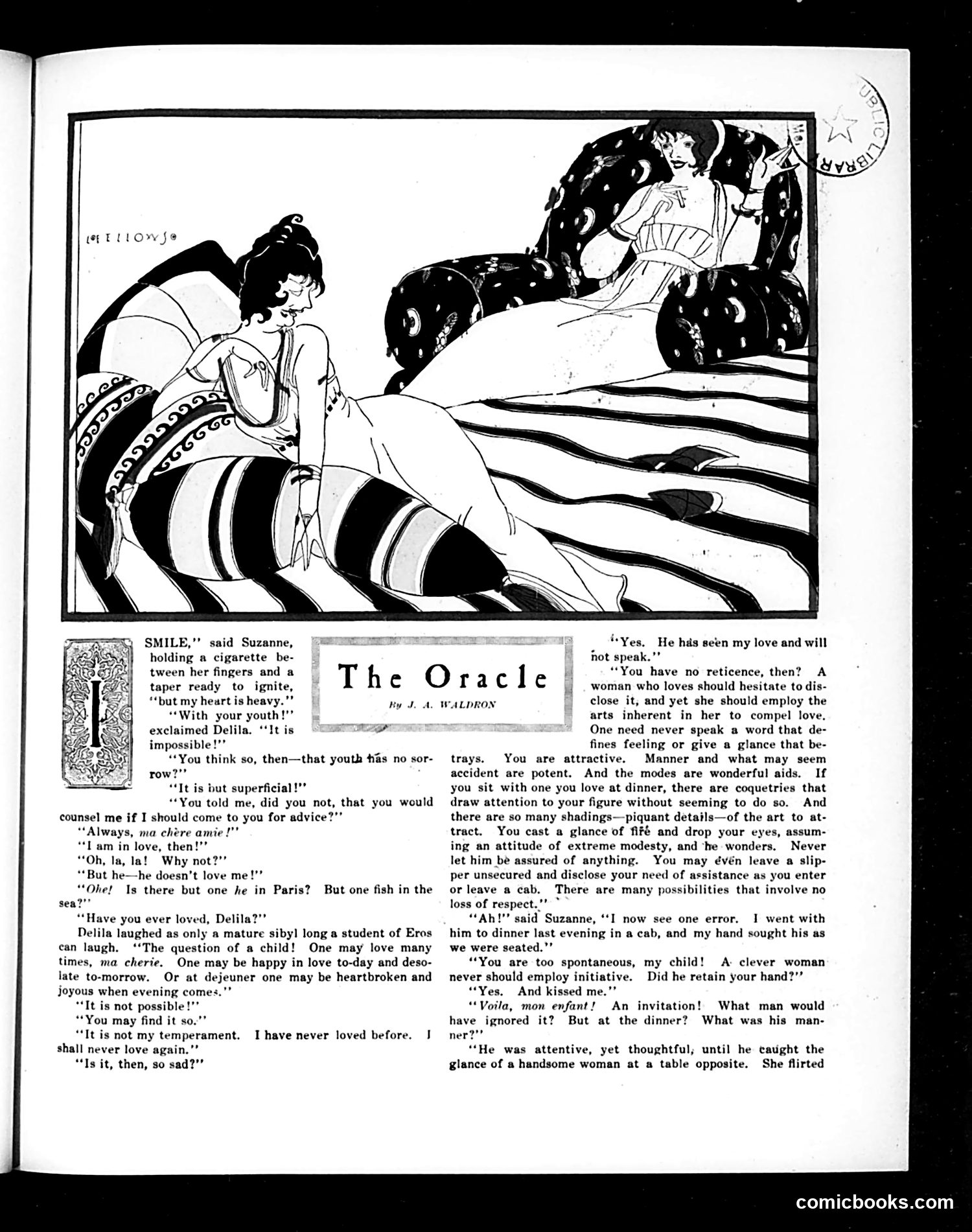
This is a prose fiction piece rather than a political cartoon. "The Oracle," by J.A. Waldron, depicts a romantic advice column scenario presented as dialogue between two women: Suzanne, a young woman in love, and Delila, an older, experienced woman offering cynical romantic counsel. The satire targets early 20th-century courtship rituals and female manipulation tactics. Delila advises Suzanne to employ calculated "coquetries"—strategic displays of vulnerability, mysterious glances, and physical cues—rather than direct emotional honesty. She recommends deliberately "unsecuring" a slipper to appear helpless, or feigning modesty while subtly drawing attention to one's figure. The humor lies in exposing the elaborate artifice expected of women pursuing romance: authentic feeling is dismissed as "superficial," while theatrical performance is prescribed as sophisticated strategy. The illustration shows voluptuous women in intimate domestic settings, reinforcing the story's focus on feminine wiles and seduction techniques.
📄 Transcribed text from this page (OCR, searchable)
Machine-transcribed from the original scan — historical spelling and the odd misread are preserved.
SMILE,’’ said Suzanne, holding a cigarette be- tween her fingers and a taper ready to ignite, “but my heurt is heavy.”” “With your youth!” exclaimed Delila. ‘‘It is impossible !”” “*You think so, then—that youth has no sor- row? It is but superficial!" “You told me, did you not, that you would counsel me if I should come to you for advice?’ ‘Always, ma chere amie !"" “Tam in love, then!’’ “Oh, la, la!’ Why not?’’ ‘*But he—he doesn’t love me!’’ “Ohe! Is there but one he in Paris? sea?”’ ‘*Have you ever loved, Delila?”’ Delila laughed as only a mature sibyl long a student of Eros can laugh. ‘The question of a child! One may love many times, ma cherie. One may be happy in love to-day and deso- late to-morrow. Or at dejeuner one may be heartbroken and joyous when evening comes."” “It is not possible!” “You may find it so."” “It is not my temperament. shall never love agai “Is it, then, so sad Ry JOA sed But one fish in the I have never loved before. J The Oracle WALDRON “Yes, hot speak. ‘You have no reticence, then? A woman who loves should hesitate to dis- close it, and yet she should employ the arts inherent in her to compel love, One need never speak a word that de- fines feeling or give a glance that be- trays. You are attractive. Manner and what may seem accident are potent. And the modes are wonderful aids. If you sit with one you love at dinner, there are coquetries that draw attention to your figure without seeming to do so. And there are so many shadings—piquant details—of the art to at- tract. You cast a glance of fifé and drop your eyes, assum- ing an attitude of extreme modesty, and ‘he wonders. Never let him be assured of anything. You may évén leave a slip- per unsecured and disclose your need of assistance as you enter or leave a cab. There are many possibilities that involve no loss of respect.’’ * “Ah!’’ said Suzanne, ‘‘I now see one error. 1 went with him to dinner last evening in a cab, and my hand sought his as we were seated.’’ “You are too spontaneous, my child! A: clever woman never should employ initiative. Did he retain your hand?”’ “Yes. And kissed me.’" “Voila, mon enfant! An invitation! have ignored it? But at the dinner? ner?"" “He was attentive, yet thoughtful, until he caught the glance of a handsome woman at a table opposite. She flirted He has seen my love and will What man would What was his man- comicbooks.com