
Judge, 1914-05-02 · page 23 of 41
Judge — May 2, 1914 — page 23: what you’re looking at
What you’re looking at
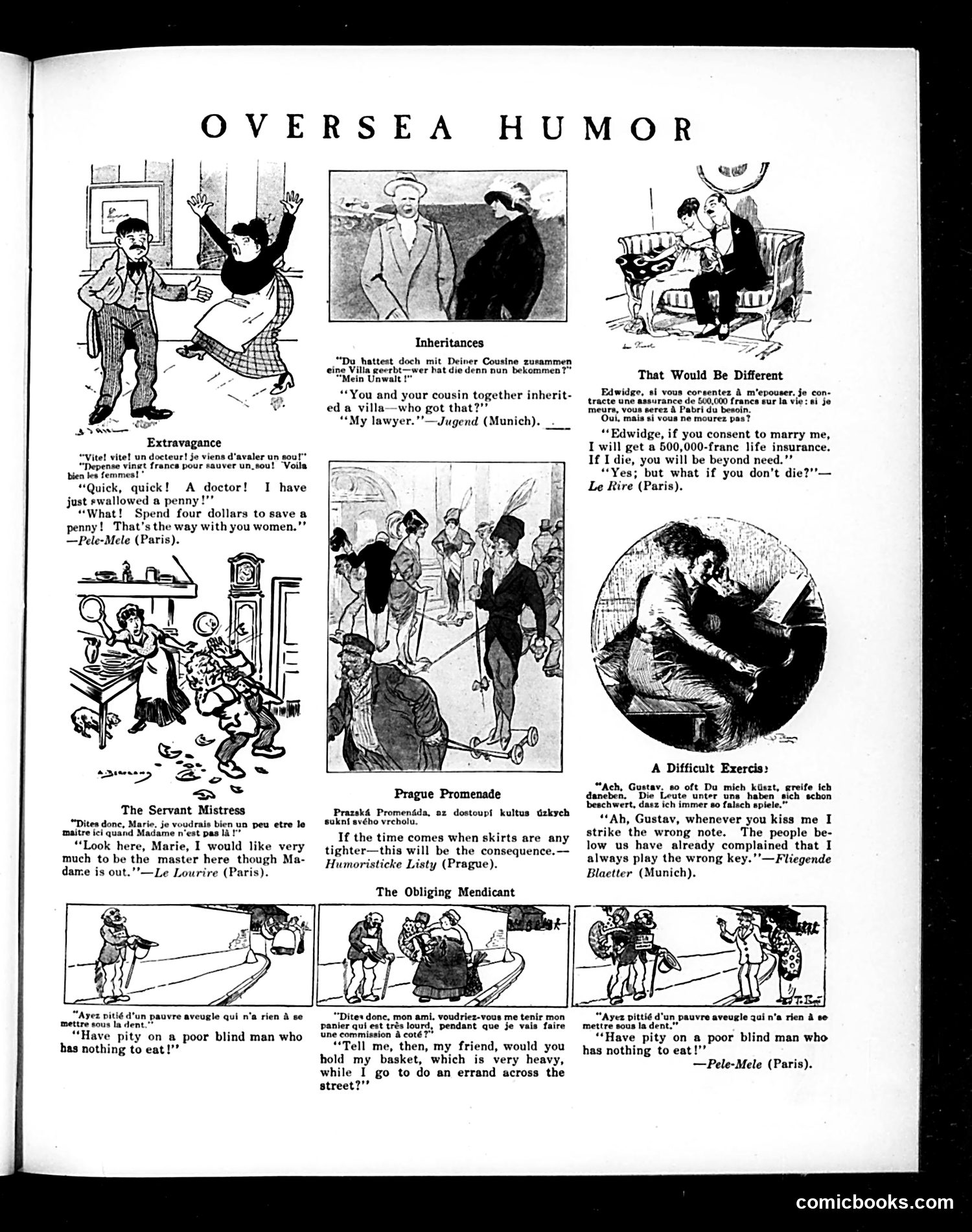
This page collects satirical comics from European publications, translated for American readers. The humor reflects early 20th-century social attitudes: **"Extravagance"** mocks women's perceived financial irresponsibility—spending money disproportionately (four dollars to save one penny). **"Inheritances"** jokes that lawyers are the real beneficiaries of estates, not heirs—a jab at the legal profession's fees. **"The Obliging Mendicant"** presents a beggar exploiting charity through manipulation, suggesting street panhandlers are con artists. **"That Would Be Different"** satirizes mercenary marriage, where a woman's interest in a husband depends on life insurance rather than love—cynical commentary on women's economic dependence. **"Prague Promenade"** jokes that excessively tight skirts (fashionable at the time) create physical consequences, likely intended as social criticism of women's fashion constraints. The page reflects period attitudes toward women, class, and professions while presenting "foreign" humor as exotic entertainment for American audiences.
📄 Transcribed text from this page (OCR, searchable)
Machine-transcribed from the original scan — historical spelling and the odd misread are preserved.
Extravagance “Vitel vite! un docteur! je viens d’avaler un sou!” “Depense vingt franca pour sauver un_sou! Voila bien les femmes! * “Quick, quick! A doctor! just swallowed a penny!” “What! Spend four dollars to save a penny! That's the way with you women.” —Pele-Mele (Paris). I have seep The Servant Mistress arie, je voudrais bien un peu etre le Madame n'est pas la!’ ere, Marie, I would like very much to be the master here though Ma- dame is out.’"’—Le Lourire (Paris). “Ayez pitié d’un pauvre aveugle qui n’a rien a se mettre sous la dent.”” “Have pity on a poor blind man who has nothing to eat!’” RSEA HU Inheritances “Du hattest doch mit Deiner Cousine zusammen cing Villa geerbt—wer hat die denn nun bekommen?” “Mein Unwalt !” “You and your cousin together inherit- ed a villa—who got that?”’ “My lawyer.’’—Jugend (Munich). Prazsk& Promendda, sz dostoup{ kultus dzkych sukn{ svého vreholu. If the time comes when skirts are any tighter—this will be the consequence.— Humoristicke Listy (Prague). The Obliging Mendicant “Dites done, mon ami. voudriez-vous me tenir mon trés lourd, pendant que je vais faire n A cote? “Tell me, then, my friend, would you hold my basket, which is very heavy, while I go to do an errand across the street?’” MOR That Would Be Different Edwidge, si vous corsentez & m'epouser. je con- tracte une assurance de 500,000 francs sur la vie: ei je meurs, vous serez & Pabri du besoin. Oui, mais si vous ne mourez pas? “‘Edwidge, if you consent to marry me, I will get a 500,000-franc life insurance. If I die, you will be beyond need.”” “Yes; but what if you don’t die?’’— Le Rire (Paris). “Ach, Gustav. 80 oft Du mich kiszt, greife ich daneben. Leute unter uns haben’ sich schon beschwert, dasz ich immer so falsch spiele.” “Ah, Gustav, whenever you kiss me I strike the wrong note. The people be- low us have already complained that I always play the wrong key.’’—Fliegende Blaetter (Munich). “Ayer pittié d’ mettre sous la dent.” “Have pity on a poor blind man who has nothing to eat —Pele-Mele (Paris). uvre aveugle qui n‘a rien A se comicbooks.com