
Judge, 1914-05-02 · page 15 of 41
Judge — May 2, 1914 — page 15: what you’re looking at
What you’re looking at
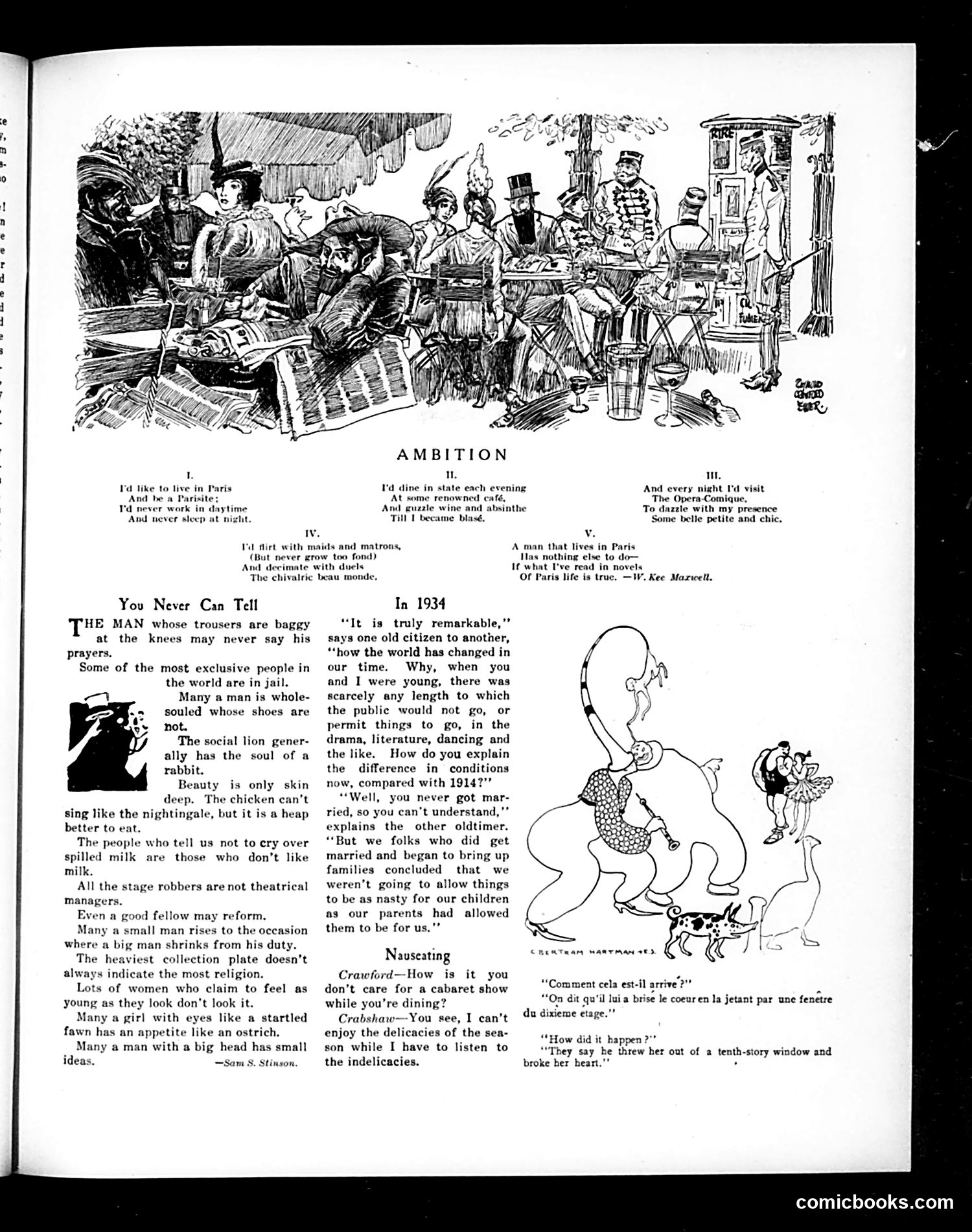
This Judge magazine page contains three satirical pieces: **"Ambition"** mocks romantic fantasies about Parisian bohemian life—living without work, drinking absinthe at cafés, attending operas, and engaging in romantic duels. The verse by W. Kee Maxwell satirizes Americans' idealized notions of Paris based on novels, suggesting the reality differs vastly. **"You Never Can Tell"** by Sam S. Stinson offers aphoristic observations deflating social pretensions: that outward respectability masks inner emptiness (exclusive people in jail, baggy-trousered men, social lions with rabbit souls). It's social commentary through paradox. **"In 1934"** presents elderly men discussing changed morality. One attributes stricter standards to married men with children protecting their families from the permissiveness their parents tolerated in 1914. The satire critiques how domesticity enforces conservatism. The French caption and illustration appear to joke darkly about romantic tragedy—throwing someone from a window "breaks her heart" literally and figuratively.
📄 Transcribed text from this page (OCR, searchable)
Machine-transcribed from the original scan — historical spelling and the odd misread are preserved.
Vd like to live in Paris And be a Parisite; T'd never work in daytime And never sleep at night, Iv. AMBITION iT I'd dine in state each evening At some renowned café, And guzzle wine and absinthe Till 1 became blasé, And every night I'd visit The Opera-Comique, To dazzle with my presence Some belle petite and chic, v. A man that lives in Paris Has nothing else to do— If what I've read in novels Of Paris life is true. —W. Kee Maxwell. Vd flirt with maids and matrons, (But never grow too fond) And decimate with duels The chivalric beau monde, You Never Can Tell HE MAN whose trousers are baggy at the knees may never say his prayers. Some of the most exclusive people in the world are in jail. Many a man is whole- souled whose shoes are not. The social lion gener- ally has the soul of a rabbit. Beauty is only skin deep. The chicken can’t sing like the nightingale, but it is a heap better to eat. The people who tell us not to cry over spilled milk are those who don’t like milk. All the stage robbers are not theatrical managers. Even a good fellow may reform. Many a small man rises to the occasion where a big man shrinks from his duty. The heaviest collection plate doesn’t alwa dicate the most religion. Lots of women who claim to feel as young as they look don't look it. Many a girl with eyes like a startled fawn has an appetite like an ostrich. Many a man with a big head has small ideas. Sam S. Stinson. In 1934 “It is truly remarkable,” says one old citizen to another, “‘how the world has changed in our time. Why, when you and I were young, there was scarcely any length to which the public would not go, or permit things to go, in the drama, literature, dancing and the like. How do you explain the difference in conditions now, compared with 19142” “*Well, you never got mar- ried, so you can’t understand, "’ explains the other oldtimer. “But we folks who did get married and began to bring up families concluded that we weren't going to allow things to be as nasty for our children as our parents had allowed them to be for us,’” Nauseating Crawford—How is it you don’t care for a cabaret show while you're dining? Crabshaw—You see, I can’t enjoy the delicacies of the sea- son while I have to listen to the indelicacies. CENTER AR MART NAN 983, “Comment cela est-il arrive?"” “On dit qu'il lui a brise le coeuren la jetant par une fenetre du dixieme etage."” “How did it happen ?"" “They say he threw her out of a tenth-story window and broke her heart."” . comicbooks.com