
Judge, 1914-05-02 · page 13 of 41
Judge — May 2, 1914 — page 13: what you’re looking at
What you’re looking at
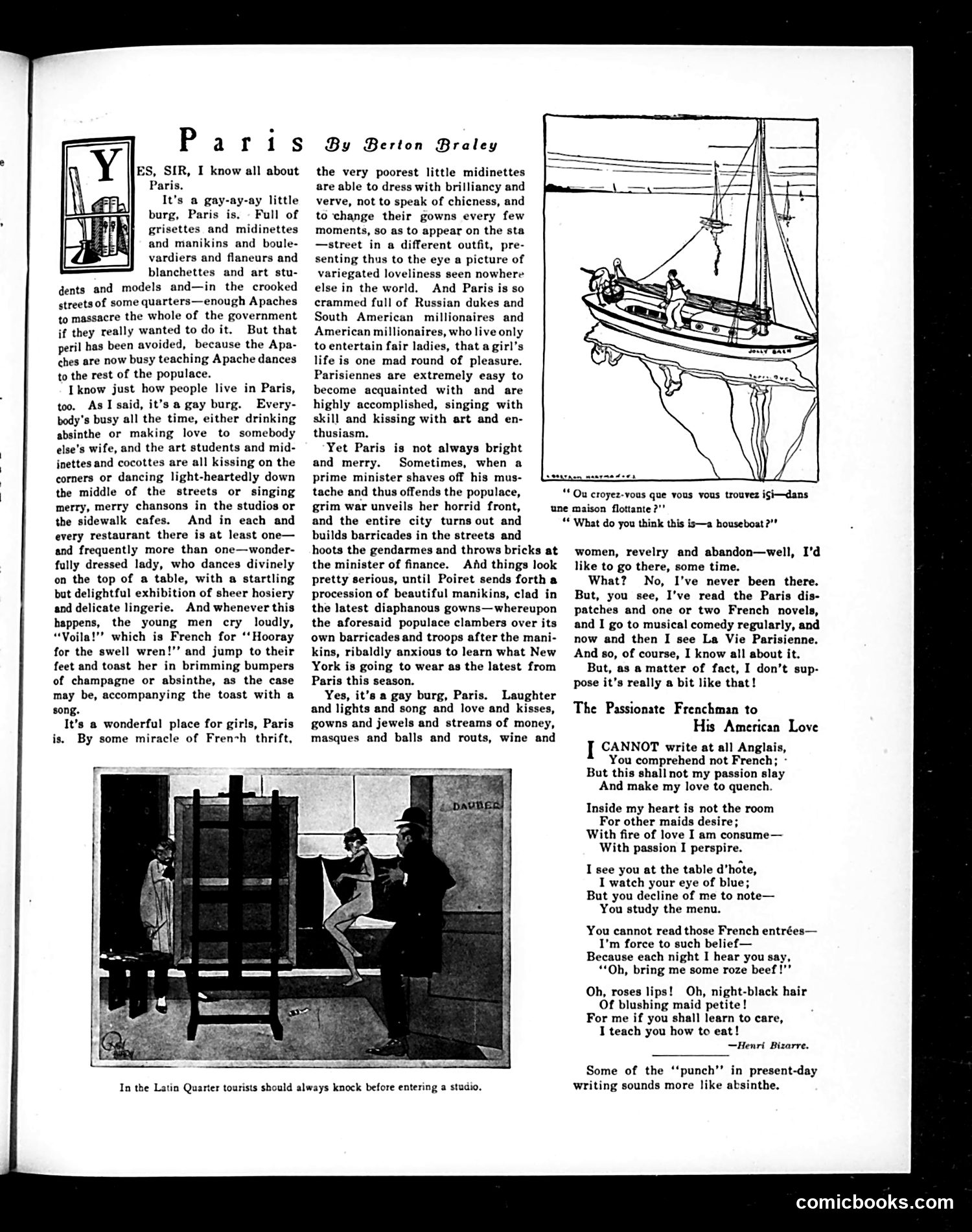
This page satirizes stereotypical American perceptions of Paris. The main article by Berton Braley is a tongue-in-cheek monologue from someone claiming expertise about Paris based entirely on secondhand sources—dispatches, French novels, and musical comedies—while admitting he's never actually been there. The satire targets American tourists' clichéd views: Paris as a hedonistic wonderland of perpetually dancing showgirls, wealthy foreign suitors, romantic intrigue, and political instability resolved by fashion parades. Braley mocks this fantasyland by exaggerating stereotypes (Apaches teaching dances, tables in restaurants where women perform, ministers' mustaches causing revolutions distracted by couture). The photograph showing a studio scene and the French-language caption ("Do you think this is a houseboat?") reinforce the joke about tourist misunderstandings. The poem "The Passionate Frenchman to His American Love" continues the theme of romantic/cultural cross-purposes between Americans and the French. Together, the page ridicules American Francophilia based on imagination rather than reality.
📄 Transcribed text from this page (OCR, searchable)
Machine-transcribed from the original scan — historical spelling and the odd misread are preserved.
ES, SIR, I know all about Paris. It’s a gay-ay-ay little burg, Paris is. . Full of grisettes and midinettes and manikins and boule- vardiers and flaneurs and blanchettes and art stu- dents and models and—in the crooked streets of some quarters—enough Apaches to massacre the whole of the government if they really wanted to do it. But that peril has been avoided, because the Apa- ches are now busy teaching Apache dances to the rest of the populace. I know just how people live in Paris, too. As I said, it’s a gay burg. Every- body's busy all the time, either drinking absinthe or making love to somebody else’s wife, and the art students and mid- inettes and cocottes are all kissing on the corners or dancing light-heartedly down the middle of the streets or singing merry, merry chansons in the studios or the sidewalk cafes. And in each and every restaurant there is at least one— and frequently more than one—wonder- fully dressed lady, who dances divinely on the top of a table, with a startling but delightful exhibition of sheer hosiery and delicate lingerie. And whenever this happens, the young men cry loudly, “Voila!’’ which is French for ‘‘Hooray for the swell wren!’’ and jump to their feet and toast her in brimming bumpers of champagne or absinthe, as the case may be, accompanying the toast with a song. It’s a wonderful place for girls, Paris is. By some miracle of French thrift, P ar 1 S By Berton Braley In the Latin Quarter tourists should always knock before entering a studio. the very poorest little midinettes are able to dress with brilliancy and verve, not to speak of chicness, and to change their gowns every few moments, so as to appear on the sta —street in a different outfit, pre- senting thus to the eye a picture of variegated loveliness seen nowhere else in the world. And Paris is so crammed full of Russian dukes and South American millionaires and American millionaires, who live only to entertain fair ladies, that agirl’s life is one mad round of pleasure. Parisiennes are extremely easy to become acquainted with and are highly accomplished, singing with skill and kissing with art and en- thusiasm. Yet Paris is not always bright and merry. Sometimes, when a prime minister shaves off his mus- tache and thus offends the populace, grim war unveils her horrid front, and the entire city turns out and builds barricades in the streets and hoots the gendarmes and throws bricks at the minister of finance. Afd things look pretty serious, until Poiret sends forth a procession of beautiful manikins, clad in the latest diaphanous gowns—whereupon the aforesaid populace clambers over its own barricades and troops after the mani- kins, ribaldly anxious to learn what New York is going to wear as the latest from Paris this season. Yes, it’s a gay burg, Paris. Laughter and lights and song and love and kisses, gowns and jewels and streams of money, masques and balls and routs, wine and une maison flottante ?’’ “Ou croyez-vous que vous vous trouves isi—dans “* What do you think this is—a houseboat ?”" women, revelry and abandon—well, I'd like to go there, some time. What? No, I’ve never been there. But, you see, I’ve read the Paris dis- patches and one or two French novels, and I go to musical comedy regularly, and now and then I see La Vie Parisienne. And so, of course, I know all about it. But, as a matter of fact, I don’t sup- pose it’s really a bit like that! The Passionate Frenchman to His American Love I CANNOT write at all Anglais, You comprehend not French; - But this shall not my passion slay And make my love to quench. Inside my heart is not the room For other maids desire; With fire of love I am consume— With passion I perspire. I see you at the table d’hote, I watch your eye of blue; But you decline of me to note— You study the menu. You cannot read those French entrées— I'm force to such belief— Because each night I hear you say, “Oh, bring me some roze beef !’’ Oh, roses lips! Oh, night-black hair Of blushing maid petite! For me if you shall learn to care, I teach you how to eat! Henri Bizarre. Some of the ‘‘punch’’ in present-day writing sounds more like absinthe. comicbooks.com