
A complete issue · 24 pages · 1914
Judge — April 25, 1914
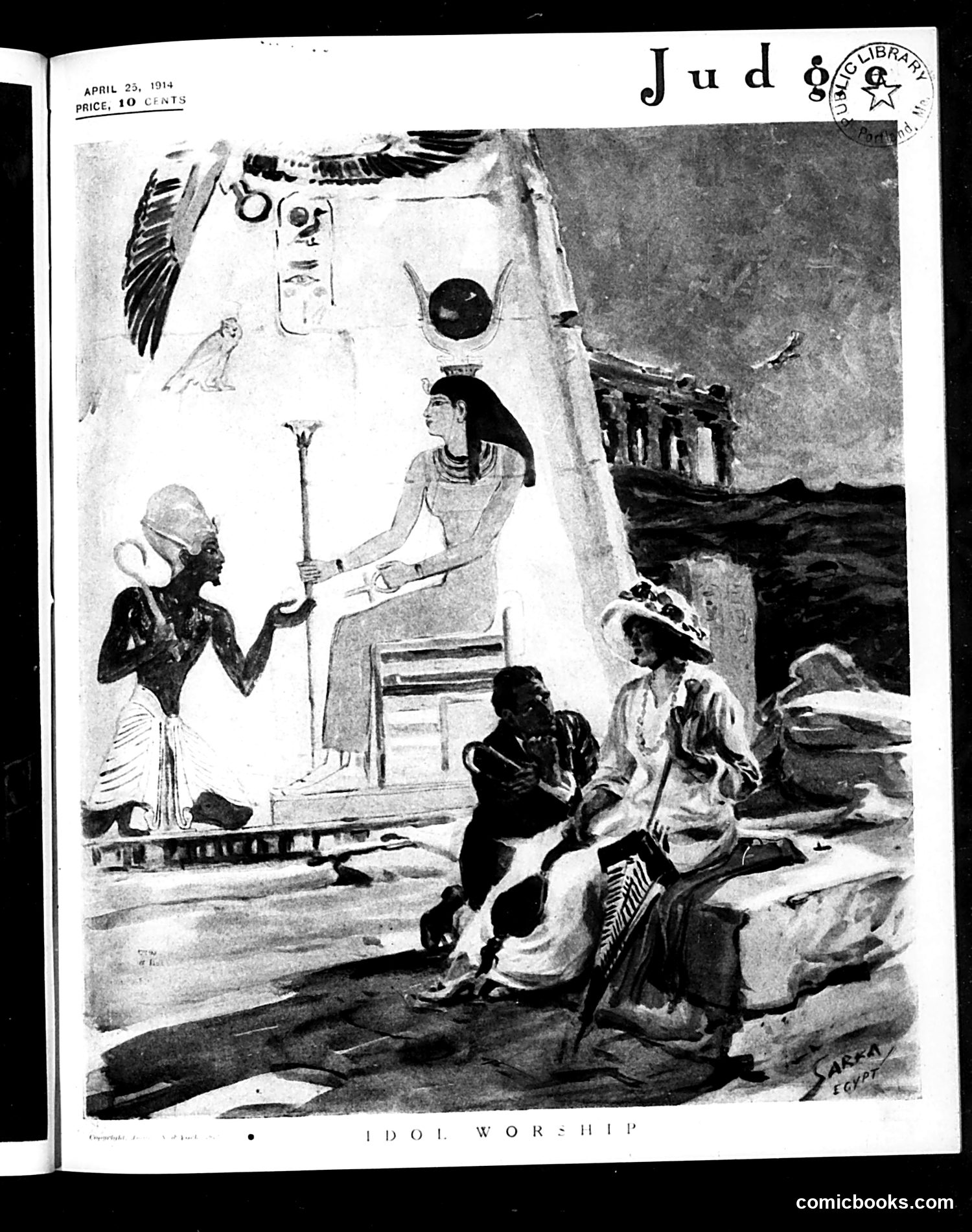
This satirical cartoon depicts ancient Egyptian idol worship to critique contemporary religious or social practices. The scene shows figures in Egyptian dress worshipping before a shrine with religious symbols (winged disk, scarab beetle, hieroglyphics). The satire likely comments on blind devotion to false gods or ideas—a common Judge magazine theme attacking superstition, materialism, or misguided faith. By presenting modern worship through ancient Egyptian imagery, the cartoonist suggests that contemporary believers are as foolish and backward as "primitive" cultures. The specific target is unclear without additional context, but Judge frequently mocked religious hypocrisy, commercial greed, and gullibility. The elaborate Egyptian setting emphasizes the absurdity of the devotion being satirized.
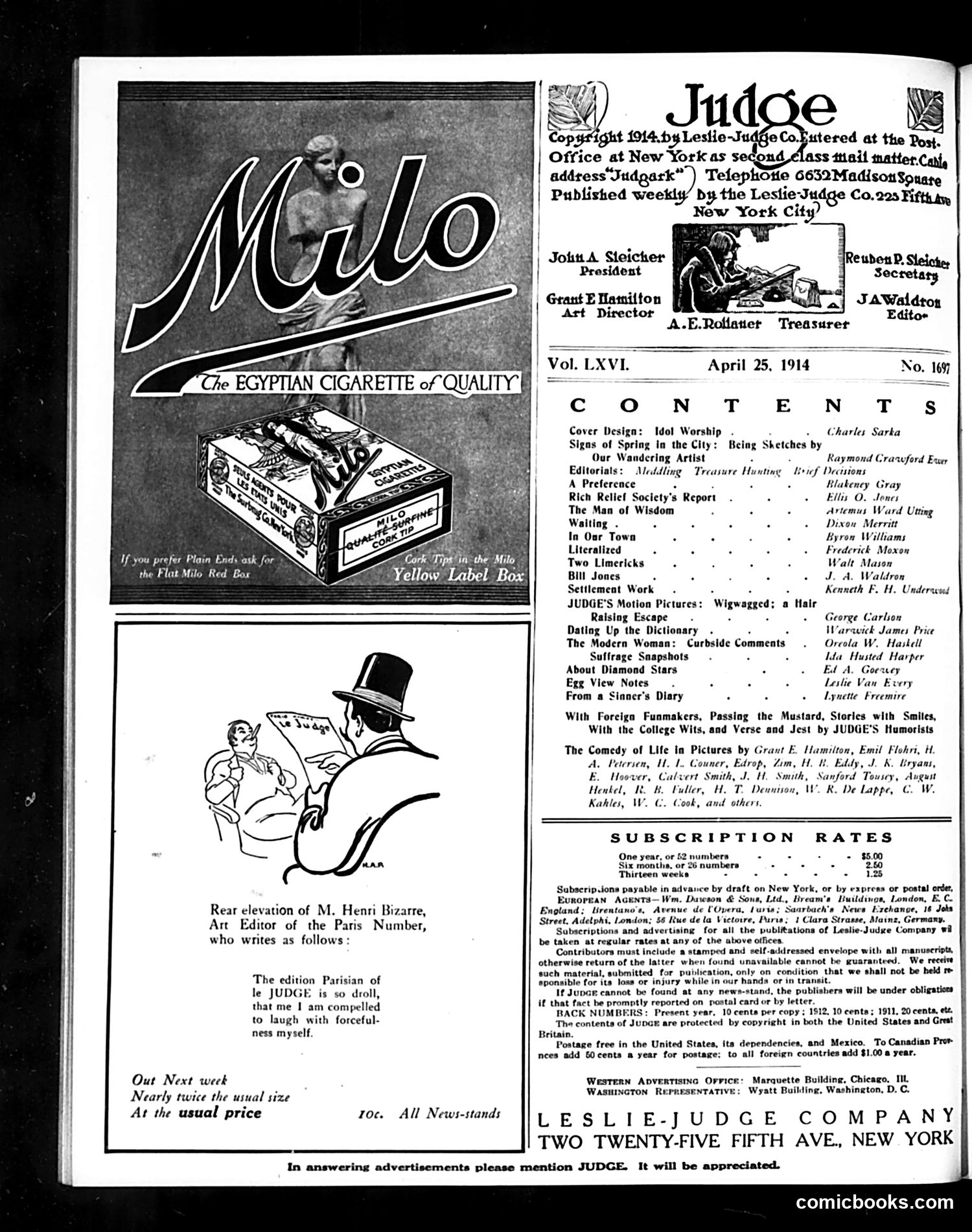
This page is primarily **advertising and masthead content** for Judge magazine rather than political satire. The main visual element is a **Milo cigarette advertisement** featuring an Egyptian cigarette brand, with marketing copy about product variants. Below that is a **caricature labeled "Rear elevation of M. Henri Bizarre, Art Editor of the Paris Number"**—a humorous illustration of a rotund man in a top hat, presumably mocking the appearance of the Paris edition's art editor. The accompanying quote suggests this is gentle mockery of the Parisian edition. The right side contains the magazine's **table of contents, masthead information, subscription rates, and publishing details** for the Leslie-Judge Company. The satirical content itself—articles like "Idol Worship," "The Man of Wisdom," and various social commentary pieces—requires reading the actual articles to assess their meaning; the page itself is structurally administrative.
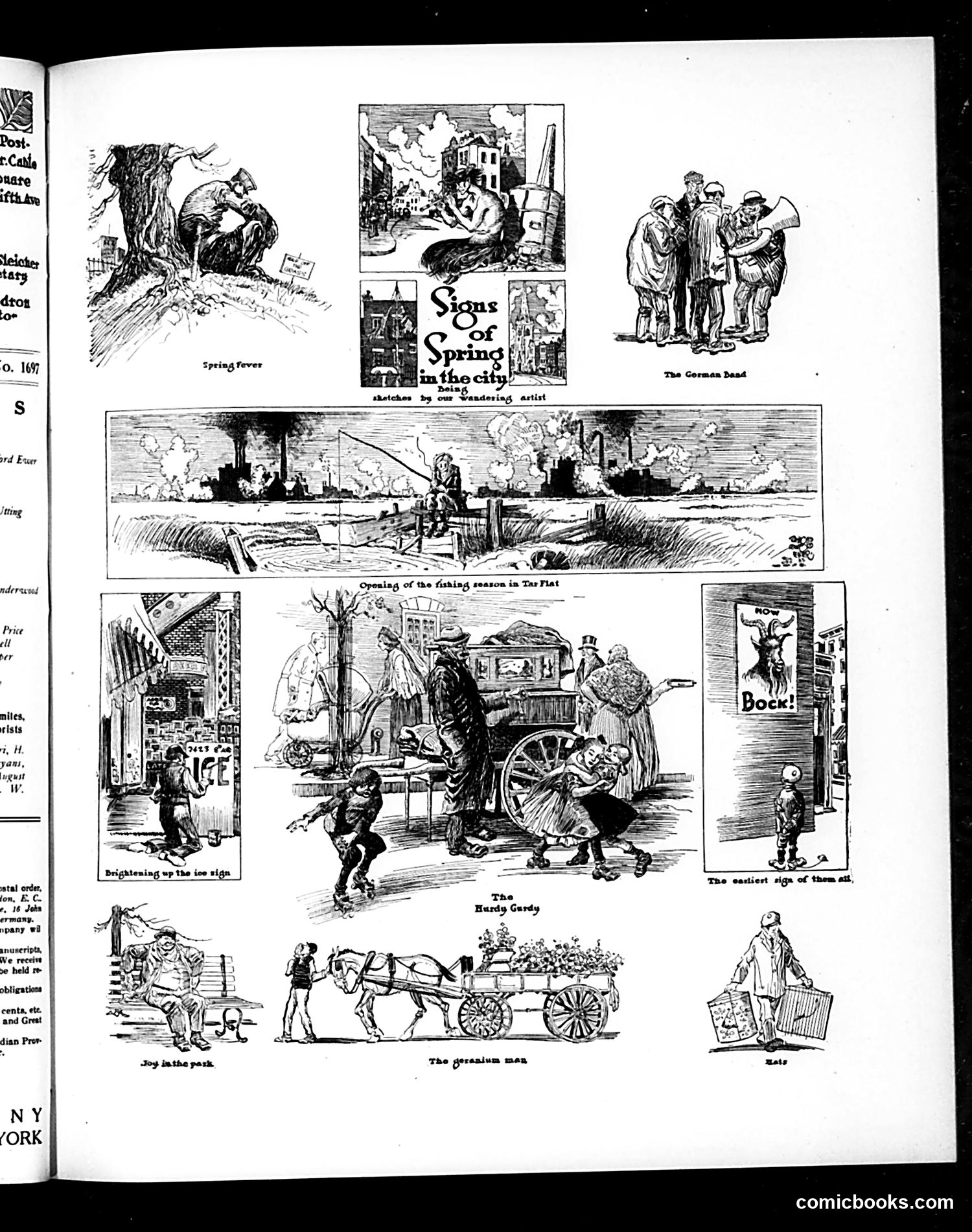
This page presents sketches depicting urban springtime scenes by an unnamed "wandering artist." The cartoons satirize lower-class city life during spring: - **"Spring Fever"**: A disheveled figure, likely homeless or unemployed - **"The German band"**: Immigrant street musicians (Germans were common urban performers) - **"Opening of the fishing season in Hell"**: Workers at industrial docks/factories - **"The Hardy gang"**: Street children playing near a cart - Vignettes showing ice vendors, scrap collectors, and street commerce The satire targets urban poverty and working-class struggles. "Hell" references industrial working conditions. The repeated focus on street children and vendors reflects anxiety about urban poverty and immigrant labor. The title's ironic tone suggests spring offers no real relief to the city's poor—it simply exposes their hardship more visibly.
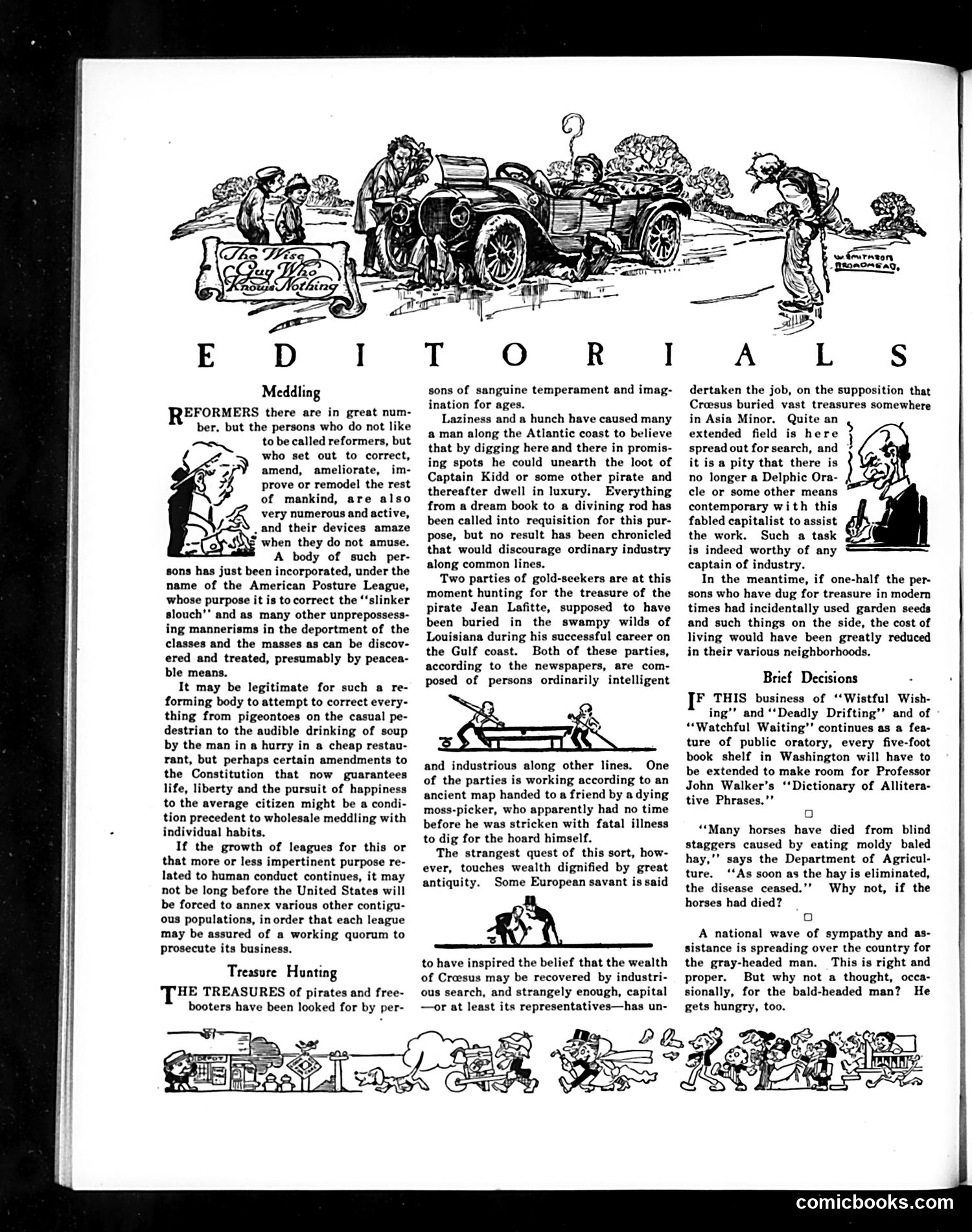
This editorial page critiques well-intentioned but ineffective reform organizations, particularly the "American Posture League" and similar groups attempting to correct public behavior—from posture to drinking habits to eating. The author argues these leagues, while legitimate in purpose, cannot succeed through meddling with individual habits. The illustrations showing people digging for pirate treasure (Captain Kidd references) mock treasure-hunting schemes and get-rich-quick ventures that distract from productive work. The satire suggests that such reformist efforts, no matter how earnest, are ultimately futile without addressing root causes. The page mocks both the reformers' naïveté and the public's susceptibility to fanciful schemes, advocating instead for Constitutional protections of liberty over paternalistic social engineering.
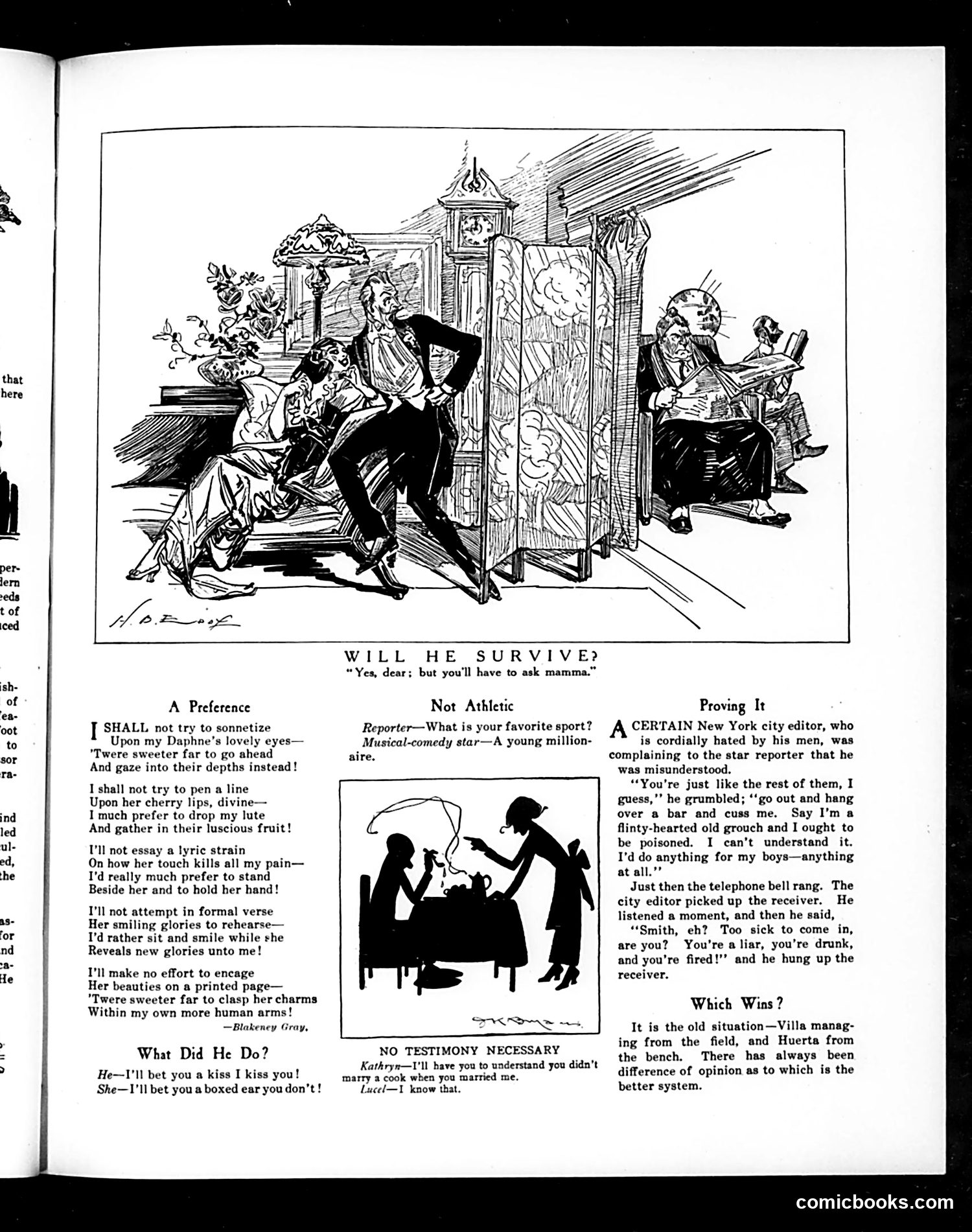
This page contains several humorous sketches satirizing early 20th-century social conventions and gender relations. **"Will He Survive?"** depicts a man caught between romantic interest and maternal control—the caption "you'll have to ask mamma" suggests mothers' excessive influence over adult sons' romantic choices, a common satirical target. **"A Preference"** is a poem mocking flowery Victorian courtship rituals, advocating instead for direct physical affection over elaborate romantic gestures. **"Not Athletic"** jokes about a sports reporter's embarrassment after claiming expertise he lacks. **"Proving It"** and **"What Did He Do?"** present workplace and relationship power dynamics through witty dialogue. **"No Testimony Necessary"** mocks marital assumptions about domestic competence. The overall theme critiques outdated social pretenses while celebrating directness and authenticity.
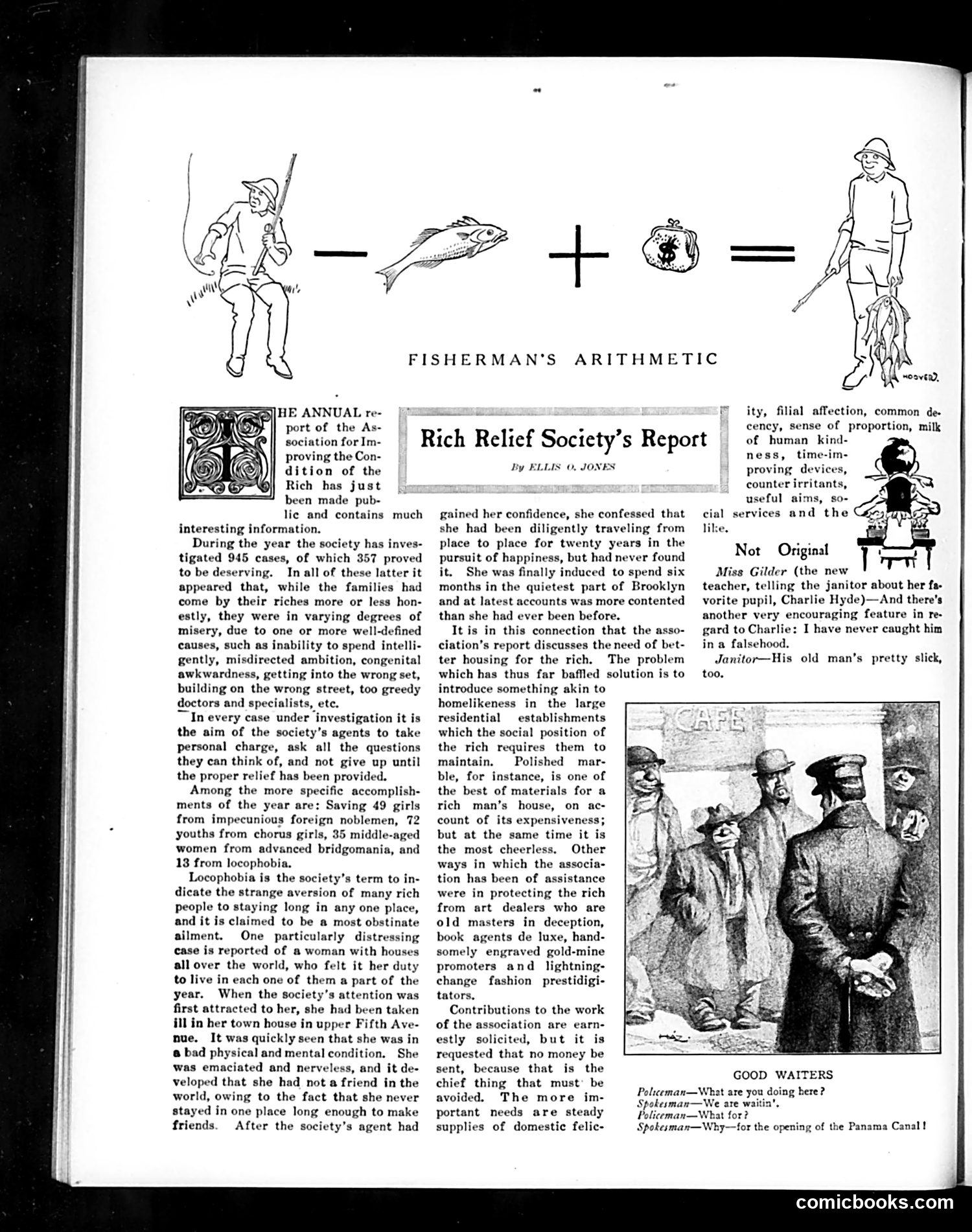
The top cartoon uses visual satire: a fisherman minus a caught fish plus an empty purse equals the fisherman with nothing—mocking the arithmetic of failed fishing trips or poor catches. Below, "Rich Relief Society's Report" satirizes wealthy people's problems through mock-serious bureaucracy. The text parodies charity organizations by inverting their purpose: instead of helping the poor, this fictional society "improves the condition of the rich." It catalogs absurd wealthy afflictions—inability to spend money intelligently, living in too many houses, socializing poorly—treating trivial upper-class complaints as serious social ills requiring intervention. The satire targets both the rich (for their disconnection from real hardship) and patronizing charity rhetoric itself. By applying social-work language to wealthy anxieties, Judge ridicules the pretension of the wealthy and the condescension of relief organizations, suggesting the rich's "problems" are self-inflicted and trivial compared to actual poverty.
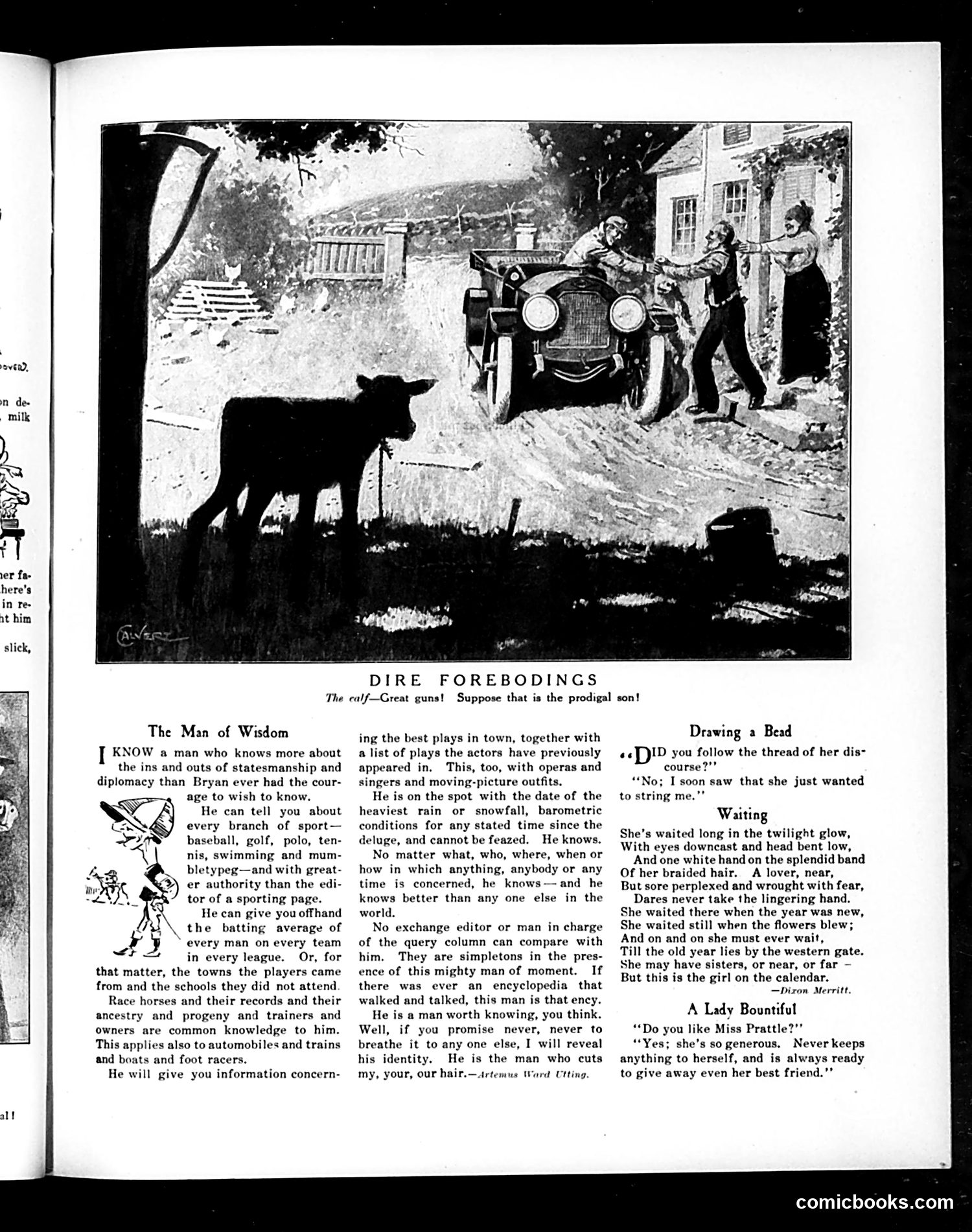
The cartoon depicts a humorous domestic scene: a car has arrived at a house where a cow stands in the yard, and the caption reads "The calf—Great guns! Suppose that is the prodigal son!" The joke plays on the double meaning of "calf" (the animal) versus "calf" (leg), suggesting the car's arrival is unexpected and comical—perhaps implying the vehicle itself looks ungainly or cow-like, or that an unwanted visitor has arrived. The page's main feature is "The Man of Wisdom," satirizing the know-it-all barber who claims encyclopedic knowledge about sports, horses, theater, weather, and everything else—yet is "just" a barber. The satire mocks pompous men who overestimate their expertise and authority across unrelated domains. The accompanying poems and short quips ("Drawing a Bead," "Waiting," "A Lady Bountiful") are typical Judge filler content—light social commentary on romance and gossip.
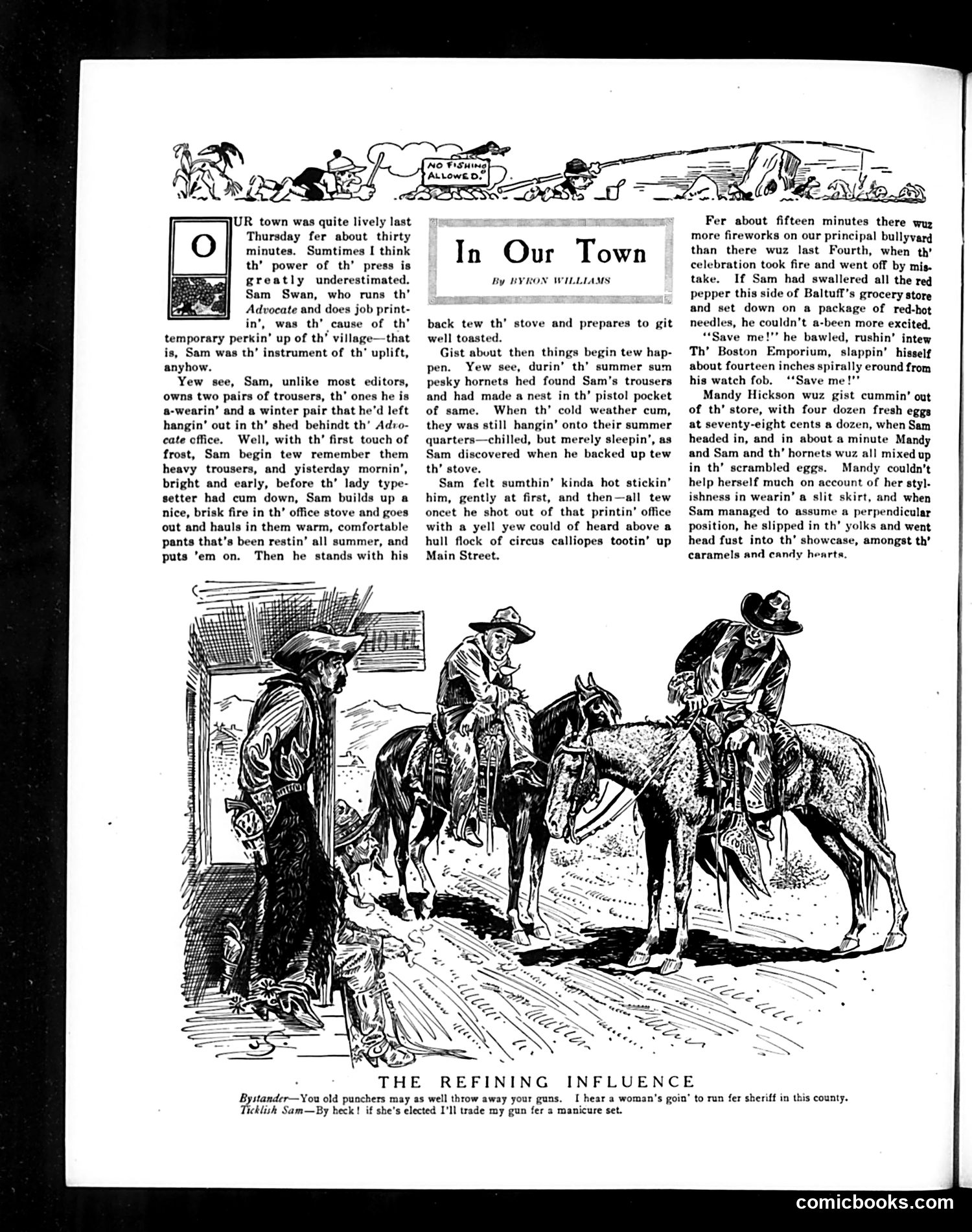
This is a humorous short story by Byron Williams titled "In Our Town," published in *Judge* magazine. The narrative describes a comedic incident involving Sam Swan, the editor of the local *Advocate* newspaper. **The Plot:** Sam retrieves his winter trousers from storage and warms them by the office stove, unaware that hornets have nested in the pocket. When heated, the hornets attack him. Sam frantically runs through town, eventually colliding with Mandy Hickson outside a store, scattering her eggs and crashing into a candy display. **The Satire:** The piece gently mocks small-town life and the local newspaper editor's pretensions. The opening suggests Sam's printing press creates disproportionate excitement in the village—then delivers a slapstick punchline showing how trivial the actual disruption is (a man chased by hornets). **The Bottom Cartoon:** "The Refining Influence" depicts cowboys dismissing guns because women may enter politics, joking that frontier masculinity is threatened by female suffrage/political participation.
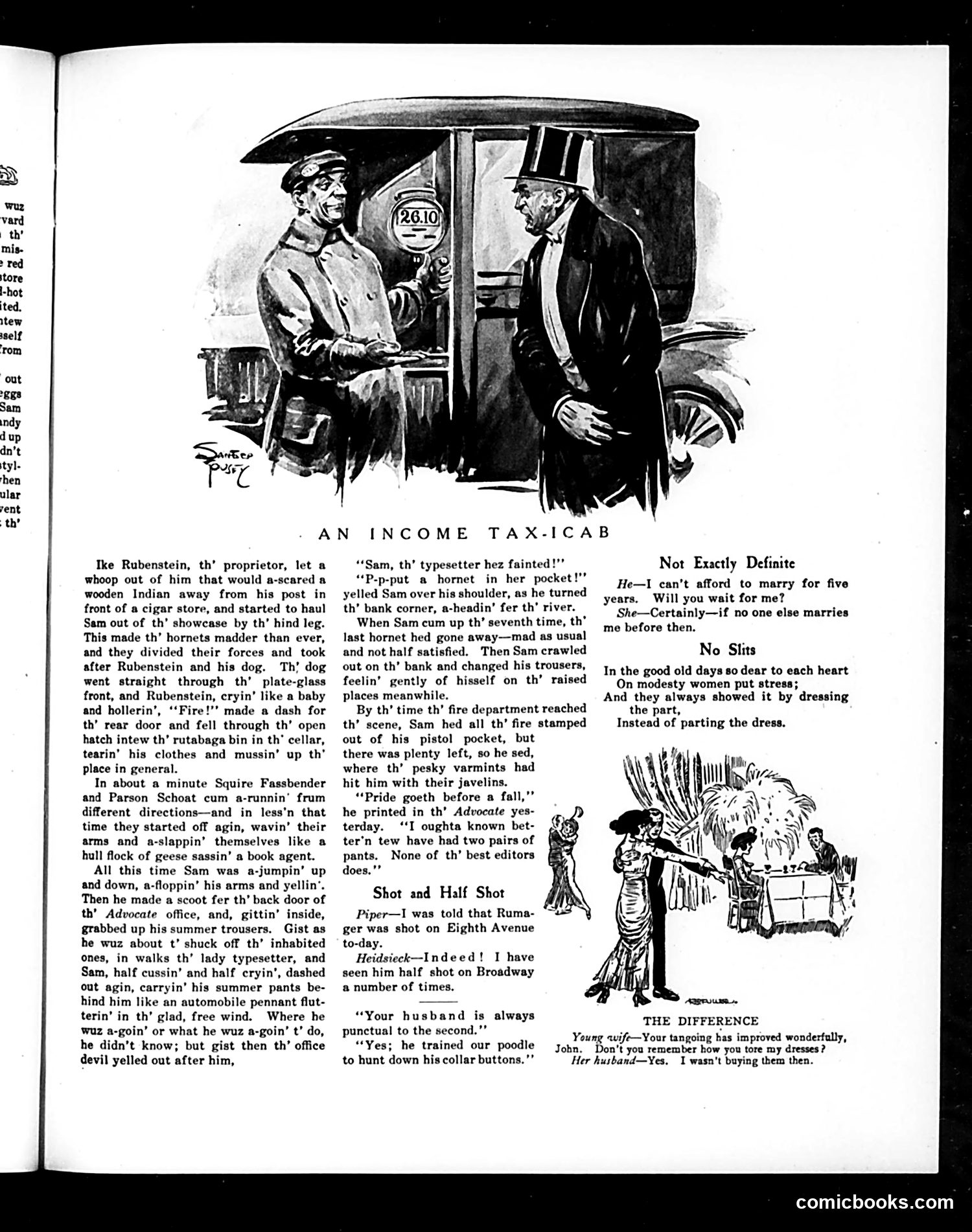
The main cartoon depicts a taxi-cab fare dispute, likely satirizing the newly-implemented income tax (introduced in 1913). The story follows "Sam," a newspaper typesetter, being chased by hornets after a chaotic cab ride, with the fare meter visible on the vehicle showing "26.10"—suggesting exorbitant charges. The satire appears to conflate the sting of unexpected taxi overcharges with the sting of the new income tax itself. The meter serves as the visual metaphor: just as Sam is stung repeatedly by hornets and bewildered bystanders, taxpayers felt "stung" by tax bills they couldn't escape. The comic chaos—with damage, confusion, and people running in different directions—reflects contemporary anxiety about this novel tax. The accompanying humor columns address marriage and social etiquette, typical filler content for Judge magazine.
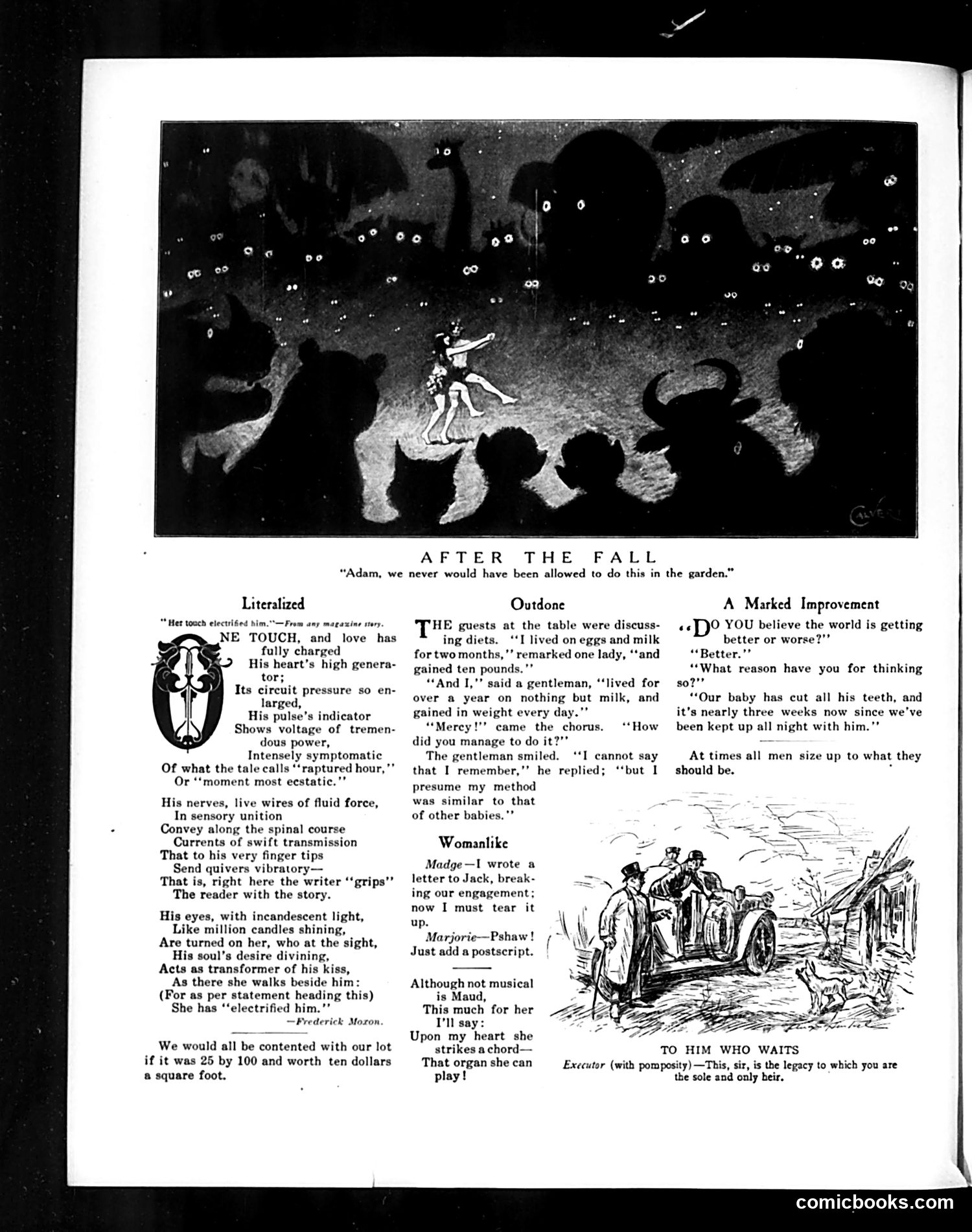
This page contains three unrelated satirical pieces typical of early 20th-century Judge magazine: **Top cartoon**: "After the Fall" depicts Adam and Eve as modern humans at a social gathering, referencing the Biblical expulsion from Eden. The joke suggests their behavior would be scandalous in polite society—a light jab at contemporary morality. **"Literalized"**: Mocks overwrought romantic prose in popular magazines. The poem ridicules the cliché of describing a woman's touch as "electrifying" by taking it literally—treating love as an electrical circuit with scientific language. It's satire of florid, pseudo-scientific writing in pulp fiction. **Other sections** ("Outdone," "Womanlike," "A Marked Improvement," "To Him Who Waits"): Brief humorous anecdotes and verses about everyday situations—a man admitting he gained weight as a baby, a woman's love striking an emotional "chord," parents relieved their baby finally grew teeth. The page targets sentimental literature, conventional domesticity, and social pretension through gentle, accessible humor meant for general audiences.
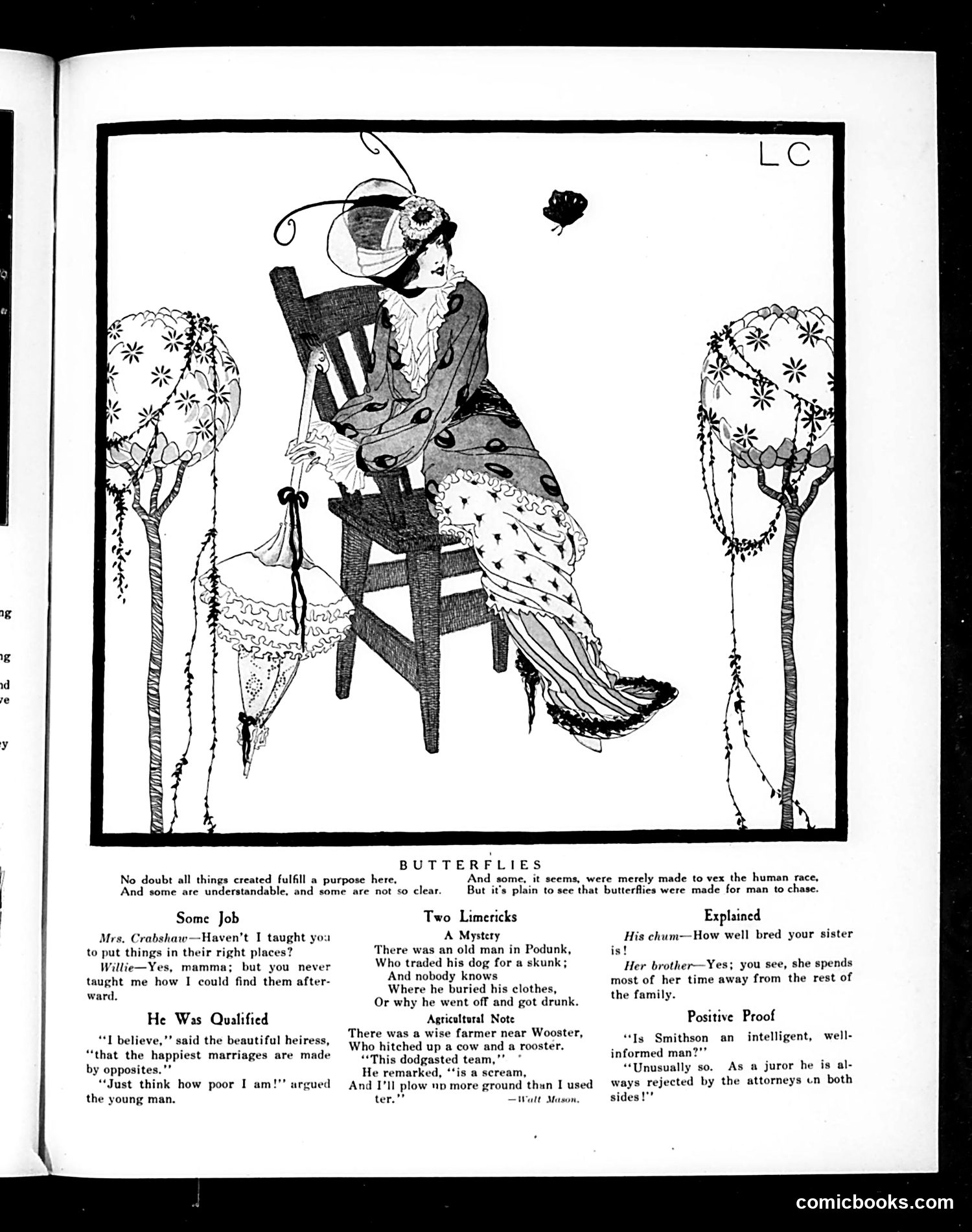
This page from *Judge* magazine presents a "Butterflies" themed collection of short humorous pieces typical of early 20th-century American satirical magazines. The central illustration shows a fashionably dressed woman chasing butterflies—a visual metaphor for frivolous pursuits. The accompanying verse suggests butterflies exist mainly to frustrate humans, establishing the page's whimsical tone. The humor relies on wordplay and social observation: Willie's mother taught him organization but not retrieval; a poor man argues he's a good match for a wealthy heiress because their opposite circumstances fit; a farmer oddly pairs a cow and rooster for plowing; a woman is "well-bred" because she avoids her family; and a man must be intelligent because lawyers reject him from juries (suggesting jurors are typically unintelligent). These jokes target Victorian pretension, rural absurdity, and class pretense through gentle mockery rather than sharp political commentary.
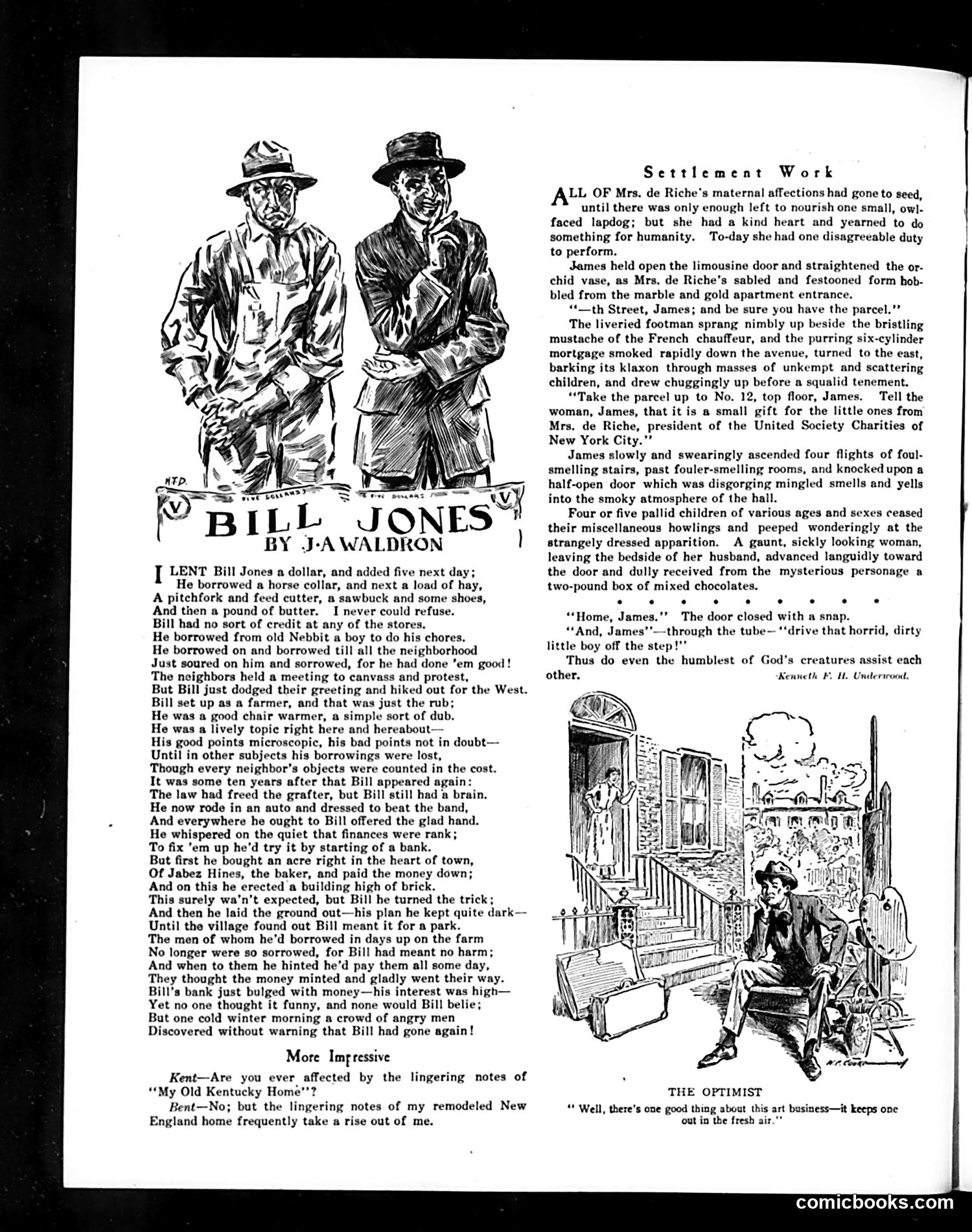
**"Bill Jones"** (by J.A. Waldron) is a cautionary tale about a chronic borrower who becomes a con artist. The narrative satirizes both foolish generosity and opportunistic fraud: Bill borrows from his entire neighborhood, disappears west, then returns years later as a successful banker. He wins back trust, builds a fake "park" scheme, and absconds with deposits—punishing the same neighbors who'd forgiven his past debts. The satire targets both gullible small-town creditors and unscrupulous financial schemers exploiting their goodwill. **"Settlement Work"** mocks wealthy philanthropists' performative charity. Mrs. de Riche—her name ironically meaning "of the rich"—ventures into tenement poverty in her luxury automobile ("six-cylinder mortgage") to deliver a modest gift, accompanied by her servant James. The satire highlights the condescension and theater of upper-class "charity work" that addresses symptoms rather than structural poverty, while maintaining distance from actual suffering. Both pieces critique American class hypocrisy and moral failure.
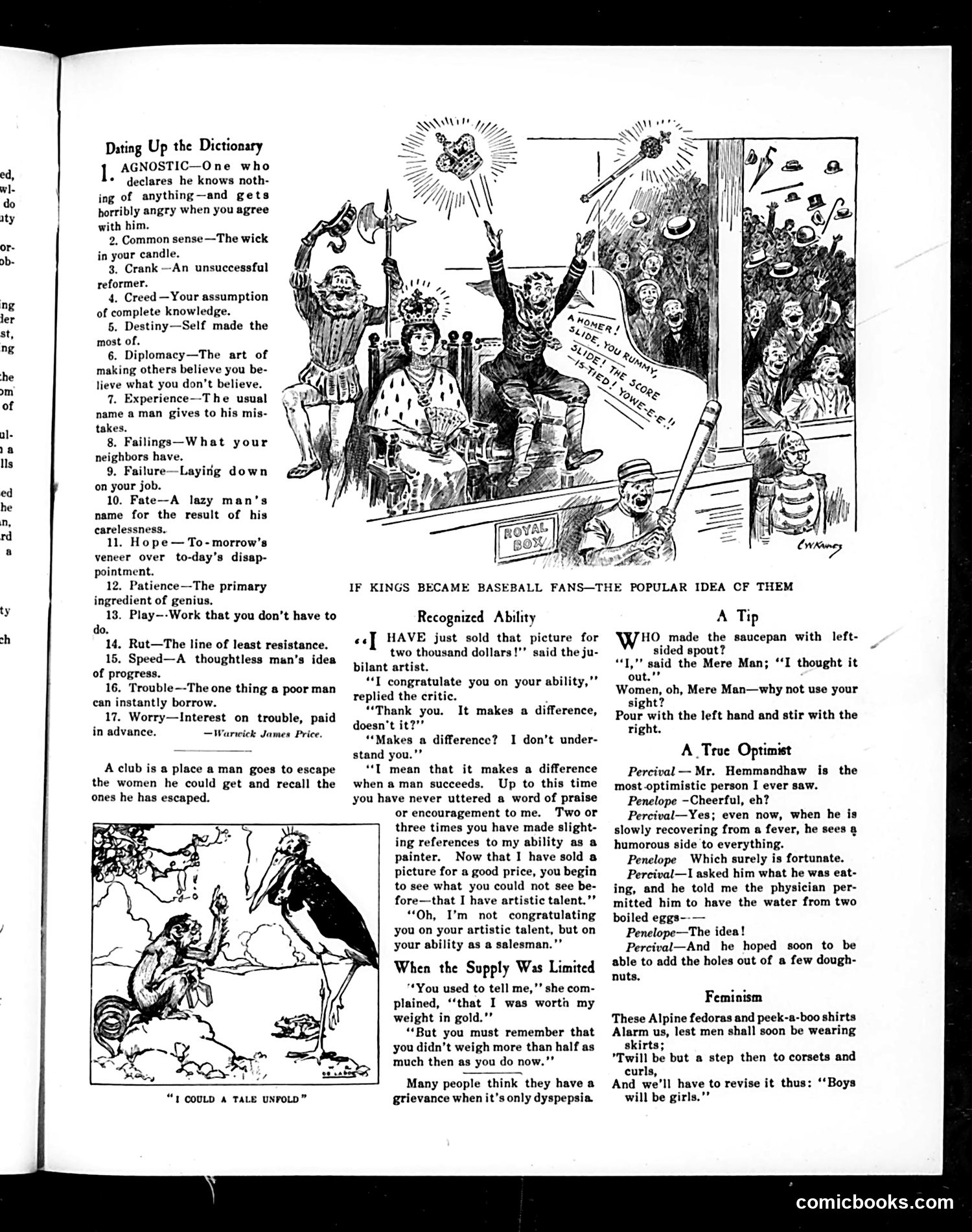
This page from *Judge* contains satirical humor columns and cartoons typical of early 20th-century American satire. **"Dating Up the Dictionary"** is a humorous glossary mocking human nature—defining concepts like "Agnostic" (someone angry when you agree he knows nothing) and "Diplomacy" (making others believe lies you don't believe). The tone is cynical social commentary. **"If Kings Became Baseball Fans"** shows monarchs behaving like enthusiastic baseball spectators, satirizing the democratic sport's ability to strip away royal dignity. The remaining anecdotes mock human hypocrisy: a critic only praising art after it sells (revealing he judges by market success, not merit); a husband's backhanded compliment about his wife's weight; and a optimist finding humor in minimal invalid food. **"Feminism"** expresses period anxiety about women's changing roles—Alpine hats and peek-a-boo shirts were modern women's fashions—joking that gender roles will reverse ("boys will be girls"). This reflects conservative resistance to women's liberation movements of the era. The overall page represents *Judge*'s satirical stance: mocking pretension, greed, and social change through witty, often cynical observations.
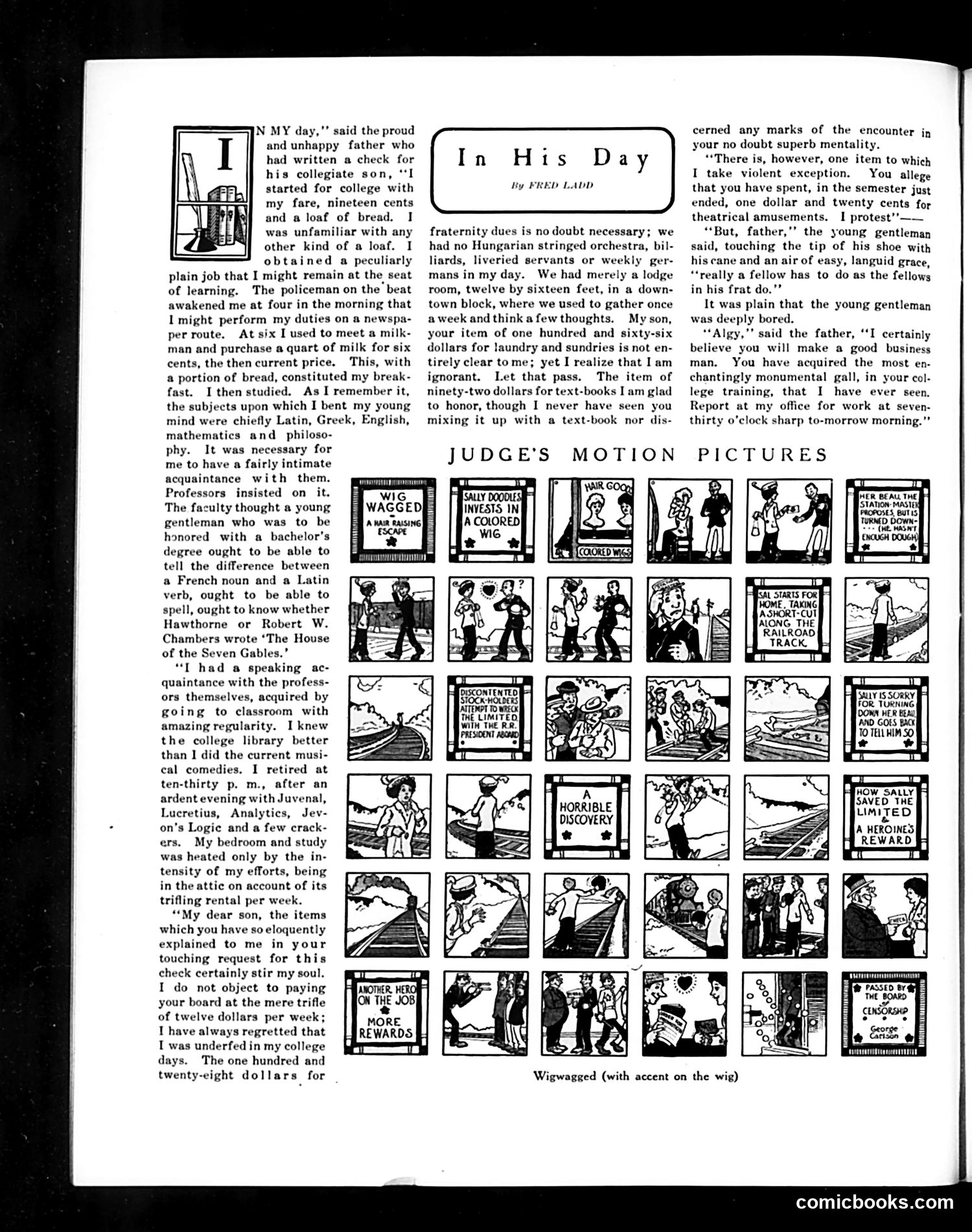
This piece satirizes the generational gap between a self-made father and his spoiled college son. The father recounts his austere college days: working before dawn, eating bread and milk, studying rigorously in an unheated attic. He tolerated fraternity dues and laundry costs as necessary college expenses. However, he erupts when his son requests reimbursement for **theatrical amusements**—a mere $1.20 for entertainment. The father sees this as pure frivolous indulgence, the final proof of his son's entitled attitude. The son's response—that "a fellow has to do as the fellows in his frat do"—perfectly encapsulates the vapid peer-pressure mentality the father finds contemptible. The satire targets wealthy college culture's consumerism and social conformity versus the "character-building" hardship of the previous generation. The father's threat to put his son to work ends the debate decisively.
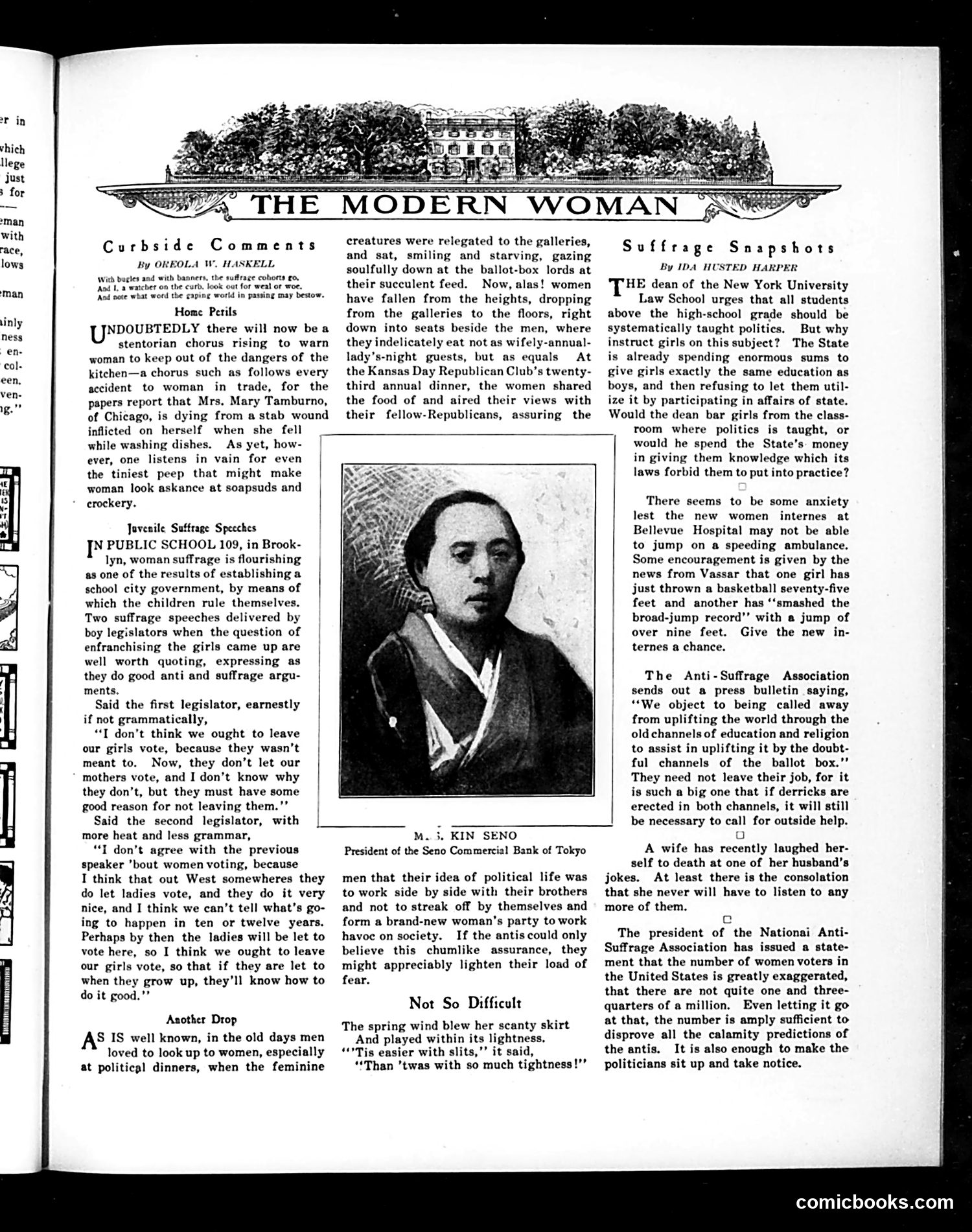
This page satirizes the women's suffrage movement circa 1910s through three sections: **"Curbside Comments"** mocks the concern that women voting will abandon domestic duties. It references Mrs. Mary Tamburno's accidental self-injury while washing dishes, sarcastically noting no one warns women away from kitchens—only from voting. **"Suffrage Snapshots"** by Ida Husted Harper critiques the hypocrisy of educating girls identically to boys while denying them political participation. It questions whether universities should teach politics to female students when the law forbids their political engagement. The photograph shows **M.S. Kin Seno, President of the Seno Commercial Bank of Tokyo**—unclear why included, possibly representing international business interests. **"Juvenile Suffrage Speeches"** presents boys debating girls' voting rights in a school government, capturing anti-suffrage logic (tradition, precedent) versus pro-suffrage pragmatism (change is coming). The page satirizes suffrage opponents' contradictions while documenting the movement's actual progress in early 20th-century America.
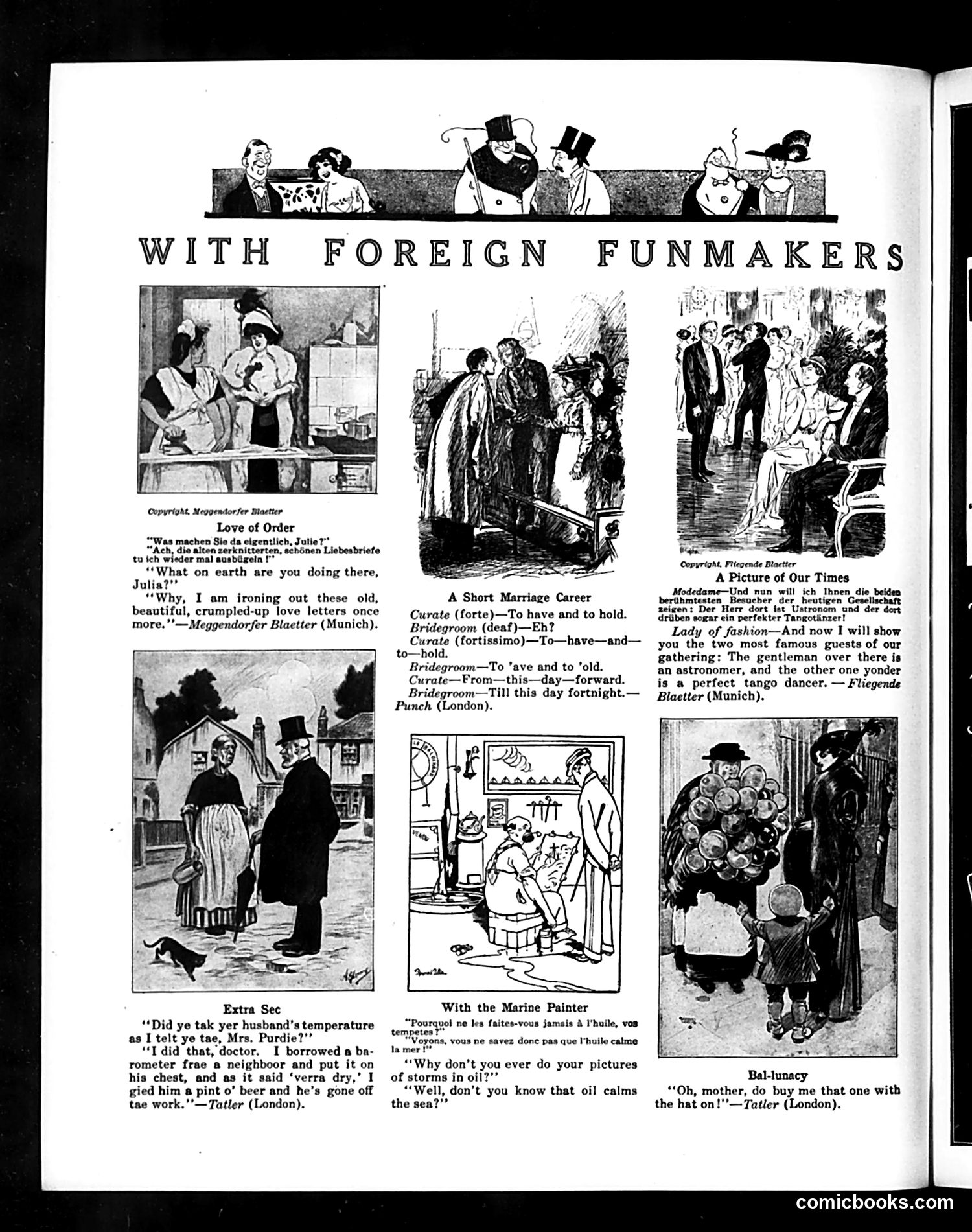
This page collects humorous cartoons from European satirical magazines (Munich's *Meggendorfer Blätter*, London's *Punch* and *Tatler*, and *Fliegende Blätter*), translated for American readers. The jokes rely on wordplay, mishearing, and cultural observations: - **"Love of Order"**: A wife irons old love letters—absurd domesticity applied to romance - **"Short Marriage Career"**: A deaf groom mishears vows, reducing "till death do us part" to "till fortnight" - **"Extra Sec"**: A Scottish woman misreads a barometer as a thermometer, treating her husband's illness with beer - **"Marine Painter"**: A painter explains he avoids oil paint for storm scenes because "oil calms the sea"—a pun on oil's literal calming effect on water - **"Picture of Our Times"**: Society values astronomers and tango dancers equally as fashionable guests - **"Bal-lunacy"**: A child wants a balloon with a hat—a visual pun on "balloon" resembling a head The satire targets everyday absurdities and linguistic confusion rather than political figures.
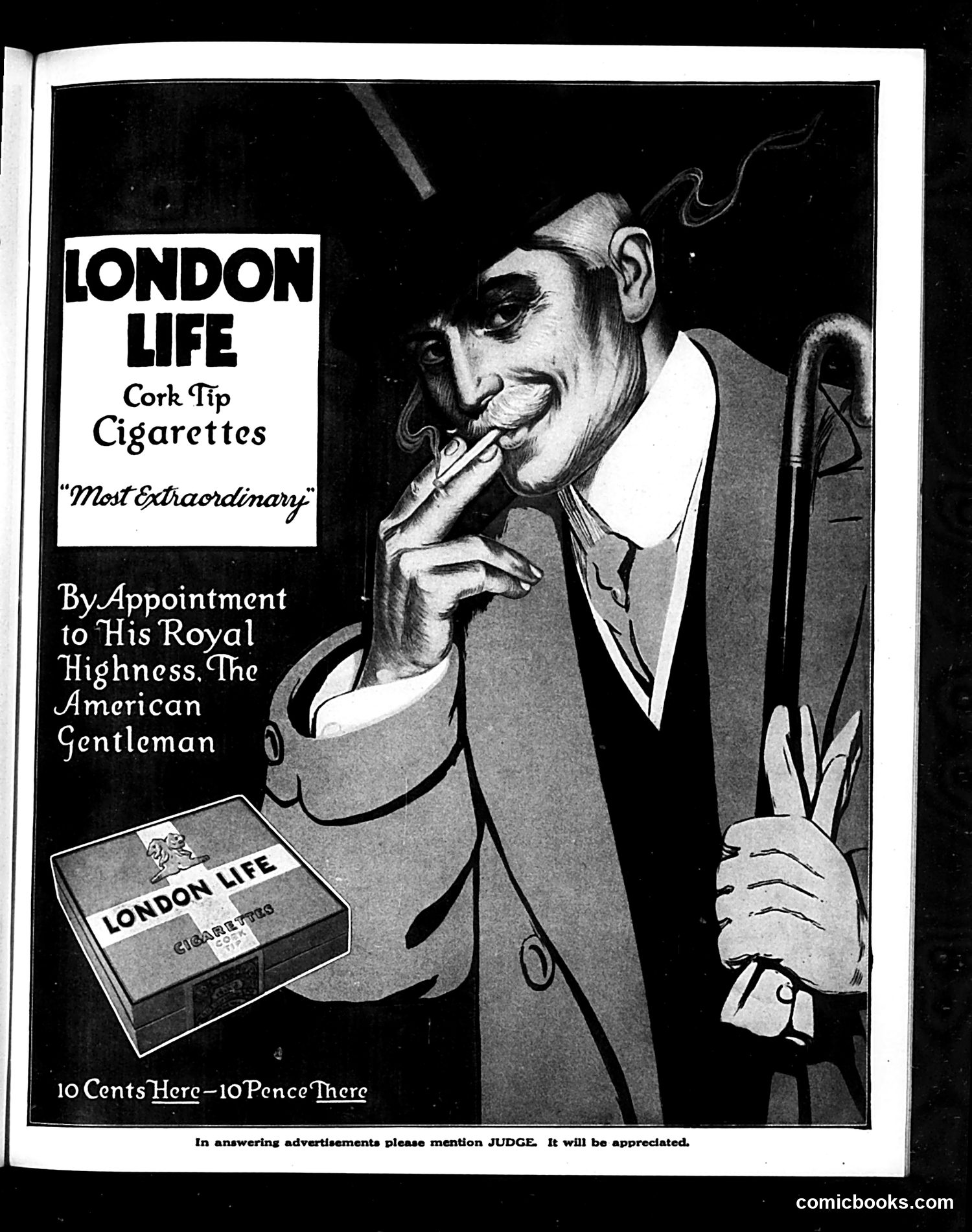
This is a cigarette advertisement for "London Life Cork Tip Cigarettes," not political satire. It features a caricatured figure—drawn with exaggerated demonic or devilish features (horns, pointed ears, goatee)—smoking a cigarette while holding a cane. The ad claims the product is "By Appointment to His Royal Highness, The American Gentleman," sarcastically suggesting these cigarettes suit a refined American consumer. The devilish imagery and phrase "Most Extraordinary" appear designed to make the product seem exotic and sophisticated. The dual pricing ("10 Cents Here—10 Pence There") indicates availability in both American and British markets. This is straightforward commercial advertising rather than editorial commentary.
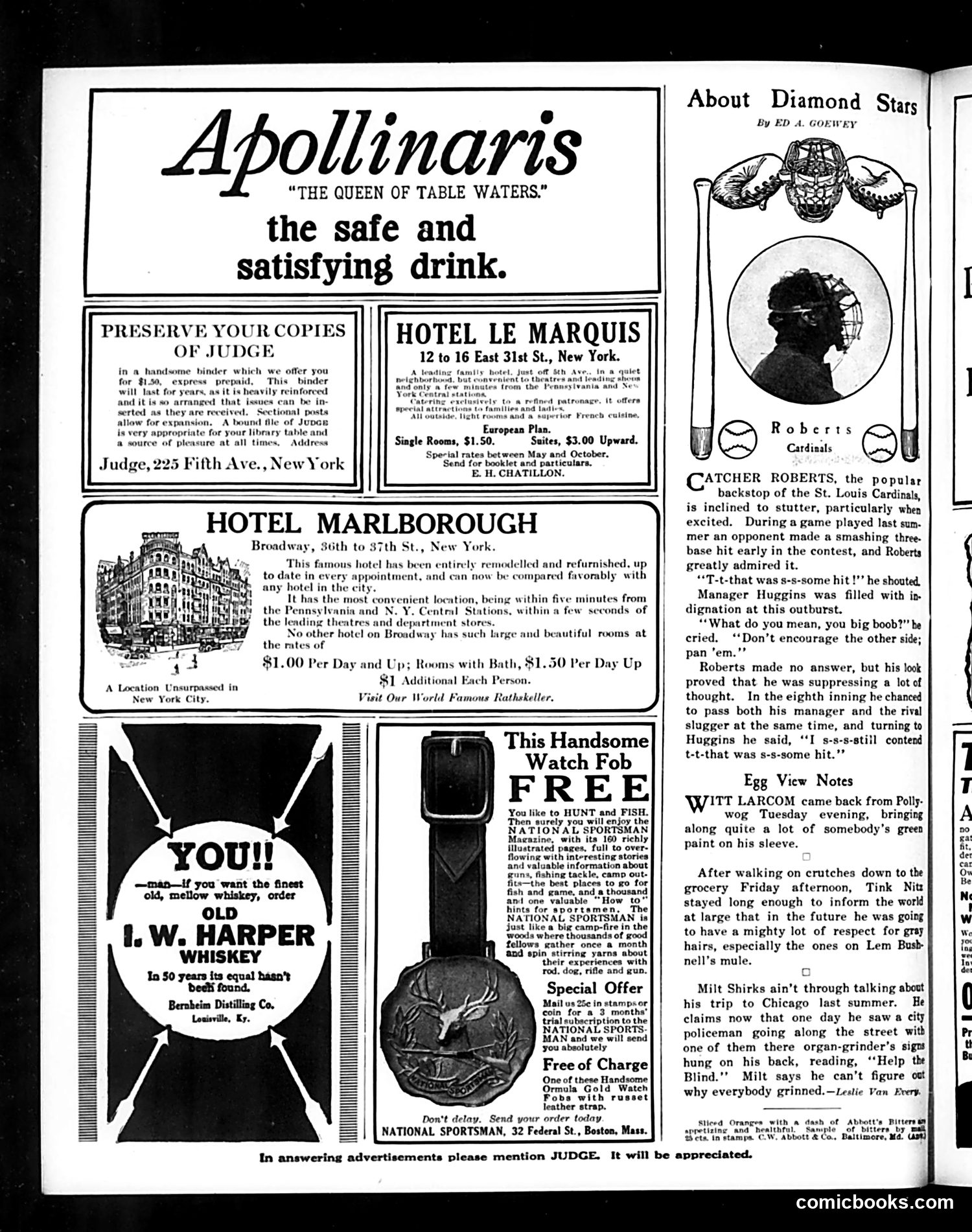
This page is primarily **advertising and filler content** rather than political satire. The main elements include: **Advertisements**: Hotels (Marlborough, Le Marquis), beverages (Apollinaris water, I.W. Harper whiskey), and a watch fob offer from National Sportsman magazine dominate the layout. **Sports Content**: "About Diamond Stars" features **Catcher Roberts** of the St. Louis Cardinals—a humorous anecdote about his stutter. During a game, Roberts admires an opponent's hit; his manager Huggins rebukes him for encouraging the opposing team. Roberts later insists the hit was impressive anyway. This is light sports humor with no political dimension. **"Egg View Notes"**: Appears to be rural/small-town gossip humor—anecdotes about local characters and their mishaps, typical of period magazines. The page lacks the satirical political cartoons one might expect from *Judge*, a publication known for social commentary. It's a fairly standard mixed advertising and entertainment page from the era.
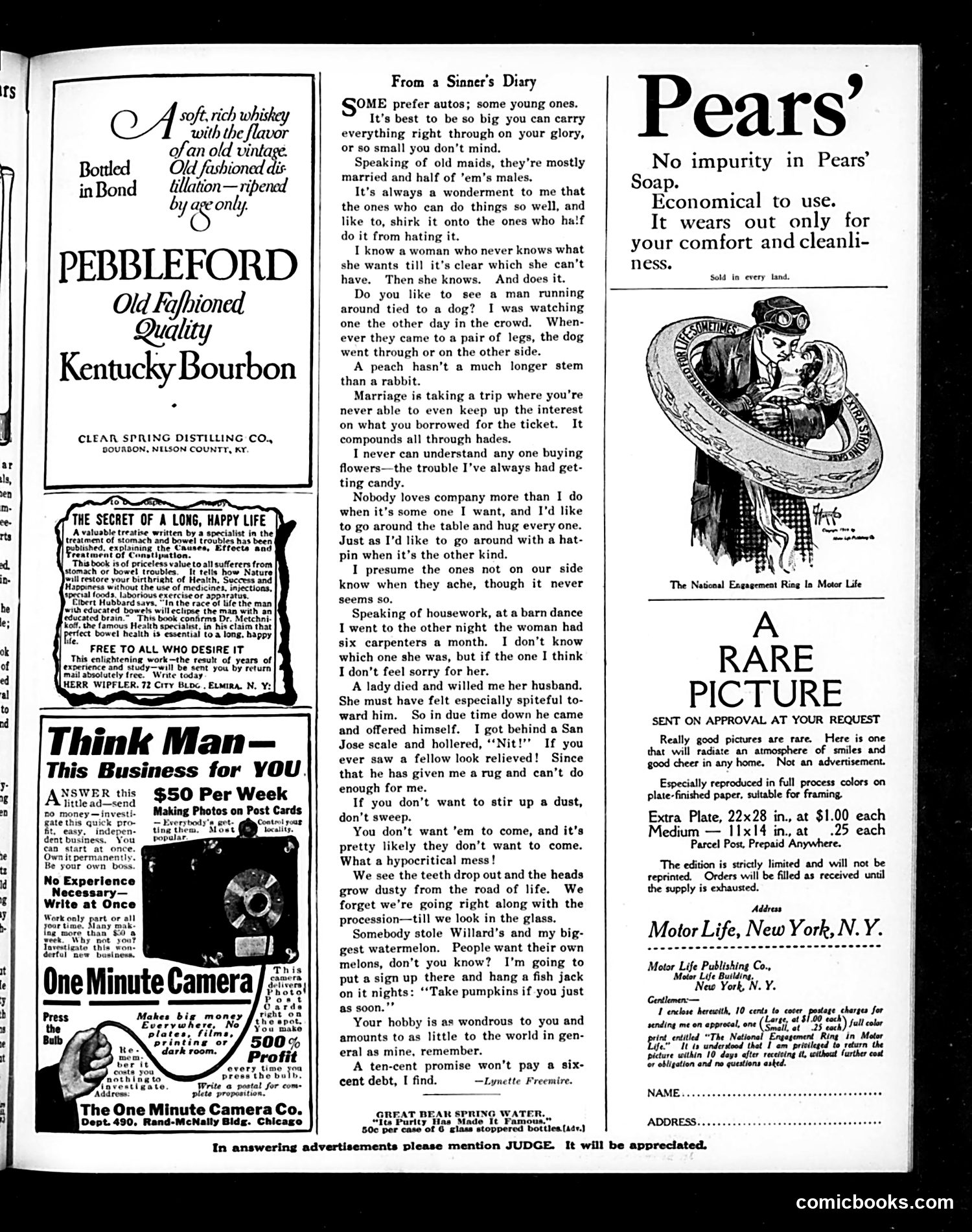
This page is primarily **advertising and humor columns** rather than political satire. The main content is "From a Sinner's Diary," a cynical humor column offering observations about marriage, relationships, and human behavior—typical of Judge's satirical tone targeting middle-class readers. The advertisements promote various business schemes ($50/week photo postcard business, "One Minute Camera"), self-help books promising digestive health secrets, and whiskey (Pebbleford Kentucky Bourbon). There's also a Pears' Soap ad featuring a caricatured figure in what appears to be an engagement ring. The "Sinner's Diary" uses dry wit to mock social conventions: marriage as financial trap, women's contradictory desires, hypocritical hospitality, and aging. References to "Willard's watermelon" and casual theft suggest rural/agricultural context. **No identified political cartoons or specific caricatures of public figures appear on this page.** It represents Judge's typical early 20th-century blend of cynical humor about everyday life, targeted at advertising revenue.
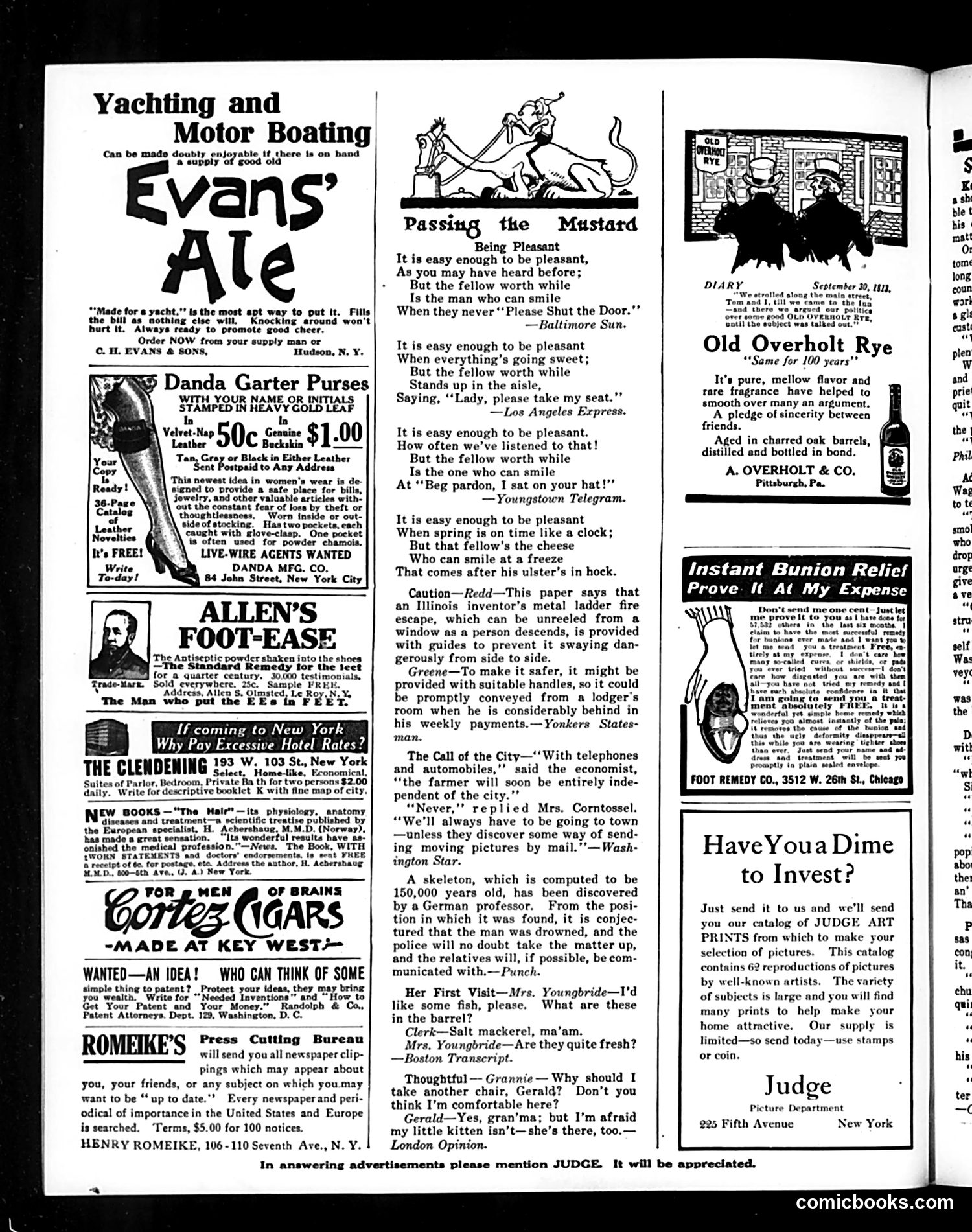
This page is primarily **advertising** with one notable humor piece: "Passing the Mustard—Being Pleasant," a poem series about maintaining courtesy in irritating situations. The poem satirizes urban etiquette through four scenarios: enduring repeated requests to close doors, yielding subway seats, having someone sit on your hat, and losing money while facing a broken umbrella. Each verse ironically praises "the fellow worth while"—the person who remains pleasant despite minor social indignities. The humor lies in its **deflation of everyday annoyances** presented as character tests. During this early-1910s period, this reflects middle-class concerns about urban crowding, public transportation friction, and maintaining composure amid modern inconveniences. The accompanying **cartoon (top center)** appears to illustrate the poem's theme with figures in a crowded situation, though specific details are unclear in reproduction. The rest of the page consists of product advertisements (Evans' Ale, garter purses, foot powder, bunion relief, art prints) typical of Judge magazine's revenue model. One small satirical note mocks an Illinois inventor's fire escape ladder—criticizing its impracticality for tenants behind on rent.
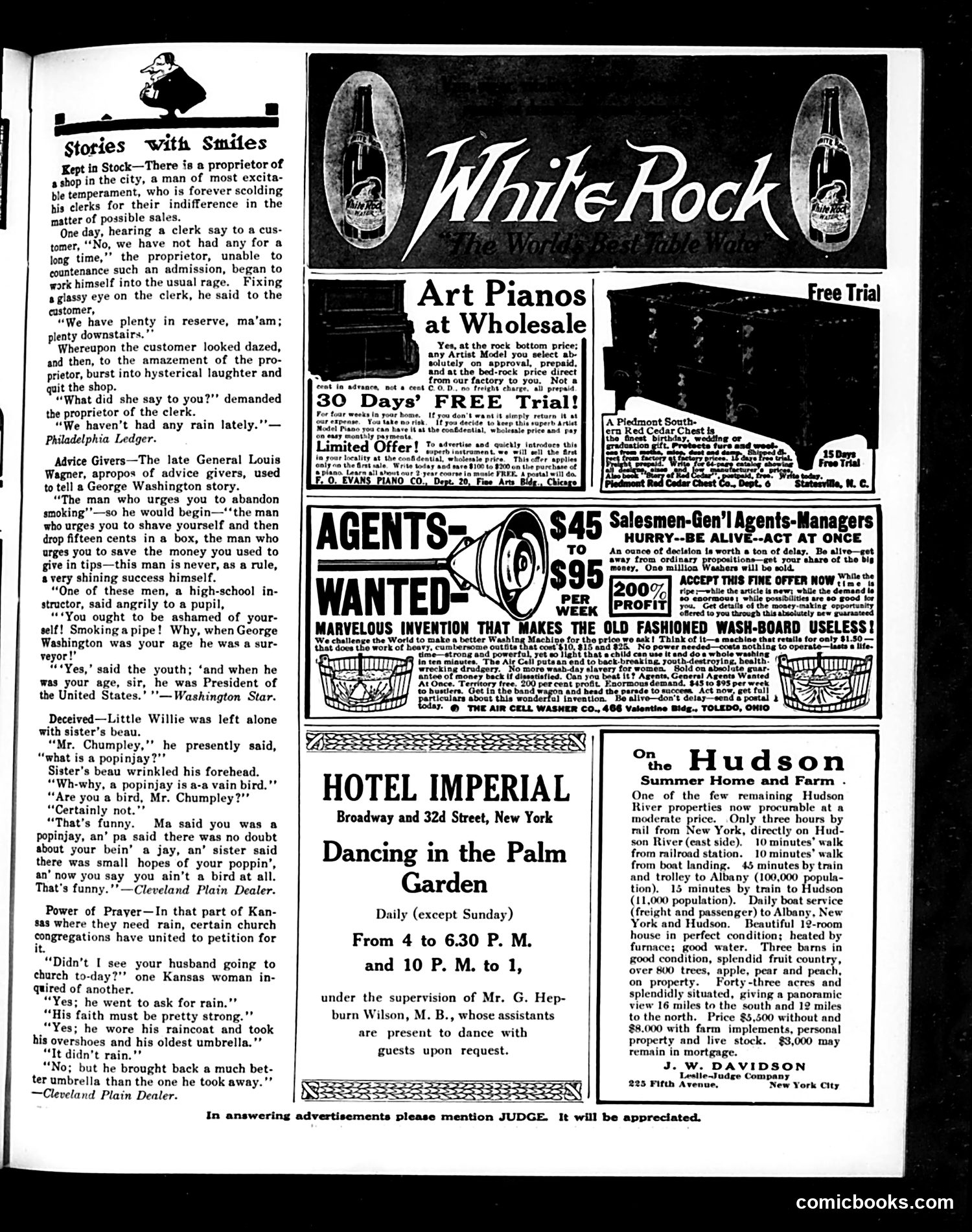
This page is primarily **advertisements and humorous anecdotes**, not political cartoons. The short stories mock human folly through everyday situations: a shop proprietor's absurd boasting to save face, advice-givers who don't practice what they preach, a child's logical trap for his sister's suitor (a "popinjay" or vain person), and Kansas farmers' cynical faith—praying for rain while preparing for its absence, with the punchline that the man returned with a better umbrella than he brought. The advertisements hawking Art Pianos at "wholesale" and a "marvelous invention" washing machine (claiming to make washboards obsolete) represent typical early-20th-century marketing hype promising unrealistic savings and revolutionary products. The Hotel Imperial ad and Hudson River property listing are straightforward commercial notices. Overall, the page reflects Judge's satirical approach to American consumer culture and human nature through gentle, comedic domestic scenarios rather than sharp political commentary.
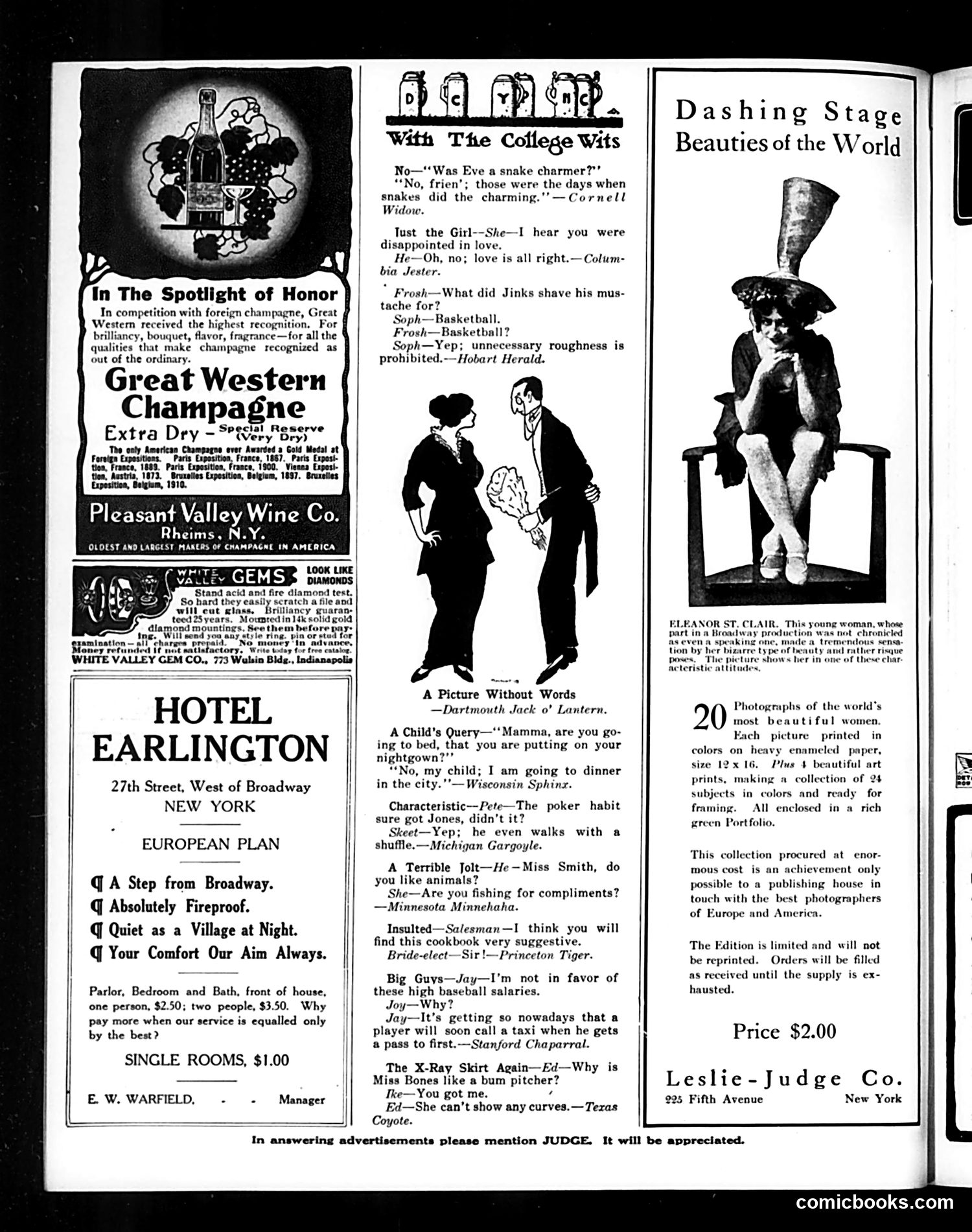
This is primarily an **advertising page** with some light satirical content. The main elements: **Advertisements:** - Great Western Champagne (competing against foreign brands) - Hotel Earlington (NYC lodging) - White Valley Gem Co. (jewelry) - Leslie-Judge Co. (art portfolio of stage actresses) **Satirical Content:** The center section, "With The College Wits," collects brief jokes from various college humor magazines (Cornell Widow, Columbia Jester, etc.). These are gentle campus humor—mostly about romantic disappointment, poker habits, and wordplay. The cartoon "A Picture Without Words" (credited to Dartmouth Jack o'Lantern) appears to be a flapper-era visual gag about modern dating. The "Dashing Stage Beauties" section advertises a portfolio of photographs of actresses, reflecting early 20th-century entertainment culture and the popularity of stage performers. **Context:** This reflects Judge's blend of advertising and light comedy targeting an educated, urban readership interested in Broadway, colleges, and consumer goods.
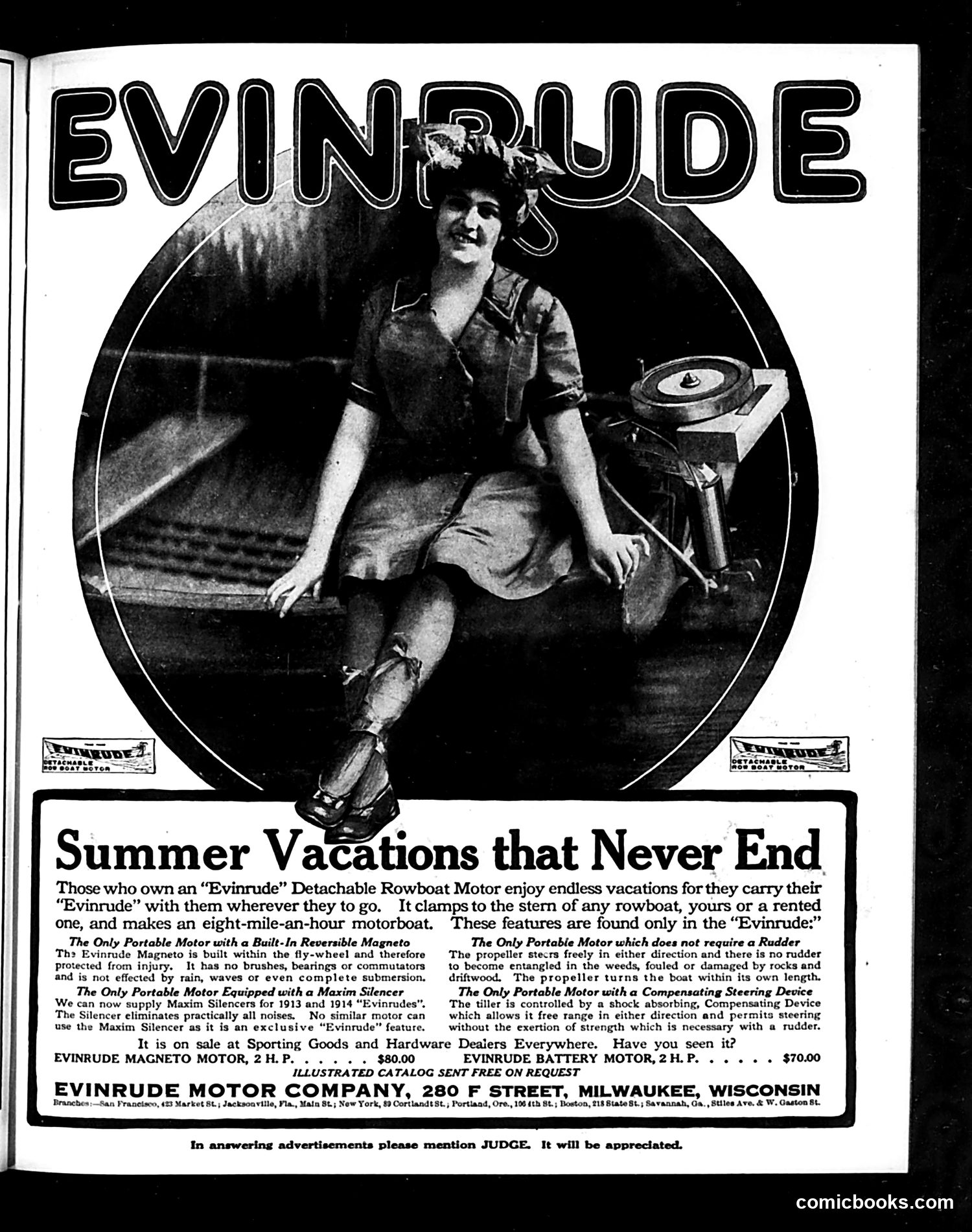
This page is primarily a **product advertisement**, not satire or political commentary. It appears in *Judge*, a satirical magazine, but functions as a straightforward commercial pitch. The image shows a woman in period dress (early 1910s) sitting in a boat with an Evinrude detachable rowboat motor, smiling contentedly. The ad's headline promises "Summer Vacations that Never End" — meaning owners can take their portable motor anywhere, extending vacation flexibility. The text emphasizes the motor's technical superiority: it's the only portable motor with various exclusive features (built-in magneto, reversible propeller, Maxim silencer, compensating steering). The $70-80 price point positioned it as a luxury leisure product for affluent consumers. For modern readers: this represents early motorization of recreational boating and the marketing of portable technology as enabling personal freedom and leisure — a then-novel consumer pitch.
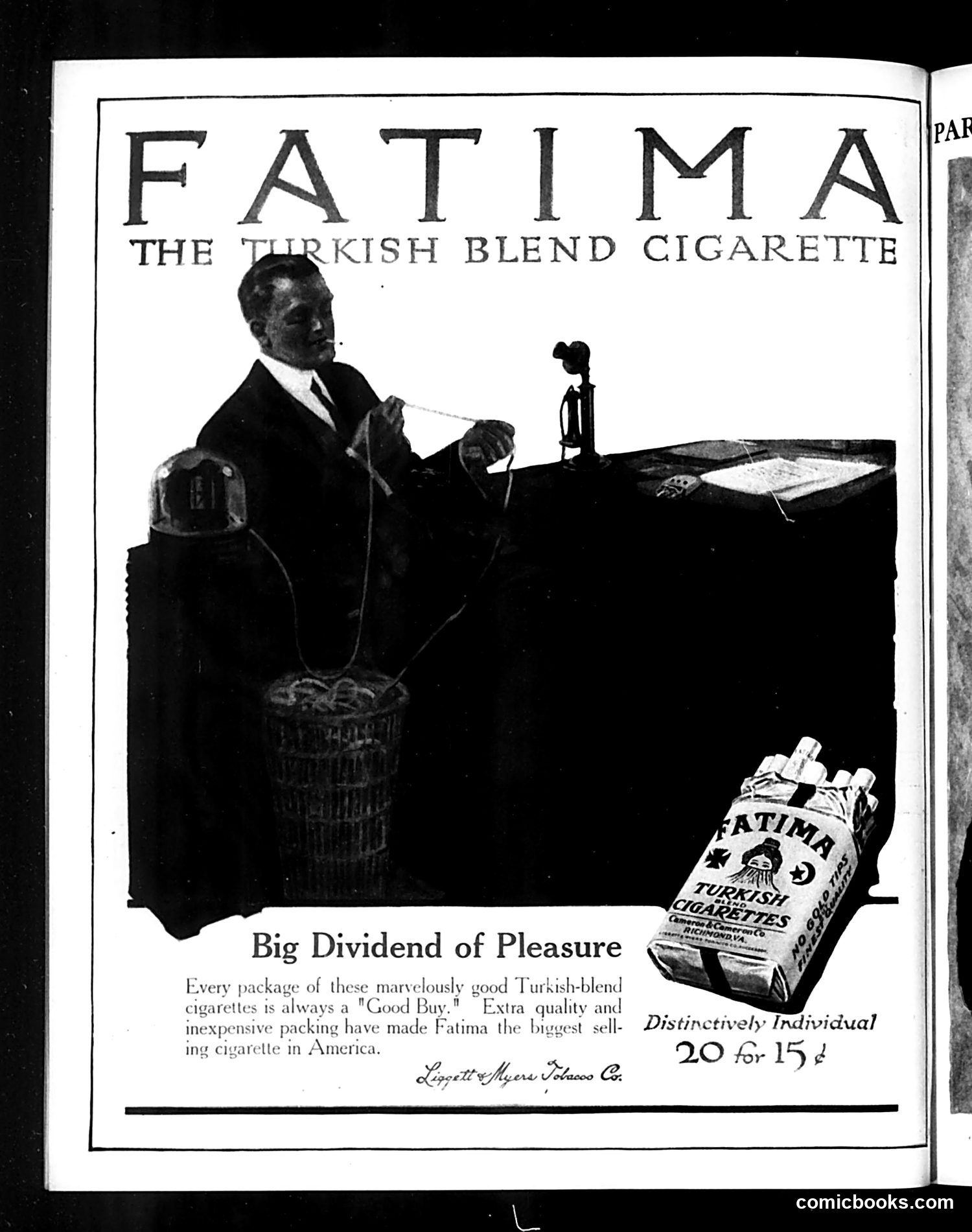
This is primarily a cigarette advertisement for Fatima Turkish-blend cigarettes, not a political cartoon. The image shows a well-dressed man at a desk examining a package of Fatimas, depicting the product as a desirable luxury item. The ad emphasizes the cigarettes as a "Good Buy" with "extra quality" and "inexpensive packing," claiming Fatima was "the biggest selling cigarette in America." The pricing of "20 for 15¢" suggests affordability for the era. The tagline "Distinctively Individual" appeals to consumer identity. This represents early 20th-century tobacco marketing, before modern health warnings, targeting middle and upper-class consumers through lifestyle imagery and value proposition.