
Judge, 1914-04-25 · page 12 of 24
Judge — April 25, 1914 — page 12: what you’re looking at
What you’re looking at
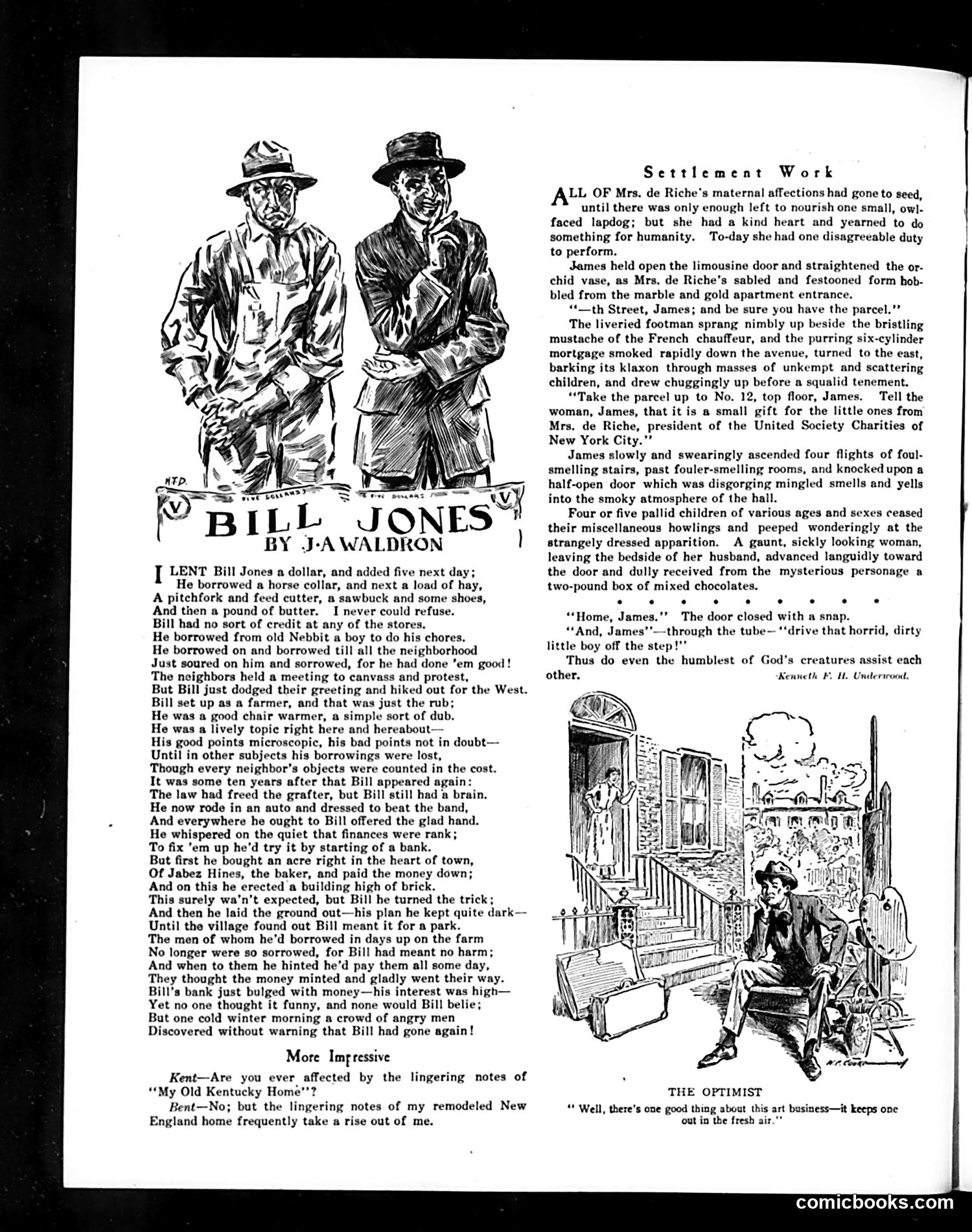
**"Bill Jones"** (by J.A. Waldron) is a cautionary tale about a chronic borrower who becomes a con artist. The narrative satirizes both foolish generosity and opportunistic fraud: Bill borrows from his entire neighborhood, disappears west, then returns years later as a successful banker. He wins back trust, builds a fake "park" scheme, and absconds with deposits—punishing the same neighbors who'd forgiven his past debts. The satire targets both gullible small-town creditors and unscrupulous financial schemers exploiting their goodwill. **"Settlement Work"** mocks wealthy philanthropists' performative charity. Mrs. de Riche—her name ironically meaning "of the rich"—ventures into tenement poverty in her luxury automobile ("six-cylinder mortgage") to deliver a modest gift, accompanied by her servant James. The satire highlights the condescension and theater of upper-class "charity work" that addresses symptoms rather than structural poverty, while maintaining distance from actual suffering. Both pieces critique American class hypocrisy and moral failure.
📄 Transcribed text from this page (OCR, searchable)
Machine-transcribed from the original scan — historical spelling and the odd misread are preserved.
If J-A WALDRON I LENT Bill Jones a dollar, and added five next day; He borrowed a horse collar, and next a load of hay, A pitchfork and feed cutter, a sawbuck and some shoes, And then a pound of butter. I never could refuse. Bill had no sort of credit at any of the stores. He borrowed from old Nebbit a boy to do his chores. He borrowed on and borrowed till all the neighborhood Just soured on him and sorrowed, for he had done 'em good! The neighbors held a meeting to canvass and protest, But Bill just dodged their greeting and hiked out for the West. Bill set up as a farmer, and that was just the rub; He was a good chair warmer, a simple sort of dub. He was a lively topic right here and hereabout— His good points microscopic, his bad points not in doubt— Until in other subjects his borrowings were lost, Though every neighbor’s objects were counted in the cost. It was some ten years after that Bill appeared again: The law had freed the grafter, but Bill still had a brain. He now rode in an auto and dressed to beat the band, And everywhere he ought to Bill offered the glad hand. He whispered on the quiet that finances were rank; To fix ’em up he'd try it by starting of a bank. But first he bought an acre right in the heart of town, Of Jabez Hines, the baker, and paid the money down; And on this he erected a building high of brick. This surely wa'n't expected, but Bill he turned the trick; And then he laid the ground out—his plan he kept quite dark— Until the village found out Bill meant it for a park. The men of whom he’d borrowed in days up on the farm No longer were so sorrowed, for Bill had meant no harm; And when to them he hinted he’d pay them all some day, They thought the money minted and gladly went their way. Bill’s bank just bulged with money—his interest was high— Yet no one thought it funny, and none would Bill belie; But one cold winter morning a crowd of angry men Discovered without warning that Bill had gone again! More Impressive Kent—Are you ever affected by the lingering notes of “My Old Kentucky Home’’? Bent—No; but the lingering notes of my remodeled New England home frequently take a rise out of me. Settlement Work LL OF Mrs, de Riche’s maternal affections had gone to seed, until there was only enough left to nourish one small, owl. faced lapdog; but she had a kind heart and yearned to do something for humanity. To-day she had one disagreeable duty to perform. James held open the limousine door and straightened the or- chid vase, as Mrs, de Riche’s sabled and festooned form hob- bled from the marble and gold apartment entrance. “‘—th Street, James; and be sure you have the parcel.’’ The liveried footman sprang nimbly up beside the bristling mustache of the French chauffeur, and the purring six-cylinder mortgage smoked rapidly down the avenue, turned to the east, barking its klaxon through masses of unkempt and scattering children, and drew chuggingly up before a squalid tenement. “Take the parcel up to No. 12, top floor, James. Tell the woman, James, that it is a small gift for the little ones from Mrs. de Riche, president of the United Society Charities of New York City.” James slowly and swearingly ascended four flights of foul- smelling stairs, past fouler-smelling rooms, and knocked upon a half-open door which was disgorging mingled smells and yells into the smoky atmosphere of the hall. Four or five pallid children of various ages and sexes ceased their miscellaneous howlings and peeped wonderingly at the strangely dressed apparition. A gaunt, sickly looking woman, leaving the bedside of her husband, advanced languidly toward the door and dully received from the mysterious personage a two-pound box of mixed chocolates. os 8 6 o 8 © © «© 6 “‘Home, James.’’ The door closed with a snap. “And, James’’—through the tube— ‘‘drive that horrid, dirty little boy off the step!"’ Thus do even the humblest of God's creatures assist each other. Kenneth F. MH. Underwood. THE OPTIMIST “ Well, there’s one good thing about this art business—it keeps one out in the fresh air."’ comicbooks.com