
A complete issue · 24 pages · 1914
Judge — February 14, 1914
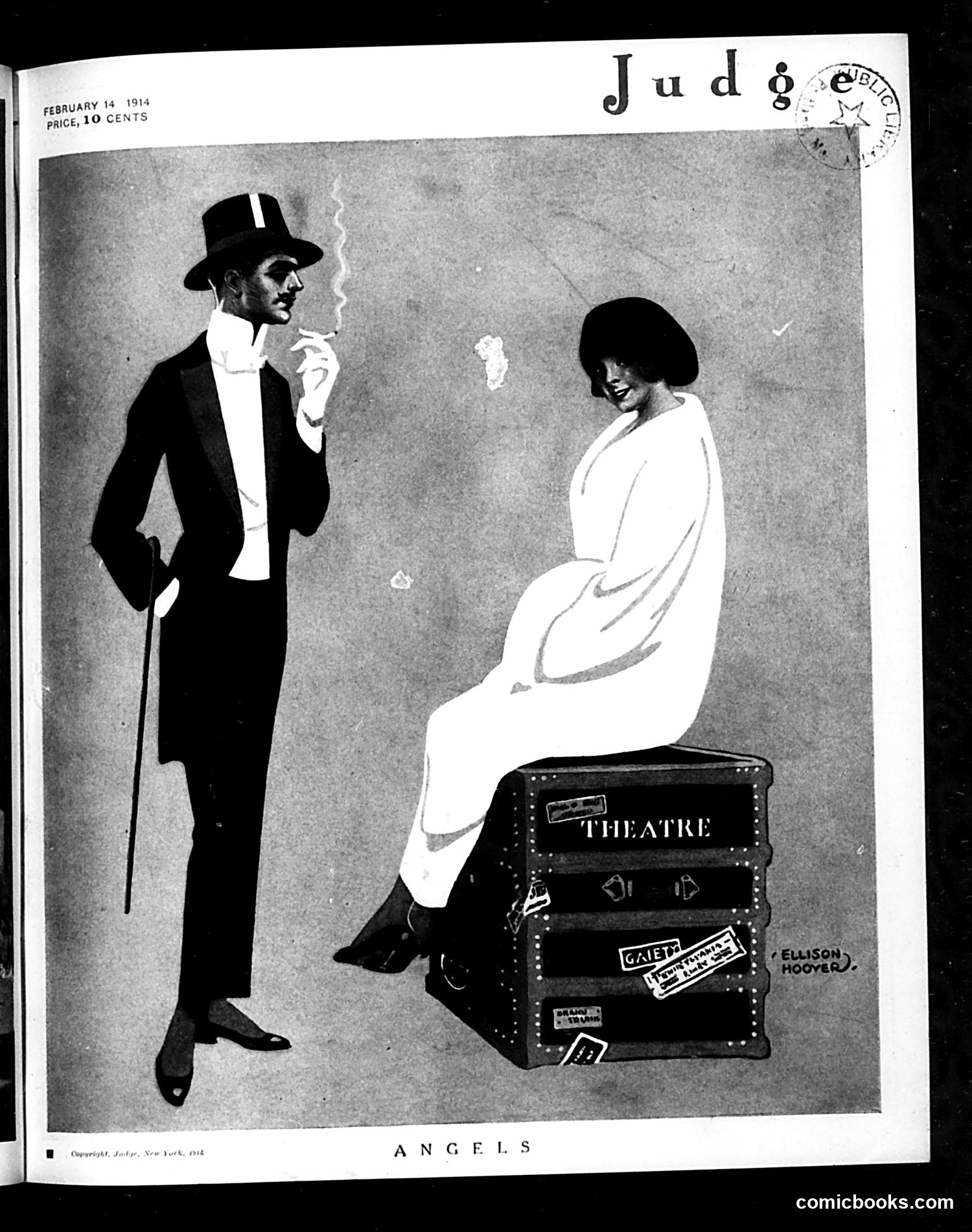
This illustration, titled "ANGELS" and credited to artist Ellison Hoover, depicts a satirical scene about theater. A well-dressed gentleman in top hat and monocle (appearing disdainful, smoking) stands apart from a woman in white seated on a theatrical trunk labeled "THEATRE." The satire likely comments on attitudes toward theater or performers in 1914 society. The juxtaposition—the refined gentleman keeping his distance from the woman associated with theater—suggests mockery of social pretension or class attitudes toward theatrical work. The woman's positioning on theater equipment emphasizes her connection to that world, while the man's aloof posture and formal dress suggest he considers himself above such associations. The exact social commentary remains somewhat unclear without additional context about 1914 theater debates.
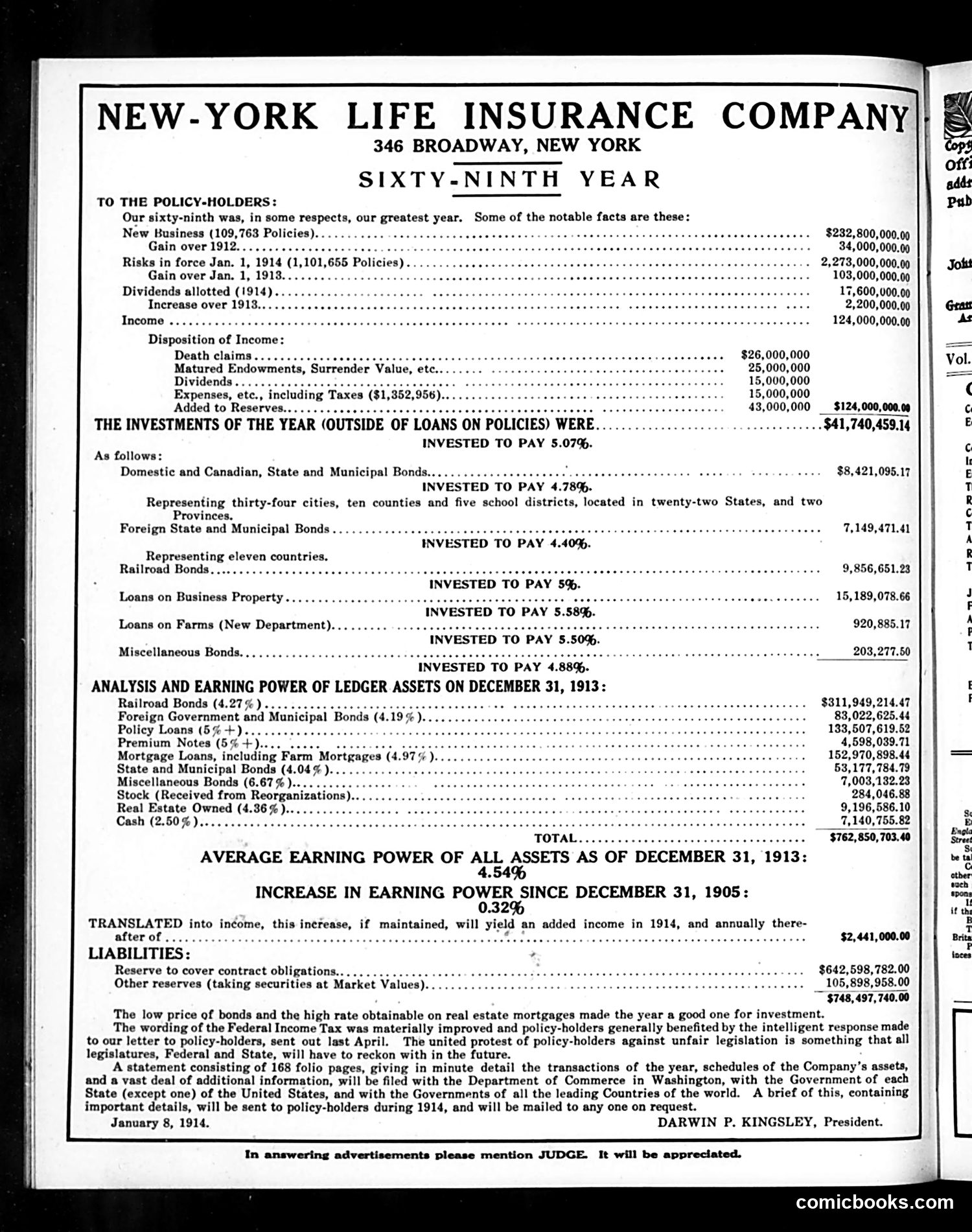
This page is primarily a **New York Life Insurance Company advertisement**, not satirical content. It presents the company's financial report for its sixty-ninth year, addressed to policyholders. The document details: - New business written: 109,763 policies worth $232.8 million - Total risks in force: 2.2+ billion dollars - Investment portfolio breakdown (bonds, railroad stocks, real estate mortgages) - Earnings analysis showing 4.54% average earning power - Liabilities and reserves The only editorial comment appears at the bottom, where President Darwin P. Kingsley notes that "the low price of bonds and the high rate obtainable on real estate mortgages made the year a good one for investment." This reflects 1913-1914 economic conditions, though no specific political satire or cartoon content is visible in this primarily financial/advertising page.
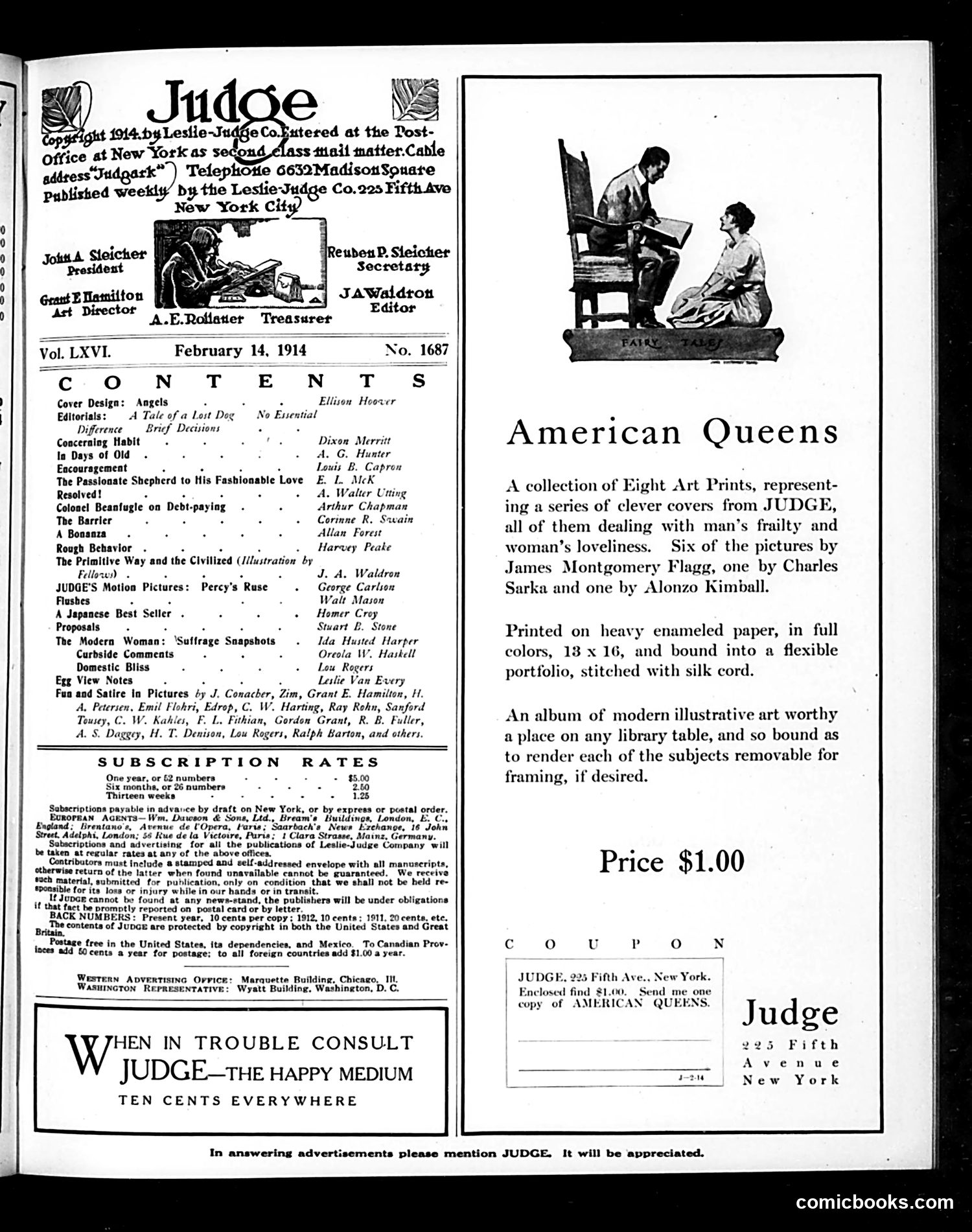
This page is primarily **advertising and editorial matter** rather than political satire. The main content advertises "American Queens," a collection of eight art prints ($1.00) featuring women's portraits by artists including James Montgomery Flagg. The images depict idealized feminine beauty—consistent with early 20th-century aesthetic standards celebrating "woman's loveliness." The small illustration shows a man presenting artwork to a seated woman, emphasizing art's role in domestic refinement. The subscription rates and masthead information confirm this is Judge's standard format. There is **no identifiable political cartoon or satirical commentary** on this particular page. It represents the magazine's commercial side rather than its satirical editorial content.
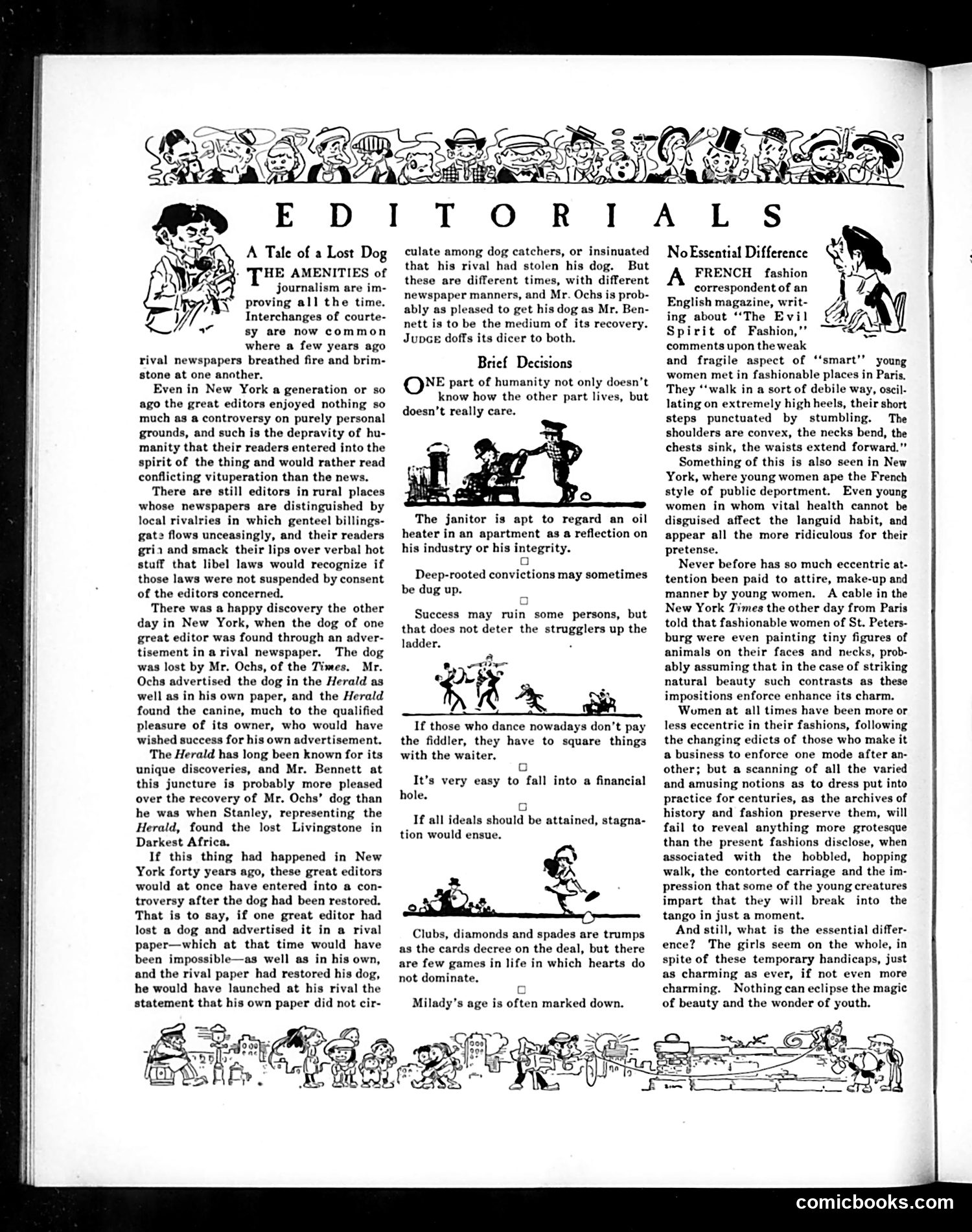
This page contains two distinct editorials with accompanying illustrations: **"A Tale of a Lost Dog"** satirizes newspaper rivalries. It describes how competing New York newspapers fought over coverage of a lost dog belonging to editor Mr. Ocha. The Herald and rival papers used the story as ammunition, with the Herald ultimately advertising the dog's recovery. The satire criticizes how newspapers sensationalize trivial personal matters to boost circulation and attack competitors—suggesting that journalistic integrity took backseat to commercial rivalry. **"No Essential Difference"** critiques fashionable Parisian and American women's exaggerated clothing and deportment. The editorial mocks their extreme high heels, contorted postures, and artificial appearance, comparing their eccentric fashion choices to animals. It argues that despite claims to sophistication, these fashions make women appear ridiculous rather than charming. Both editorials employ social satire typical of Judge's approach.
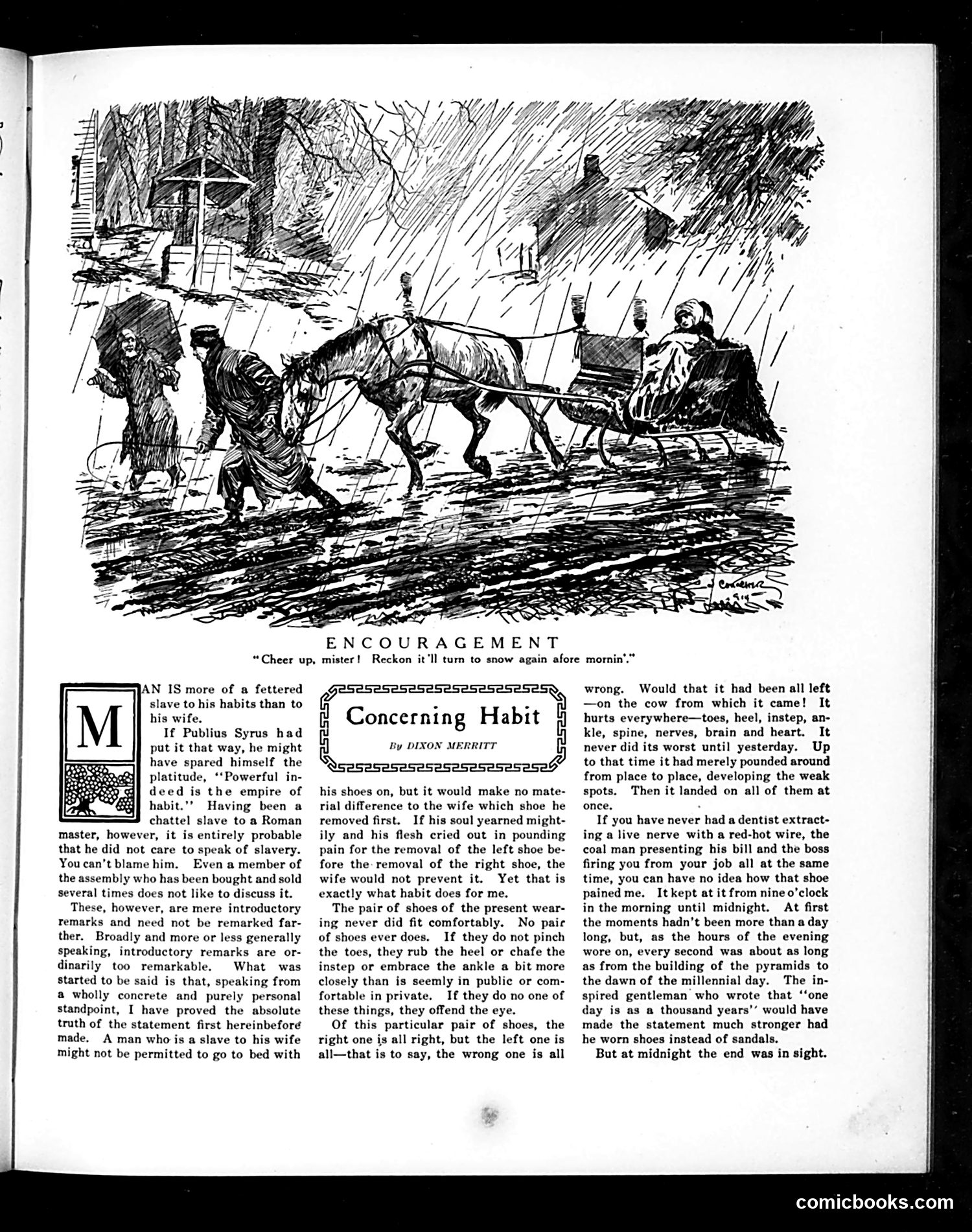
**The Cartoon ("Encouragement"):** The top illustration depicts a snowy rural scene with a horse-drawn sleigh carrying passengers in heavy rain/snow. A figure walks alongside holding an umbrella, while another stands to the left. The caption reads: "Cheer up, mister! Reckon it'll turn to snow again afore mornin'." This appears to be gentle humor about rural pessimism—a countryman offering dubious "encouragement" during miserable weather. **The Article:** "Concerning Habit" by Dixon Merritt discusses how habits enslaved him, using the extended metaphor of wearing uncomfortable shoes. He illustrates how people tolerate daily discomforts without questioning them—the left shoe always pinches, yet he never changes either shoe. The piece is philosophical commentary on human acceptance of unnecessary suffering due to habit rather than necessity. Neither the cartoon nor article addresses specific political events or figures.
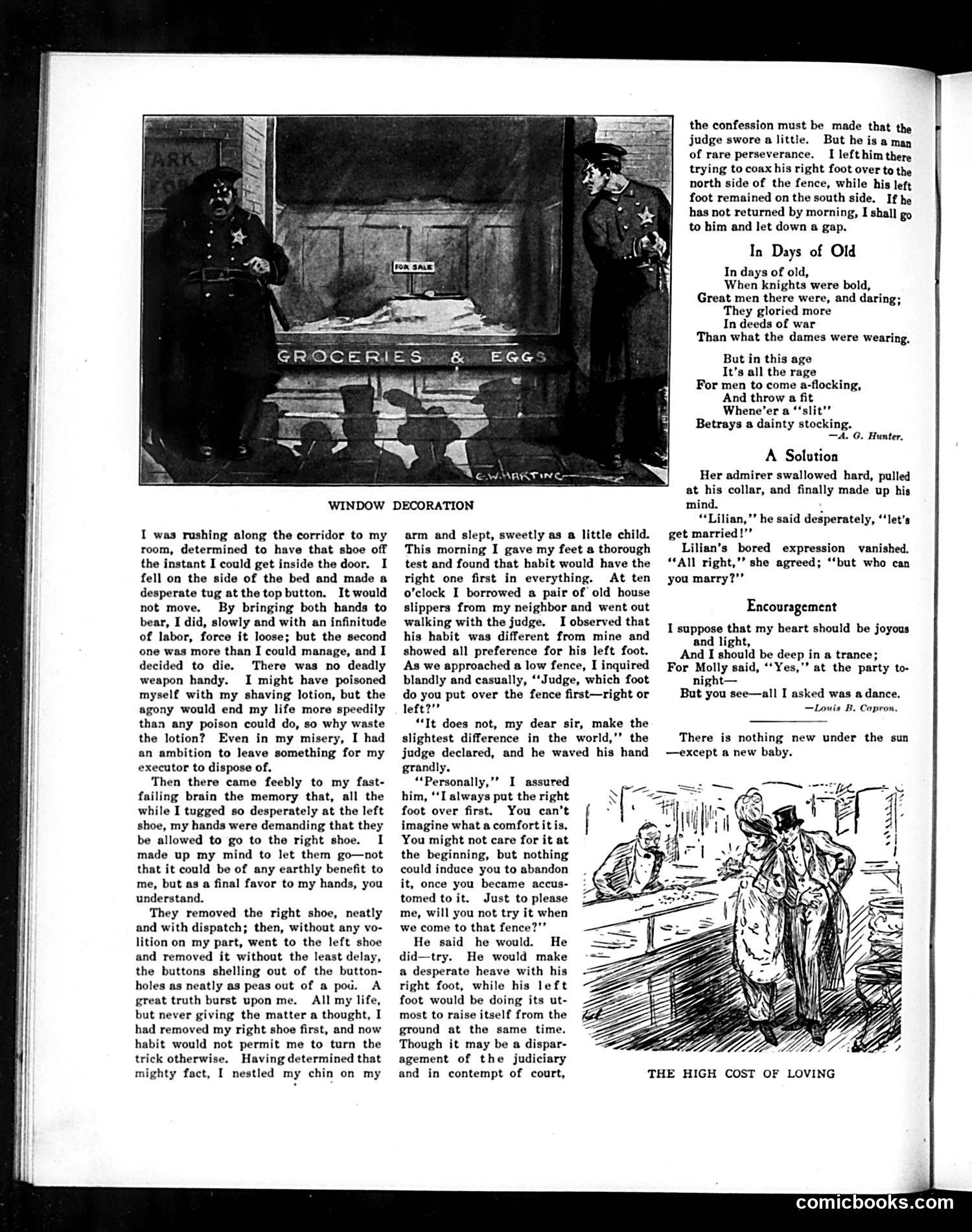
The main cartoon, "Window Decoration," depicts a humorous scene outside a "Groceries & Eggs" shop where two uniformed military or official figures stand guard while someone struggles with a low fence. The accompanying text is a comedic anecdote about habit and human nature: the narrator discovers he always removes his right shoe first due to ingrained habit. When he cajoles a judge to try removing his left shoe first at a fence, the judge's body rebelliously refuses—his left foot won't cooperate. The satire mocks the judge's pretension of being unaffected by habit, showing how even authority figures are slaves to routine. The other content includes poems mocking modern fashion vanity and romantic conventions, presenting satirical commentary on contemporary social customs rather than specific political figures.
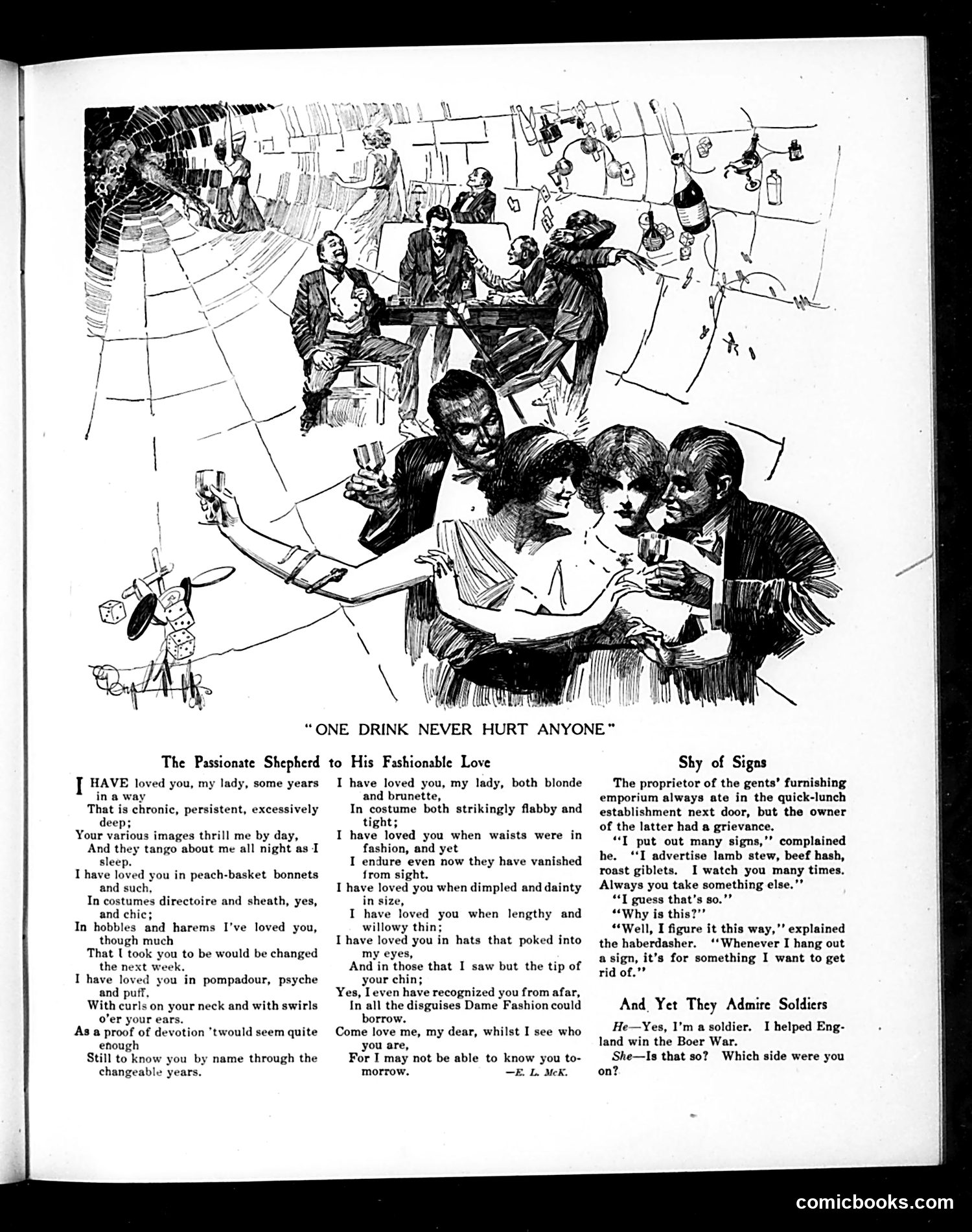
This page contains three separate pieces of humor typical of early 20th-century satirical magazine content. **Top illustration and "The Passionate Shepherd"**: A poem mocking fashion's constant changes. The speaker claims unchanging love for a woman despite her perpetually shifting appearance—different hairstyles, silhouettes, and clothing trends. The satire targets women's fashion industry's relentless reinvention, suggesting women are unknowable chameleons following every whim. The theatrical scene above depicts fashionable society. **"Shy of Signs"**: A brief comic dialogue. A restaurant owner complains his neighbor (haberdasher) never orders advertised specials. The punchline reveals the haberdasher believes signs advertise items the proprietor wants to *dispose of*, not sell—mocking both advertising's unreliability and commercial skepticism. **"And Yet They Admire Soldiers"**: A short flirtation joke. A soldier boasts of serving in the Boer War; when a woman asks which side he was on, the implication is ambiguous—possibly satirizing mercenaries or questioning actual military service claims during that conflict (1899-1902). The page emphasizes social pretense and commercial dishonesty.
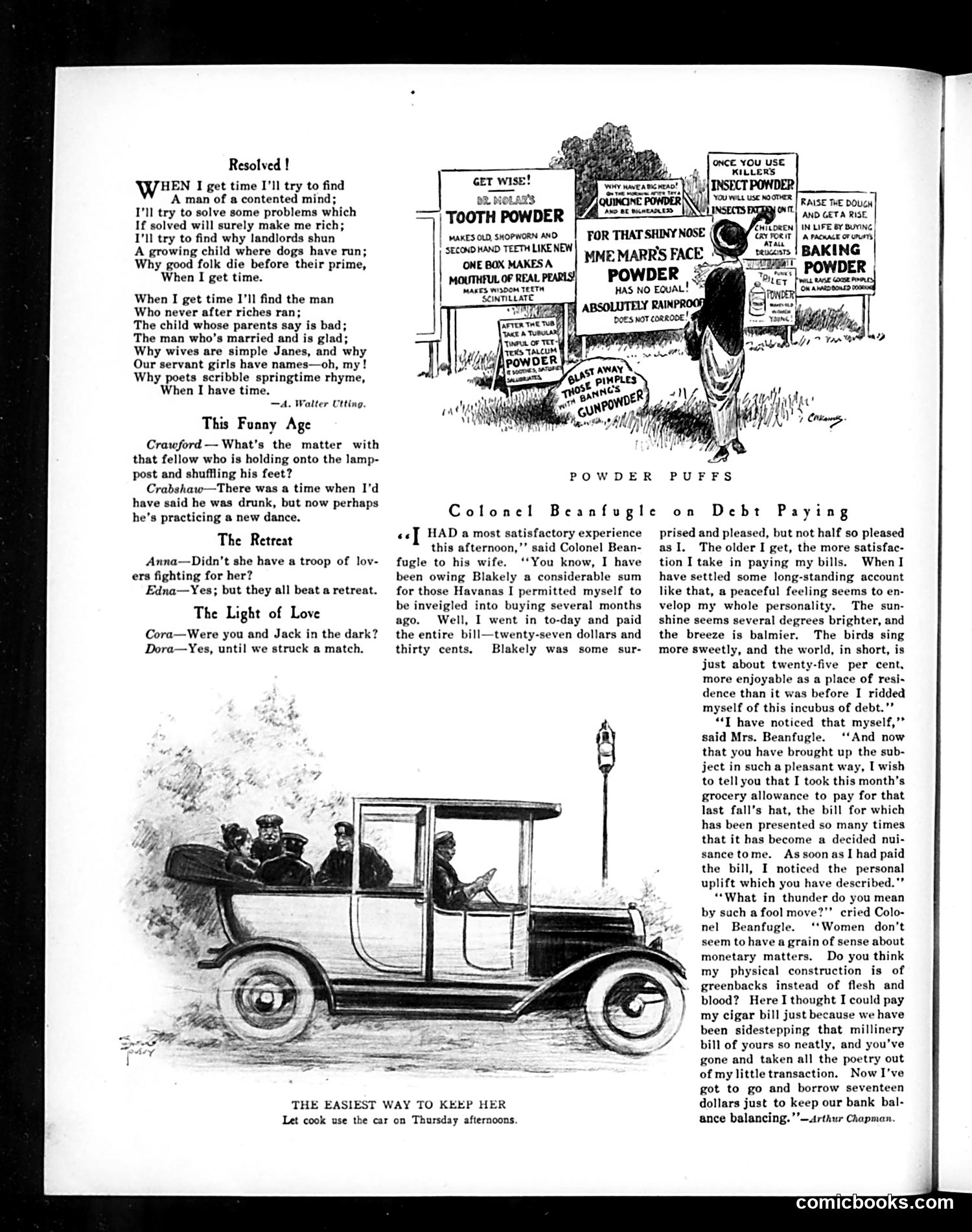
This page contains satirical humor and period advertising typical of early 20th-century American magazines. **Main Content:** The "Powder Puffs" cartoon depicts a woman surrounded by exaggerated advertisements for patent medicines and powders—tooth powder, face powder, insect powder, baking powder. The satire mocks the era's obsession with commercial products promising miraculous results (yellowed teeth made "like new," pimples "blasted away"). **Stories/Humor:** Short comic dialogues mock social conventions: a drunk man "practicing a new dance," lovers who "retreat" from courtship, a couple in the dark until they "strike a match." **"Colonel Beanfugle" Story:** A husband proudly pays off a debt, feeling virtuous and peaceful. His wife then reveals she spent the grocery allowance on a hat, destroying his moral satisfaction and forcing him to borrow money to balance the budget. The satire targets marital financial conflicts and the husband's hypocrisy—his self-righteousness evaporates when confronted with his wife's spending. The humor assumes readers recognize the common tension between spouses over household finances.
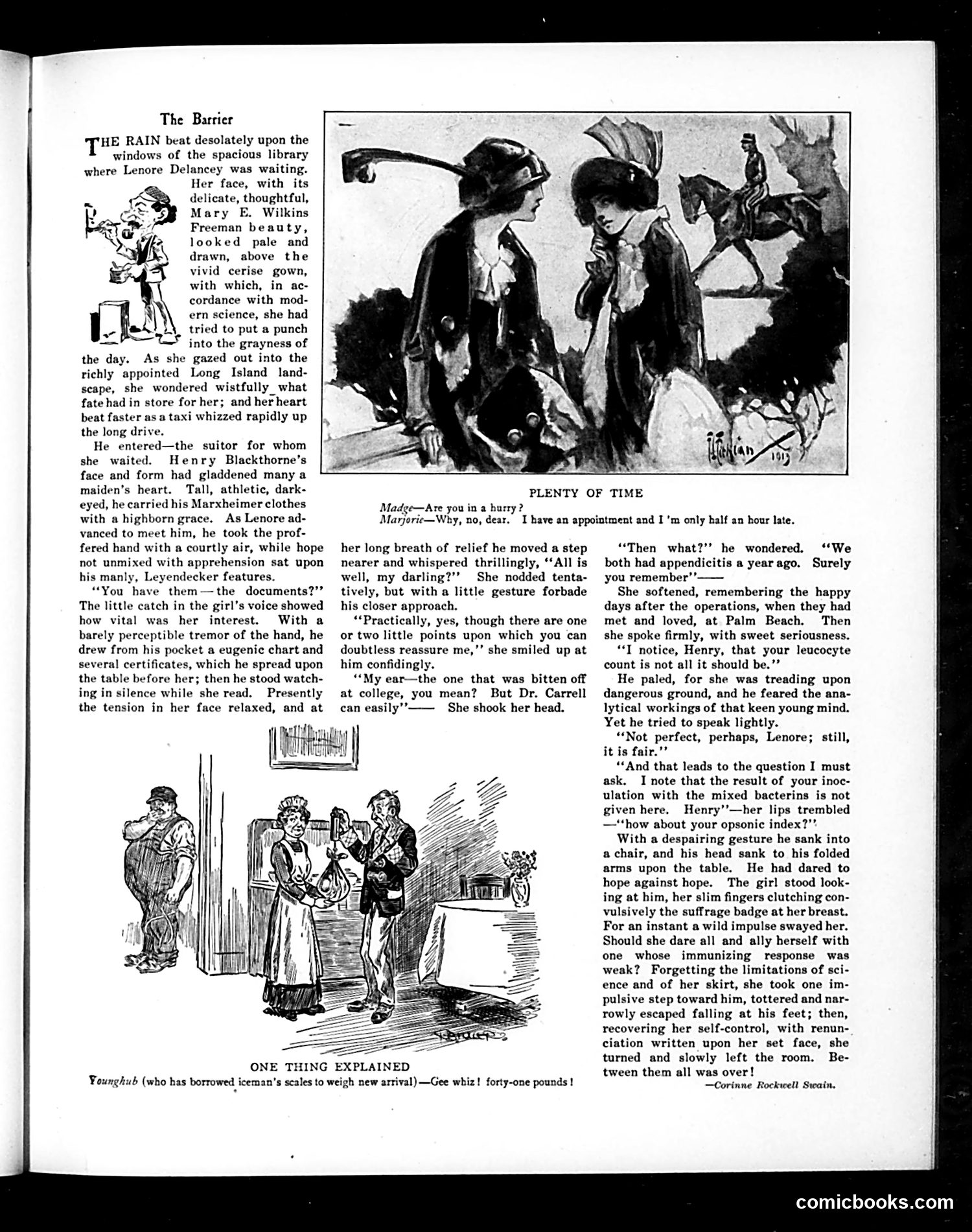
This page satirizes the early 20th-century obsession with eugenics and scientific rationality in courtship. The main story follows Lenore Delancey, who evaluates her suitor Henry Blackthorne not on love or character, but on medical certificates and eugenic charts—checking his leucocyte count, opsonic index, and inoculation records. The joke targets Progressive Era enthusiasm for applying "science" to human improvement and mate selection. Rather than romantic passion, their relationship hinges on laboratory data. When Henry's immunological response proves inadequate, Lenore—wearing a suffrage badge—rejects him despite emotional attachment, prioritizing scientific standards. The bottom cartoon, "One Thing Explained," shows a new arrival weighed at 41 pounds, likely mocking the period's obsession with measuring and quantifying everything, even infants. The satire critiques how pseudo-scientific thinking could replace human emotion and judgment in intimate decisions.
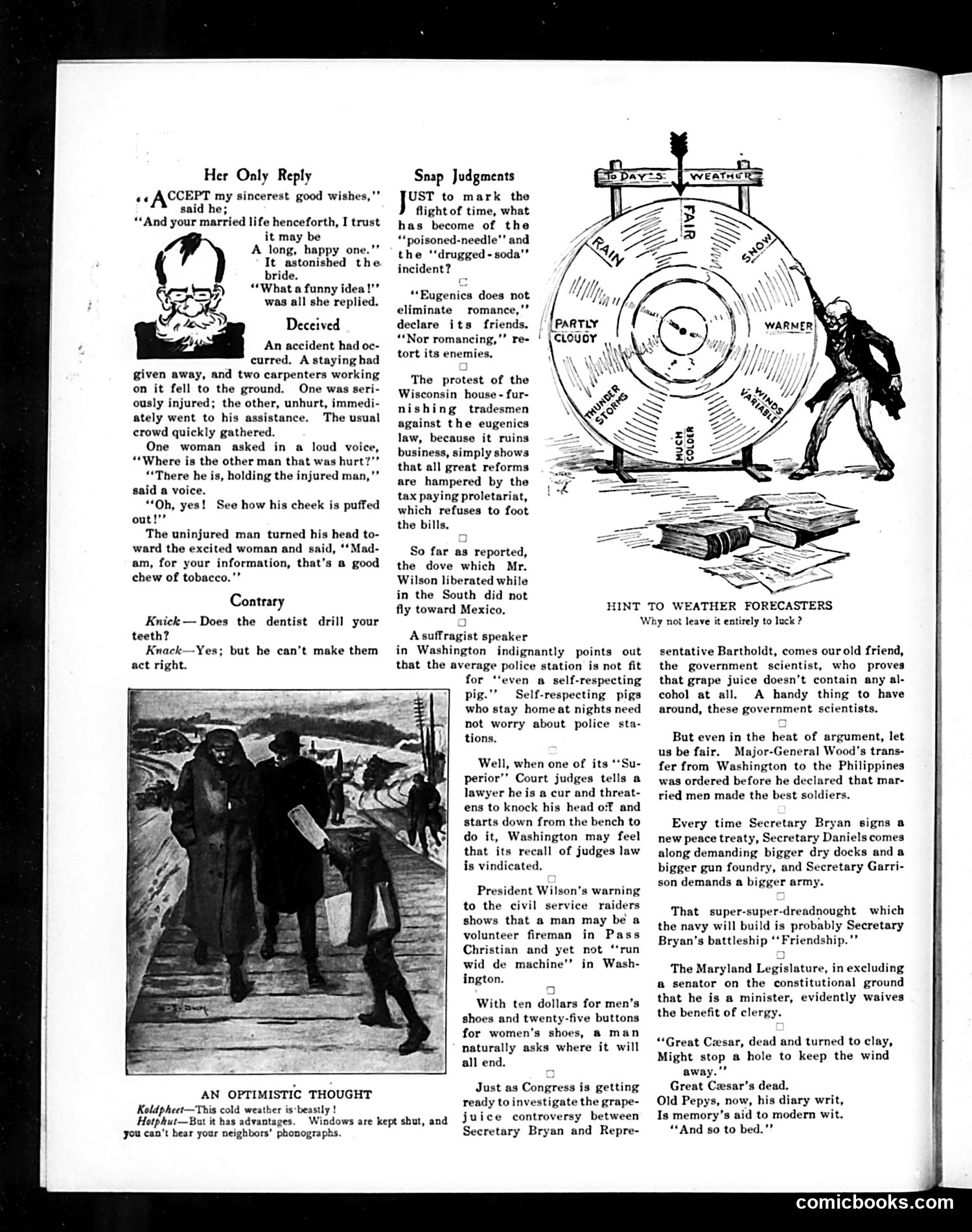
This page from Judge magazine contains multiple brief satirical commentaries on early 20th-century American politics and social issues, likely from President Woodrow Wilson's administration (1913-1921). **Key targets:** - **Secretary Bryan**: Referenced multiple times regarding his pacifism (peace treaties) versus Secretary Daniels's military buildup—mocking the contradiction between the administration's peace rhetoric and defense spending. - **Eugenics law**: Wisconsin's eugenics legislation is mocked as economically damaging to businesses while claiming to represent "reform." - **Suffragists**: A female speaker complaining about poor police station conditions is sarcastically compared to a "self-respecting pig." - **Wilson's civil service reform**: His anti-corruption stance is questioned through an anecdote about a judge behaving violently. The overall tone satirizes government inconsistency, questions about progressive reform's practicality, and includes period gender-based humor. The "weather forecasters" cartoon appears unrelated political commentary.
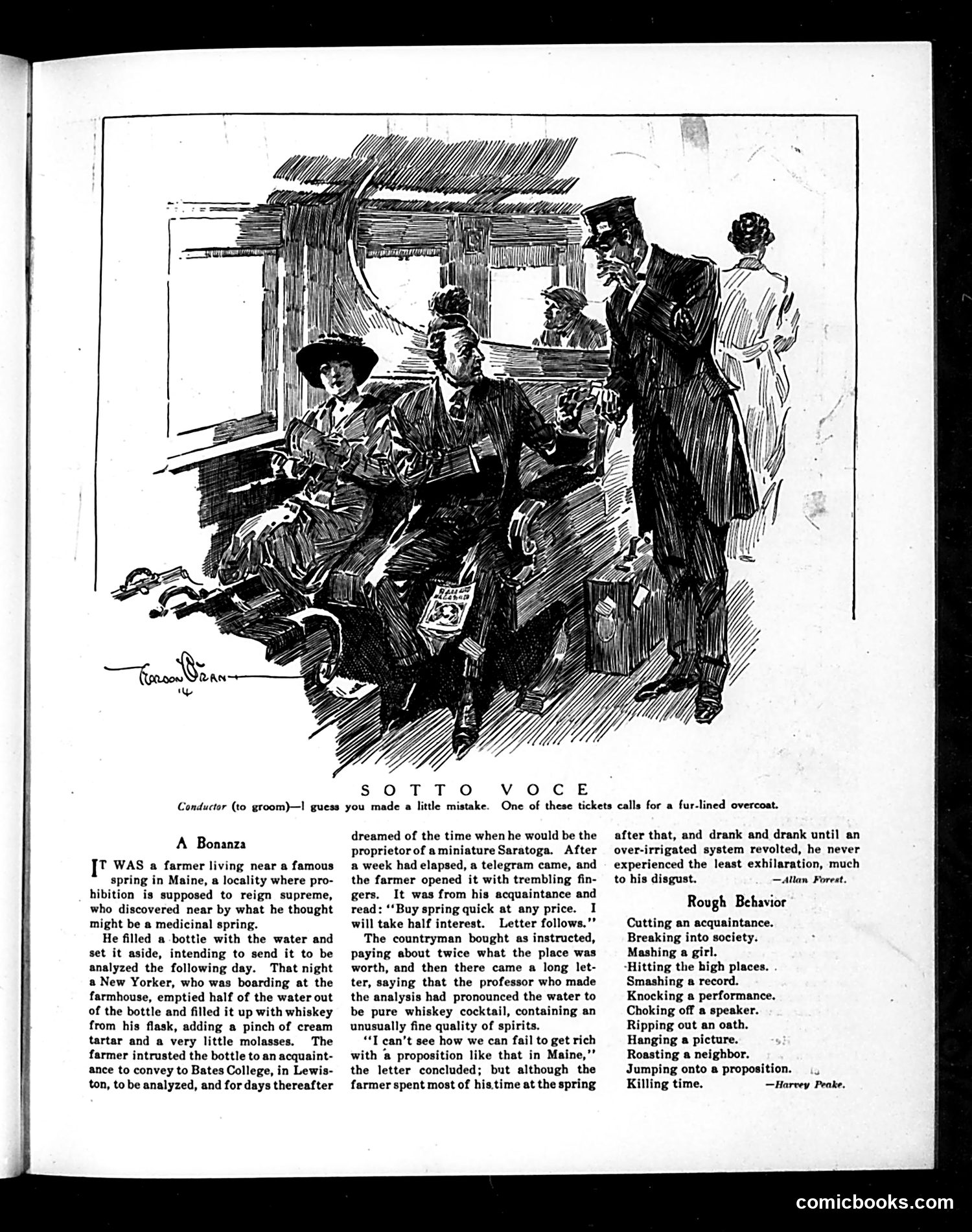
The top illustration, titled "Sotto Voce," depicts a streetcar conductor addressing a groom (likely a wedding attendant), suggesting the groom made "a little mistake"—presumably a social or transportation error. The cartoon satirizes awkward public moments and social missteps. Below, "A Bonanza" recounts a con story: a New York visitor adulterates a Maine farmer's spring water sample with whiskey and molasses, then has it "analyzed" at Bates College with a fake telegram claiming it's pure whiskey cocktail. The gullible farmer buys the worthless spring at inflated price, expecting to become wealthy like Saratoga Springs resort owners. The satire mocks rural naïveté and the era's dubious mineral-spring health crazes. The right column lists "Rough Behavior"—slang terms for impolite acts (cutting acquaintances, roasting neighbors, etc.)—likely a glossary of contemporary slang for modern readers.
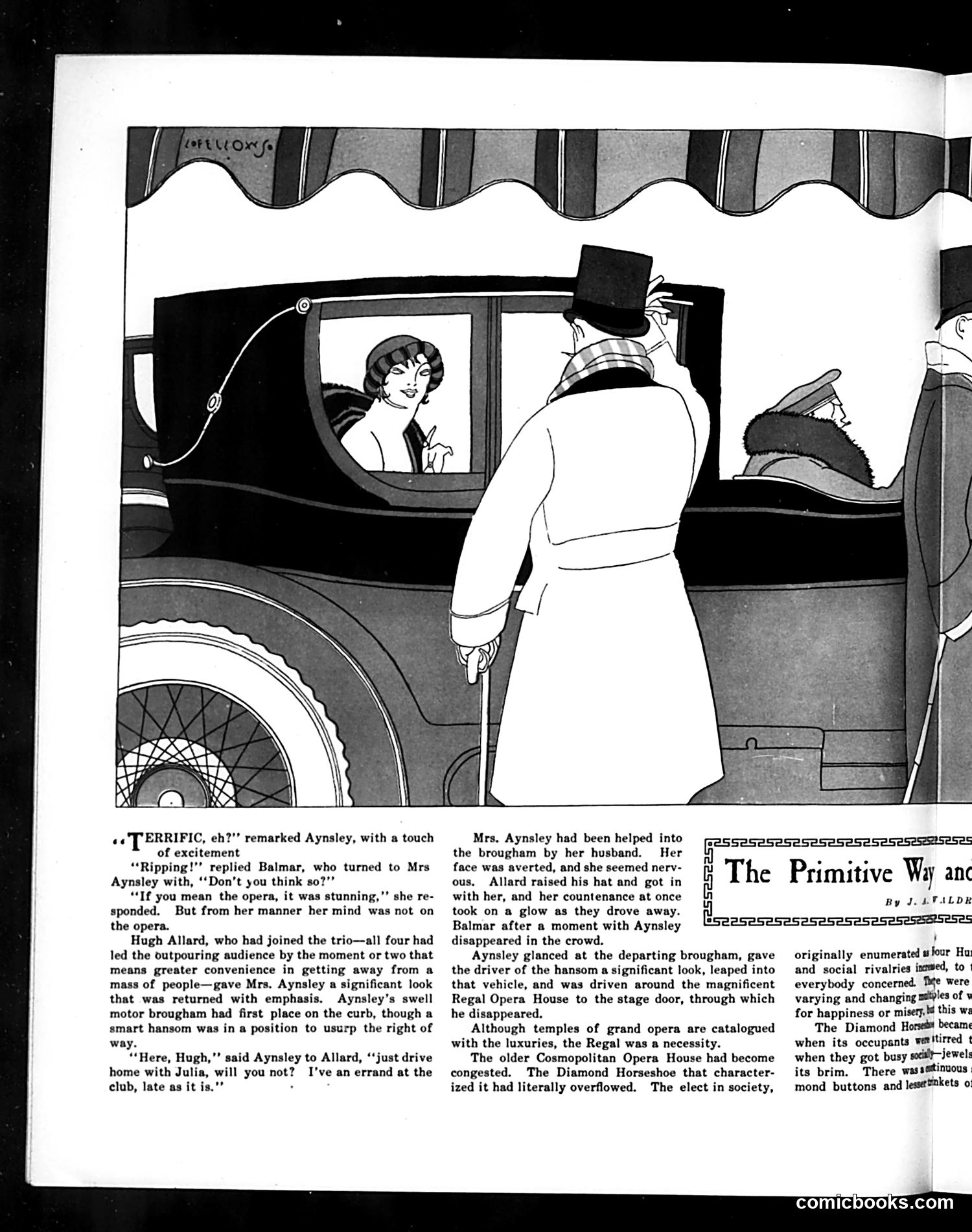
This page depicts a social comedy of manners centered on infidelity at the opera. The scene shows Mr. Aynsley arranging for his wife Julia to leave with Hugh Allard in their motorcar while he pretends to have "an errand at the club." The text reveals Aynsley's deception: he actually follows them by hansom cab to the stage door of the opera house, suggesting an assignation. The satire targets upper-class hypocrisy and the motorcar's role in enabling clandestine affairs. The "swell motor brougham" provides convenient cover for illicit behavior—Aynsley deliberately positions it to usurp the hansom's spot, symbolizing his control over the situation. The broader context is society's obsession with the new Regal Opera House as a status symbol where "the elect in society" gather, yet beneath this veneer of respectability lurk deception and moral compromise. The joke relies on readers recognizing the transparent pretense of the polite excuse and the knowing glances exchanged among the characters.
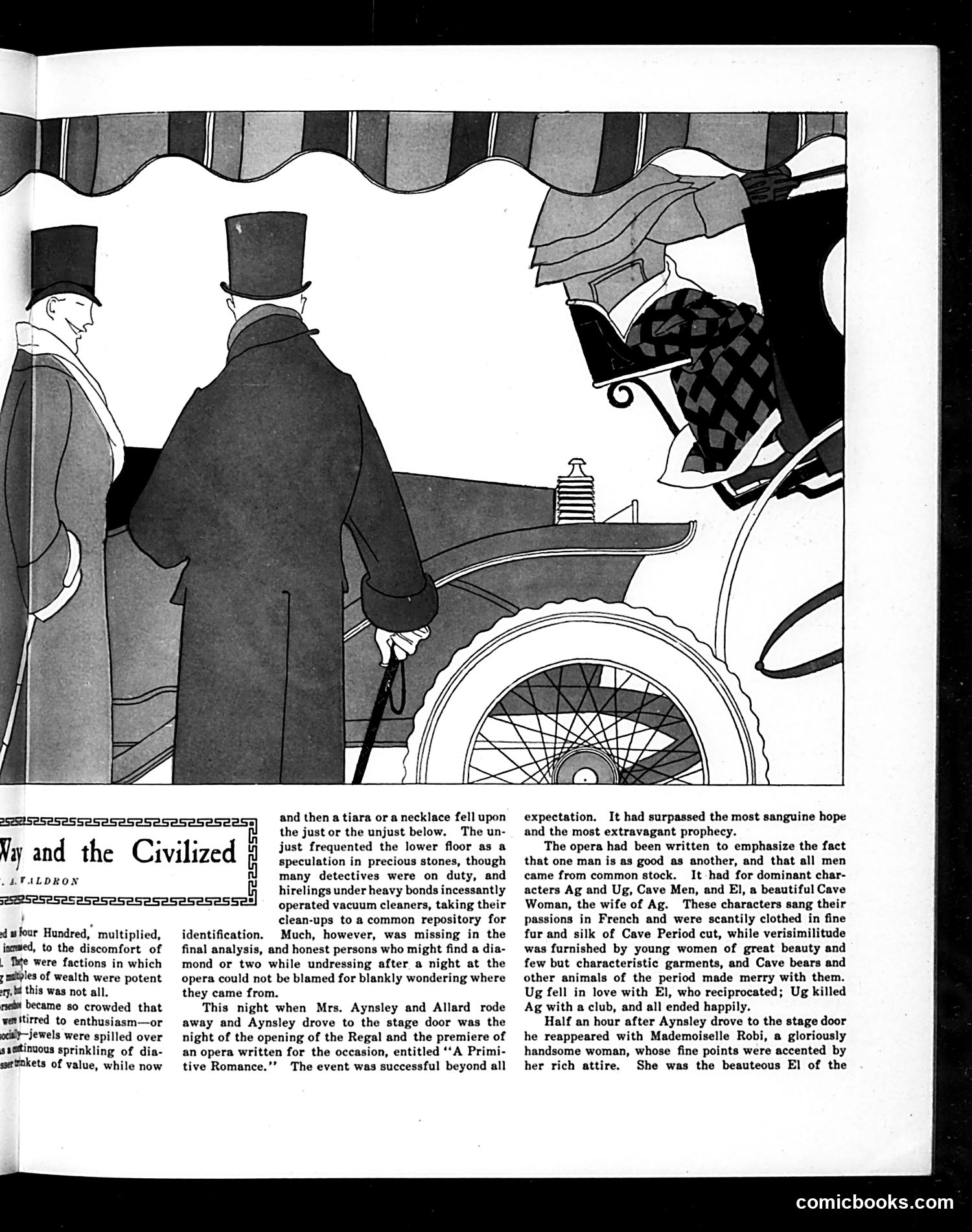
This page satirizes the opera world and wealthy society's hypocrisy regarding egalitarianism. The illustration shows well-dressed men in top hats and a woman arriving at what appears to be the opera house in an automobile. The text describes a newly premiered opera titled "A Primitive Romance," which ironically emphasizes that "all men came from common stock" while being performed by scantily-clad female dancers and featuring "Cave Period" costumes. The opera's plot—featuring cave men characters fighting over a woman—deliberately contrasts primitive themes with the refined, wealthy audience attending it. The satire targets how the upper classes (the "Four Hundred," referencing New York's social elite) attend productions preaching equality and common humanity, while living in a world of extreme wealth disparity marked by stolen jewels, detectives, and vacuum cleaners recovering lost diamonds from opera floors. The apparent protagonist, Aynsley, departs with "Mademoiselle Robi," the actress playing the lead role—suggesting romantic entanglement beneath society's civilized veneer.
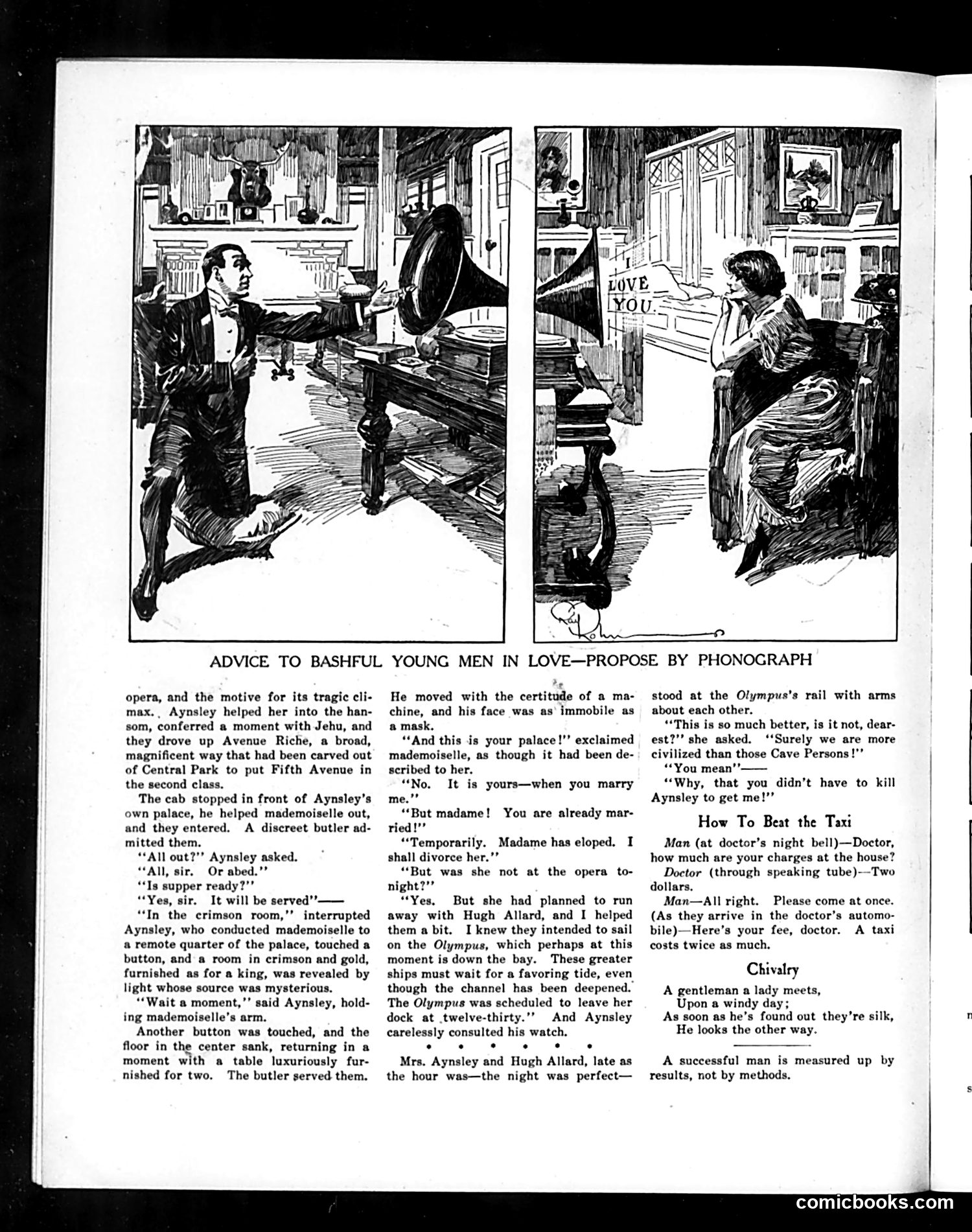
This *Judge* magazine page contains a serialized story titled "Advice to Bashful Young Men in Love—Propose by Phonograph," illustrated with two panels showing a wealthy man (Aynsley) seducing a woman (mademoiselle) in his luxurious home. **The Satire:** The story mocks upper-class excess and moral hypocrisy. Aynsley casually reveals he's helped his current wife elope with another man so he can marry the woman he's currently seducing—presenting infidelity and abandonment as convenient arrangements among the wealthy. The woman celebrates escaping "Cave Persons" (primitive people) who "had to kill" to get partners, congratulating herself on civilization while committing adultery. **Social Context:** This targets Gilded Age wealth disparity (the fictional "Avenue Riche" carved from Central Park) and mocks how the wealthy rationalize immoral behavior as sophistication. The page also includes unrelated humor: a taxi-beating joke and a brief piece on chivalry. These were typical *Judge* format—satirical stories mixed with short comic bits.
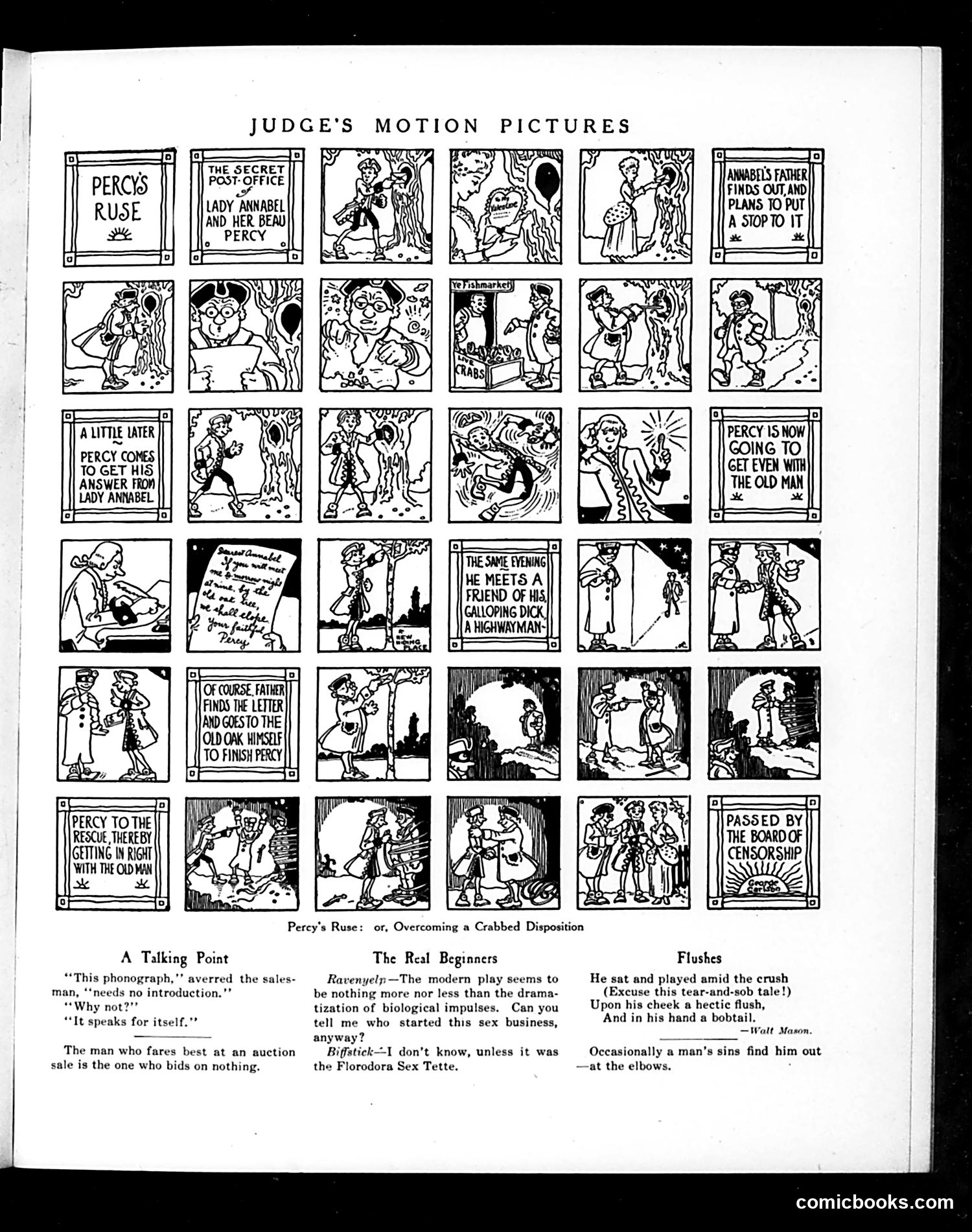
This page presents a sequential comic strip titled "Percy's Ruse: or, Overcoming a Crabbed Disposition," depicting a young man named Percy pursuing a romantic objective. The narrative appears to involve Percy courting a woman (Lady Annabel) whose father opposes the relationship, prompting Percy to devise schemes to win approval or elope. The strip's humor relies on physical comedy typical of early 20th-century silent film—exaggerated expressions, slapstick situations, and escalating predicaments. The repeated captions ("A Little Later," "The Same Evening") mimick film title cards. Below the strip, three brief satirical commentaries mock contemporary social attitudes: phonographs as status symbols, modern theater's fixation on sexuality, and auction etiquette. References to "Florodora Sex Tette" and "biological impulses" suggest Judge magazine's critique of increasingly frank theatrical content of that era. The overall tone is lighthearted domestic comedy aimed at middle-class readers.
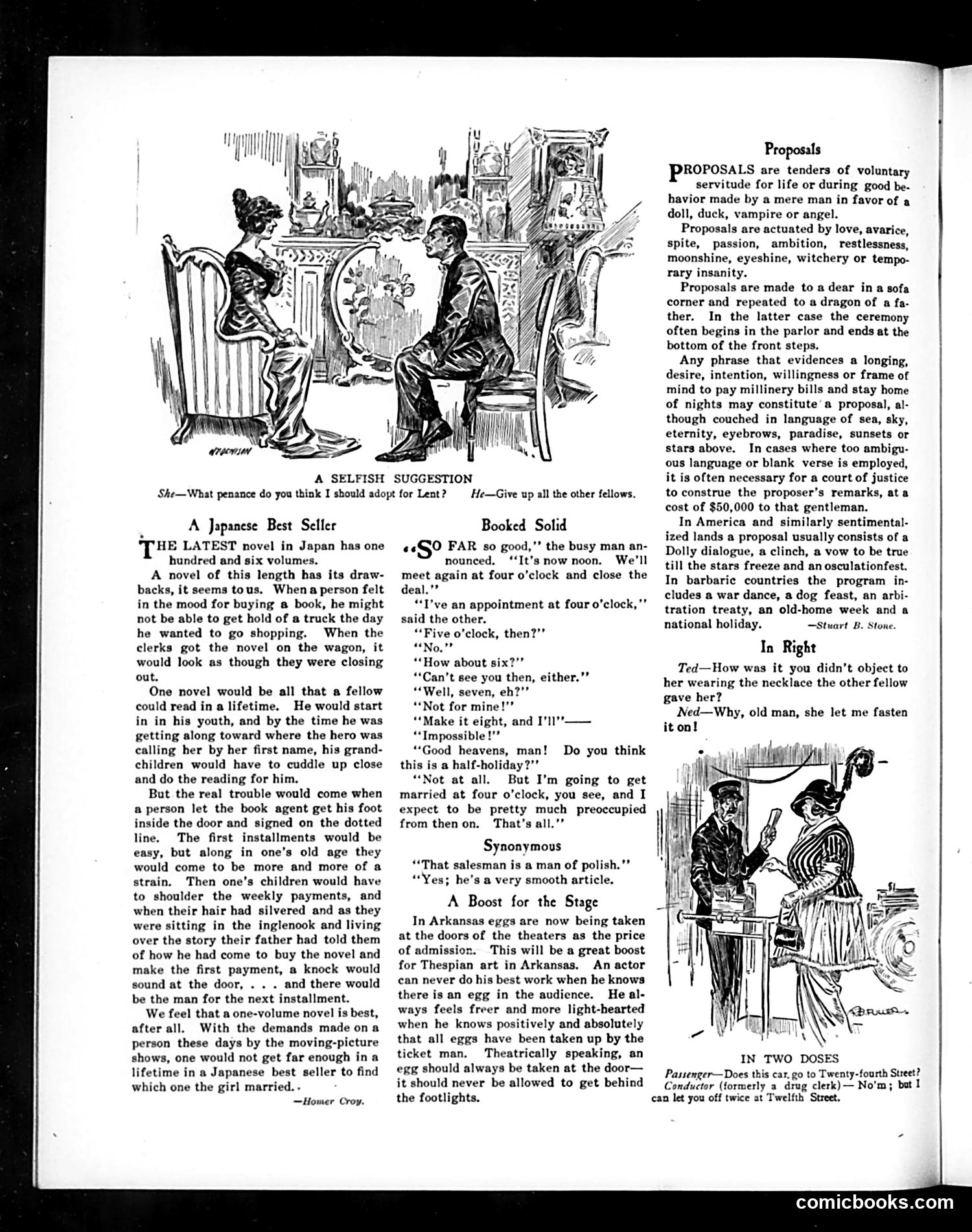
This page contains several brief humorous pieces satirizing early-20th-century American life: **"A Japanese Best Seller"** mocks the impracticality of an allegedly 106-volume Japanese novel, joking that readers would need a truck to transport it and spend their entire lifetime reading without finishing the plot. **"A Selfish Suggestion"** is a quick joke about Lenten sacrifice: a woman asks what penance to adopt; the man suggests she give up her other romantic suitors—implying she's juggling multiple admirers. **"Booked Solid"** satirizes a workaholic businessman so chronically busy that even his wedding day can't interrupt his schedule. When pressed to meet, he dismisses the other man's availability until revealing he's getting married at four o'clock. **"A Boost for the Stage"** is absurdist humor about Arkansas theaters accepting eggs as admission payment, suggesting this prevents actors from performing well because they fear "eggs in the audience"—a veiled reference to audiences throwing rotten eggs at poor performances. The "Proposals" section defines romantic marriage proposals with dry, cynical humor about motivations and melodrama.
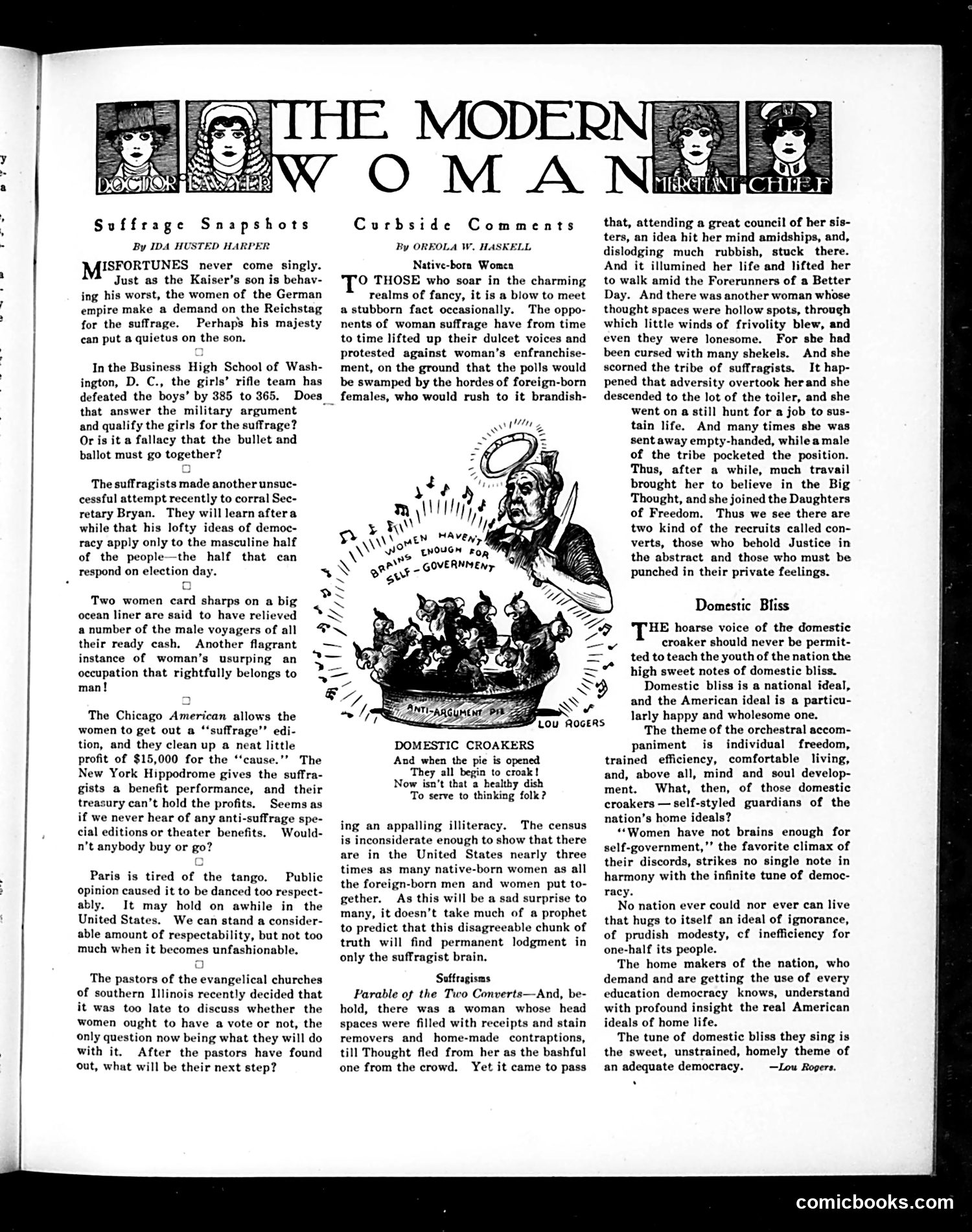
This *Judge* magazine page presents **opposing arguments about women's suffrage** through satirical commentary and cartoons, circa 1910s. **"Suffrage Snapshots"** (left) uses ironic anecdotes to mock anti-suffrage logic: German women demanding votes while the Kaiser's son misbehaves; girls outshoooting boys in rifle competition, yet opponents claim women lack military capacity; women successfully fundraising for suffrage while critics claim no one supports it. **"Curbside Comments"** (right) directly refutes a common anti-suffrage argument: opponents claimed foreign-born women would "swamp" polls with illiteracy. The census data, Haskell argues, shows nearly *three times* as many native-born women exist—rendering this fear absurd. The **cartoon** depicts caricatured "Domestic Croakers"—opponents depicted as gossiping figures in a pie—literally complaining ("croaking") about women's advancement, suggesting their criticism is baseless noise rather than reasoned debate. The overall message: anti-suffrage arguments are hypocritical, data-defying complaints masquerading as legitimate concerns.
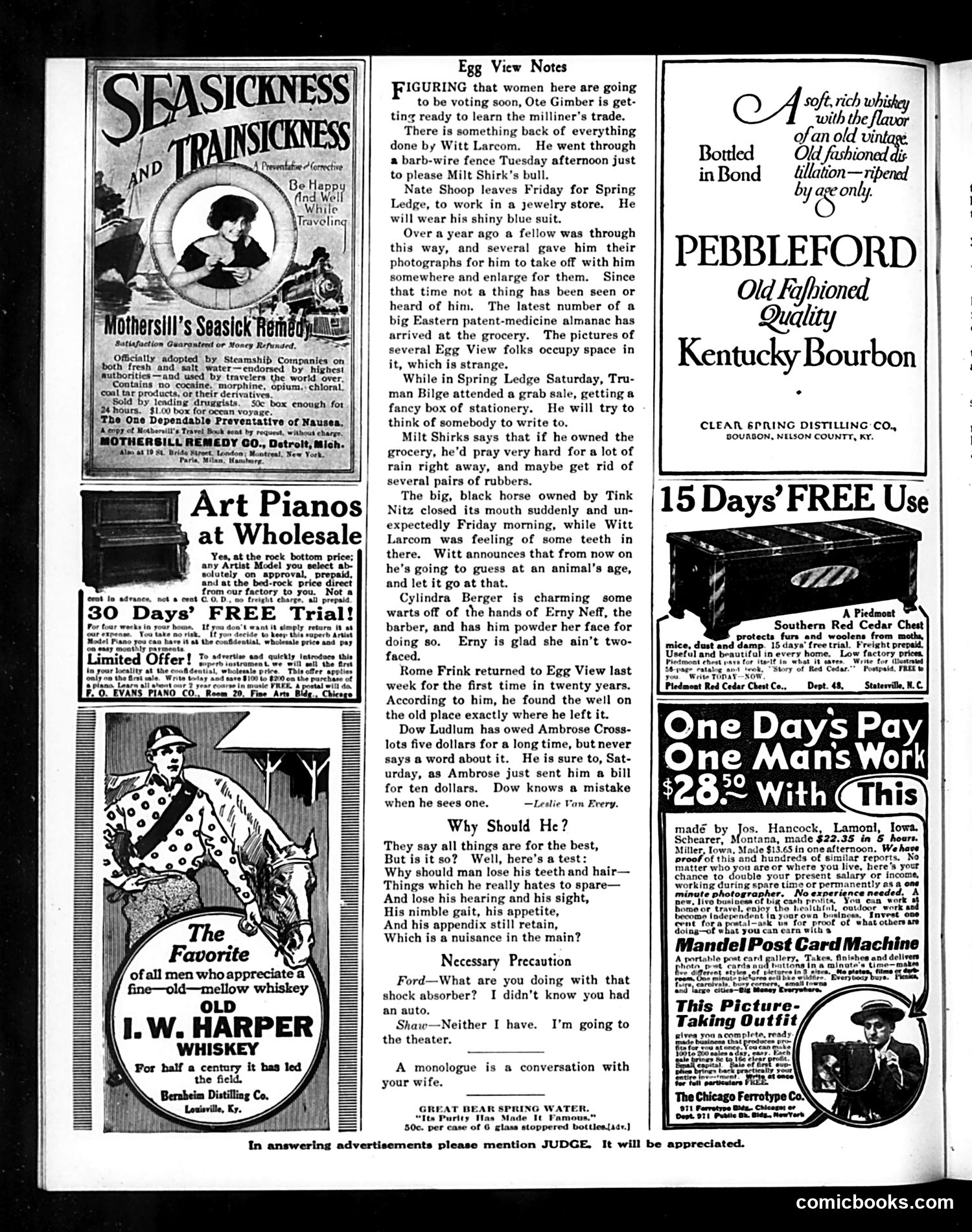
This page is primarily **advertising and humor filler** rather than political satire. The main content includes: **"Egg View Notes"** — A rural gossip column featuring small-town characters (Witt Larcom, Milt Shirk, Nate Shoop, etc.) engaged in mundane local happenings: someone learning millinery, jewelry store work, a missing photographer, and various romantic entanglements. The humor is gentle small-town Americana, not political. **Miscellaneous jokes** include "Why Should He?" (satirizing aging—why lose teeth/hair but keep a useless appendix?) and "Necessary Precaution" (a Ford joke about shock absorbers). **Advertisements** dominate: Mothersill's seasickness remedy, Art Pianos, I.W. Harper Whiskey, Pebbleford Kentucky Bourbon, and other products. No clear political cartoons or caricatures appear on this page. It represents typical Judge filler content: light humor, advertising, and rural Americana rather than satirical commentary on contemporary events or figures.
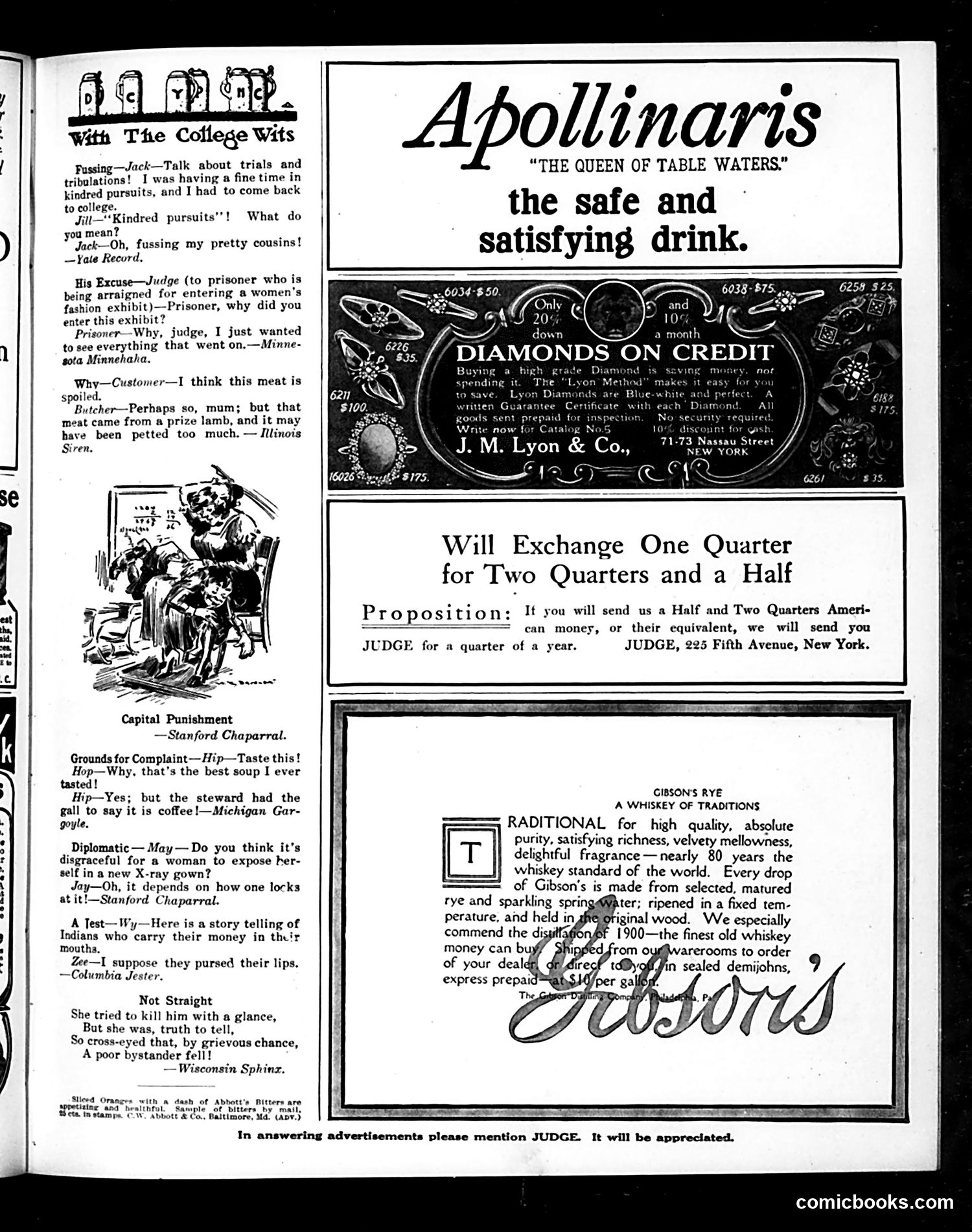
This page is primarily **advertising** interspersed with humor columns. The left side contains "College Wits"—brief jokes about university life, mostly playing on double meanings (a student caught "fussing" his cousins, a prisoner entering a women's fashion exhibit, wordplay about soup being called "coffee"). These are gentle, collegiate humor typical of early 20th-century satirical magazines. The advertisements dominate the right side: Apollinaris mineral water, J.M. Lyon & Co. diamonds sold on credit, Gibson's Rye whiskey, and notably a peculiar offer from Judge magazine itself—exchanging one quarter for "two quarters and a half" in coins to fund subscriptions. This last appears to be a subscription incentive or possibly a joke about inflation or currency manipulation, though the exact context is unclear. The single illustration shows "Capital Punishment," a somewhat grotesque figure, but without additional context its specific reference is uncertain.
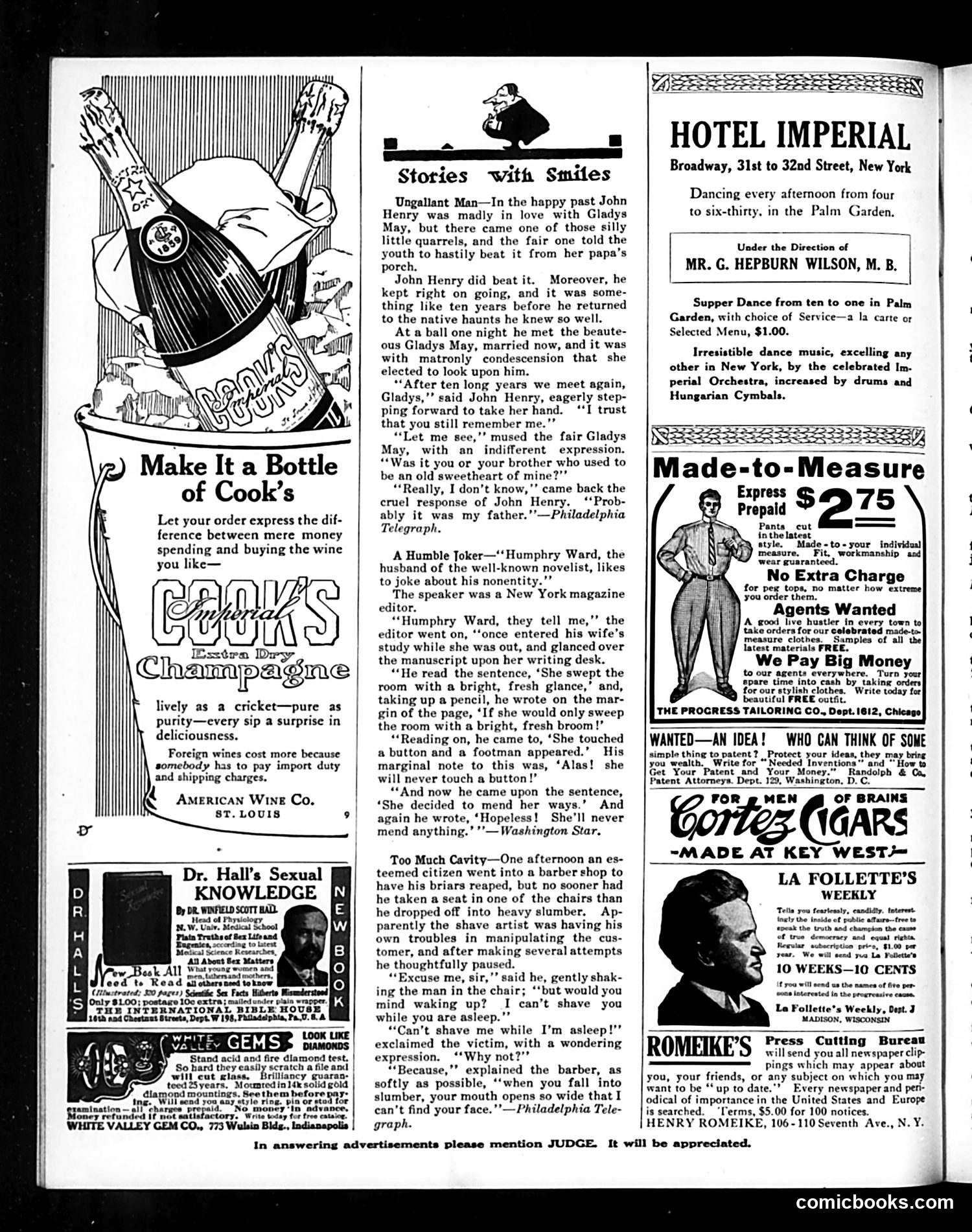
This page consists primarily of advertisements and short humorous fiction typical of *Judge* magazine. The main visual elements are ads for Cook's champagne and jewelry, along with three brief comedic anecdotes under "Stories with Smiles." The jokes exploit early 20th-century social conventions: one mocks a man's failed romantic pursuit; another satirizes a novelist's husband's self-deprecating jokes about his wife's success and his own irrelevance; the third relies on an insulting physical joke about a man's wide-open mouth while sleeping, implying his face is so large the barber cannot locate it to shave him. The advertising emphasizes luxury consumption—champagne, diamonds, and high-end hotel dining—typical of *Judge*'s wealthy readership. There's no overtly political satire; rather, the humor reinforces class assumptions and genteel courtship norms of the era.
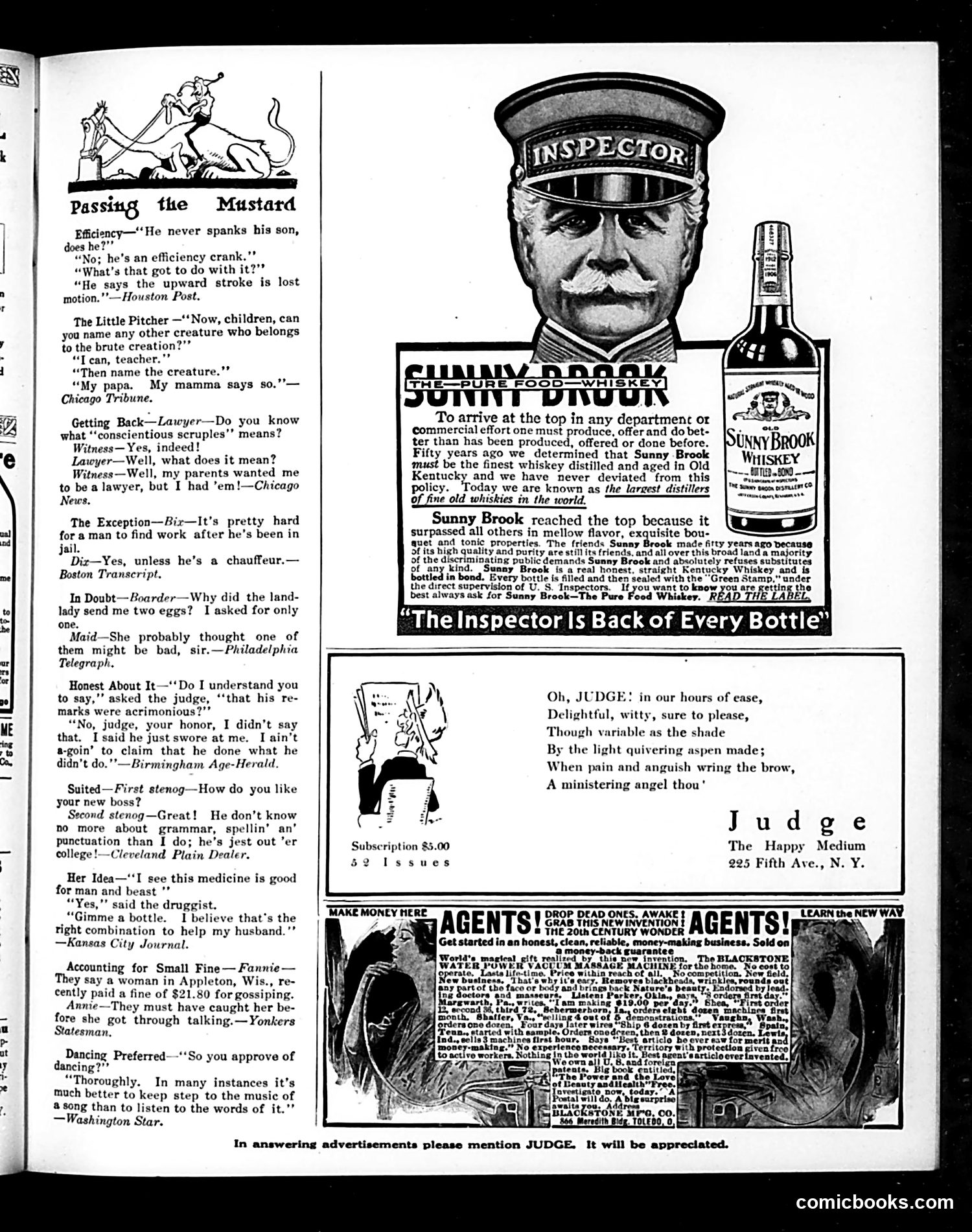
This page from *Judge* magazine contains brief humorous anecdotes and advertisements typical of early 20th-century American humor magazines. **The Jokes:** The left column collects short, punchy one-liners mocking contemporary social types—the "efficiency crank" who eliminates "lost motion" from parenting, the know-it-all lawyer, the naive secretary fresh from college who can't spell. These satirize modern workplace culture and pretension. **The Advertisement:** The dominant imagery is a Sunny Brook Whiskey ad featuring an "Inspector" character and bottle, emphasizing purity and government inspection under "Pure Food" standards—likely referencing the 1906 Pure Food and Drug Act. The ad claims 50 years of quality leadership. **The Poetry:** A brief verse addresses *Judge* magazine itself as a "ministering angel" during times of pain, promoting the magazine's $5 annual subscription. **The Agents Ad:** At bottom, a recruitment ad for selling "20th Century Wonder" machines—typical of period mail-order business schemes. Overall, the page reflects Edwardian-era consumer culture, workplace anxieties, and advertising appeals to safety and modernity.
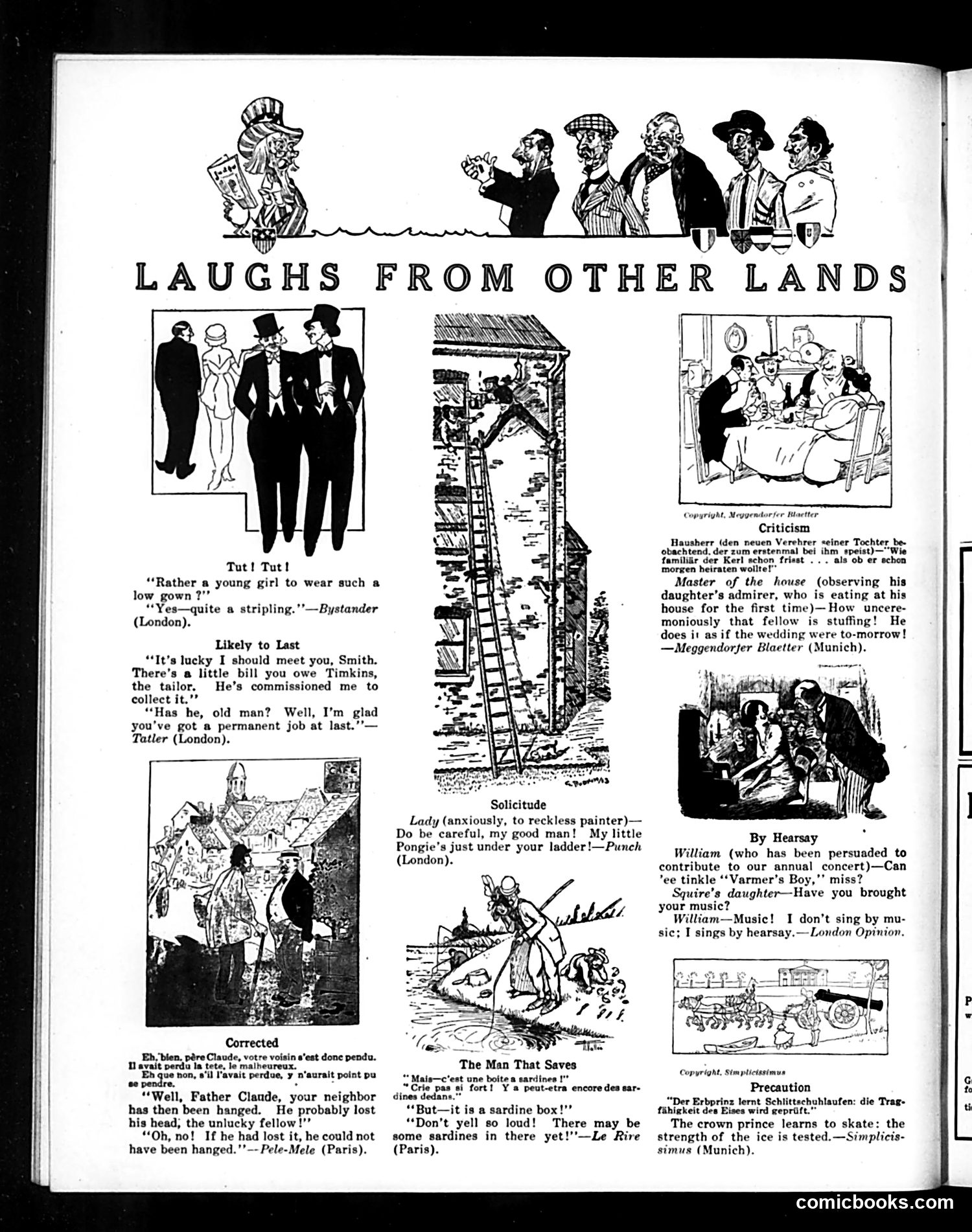
This page reprints humor from European satirical magazines (Punch, Le Rire, Simplicissimus, etc.), showcasing international comic sensibilities of the era. The jokes reflect period social attitudes: a young woman in a revealing gown draws disapproval; a tailor's endless bill-collecting becomes a "permanent job"; a priest's logic puzzle about a hanged man who "lost his head"; a painter recklessly working above a child; a miser hoarding sardines; a young suitor eating too familiarly before engagement; a rustic farmhand singing "by hearsay" rather than sheet music; and aristocratic caution testing ice for a crown prince's skating lesson. These are largely gentle observational humor about class, propriety, and human behavior—reflecting early 20th-century European middle-class anxieties about decorum, debt, and social mobility. The translations suggest American readers found foreign humor entertaining and culturally instructive.
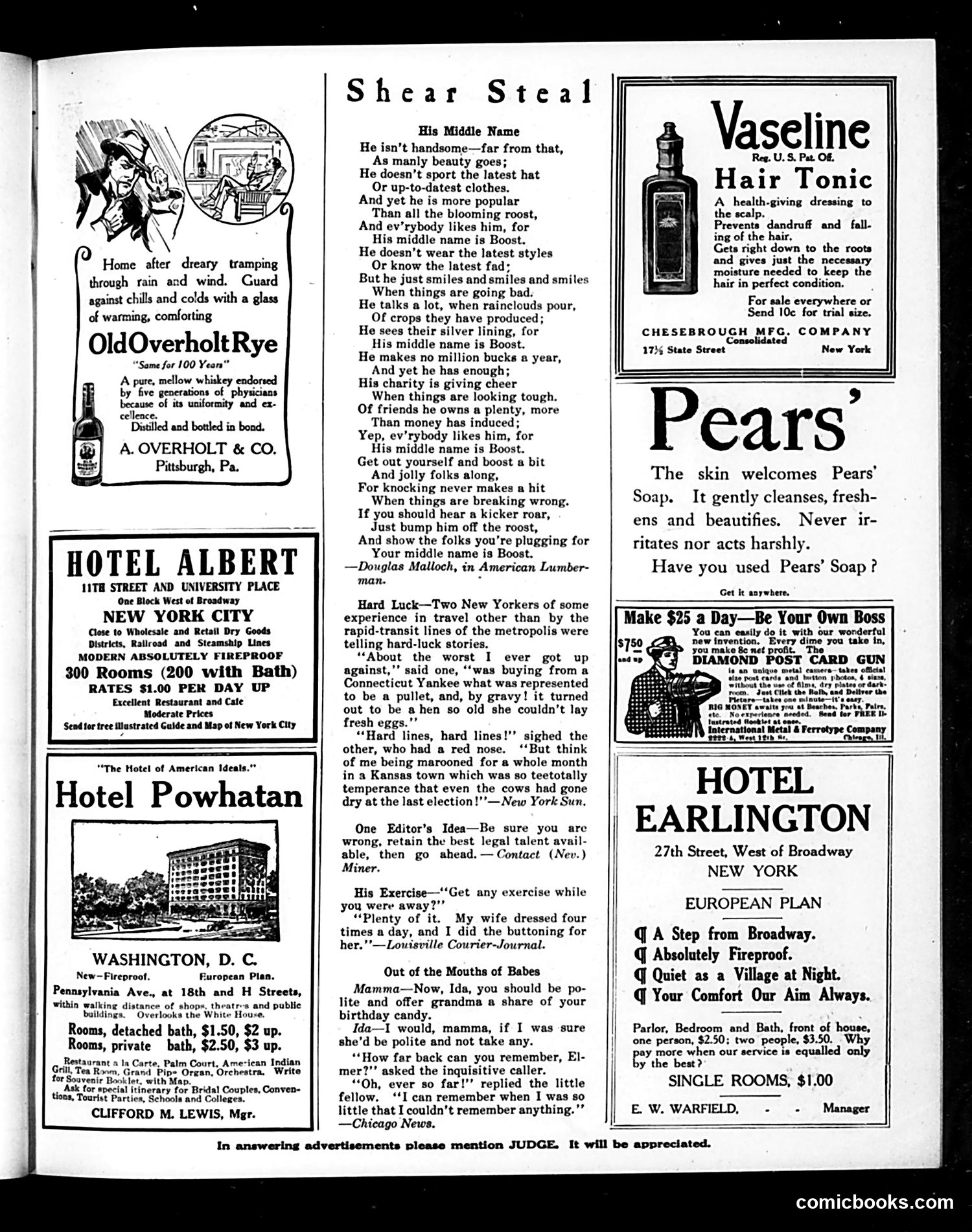
This is primarily an **advertising page** from Judge magazine, with small humorous anecdotes interspersed. The main illustrated content is a poem titled "Shear Steal: His Middle Name," which celebrates an unnamed everyman character whose defining trait is optimism and cheerfulness (his "middle name is Boost"). The satire appears gentle—mocking neither the character nor boosterism itself, but rather celebrating the social value of positive thinking and encouragement during hard times. The poem advocates for practical optimism: promoting your cause, supporting friends, and discouraging complainers. The remaining text consists of brief jokes about travel mishaps, legal strategy, marital life, and children's innocent logic—typical light humor from the era. The advertisements promote whiskey, hotels, soap, and a dubious "make $25 a day" business scheme, reflecting early-twentieth-century print media conventions.
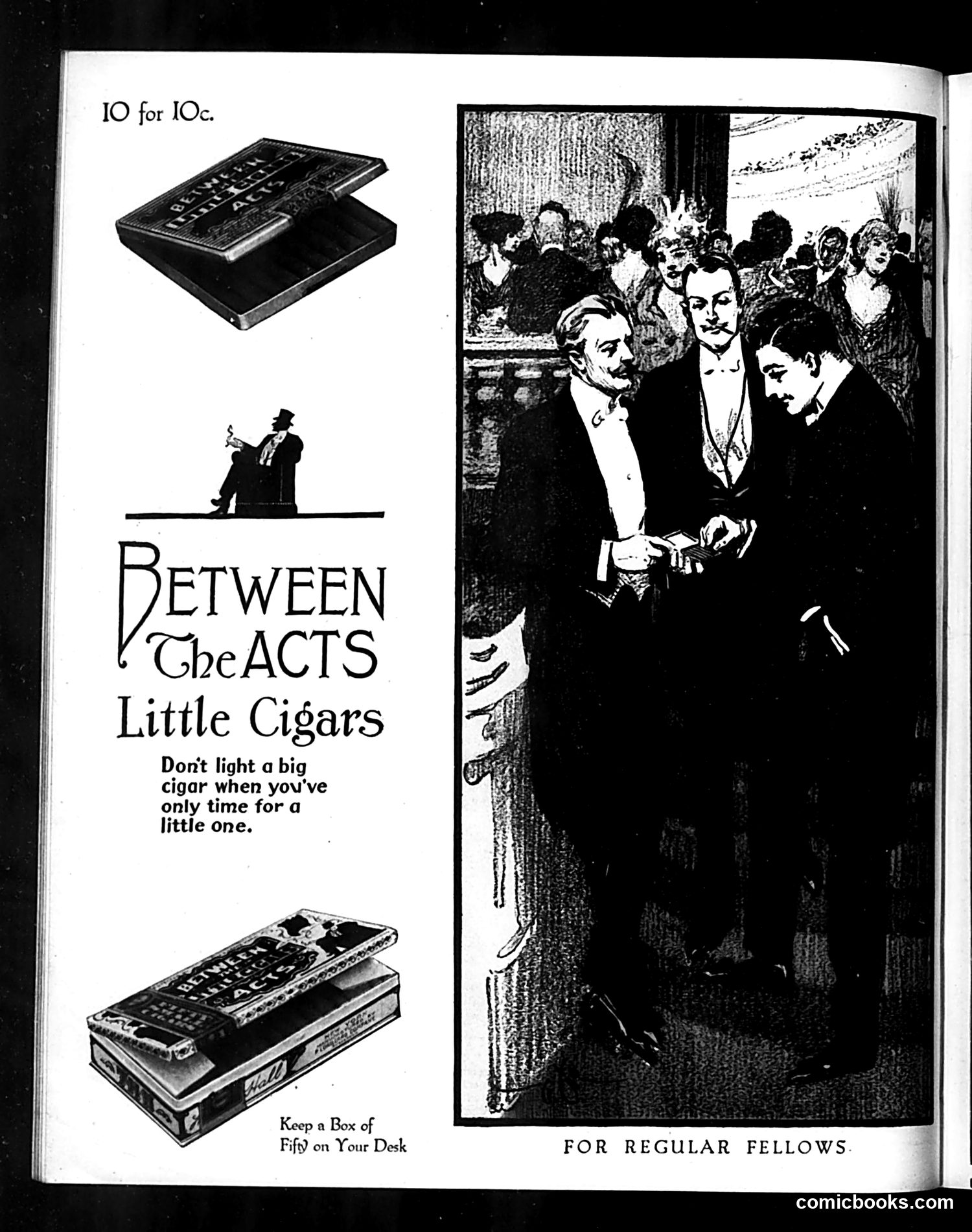
This is primarily a **cigarette advertisement**, not a political cartoon. The page advertises "Little Cigars" at 10 for 10 cents, positioned as practical for theatergoers during intermissions ("Between the Acts"). The accompanying illustration shows well-dressed men in formal attire at what appears to be a theater or social event. The tagline "For Regular Fellows" uses period-appropriate marketing language suggesting these cigars suit ordinary gentlemen. The sole satirical element is subtle: the ad's premise mocks the inconvenience of smoking large cigars during brief theater breaks—implying that "regular fellows" lack time for proper leisure. This reflects early 20th-century social commentary on rushed modern life, though it's incidental to the product pitch rather than the page's primary purpose.