
Judge, 1914-02-14 · page 6 of 24
Judge — February 14, 1914 — page 6: what you’re looking at
What you’re looking at
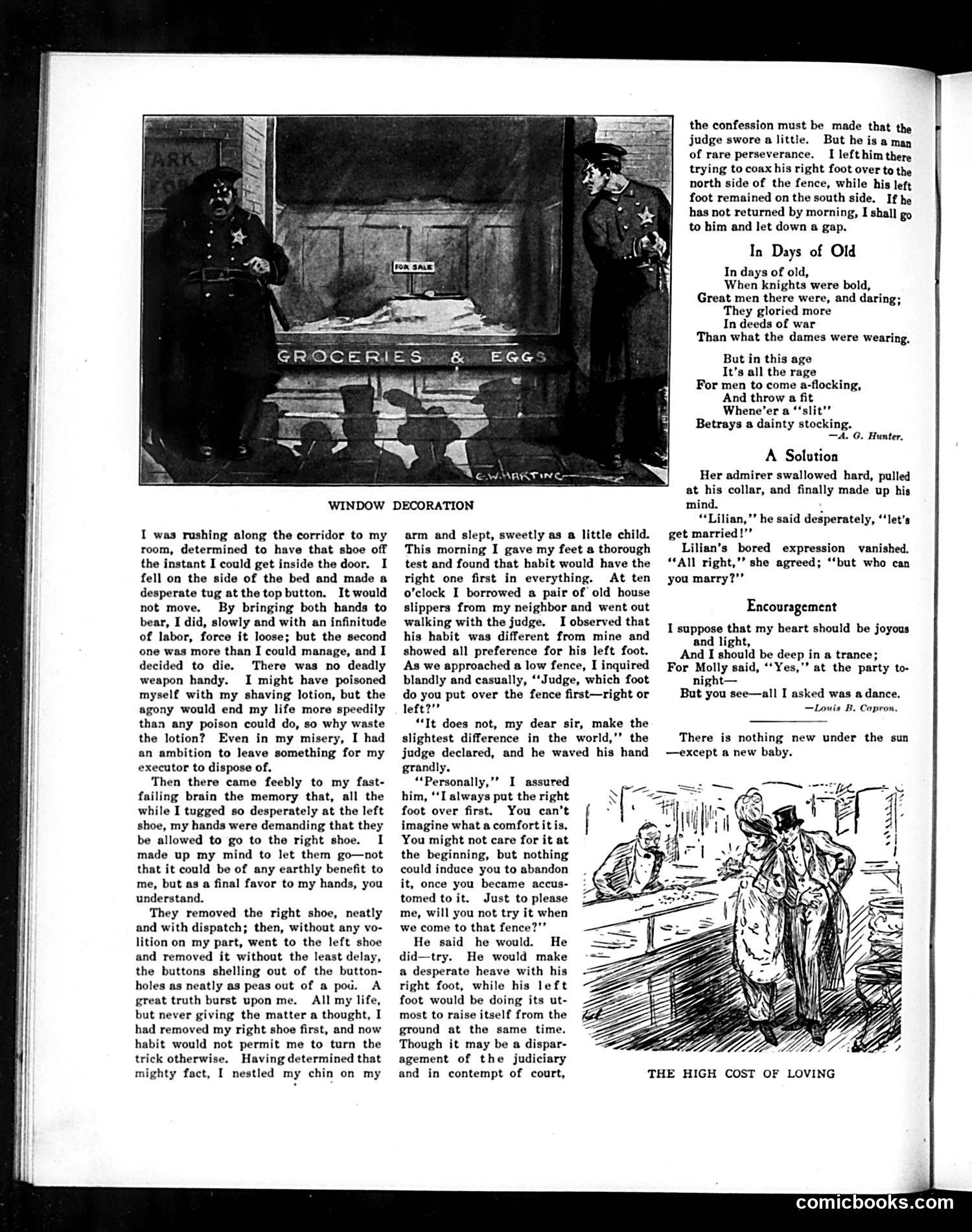
The main cartoon, "Window Decoration," depicts a humorous scene outside a "Groceries & Eggs" shop where two uniformed military or official figures stand guard while someone struggles with a low fence. The accompanying text is a comedic anecdote about habit and human nature: the narrator discovers he always removes his right shoe first due to ingrained habit. When he cajoles a judge to try removing his left shoe first at a fence, the judge's body rebelliously refuses—his left foot won't cooperate. The satire mocks the judge's pretension of being unaffected by habit, showing how even authority figures are slaves to routine. The other content includes poems mocking modern fashion vanity and romantic conventions, presenting satirical commentary on contemporary social customs rather than specific political figures.
📄 Transcribed text from this page (OCR, searchable)
Machine-transcribed from the original scan — historical spelling and the odd misread are preserved.
WINDOW DECORATION I was rushing along the corridor to my room, determined to have that shoe off the instant I could get inside the door. I fell on the side of the bed and made a desperate tug at the top button. It would not move. By bringing both hands to bear, I did, slowly and with an infinitude of labor, force it loose; but the second one was more than I could manage, and I decided to die. There was no deadly weapon handy. I might have poisoned myself with my shaving lotion, but the agony would end my life more speedily than any poison could do, so why waste the lotion? Even in my misery, I had an ambition to leave something for my executor to dispose of. Then there came feebly to my fast- failing brain the memory that, all the while I tugged so desperately at the left shoe, my hands were demanding that they be allowed to go to the right shoe. I made up my mind to let them go—not that it could be of any earthly benefit to me, but as a final favor to my hands, you understand. They removed the right shoe, neatly and with dispatch; then, without any vo- lition on my part, went to the left shoe and removed it without the least delay, the buttons shelling out of the button- holes as neatly as peas out of a pod. A great truth burst upon me. All my life, but never giving the matter a thought, I had removed my right shoe first, and now habit would not permit me to turn the trick otherwise. Having determined that mighty fact, I nestled my chin on my arm and slept, sweetly as a little child. This morning I gave my feet a thorough test and found that habit would have the right one first in everything. At ten o’clock I borrowed a pair of old house slippers from my neighbor and went out walking with the judge. I observed that his habit was different from mine and showed all preference for his left foot. As we approached a low fence, I inquired blandly and casually, ‘‘Judge, which foot do you put over the fence first—right or left?” “It does not, my dear sir, make the slightest difference in the world,’’ the judge declared, and he waved his hand grandly. “Personally,” I assured him, ‘‘I always put the right foot over first. You can’t imagine what a comfort itis. You might not care for it at the beginning, but nothing could induce you to abandon it, once you became accus- tomed to it. Just to please me, will you not try it when we come to that fence?” He said he would. He did—try. He would make a desperate heave with his right foot, while his left foot would be doing its ut- most to raise itself from the ground at the same time. Though it may be a dispar- agement of the judiciary and in contempt of court, the confession must be made that the judge swore a little. But he is a man of rare perseverance. I lefthim there trying to coax his right foot over to the north side of the fence, while his left foot remained on the south side. If he has not returned by morning, I shall go to him and let down a gap. In Days of Old In days of old, When knights were bold, Great men there were, and daring; They gloried more In deeds of war Than what the dames were wearing, But in this age It’s all the rage For men to come a-flocking, And throw a fit Whene’er a ‘‘slit’’ Betrays a dainty stocking. —A. G. Hunter, A Solution Her admirer swallowed hard, pulled at his collar, and finally made up his mind. . “Lilian,” he said desperately, ‘let's get married!’’ Lilian’s bored expression vanished. “All right,’’ she agreed; ‘‘but who can you marry?’’ Encouragement I suppose that my heart should be joyous and light, And I should be deep in a trance; For Molly said, ‘‘Yes,’’ at the party to- night— But you see—all I asked was a dance. —Lonis B. Capron. There is nothing new under the sun —except a new baby. THE HIGH COST OF LOVING comicbooks.com