
Judge, 1914-02-14 · page 7 of 24
Judge — February 14, 1914 — page 7: what you’re looking at
What you’re looking at
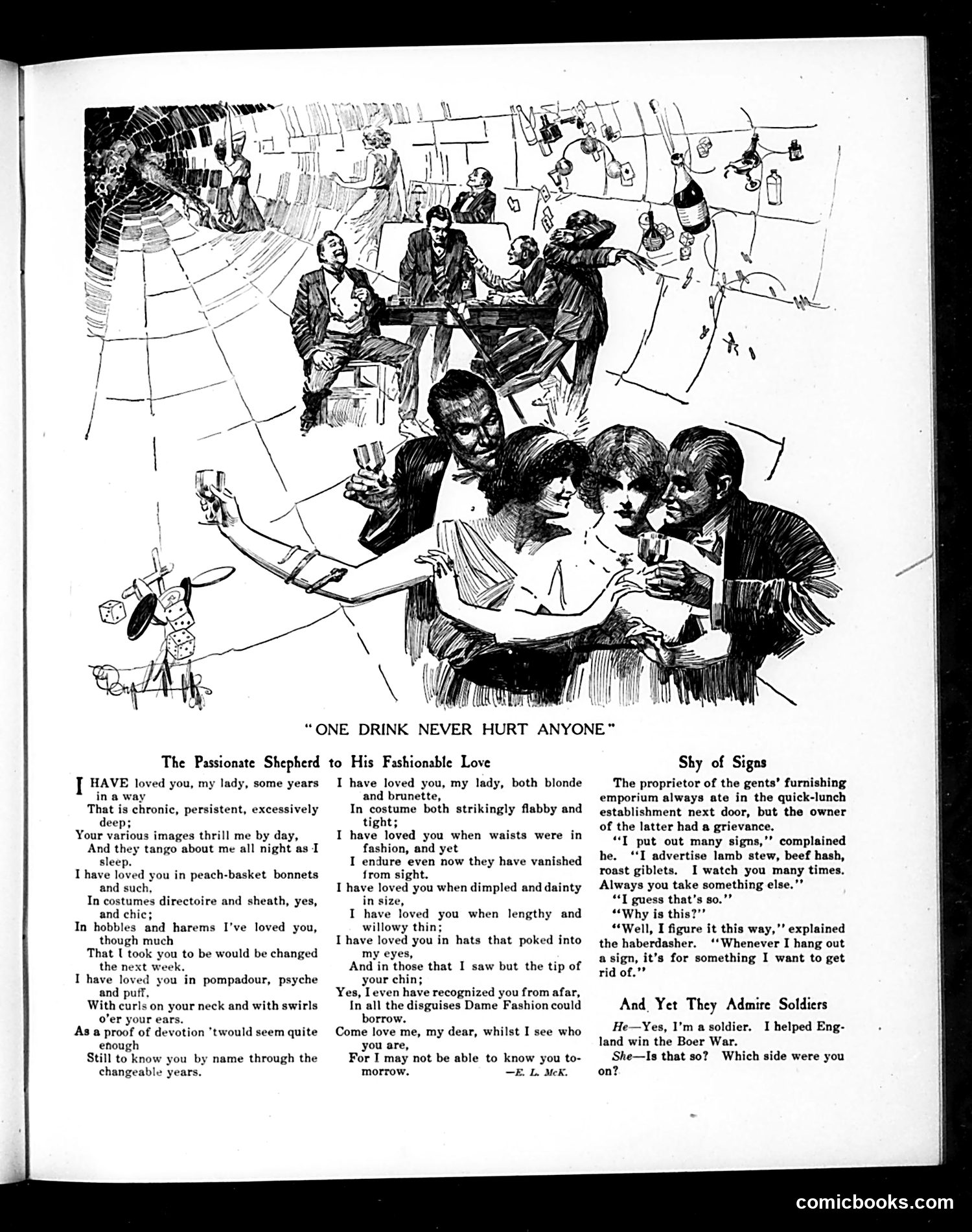
This page contains three separate pieces of humor typical of early 20th-century satirical magazine content. **Top illustration and "The Passionate Shepherd"**: A poem mocking fashion's constant changes. The speaker claims unchanging love for a woman despite her perpetually shifting appearance—different hairstyles, silhouettes, and clothing trends. The satire targets women's fashion industry's relentless reinvention, suggesting women are unknowable chameleons following every whim. The theatrical scene above depicts fashionable society. **"Shy of Signs"**: A brief comic dialogue. A restaurant owner complains his neighbor (haberdasher) never orders advertised specials. The punchline reveals the haberdasher believes signs advertise items the proprietor wants to *dispose of*, not sell—mocking both advertising's unreliability and commercial skepticism. **"And Yet They Admire Soldiers"**: A short flirtation joke. A soldier boasts of serving in the Boer War; when a woman asks which side he was on, the implication is ambiguous—possibly satirizing mercenaries or questioning actual military service claims during that conflict (1899-1902). The page emphasizes social pretense and commercial dishonesty.
📄 Transcribed text from this page (OCR, searchable)
Machine-transcribed from the original scan — historical spelling and the odd misread are preserved.
“ONE DRINK NEVER HURT ANYONE” The Passionate Shepherd to His Fashionable Love | HAVE loved you, my Indy, some years in a way That is chronic, persistent, excessively deep; Your various images thrill me by day, And they tango about me all night as I sleep. T have loved you in peach-basket bonnets and such, In costumes directoire and sheath, yes, and chic; In hobbles and harems I've loved you, though much That [ took you to be would be changed the next week. I have loved you in pompadour, psyche and puff, With curls on your neck and with swirls o’er your ears. As a proof of devotion ‘twould seem quite enough Still to know you by name through the changeable years. I have loved you, my lady, both blonde and brunette, In costume both strikingly flabby and tight; I have loved you when waists were in fashion, and yet I endure even now they have vanished from sight. T have loved you when dimpled and dainty in size, I have loved you when lengthy and willowy thin; I have loved you in hats that poked into my eyes, And in those that I saw but the tip of your chin; Yes, Ieven have recognized you from afar, In all the disguises Dame Fashion could borrow. Come love me, my dear, whilst I see who you are, For I may not be able to know you to- morrow. TE. L. Mek. Shy of Signs The proprietor of the gents’ furnishing emporium always ate in the quick-lunch establishment next door, but the owner of the latter had a grievance. “I put out many signs,’’ complained he. ‘‘I advertise lamb stew, beef hash, roast giblets. I watch you many times. Always you take something else.’’ “I guess that’s so.”” “Why is this?’’ “Well, I figure it this way,’’ explained the haberdasher. ‘‘Whenever I hang out a sign, it’s for something I want to get rid of.”” And Yet They Admire Soldiers He—Yes, I’m a soldier. I helped Eng- land win the Boer War. She—Is that so? Which side were you on? comicbooks.com