
Judge, 1914-02-14 · page 22 of 24
Judge — February 14, 1914 — page 22: what you’re looking at
What you’re looking at
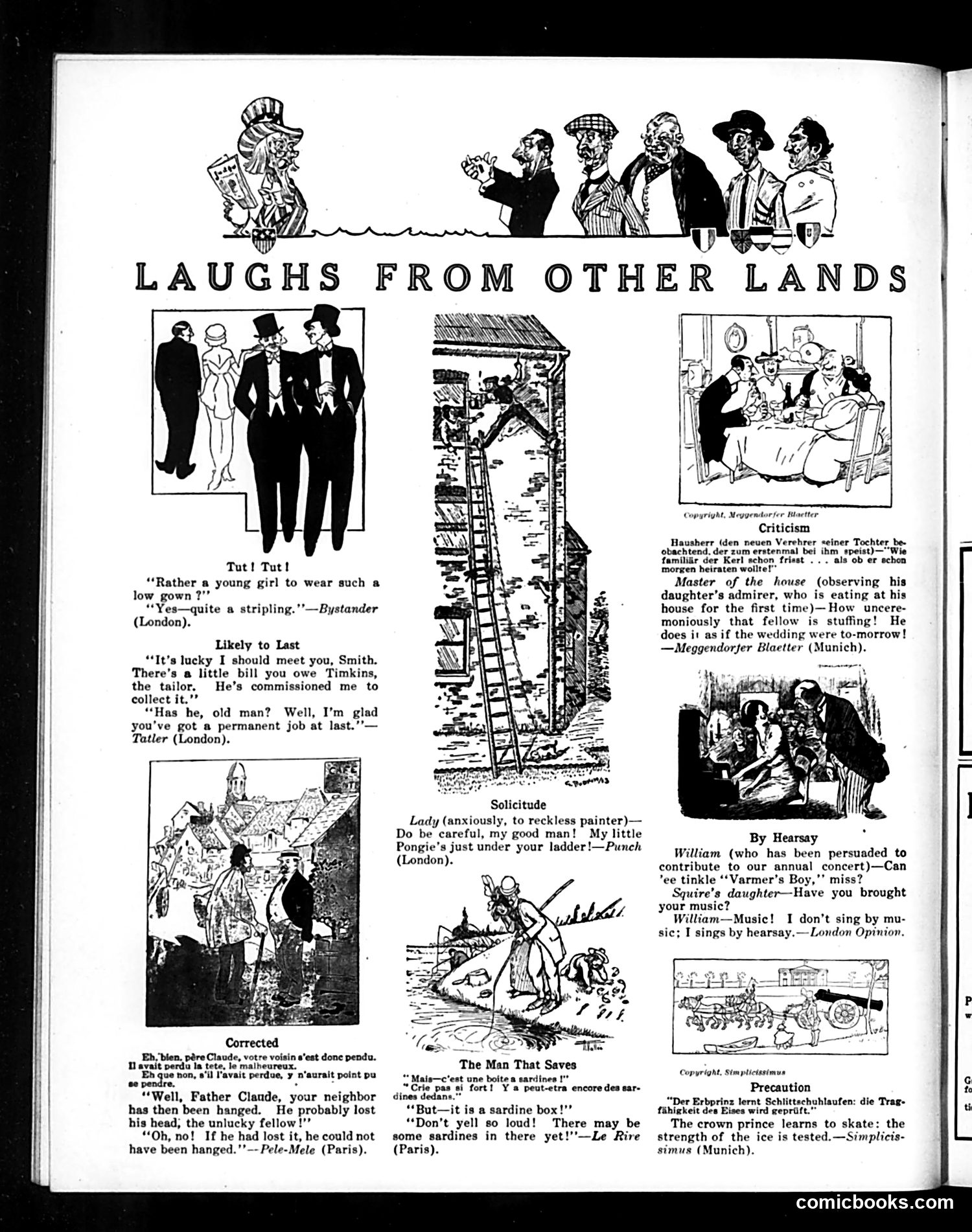
This page reprints humor from European satirical magazines (Punch, Le Rire, Simplicissimus, etc.), showcasing international comic sensibilities of the era. The jokes reflect period social attitudes: a young woman in a revealing gown draws disapproval; a tailor's endless bill-collecting becomes a "permanent job"; a priest's logic puzzle about a hanged man who "lost his head"; a painter recklessly working above a child; a miser hoarding sardines; a young suitor eating too familiarly before engagement; a rustic farmhand singing "by hearsay" rather than sheet music; and aristocratic caution testing ice for a crown prince's skating lesson. These are largely gentle observational humor about class, propriety, and human behavior—reflecting early 20th-century European middle-class anxieties about decorum, debt, and social mobility. The translations suggest American readers found foreign humor entertaining and culturally instructive.
📄 Transcribed text from this page (OCR, searchable)
Machine-transcribed from the original scan — historical spelling and the odd misread are preserved.
LA Tut! Tut! “Rather a young girl to wear such a low gown ?’’ “Yes—quite a stripling.”"—Bystander (London). Likely to Last “It’s lucky I should meet you, Smith. There's a little bill you owe Timkins, the tailor. He’s commissioned me to collect it.’” “Has he, old man? Well, I’m glad you've got a permanent job at last.”’"— Tatler (London). Eh, bien. pare Claude, votre voisin s'est done pendu. avait perdu Ia tete, le malheureux. Eb que non, s'il l'avait perdue, y n’aurait point pu fe per 5 . “Well, Father Claude, your neighbor has then been hanged. He probably lost his head, the unlucky fellow!’” “Oh, no! If he had lost it, he could not have been hanged.’’-- Pele-Mele (Paris). Solicitude Lady (anxiously, to reckless painter)— Do be careful, my good man! My little Pongie’s just under your ladder!—Punch (London). The Man That Saves ‘“!Mais—cest une boite a sardines 1” “Crie pas si fort! Y a peut-etra encore des sar- “Don’t yell so loud! There may be some sardines in there yet!""—Le Rire (Paris). Copyright, Meggendorfer Blactter Criticism Hausherr (den neuen Verehrer seiner Tochter be- obachtend. der zum erstenmal bei ihm speist)—"Wie familiir der Kerl schon frisst .. . als ob er echon morgen heiraten wollte!” Master of the house (observing his daughter’s admirer, who is eating at his house for the first time)—How uncere- moniously that fellow is stuffing! He does it as if the wedding were to-morrow! —Meggendorfer Blaetter (Munich). William (who has been persuaded to contribute to our annual concert)—Can ’ee tinkle ‘‘Varmer’s Boy,"’ miss? Squire’s daughter—Have you brought your music? William—Music! I don’t sing by mu- sic; I sings by hearsay.—London Opinion. Copyright, Stmplictsstmus Precaution “Der Erbprinz lernt Schlittschuhlaufen: die Trag- fahigkeit des Eises wird geprift.”” The crown prince learns to skate: the strength of the ice is tested.—Simplicis- simus (Munich). comicbooks.com