
A complete issue · 24 pages · 1913
Judge — November 1, 1913
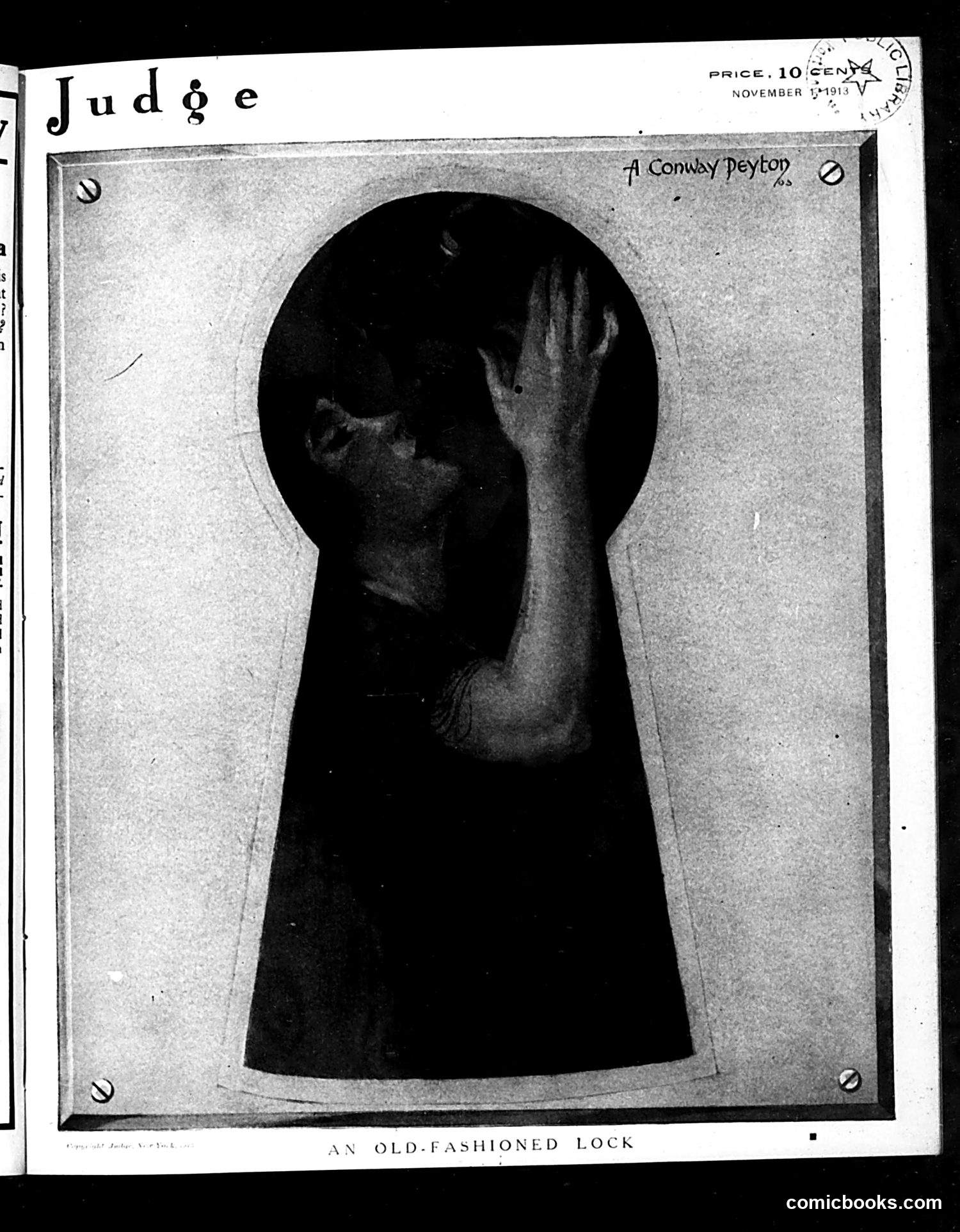
This Judge magazine cover from November 1913 shows a silhouetted figure of a woman with her hand raised against a keyhole-shaped opening, titled "An Old-Fashioned Lock." The cartoon likely satirizes women's suffrage debates of the era. The "lock" metaphor suggests women were excluded from political participation—unable to access power or voting rights. The woman's raised hand and pressing posture indicate struggle or protest against this exclusion. By 1913, the suffrage movement was intensifying in America. This image appears to mock either anti-suffrage arguments (portraying women as locked out) or possibly criticize the slow pace of reform. The "old-fashioned" label suggests the restriction itself was outdated, though the cartoon's exact stance—supportive or critical—remains somewhat ambiguous without additional context.
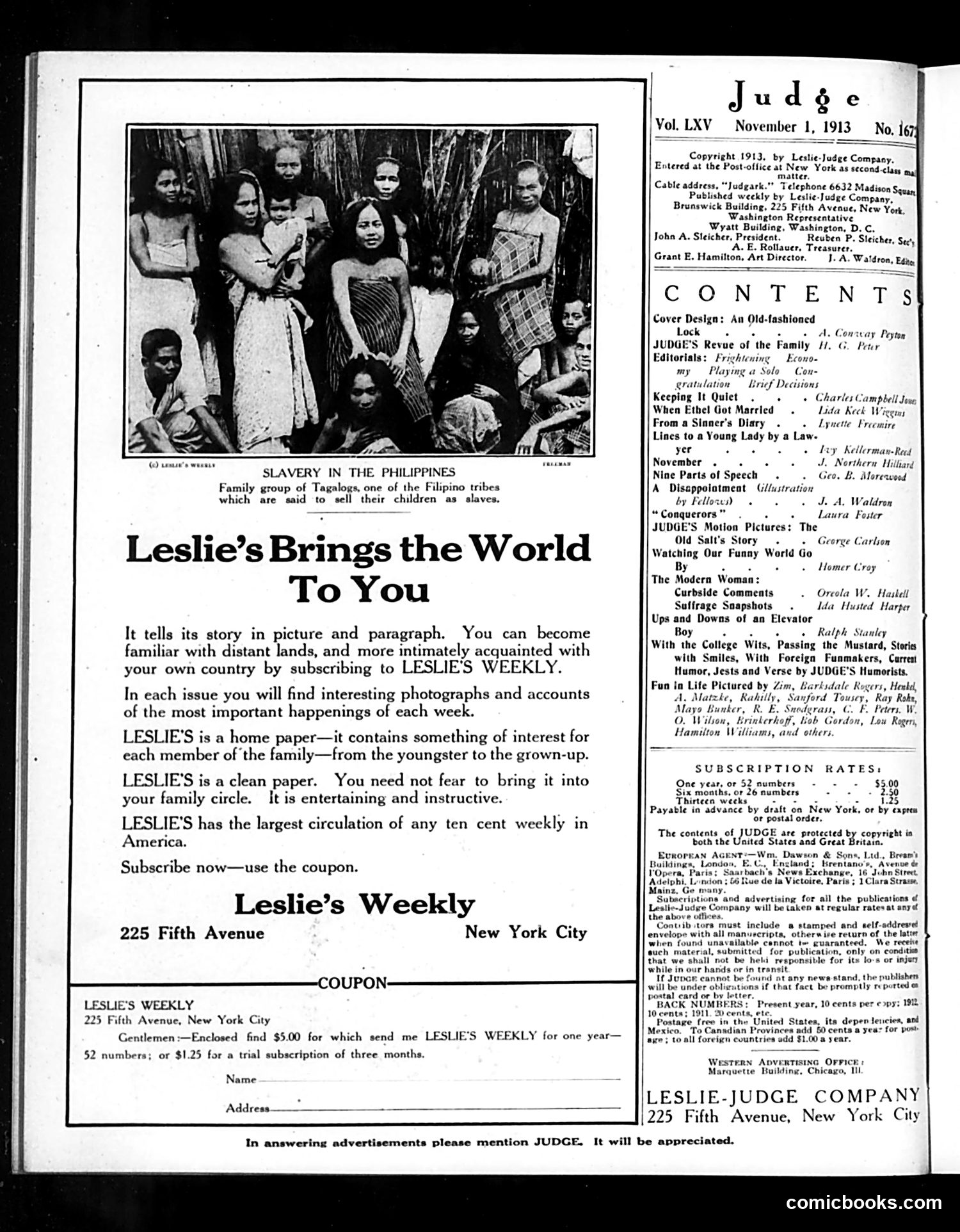
This page is primarily **advertising for Leslie's Weekly magazine**, not political satire. The main image shows a family group of Tagalogs (Filipino people) labeled "Slavery in the Philippines," accompanying text promoting Leslie's Weekly as an illustrated publication offering readers views of "distant lands" and their own country. The slavery reference reflects **early 20th-century American discourse about the Philippines**—then a U.S. colony following the 1898 Spanish-American War. The image and caption appear designed to appeal to readers' curiosity about exotic peoples under American control, framing Leslie's Weekly as offering educational "pictures and paragraphs" about the expanding American world. The right side contains magazine contents and subscription information.
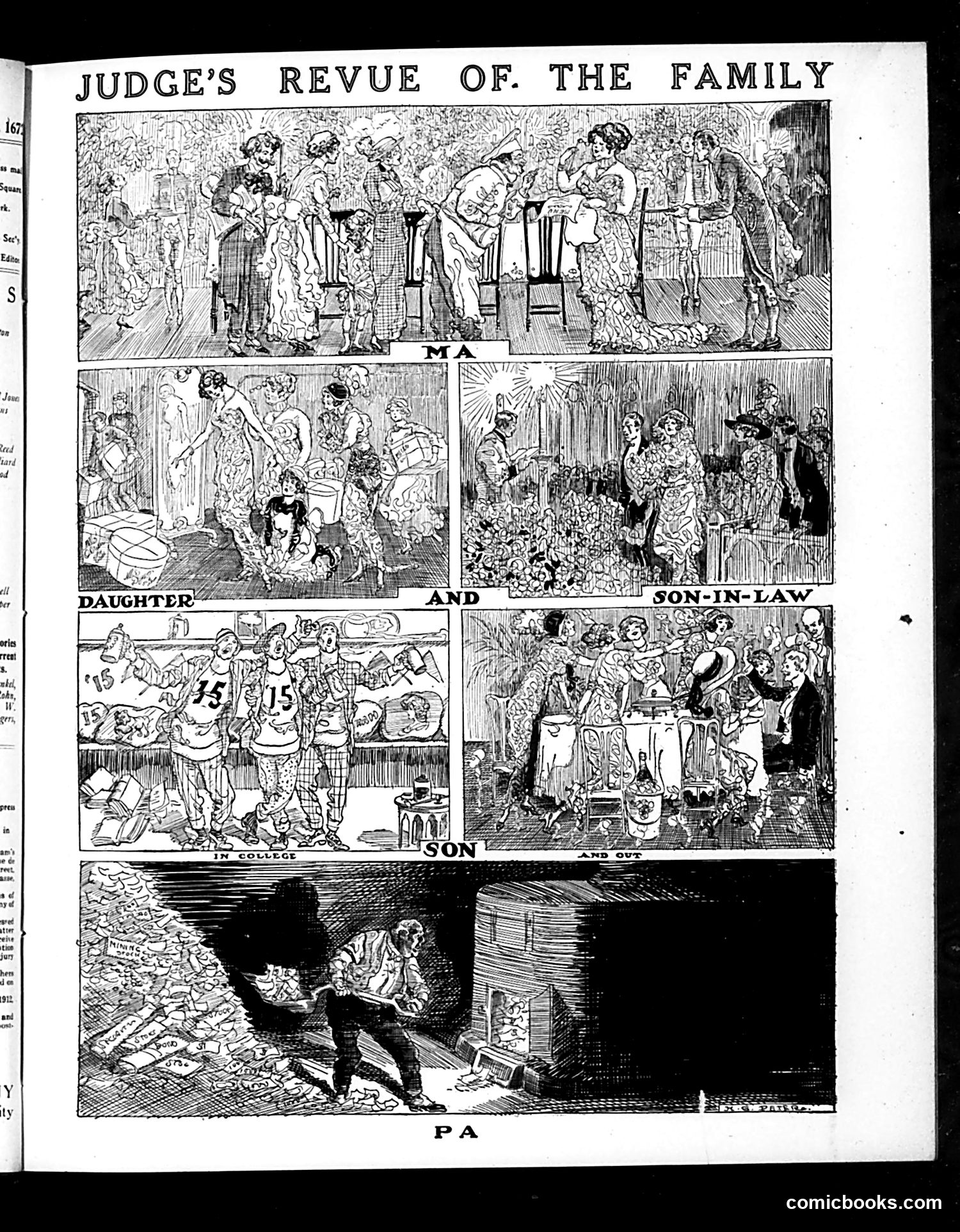
This is a multi-panel comic satirizing family members through stereotyped performances, organized by labels: "MA," "DAUGHTER AND SON-IN-LAW," "SON IN COLLEGE," and "PA." The panels depict theatrical "acts" or performances, with each family member exaggerated for comic effect. The top panel shows a crowded performance or entertainment scene. Subsequent panels mock the daughter and son-in-law's social pretensions, the son's college behavior, and conclude with the father ("PA") in what appears to be financial distress or ruin—shown in darker, more dramatic imagery. The underlying satire targets family members' vanity, wastefulness, and poor financial management, with the father bearing the economic consequences. It reflects early 20th-century anxieties about spending, social climbing, and generational values.
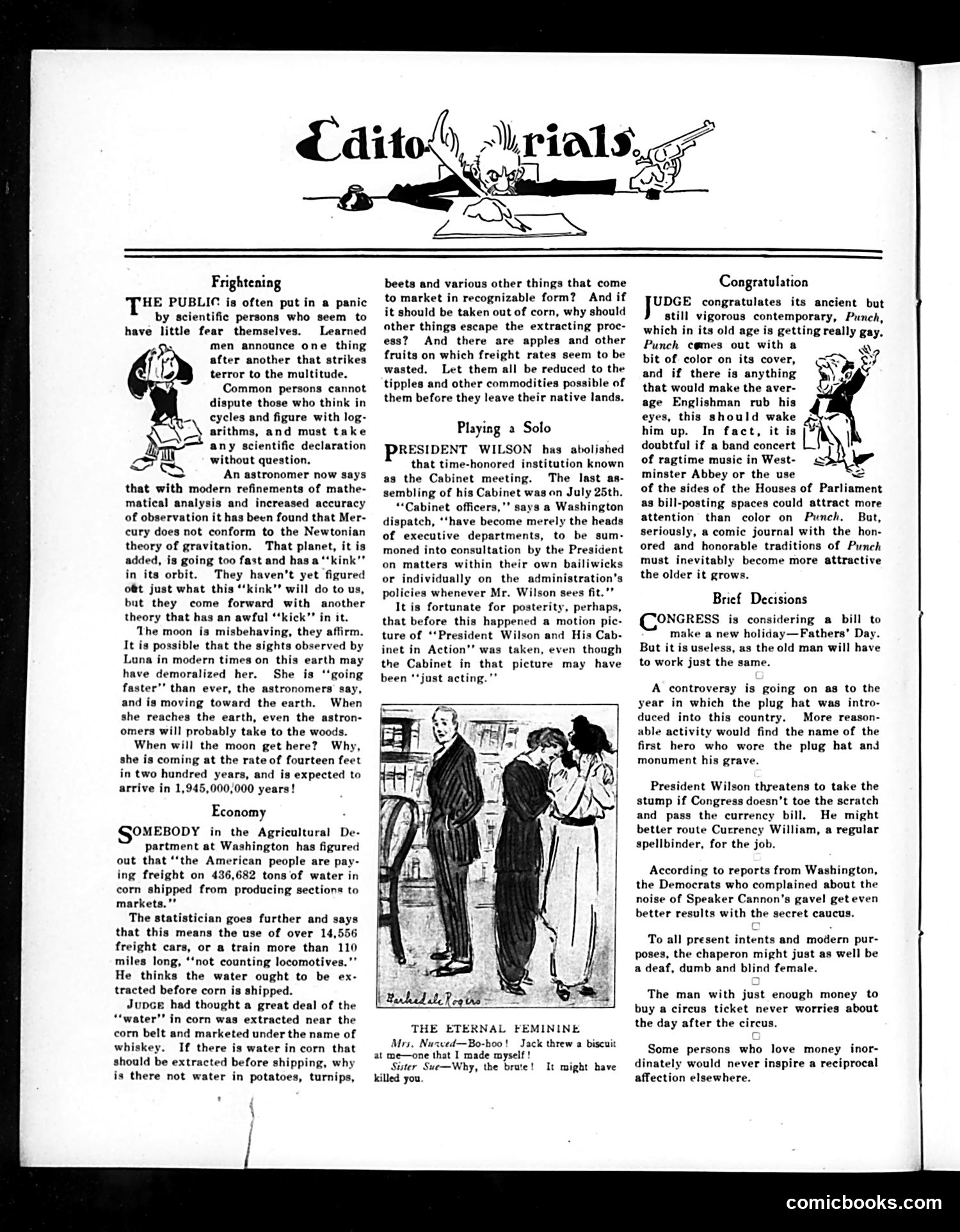
This cartoon satirizes gender dynamics in early 20th-century America. The image shows a woman (labeled "Mrs. Newed") throwing a biscuit at a man while making excuses—she claims he threw it first and calls him a "brute," suggesting she's being deliberately provocative while playing the victim. The accompanying dialogue mocks women who initiate conflict then feign innocence or victimhood. The satire targets what Judge perceived as manipulative feminine behavior: starting disputes, then leveraging societal chivalry and male protective instincts to avoid accountability. This reflects period attitudes dismissing women's agency as inherent dishonesty rather than recognizing legitimate grievances. The joke relies on misogynistic assumptions about female nature being inherently duplicitous.
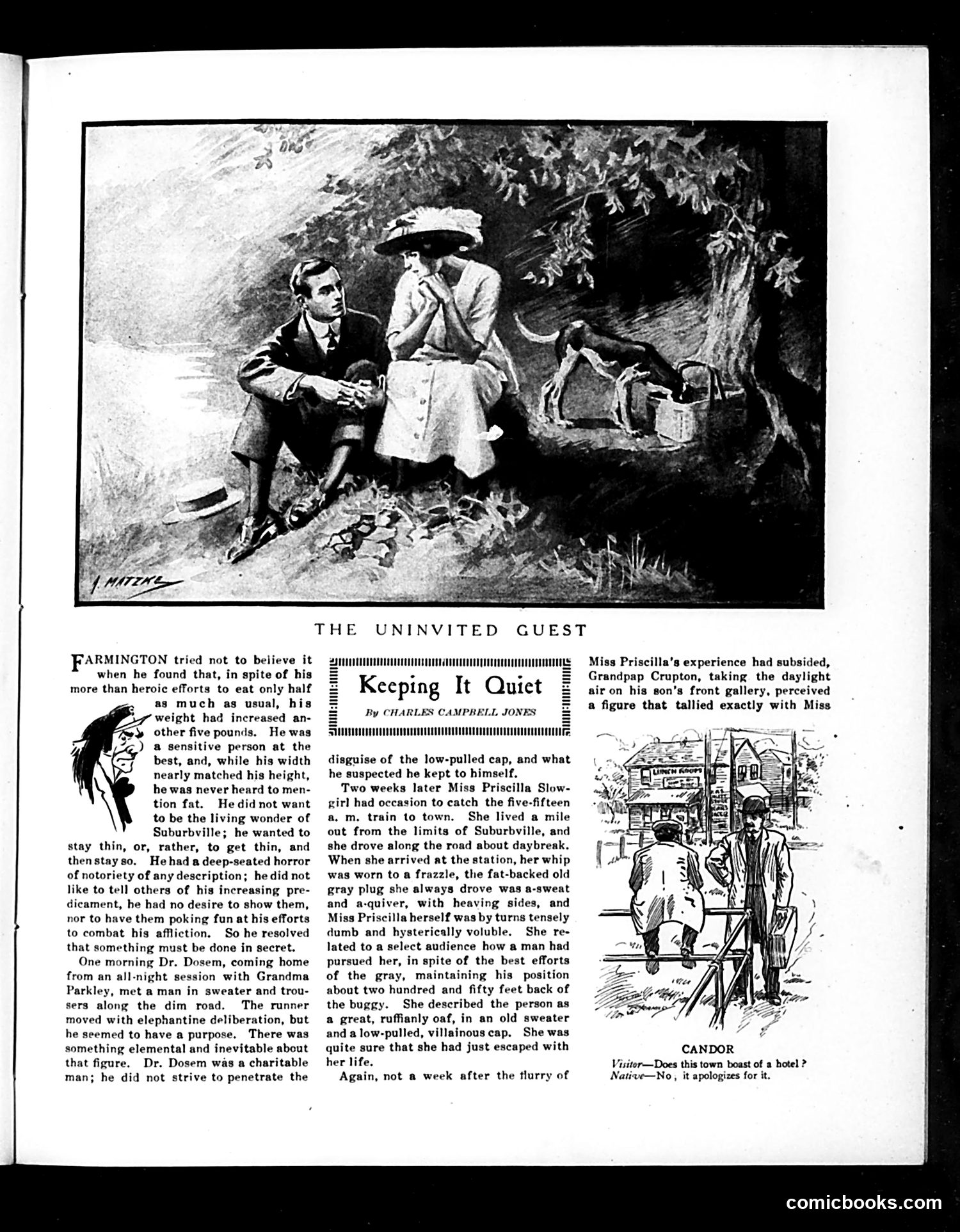
This page contains a short story titled "Keeping It Quiet" by Charles Campbell Jones, illustrated with a sketch of a man and woman in conversation outdoors. The narrative concerns a man named Farmington who discovers he's gained significant weight despite eating only half his usual food. A doctor visits and encounters Farmington on a country road—apparently the "uninvited guest" of the title. The story involves Miss Priscilla Slowbelt, who pursues Farmington romantically despite his efforts to discourage her attention. The humor derives from social embarrassment and romantic entanglement rather than political satire. The accompanying cartoon (captioned "CANDOR") appears unrelated—it depicts travelers discussing whether a town has a hotel. The page is primarily literary content rather than political commentary typical of Judge magazine's satirical focus.
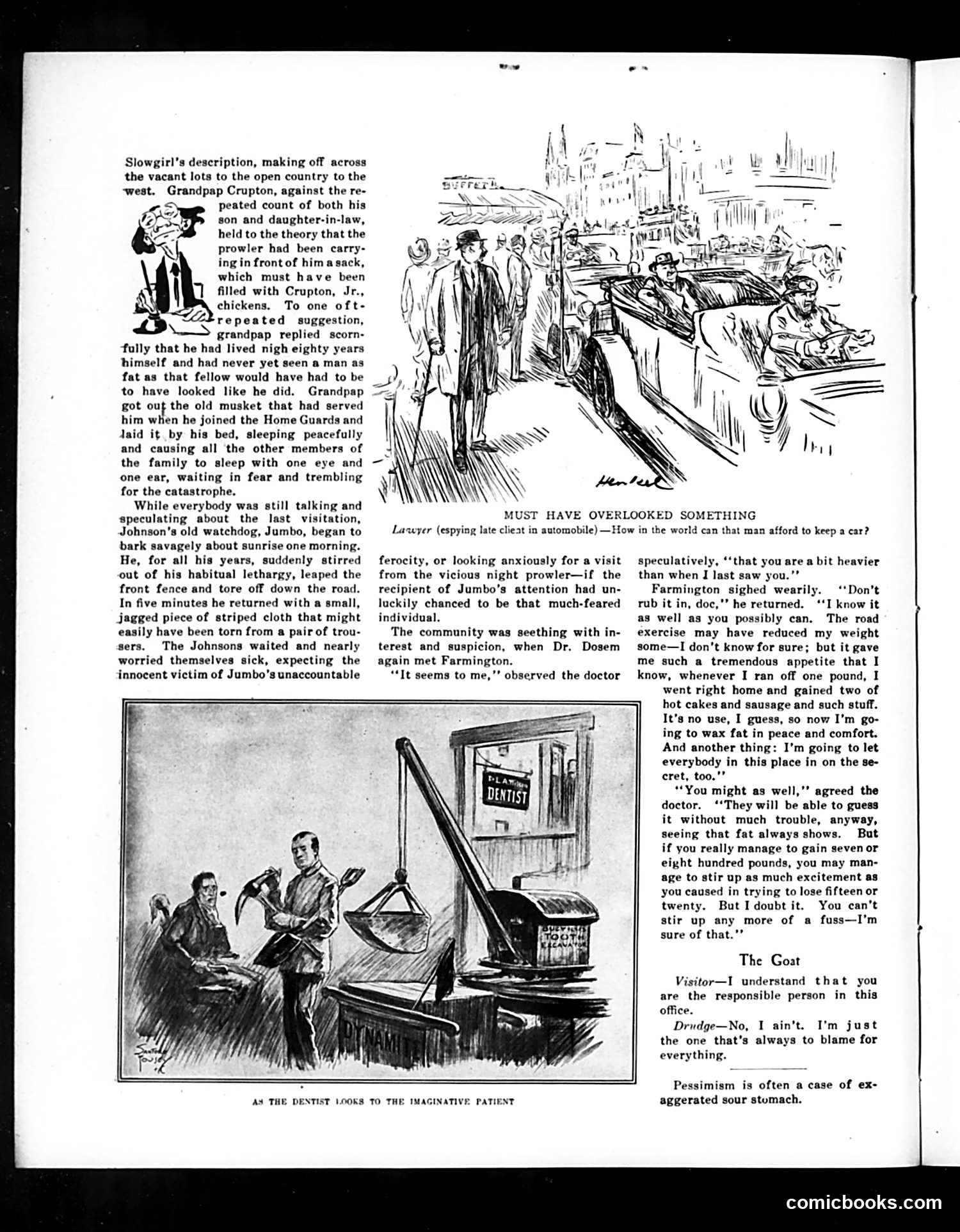
This page contains three distinct satirical pieces: **"Slowgirl's Description"** is a serialized story about rural paranoia. A community mistakes an innocent fat man for a nocturnal prowler carrying stolen chickens in a sack. The humor lies in the townspeople's wild speculation and fear—particularly Grandpap's insistence the man must be impossibly obese to match the "sack," and the dog Jumbo's attack producing only a scrap of cloth as "evidence." **"Must Have Overlooked Something"** mocks economic hypocrisy: a lawyer questions how a man affords a car, missing the obvious answer that the man simply spends money he has—a subtle jab at wealth-shaming while ignoring one's own consumption. **"The Goat"** is a brief joke about office scapegoating: the "responsible person" is actually just the perpetual fall guy blamed for everything—satirizing workplace dynamics where one employee absorbs all blame. The dentist cartoon depicts an anxious patient imagining torture, poking fun at dental anxiety itself.
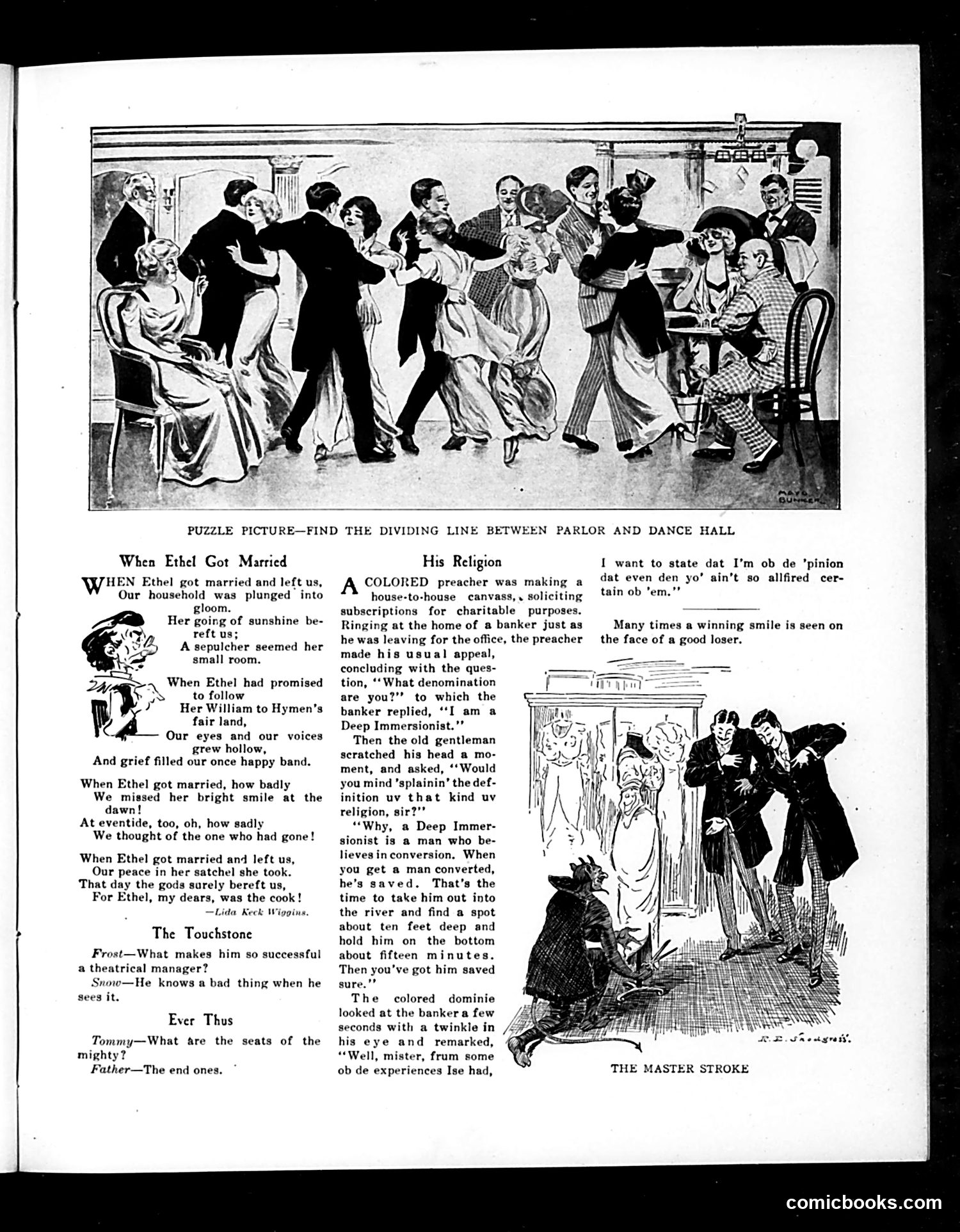
This Judge magazine page contains three separate humor pieces satirizing early 20th-century American life: **"When Ethel Got Married"** is a sentimental poem about a family's sadness at losing their servant girl Ethel to marriage—the punchline reveals the real loss: she was their cook. **"The Touchstone"** is a brief joke about theatrical managers having poor taste. **"His Religion"** satirizes racial and class dynamics. A Black preacher soliciting donations from a wealthy banker describes "Deep Immersionism" as holding converts underwater for fifteen minutes to ensure salvation. The preacher's clever response—noting from "experiences" he's had that even this doesn't guarantee results—is a darkly humorous commentary on the banker's dishonesty and shallow faith, using the preacher's dialect to satirize both the banker's greed and racist stereotypes of the era. The top puzzle image depicts a chaotic social gathering, likely illustrating the blurred boundary between respectable "parlor" socializing and disreputable "dance hall" behavior—a common morality concern of the period.
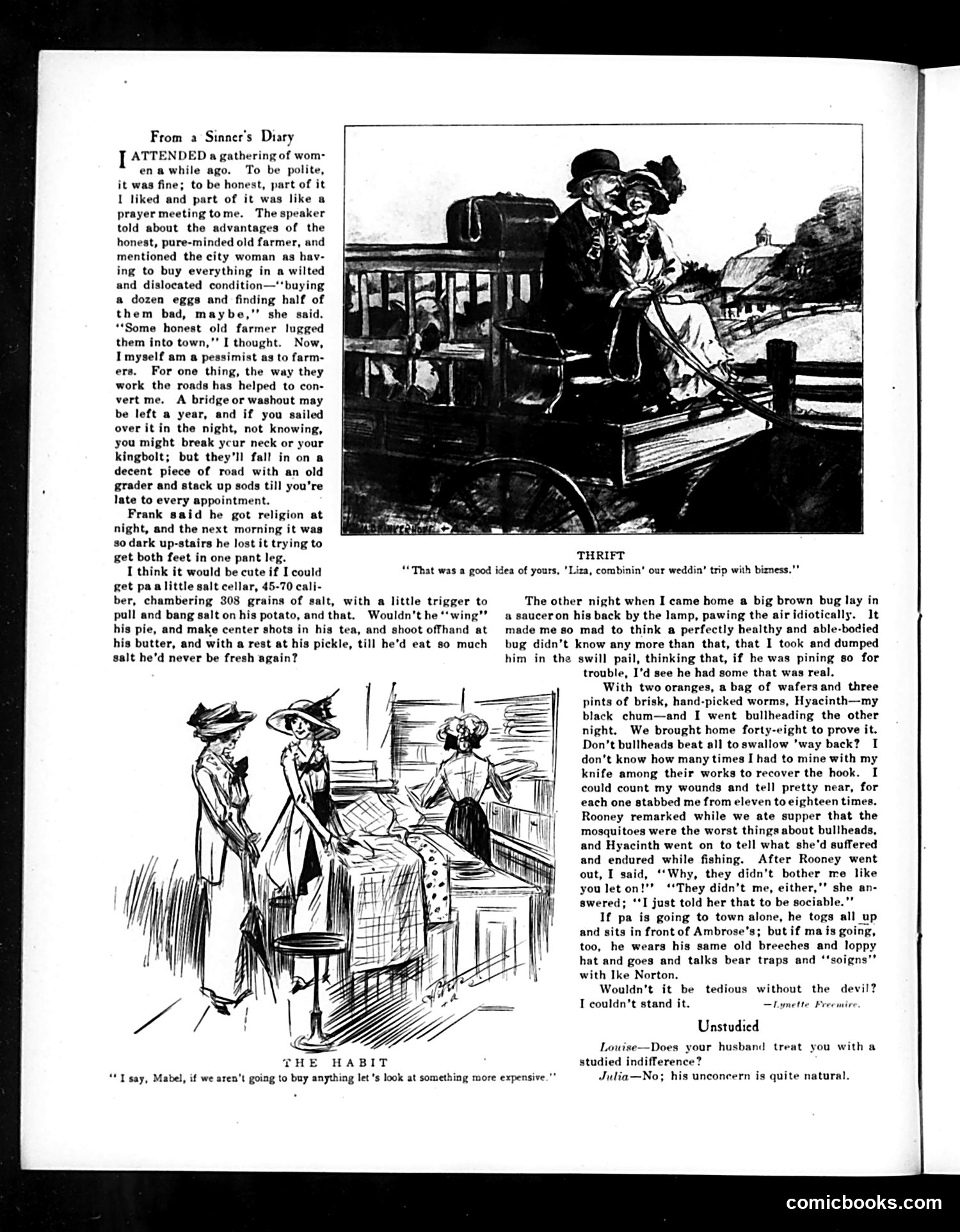
This page from *Judge* magazine contains three separate humorous pieces satirizing rural and urban American life, likely from the early 20th century. **"From a Sinner's Diary"** mocks the rural-versus-urban moral divide. A speaker praises honest farmers while criticizing city women for buying spoiled produce. The narrator counters that farmers are actually negligent—they damage roads but neglect maintenance. The anecdotes (about his husband Frank losing religion, the salt-cellar gun idea, the dead bug, bullhead fishing) humorously depict rural life as messy and frustrating, undercutting the speaker's idealization. **"The Habit"** shows a couple window shopping without buying, preferring to admire expensive items—satirizing window-shopping culture and conspicuous consumption. **"Thrift"** and **"Unstudied"** are brief jokes: the first combines honeymoon romance with business practicality; the second jokes about marital indifference masquerading as studied coolness. The overall tone criticizes romantic notions of rural virtue while poking fun at urban affectation and materialism.
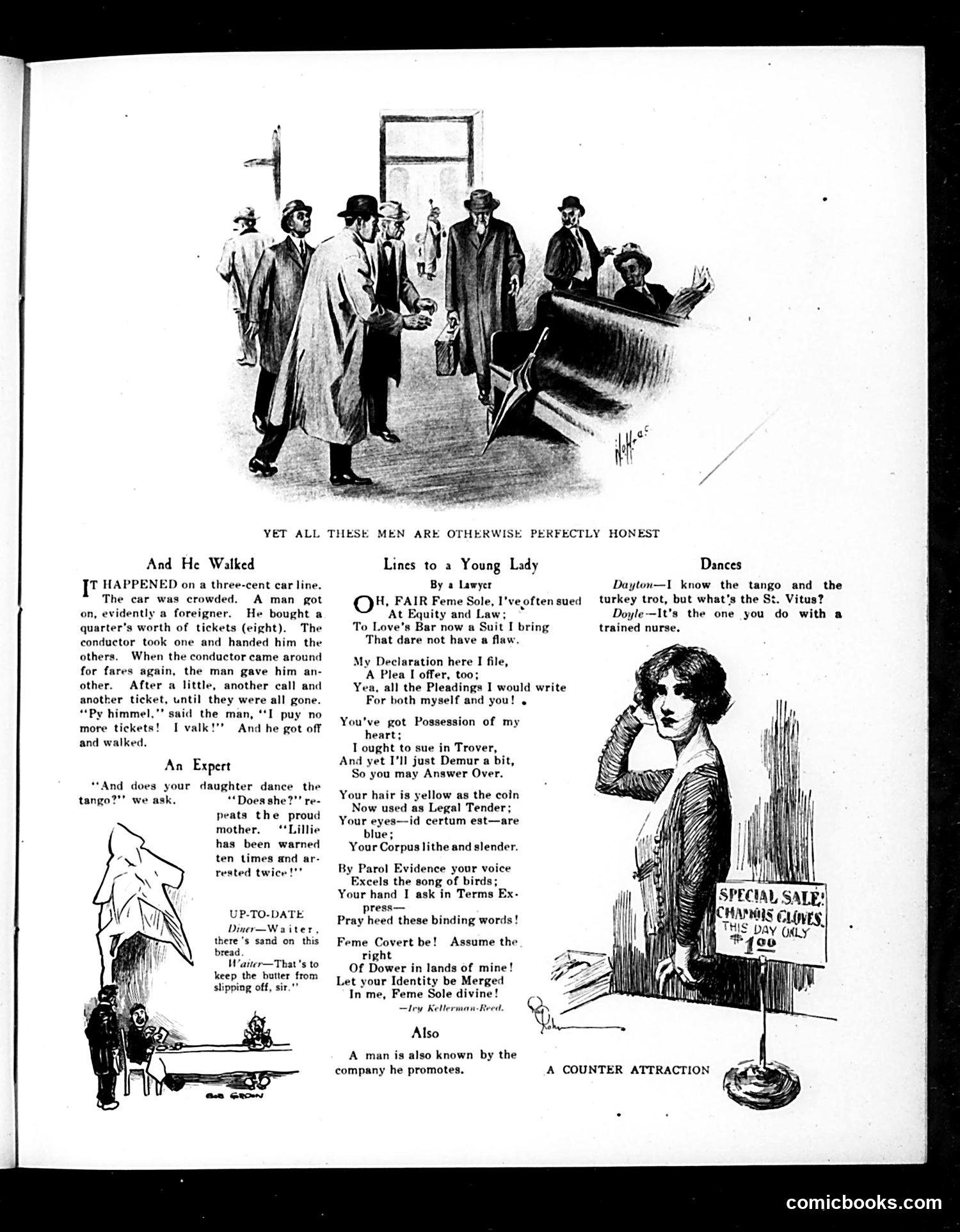
This Judge magazine page contains several brief satirical pieces mocking early 20th-century social absurdities: **"And He Walked"** ridicules a foreign immigrant's literal interpretation of a transit system—he buys eight tickets, uses them one-by-one, then walks rather than buy more, missing the point that fares work differently. **"An Expert"** jokes that a proud mother considers her daughter's dancing expertise proven by police warnings and arrests (likely referencing St. Vitus's Dance, a nervous condition, or scandalous modern dance). **"Lines to a Young Lady"** parodies overly clever courtship poetry by a lawyer who compulsively uses legal terminology ("Feme Sole," "Trover," "Demur") to propose marriage—mocking both legal jargon and sentimental verse. **Minor jokes** include a waiter's cheeky non-answer about sand in bread, and a quip about company character judgments. The top cartoon shows men in formal dress—the caption "Yet All These Men Are Otherwise Perfectly Honest" suggests satire about corruption or hypocrisy among respectable-looking officials or businessmen, though the specific context is unclear.
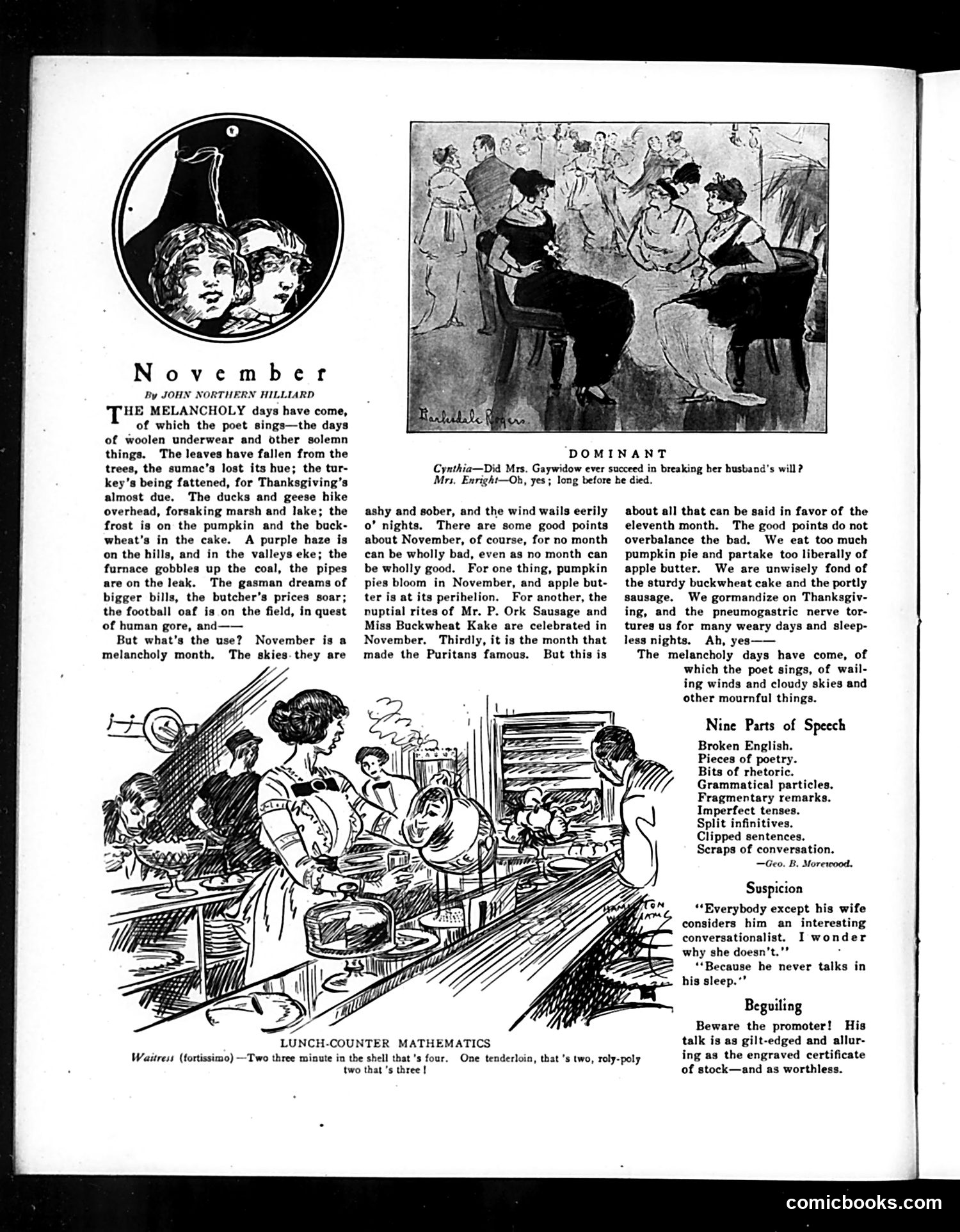
This Judge magazine page contains three separate satirical pieces from the early 1900s: **"November"** is a humorous essay by John Northern Hilliard about the month's melancholy nature—falling leaves, cold weather, heating costs, and butchers' price increases. It's genteel period humor about seasonal complaints. **"Dominant"** is a one-liner joke about marital dynamics: a woman asking if another succeeded in "breaking her husband's will" (controlling him), with the response that she did so long before he died—a dig at wives' perceived dominance. **"Lunch-Counter Mathematics"** mocks a waitress's confused arithmetic while tallying a diner's order, playing on working-class speech patterns and service-industry incompetence for laughs. Additional sections include vocabulary humor ("Nine Parts of Speech") and brief satirical definitions of character types—the uninteresting conversationalist, the deceptive stock promoter—typical Judge fare offering social commentary through witty observations of contemporary life.
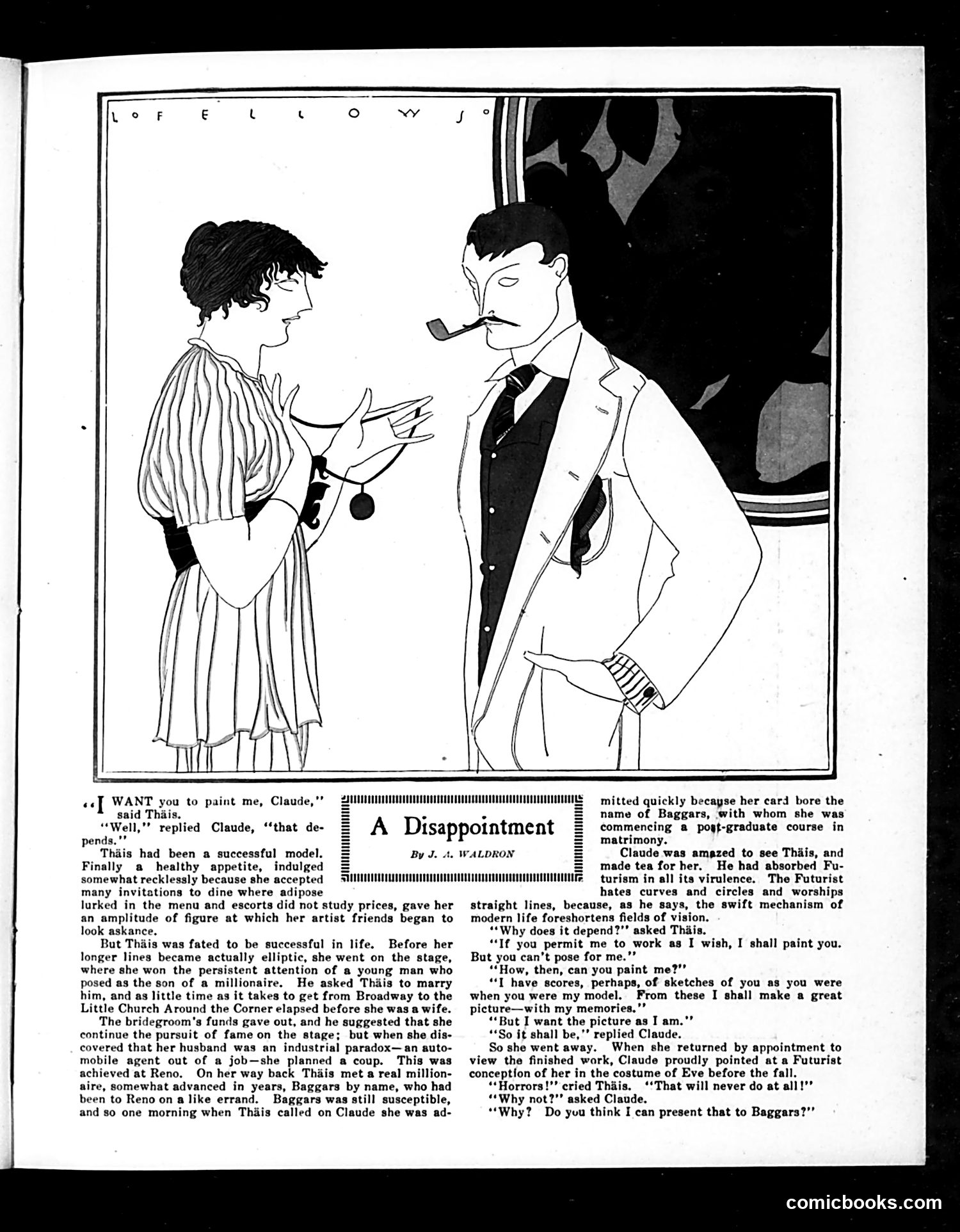
This story satirizes both **artistic modernism** (specifically Futurism) and **social climbing through marriage**. **The plot**: Thais, a former model turned actress, has married a millionaire named Baggars after divorcing a penniless husband. She visits her old artist friend Claude, asking him to paint her portrait. Claude, now a Futurist, refuses to paint from life, claiming modern art rejects curves for straight lines. Instead, he paints Thais from memory in an abstract, distorted style—depicting her as Eve in a hyper-modern Futurist manner. **The joke**: Thais is horrified by the avant-garde result because she needs a flattering portrait to present to her wealthy new husband. The satire mocks **Futurism's impracticality** (an artist who won't actually observe his subject) while poking fun at **social-climbing women** who value appearance and respectability over artistic integrity. The cartoon illustrates the clash between cutting-edge artistic movements and conventional bourgeois expectations.
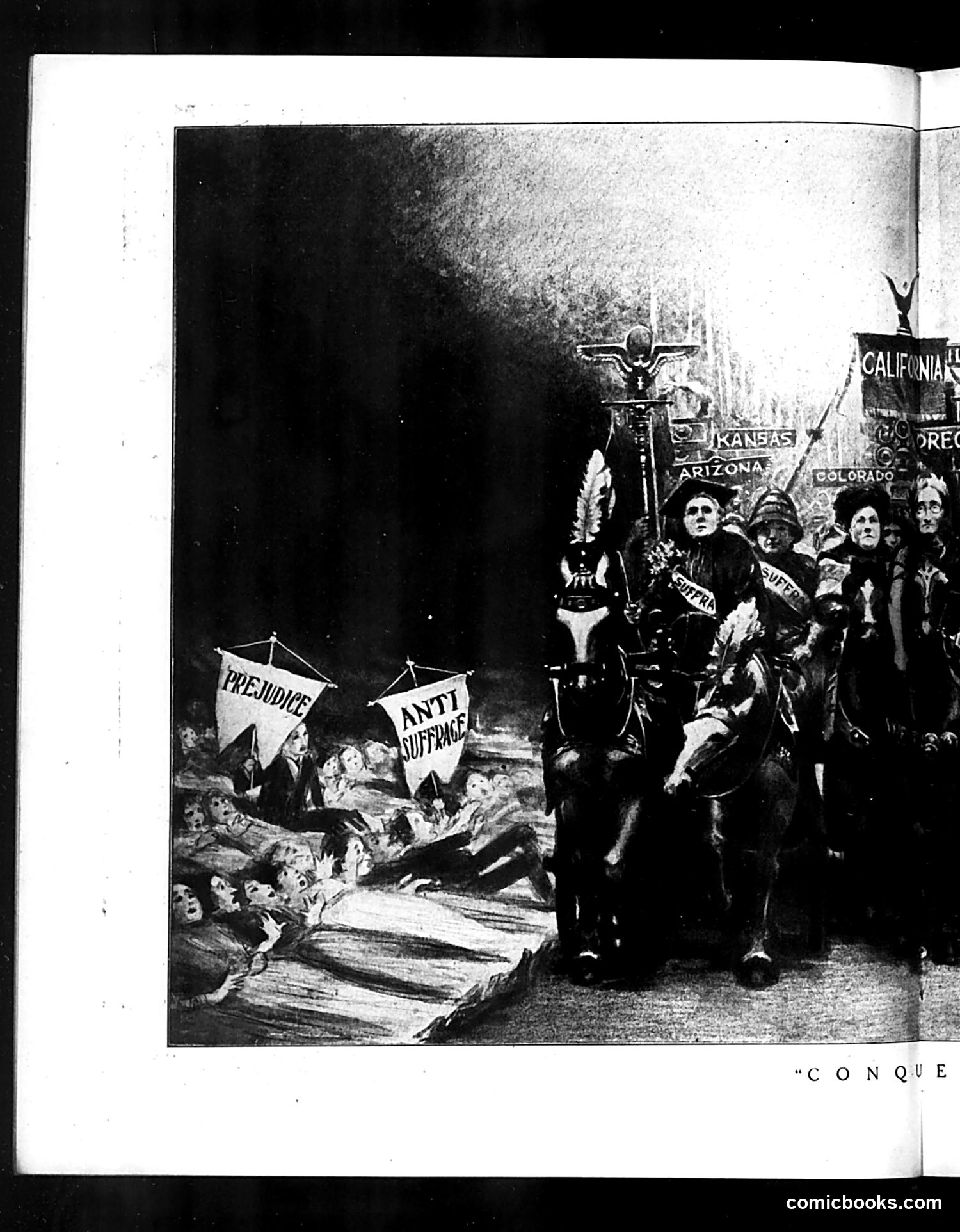
This appears to be a political cartoon from *Judge* magazine satirizing anti-suffrage sentiment. The image shows a skeletal Death figure mounted on a motorcycle, accompanied by what appear to be state banners (California, Kansas, Arizona, Colorado visible). Below, figures hold signs reading "PREJUDICE" and "ANTI SUFFRAGE," standing amid skulls and bones. The cartoon's message is clear: anti-suffrage forces are depicted as instruments of death and destruction, literally riding Death itself. The motorcycle (modern technology) suggests these are contemporary, not antiquated, forces. The state banners indicate this is a nationwide phenomenon. The satire argues that opposing women's suffrage is essentially murderous—killing progress and democratic principles. This likely dates to the women's suffrage movement's peak (early 1900s-1920), when *Judge* supported voting rights.
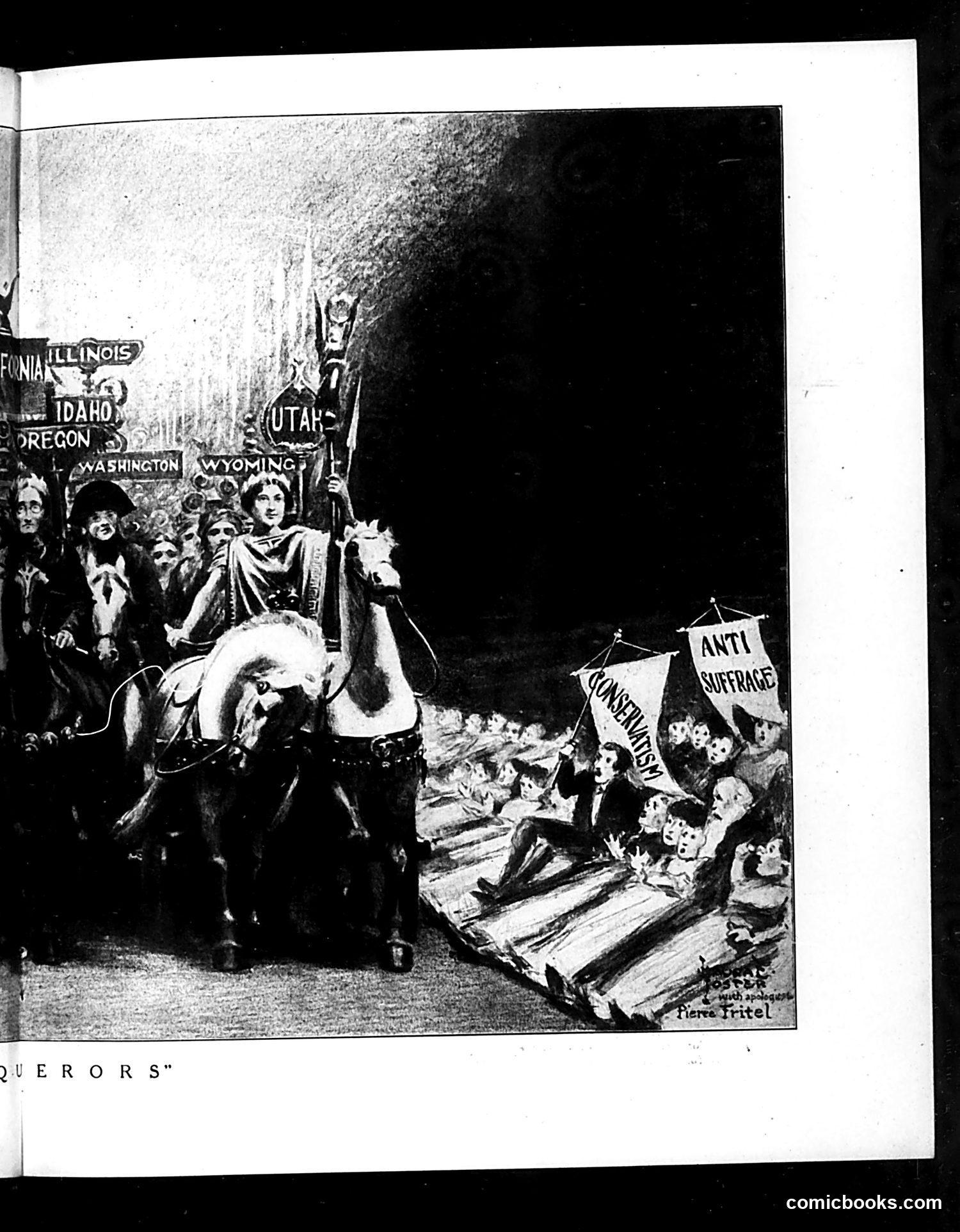
This is a satirical cartoon from *Judge* magazine depicting opposition to women's suffrage. The image shows a procession led by a figure on horseback (representing Britannia or Liberty) carrying a torch, accompanied by suffragists holding banners reading "Votes for Women" and "Anti Suffrage." State names visible on signs (Illinois, Idaho, Oregon, Washington, Wyoming) likely reference states debating or granting women voting rights. The cartoon satirizes anti-suffrage forces by portraying them as barbaric obstacles blocking progress—the bodies lying in the procession's path suggest they view suffrage as an inevitable movement that will overcome resistance. The artist appears to support women's suffrage, using the cartoon to mock its opponents.
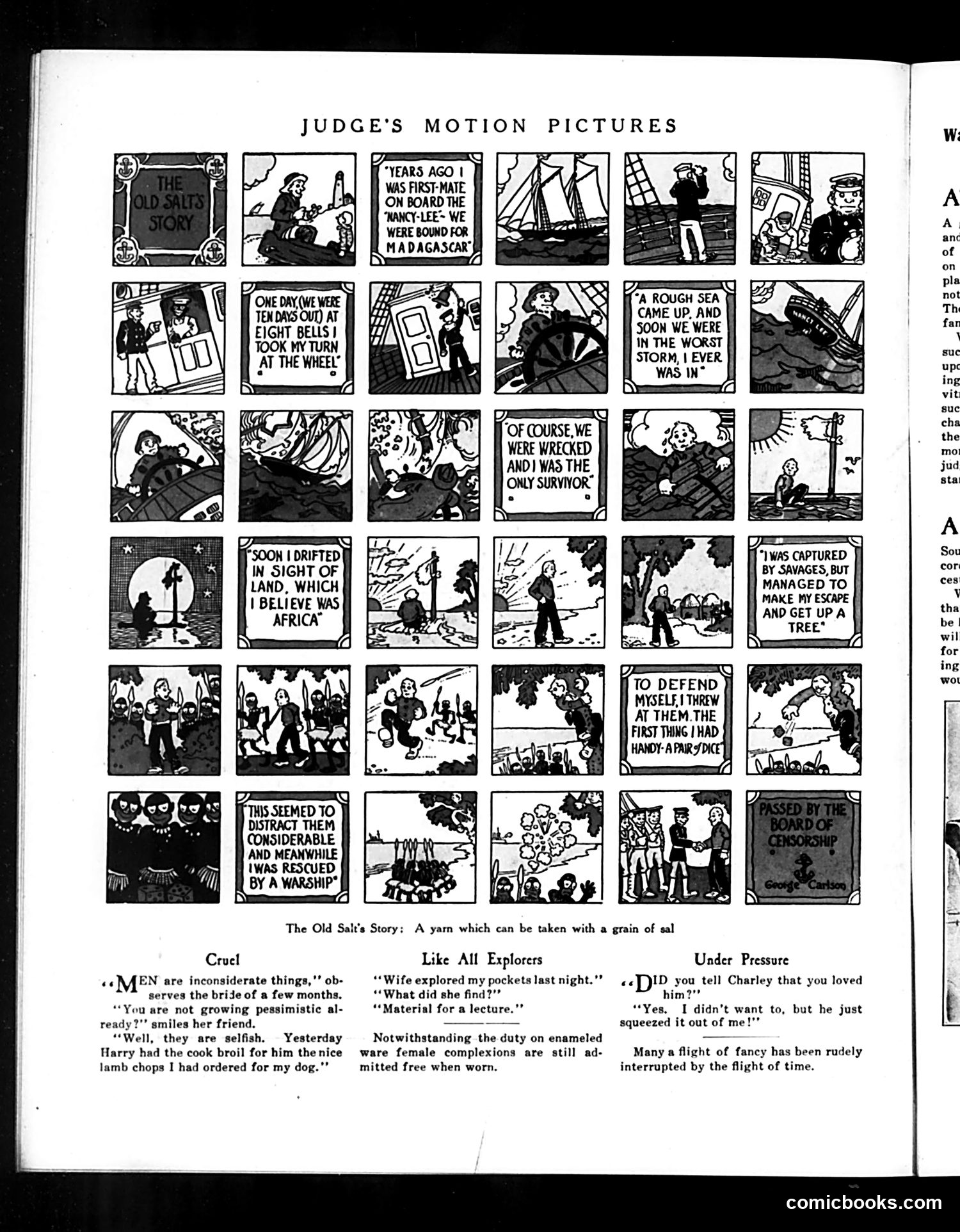
This page presents three distinct elements: **"The Old Salt's Story"** (top): A 30-panel comic strip depicting an elderly sailor recounting an implausibly exaggerated adventure—shipwreck, Madagascar, capture by savages, rescue—told with increasingly absurd details. The subtitle notes this yarn should be taken "with a grain of salt," mocking the tall tales traditionally associated with seafaring men. The humor lies in the obvious fabrication. **Three brief joke columns below** satirize domestic life and gender relations: - "Cruel" mocks husbands as selfish (the husband prioritizes his meal over his wife's interests) - "Like All Explorers" jokes about wives investigating husbands' pockets for evidence of infidelity or misconduct - "Under Pressure" uses a sexual double-entendre about a woman admitting love only when physically coerced The page reflects early 20th-century Judge magazine's typical content: visual comedy strips and short domestic humor emphasizing male-female tensions, seafaring folklore, and wordplay.
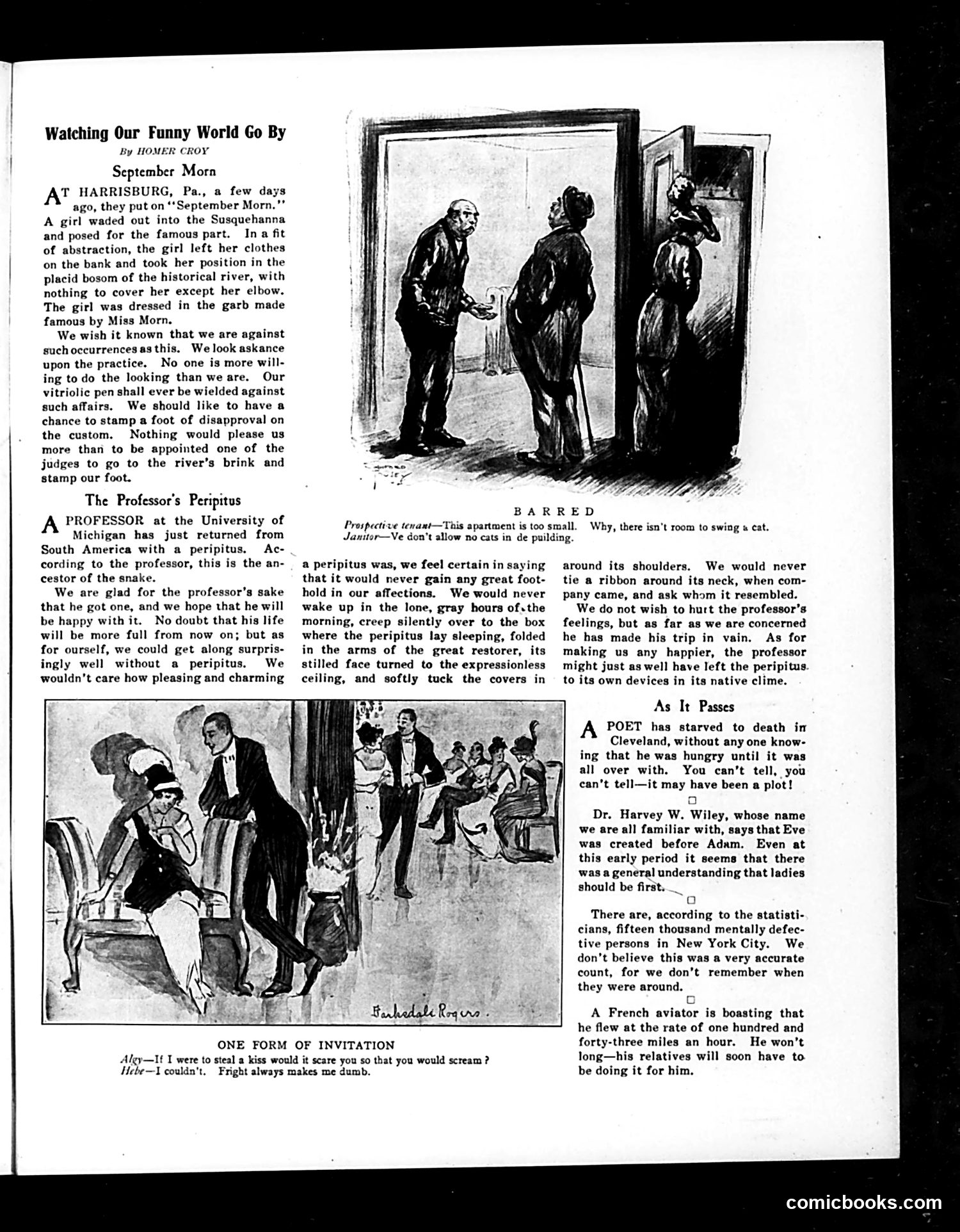
This humor column by Homer Croy contains four unrelated satirical pieces: **"September Morn"**: References a famous 1912 Paul Chabas painting of a nude woman bathing that caused public scandal. Croy mocks the hypocrisy of moral guardians—pretending disapproval while eagerly volunteering to "judge" such displays. **"The Professor's Peripitus"**: A zoologist returned from South America with a prehistoric snake ancestor. Croy satirizes academic enthusiasm for obscure specimens, deadpan insisting the creature holds no appeal for ordinary people. **"Barred" (cartoon)**: A landlord refuses to rent to a tenant, claiming no cats allowed—but the tenant never mentioned owning one. The joke plays on ethnic dialect humor (the janitor's thick accent) common in early-20th-century comedy. **"As It Passes"**: Brief items mocking current events—a starved poet, dubious mental health statistics, and a boastful French aviator (likely referencing early aviation's dangers). The satire targets humbug, academic pretension, and statistical absurdity typical of Judge's irreverent social commentary.
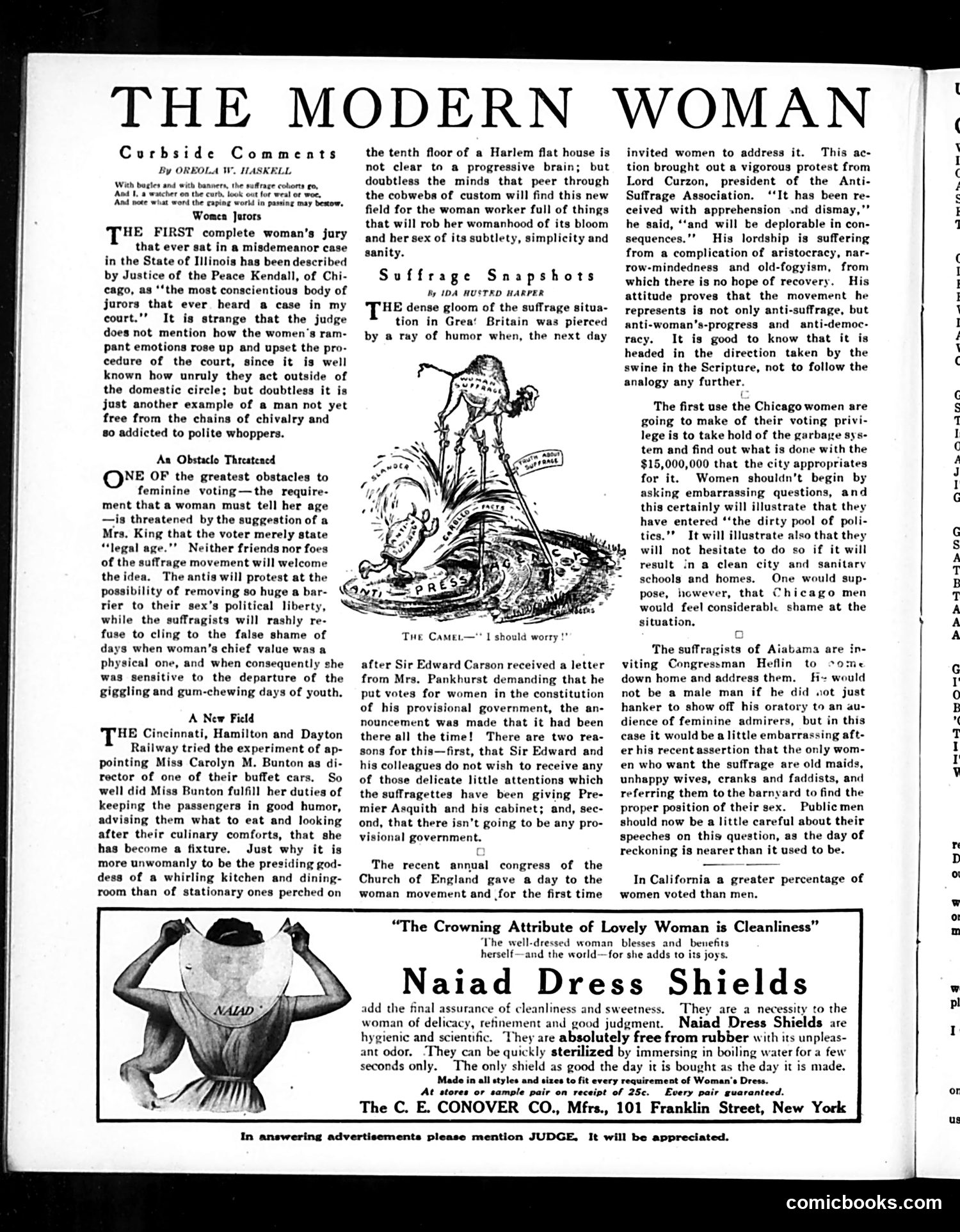
This Judge magazine page satirizes the women's suffrage movement through multiple pieces: **Main cartoon**: A camel labeled "I should worry" depicts the suffrage cause as indifferent to opposition—likely referencing Sir Edward Carson's anti-suffrage stance in Britain. **"Women Jurors"**: The author mocks the praise given to an all-female jury in Illinois, sarcastically noting the judge avoided mentioning "rampant emotions" disrupting court—a common anti-suffrage stereotype about women's supposed emotional instability. **"Obstacle Threatened"**: Satirizes women's reluctance to reveal their age for voting, suggesting female vanity about aging makes them hypocritical advocates for equality. **"A New Field"**: Questions why managing a train buffet car is "unwomanly" when managing a Harlem apartment isn't—using rhetorical irony to mock traditional gender restrictions. The overall tone is anti-suffrage, using humor to suggest women lack the temperament, sincerity, and judgment for voting rights.
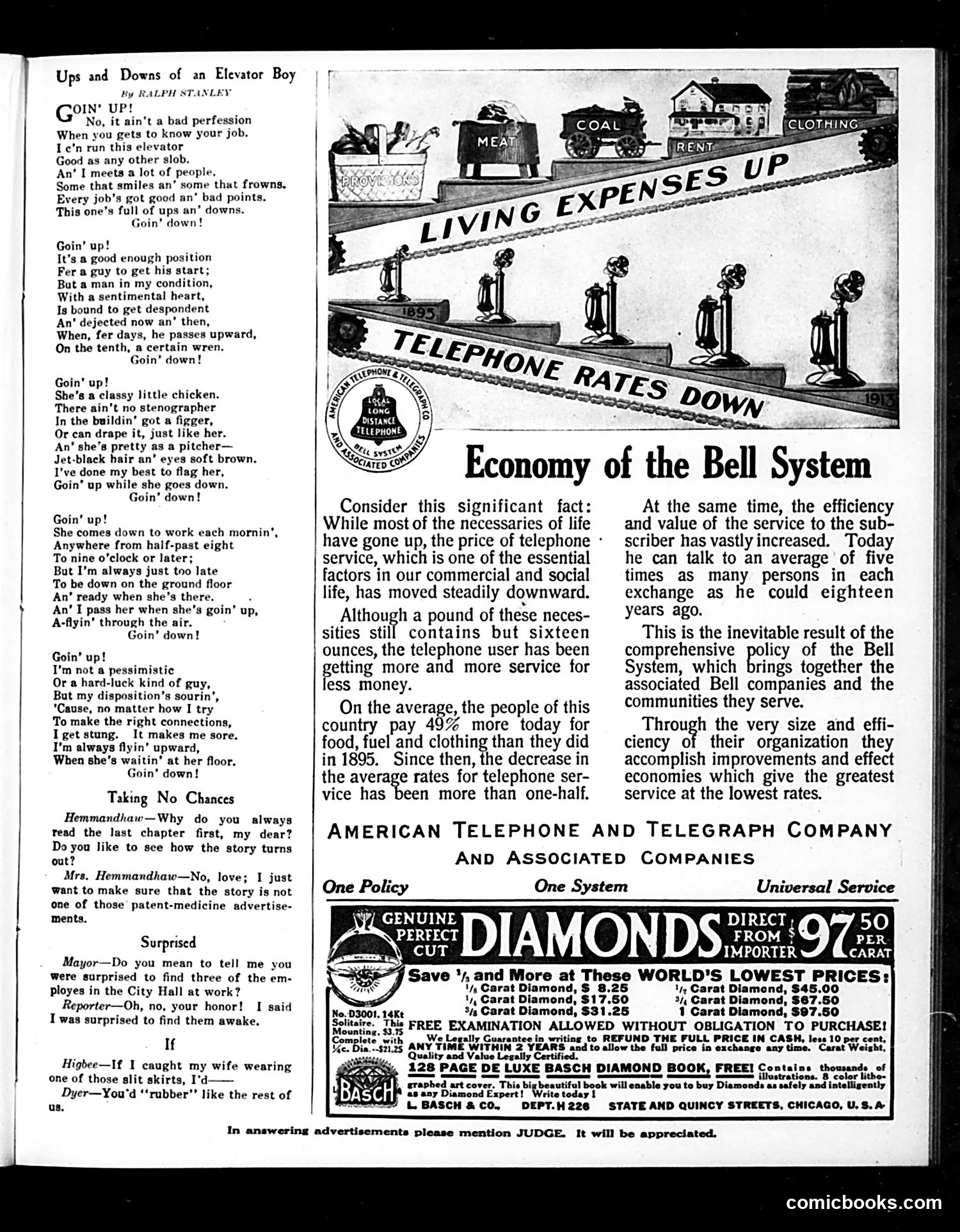
**"Ups and Downs of an Elevator Boy"** is a humorous poem about an elevator operator's romantic misfortune. The narrator is infatuated with a young woman working in the building, but through cruel timing, whenever he operates his elevator going *up*, she's going *down*, and vice versa. He can never coordinate their movements to encounter her. The joke plays on the literal "ups and downs" of elevator operation while depicting the emotional ups and downs of unrequited romantic pursuit. The page also includes brief comic anecdotes mocking pretension and revealing human nature (a wife avoiding patent-medicine ads, a mayor's employee caught actually working). The substantial Bell Telephone advertising argues that despite rising costs for food and clothing since 1895, telephone rates have *decreased* by over half—positioning the monopoly as consumer-friendly through efficiency and scale. The ads contrast "Living Expenses Up" with "Telephone Rates Down."
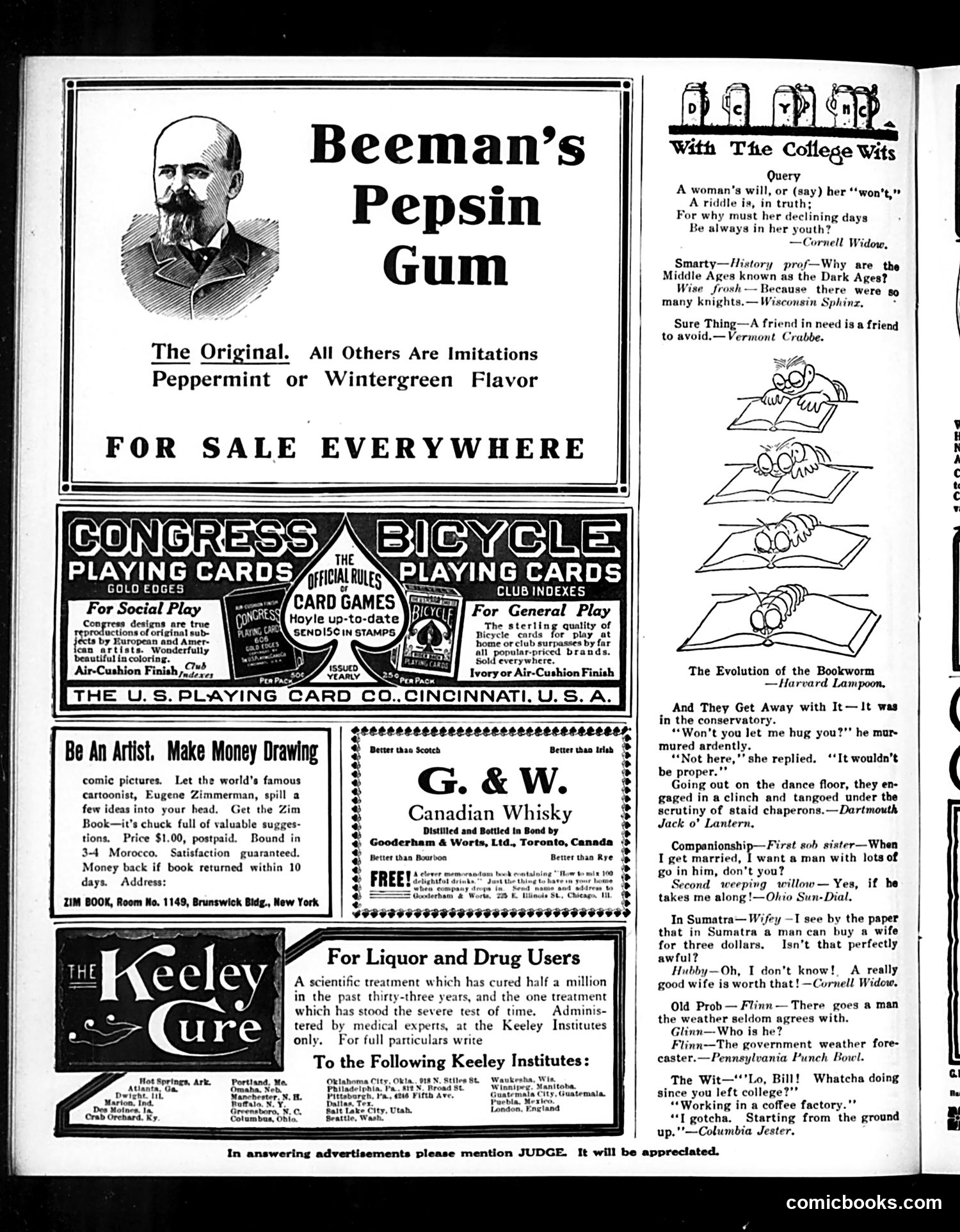
This page is primarily **advertising with a small humor section**. The main content includes: **Advertisements:** - Beeman's Pepsin Gum (claiming to be "the Original") - Congress Bicycle Playing Cards - A correspondence course for aspiring cartoonists by Eugene Zimmerman - G. & W. Canadian Whisky - The Keeley Institute (a treatment center for "Liquor and Drug Users") **The Humor Section** ("With The College Wits") contains jokes from various college humor magazines (Cornell, Wisconsin, Dartmouth, etc.). These are mild, innocent college jokes—puns about relationships, professors, and wordplay—typical of early 1900s collegiate humor. They're largely self-explanatory to modern readers, though the references to "chaperons" and dance-floor propriety reflect period gender norms. **No political satire or social commentary** appears on this page. It's a straightforward advertising and light humor publication, representative of Judge magazine's mixed content format.
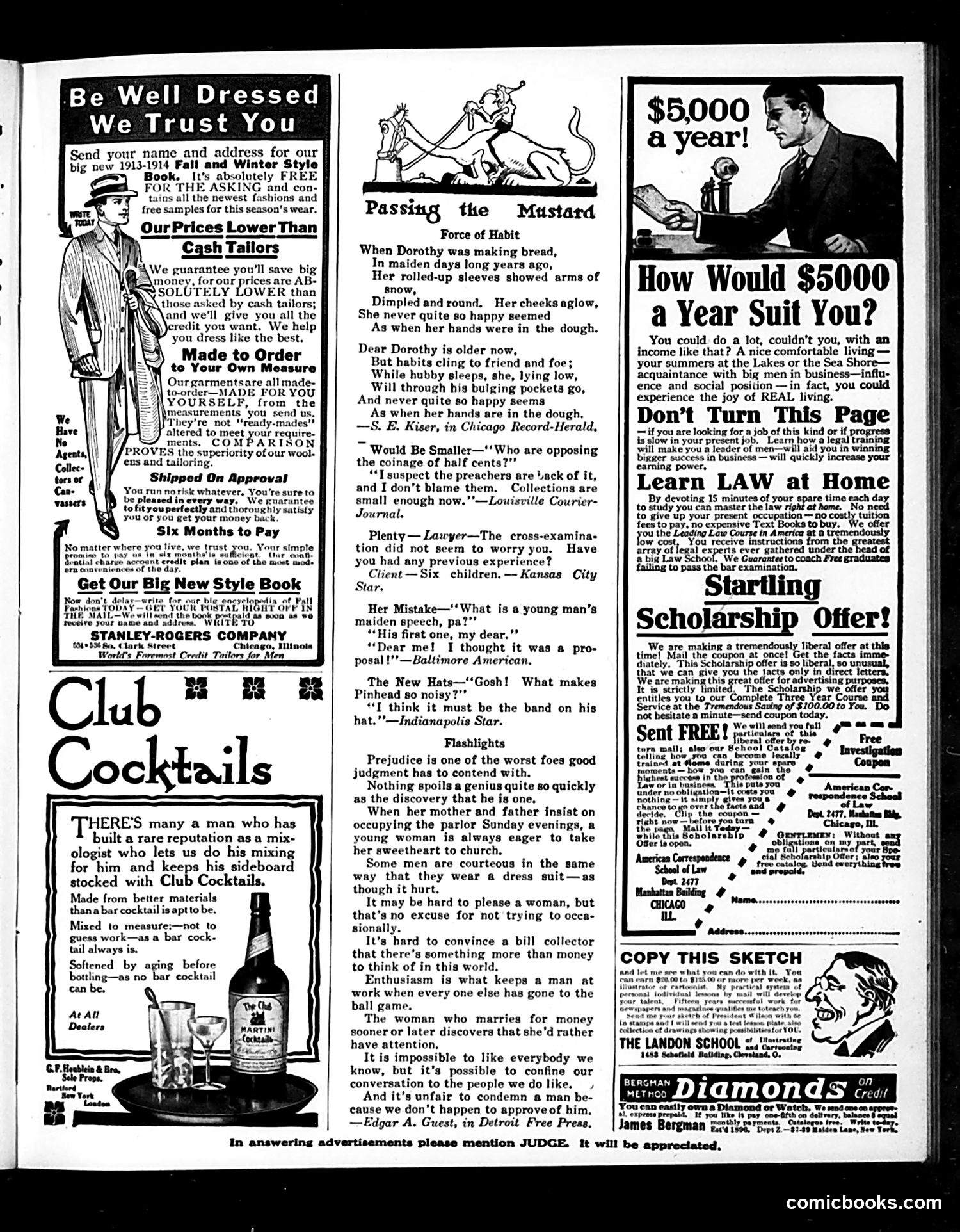
This is primarily an **advertising and humor page** from Judge's 1913-1914 issue. The main content includes: **Advertisements:** Tailor services (Stanley-Rogers), Club Cocktails, and correspondence law schools dominate the layout—typical early 20th-century marketing. **Humor Pieces:** Short jokes and witticisms fill the margins: - "Passing the Mustard" by S.E. Kiser: A domestic comedy about a wife's habit of searching her sleeping husband's pockets, mimicking her old bread-making gesture - Various one-liners about preachers avoiding half-cent coins (weak collections), lawyers, maiden speeches, and marital dynamics - Edgar A. Guest's "Flashlights": Moralizing aphorisms about prejudice, enthusiasm, and relationships **The Satire:** These pieces gently mock domestic life, marriage economics, and human nature—typical Judge fare offering mild social commentary wrapped in sentimental or humorous packaging. Nothing explicitly political appears here; the page reflects period attitudes about gender roles and consumer aspirations rather than current events.
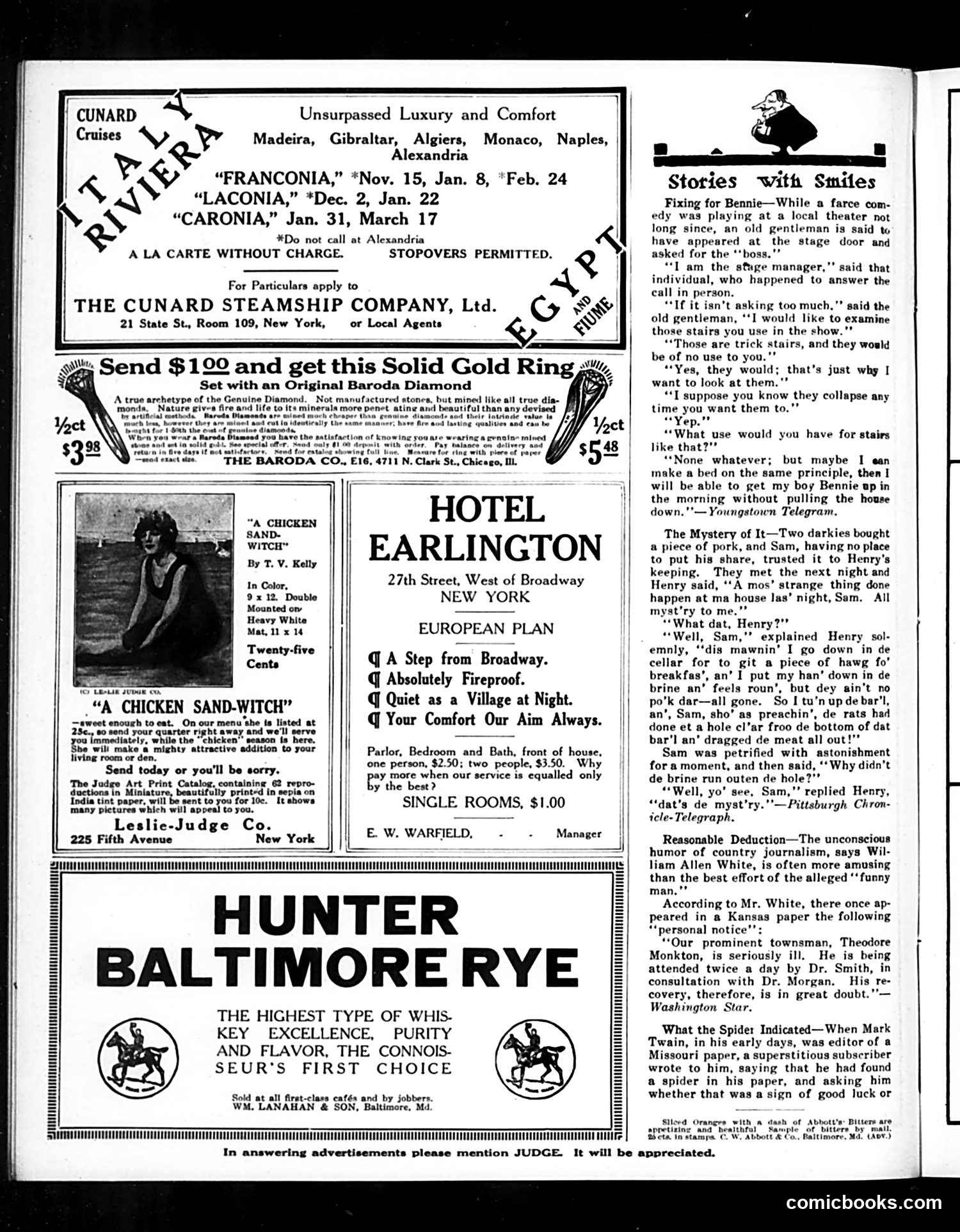
This page is primarily **advertising**, not political satire. It contains: - **Cunard cruise line ads** promoting luxury Mediterranean voyages - **Hotel Earlington** lodging advertisements - **Hunter Baltimore Rye whiskey** promotion - **Leslie-Judge art prints** (a "Chicken Sand-Witch" painting) The only editorial content is a small section titled **"Stories with Smiles"**—brief humorous anecdotes: 1. An elderly man requests "trick stairs" from a theater to build a collapsible bed for his son Bennie 2. Two Black men discuss mysteriously disappearing pork, with one blaming rats who supposedly chewed through a barrel These are light, genteel humor pieces typical of Judge magazine's era—the second relies on racist dialect humor common to early 20th-century American publications. Neither contains political commentary or social satire; they're simply meant as amusing diversions alongside the advertising that dominates the page.
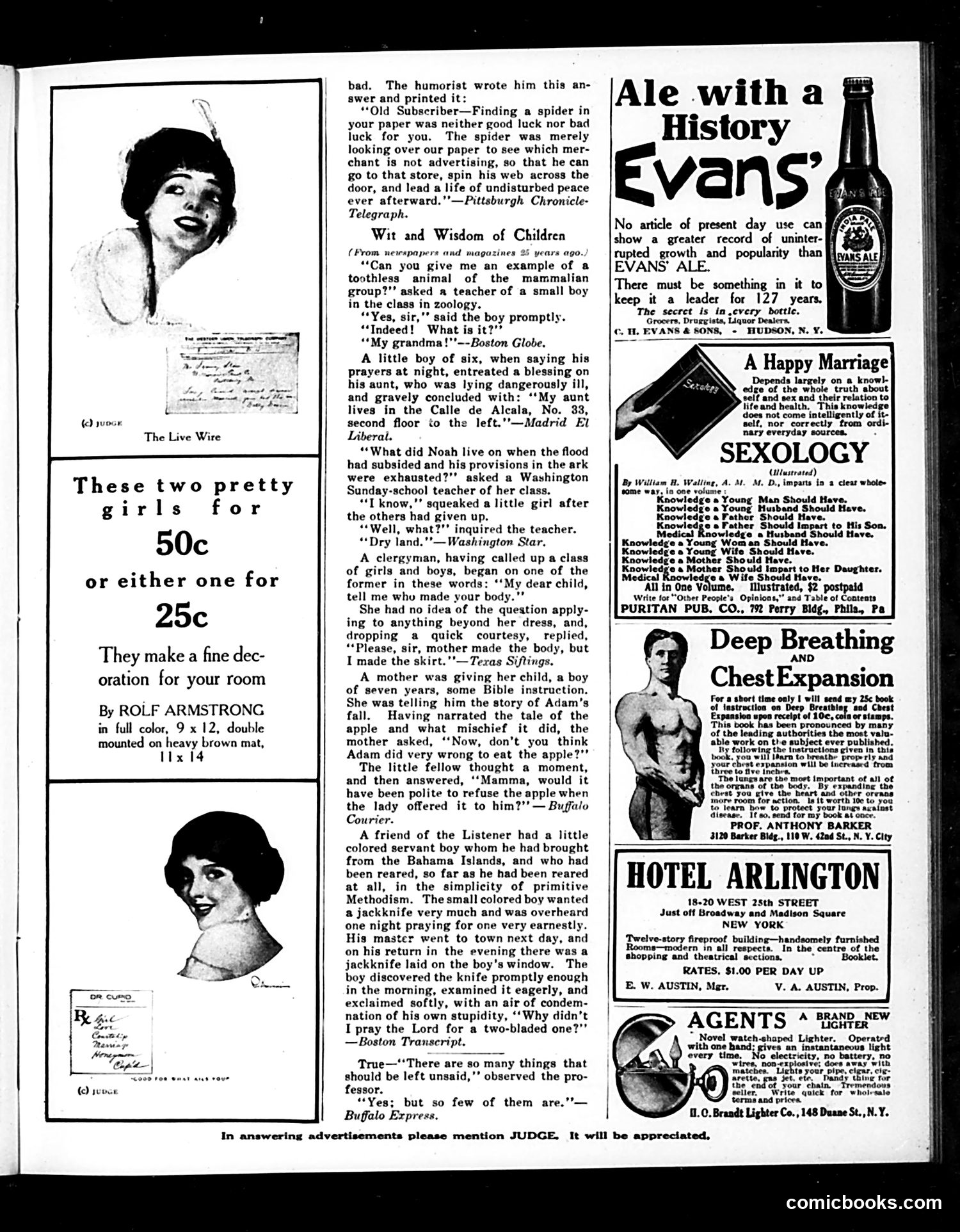
This page is primarily **advertising and filler content** rather than political satire. The main elements are: **"The Live Wire"** features two portrait illustrations of attractive young women by artist Rolf Armstrong, offered as decorative prints (50¢ for both or 25¢ each)—typical pin-up style content from this era. **"Wit and Wisdom of Children"** is a humor column collecting anecdotes about children's innocent misunderstandings, sourced from newspapers and magazines. These showcase period attitudes: a boy calling his grandmother "toothless," a girl attributing her dress-making to her mother, and a servant boy's naive prayer logic. The humor relies on children's literalism and class/racial stereotypes acceptable at the time. **Advertisements** dominate the right side: Evans Ale (claiming 127 years of popularity), a "Sexology" instructional book, Hotel Arlington, and a cigarette lighter. The page reflects early-20th-century magazine conventions: mixing light humor, cheesecake imagery, and commercial ads with no overtly political commentary.
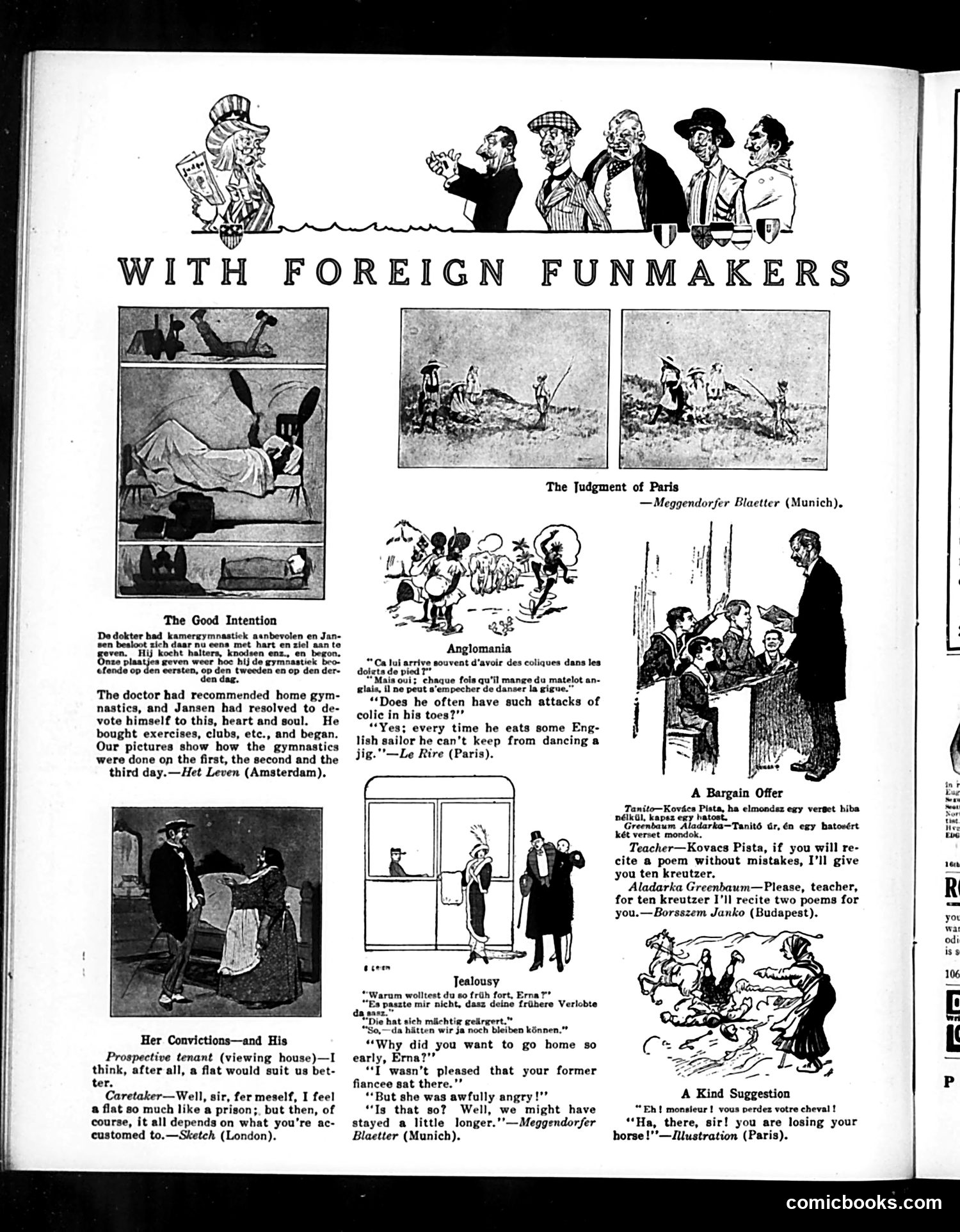
This page collects humorous shorts translated from European satirical publications, demonstrating early 20th-century international comic culture. **"The Good Intention"** (Amsterdam): A man enthusiastically begins home gymnastics with weights and clubs, then progressively abandons the effort—by day three, he's collapsed in exhaustion. The joke: noble resolutions quickly fail. **"Her Convictions—and His"** (London): A tenant and caretaker debate apartment versus flat living, with the caretaker's cynical aside that flats feel like prisons—implying the tenant is accustomed to confinement (possibly a dig at class or criminal background). **Other shorts** include mild jokes about colic caused by eating English sailors (French), a jealousy scene (German), a schoolboy offering to recite extra poems for payment (Hungarian), and a warning about a runaway horse (French). The page satirizes everyday human nature: laziness, pretension, vanity, and petty bargaining—universal themes requiring no specific historical knowledge to understand.
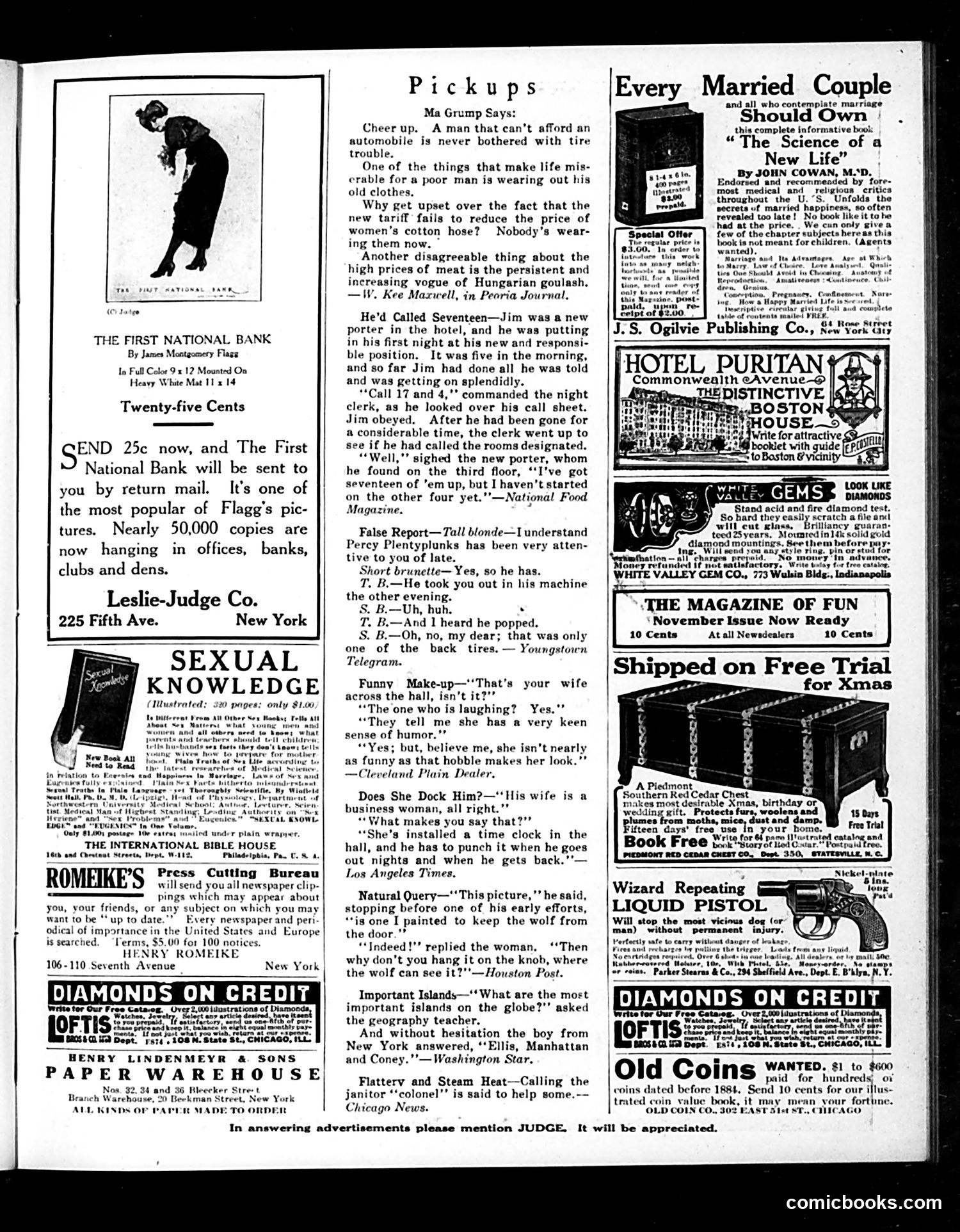
This page is primarily **advertisements and miscellaneous humor content**, with one notable cartoon at top-left showing a man in formal attire bending over, captioned "THE FIRST NATIONAL BANK." The cartoon's joke appears to reference financial hardship or physical strain related to banking/money—the exaggerated posture suggests either physical burden or humiliation tied to financial matters. The text sections labeled "Pickups" contain brief humorous anecdotes and "Ma Grump Says" offers cynical observations about poverty, automobiles, and tariffs—typical of satirical magazines mocking both wealth inequality and economic policy of the era. The bulk of the page consists of advertising for books (notably "Sexual Knowledge" and "The Science of a New Life," both addressing marriage topics), hotels, diamonds, and other products. No specific political figures or events are referenced. The satire targets general social conditions—class differences, poverty, and changing gender roles (women's employment, fashion)—rather than particular politicians or events.
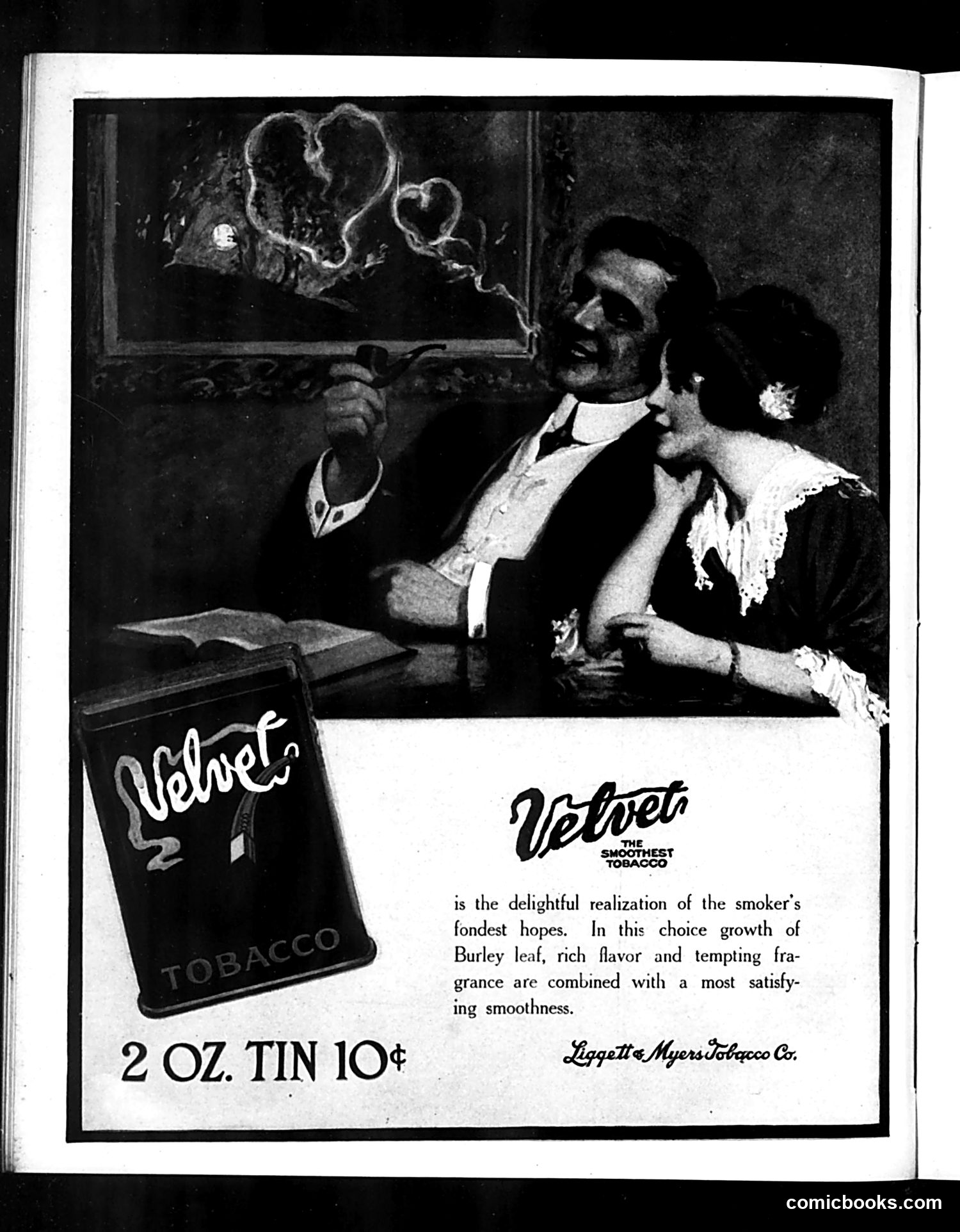
This is primarily a **tobacco advertisement**, not political satire. It promotes Velvet brand tobacco (2 oz. tin for 10¢) by Liggett & Myers Tobacco Co. The image shows a well-dressed man and woman examining what appears to be a framed drawing or advertisement featuring two intertwined snakes forming heart shapes—likely representing the product's appeal to romance or intimacy. The ad copy emphasizes Velvet as "the smoothest tobacco," combining Burley leaf with "rich flavor" and "satisfying smoothness." The romantic imagery and couple gazing at the hearts suggest the advertiser is marketing tobacco as a sophisticated, desirable product associated with romance and refined taste. This reflects early 20th-century advertising strategies that linked consumer goods to aspirational lifestyles and emotions.