
Judge, 1913-11-01 · page 7 of 24
Judge — November 1, 1913 — page 7: what you’re looking at
What you’re looking at
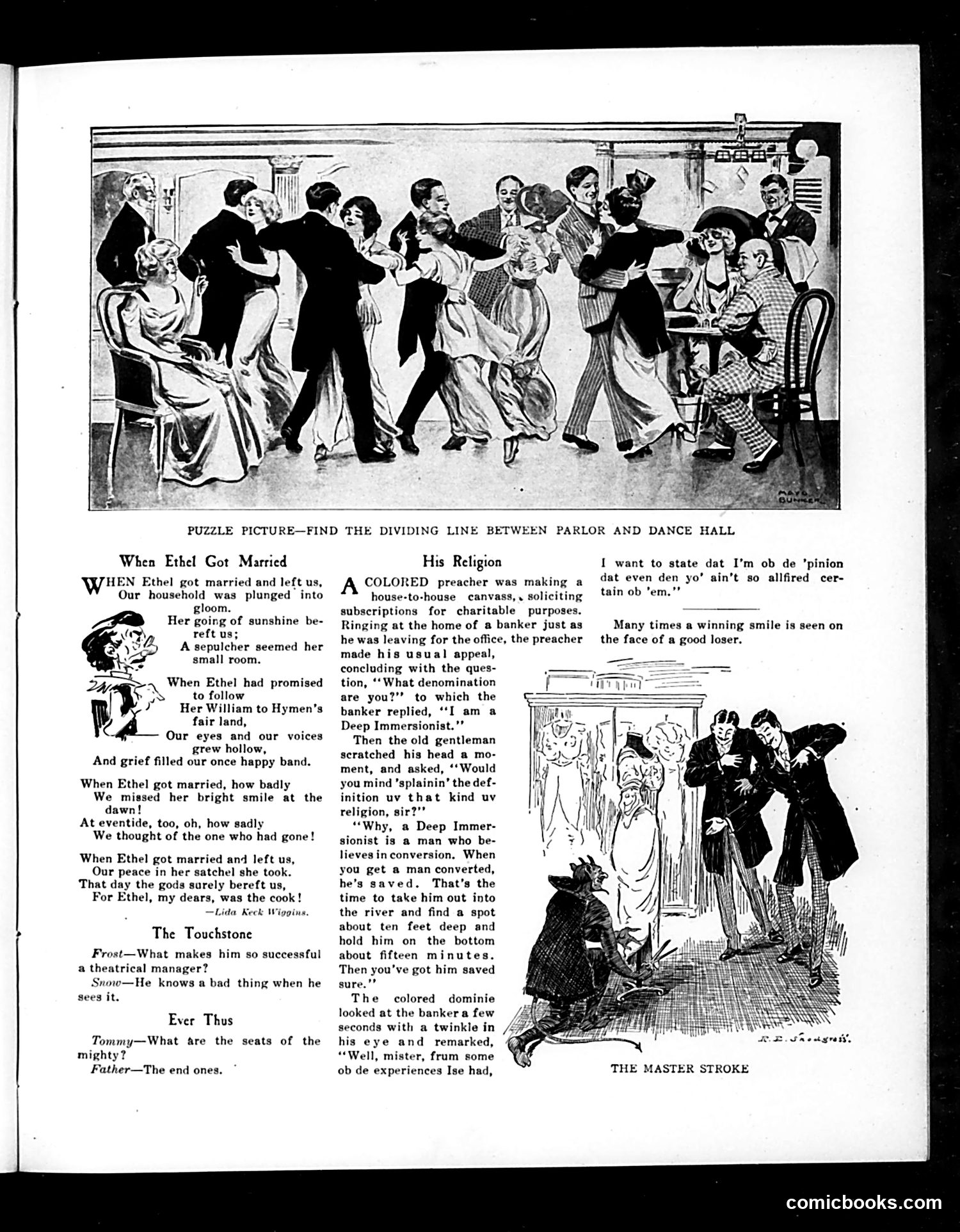
This Judge magazine page contains three separate humor pieces satirizing early 20th-century American life: **"When Ethel Got Married"** is a sentimental poem about a family's sadness at losing their servant girl Ethel to marriage—the punchline reveals the real loss: she was their cook. **"The Touchstone"** is a brief joke about theatrical managers having poor taste. **"His Religion"** satirizes racial and class dynamics. A Black preacher soliciting donations from a wealthy banker describes "Deep Immersionism" as holding converts underwater for fifteen minutes to ensure salvation. The preacher's clever response—noting from "experiences" he's had that even this doesn't guarantee results—is a darkly humorous commentary on the banker's dishonesty and shallow faith, using the preacher's dialect to satirize both the banker's greed and racist stereotypes of the era. The top puzzle image depicts a chaotic social gathering, likely illustrating the blurred boundary between respectable "parlor" socializing and disreputable "dance hall" behavior—a common morality concern of the period.
📄 Transcribed text from this page (OCR, searchable)
Machine-transcribed from the original scan — historical spelling and the odd misread are preserved.
PUZZLE PICTURE—FIND THE DIVIDING LINE BETWEEN PARLOR AND DANCE HALL When Ethel Got Married WHEN Ethel got married and left us, Our household was plunged’ into gloom. Her going of sunshine be- reft us; A sepulcher seemed her small room. When Ethel had promised to follow Her William to Hymen’s fair land, Our eyes and our voices grew hollow, And grief filled our once happy band. When Ethel got married, how badly We missed her bright smile at the dawn! At eventide, too, oh, how sadly We thought of the one who had gone! When Ethel got married and left us, Our peace in her satchel she took. That day the gods surely bereft us, For Ethel, my dears, was the cook! —Lida Keck Wiggins. The Touchstone Frost—What makes him so successful a theatrical manager? Snow—He knows a bad thing when he sees it. Ever Thus Tommy—What fre the seats of the mighty? Father—The end ones. His Religion A COLORED preacher was making a house-to-house canvass, , soliciting subscriptions for charitable purposes. Ringing at the home of a banker just as he was leaving for the office, the preacher made his usual appeal, concluding with the ques- tion, ‘What denomination are you?”? to which the banker replied, ‘I am a Deep Immersionist.’" Then the old gentleman scratched his head a mo- ment, and asked, ‘*Would you mind ’splainin’ the def- inition uv that kind uv religion, sir?’’ “Why, a Deep Immer- sionist is a man who be- lieves in conversion, When you get a man converted, he’s saved. That’s the time to take him out into the river and find a spot about ten feet deep and hold him on the bottom about fifteen minutes. Then you've got him saved sure.’” The colored dominie looked at the banker a few seconds with a twinkle in his eye and remarked, “Well, mister, frum some ob de experiences Ise had, 1 want to state dat I’m ob de ’pinion dat even den yo’ ain’t so allfired cer- tain ob 'em.”’ Many times a winning smile is seen on the face of a good loser. BR Sot grasy, THE MASTER STROKE comicbooks.com