
Judge, 1913-11-01 · page 11 of 24
Judge — November 1, 1913 — page 11: what you’re looking at
What you’re looking at
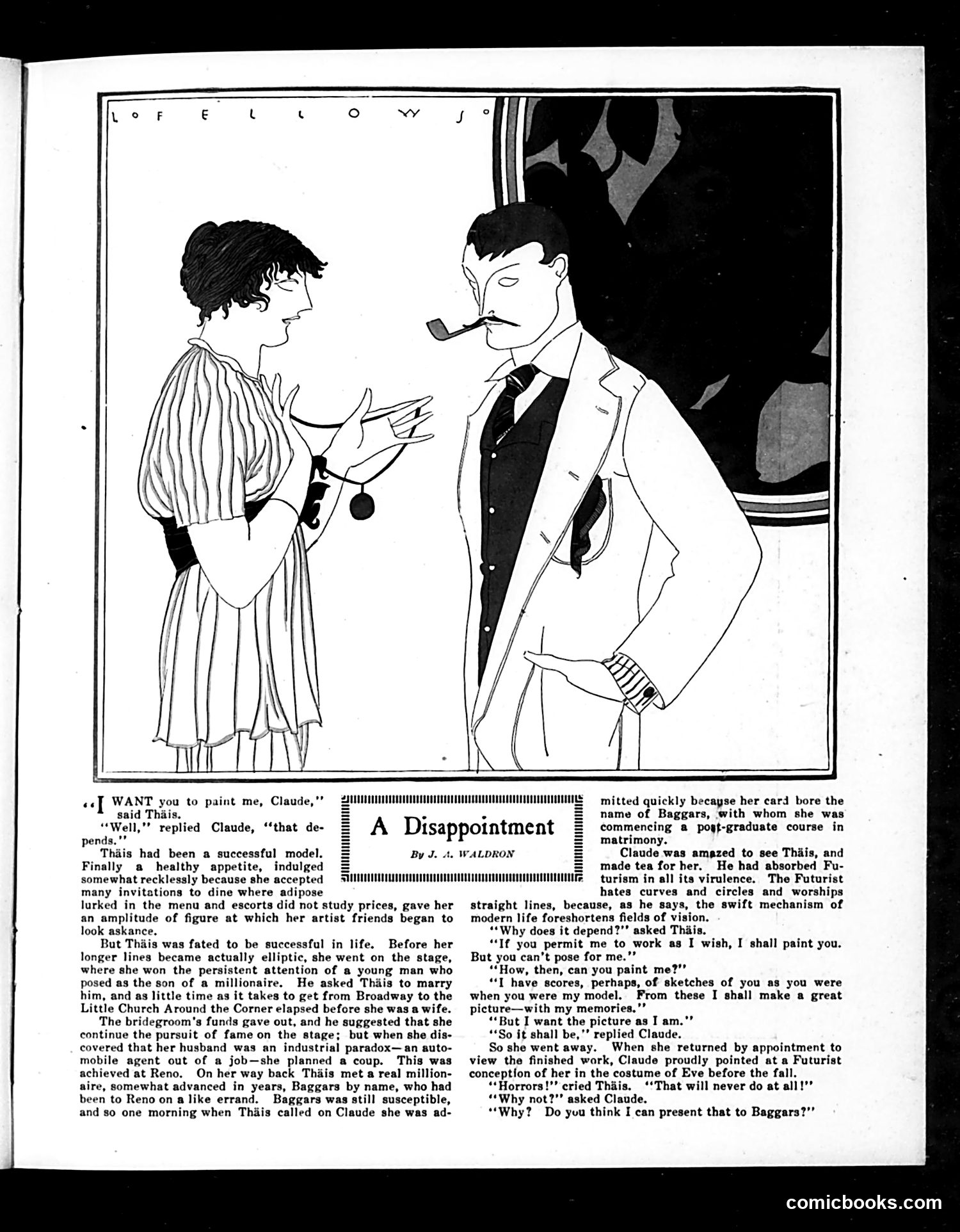
This story satirizes both **artistic modernism** (specifically Futurism) and **social climbing through marriage**. **The plot**: Thais, a former model turned actress, has married a millionaire named Baggars after divorcing a penniless husband. She visits her old artist friend Claude, asking him to paint her portrait. Claude, now a Futurist, refuses to paint from life, claiming modern art rejects curves for straight lines. Instead, he paints Thais from memory in an abstract, distorted style—depicting her as Eve in a hyper-modern Futurist manner. **The joke**: Thais is horrified by the avant-garde result because she needs a flattering portrait to present to her wealthy new husband. The satire mocks **Futurism's impracticality** (an artist who won't actually observe his subject) while poking fun at **social-climbing women** who value appearance and respectability over artistic integrity. The cartoon illustrates the clash between cutting-edge artistic movements and conventional bourgeois expectations.
📄 Transcribed text from this page (OCR, searchable)
Machine-transcribed from the original scan — historical spelling and the odd misread are preserved.
WANT you to paint me, Claude,"’ said Th “] “‘Well,’’ replied Claude, ‘‘that de- pends."’ Thais had been a successful model. By J. Finally a healthy appetite, indulged somewhat recklessly because she accepted many invitations to dine where adipose lurked in the menu and escorts did not study prices, gave her an amplitude of figure at which her artist friends began to look askance, But Thiis was fated to be successful in life. Before her longer lines became actually elliptic, she went on the stage, where she won the persistent attention of a young man who posed as the son of a millionaire. He asked Thais to marry him, and as little time as it takes to get from Broadway to the Little Church Around the Corner elapsed before she was a wife. The bridegroom's funds gave out, and he suggested that she continue the pursuit of fame on the stage; but when she dis- covered that her husband was an industrial paradox—an auto- mobile agent out of a job—she planned a coup. This was achieved at Reno. On her way back Thais meta real million- aire, somewhat advanced in years, Baggars by name, who had been to Reno on a like errand. Baggars was still susceptible, and so one morning when Thiis called on Claude she was ad- TUT A Disappointment «A. WALDRON SUOUUUUENAUAAEGDANEAUANAUAGOLOGELONEOUENUNOOAUENONOENUEA ENON mitted quickly becayse her card bore the name of Baggars, with whom she was commencing @ pogt-graduate course in matrimony. Claude was amazed to see Thiis, and made tea for her. He had absorbed Fu- turism in all its virulence. The Futurist hates curves and circles and worships straight lines, because, as he says, the swift mechanism of modern life foreshortens fields of vision. “*Why does it depend?’’ asked Thai “If you permit me to ,work as I wish, I shall paint you. But you can’t pose for me.’ “How, then, can you paint me?” “I have scores, perhaps, of sketches of you as you were when you were my model. From these I shall make a great picture—with my memories,’” “But I want the picture as I am."” “*So it shall be,’’ replied Claude. So she went away. When she returned by appointment to view the finished work, Claude proudly pointed at a Futurist conception of her in the costume of Eve before the fall. “*Horrors!’’ cried Thiis. ‘‘That will never do at all!’* “Why not?"’ asked Claude. “Why? Do you think I can present that to Baggars?’’ comicbooks.com