
Judge, 1913-11-01 · page 4 of 24
Judge — November 1, 1913 — page 4: what you’re looking at
What you’re looking at
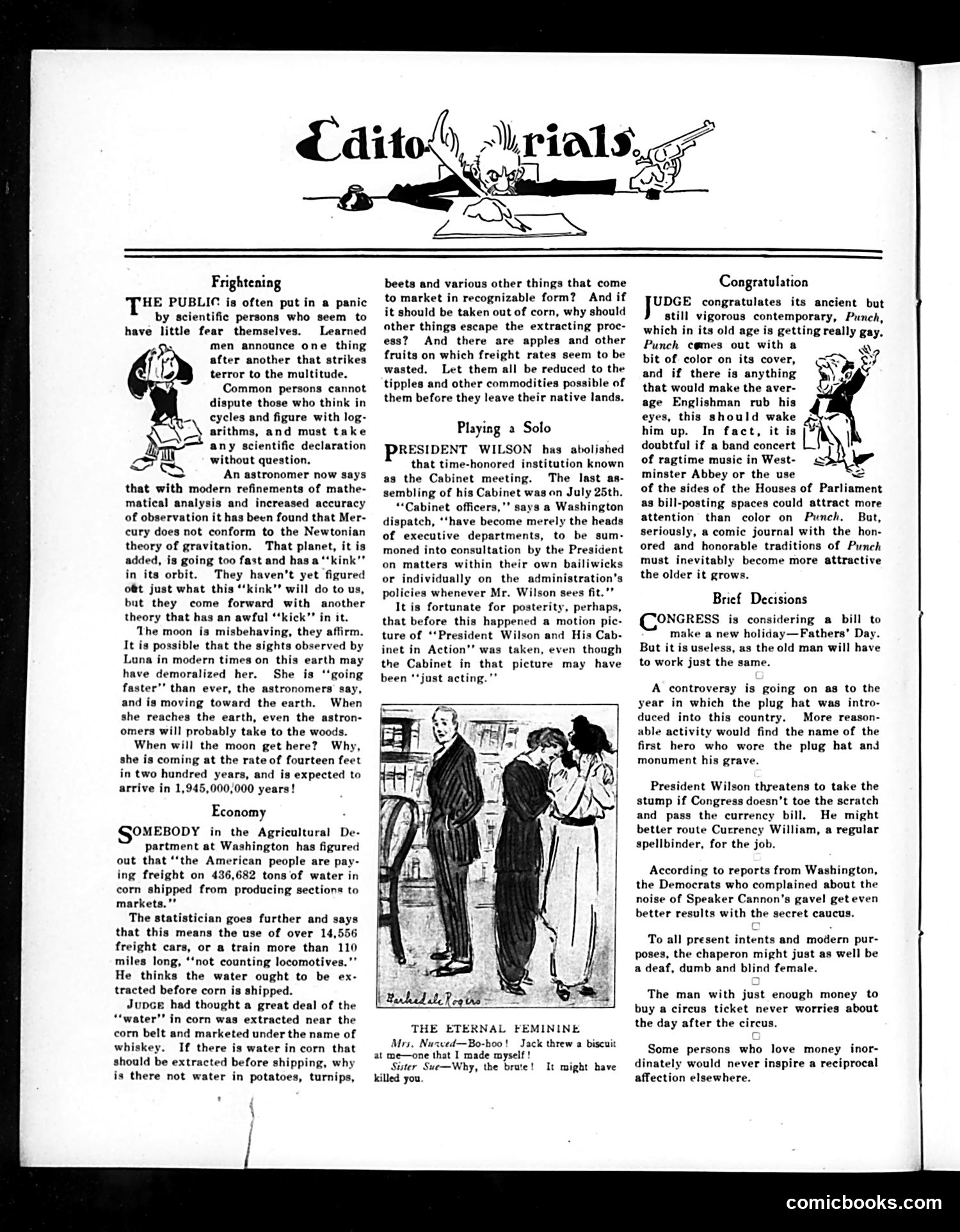
This cartoon satirizes gender dynamics in early 20th-century America. The image shows a woman (labeled "Mrs. Newed") throwing a biscuit at a man while making excuses—she claims he threw it first and calls him a "brute," suggesting she's being deliberately provocative while playing the victim. The accompanying dialogue mocks women who initiate conflict then feign innocence or victimhood. The satire targets what Judge perceived as manipulative feminine behavior: starting disputes, then leveraging societal chivalry and male protective instincts to avoid accountability. This reflects period attitudes dismissing women's agency as inherent dishonesty rather than recognizing legitimate grievances. The joke relies on misogynistic assumptions about female nature being inherently duplicitous.
📄 Transcribed text from this page (OCR, searchable)
Machine-transcribed from the original scan — historical spelling and the odd misread are preserved.
dito Frightening THE PUBLIC. is often put in a panic by scientific persons who seem to have little fear themselves. Learned a men announce one thing ip after another that strikes ao terror to the multitude. Common persons cannot dispute those who think in cycles and figure with log- AoNey arithms, and must take ae any scientific declaration without question. a Se An astronomer now says that with modern refinements of mathe- matical analysis and increased accuracy of observation it has been found that Mer- cury does not conform to the Newtonian theory of gravitation. That planet, it is added, is going too fast and has a ‘‘kink’’ in its orbit. They haven't yet figured o@t just what this ‘‘kink’’ will do to us, but they come forward with another theory that has an awful ‘‘kick’’ in it. ‘The moon is misbehaving, they affirm. It is possible that the sights observed by Luna in modern times on this earth may have demoralized her. She is ‘‘going faster’’ than ever, the astronomers say, and is moving toward the earth. When she reaches the earth, even the astron- omers will probably take to the woods. When will the moon get here? Why, she is coming at the rate of fourteen feet in two hundred years, and is expected to arrive in 1,945,000,000 years! Economy SOMEBODY in the Agricultural De- partment at Washington has figured out that ‘‘the American people are pay- ing freight on 436,682 tons of water in corn shipped from producing sections to markets. The statistician goes further and says that this means the use of over 14,556 freight cars, or a train more than 110 miles long, ‘‘not counting locomotives.”’ He thinks the water ought to be ex- tracted before corn is shipped. Jupce had thought a great deal of the “‘water’’ in corn was extracted near the corn belt and marketed under the name of whiskey. If there is water in corn that should be extracted before shipping, why is there not water in potatoes, turnips, beets and various other things that come to market in recognizable form? And if it should be taken out of corn, why should other things escape the extracting proc- ess? And there are apples and other fruits on which freight rates seem to be wasted. Let them all be reduced to the tipples and other commodities possible of them before they leave their native lands. Playing a Solo PRESIDENT WILSON has abolished that time-honored institution known as the Cabinet meeting. The last as- sembling of his Cabinet was on July 25th. “Cabinet officers,’’ says a Washington dispatch, ‘‘have become merely the heads of executive departments, to be sum- moned into consultation by the President on matters within their own bail ks or individually on the administration's policies whenever Mr. Wilson sees fit.’” It is fortunate for posterity, perhaps, that before this happened a motion pic- ture of ‘‘President Wilson and His Cab- inet in Action’? was taken, even though the Cabinet in that picture may have been ‘*just acting."’ THE ETERNAL FEMININE Mrs, Nuzved—Bo-hoo! Jack threw a biscuit at me—one that I made myself! Sister Sue—Why, the brute! killed you. It might have (pias, < SF Congratulation UDGE congratulates its ancient but still vigorous contemporary, Punch, which in its old age is getting really gay. Punch cemes out with a RY bit of color on its cover, <> os and if there is anything ® $ that would make the aver- J, age Englishman rub his eyes, this should wake Ayo \ him up. In fact, it is E | doubtful if a band concert of ragtime music in West- <> minster Abbey or the use of the sides of the Houses of Parliament as bill-posting spaces could attract more attention than color on Punch. But, seriously, a comic journal with the hon- ored and honorable traditions of Punch must inevitably become more attractive the older it grows. Brief Decisions CONGRESS is considering a bill to make a new holiday—Fathers’ Day. But it is useless, as the old man will have to work just the same. A controversy is going on as to the year in which the plug hat was intro- duced into this country. More reason- able activity would find the name of the first hero who wore the plug hat and monument his grave. President Wilson threatens to take the stump if Congress doesn’t toe the scratch and pass the currency bill. He might better route Currency William, a regular spellbinder, for the job. According to reports from Washington, the Democrats who complained about the noise of Speaker Cannon's gavel geteven better results with the secret caucus. To all present intents and modern pur- poses, the chaperon might just as well be a deaf, dumb and blind female. The man with just enough money to buy a circus ticket never worries about the day after the circus. Some persons who love money inor- dinately would never inspire a reciprocal affection elsewhere. comicbooks.com