
Judge, 1913-11-01 · page 15 of 24
Judge — November 1, 1913 — page 15: what you’re looking at
What you’re looking at
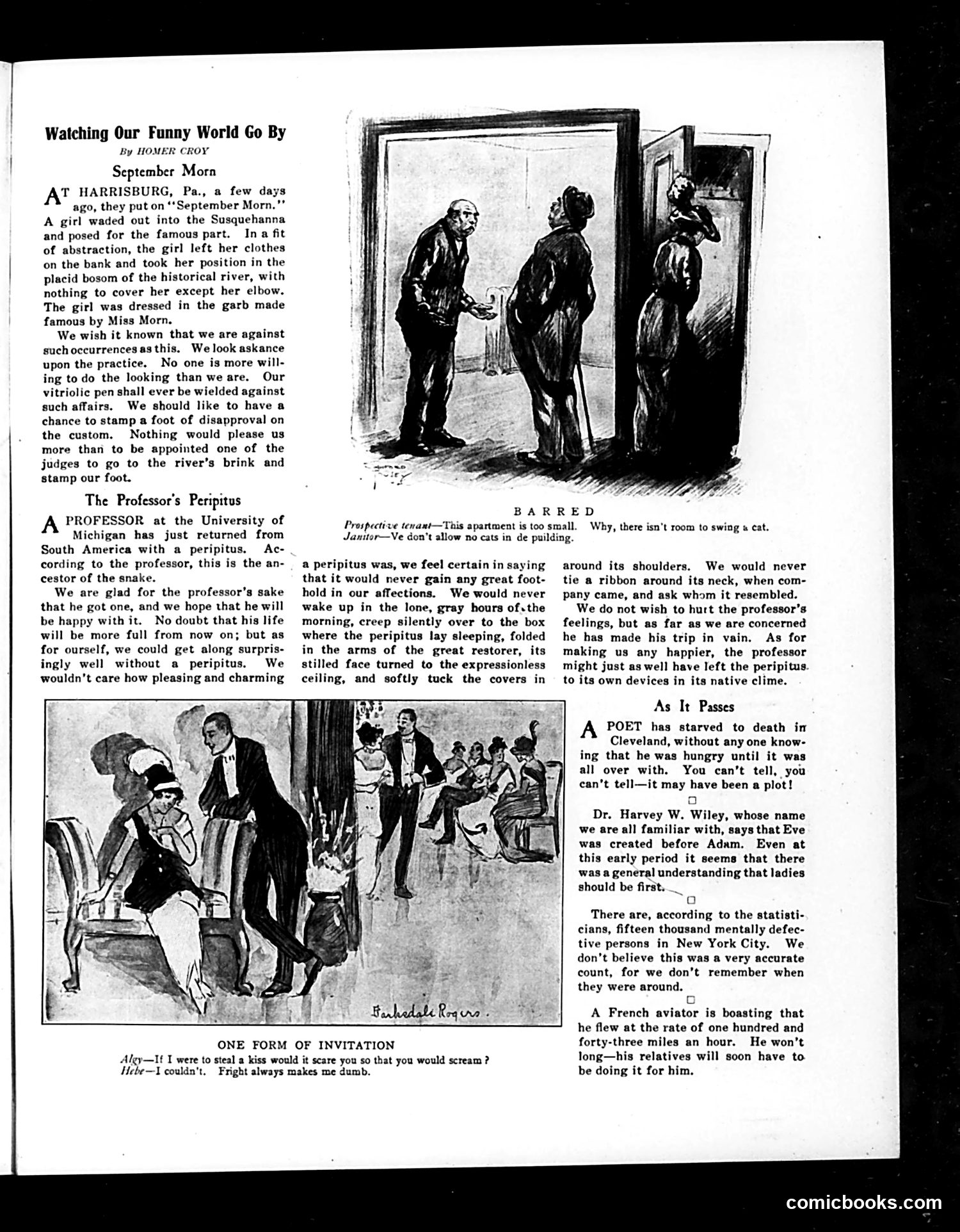
This humor column by Homer Croy contains four unrelated satirical pieces: **"September Morn"**: References a famous 1912 Paul Chabas painting of a nude woman bathing that caused public scandal. Croy mocks the hypocrisy of moral guardians—pretending disapproval while eagerly volunteering to "judge" such displays. **"The Professor's Peripitus"**: A zoologist returned from South America with a prehistoric snake ancestor. Croy satirizes academic enthusiasm for obscure specimens, deadpan insisting the creature holds no appeal for ordinary people. **"Barred" (cartoon)**: A landlord refuses to rent to a tenant, claiming no cats allowed—but the tenant never mentioned owning one. The joke plays on ethnic dialect humor (the janitor's thick accent) common in early-20th-century comedy. **"As It Passes"**: Brief items mocking current events—a starved poet, dubious mental health statistics, and a boastful French aviator (likely referencing early aviation's dangers). The satire targets humbug, academic pretension, and statistical absurdity typical of Judge's irreverent social commentary.
📄 Transcribed text from this page (OCR, searchable)
Machine-transcribed from the original scan — historical spelling and the odd misread are preserved.
Watching Our Funny World Go By By HOMER CROY September Mora A’ HARRISBURG, Pa., a few days ago, they put on ‘September Morn.’" A girl waded out into the Susquehanna and posed for the famous part. Ina fit of abstraction, the girl left her clothes on the bank and took her position in the placid bosom of the historical river, with nothing to cover her except her elbow. The girl was dressed in the garb made famous by Miss Morn. We wish it known that we are against such occurrences as this. We look askance upon the practice. No one is more will- ing to do the looking than we are. Our vitriolic pen shall ever be wielded against such affairs. We should like to have a chance to stamp a foot of disapproval on the custom. Nothing would please us more than to be appointed one of the judges to go to the river’s brink and stamp our foot. The Professor's Peripitus PROFESSOR at the University of Michigan has just returned from South America with a peripitus. Ac- cording to the professor, this is the an- cestor of the snake. We are glad for the professor’s sake that he got one, and we hope that he will be happy with it. No doubt that his life will be more full from now on; but as for ourself, we could get along surpris- ingly well without a peripitus. We wouldn't care how pleasing and charming BARRED Prospective tenant—This apartment is too small. Why, there isn't room to swing « cat. Janitor—Ve don't allow no cats in de puilding. a peripitus was, we feel certain in saying that it would never gain any great foot- hold in our affections. We would never wake up in the lone, gray hours of.the morning, creep silently over to the box where the peripitus lay sleeping, folded in the arms of the great restorer, its stilled face turned to the expressionless ceiling, and softly tuck the covers in ONE FORM OF INVITATION Algy—It I were to steal a kiss would it scare you so that you would scream? Hebe—I couldn't. Fright always makes me dumb. around its shoulders. We would never tie a ribbon around its neck, when com- pany came, and ask whom it resembled. We do not wish to hurt the professor’s feelings, but as far as we are concerned he has made his trip in vain. As for making us any happier, the professor might just as well have left the peripitus. to its own devices in its native clime. As It Passes A POET has starved to death in Cleveland, without any one know- ing that he was hungry until it was all over with. You can’t tell, you can’t tell—it may have been a plot! ao Dr. Harvey W. Wiley, whose name we are all familiar with, says that Eve was created before Adam. Even at this early period it seems that there was a general understanding that ladies should be first. _ a There are, according to the statisti- cians, fifteen thousand mentally defec- tive persons in New York City. We don’t believe this was a very accurate count, for we don’t remember when they were around. oC A French aviator is boasting that he flew at the rate of one hundred and forty-three miles an hour. He won’t long—his relatives will soon have to be doing it for him. comicbooks.com