
A complete issue · 24 pages · 1913
Judge — May 31, 1913
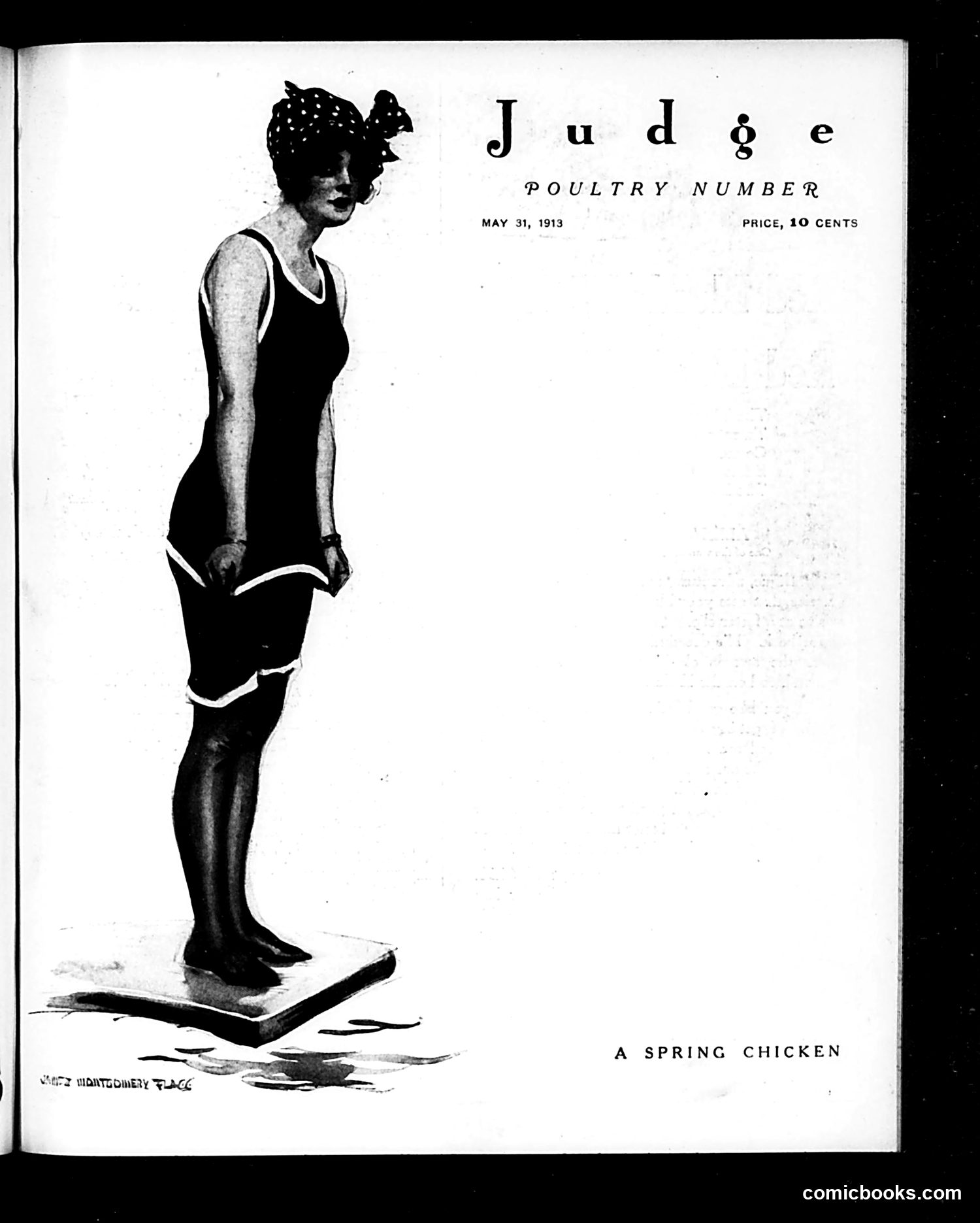
This May 31, 1913 cover is a visual pun titled "A Spring Chicken." The illustration depicts a woman posed on a scale, dressed in a sleeveless bathing suit with a fashionable feathered hat typical of the 1910s era. The humor operates on two levels: "spring chicken" was contemporary slang for an attractive young woman, while the scale suggests weighing oneself—a concern associated with vanity and body-consciousness. The woman's composed posture and elegant attire emphasize the satirical commentary on female appearance and the social pressures women faced regarding their bodies and fashion. The cartoon likely mocks both feminine vanity and the era's obsession with maintaining an idealized female form, themes popular in Judge's satirical humor of the period.
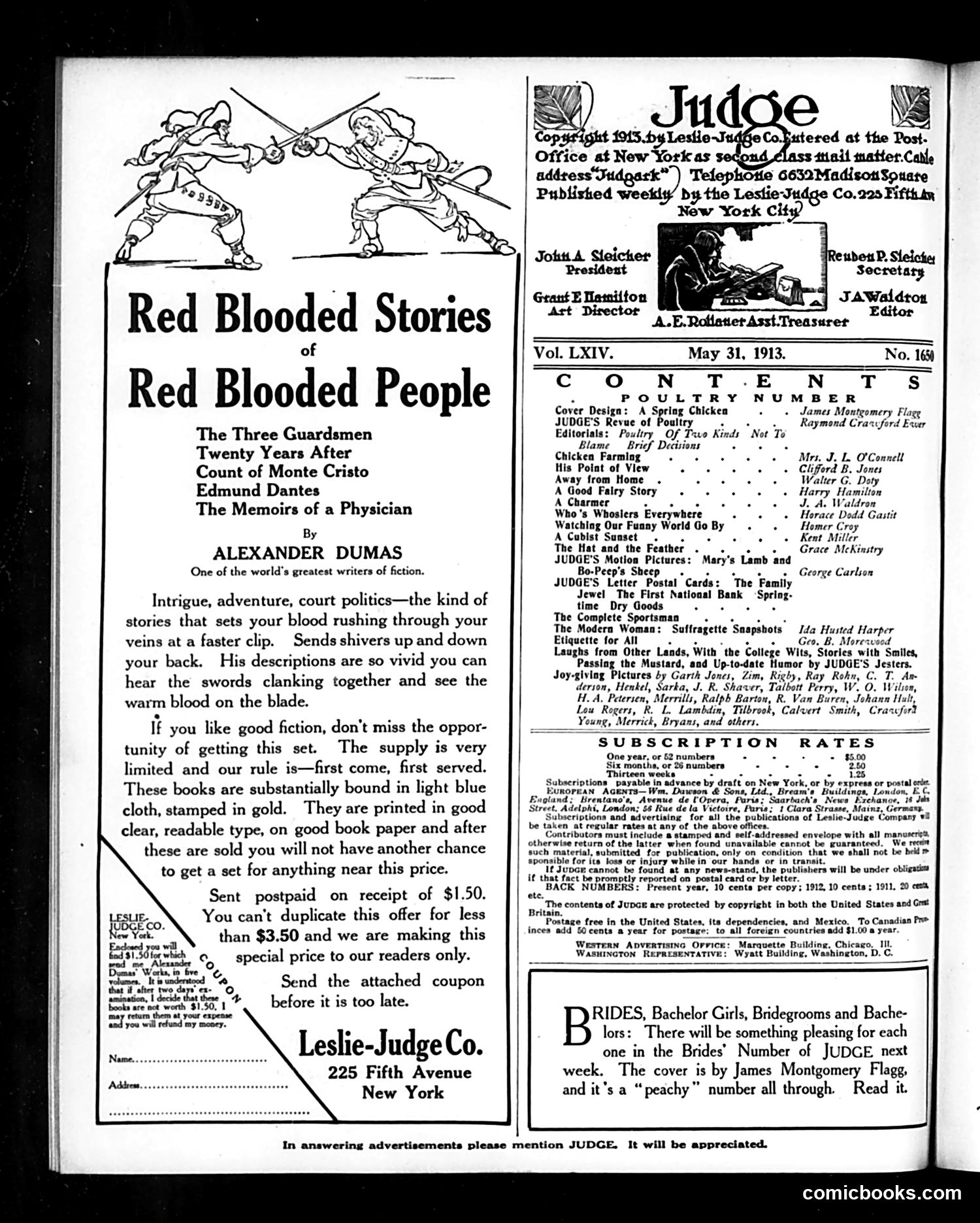
This page is primarily **advertising and editorial content** rather than political satire. The left side features a large advertisement for the Leslie-Judge Company promoting Alexander Dumas's "Red Blooded Stories of Red Blooded People" — adventure novels emphasizing intrigue, sword-fighting, and court politics. The ad targets readers seeking excitement. The top illustration shows **two figures in classical fencing poses**, likely representing the swashbuckling adventure promised in Dumas's works. The right side contains the magazine's masthead, subscription information, and a table of contents for a "Poultry Number" issue. A brief editorial note at bottom mentions upcoming content about "Brides" with a cover by James Montgomery Flagg. **Overall**: This is a commercial/administrative page with minimal satire.
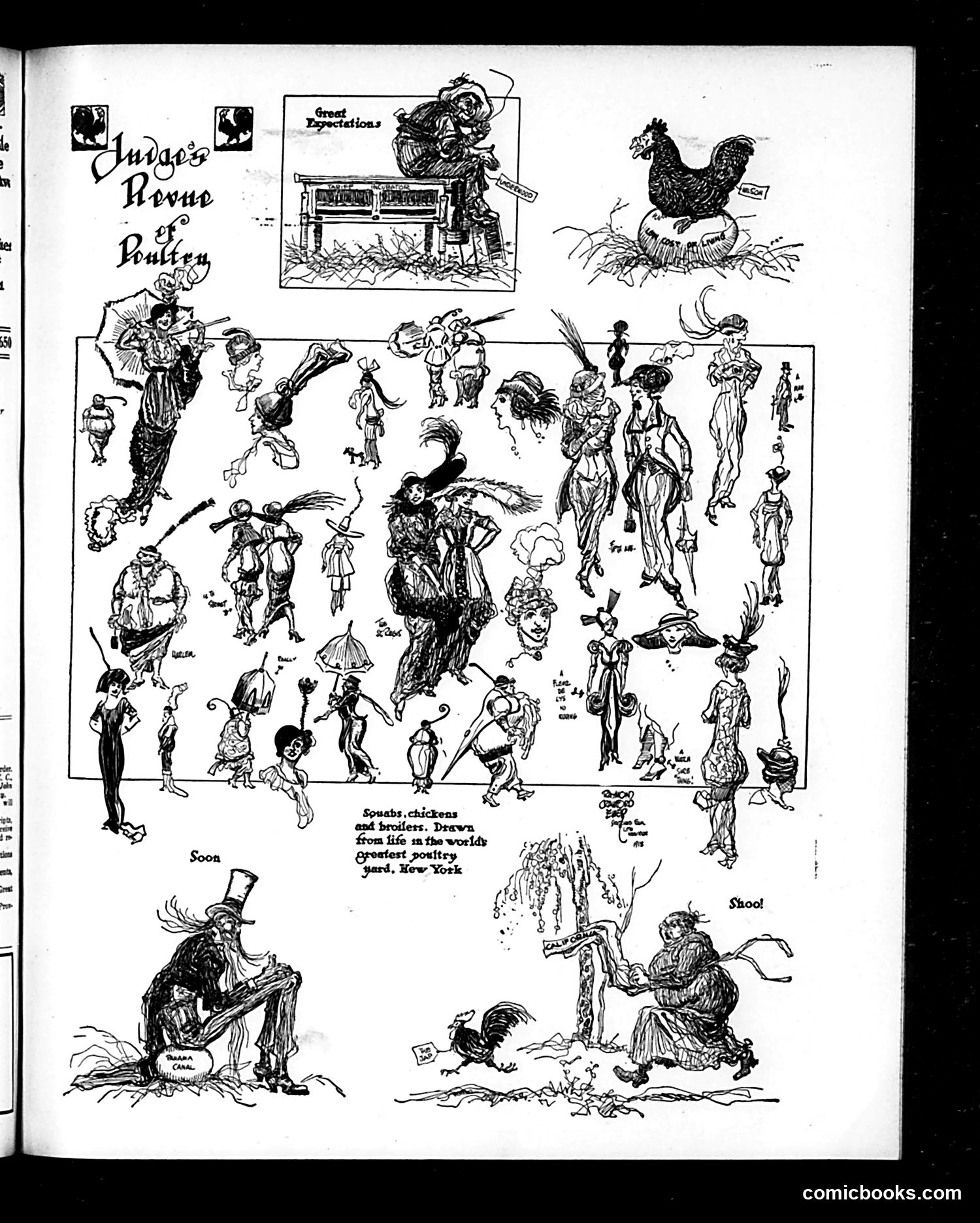
This page satirizes the poultry industry through anthropomorphic characters labeled "Great Expectations," "Soon," and "Skool." The central panel depicts numerous human figures in various poses—some dignified, others grotesque or undignified—labeled as "Specimens: chickens and broilers. Drawn from life in the world's greatest poultry yard, New York." The satire compares New York's people to chickens in a farmyard, suggesting they're being bred, sorted, and managed like poultry. The framing implies social commentary on urban life, class stratification, or possibly political corruption—treating citizens as mere commodities. The rooster illustration reinforces the barnyard metaphor. Without clearer date or specific context, the exact political target remains unclear, but the mockery of New York society's organization is evident.
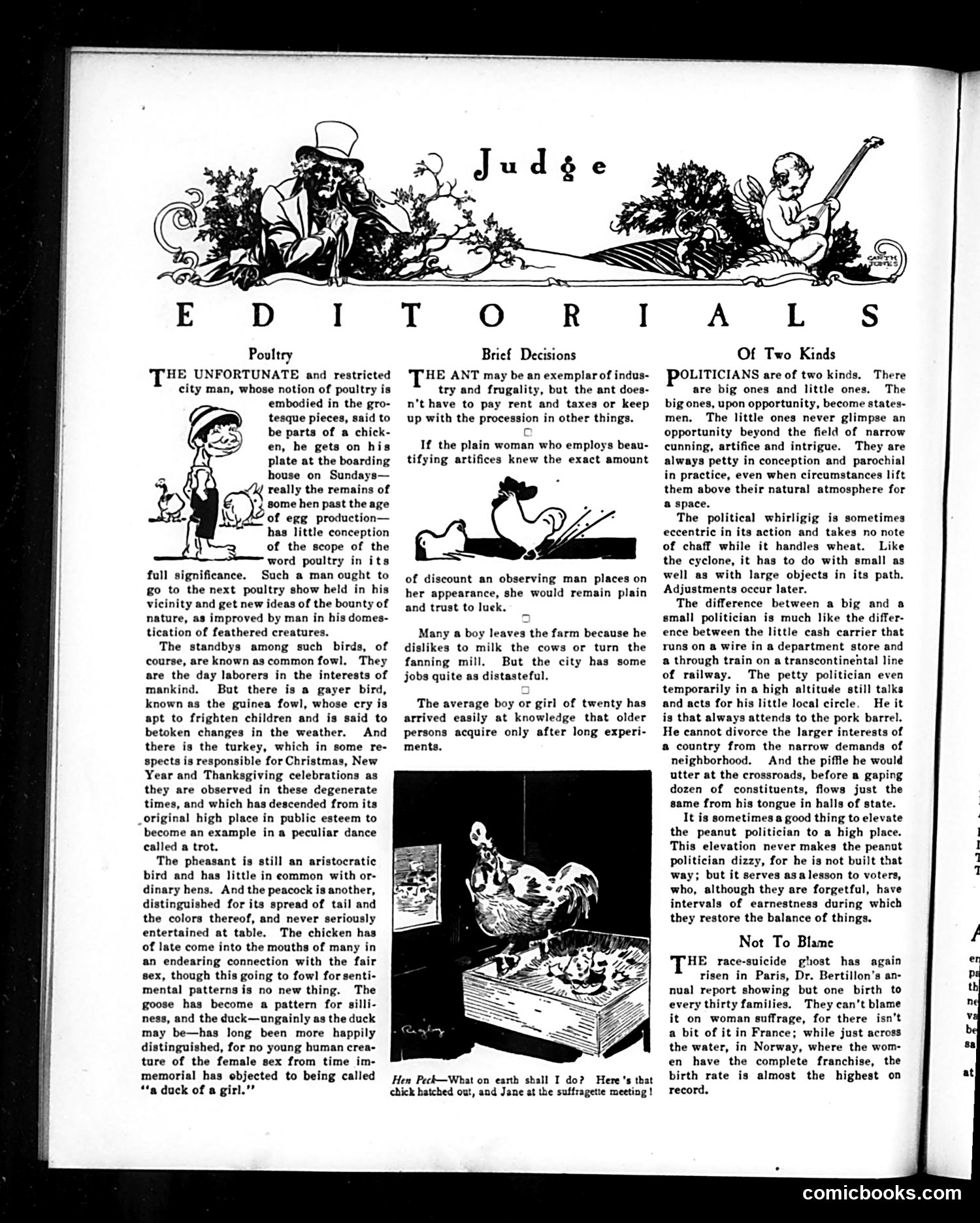
This page from *Judge* magazine contains three distinct editorial pieces with illustrations: **"Poultry"** (left): A satirical essay mocking urban men's ignorance of poultry, using chickens and guinea fowl as metaphors for understanding nature and proper domestication. **"Brief Decisions"** (center): Short observations on industry, farm life, and social behavior—noting how boys avoid farm work and city jobs are equally undesirable. **"Of Two Kinds"** (right): A political commentary distinguishing "big" and "little" politicians. The satire suggests petty politicians operate in narrow spheres and cannot transcend local interests, comparing them unfavorably to those with broader vision and influence. **"Not To Blame"** (bottom right): A brief piece on race suicide and women's suffrage, addressing contemporary debates about birth rates and voting rights. The illustrations feature simple line drawings complementing each essay's theme.
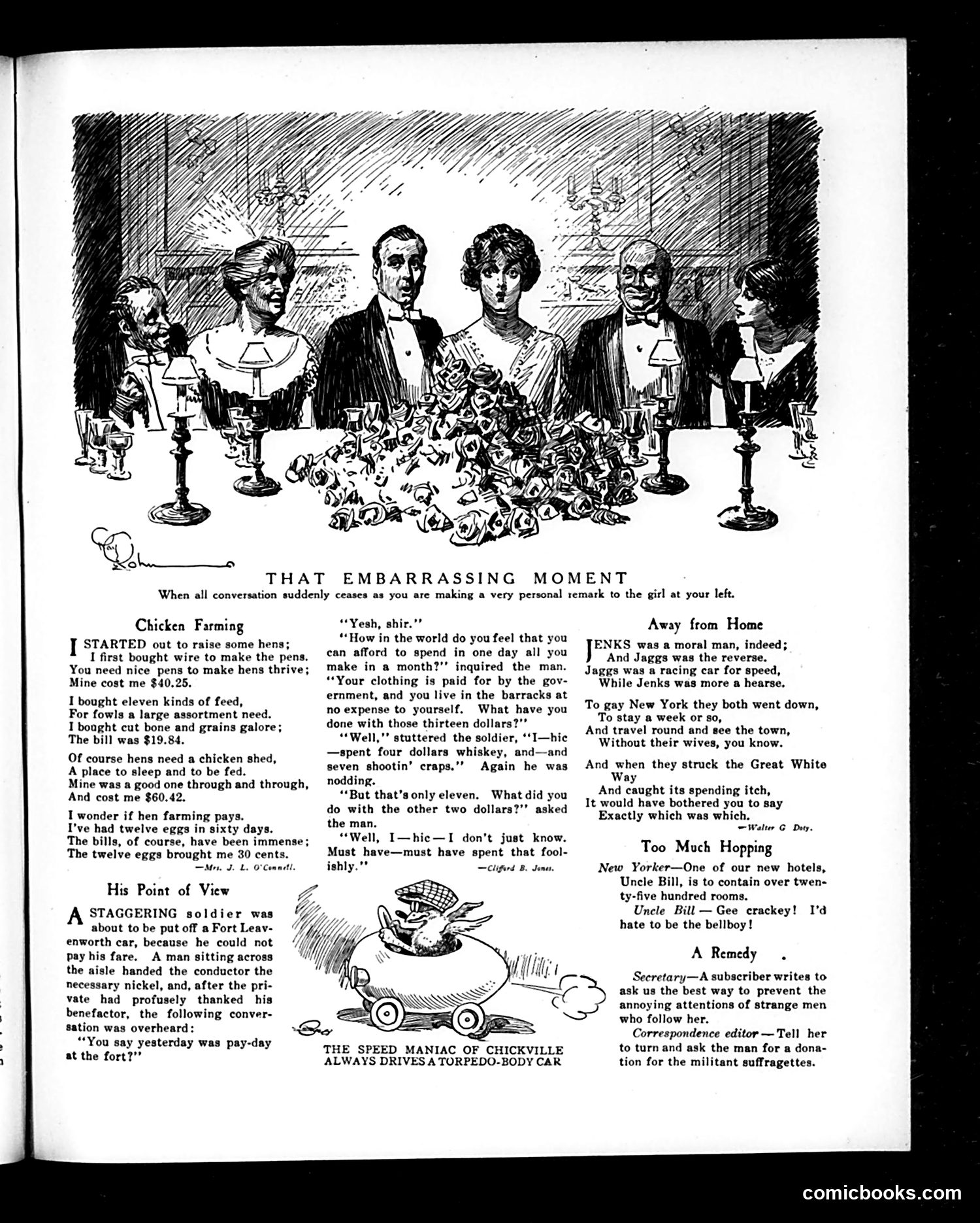
The main cartoon "That Embarrassing Moment" depicts a dinner party where conversation abruptly stops as someone makes an awkward personal remark to a woman. This is social satire about etiquette violations—a universal humor topic then and now. Below are four short humorous pieces: "Chicken Farming" mocks agricultural inexperience; "His Point of View" satirizes a soldier's complaint about military pay; "Away from Home" jokes about a soldier's reckless behavior; and "Too Much Hopping" appears to reference hotel capacity. The small cartoon "The Speed Maniac of Chickville" caricatures reckless driving, a contemporary concern. The final item, "A Remedy," references suffragettes—suggesting militant feminists follow politicians to demand donations for women's voting rights, topical political satire of the suffrage movement era.
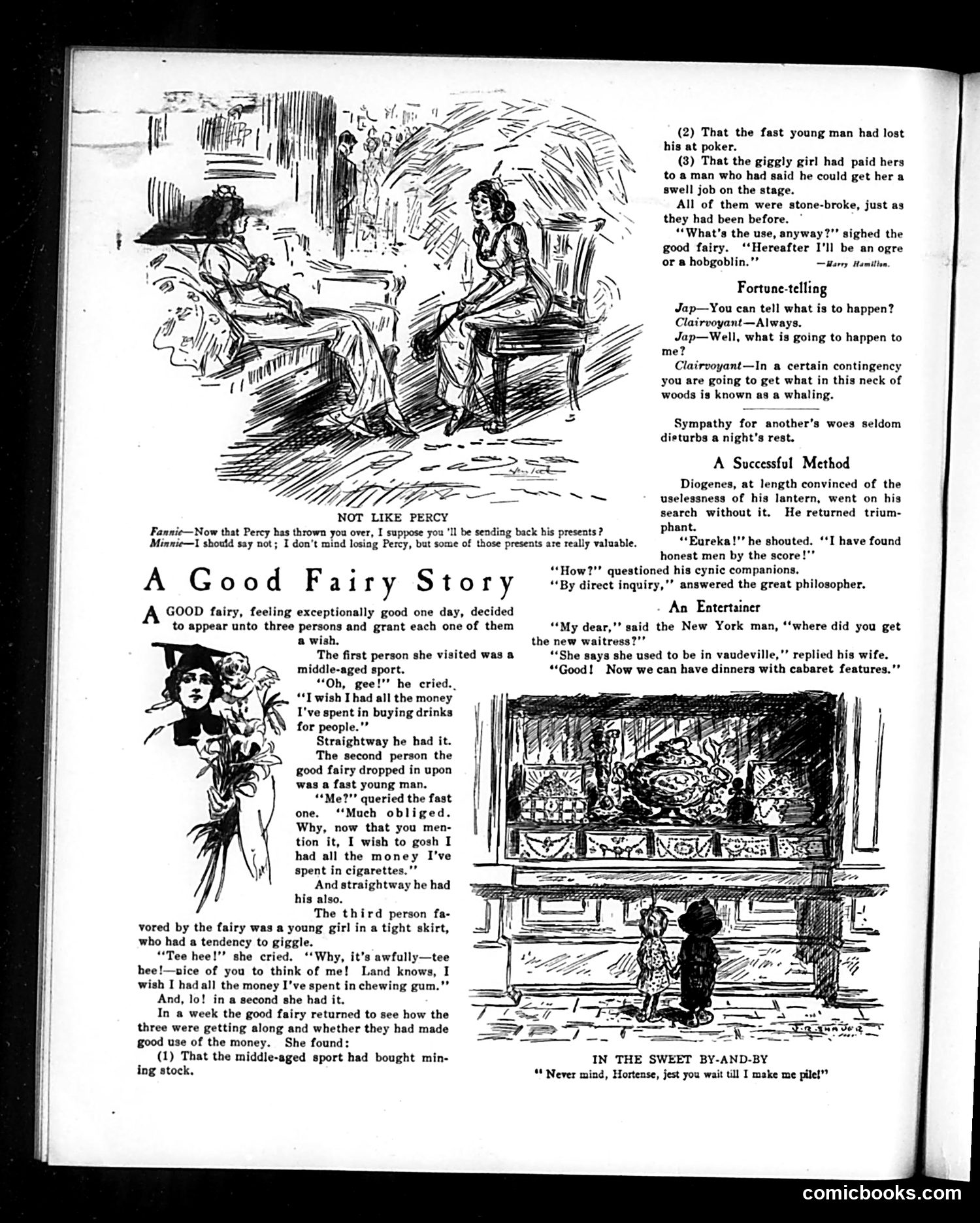
This page contains three satirical pieces mocking early-1900s social attitudes: **"Not Like Percy"**: A brief joke about a woman keeping her ex-boyfriend's expensive gifts despite the breakup—satirizing materialism and female opportunism. **"A Good Fairy Story"**: The main cartoon mocks young people's frivolous spending. A fairy grants three wishes to a middle-aged man (who squanders money on drinks), a "fast young man" (cigarettes), and a giggling girl (chewing gum). When the fairy returns, all three have wasted their windfalls again. The satire targets perceived recklessness of youth and the futility of redemption—a common Judge theme. **Other items**: Brief jokes about fortune-telling, a reference to Diogenes (ancient philosopher searching for honest men), and a vaudeville entertainer joke. The overall tone reflects Judge's conservative, moralistic stance toward young people's spending habits, romance, and entertainment culture of the era.
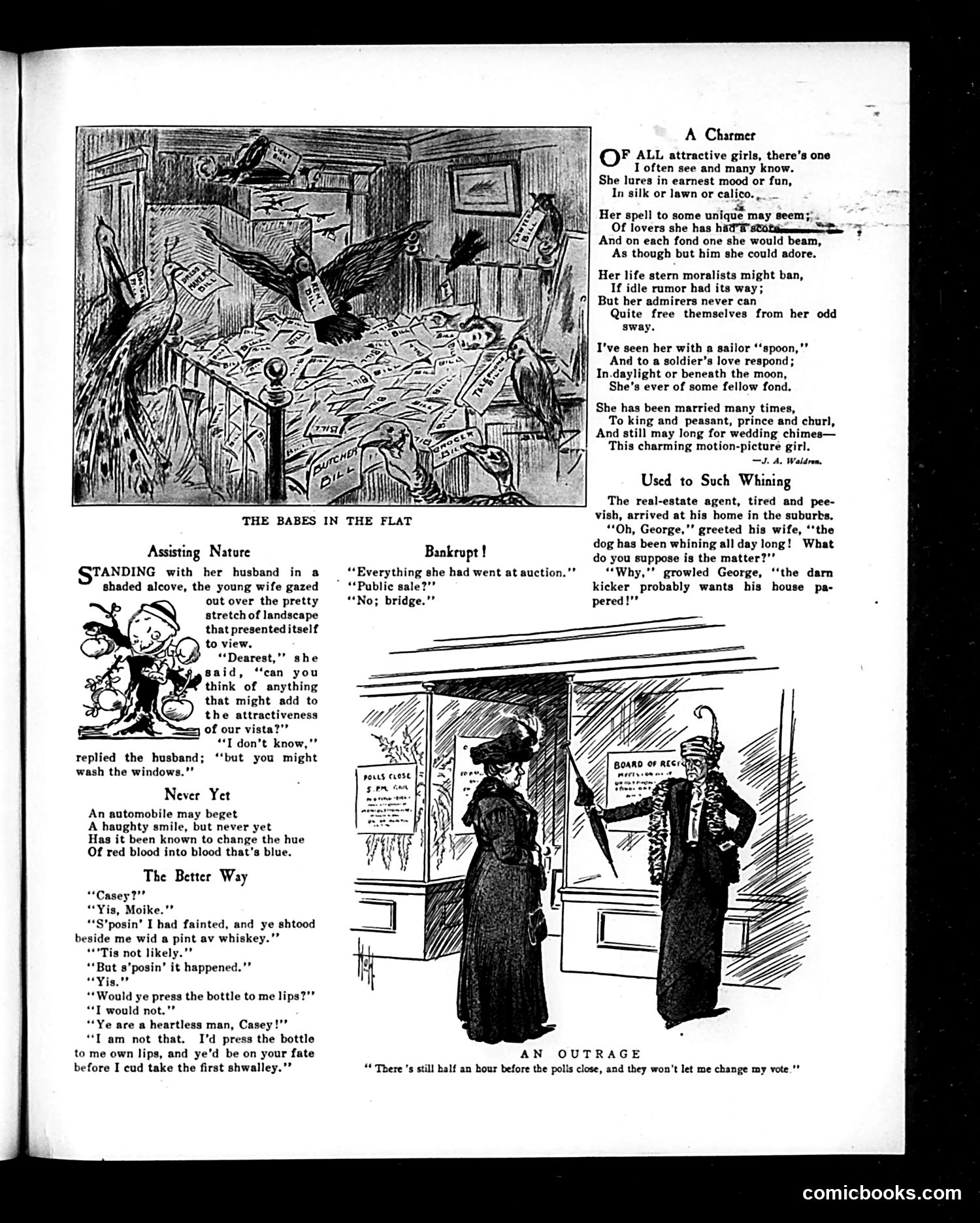
This page contains several distinct satirical pieces: **"A Charmer"** - A poem mocking women in early motion pictures, depicting actresses as frivolous figures who marry repeatedly and flirt indiscriminately. The satire reflects early 20th-century moral anxiety about cinema and actresses' public personas. **"The Babes in the Flat"** and related vignettes - Brief humorous domestic scenes poking fun at middle-class life and marital dynamics. **"An Outrage"** (bottom illustration) - A political cartoon about voting. A woman complains she cannot change her vote despite a polling deadline still remaining. This likely satirizes early female suffrage debates or voting access restrictions—suggesting frustration with electoral procedures that prevented vote-changing. The overall page uses caricature and dialect humor (Irish accents in "The Better Way") typical of early-1900s American satirical magazines. The content reflects period attitudes toward women, class, and civic participation, with particular emphasis on mocking modern technology's (cinema, automobiles) cultural impact.
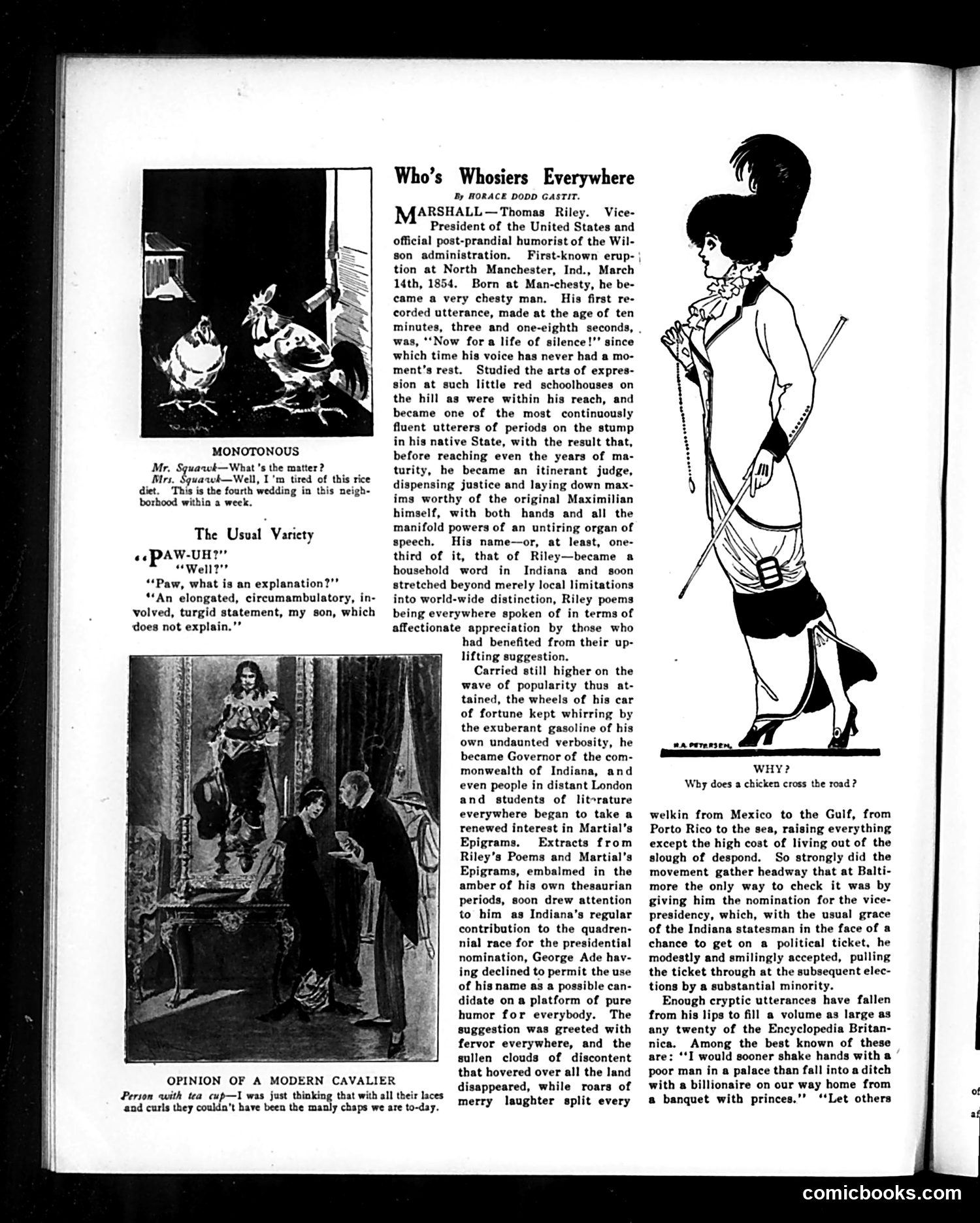
This page satirizes **Thomas Riley Marshall**, Vice President under Woodrow Wilson. The main article, "Who's Whosiers Everywhere," is a mock biography mocking Marshall's reputation as an incessant talker and purveyor of folksy wisdom. The satire hinges on Marshall's verbosity: he's described as having never experienced "a moment's rest" from speaking since infancy, becoming famous for continuous "fluent utterance" across Indiana. The piece suggests his popularity derived entirely from relentless speechmaking rather than substantive accomplishment—he "became Governor" and nearly won the presidency simply through gaseous verbosity. The sidebar cartoons offer lighter humor: one depicts chickens (likely referencing the common joke "Why does a chicken cross the road?"), another shows a father defining "explanation" as a pointless, wordy statement, and a third mocks modern men's vanity about their masculine appearance. The overall message: Marshall embodied early-20th-century political superficiality—winning office through charm and empty rhetoric rather than meaningful policy.
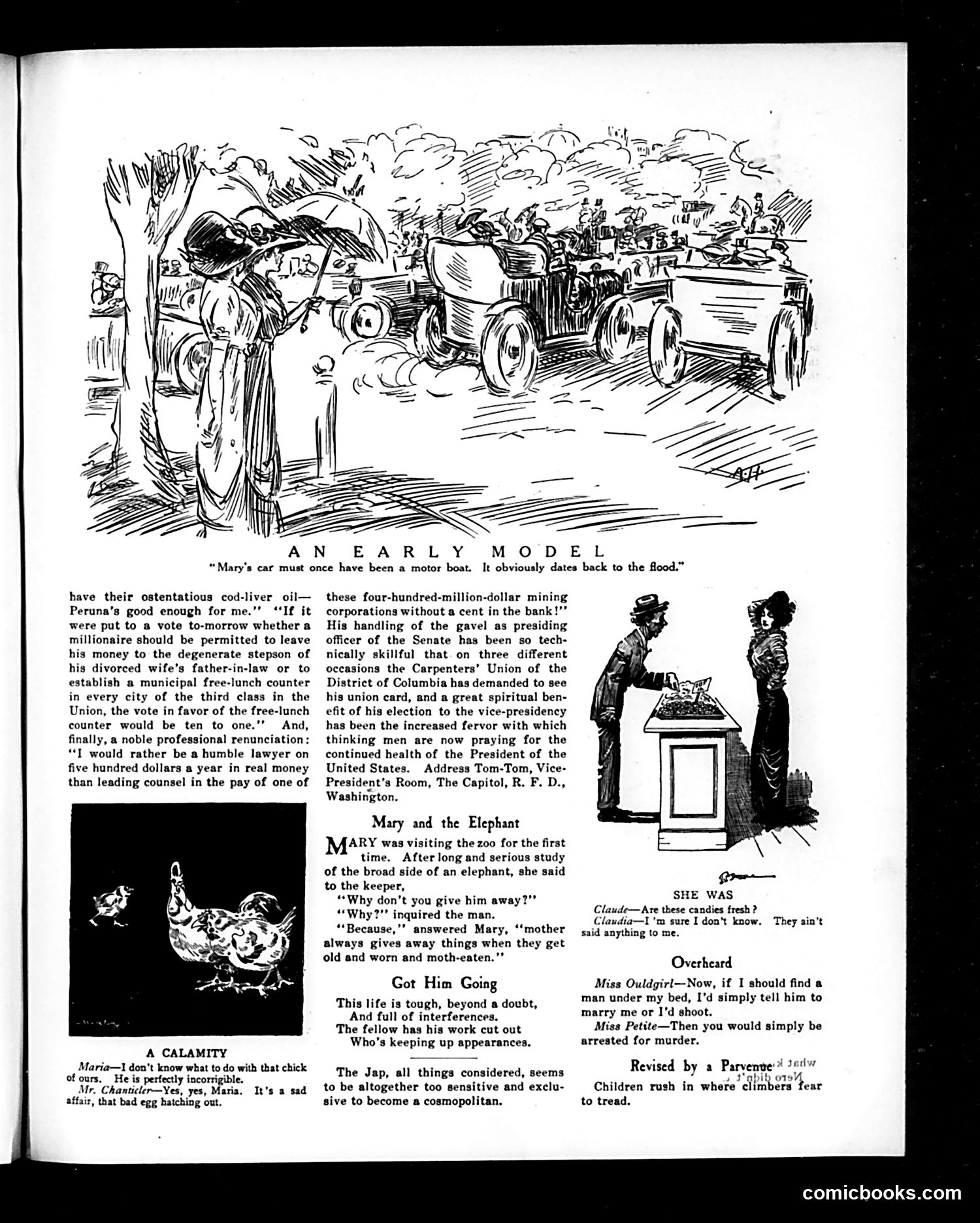
**"An Early Model" cartoon** (top): Shows early automobiles at a race or gathering. The caption jokes that "Mary's car must once have been a motor boat"—likely mocking the primitive, boat-like appearance of early motorcars, perhaps suggesting one looks so poorly designed it belongs in water rather than on roads. **"Mary and the Elephant"**: A child visiting the zoo observes an elephant's large, worn appearance and asks why they don't "give him away," explaining that her mother discards old, worn, moth-eaten things. It's gentle humor about a child's innocent logic applied to zoo animals. **"Got Him Going"** and **"The Jap"** passages: Brief philosophical quips about life's difficulties and a dismissive comment about Japanese people being "too sensitive" for cosmopolitan society—reflecting casual period prejudice. **Bottom sections**: Miscellaneous short humorous dialogues about candy freshness and romantic ultimatums—typical light magazine filler humor. The page is primarily light domestic and observational humor rather than hard political satire.
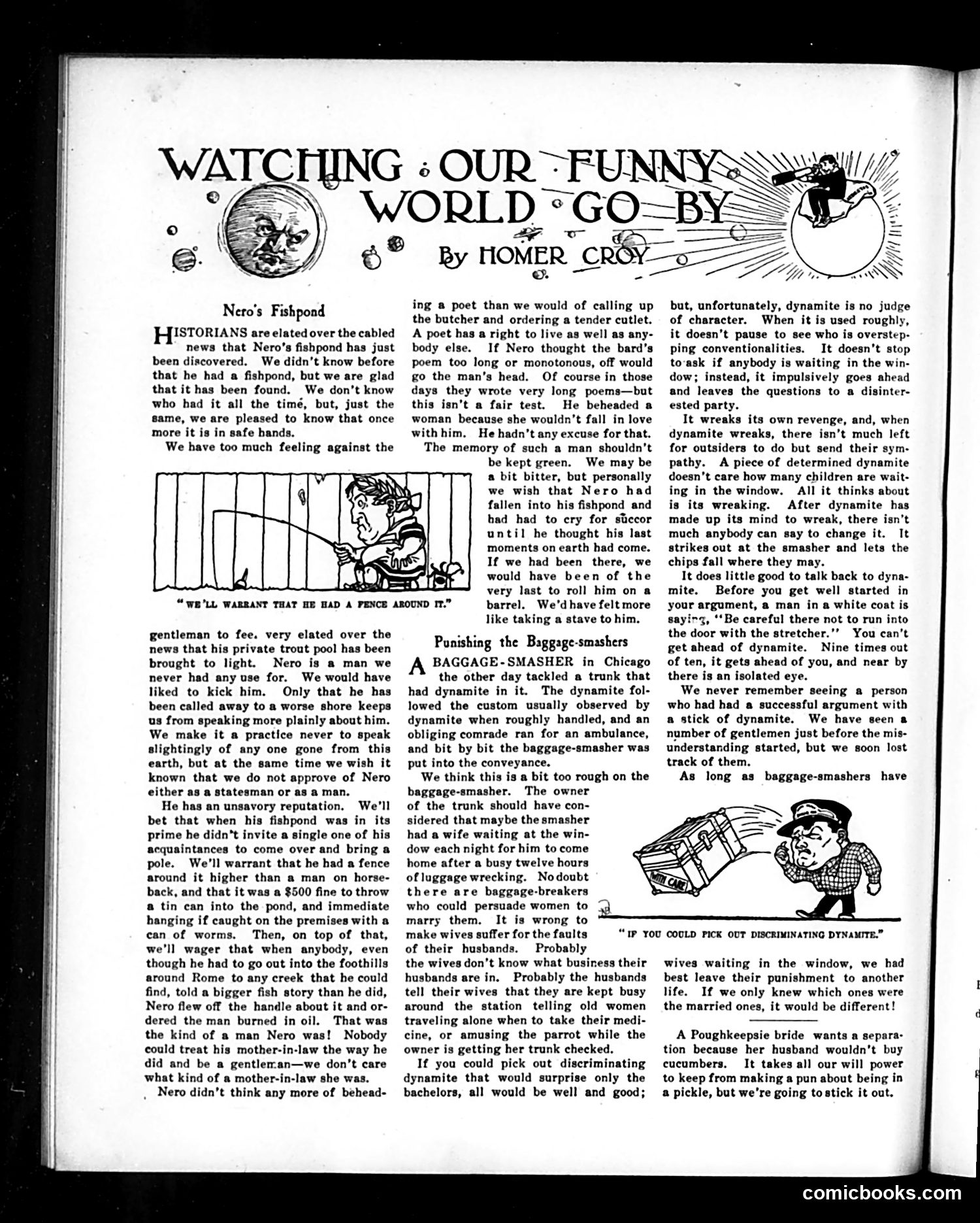
This page contains two satirical columns mocking historical and contemporary figures through exaggerated moral indignation. **"Nero's Fishpond"** sarcastically celebrates the archaeological discovery of the Roman emperor's fishpond while pretending outrage at Nero's cruelty—beheading poets, murdering a woman for not loving him, and hoarding his private trout pool behind expensive fences. The humor lies in the writer's overwrought condemnation of ancient atrocities while dwelling on petty grievances (the fishpond exclusivity, exaggerated fish-story punishments). **"Punishing the Baggage-smashers"** mocks sympathy for a Chicago baggage handler injured by dynamite in a trunk he was roughing up. The satire cuts both ways: it ridicules both the brutal "baggage-smasher" profession and the sentimental notion that we should pity workers who mistreat luggage because they might have waiting wives—wives who presumably don't know their husbands' actual jobs. Both pieces use deadpan, faux-earnest tone to expose absurd reasoning and misplaced priorities.
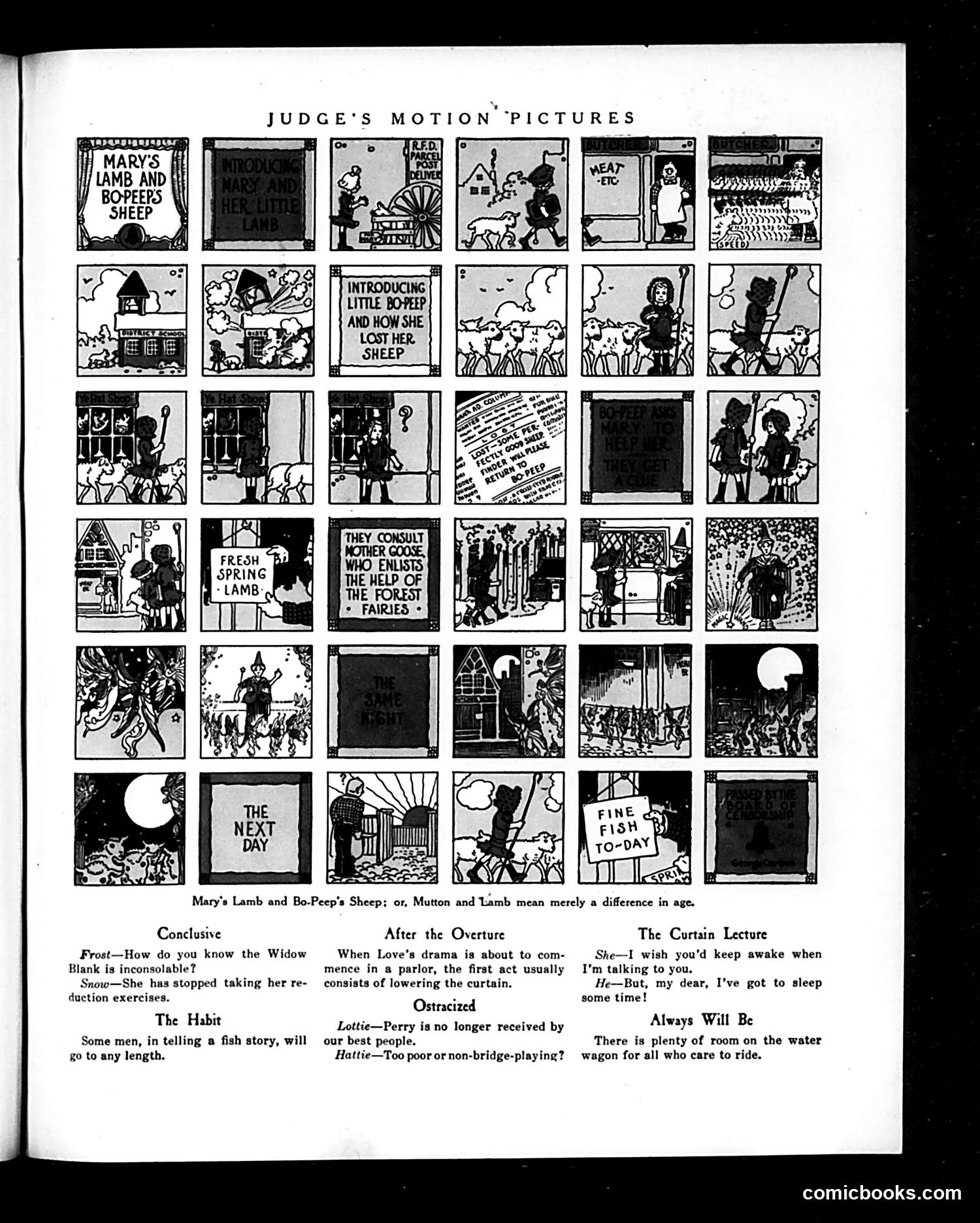
This page presents a serialized comic adaptation of the nursery rhyme "Mary Had a Little Lamb" paired with witty one-liners mocking contemporary social behavior. **The main comic** (top grid) visually tells the familiar children's story, likely aiming humor at audiences who knew the rhyme well. **The accompanying jokes** target early 20th-century social conventions: - **"Conclusive"** mocks women's vanity—a widow's cessation of beauty exercises supposedly proves her indifference to remarriage. - **"The Habit"** satirizes men's tendency to exaggerate fishing stories. - **"After the Overture"** uses theatrical metaphor to joke about courtship's physical intimacy. - **"Ostracized"** questions why someone lost social standing: poverty or poor bridge-playing skills. - **"The Curtain Lecture"** humorously depicts marital boredom through spousal sleep. - **"Always Will Be"** refers to the temperance "water wagon"—sobriety being eternally available. These brief gags represent Judge's satirical commentary on American social life, particularly gender dynamics, class consciousness, and domestic relationships.
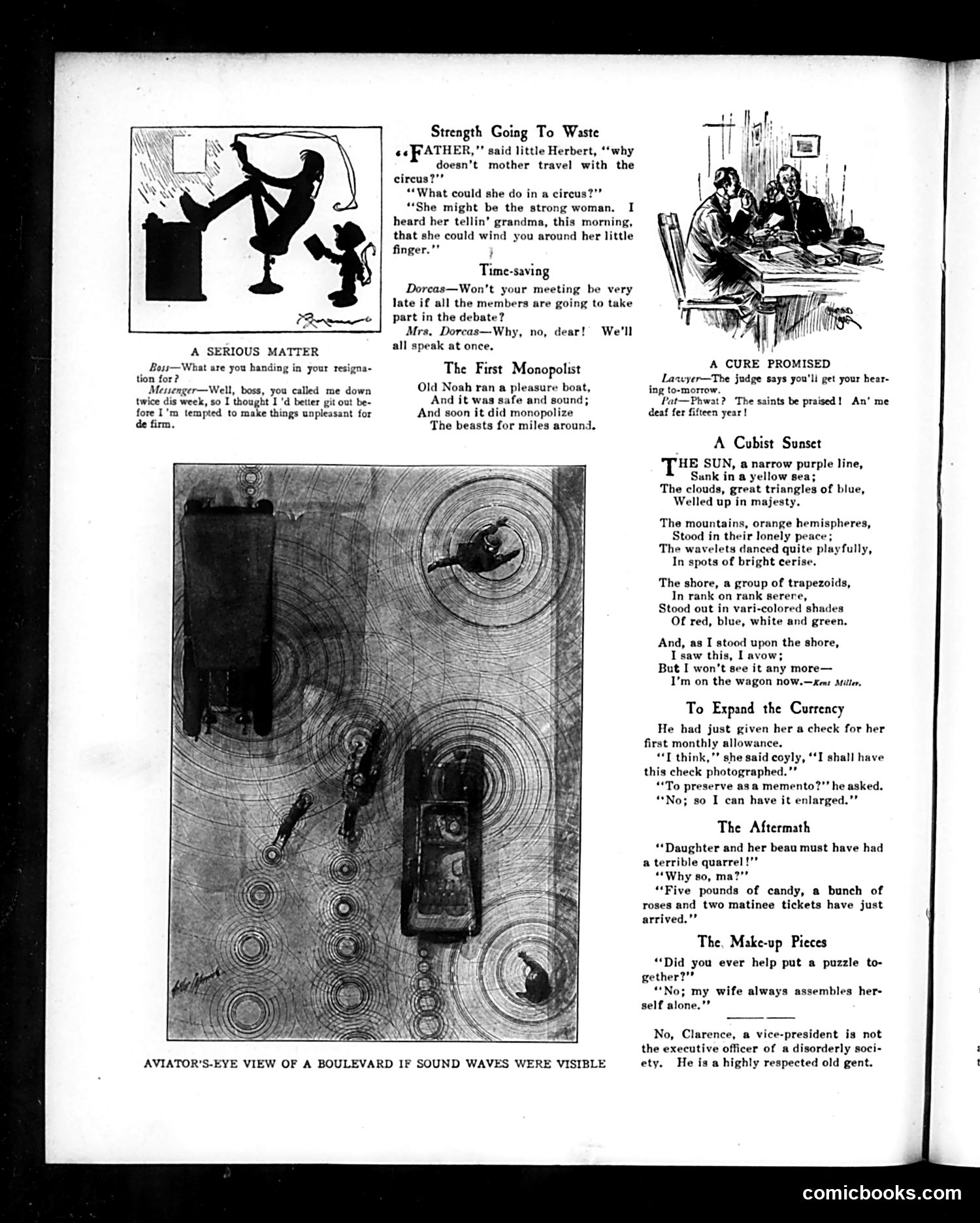
This page contains multiple short humorous pieces typical of early 20th-century satirical journalism: **"A Serious Matter"** mocks workplace hierarchy—a messenger threatens to resign after being called down twice, suggesting he'll "make things unpleasant" if provoked further. **"Strength Going To Waste"** is a domestic joke: a wife claims she could "wind" her husband around her finger, so Herbert suggests she'd make a good circus strong woman. **"The First Monopolist"** applies modern monopoly concerns to Noah's Ark—humorously suggesting Noah monopolized animal transportation. The remaining pieces satirize contemporary social concerns: time-wasting meetings, legal delays, artistic pretension (Cubism), courtship customs, and misunderstanding of corporate titles. The large **sound-wave visualization** appears experimental—imagining how sound travels visually if made visible from above. Overall, the page reflects Judge's formula: brief, topical humor targeting everyday life, modern anxieties (monopolies, corporate culture), and artistic trends (Cubism).
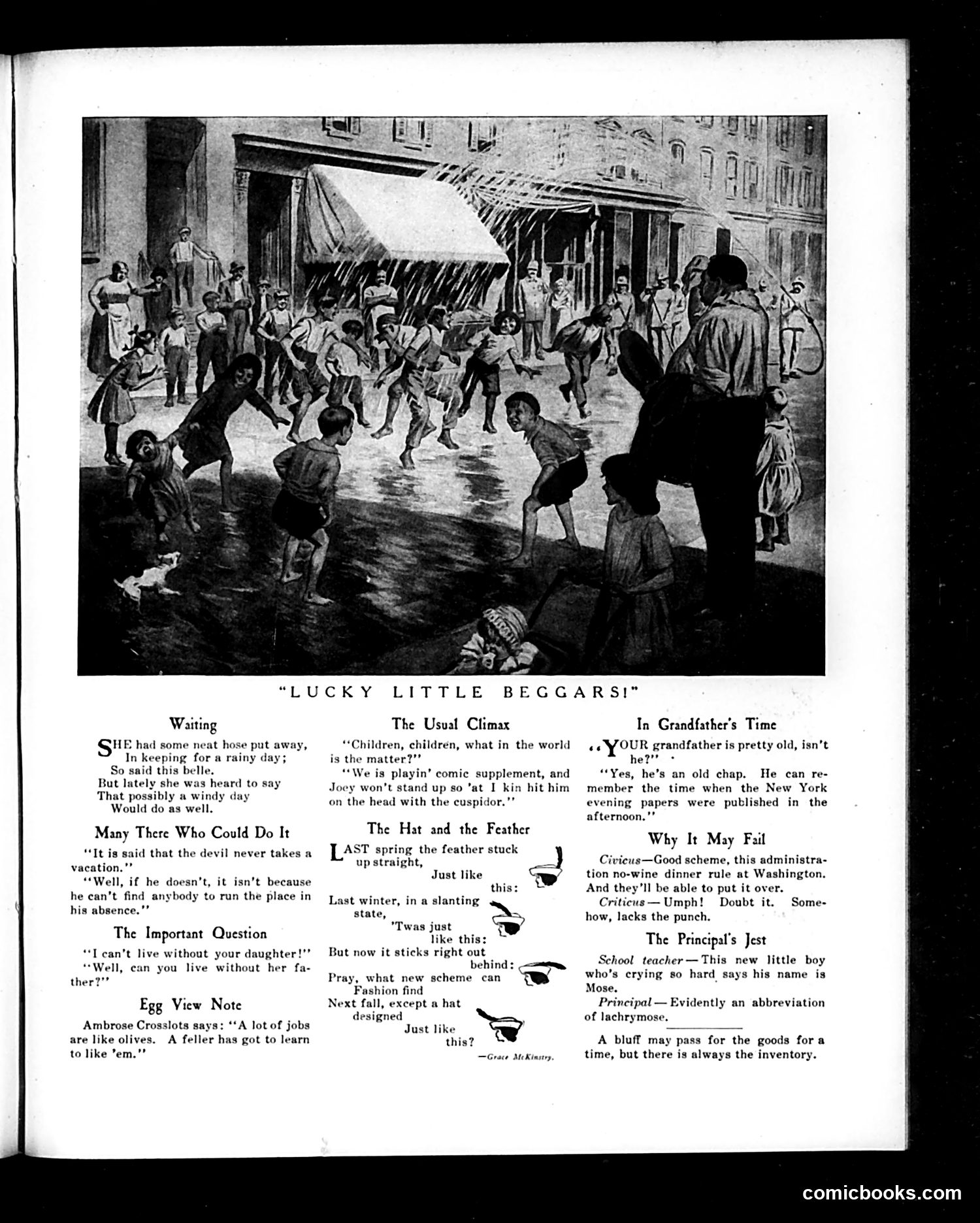
This page collects short jokes and satirical quips typical of Judge's humor. The main illustrated cartoon shows children playing in a street, apparently enacting comic strip scenarios with violence—one child wants to hit another "on the head with the cuspidor" (spittoon) while "playin' comic supplement." The scattered jokes mock everyday absurdities: a man who can't find time off (like the devil), a suitor's financial dependence on his fiancée's father, fashion's circular trends (hat feathers changing angles seasonally with no real innovation), and a grandfather old enough to remember when New York evening papers published in the afternoon (referencing when afternoon papers were the evening edition). "Lachrymose" and the Washington "no-wine dinner" reference suggest Progressive-era temperance debates. The humor is gentle, domestic satire—poking fun at fashion cycles, generational differences, and social pretense rather than sharp political commentary.
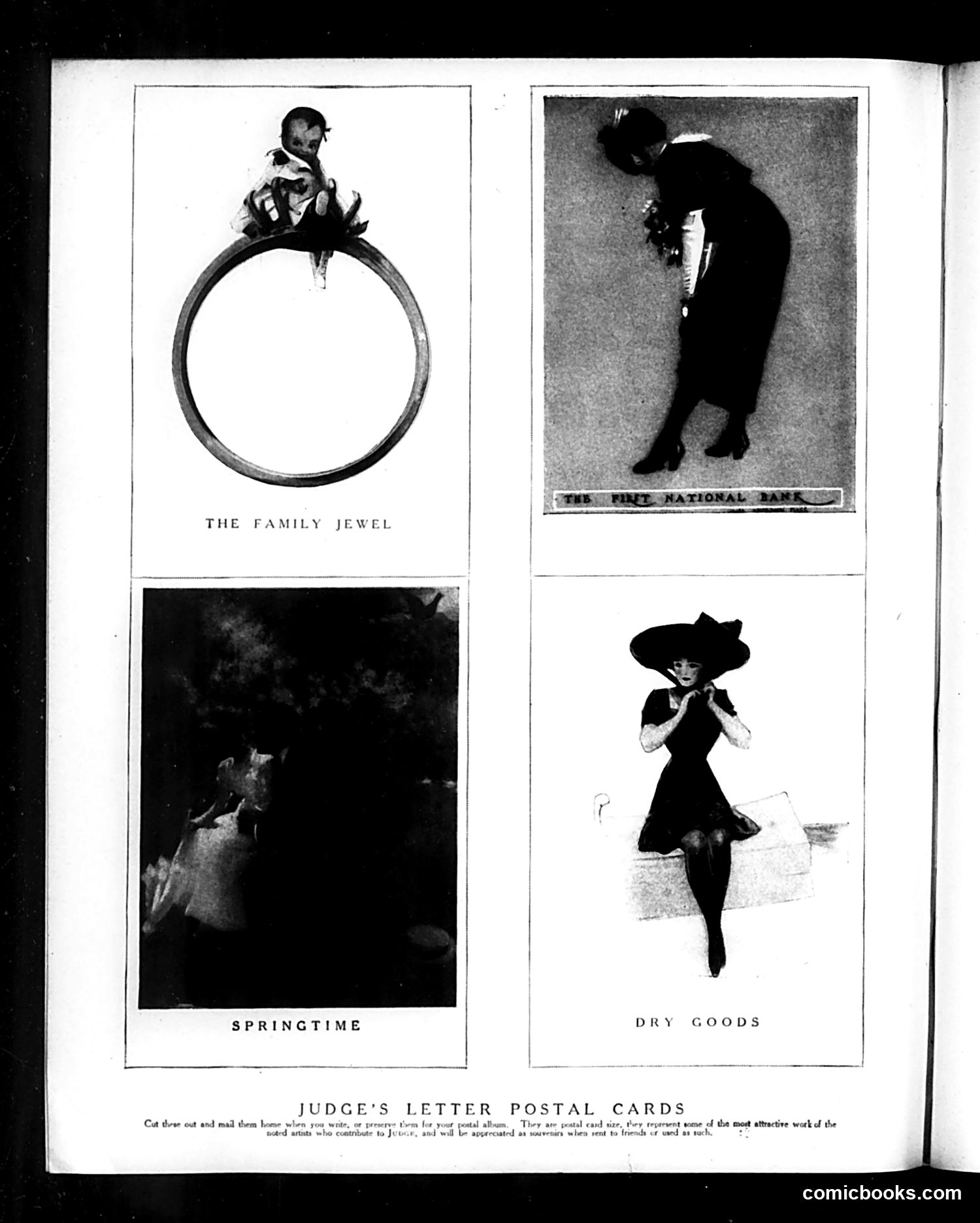
This page presents four satirical postal cards from Judge magazine. "The Family Jewel" depicts a small child perched atop a large ring—likely mocking wealthy families' obsession with displaying status symbols. "The First National Bank" shows a bent-over figure, apparently satirizing banking practices or financial strain. "Springtime" appears to be a romantic or sentimental scene (image too dark to discern clearly). "Dry Goods" shows a fashionable woman, possibly mocking consumer culture or women's fashion trends. These were mail-at-home postal cards featuring satirical commentary on contemporary American society—wealth, banking, consumerism, and fashion. The instruction to "mail them home for your postal album" indicates these were collectible items meant for social circulation.
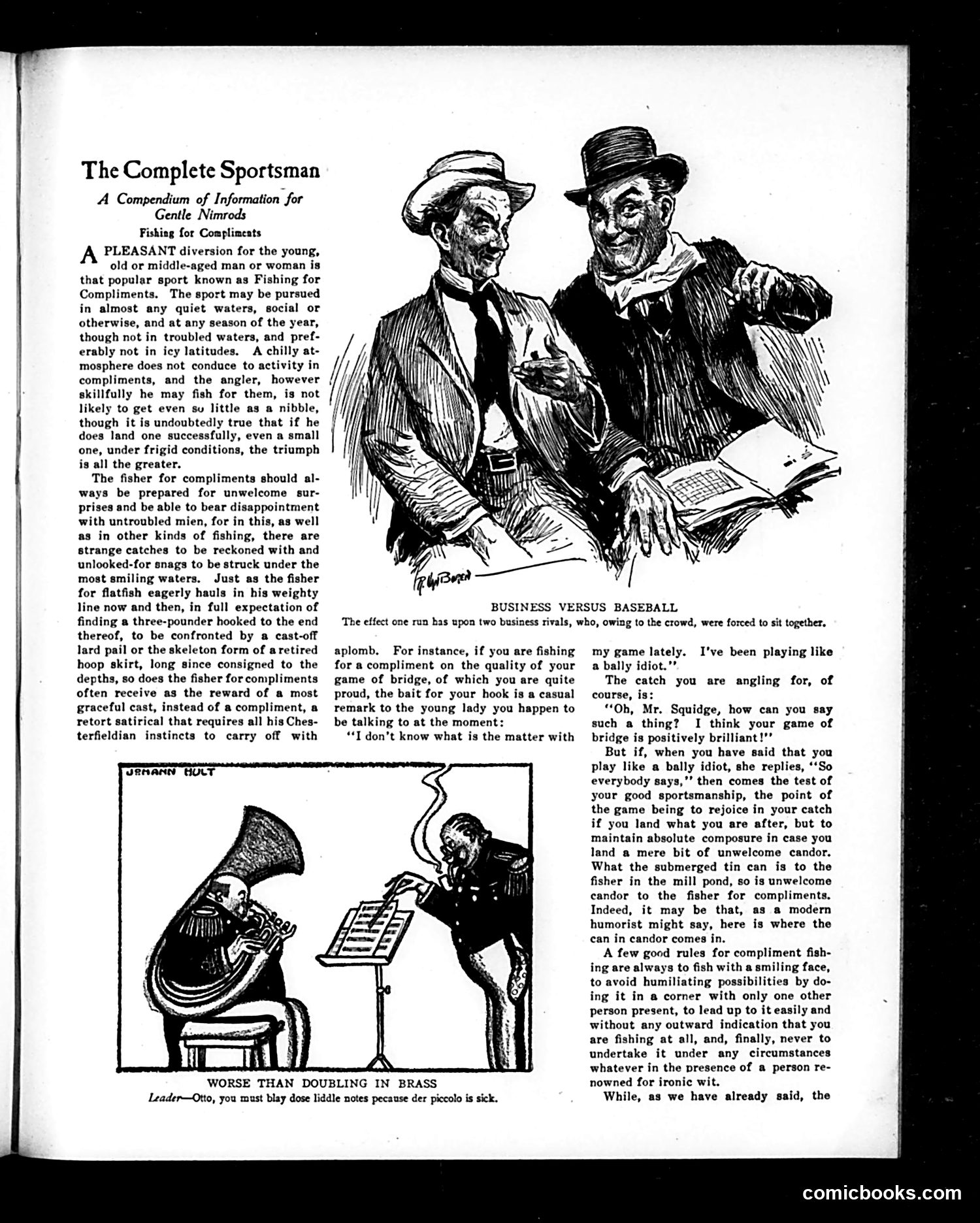
This is a humorous article from *Judge* magazine about "Fishing for Compliments"—a social game where people fish for praise by false modesty (e.g., claiming they played badly at bridge, hoping someone contradicts them). The main cartoon (top) shows two businessmen forced to sit together at what appears to be a baseball game. The caption "Business Versus Baseball" jokes that even rival businessmen must temporarily set aside competition when crowded together, a relatable social awkwardness. The second cartoon depicts a frustrated orchestra leader scolding a musician named Otto in exaggerated immigrant dialect, saying he must play those "little notes" because the piccolo player is sick—a joke about musical substitution and the absurdity of asking someone to play an unfamiliar instrument. The article itself is satire about the social etiquette and psychology of seeking compliments—comparing it to fishing with "bait," warning of "unwelcome catches" (insults instead of praise), and offering rules for conducting this "sport" gracefully without embarrassment.
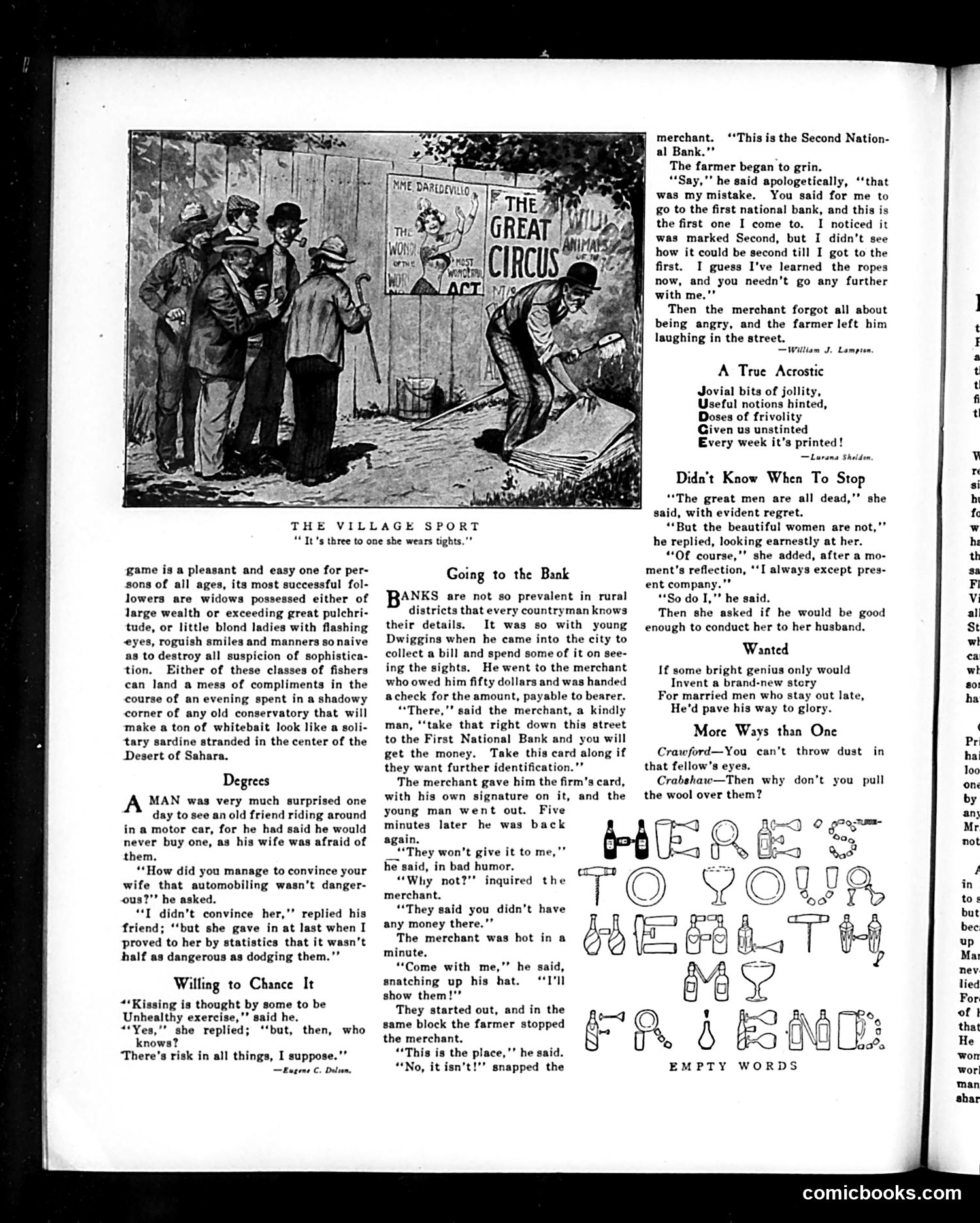
This story mocks rural ignorance of urban banking systems. A country farmer, Dwiggins, receives a check from a merchant and is directed to "the First National Bank." He returns confused because he went to the "Second National Bank" instead—reasoning that since it was the first bank he encountered, it must be the first one, not understanding that banks have distinct names rather than sequential numbering. The humor lies in the farmer's literal-minded logic clashing with city conventions. The merchant's anger dissolves into laughter at the farmer's innocent misunderstanding and good-natured acceptance of his mistake. This reflects early-20th-century Judge magazine's common theme: satirizing rural Americans as unsophisticated when confronted with urban institutions and practices, playing on stereotypes of country folk as simple but ultimately endearing.
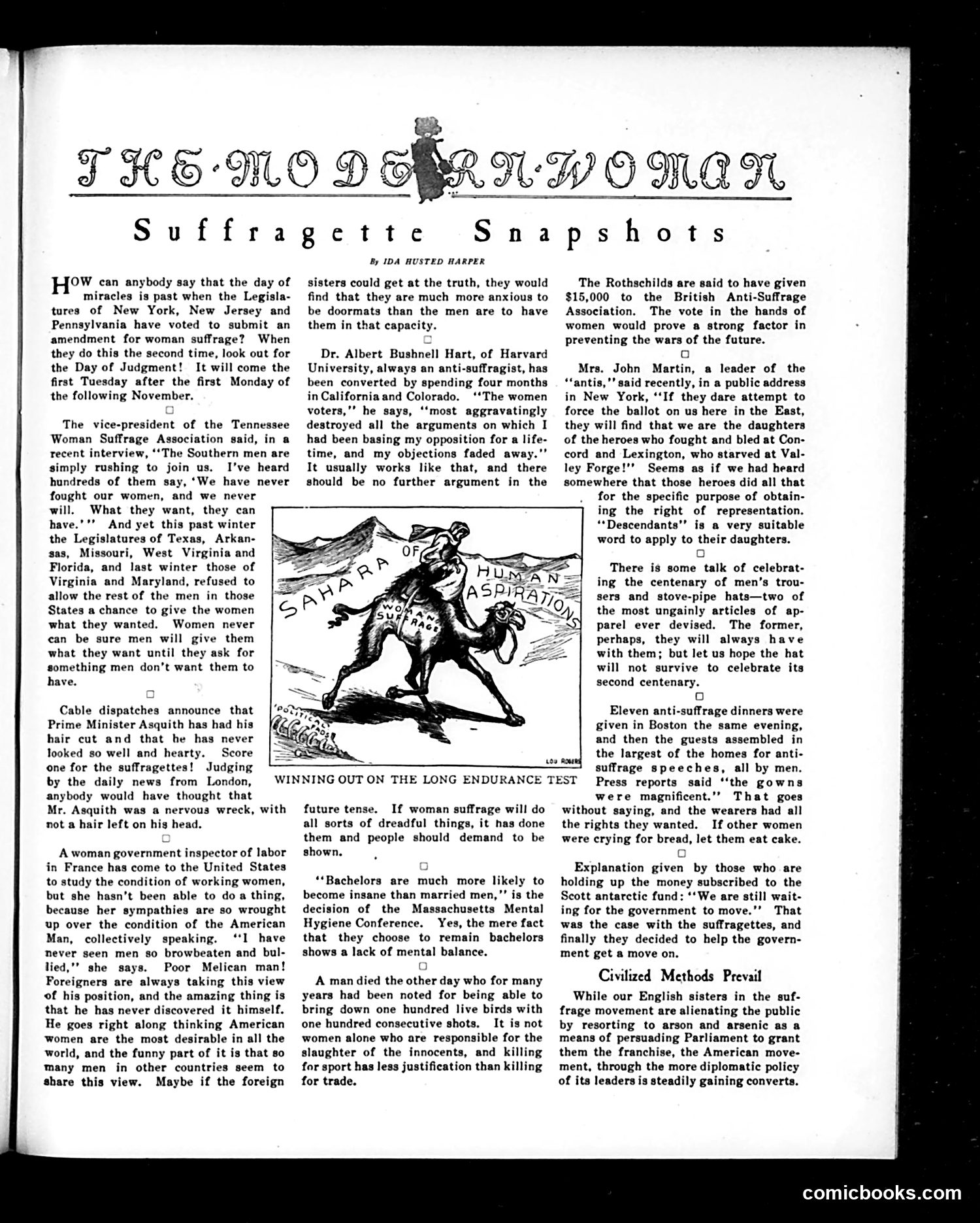
This page lampoons opposition to women's suffrage through satirical commentary and a central cartoon titled "Winning Out on the Long Endurance Test." The cartoon depicts a camel labeled with "Sahara of Human Aspiration" carrying multiple burdens, likely representing women struggling under the weight of anti-suffrage arguments and male opposition. The text mocks anti-suffragists through ironic anecdotes: Southern legislators claiming support while their states voted against suffrage; Harvard professor Dr. Albert Bushnell Hart converting to pro-suffrage after witnessing women voters in California; and descendants of Revolutionary War heroes opposing representation while claiming patriotic lineage. The author (Ida Husted Harper) uses sarcasm to expose the hypocrisy and inconsistency of suffrage opponents. She highlights that men won't grant women rights voluntarily—women must demand them. The page argues suffrage opponents lack genuine principled objections, their positions collapse under scrutiny, and their resistance contradicts American democratic ideals.
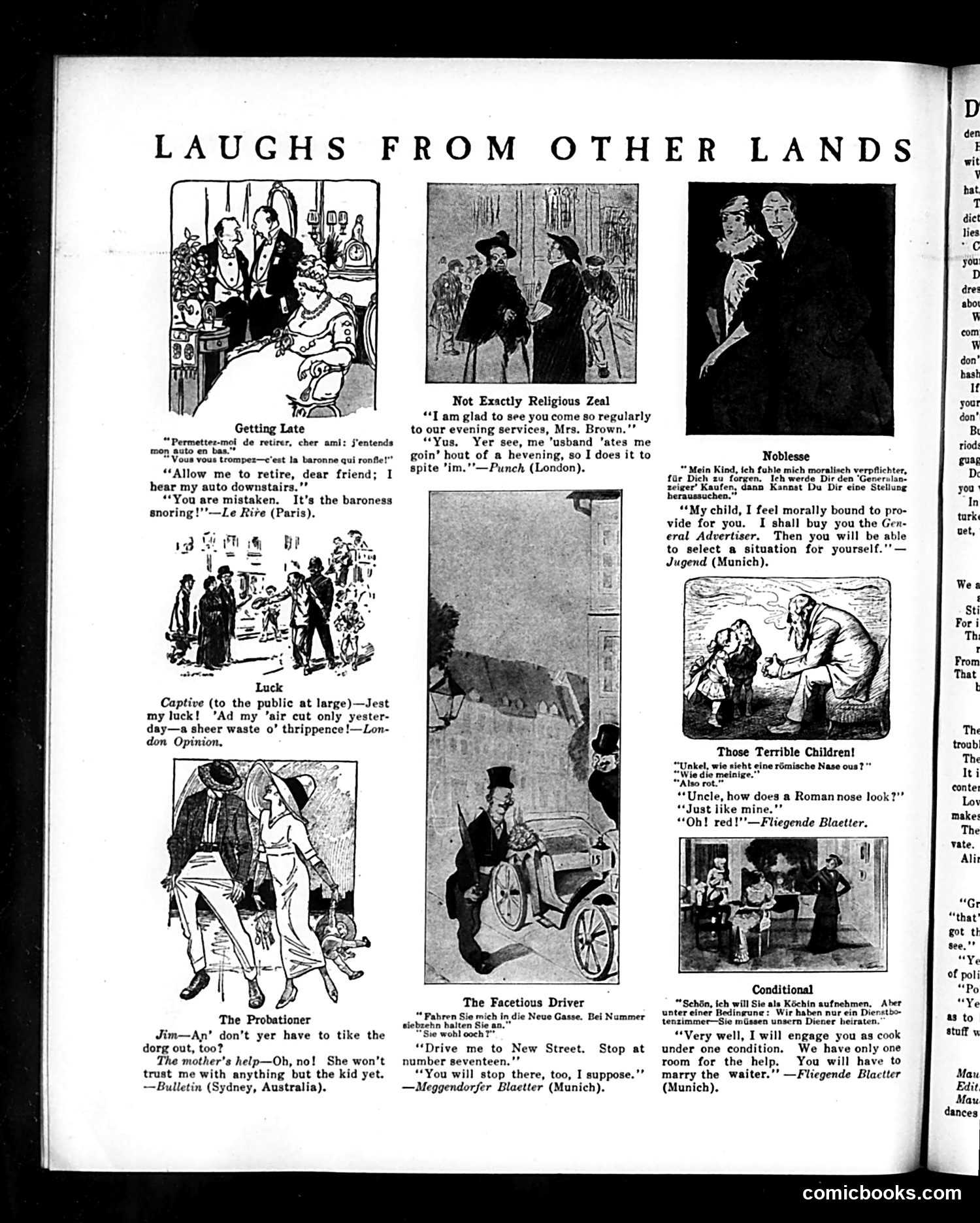
This page collects humor translated from European satirical publications (Paris, London, Munich, Sydney). The cartoons showcase period social comedy: **"Getting Late"** mocks aristocratic pretension—a guest mistakes a baroness's loud snoring for his automobile. **"The Probationer"** uses working-class dialect humor about a servant's duties expanding with a new baby. **"Not Exactly Religious Zeal"** satirizes a woman attending church services solely to spite her husband, contradicting genuine piety. **"The Facetious Driver"** plays on a taxi passenger's assumption the driver will make unauthorized stops. **"Noblesse"** ironically presents wealthy paternalism—a father "morally bound" to buy his son a newspaper (job listings) rather than direct support. **"Those Terrible Children"** and **"Conditional"** use innocent children's misunderstandings and servant-hiring complications for humor. The page reflects early 20th-century class-based comedy, marital tension jokes, and servant-employer dynamics common across Western publications.
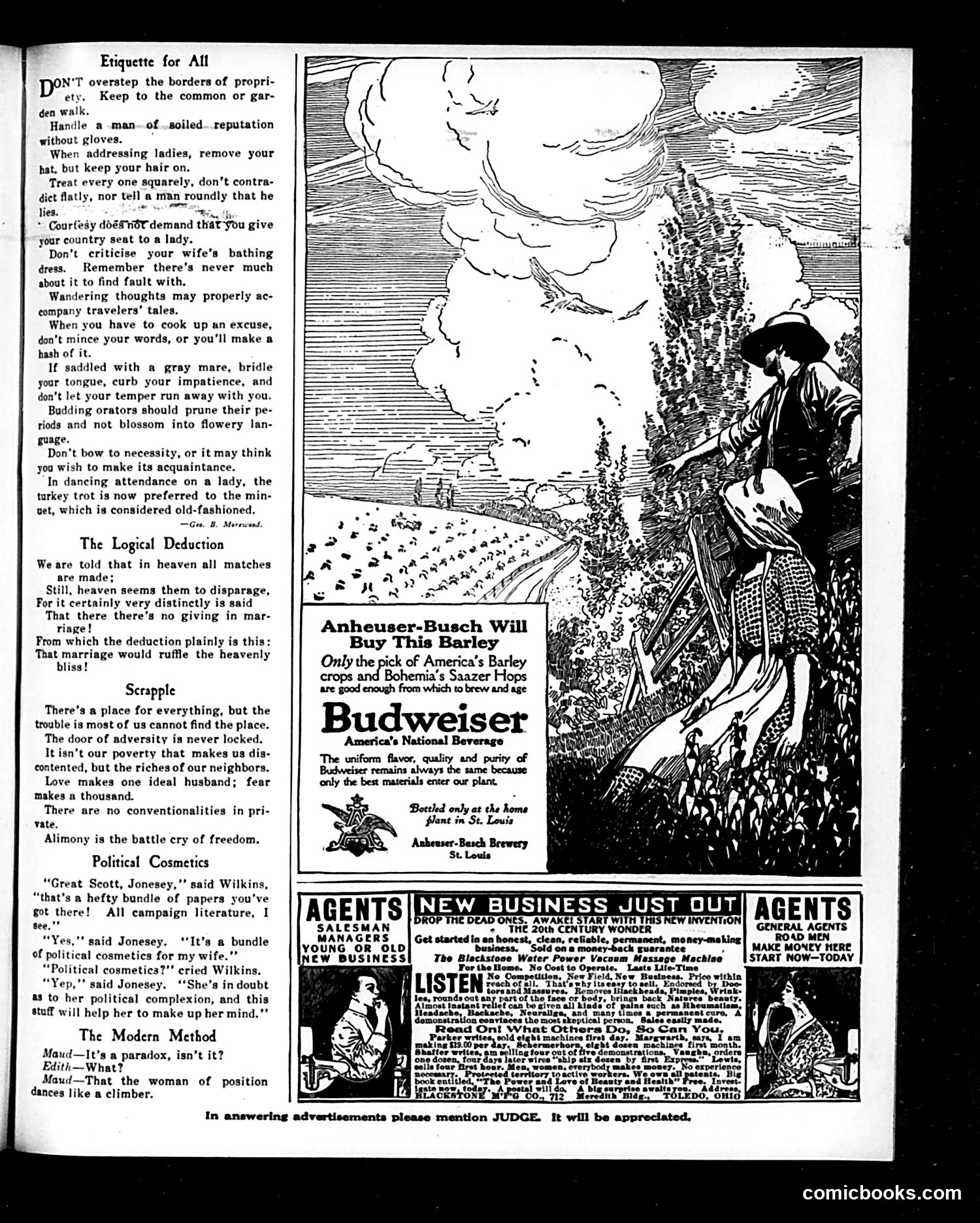
This page from *Judge* contains mostly satirical humor columns and period advertisements, rather than political cartoons. The left column features witty aphorisms on etiquette, logic, and social observation. "Political Cosmetics" is a pun suggesting a wife uses campaign literature as makeup—treating politics like cosmetic choices rather than serious matters. This mocks both political superficiality and women's perceived lack of serious political engagement. "The Modern Method" presents a paradox: society women dance athletically (like climbers scaling heights) rather than with traditional grace, representing modern women's shift away from Victorian femininity. The large right-side advertisement for **Budweiser** is prominent, emphasizing quality ingredients and consistent production at their St. Louis brewery—typical early-20th-century beer marketing. Below are business opportunity ads for salesmen and agents promoting various products (a massage machine, vacuum technology) as "money-making" ventures—typical of speculative business schemes of this era. The overall page reflects early 1900s concerns: gender roles, political participation, consumer products, and entrepreneurial aspiration.
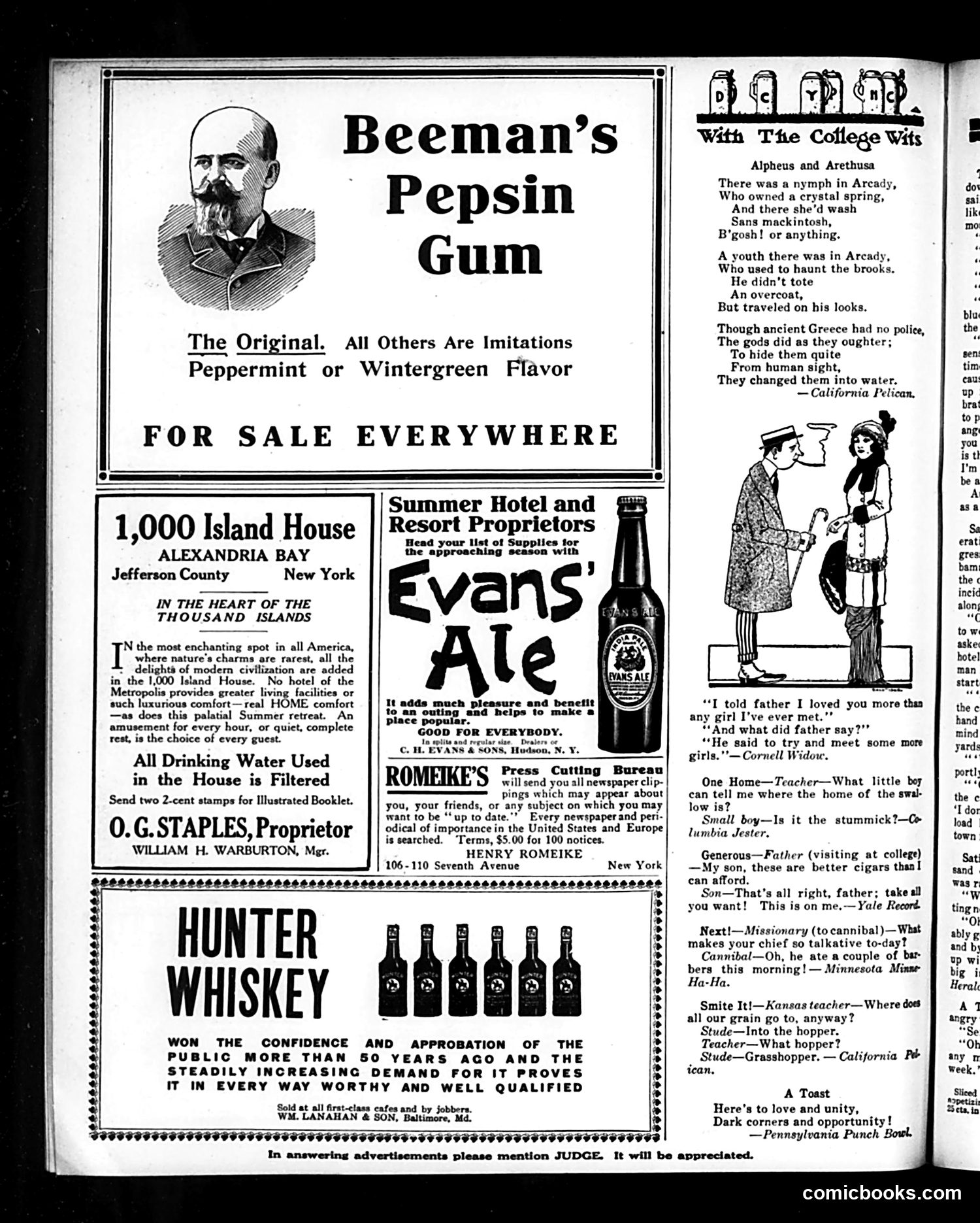
This page is primarily **advertising** with college humor sections. The main content includes: **Advertisements:** - Beeman's Pepsin Gum (top), claiming to be "the original" - 1,000 Island House resort in upstate New York - Evans' Ale - Romeike's Press Cutting Bureau (a clipping service) - Hunter Whiskey **College Humor Section ("With The College Wits"):** Contains short jokes and comic verses from various college publications (Cornell Widow, Yale Record, etc.). These are light, flirtatious pieces about college romance, including: - A classical allusion about nymphs and young men - Jokes about students boasting to fathers about romantic conquests - Innocent humor about classroom confusion and mixups The page reflects early 20th-century magazine advertising mixed with genteel collegiate comedy—nothing particularly satirical or pointed. It's representative of Judge's mix of ads and light entertainment.
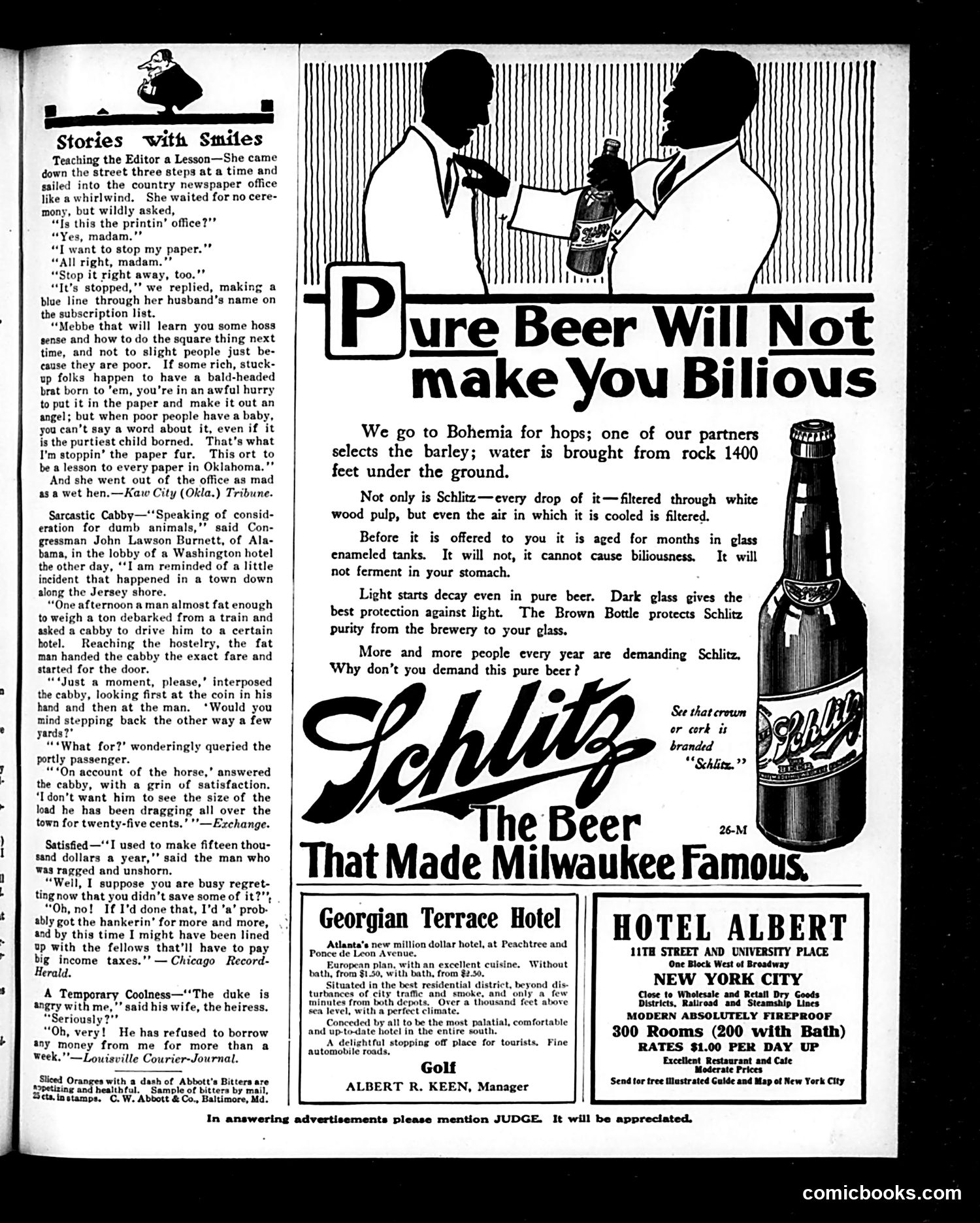
This page from *Judge* magazine contains several short humorous anecdotes and advertisements, typical of early 20th-century satirical publications. The main cartoons/stories are brief, joke-based pieces: 1. **"Teaching the Editor a Lesson"** – A rural woman (identified by dialect) complains to a newspaper editor that he gives prominent coverage to babies born to wealthy families but ignores those born to poor families. She cancels her subscription to protest the class bias. The satire critiques newspapers' social prejudice and favoritism toward the rich. 2. **"Sarcastic Cabby"** – A taxi driver asks an extremely overweight passenger to step back several yards, claiming he doesn't want his horse to see the size of the load. It's a blunt joke about obesity. 3. **"Satisfied"** – A poor man claims he deliberately spent his earnings rather than save them, to avoid developing greed. The satire mocks rationalization of financial irresponsibility. The remainder is mostly **advertising** for Schlitz beer and hotels, using period marketing language about purity and filtration.
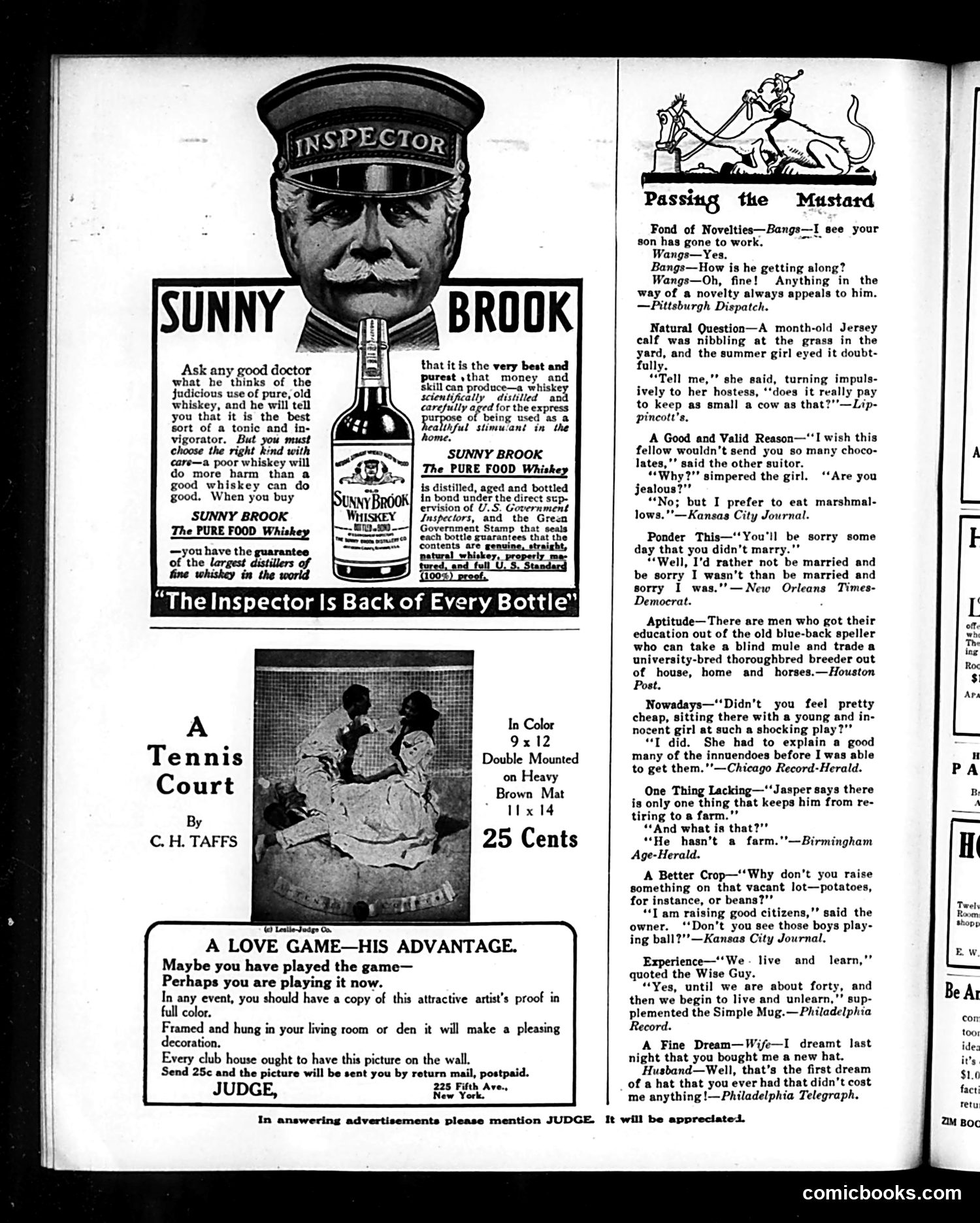
This page is primarily **advertising and humor fillers** rather than political satire. The dominant content is a Sunny Brook whiskey advertisement featuring an "Inspector" character whose seal guarantees the product's purity under U.S. Government supervision—likely referencing the Pure Food and Drug Act (1906), which created federal food safety standards. The ad appeals to doctors' endorsement of whiskey as medicinal tonic. The right column contains brief humorous anecdotes ("Passing the Mustard") on everyday topics: a young man starting work, a farm girl questioning calf economics, romantic jealousy, and marriage regrets. These are gentle, domestic jokes typical of early 20th-century magazines—no sharp political edge. A secondary advertisement promotes "A Love Game—His Advantage," a framed color print for 25 cents, depicting apparently romantic or flirtatious interaction. The page reflects Judge's mixed editorial/advertising model and the era's acceptance of whiskey as respectable medicinal commerce.
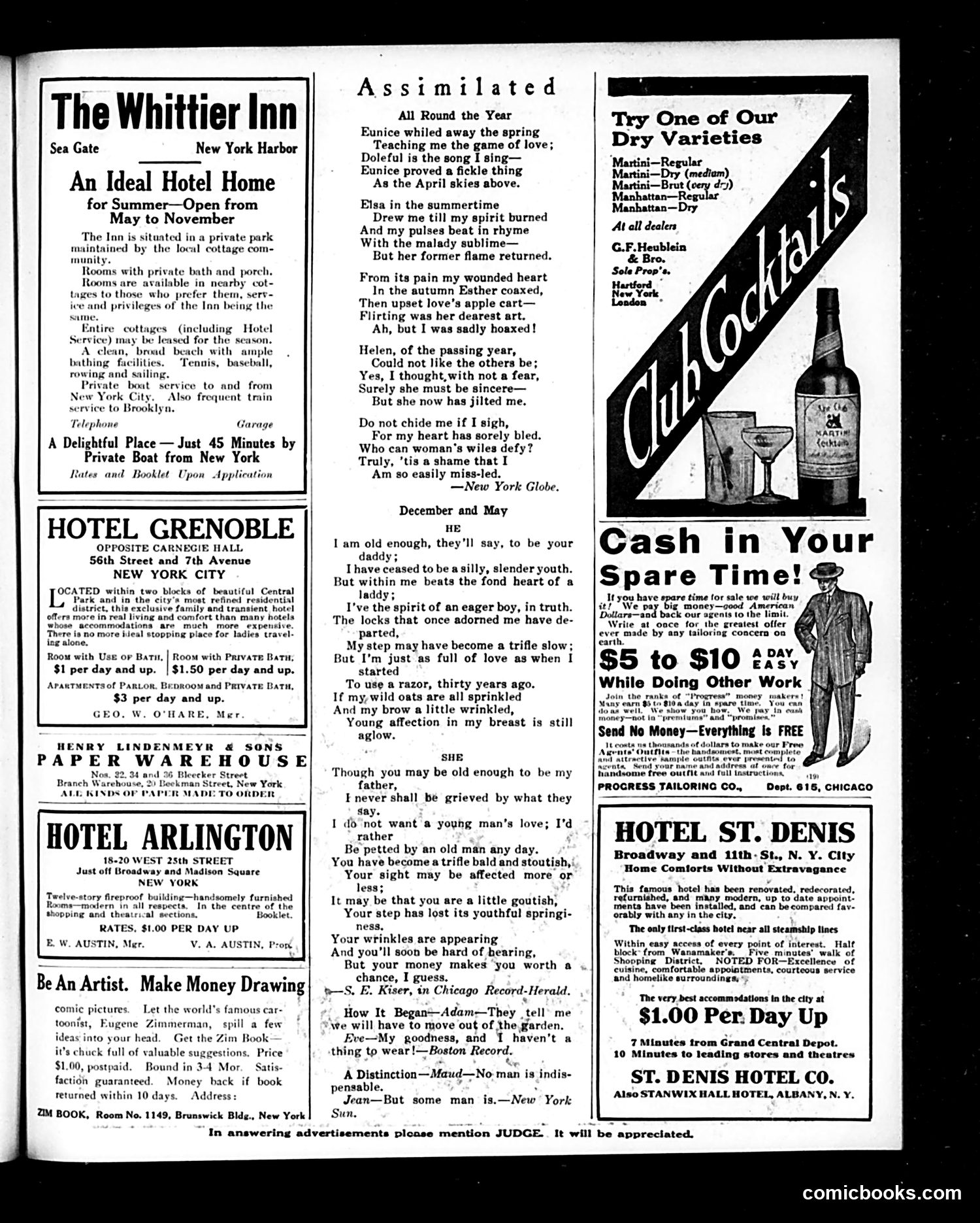
This is primarily an **advertising page** from Judge magazine, featuring hotel and business advertisements with minimal editorial cartoon content. The page includes: **Main Advertisement Content:** - Multiple hotel ads (The Whittier Inn, Hotel Grenoble, Hotel Arlington, Hotel St. Denis) targeting affluent leisure travelers - A "Paper Warehouse" business ad - A correspondence course ad for aspiring cartoonists **Editorial Poetry:** The page contains two satirical poems: 1. **"Assimilated"** - A humorous lament about a romantic man serially jilted by women named Eunice, Elsa, Esther, and Helen throughout the seasons. The joke is his predictable pattern of emotional vulnerability. 2. **"December and May"** - A satirical dialogue between an aging man and a younger woman. The satire is transparent: she explicitly states she prefers his money to genuine affection, while he romanticizes their age difference. The poem mocks both his self-deception and her mercenary motivations. Both poems target romantic delusions—his naïveté and her materialism—reflecting early 20th-century social commentary on relationships and class.
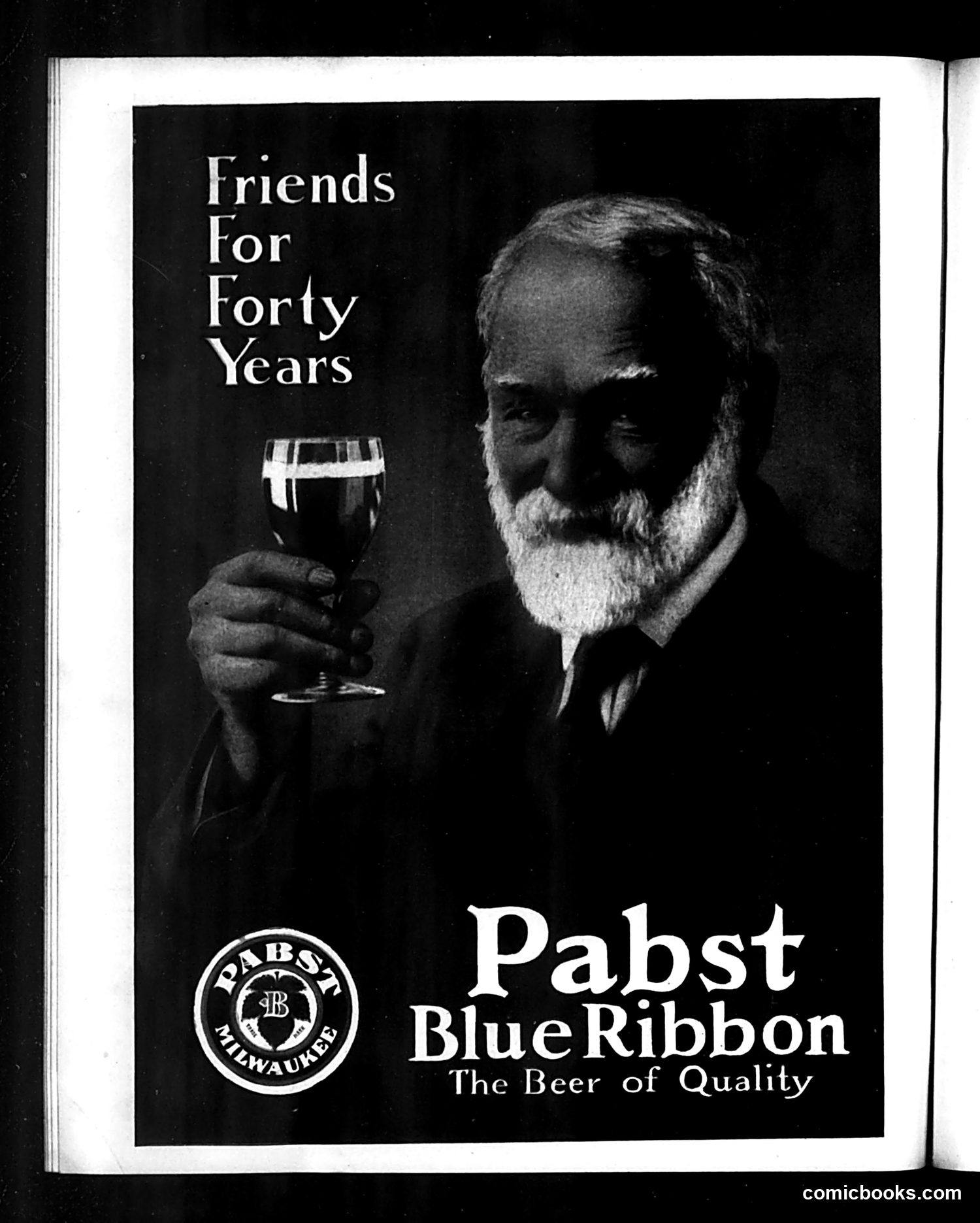
This is a **beer advertisement**, not political satire. It shows an elderly man with a white beard holding a glass of beer, presenting Pabst Blue Ribbon as "The Beer of Quality." The tagline "Friends For Forty Years" suggests the ad targets long-time, loyal consumers—positioning the product as a reliable companion through decades of life. The Milwaukee-brewed Pabst appears here in *Judge* magazine, a publication known for satire, but this particular page is straightforward commercial advertising rather than editorial commentary. The image's dignified presentation of an older gentleman conveys respectability and trustworthiness, marketing strategies common in early-to-mid 20th-century beer advertising.