
Judge, 1913-05-31 · page 6 of 24
Judge — May 31, 1913 — page 6: what you’re looking at
What you’re looking at
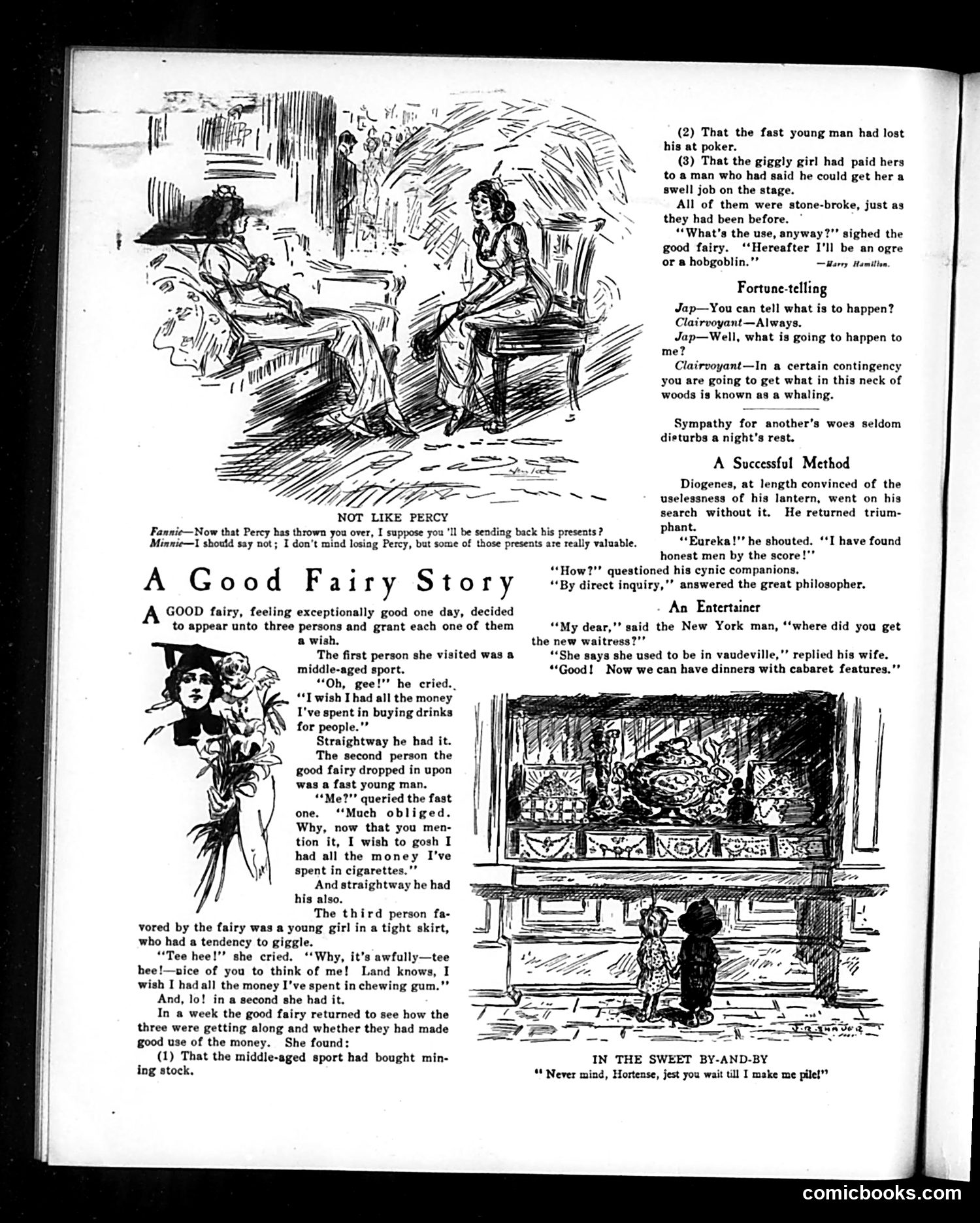
This page contains three satirical pieces mocking early-1900s social attitudes: **"Not Like Percy"**: A brief joke about a woman keeping her ex-boyfriend's expensive gifts despite the breakup—satirizing materialism and female opportunism. **"A Good Fairy Story"**: The main cartoon mocks young people's frivolous spending. A fairy grants three wishes to a middle-aged man (who squanders money on drinks), a "fast young man" (cigarettes), and a giggling girl (chewing gum). When the fairy returns, all three have wasted their windfalls again. The satire targets perceived recklessness of youth and the futility of redemption—a common Judge theme. **Other items**: Brief jokes about fortune-telling, a reference to Diogenes (ancient philosopher searching for honest men), and a vaudeville entertainer joke. The overall tone reflects Judge's conservative, moralistic stance toward young people's spending habits, romance, and entertainment culture of the era.
📄 Transcribed text from this page (OCR, searchable)
Machine-transcribed from the original scan — historical spelling and the odd misread are preserved.
NOT LIKE PERCY Fannie—Now that Percy has thrown you over, I suppose you ‘ll be sending back his presents ? Minnie—I should say not; I don’t mind losing Percy, but some of those presents are really valuable. (2) That the fast young man had lost his at poker. (3) That the giggly girl had paid hers to a man who had said he could get her a swell job on the stage. All of them were stone-broke, just as they had been before. ‘What's the use, anyway?" sighed the good fairy. ‘‘Hereafter I'll be an ogre or a hobgoblin.’* Marry Hamition Fortune-telling Jap—You can tell what is to happen? Clairvoyant—Always. Jap—Well, what is going to happen to me? Clairvoyant—In a certain contingency you are going to get what in this neck of woods is known as a whaling. Sympathy for another’s woes seldom disturbs a night's rest. A Successful Method Diogenes, at length convinced of the uselessness of his lantern, went on his search without it. He returned trium- phant. “Eureka!"’ he shouted. ‘‘I have found honest men by the score!"" A Good Fairy Story A 00D fairy, feeling exceptionally good one day, decided to appear unto three persons and grant each one of them a wish, The first person she visited was a middle-aged sport. “Oh, gee!"? he cried., “IT wish Ihad all the money I've spent in buying drinks for people.”” Straightway he had it. The second person the good fairy dropped in upon wi fast young man. Me?’ queried the fast one. ‘Much obliged. Why, now that you men- tion it, I wish to gosh I had all the money I’ve spent in cigarettes."” And straightway he had his also. The third person fa- vored by the fairy was a young girl in a tight skirt, who had a tendency to giggle. “Tee hee!’ she cried. ‘‘Why, it’s awfully—tee hee!—nice of you to think of me! Land knows, I wish I hadall the money I've spent in chewing gum."” And, lo! in a second she had it. In a week the good fairy returned to see how the three were getting along and whether they had made good use of the money. She found: (1) That the middle-aged sport had bought min- ing stock. “*How?’’ questioned his cynic companions, “‘By direct inquiry,’’ answered the great philosopher. An Entertainer ‘*My dear,’’ said the New York man, ‘‘where did you get the new waitress?"’ “She says she used to be in vaudeville,”’ replied his wife. “Good! Now we can have dinners with cabaret features."’ IN THE SWEET BY-AND-BY “* Never mind, Hortense, jest you wait till I make me pilel"” comicbooks.com