
Judge, 1913-05-31 · page 4 of 24
Judge — May 31, 1913 — page 4: what you’re looking at
What you’re looking at
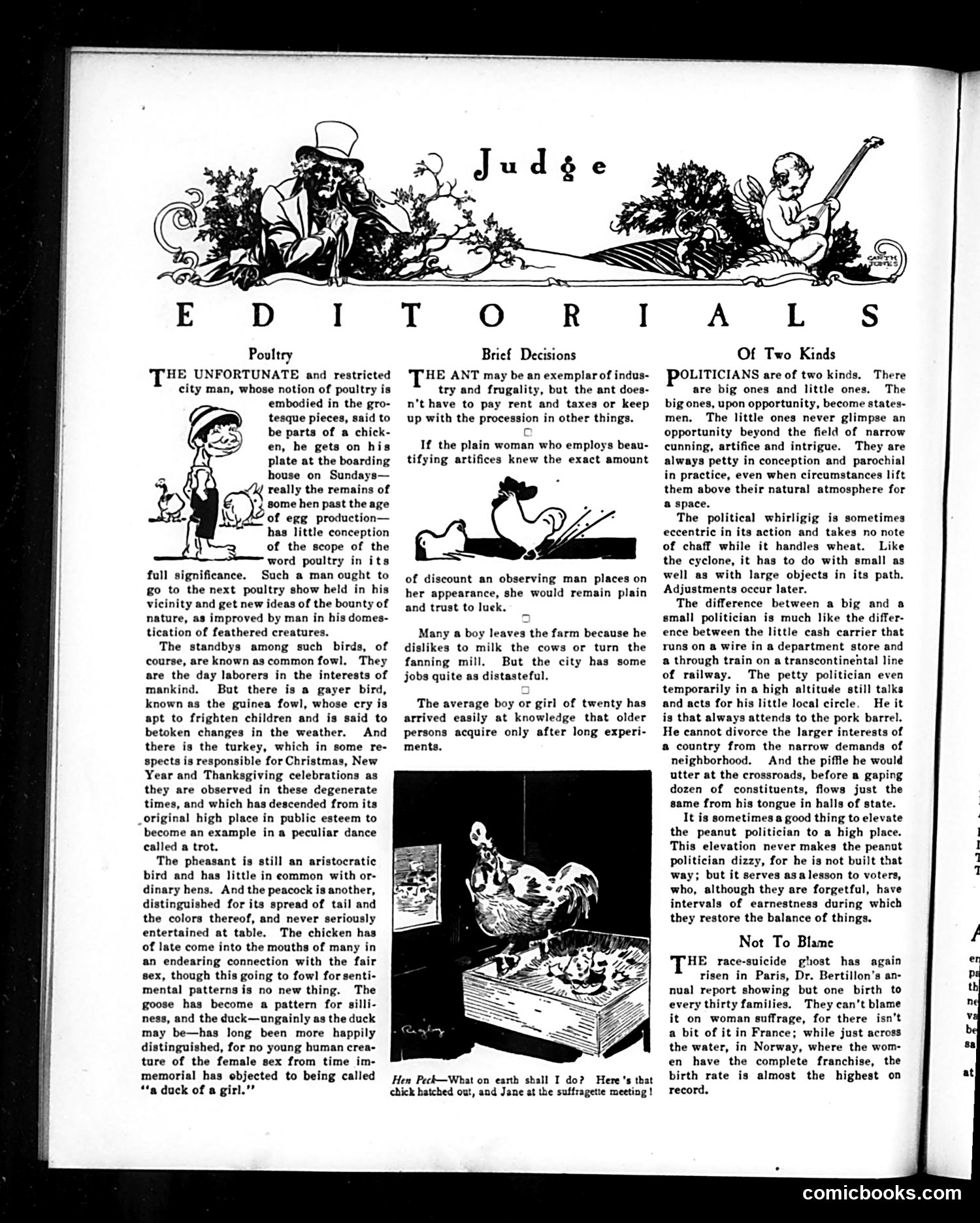
This page from *Judge* magazine contains three distinct editorial pieces with illustrations: **"Poultry"** (left): A satirical essay mocking urban men's ignorance of poultry, using chickens and guinea fowl as metaphors for understanding nature and proper domestication. **"Brief Decisions"** (center): Short observations on industry, farm life, and social behavior—noting how boys avoid farm work and city jobs are equally undesirable. **"Of Two Kinds"** (right): A political commentary distinguishing "big" and "little" politicians. The satire suggests petty politicians operate in narrow spheres and cannot transcend local interests, comparing them unfavorably to those with broader vision and influence. **"Not To Blame"** (bottom right): A brief piece on race suicide and women's suffrage, addressing contemporary debates about birth rates and voting rights. The illustrations feature simple line drawings complementing each essay's theme.
📄 Transcribed text from this page (OCR, searchable)
Machine-transcribed from the original scan — historical spelling and the odd misread are preserved.
HE UNFORTUNATE and restricted city man, whose notion of poultry is embodied in the gro- tesque pieces, said to be parts of a chick- en, he gets on his plate at the boarding house on Sunda: really the remains of some hen past the age of egg production— has little conception of the scope of the word poultry in its full significance. Such a man ought to go to the next poultry show held in his vicinity and get new ideas of the bounty of nature, as improved by man in his domes- tication of feathered creatures. The standbys among such birds, of course, are known as common fowl. They are the day laborers in the interests of mankind. But there is a gayer bird, known as the guinea fowl, whose cry is apt to frighten children and is said to betoken changes in the weather. And there is the turkey, which in some re- spects is responsible for Christmas, New Year and Thanksgiving celebrations as they are observed in these degenerate times, and which has descended from its original high place in public esteem to become an example ina peculiar dance called a trot. The pheasant is still an aristocratic bird and has little in eommon with or- dinary hens, And the peacock is another, distinguished for its spread of tail and the colors thereof, and never seriously entertained at table. The chicken has of late come into the mouths of many in an endearing connection with the fair sex, though this going to fowl forsenti- mental patterns is no new thing. The goose has become a pattern for silli- ness, and the duck—ungainly as the duck may be—has long been more happily distinguished, for no young human crea- ture of the female sex from time im- memorial has objected to being called Brief Decisions "THE ANT may be an exemplar of indus- try and frugality, but the ant does- n't have to pay rent and taxes or keep up with the procession in other things. If the plain woman who employs beau- tifying artifices knew the exact amount of discount an observing man places on her appearance, she would remain plain and trust to luek, Many a boy leaves the farm because he dislikes to milk the cows or turn the fanning mill. But the city has some jobs quite as distasteful. The average boy or girl of twenty has arrived easily at knowledge that older persons acquire only after long experi- ments. Hen Peck—What on earth shall I do? Here's that Of Two Kinds POLITICIANS are of two kinds. There are big ones and little ones. The big ones, upon opportunity, become states- men. The little ones never glimpse an opportunity beyond the field of narrow cunning, artifice and intrigue. The: always petty in conception and parochial in practice, even when circumstances lift them above their natural atmosphere for @ space. The political whirligig is sometimes eccentric in its action and takes no note of chaff while it handles wheat. Like the cyclone, it has to do with small as well as with large objects in its path. Adjustments occur later. The difference between a big and a small politician is much like the differ- ence between the little cash carrier that runs on a wire in a department store and a through train on a transcontinental line of railway. The petty politician even temporarily in a high altitude still talks and acts for his little local circle. He it is that always attends to the pork barrel. He cannot divorce the larger interests of a country from the narrow demands of neighborhood. And the piffle he would utter at the crossroads, before a gaping dozen of constituents, flows just the same from his tongue in halls of state. It is sometimes a good thing to elevate the peanut politician to a high place. is elevation never makes the peanut jan dizzy, for he is not built that way; but it serves asa lesson to voters, who, although they are forgetful, have intervals of earnestness during which they restore the balance of things. Not To Blame HE race-suicide ghost has again risen in P. Dr. Bertillon’s an- nual report showing but one birth to every thirty families. They can’t blame it on woman suffrage, for there isn’t a bit of it in France; while just across the water, in Norway, where the wom- en have the complete franchise, the birth rate is almost the highest on record. “a duck of a girl.” chick hatched out, and Jane at the suffragette meeting! comicbooks.com