
A complete issue · 24 pages · 1913
Judge — February 1, 1913
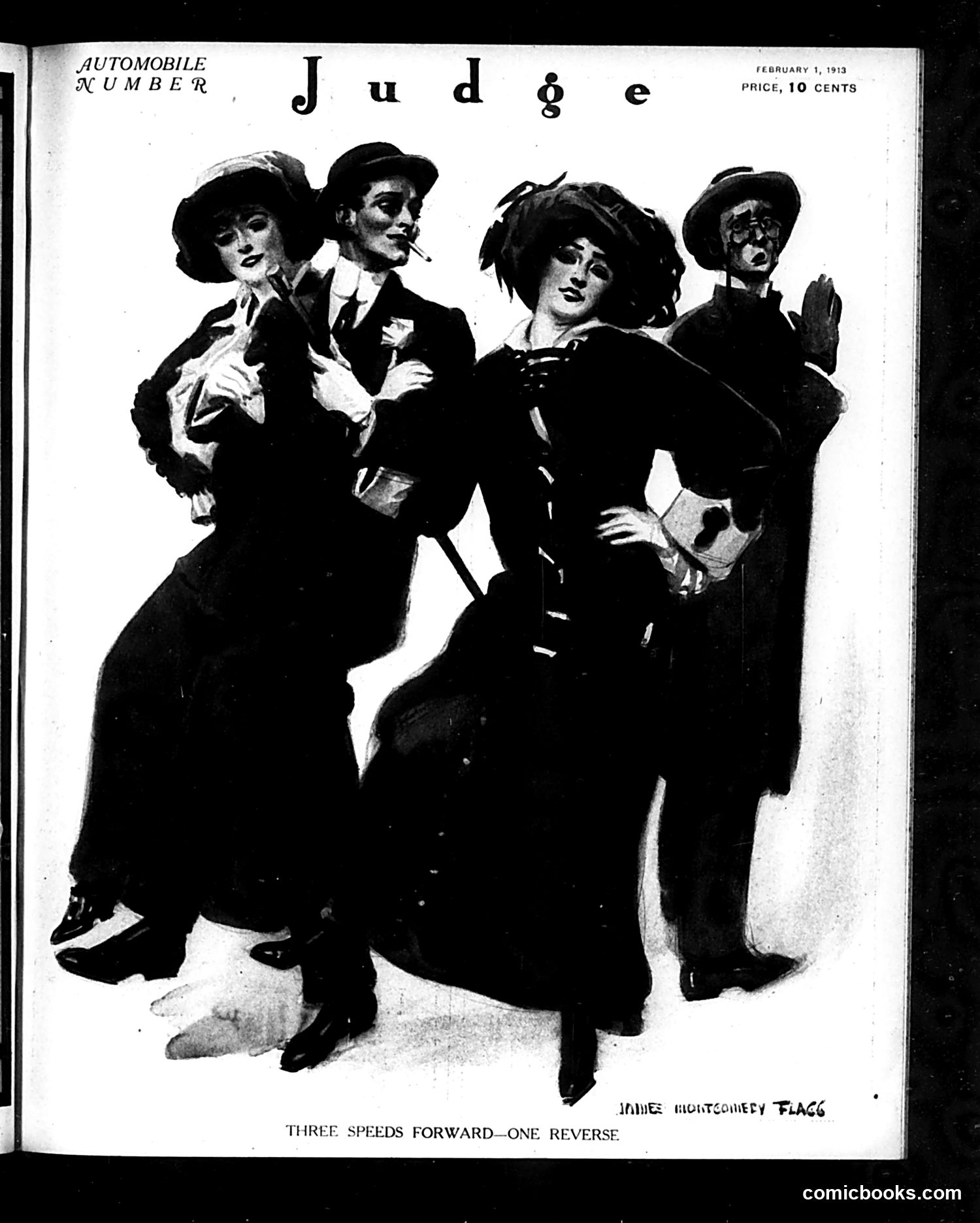
This is the cover illustration by James Montgomery Flagg for Judge's "Automobile Number." The caption reads "THREE SPEEDS FORWARD—ONE REVERSE," which appears to be a double entendre about automobiles and social behavior. The image depicts four fashionably dressed figures in 1913 attire—three women and one man—in a suggestive pose. The satirical joke likely plays on: 1. **Automobile technology**: Cars had forward and reverse gears, a relatively new feature in 1913 2. **Social commentary**: The suggestive grouping and caption imply commentary on modern courtship and sexual morality among the wealthy classes who could afford automobiles The illustration reflects the period's anxieties about automobiles as spaces enabling unsupervised interactions between young men and women, challenging Victorian social norms.
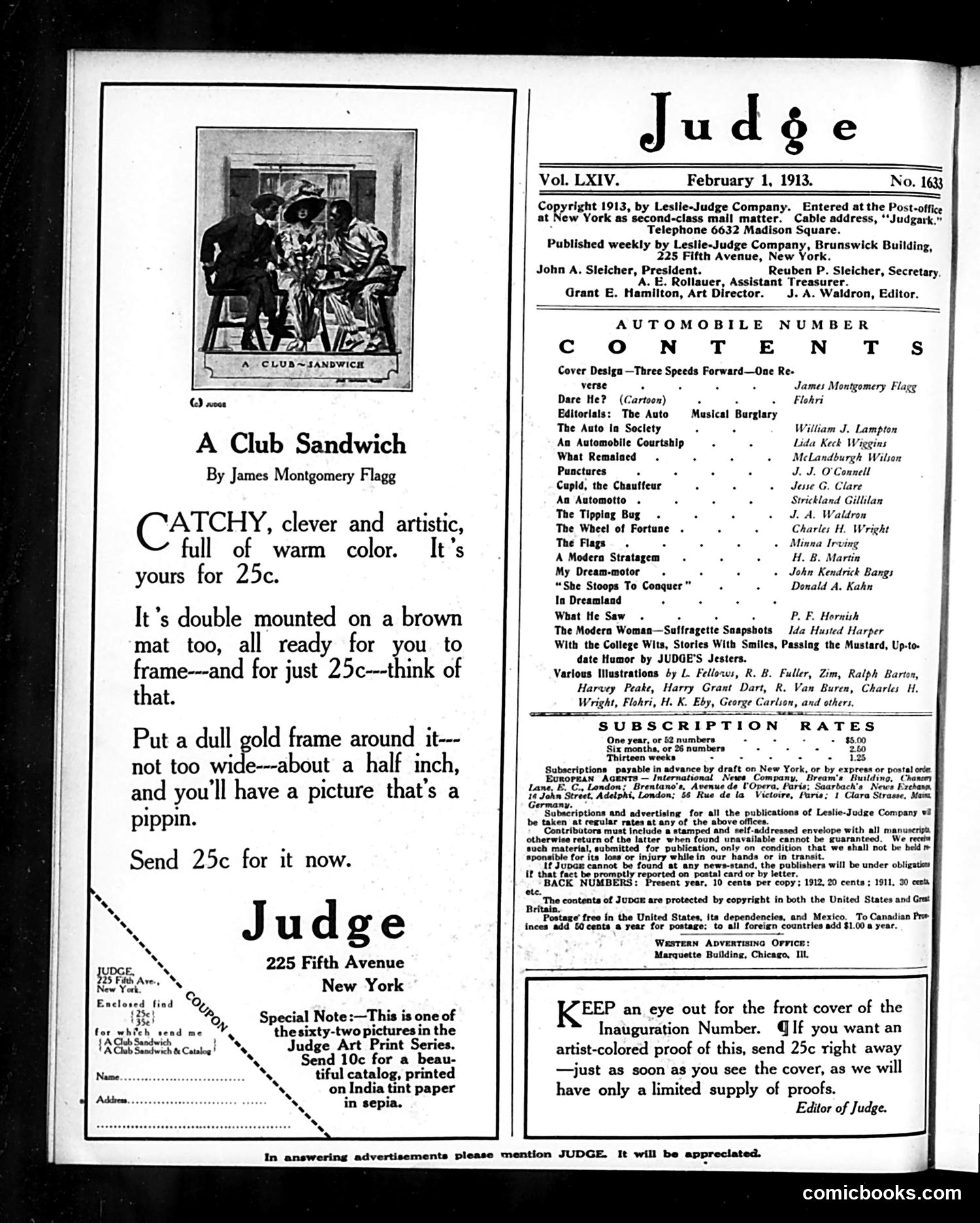
This page is primarily an **advertisement** for an art print rather than political satire. The illustration shows a humorous scene labeled "A Club Sandwich"—apparently depicting multiple figures crowded together in a club setting, playing on the double meaning of "sandwich" (the food and being squeezed between others). The ad promotes a framed art print for 25 cents, positioned as part of Judge's "Art Print Series." Flagg, a renowned illustrator, created this lighthearted domestic humor piece. The remaining page content consists of magazine masthead information, subscription rates, and advertising rates—typical of early 20th-century magazine formatting. There is no apparent political commentary or social satire on this particular page.
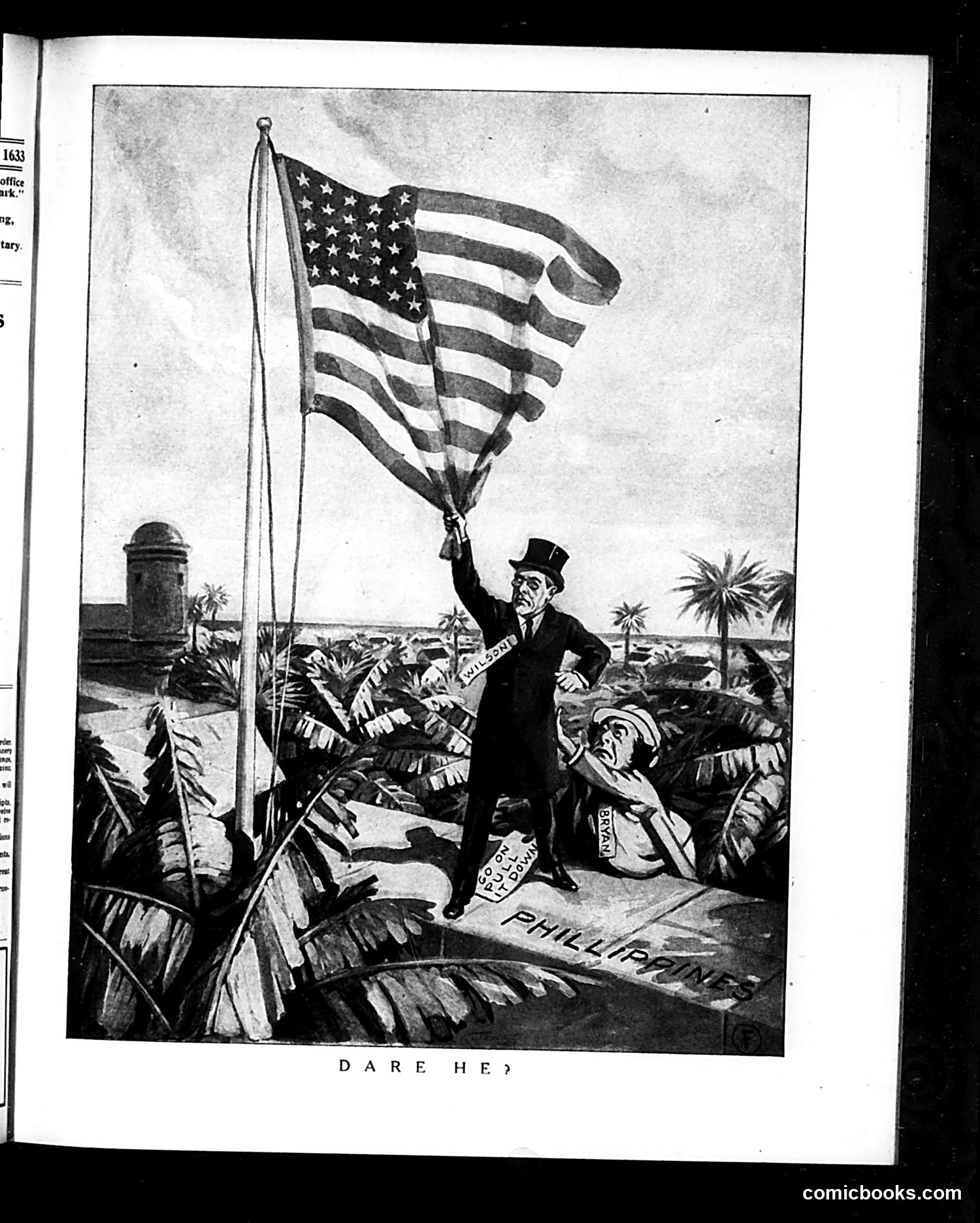
This political cartoon satirizes American imperial ambitions regarding the Philippines. A well-dressed American politician (likely representing U.S. political leadership) holds the American flag aloft over Philippine territory, surrounded by tropical vegetation and what appears to be indigenous populations or soldiers. The caption "Dare He?" poses a challenge: would American leadership dare to formally annex or directly control the Philippines? This references the Spanish-American War's aftermath (1898), when the U.S. faced choices about Philippine governance. The cartoon suggests internal debate about whether America should extend its territorial empire to Asia—a controversial question that divided American policymakers and the public. The tropical setting and flag-planting imagery evoke colonial conquest, inviting readers to question American expansionism.
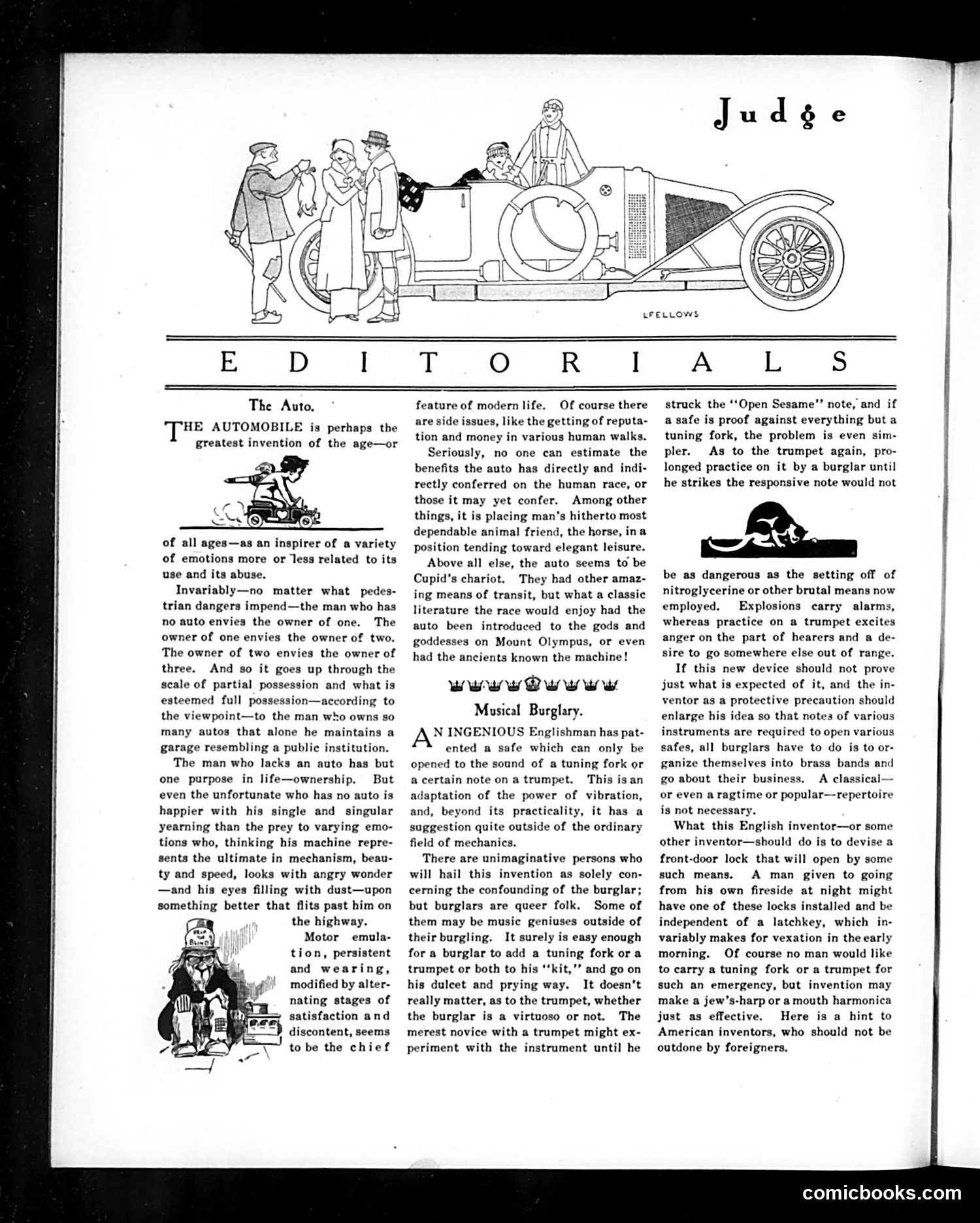
This page contains two satirical articles about modern inventions rather than political cartoons. **"The Auto"** mocks automobile ownership, suggesting that while cars are impressive, they inspire jealousy and anxiety in non-owners. The satire critiques how automobiles have become status symbols, with owners envied for their possession while also inspiring resentment in those without vehicles. **"Musical Burglary"** presents a humorous solution to a real problem: an Englishman has patented a safe that opens only to specific musical notes (tuning fork, trumpet, etc.). The satire mocks both the invention's impracticality and burglars' supposed musical incompetence, joking that burglars are "queer folk" who wouldn't bother learning music to steal. Both articles satirize the age's fascination with mechanical invention and modern life's contradictions.
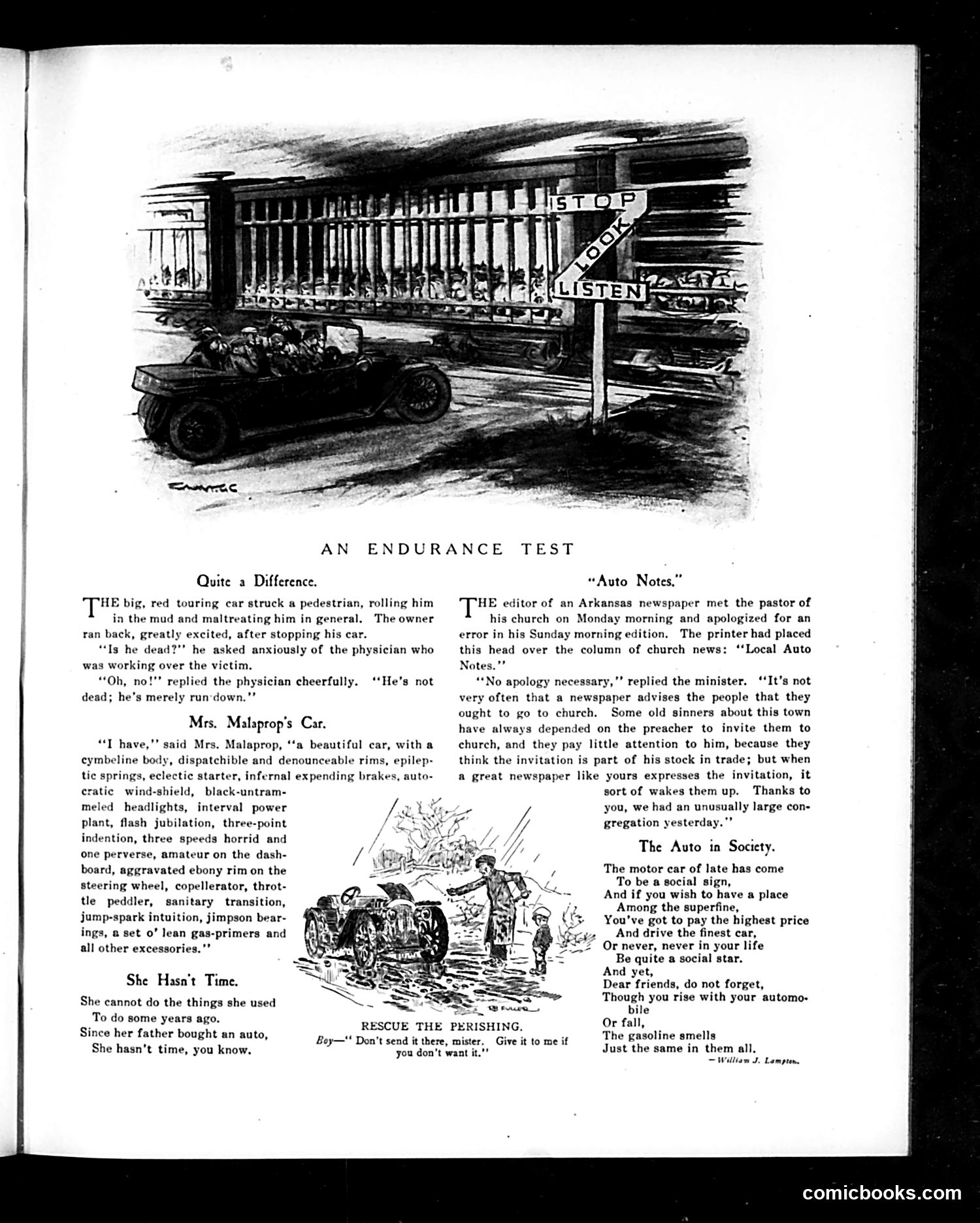
The main cartoon depicts an early automobile striking a pedestrian, with a physician reassuring the car's owner that the victim is "merely run down"—a dark pun on the automobile's literal act. This satirizes the emerging danger of motor cars in early 20th-century America and society's casual acceptance of traffic casualties. The accompanying articles mock automobile culture: "Mrs. Malsopop's Car" humorously catalogs excessive automotive features as status symbols; "She Hasn't Time" jokes about women's newfound independence through car ownership; and "The Auto in Society" uses verse to critique automobiles as social pretension markers. Overall, the page reflects early anxieties about automobiles as both dangerous public hazards and frivolous wealthy indulgences, while gently mocking the automobile's rapid social infiltration.
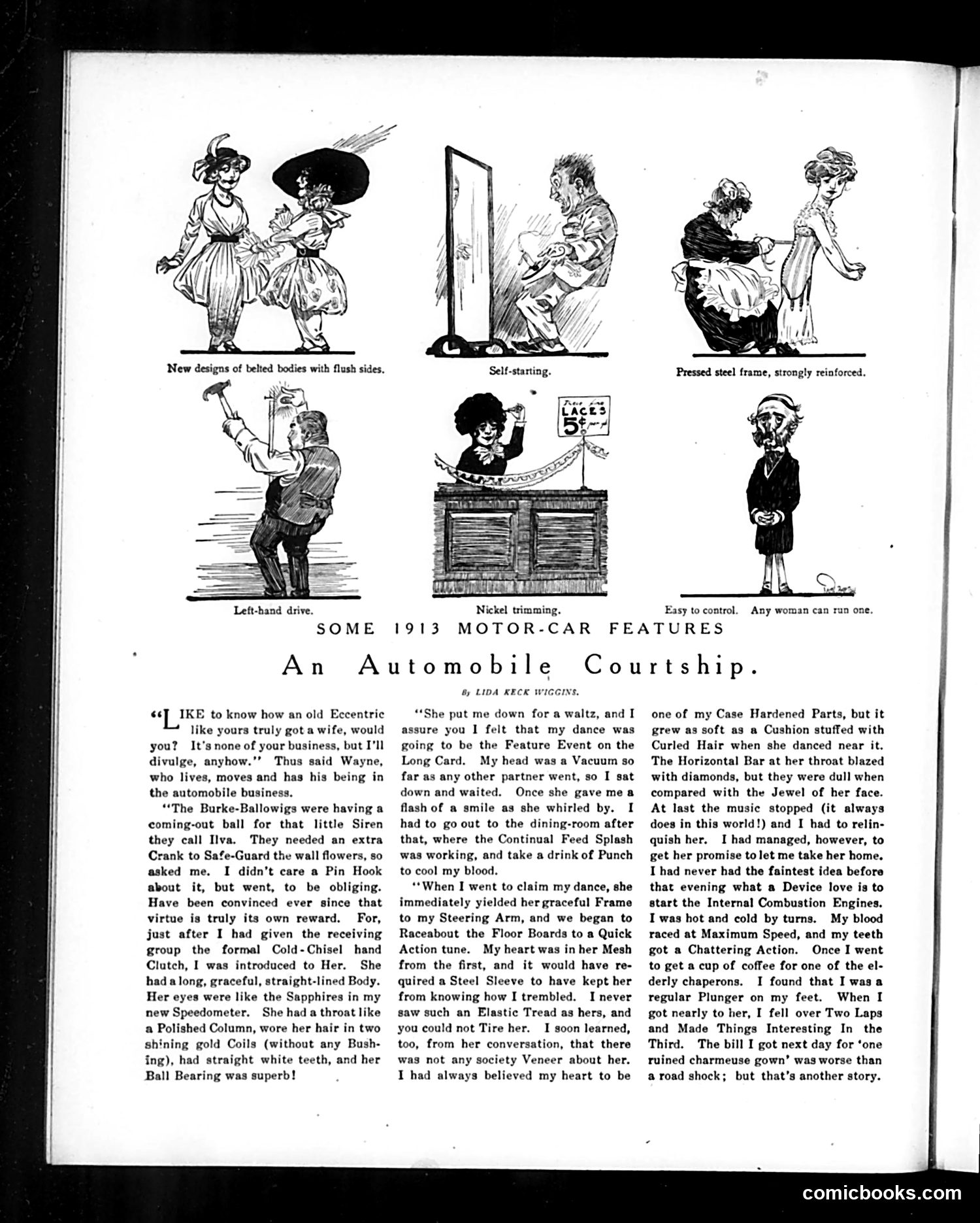
This is a humorous story using automobile terminology as extended metaphor for romance and courtship. The narrator, Wayne, describes meeting and falling for a woman at a ball, but every aspect of their interaction is described using car mechanics language: her "Body," "Speedometer" eyes, "Ball Bearing," "Steering Arm," "Elastic Tread," and "Internal Combustion Engines" (for love). The joke relies on the 1913 reader's familiarity with new automotive technology—then cutting-edge and widely discussed. By treating romantic attraction as mechanical engineering, the satire gently mocks both the era's obsession with automobiles and the mechanical, calculated nature of courtship rituals among the upper classes (the ball setting suggests wealth). The accompanying cartoon panels above satirize 1913 car "features" marketed to women, implying that even vehicles are being promoted with frivolous gendered appeals ("Any woman can run one").
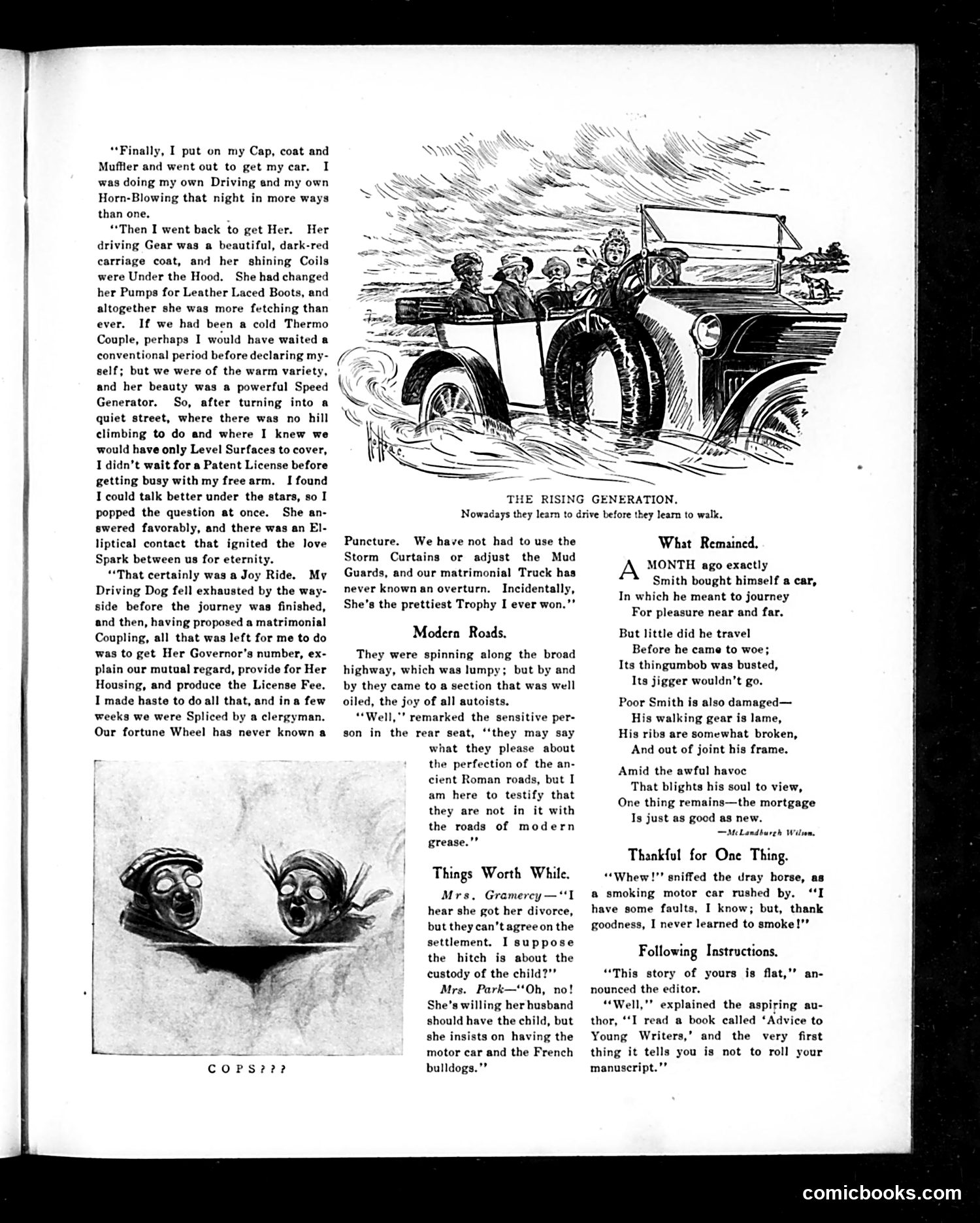
This page satirizes early automotive culture and courtship customs circa 1910s-1920s. **Main Narrative:** A humorous account of a man proposing to his girlfriend during a joyride, using extended automotive metaphors (her beauty as a "Speed Generator," their embrace as "elliptical contact," marriage as a "Coupling"). The joke centers on how cars enabled romantic privacy away from chaperones—a social revolution for the era. **Secondary Cartoons:** - *"The Rising Generation"*: Comments on how modern children learn to drive before walking - *"Modern Roads"*: Contrasts ancient Roman roads with modern oil-treated highways - *"What Remained"*: Dark humor about Smith's car crash leaving him injured but his mortgage intact - *"Thankful for One Thing"*: A dray horse grateful it never learned to smoke, mocking automobiles' pollution The page reflects Judge's satirical coverage of rapid technological change disrupting traditional society—particularly how automobiles challenged social conventions around courtship, gender roles, and urban/rural life.
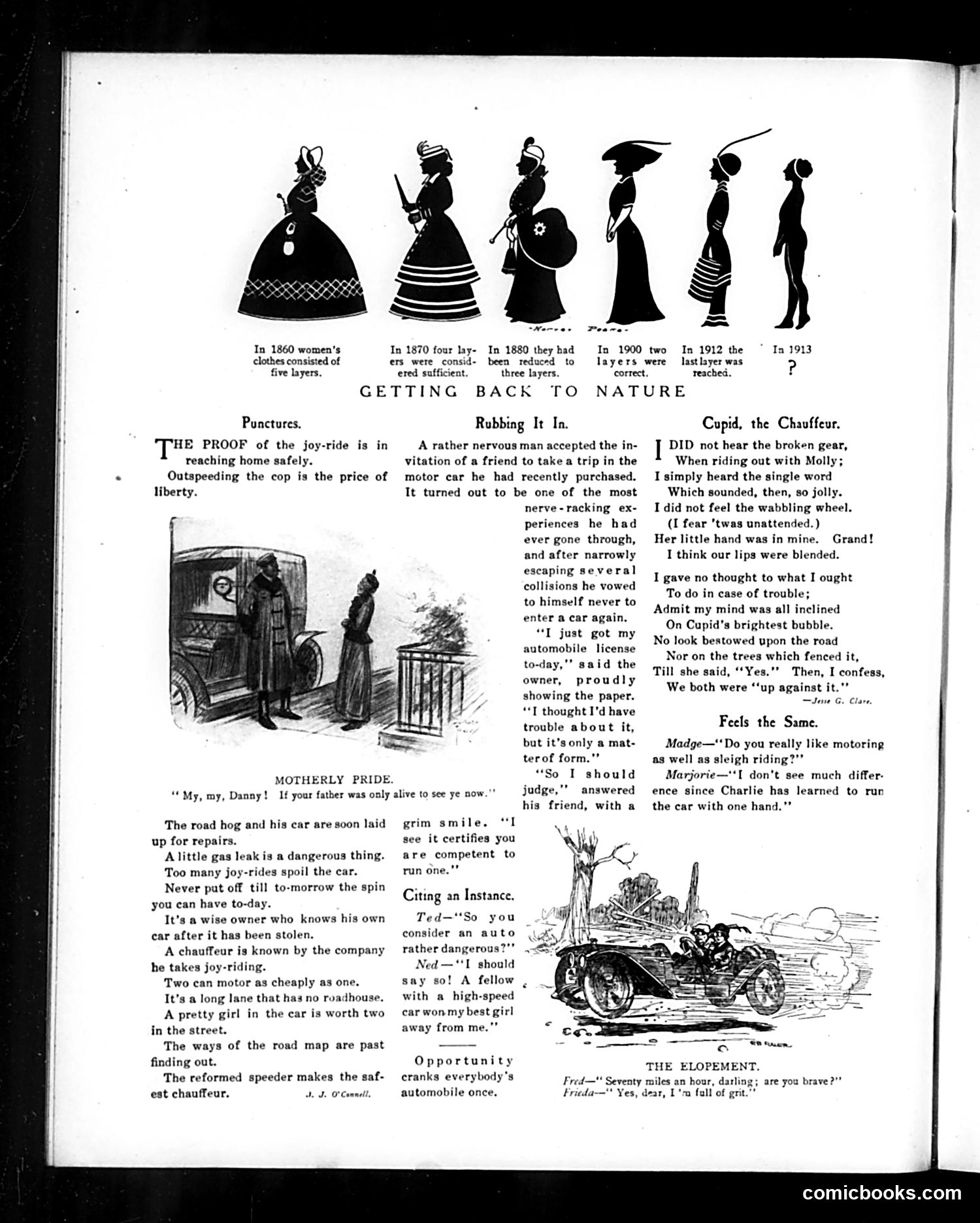
This page satirizes the early automobile era (circa 1910s) and its social impacts. The header "Getting Back to Nature" tracks women's fashion becoming progressively less restrictive as decades pass—a dig at how automobiles are supposedly "liberating" women by requiring less clothing, though the satire's target is unclear. The main humor concerns automobile culture itself: reckless driving ("joy-rides"), dangerous drivers ("road hogs"), and cars as romantic venues. "Cupid, the Chauffeur" and "The Elopement" depict courtship enabled by automobiles, while "Feels the Same" compares car-riding to sleigh-riding as romantic activities—both allow couples to sit close together. "Rubbing It In" mocks a newly licensed driver by suggesting his license merely certifies he's *survived* rather than proven competence. The illustrated joke depicts the nervous passenger's terrified reaction to a reckless driver. Overall, the page reflects contemporary anxieties: automobiles as dangerous, drivers as incompetent, and cars as agents of social change—particularly regarding courtship and women's independence.
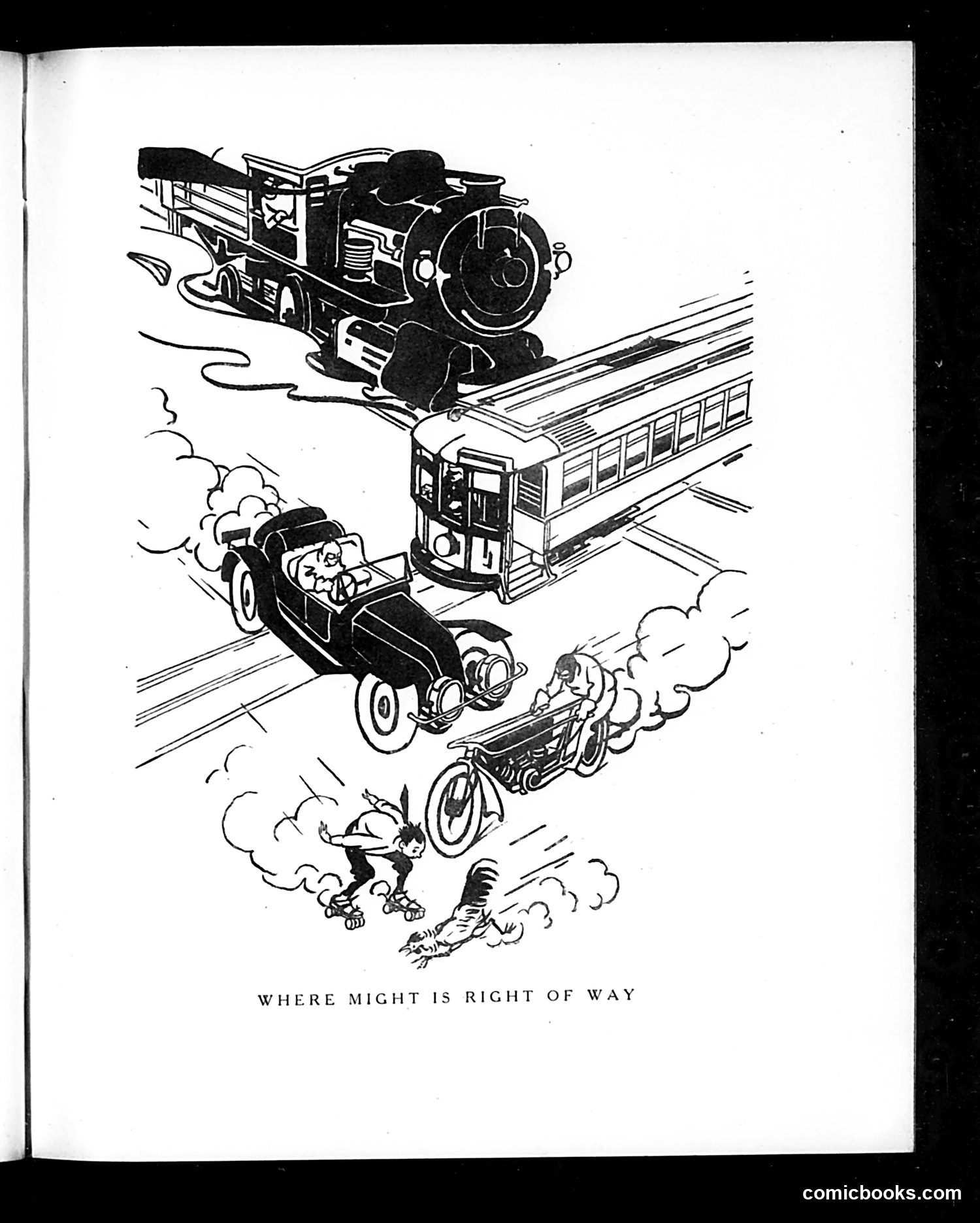
This cartoon satirizes traffic safety and power dynamics on roads. It depicts a hierarchical "food chain" of vehicles: at the top, a steam locomotive dominates; below it, a streetcar; then an automobile with a wealthy-looking driver; then a motorcycle rider; and finally pedestrians (appearing to be workers or common people) at the bottom, being crushed underfoot. The title "Where Might Is Right of Way" criticizes how larger, more powerful vehicles—and by extension, wealthier vehicle owners—literally run over smaller road users and pedestrians with impunity. The cartoon suggests that traffic rules favor the powerful while the vulnerable (workers, pedestrians) have no protection. It's a commentary on Gilded Age inequality, where economic power translated into literal physical danger for working-class citizens.
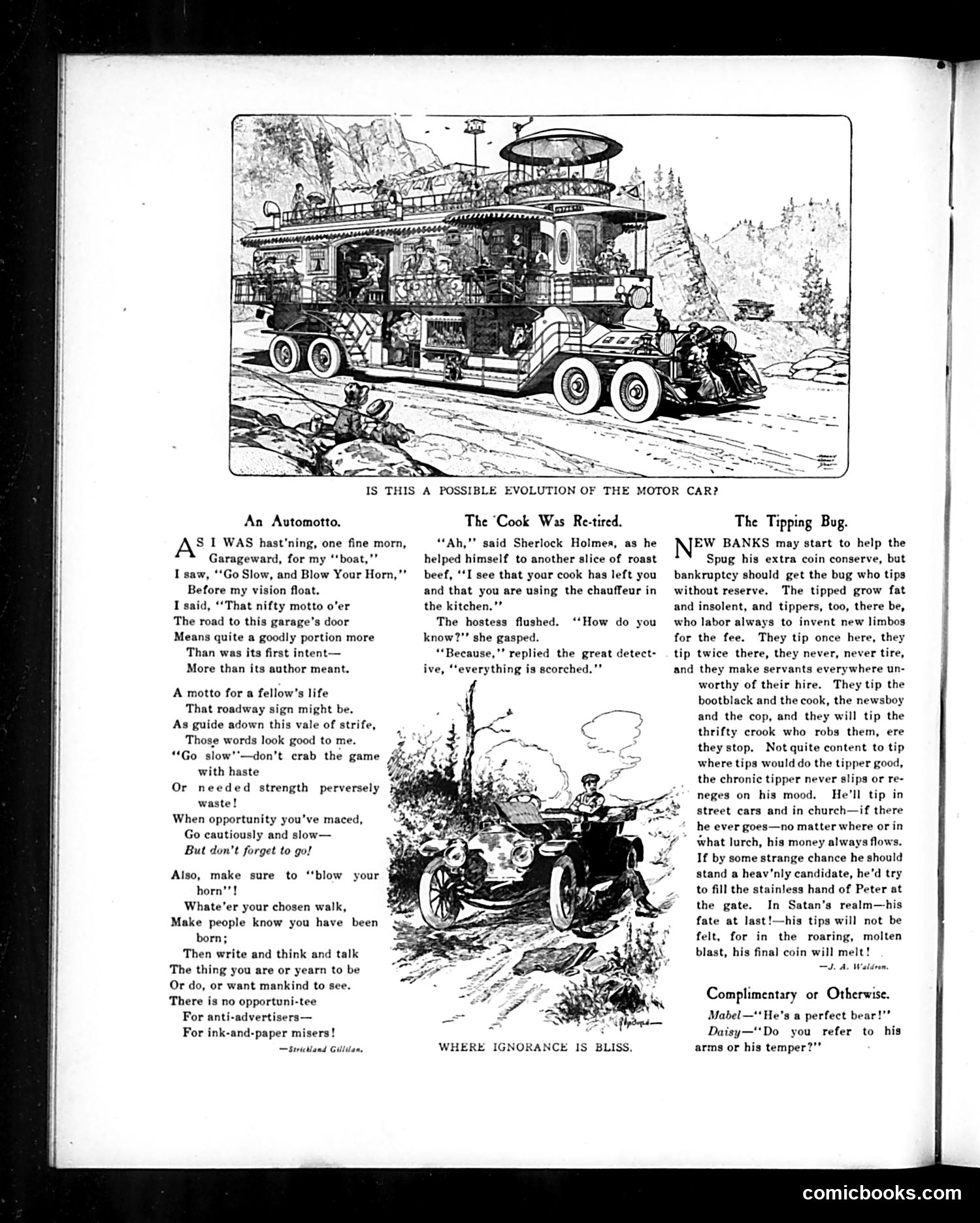
This page contains three satirical pieces reflecting early 1900s automotive culture and social commentary: **"An Automotto"** plays on the new motor car's cultural prominence. A driver sees a street sign ("Go Slow, and Blow Your Horn") and extrapolates it as life advice—urging ambition ("blow your horn"/self-promotion) balanced with caution. The satire mocks both reckless drivers and those too timid to succeed. **"The Cook Was Re-tired"** presents a Sherlock Holmes parody. Holmes deduces a cook quit by observing burnt food, blaming the chauffeur-turned-cook. The joke reflects class anxieties: automobiles required chauffeurs, a new servant class that disrupted traditional household hierarchies. **"The Tipping Bug"** satirizes excessive tipping culture—a growing problem as service industries expanded. The piece attacks chronic tippers as enabling servant corruption and financial ruin, even imagining a tipper attempting to bribe Saint Peter at heaven's gates. The top illustration shows a fantastical "motor car evolution"—a multi-story vehicle with observation decks, reflecting contemporary speculation about automobiles' future.
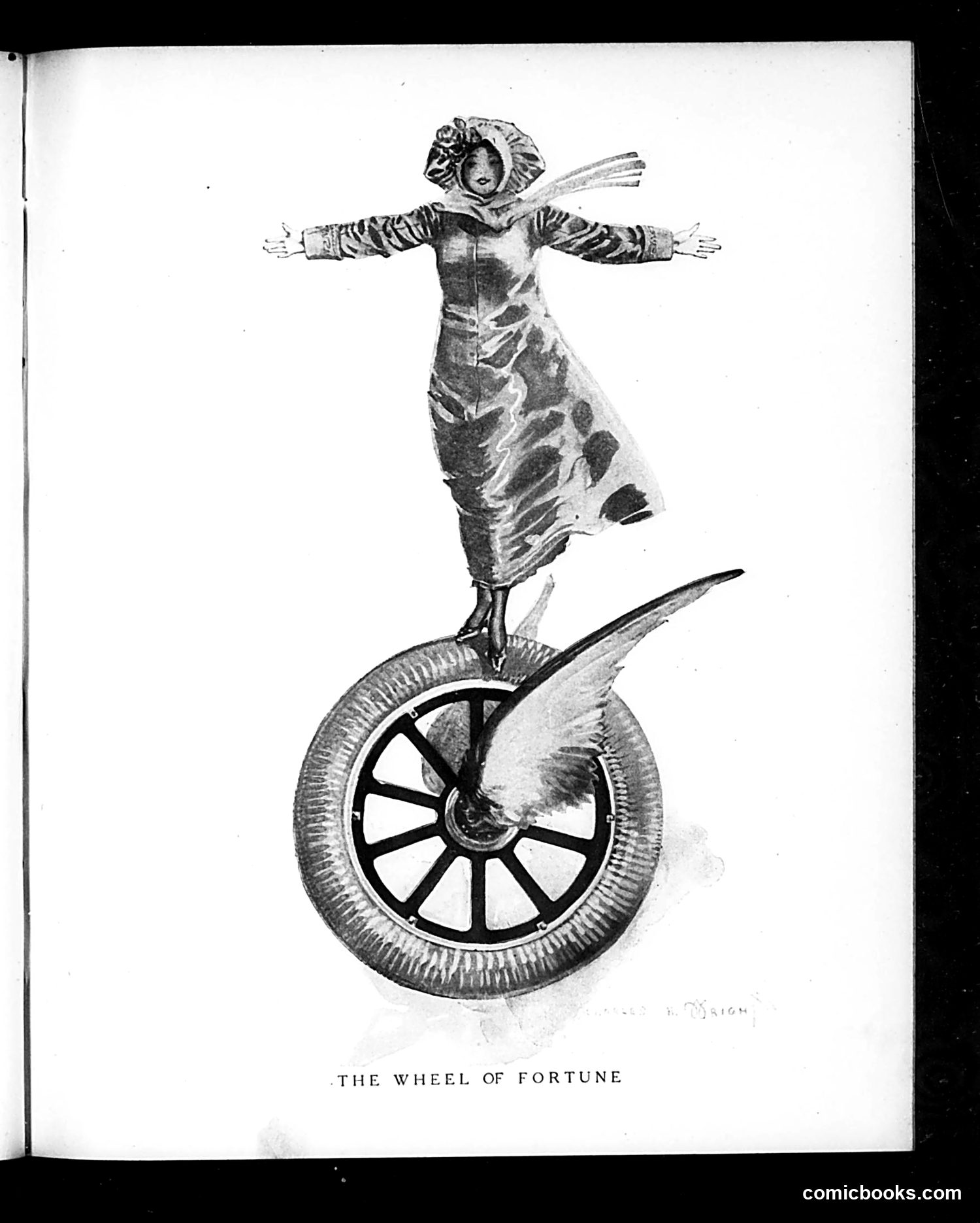
This illustration depicts a stylized female figure balanced precariously atop an automobile tire, arms outstretched in an unstable pose. The figure wears 1920s-era clothing with a decorative hat and patterned dress. The title "The Wheel of Fortune" plays on the classical image of Lady Fortune (or Fortuna) spinning her wheel to determine fate. Here, the "wheel" is a modern automobile tire—likely satirizing how chance and fortune have become tied to the new automobile industry and modern consumer culture. The woman's precarious, unbalanced stance suggests the instability and unpredictability of this new industrial economy. The cartoon likely critiques either the volatility of automobile-related investments or society's reckless embrace of automotive modernity as a path to prosperity.
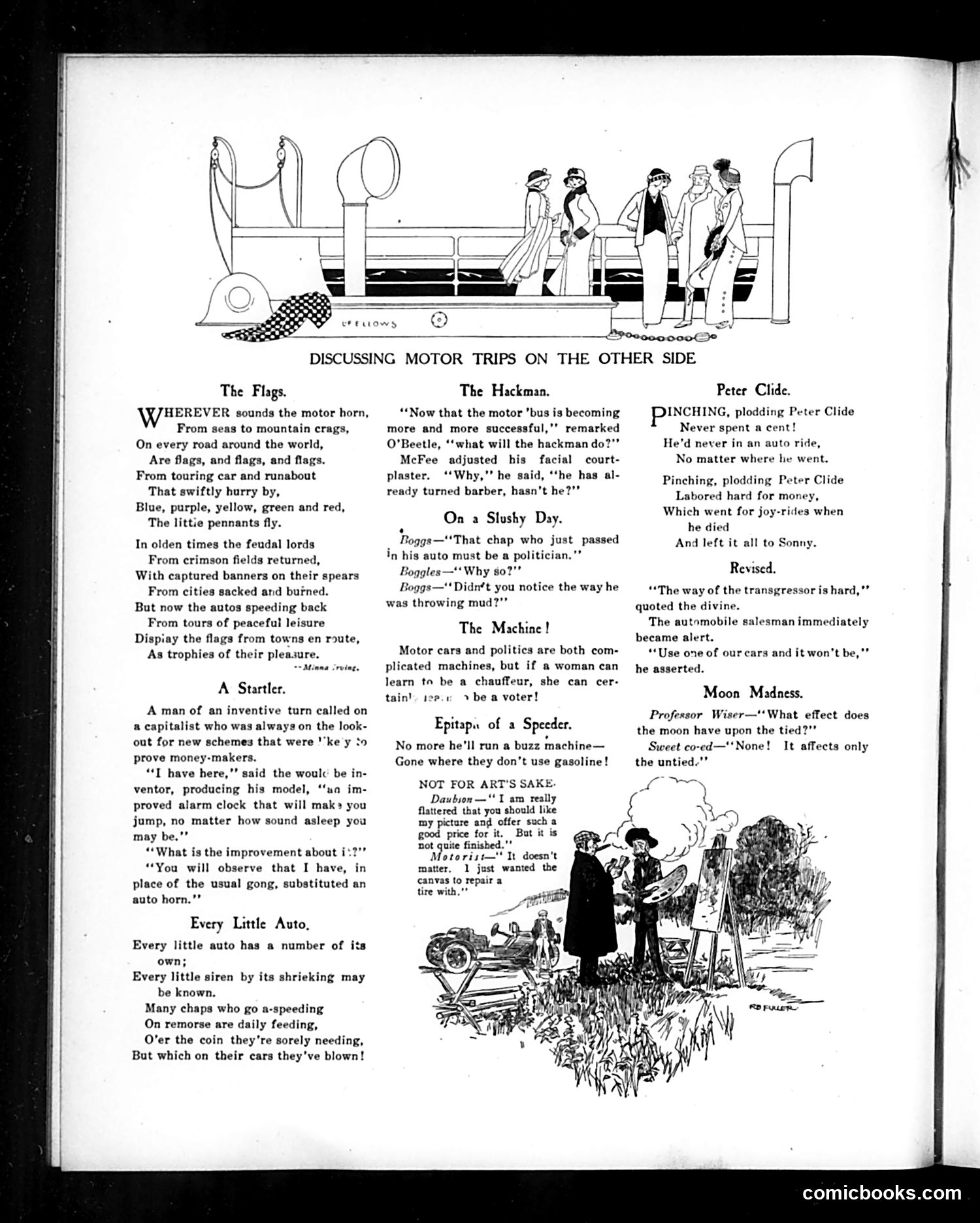
This Judge magazine page satirizes early automobile culture (likely 1900s-1910s) through poems and brief comedic sketches. **The Flags**: Mocks wealthy motorists who collect souvenir pennants from towns they visit during leisure trips, comparing this peacetime trophy-collecting unfavorably to feudal lords returning with conquered banners from actual warfare. **A Startler & Every Little Auto**: Ridicule the automobile horn as an unbearably loud nuisance and criticize speeding drivers who waste money on cars they can't afford. **The Hackman/Machine**: Dark humor about automobile disrupting traditional jobs (horse-drawn taxis), and a comment suggesting women capable of driving cars should logically be allowed to vote. **Other pieces**: Include tired jokes about politicians "throwing mud," the automobile salesman's opportunism, and a sketch of motorists repairing cars with canvas (unclear context). Overall, the page reflects mixed public anxiety and humor about automobiles as luxury goods disrupting society and traditional livelihoods.
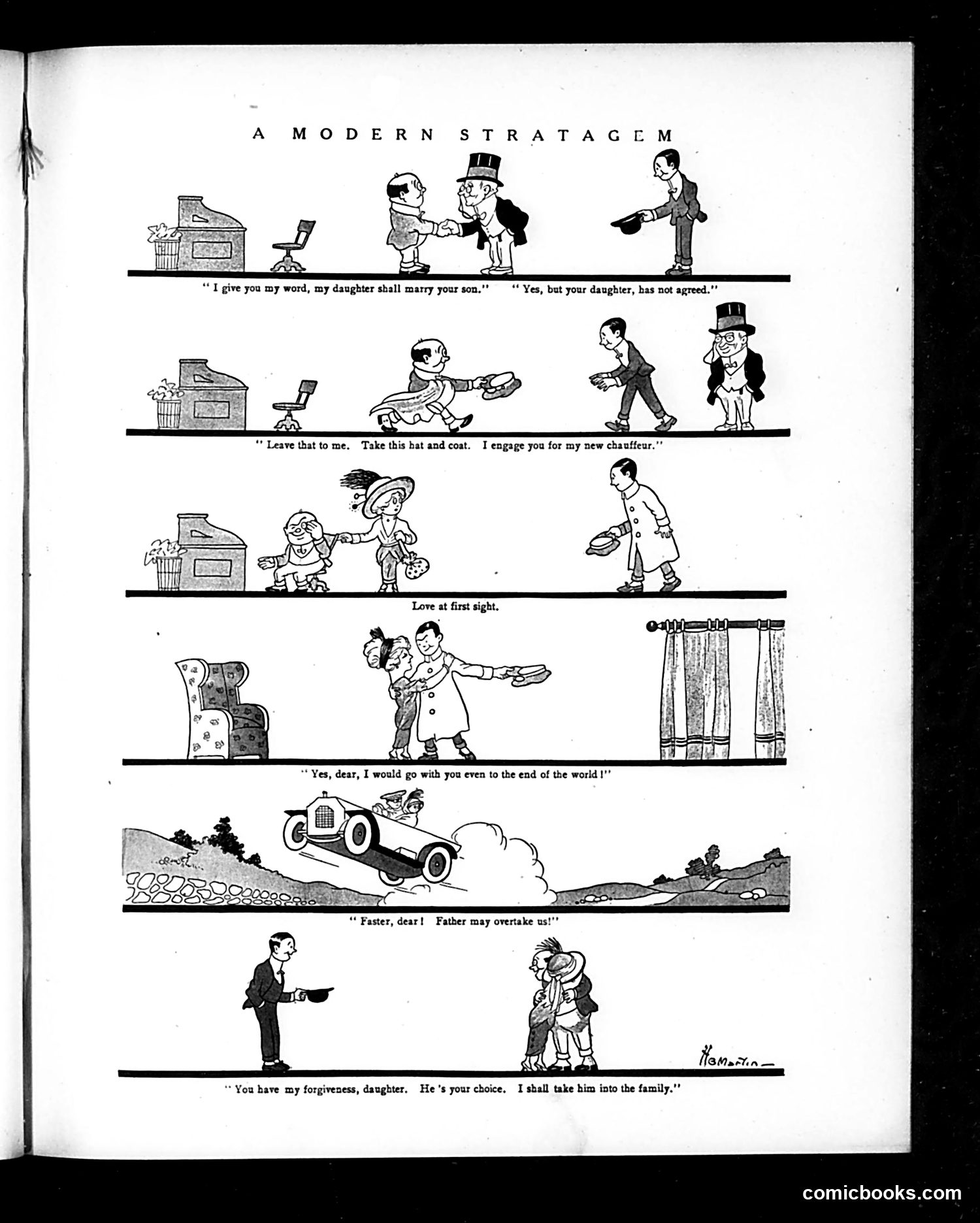
This comic satirizes early 20th-century courtship conventions and class mobility. A wealthy father arranges his son's marriage to a poor girl, but she refuses. The suitor then poses as a chauffeur (a prestigious, new occupation) to win her affection through proximity and perceived status. After romance blossoms—including a dramatic car ride where she declares eternal devotion—the father ultimately accepts the match, having been manipulated by the same class-consciousness he initially valued. The satire critiques: arranged marriages losing power to romantic choice; the nouveaux-riche status of automobile owners and their servants; and parental hypocrisy about social climbing. The "modern stratagem" uses contemporary technology and social ambition to overturn traditional marriage negotiations.
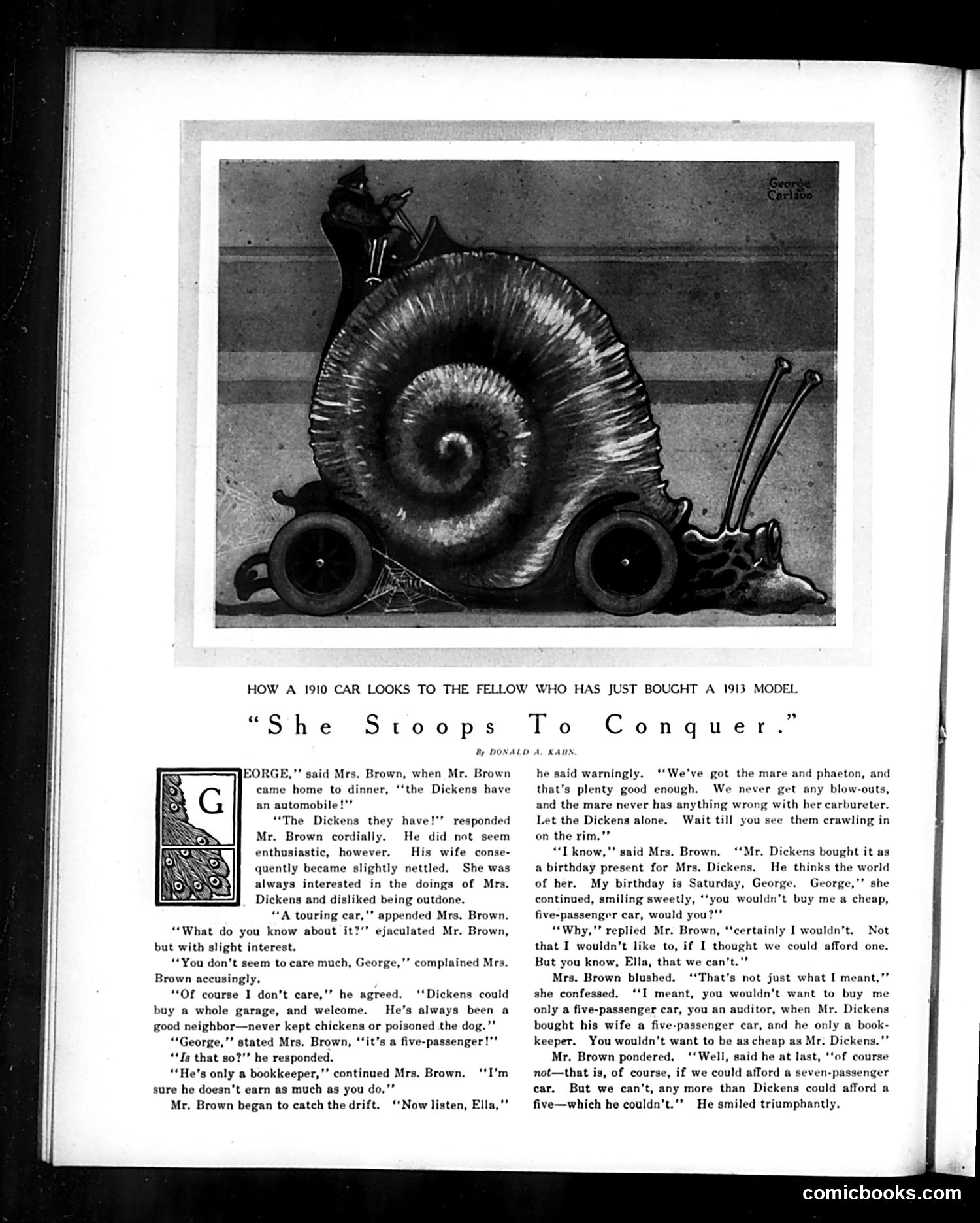
This Judge magazine piece satirizes **consumer envy and marital pressure** in the early automobile era. The cartoon depicts a grotesque snail—representing an outdated 1910 car—as how newer-car owners view older models, emphasizing rapid technological obsolescence. The accompanying story mocks middle-class status anxiety: Mrs. Brown pressures her husband George to buy a newer five-passenger automobile because their neighbor Mr. Dickens (a mere bookkeeper) has one. Though the Browns are wealthier—George is an auditor—Mrs. Brown feels socially undermined. George resists, pointing out their horse and carriage suffice, but ultimately capitulates to avoid appearing "cheap." The satire targets **conspicuous consumption** and **keeping-up-with-the-Joneses** mentality among the rising middle class. The joke is that Mr. Brown wins the argument by suggesting they'd need a *seven*-passenger car to truly outdo Dickens—an absurdly expensive escalation that exposes the futility of competitive spending.
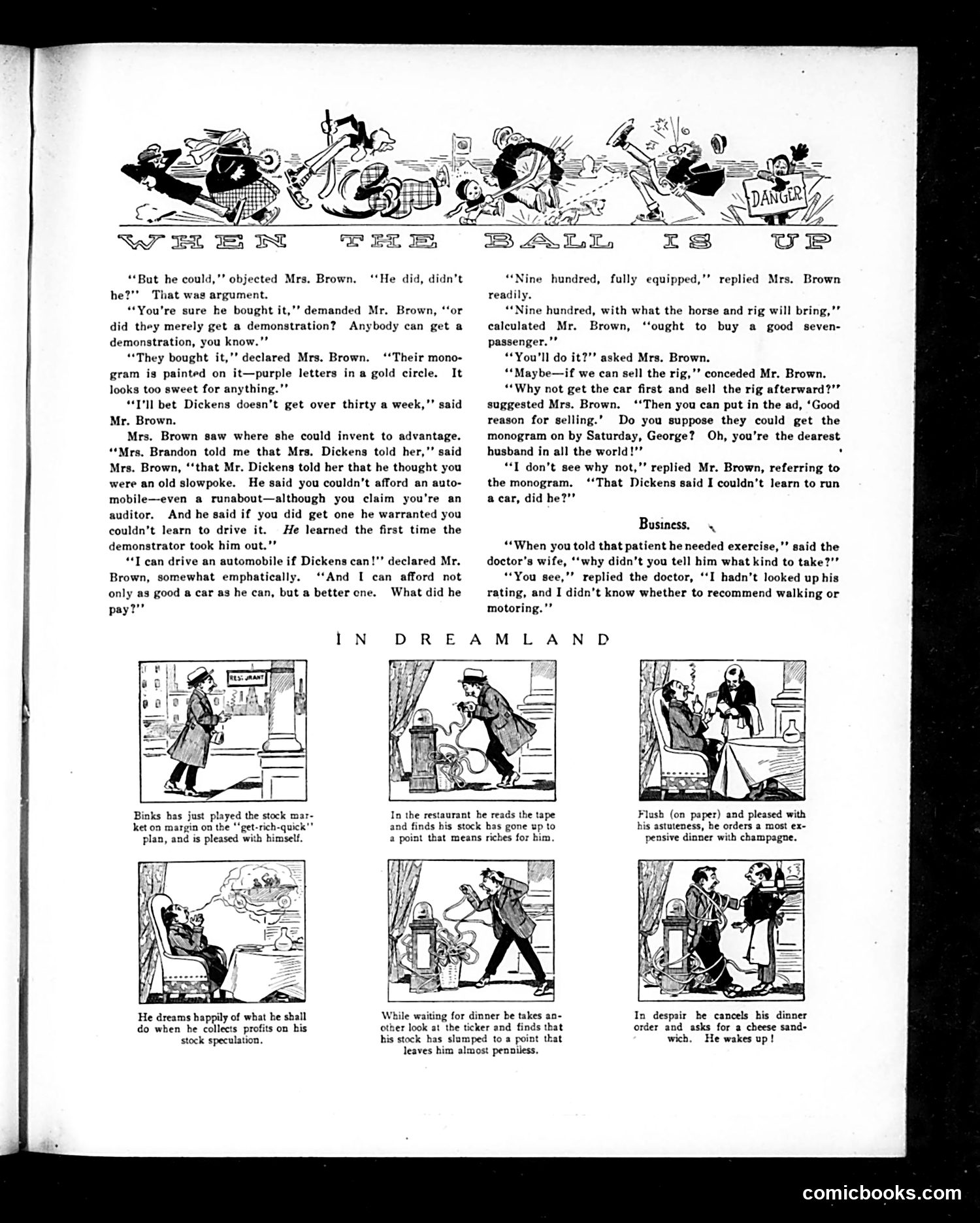
This page contains two satirical pieces from *Judge* magazine reflecting early 1900s anxieties: **"When the Ball Is Up"** mocks status-seeking through automobiles. The Browns compete with the Dickenses over who can afford a new car first. Mrs. Brown uses gossip (fabricated through layers of hearsay) to shame her husband into buying one, claiming Dickens called him a "slowpoke" who couldn't learn to drive. Mr. Brown capitulates, planning to sell their horse and carriage to fund the purchase—all driven by competitive vanity rather than practical need. The satire targets both conspicuous consumption and how easily people are manipulated by social pressure. **"In Dreamland"** depicts stock-market speculation's volatility. Binks plays the market "on margin" (buying with borrowed money), then celebrates his paper profits with an expensive dinner. A stock ticker check reveals his gains have evaporated. He wakes up—the dream underscoring how quickly market fortunes reverse and how foolish such speculation is. Both pieces satirize period obsessions with wealth display and financial risk-taking.
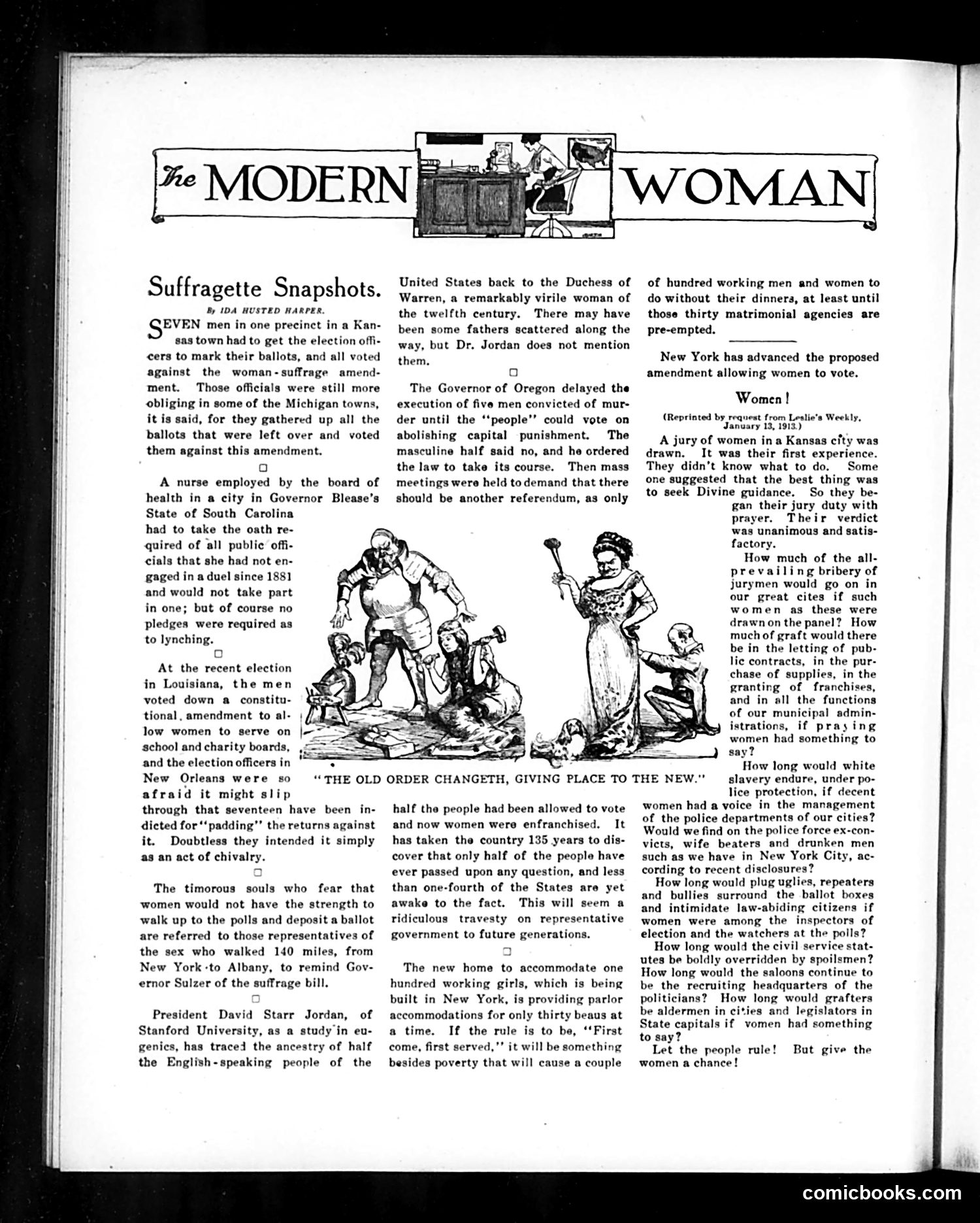
This is anti-suffrage satire disguised as pro-suffrage advocacy. Written by Ida Husted Harper (a real suffragist), the article documents electoral fraud and corruption opposing women's voting rights while mocking opponents' arguments. The central cartoon shows "The Old Order" (a crowned male figure) yielding to "The New" (a woman with children), illustrating the suffrage debate. The "snapshots" detail real incidents: Kansas officials marking ballots *against* suffrage, Louisiana officials indicting themselves to prevent women from voting, and Oregon's governor denying women a voice on capital punishment—all presented as absurd examples of male resistance to women's political participation. The final section sardonically suggests women jurors would eliminate corruption through moral superiority and prayer—a rhetorical strategy turning anti-suffragists' own arguments (women's "purity") into reasons *for* enfranchisement. The page advocates women's suffrage by exposing the desperation and dishonesty of those fighting it.
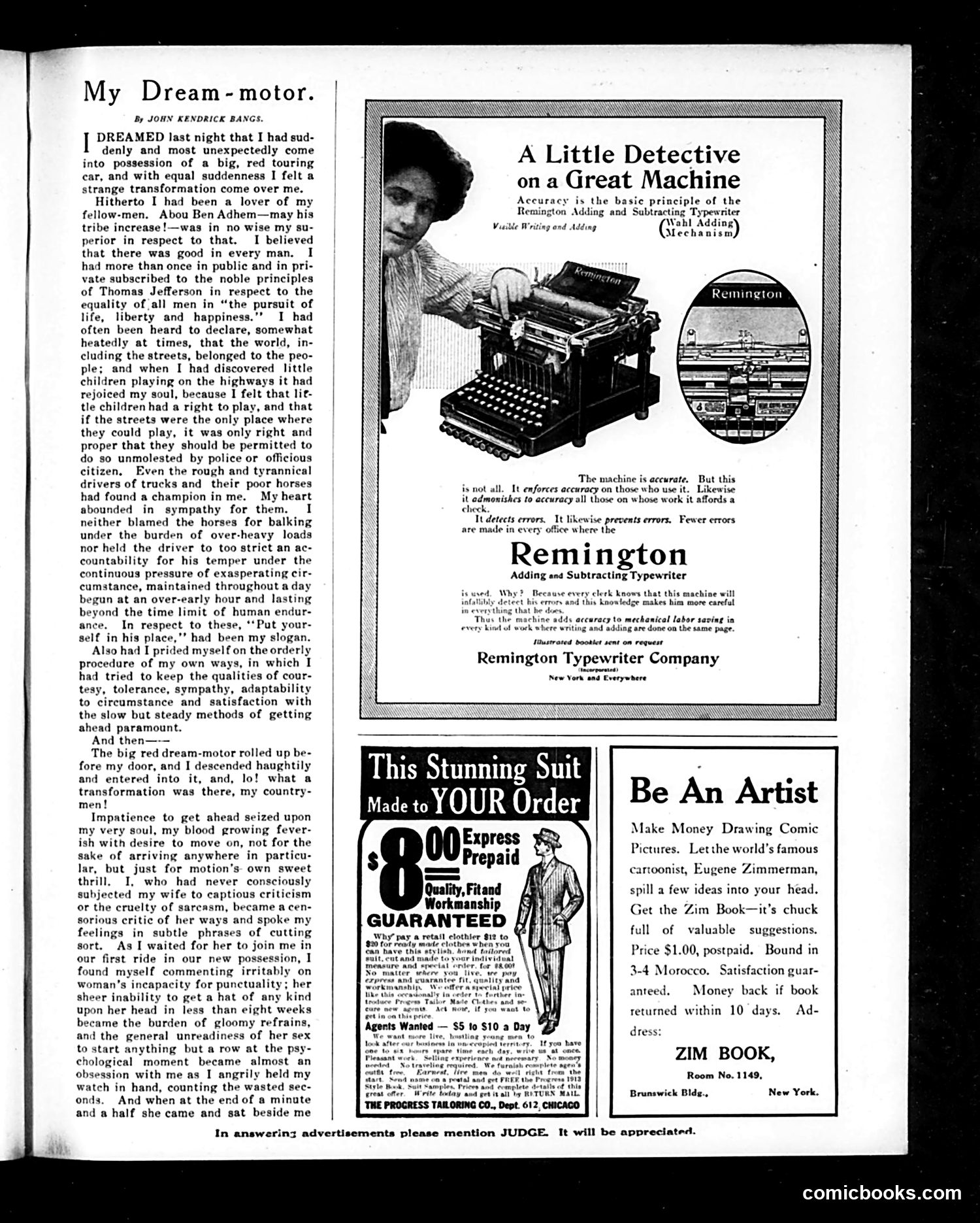
This is a satirical essay about how acquiring an automobile transforms the narrator's character. Originally a sympathetic, egalitarian man who championed the poor and downtrodden—referencing Thomas Jefferson and the children's right to play in streets—he becomes, upon purchasing a "big red touring car," irritable, impatient, and contemptuous. The satire mocks how motorcar ownership corrupts moral virtue: he grows hostile toward his wife's punctuality, dismissive of women generally, and consumed by obsession with speed and motion. The joke targets the era's newly wealthy automobile owners who abandoned their professed democratic ideals the moment they possessed this status symbol, revealing their hypocrisy. The accompanying advertisements (for a Remington typewriter and custom-tailored suits) are unrelated commercial content typical of *Judge* magazine's revenue model.
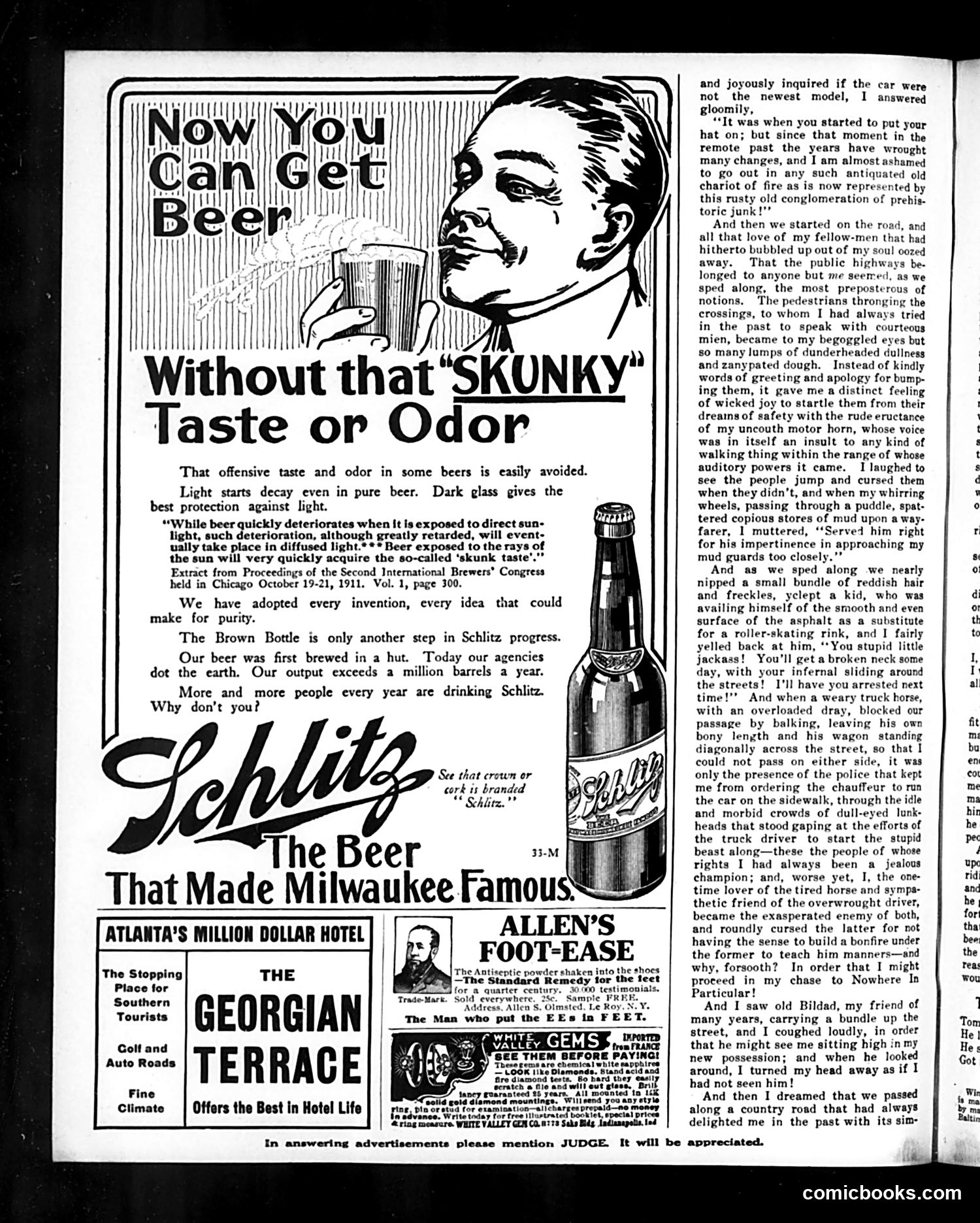
This is primarily an **advertising page** rather than political satire. The main content is a Schlitz beer advertisement addressing a genuine brewing problem from the early 1900s. **The Schlitz Ad:** The headline "Without that 'SKUNKY' Taste or Odor" references the actual chemical degradation beer undergoes when exposed to sunlight—a real problem brewers faced. Schlitz promoted their brown bottle as superior protection, citing an 1911 International Brewers' Congress as authority. The ad emphasizes purity and technological progress ("adopted every invention"). **Supporting Ads:** - Atlanta's Georgian Terrace Hotel - Allen's Foot-Ease (antiseptic powder) - Allen Gem Company (jewelry) **Right-side story** (unrelated to the ads): A lengthy first-person narrative about a motorist's personality change while driving—becoming aggressive and rude to pedestrians, children, and animals. This appears to be satirical commentary on how automobiles corrupted civility and social behavior, a common concern of the era. The page mixes commerce with social observation typical of Judge's format.
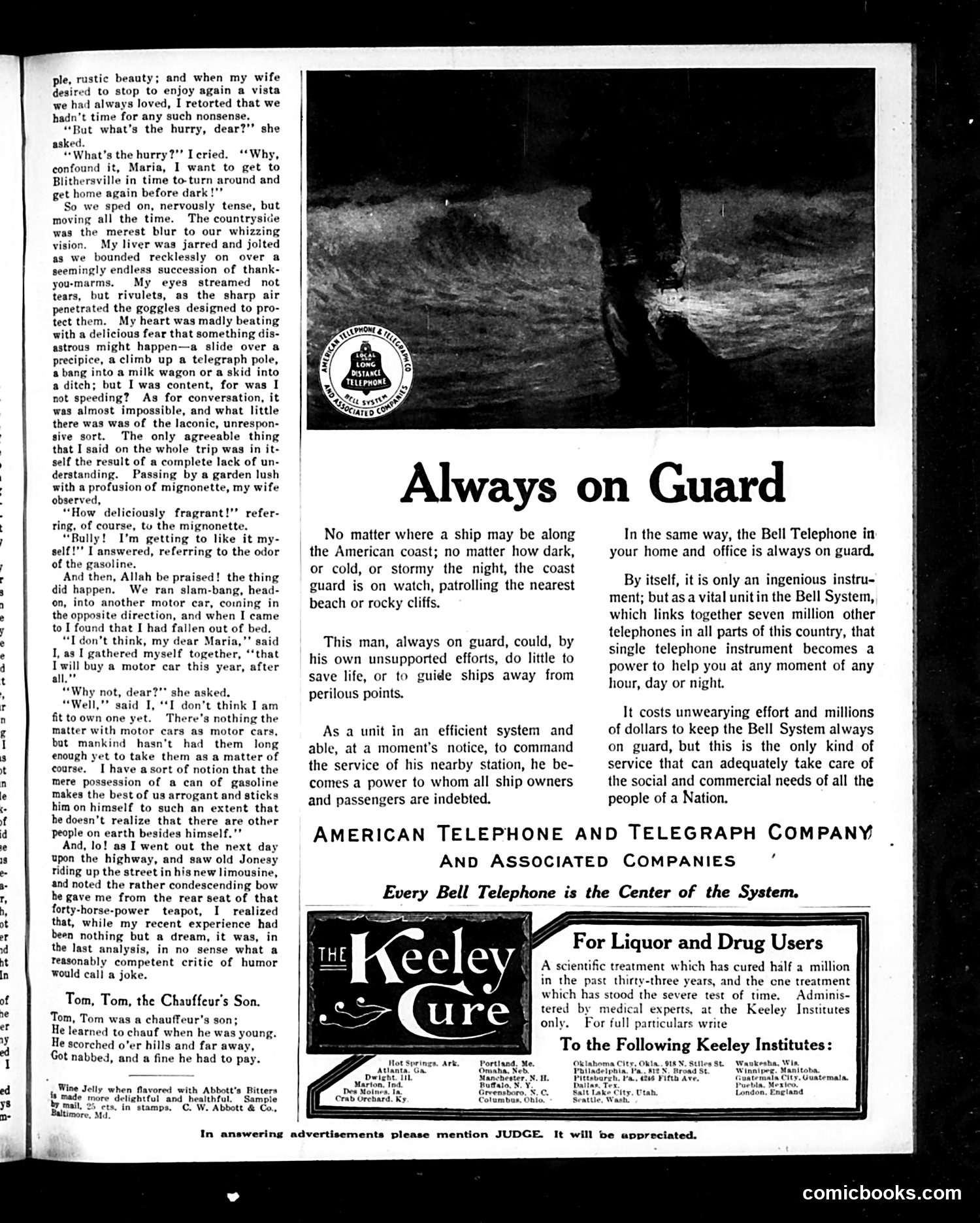
This page contains two distinct pieces of content: **Main Story ("Tom, Tom, the Chauffeur's Son")**: A satirical narrative mocking the reckless, speed-obsessed early automobile driver. The unnamed narrator obsesses over reaching his destination quickly, ignoring scenery and his wife's pleas, racing dangerously until he crashes—then wakes up, realizing it was a dream. The satire targets the arrogance automobile ownership inspired in the early 1900s, when possession of a "can of gasoline" made drivers feel superior to non-motorists. The ending criticizes wealthy car owners like "old Jonesy" for their condescending behavior toward pedestrians. **Advertisement Section**: The right page features a Bell Telephone company ad comparing the coast guard's effectiveness within a system to the telephone's value within the Bell network. Below is a Keeley Cure advertisement for alcohol and drug treatment. The humor targets nouveau-riche automobile owners and broader anxieties about technology's social disruptions.
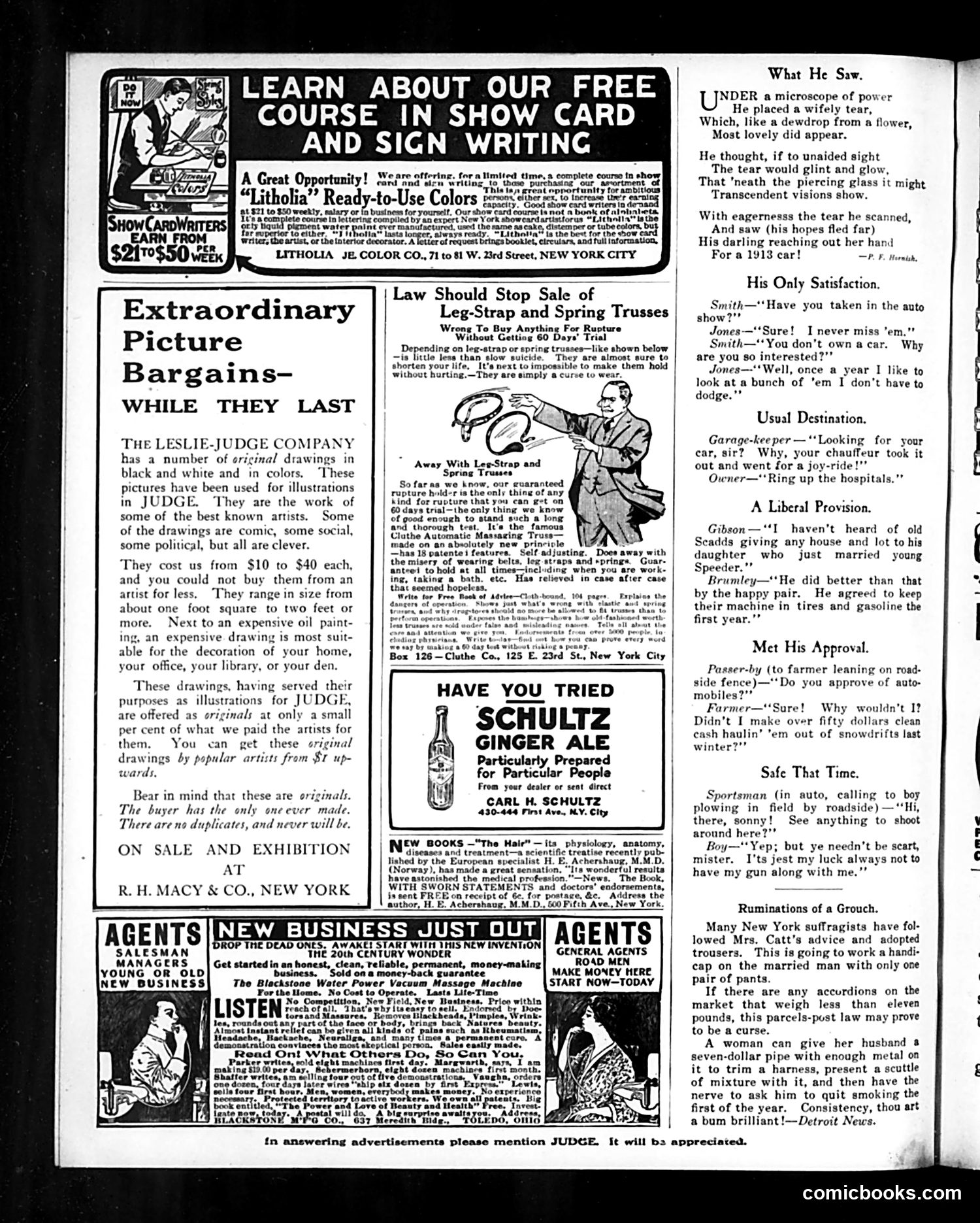
This is primarily an **advertising page** from Judge magazine, with minimal editorial cartoon content. The page showcases various commercial advertisements from the early 20th century. Key advertisements include: 1. **Show Card and Sign Writing Course** (top) - promoting vocational training and "Litholia" paints for artistic lettering work 2. **Leslie-Judge Company's Art Sales** - selling original drawings previously published in Judge, ranging from $1 upward, emphasizing they are authentic one-of-a-kind pieces 3. **Medical device advertisements** - notably a "rupture hold-er" (truss) positioned against traditional leg-strap designs, claiming superiority and offering a 60-day trial 4. **Schultz Ginger Ale** - a simple beverage ad 5. **"New Business" opportunity ads** - promoting the "Blackstone Water Power Vacuum Massage Machine" and other entrepreneurial schemes promising easy money-making The page reflects early 1900s consumer culture, targeting both commercial artists and working-class readers seeking business opportunities or medical solutions. Most ads emphasize guarantees and risk-free trials—marketing strategies aimed at building consumer confidence.
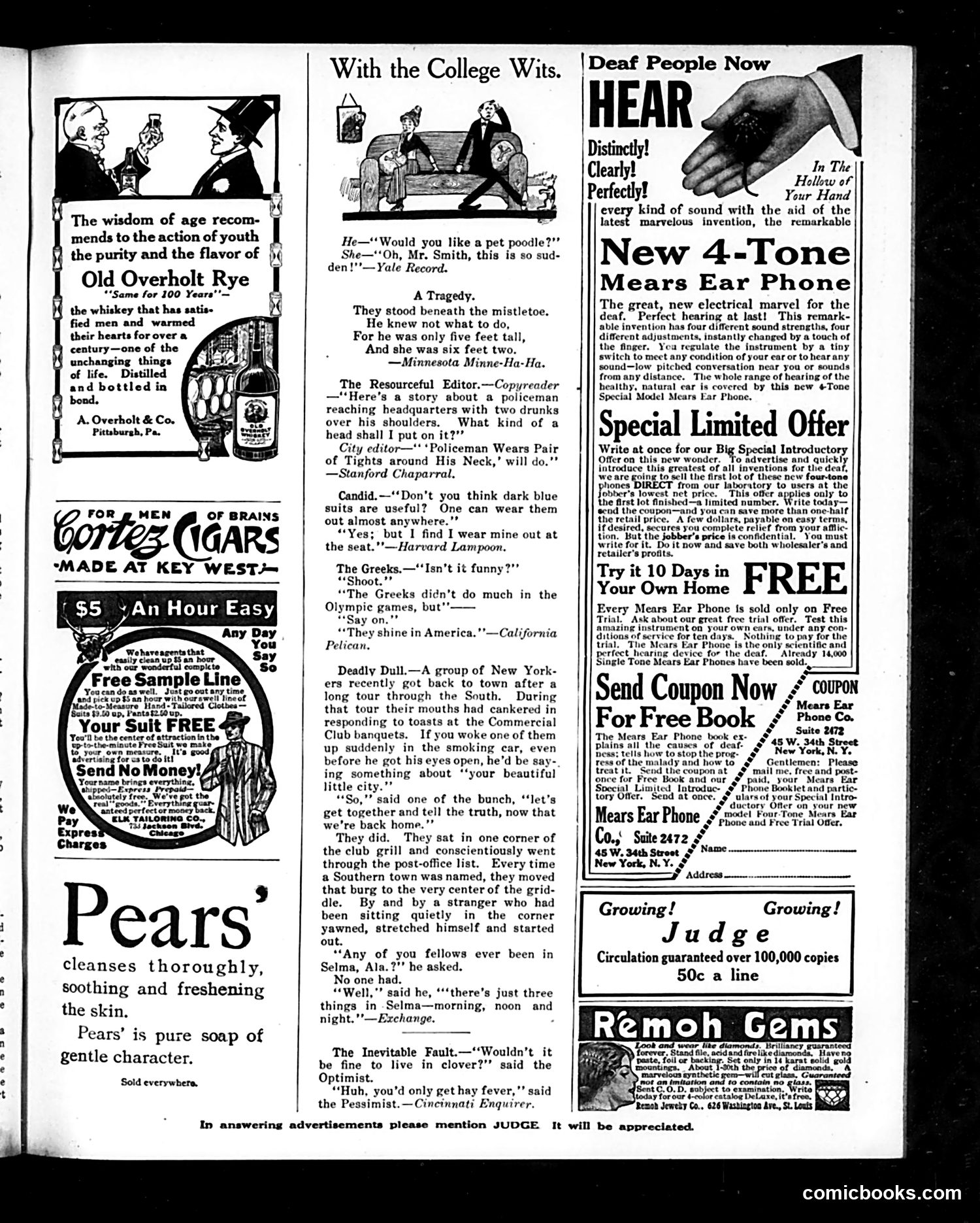
This page from *Judge* magazine is primarily **advertising**, with humor pieces supporting product promotions. The main cartoon "With the College Wits" satirizes young college students' behavior—depicting them discussing whether to buy a poodle or other frivolous matters. The joke contrasts their shallow concerns with "the wisdom of age," used to advertise Old Overholt Rye whiskey. Below are humorous anecdotes mocking various professions and situations: a resourceful newspaper editor, incompetent policemen, and pretentious travelers boasting about the South. These jokes were typical *Judge* fare—light social satire attacking pomposity and foolishness. The dominant content is advertising for the **Mears Ear Phone**, a hearing aid device marketed to deaf people. The ads emphasize this as a new electrical invention with adjustable "4-Tone" settings—revolutionary for 1920s hearing technology. The promotional copy offers free trials and special introductory prices to generate immediate sales interest.
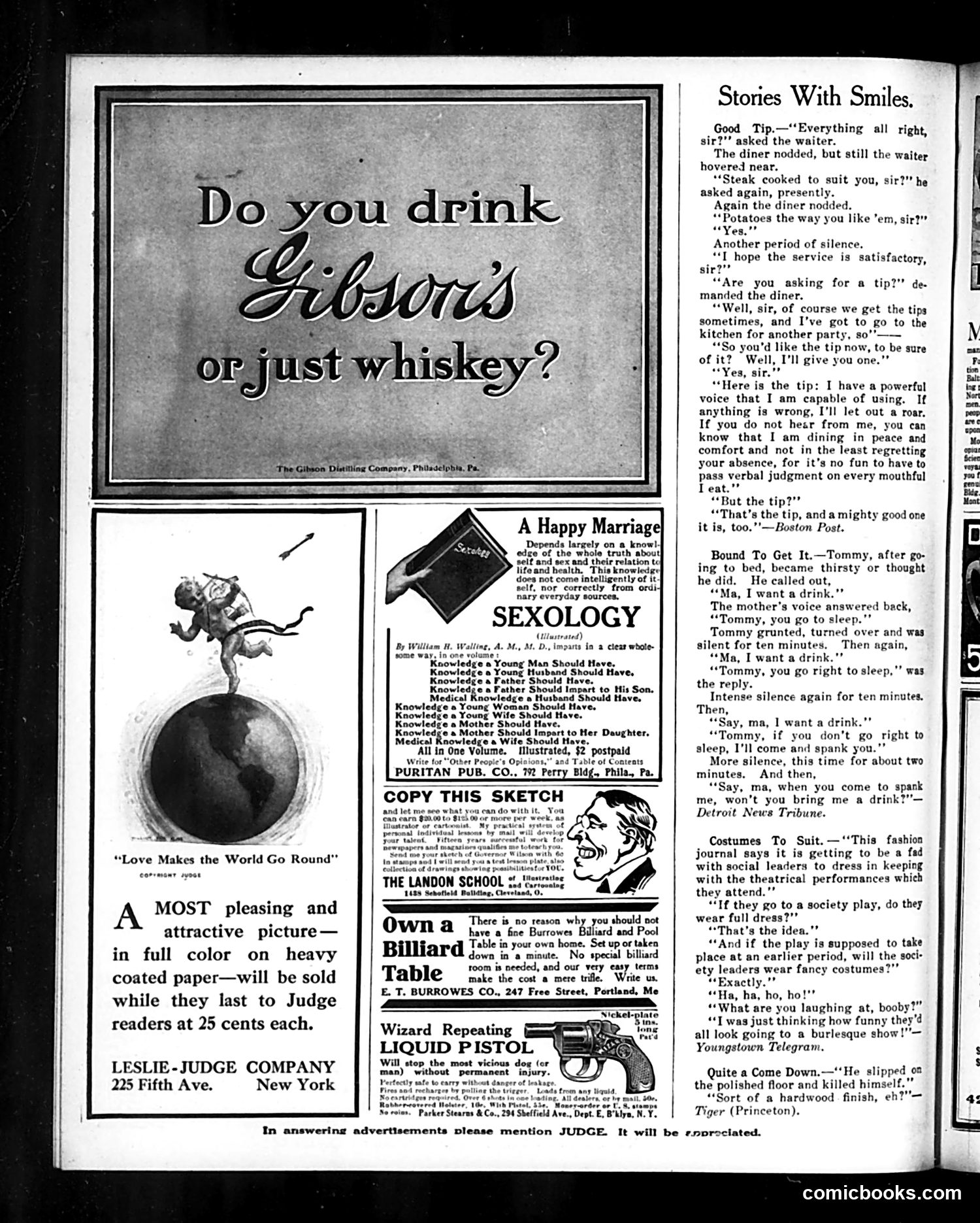
This page is primarily **advertisements and humor columns** rather than political cartoons. The visible content includes: **Advertisements:** Gibson whiskey, a Sexology book (educational/medical), Leslie-Judge Company art prints, billiard tables, and a "Liquid Pistol" self-defense weapon. **"Stories With Smiles" humor section:** Three brief comedic anecdotes reflecting early 20th-century attitudes: - A diner deflects a waiter's tip-fishing with wit about maintaining peace - A child persistently requests water before bed, ultimately getting spanked - Society women humorously wearing theatrical costumes to matching plays, with the punchline that they'd look funniest attending burlesque shows **Social context:** The jokes reflect class dynamics (waiter-diner interaction), parental discipline norms of the era, and satirize upper-class pretension regarding fashion. The page contains no identifiable political figures or major satirical commentary—it's entertainment-focused content typical of Judge's lighter offerings.
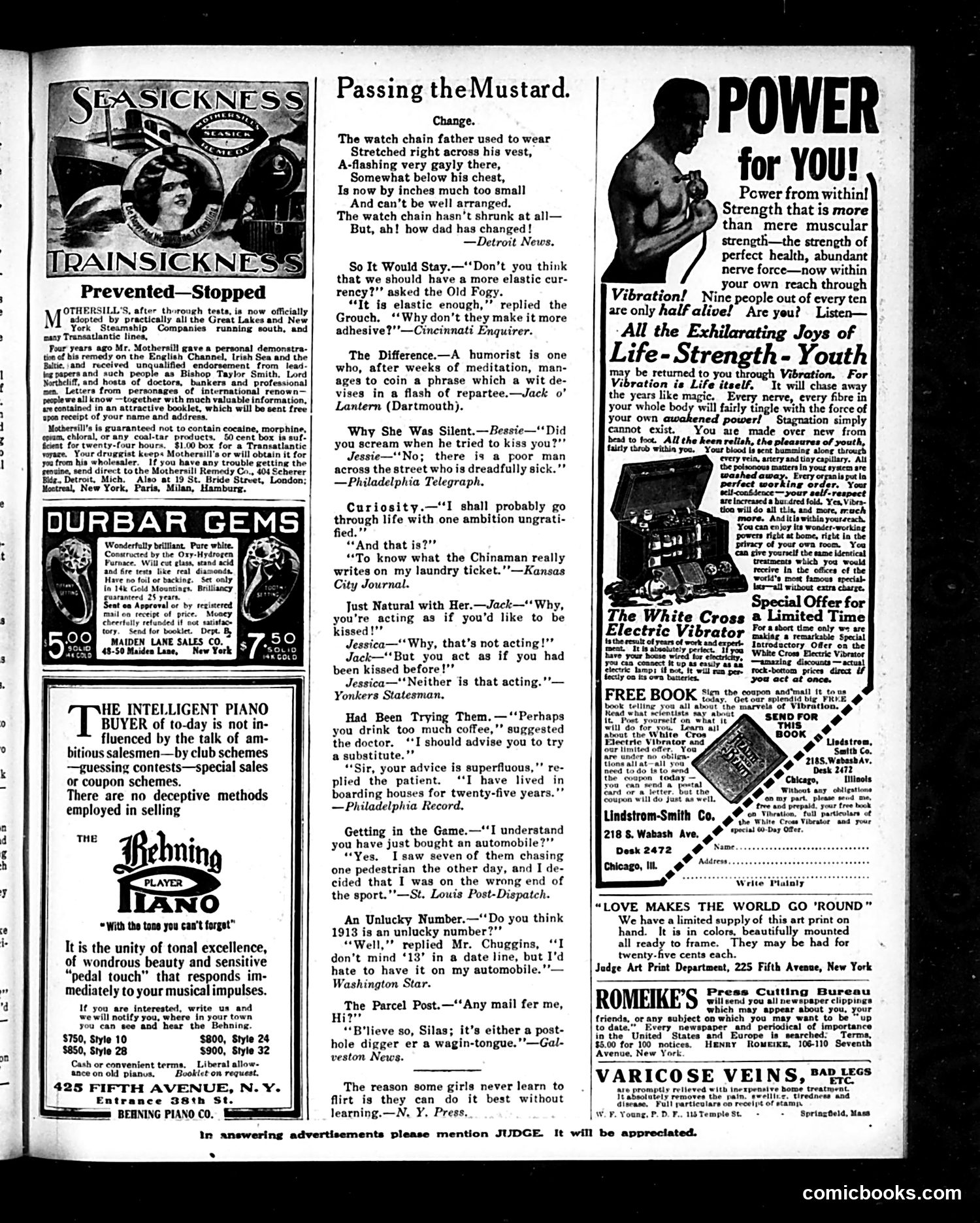
This page from the satirical magazine *Judge* is primarily **advertising and humor columns**, not political cartoons. The notable content includes: **"Passing the Mustard"** section: A collection of brief humorous anecdotes poking fun at everyday situations—a father's expanding waistline making his watch chain too small, debates over currency elasticity versus adhesiveness, and flirtatious banter between young couples. These are gentle social satire typical of early 20th-century magazines, mocking vanity, pretension, and romantic awkwardness. **Advertisements dominate**: Mothersill's seasickness remedy, Durbar Gems jewelry, Behning pianos, and medical treatments for varicose veins. These reflect period consumer culture. The humor is lighthearted and non-partisan—no identifiable political figures or movements are targeted. The satire operates at the level of universal human foibles rather than topical commentary. This appears to be a general-interest issue focused on entertainment and commerce rather than political critique.
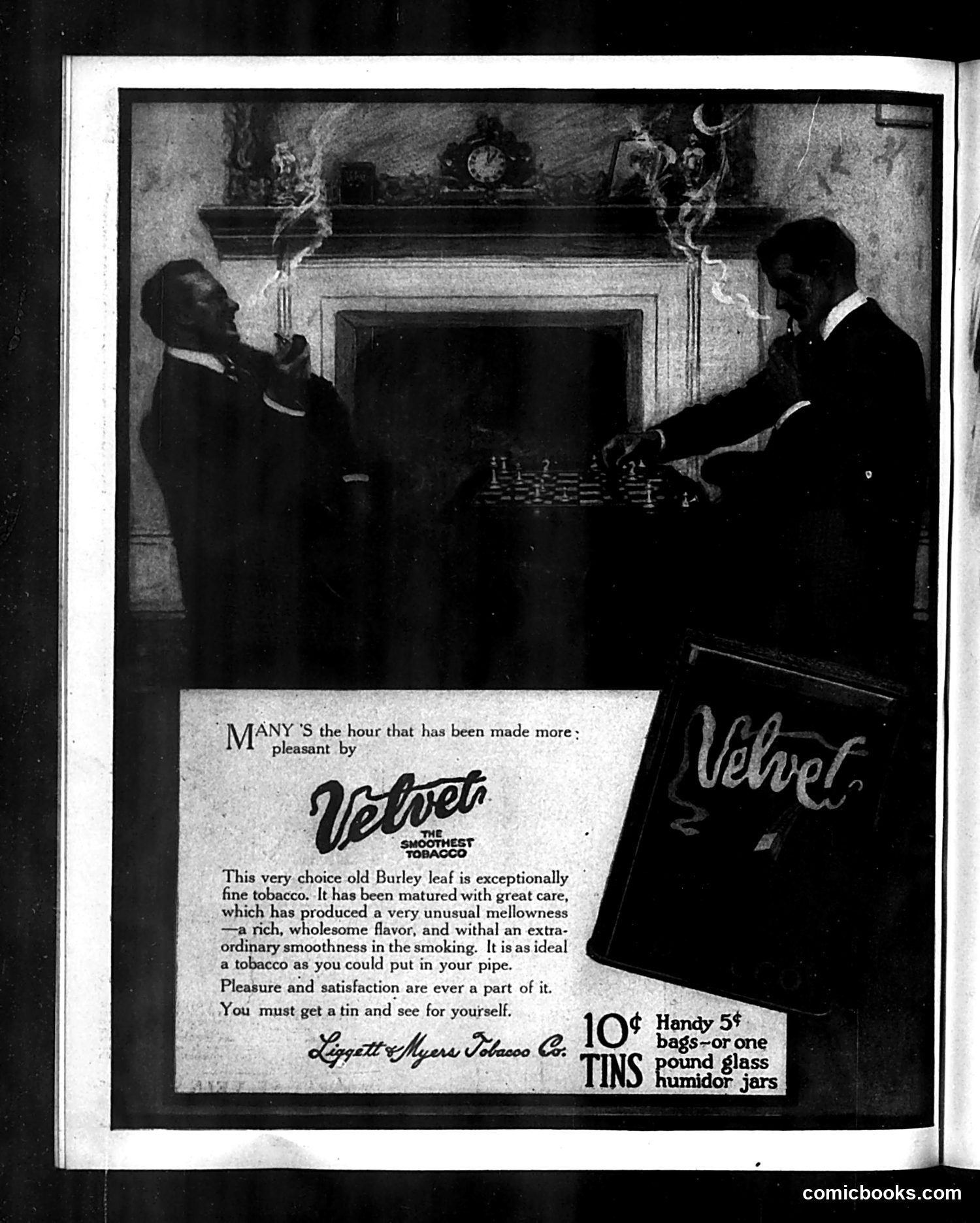
This page is **primarily an advertisement**, not political satire. It advertises Velvet tobacco, "the smoothest tobacco," by the Liggett & Myers Tobacco Co. The image shows two men in formal attire playing chess by a fireplace—a scene suggesting leisure, refinement, and intellectual companionship. This visual framing associates smoking Velvet with genteel relaxation and cultured pursuits. The advertisement emphasizes the product's qualities: aged Burley leaf, mellowness, and smoothness. It uses the tagline "Many's the hour that has been made more pleasant by Velvet," suggesting the tobacco enhances social moments. Pricing information indicates 10¢ tins, 5¢ handy bags, or one-pound glass humidor jars were available. For modern readers, this represents mid-20th-century tobacco marketing before health warnings—using aspirational imagery of educated, leisure-class men to sell smoking as a pleasure-enhancing habit.