
Judge, 1913-02-01 · page 10 of 24
Judge — February 1, 1913 — page 10: what you’re looking at
What you’re looking at
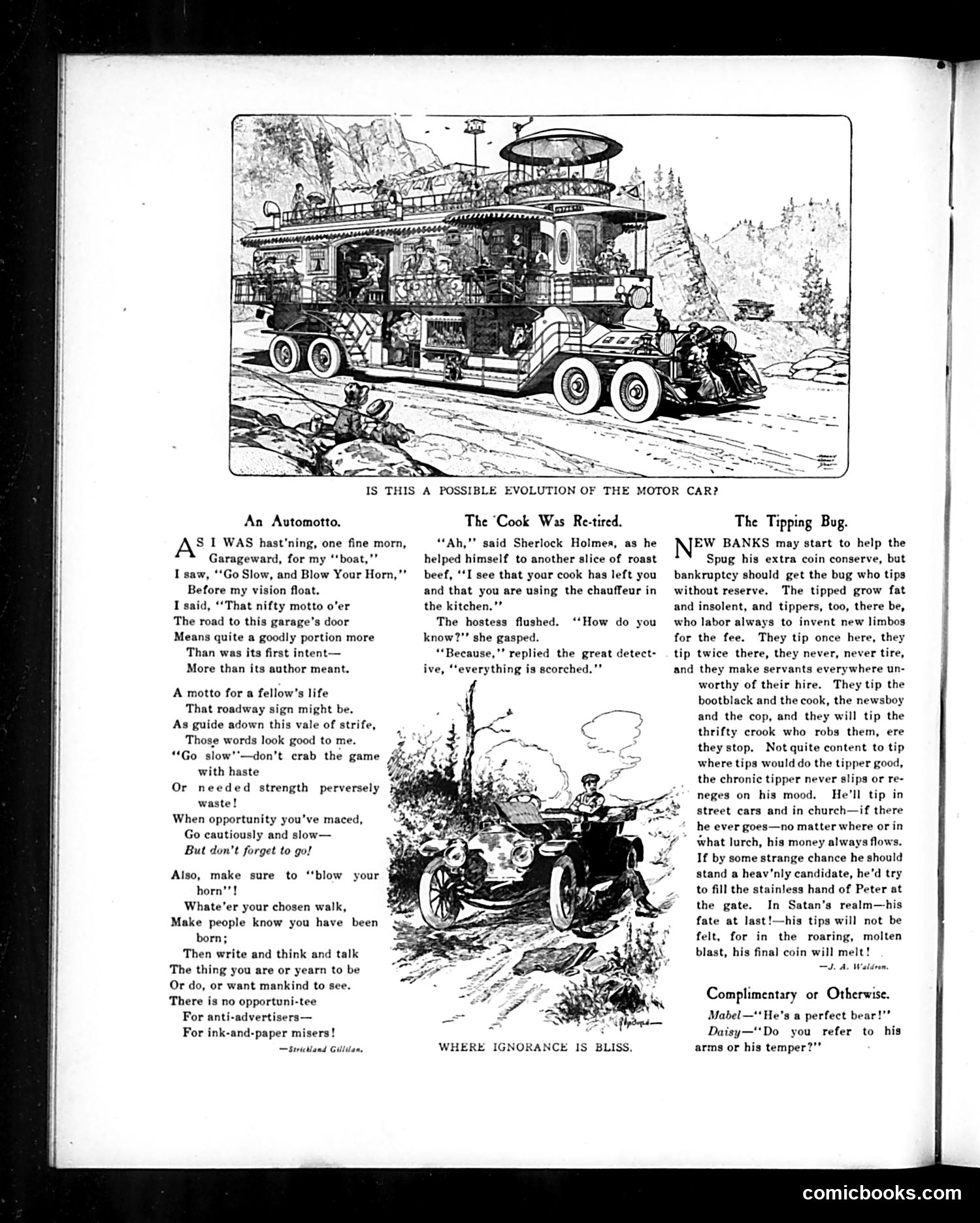
This page contains three satirical pieces reflecting early 1900s automotive culture and social commentary: **"An Automotto"** plays on the new motor car's cultural prominence. A driver sees a street sign ("Go Slow, and Blow Your Horn") and extrapolates it as life advice—urging ambition ("blow your horn"/self-promotion) balanced with caution. The satire mocks both reckless drivers and those too timid to succeed. **"The Cook Was Re-tired"** presents a Sherlock Holmes parody. Holmes deduces a cook quit by observing burnt food, blaming the chauffeur-turned-cook. The joke reflects class anxieties: automobiles required chauffeurs, a new servant class that disrupted traditional household hierarchies. **"The Tipping Bug"** satirizes excessive tipping culture—a growing problem as service industries expanded. The piece attacks chronic tippers as enabling servant corruption and financial ruin, even imagining a tipper attempting to bribe Saint Peter at heaven's gates. The top illustration shows a fantastical "motor car evolution"—a multi-story vehicle with observation decks, reflecting contemporary speculation about automobiles' future.
📄 Transcribed text from this page (OCR, searchable)
Machine-transcribed from the original scan — historical spelling and the odd misread are preserved.
IS THIS A POSSIBLE EVOLUTION OF THE MOTOR CAR? An Avtomotto. As I WAS hast'ning, one fine morn, Garageward, for my ‘‘boat,’’ I saw, ‘‘Go Slow, and Blow Your Horn,” Before my vision float. I said, ‘‘That nifty motto o’er The road to this garage’s door Means quite a goodly portion more Than was its first intent— More than its author meant. A motto for a fellow's life That roadway sign might be. As guide adown this vale of strife, Those words look good to me. with haste Or needed strength perversely waste! When opportunity you've maced, Go cautiously and slow— But don’t forget to go! Also, make sure to ‘‘blow your horn’’! Whate’er your chosen walk, Make people know you have been born; Then write and think and talk The thing you are or yearn to be Or do, or want mankind to see. There is no opportuni-tee For anti-advertisers— For ink-and-paper misers! —Strichiand Gillilan. The ‘Cook Was Re-tired. “Ah,"’ said Sherlock Holmes, as he helped himself to another slice of roast beef, ‘‘I see that your cook has left you and that you are using the chauffeur in the kitchen.’” The hostess flushed. ‘‘How do you know?" she gasped. “Because,” replied the great detect- verything is scorched.’" WHERE IGNORANCE IS BLISS. The Tipping Bug. NEW BANKS may start to help the Spug his extra coin conserve, but bankruptcy should get the bug who tips without reserve. The tipped grow fat and insolent, and tippers, too, there be, who labor always to invent new limbos for the fee. They tip once here, they tip twice there, they never, never tire, and they make servants everywhere un- worthy of their hire. They tip the bootblack and the cook, the newsboy and the cop, and they will tip the thrifty crook who robs them, ere they stop. Not quite content to tip where tips would do the tipper good, the chronic tipper never slips or re- neges on his mood. He'll tip in street cars and in church—if there he ever goes—no matter where or in what lurch, his money always flows. If by some strange chance he should stand a heav’nly candidate, he'd try to fill the stainless hand of Peter at the gate. In Satan’s realm—his fate at last!—his tips will not be felt, for in the roaring, molten blast, his final coin will melt! J. A. Waldron. Complimentary or Otherwise. Mabel Je’s a perfect bear!"’ Daisy—"‘Do you refer to his arms or his temper?” comicbooks.com