
Judge, 1913-02-01 · page 4 of 24
Judge — February 1, 1913 — page 4: what you’re looking at
What you’re looking at
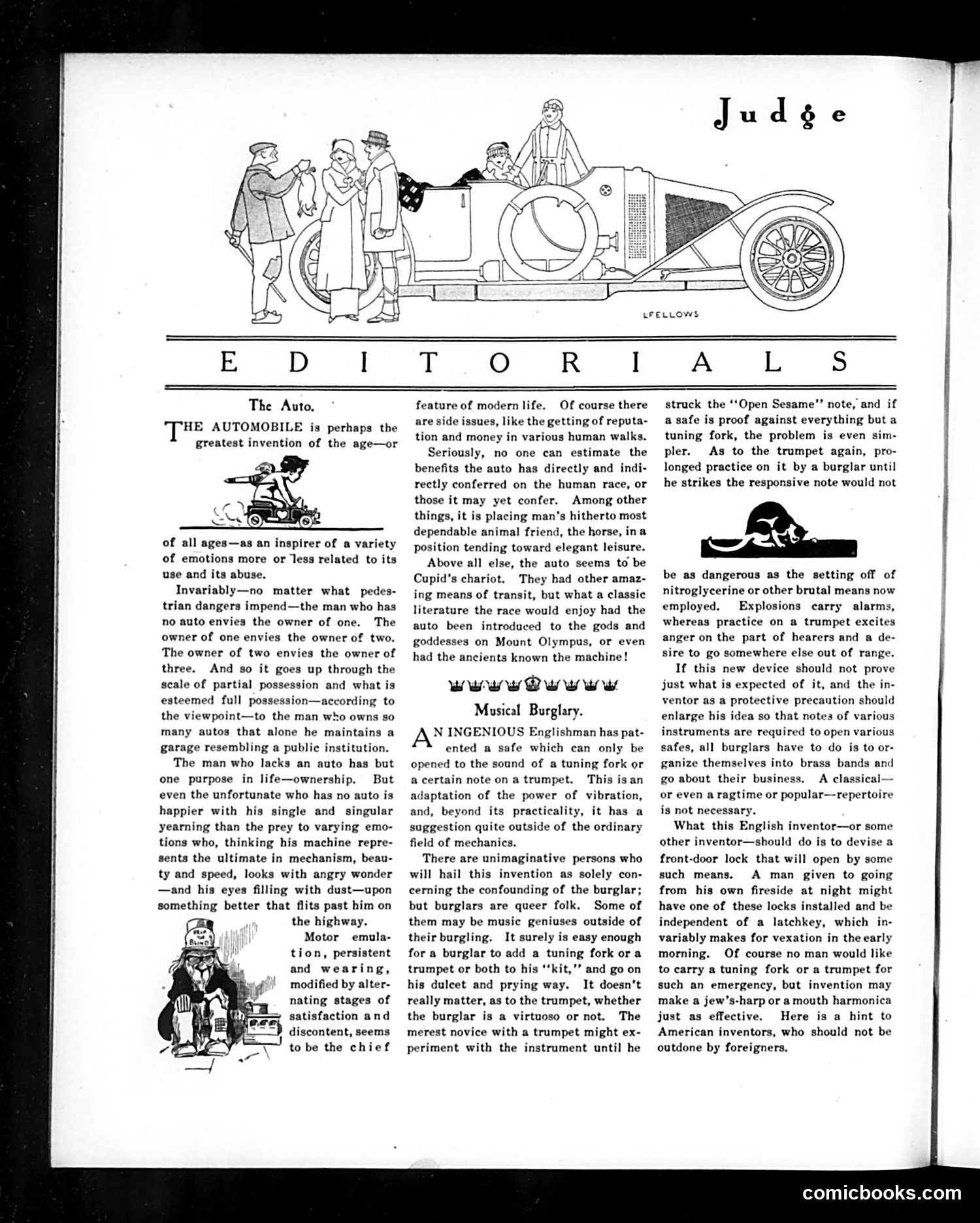
This page contains two satirical articles about modern inventions rather than political cartoons. **"The Auto"** mocks automobile ownership, suggesting that while cars are impressive, they inspire jealousy and anxiety in non-owners. The satire critiques how automobiles have become status symbols, with owners envied for their possession while also inspiring resentment in those without vehicles. **"Musical Burglary"** presents a humorous solution to a real problem: an Englishman has patented a safe that opens only to specific musical notes (tuning fork, trumpet, etc.). The satire mocks both the invention's impracticality and burglars' supposed musical incompetence, joking that burglars are "queer folk" who wouldn't bother learning music to steal. Both articles satirize the age's fascination with mechanical invention and modern life's contradictions.
📄 Transcribed text from this page (OCR, searchable)
Machine-transcribed from the original scan — historical spelling and the odd misread are preserved.
KFELLOWS The Auto, TH AUTOMOBILE is perhaps the greatest invention of the age—or of all ages—as an inspirer of a variety of emotions more or less related to its use and its abuse. Invariably—no matter what pedes- trian dangers impend—the man who has no auto envies the owner of one. The owner of one envies the owner of two. The owner of two envies the owner of three. And so it goes up through the scale of partial possession and what is esteemed full possession—according to the viewpoint—to the man who owns so many autos that alone he maintains a garage resembling a public institution. The man who lacks an auto has but one purpose in life—ownership. But even the unfortunate who has no auto is happier with his single and singular yearning than the prey to varying emo- tions who, thinking his machine repre- sents the ultimate in mechanism, beau- ty and speed, looks with angry wonder —and his eyes filling with dust—upon something better that flits past him on the highway. Motor emula- tion, persistent and wearing, modified by alter- nating stages of satisfaction and discontent, seems to be the chief R feature of modern life. Of course there are side issues, like the getting of reputa- tion and money in various human walks. Seriously, no one can estimate the benefits the auto has directly and indi- rectly conferred on the human race, or those it may yet confer. Among other things, it is placing man's hitherto most dependable animal friend, the horse, ina position tending toward elegant leisure. Above all else, the auto seems to be Cupid’s chariot. They had other amaz- ing means of transit, but what a classic literature the race would enjoy had the auto been introduced to the gods and goddesses on Mount Olympus, or even had the ancients known the machine! www Ow were Musical Burglary. N INGENIOUS Englishman has pat- ented a safe which can only be opened to the sound of a tuning fork or a certain note on a trumpet. This isan adaptation of the power of vibration, and, beyond its practicality, it has a suggestion quite outside of the ordinary field of mechanics. There are unimaginative persons who will hail this invention as solely con- cerning the confounding of the burglar; but burglars are queer folk. Some of them may be music geniuses outside of their burgling. It surely is easy enough for a burglar to add a tuning fork ora trumpet or both to his ‘‘kit,’’ and go on his dulcet and prying way. It doesn’t really matter, as to the trumpet, whether the burglar is a virtuoso or not. The merest novice with a trumpet might ex- periment with the instrument until he A struck the ‘‘Open Sesame”’ note, and if a safe is proof against everything but a tuning fork, the problem is even sim- pler. As to the trumpet again, pro- longed practice on it by a burglar until he strikes the responsive note would not be as dangerous as the setting off of nitroglycerine or other brutal means now employed. Explosions carry alarms, whereas practice on a trumpet excites anger on the part of hearers and a de- sire to go somewhere else out of range. If this new device should not prove just what is expected of it, and the in- ventor as a protective precaution should enlarge his idea so that notes of various instruments are required to open various safes, all burglars have to do is to or- ganize themselves into brass bands and go about their business. A classical— or even a ragtime or popular—repertoire is not necessary. What this English inventor—or some other inventor—should do is to devise a front-door lock that will open by some such means. A man given to going from his own fireside at night might have one of these locks installed and be independent of a latchkey, which in- variably makes for vexation in the early morning. Of course no man would like to carry a tuning fork or a trumpet for such an emergency, but invention may make a jew’s-harp or a mouth harmonica just as effective. Here is a hint to American inventors, who should not be outdone by foreigners. comicbooks.com