
A complete issue · 24 pages · 1913
Judge — January 11, 1913
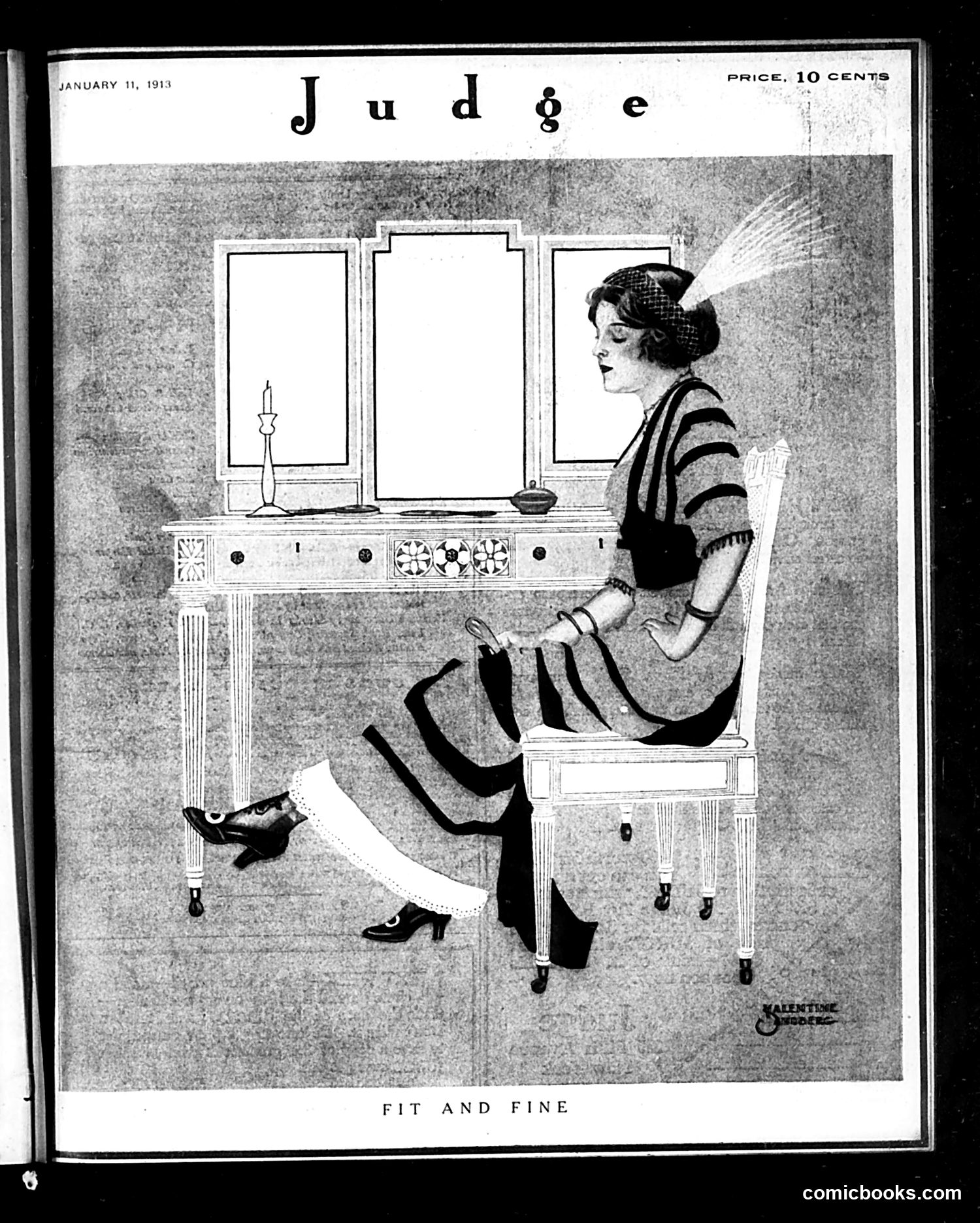
This cover cartoon, titled "Fit and Fine," satirizes women's fashion of the era, specifically the exaggerated silhouettes created by corsetry and hobble skirts. The illustration shows a woman seated at her vanity in an uncomfortably contorted posture, her body dramatically compressed and bent by restrictive clothing. The satire targets the physical toll of fashionable dress—the woman appears almost broken or twisted by her garments. The caption "Fit and Fine" is ironic, suggesting that despite looking fashionable, such clothing is neither comfortable nor healthy. This reflects early 20th-century debates about women's fashion and emerging concerns about health impacts of tight-lacing and restrictive garments, which were becoming increasingly controversial during the Progressive Era.
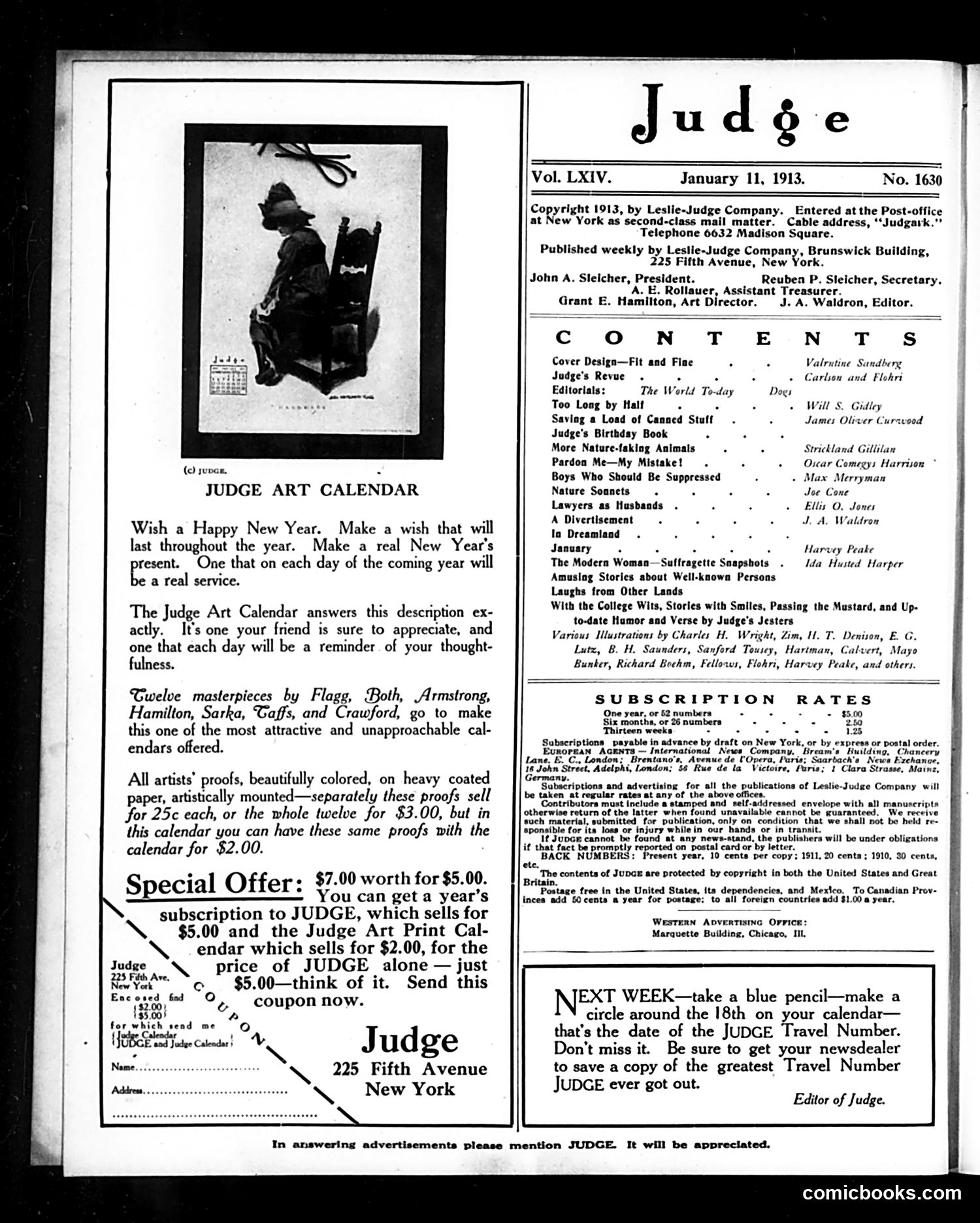
This page is primarily **advertising** for Judge's Art Calendar and subscription offers, rather than political satire. The central image shows a silhouetted figure in a chair—likely meant to be contemplative or leisurely. The calendar promotion emphasizes that it features "twelve masterpieces by Flagg, Roth, Armstrong, Hamilton, Sartee, Giffs, and Craigsfold"—prominent illustrators of the era. The special offer ($7 worth of content for $5) was Judge's standard year-end subscription push. The bottom section includes a notice about next week's "Travel Number," indicating Judge's regular themed issues. There is **no clear political cartoon or satirical commentary** visible on this particular page—it's a marketing-focused issue.
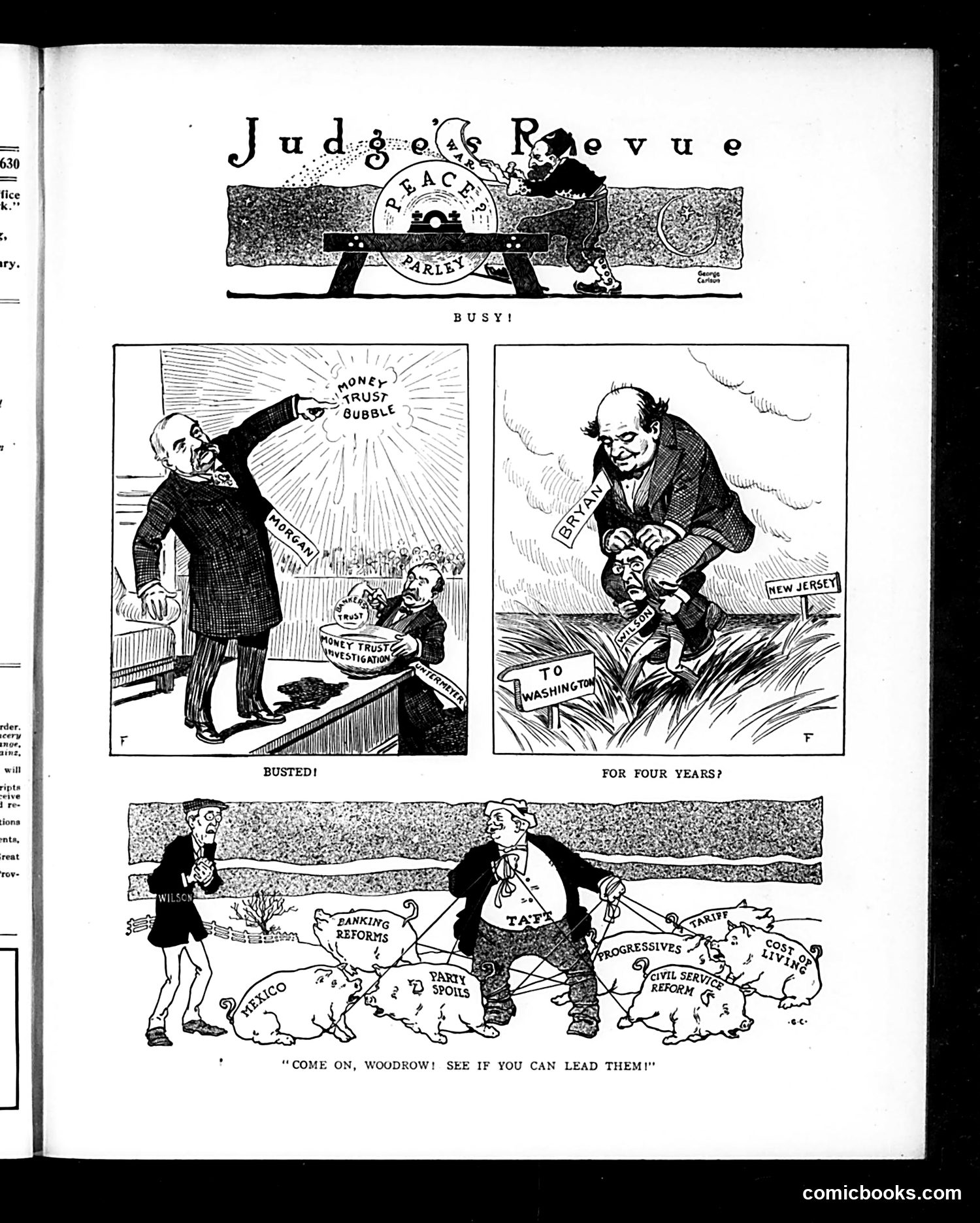
This page satirizes President Woodrow Wilson's domestic agenda during his first term. The top cartoon, "Busted!," shows Wilson's "Money Trust" investigation failing under scrutiny. The second, "For Four Years?," depicts Wilson struggling to control Washington and New Jersey political forces. The bottom panel, "Come On, Woodrow! See If You Can Lead Them!," is the key image: Wilson attempts to corral various reform agendas (banking reform, civil service reform, progressive policies, tariff, cost-of-living concerns) represented as unruly piglets. The satire suggests Wilson cannot effectively manage these competing political demands—that his reformist promises are spinning out of control. The cartoon mocks both his leadership capacity and the chaotic nature of progressive politics.
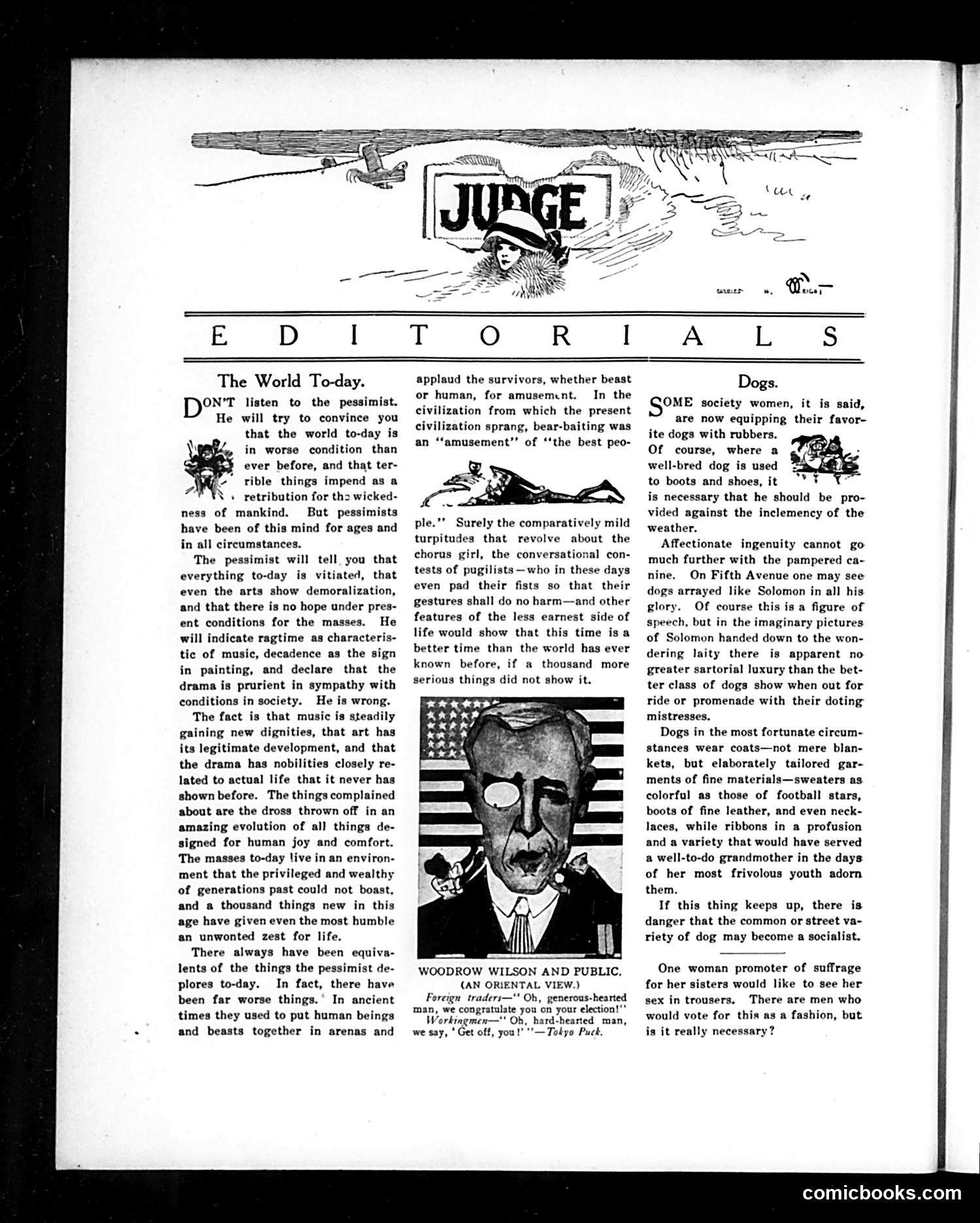
The main illustration depicts **Woodrow Wilson** (labeled "An Oriental View"), caricatured with exaggerated features in a style associating him with Asian stereotypes. The caption quotes foreign traders congratulating Wilson on his election, sarcastically contrasting Western democratic ideals with Oriental despotism. The left editorial "The World To-day" argues against pessimism about civilization's progress, countering claims that modern conditions are worse than historical barbarism. The right column "Dogs" satirizes wealthy society women equipping lap dogs with elaborate clothing and accessories—comparing their indulgence to historical decadence. It concludes with gentle mockery of women's suffrage advocates, questioning whether such fashion priorities demonstrate readiness for serious political participation. The overall tone is conservative social satire.
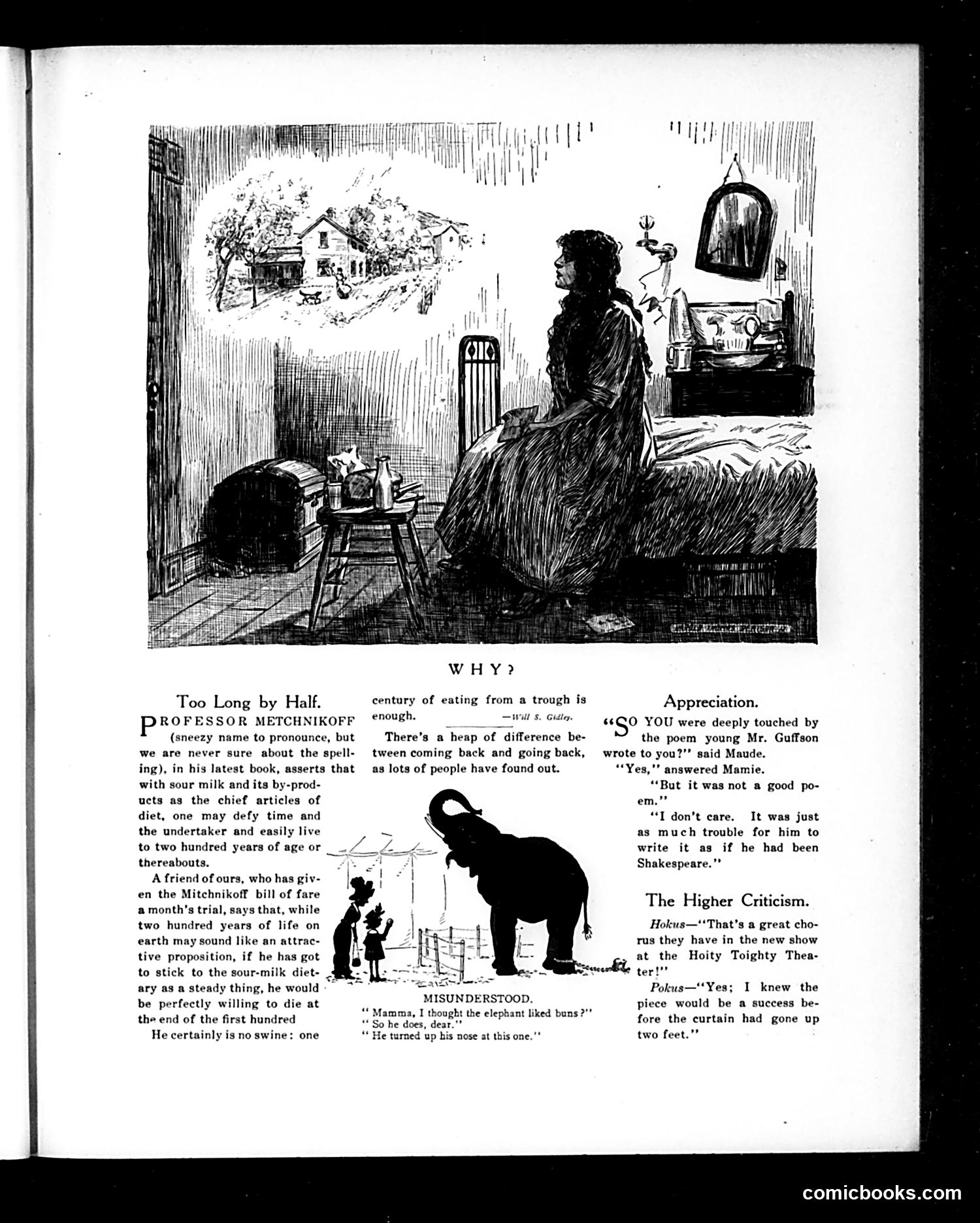
This page contains three separate humorous pieces typical of early 20th-century Judge magazine: 1. **"Too Long by Half"** mocks Professor Metchnikoff's dietary theory claiming humans could live 200+ years on milk alone. The satire suggests this proposition is absurd. 2. **"Misunderstood"** depicts a child asking her mother about an elephant's beans, with the mother correcting the misidentification—a simple visual gag about childhood confusion. 3. **"Appreciation" and "The Higher Criticism"** are brief comedic dialogues about theater appreciation, poking fun at pretentious literary criticism and audiences who judge plays by arbitrary standards (here, praising a show's success before the curtain even rises). The page exemplifies Judge's mix of political/scientific satire with lighthearted domestic humor.
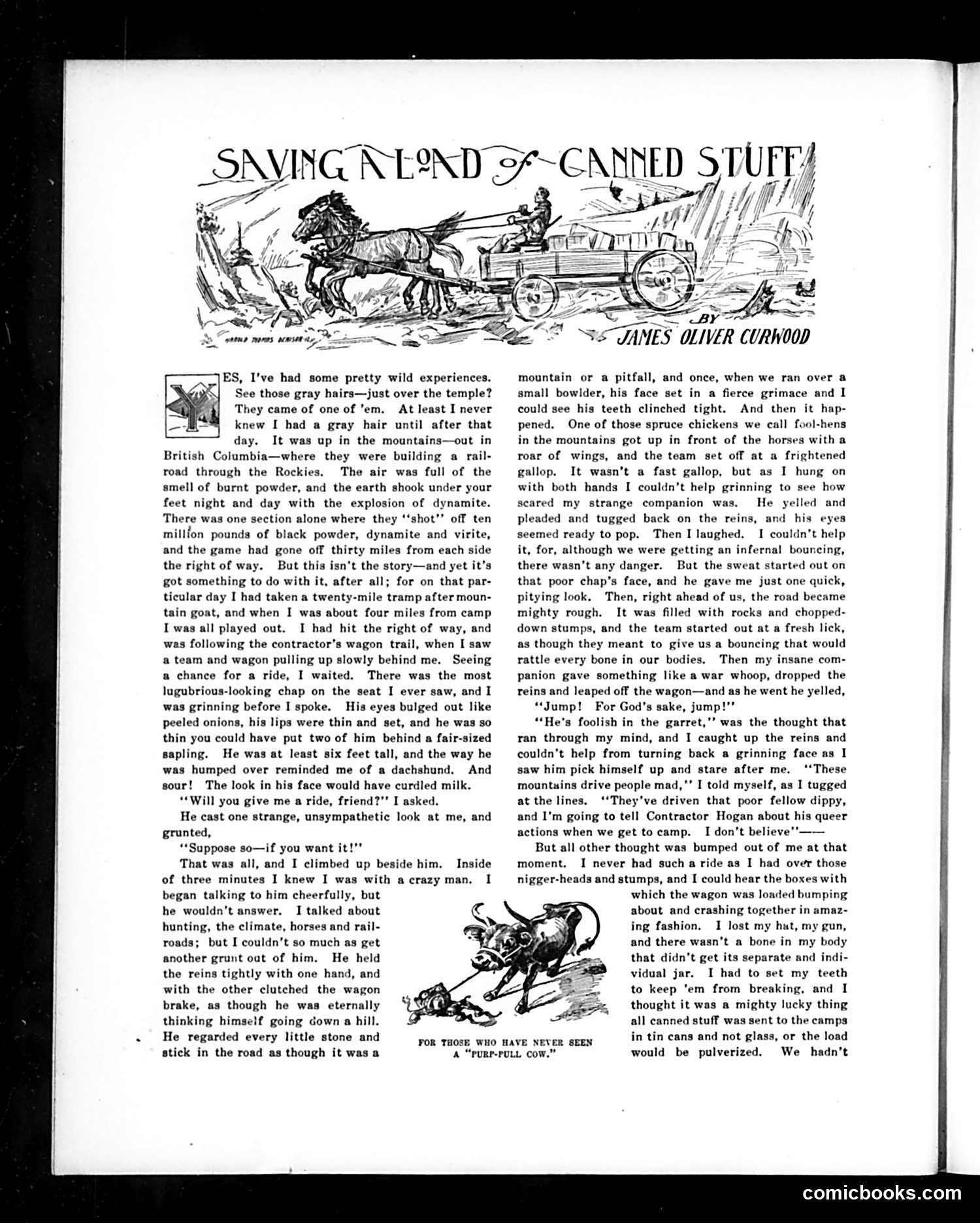
This is a humorous adventure story rather than political satire. The narrative describes the narrator's encounter with an eccentric, temperamentally unstable wagon driver during railroad construction in the Canadian Rockies. The driver's extreme nervousness—bulging eyes, skeletal frame, perpetual grimness—is played for comedy as he obsesses over every minor road hazard while transporting cargo. When a grouse startles the horses and the wagon hits rough terrain, the unhinged driver abandons ship, yelling "Jump! For God's sake, jump!"—despite there being no actual danger. The narrator, initially amused, realizes the man is mentally unstable ("foolish in the garret"), concluding that mountain life has driven him "dippy." The satire targets the psychological toll of frontier work rather than any political target.
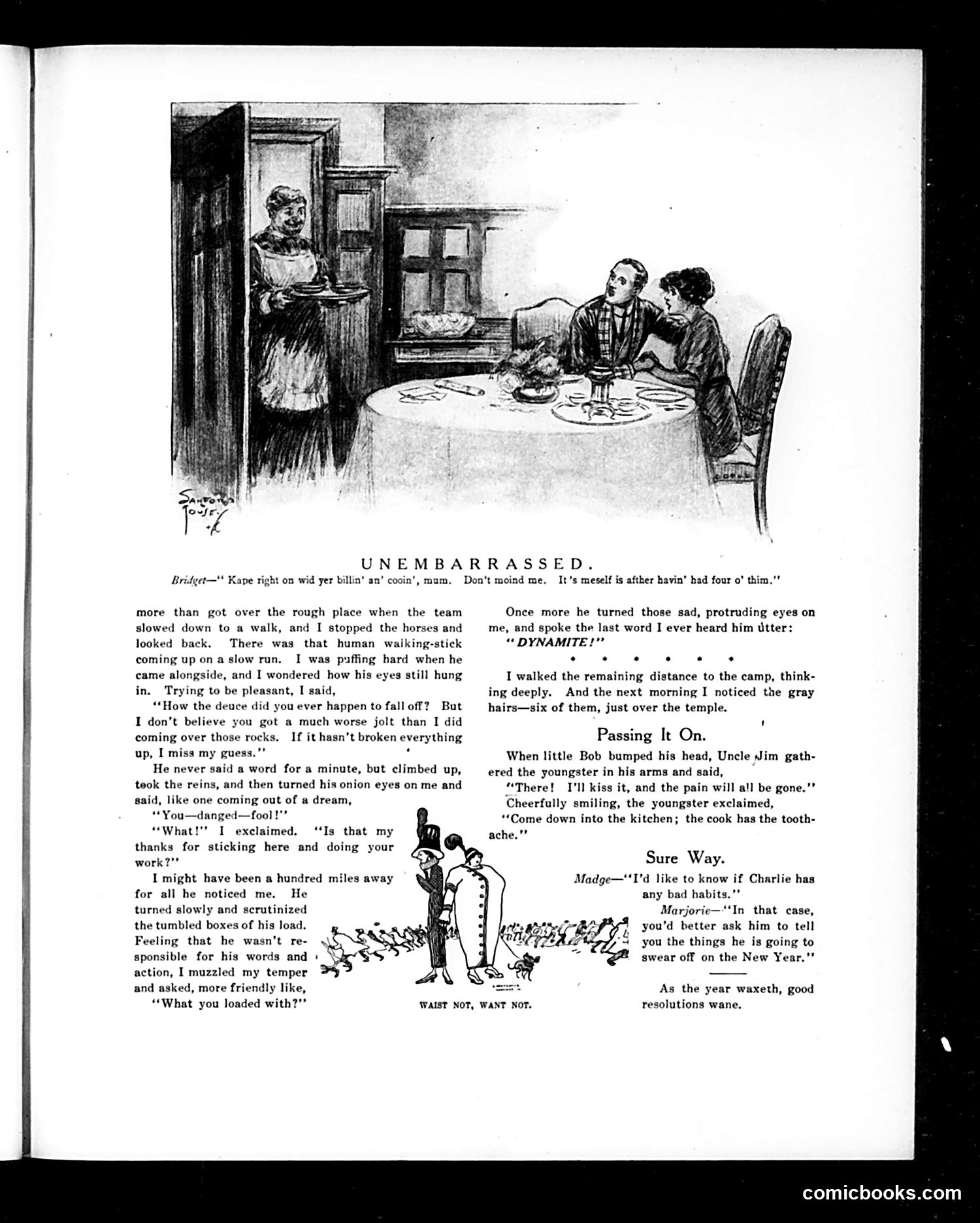
This page contains three separate humorous pieces from *Judge* magazine: **"Unembarrassed"** (top): A narrative about a wagon driver who falls off after drinking four whiskeys ("four o' thim"). When asked what cargo he's carrying, he cryptically replies "DYNAMITE!"—suggesting his volatile, unpredictable state while intoxicated. The joke: the driver is himself the danger. **"Passing It On"** (middle): A brief joke about a child whose bumped head is kissed by Uncle Jim. The child then suggests the cook needs the same treatment for her toothache—innocently spreading affection as a cure-all. **"Sure Way"** (bottom): A New Year's joke where Marjorie suggests that if Charlie has bad habits, he should be asked what he plans to *swear off* in the coming year—implying his resolutions will inevitably fail. The caption mocks the human tendency to abandon good intentions. The page's title, "Waist Not, Want Not," appears to reference the cartoon about the cook's toothache, playing on the saying "Waste not, want not."
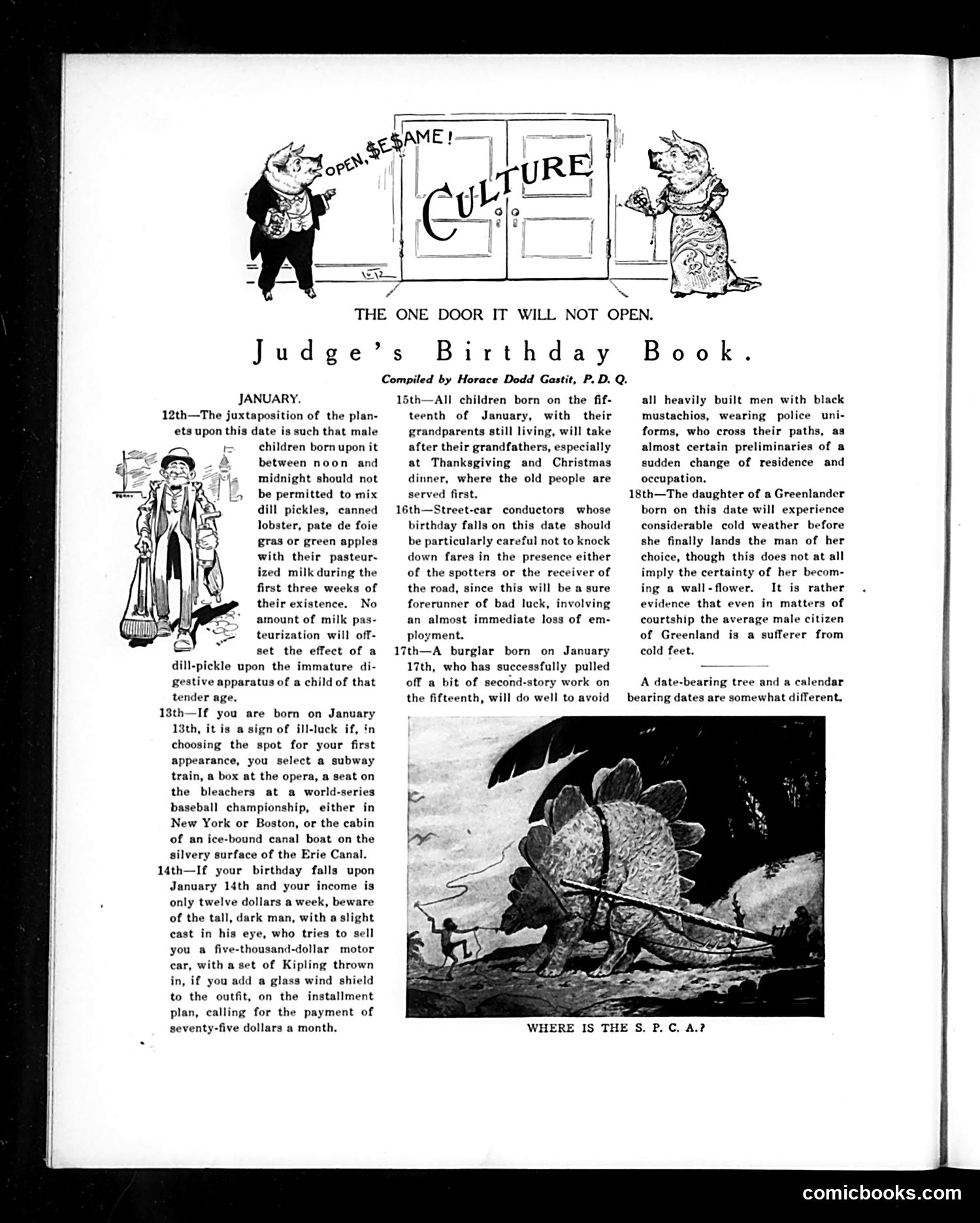
This page is a humorous satirical "birthday book" compiled by "Horace Dodd Gastit, P.D.Q." (a made-up name). Rather than genuine astrology, it offers absurdist mock-predictions for January birthdays that mock various contemporary social types and situations. The humor works through exaggeration and irony: babies born on the 12th shouldn't mix pickles with milk; those on the 13th face bad luck in subways, opera boxes, or baseball bleachers; the poor earning twelve dollars weekly should fear con-men selling expensive motor cars on installment plans. Later entries target specific professions (streetcar conductors, burglars) and social stereotypes (Greenlanders, their supposedly cold-footed men). The cartoon at bottom—captioned "WHERE IS THE S.P.C.A.?"—appears to reference animal cruelty, though its connection to the text above is unclear without additional context. The satire mocks fortune-telling's absurdity while needling contemporary American social pretensions and economic anxieties of the early 20th century.
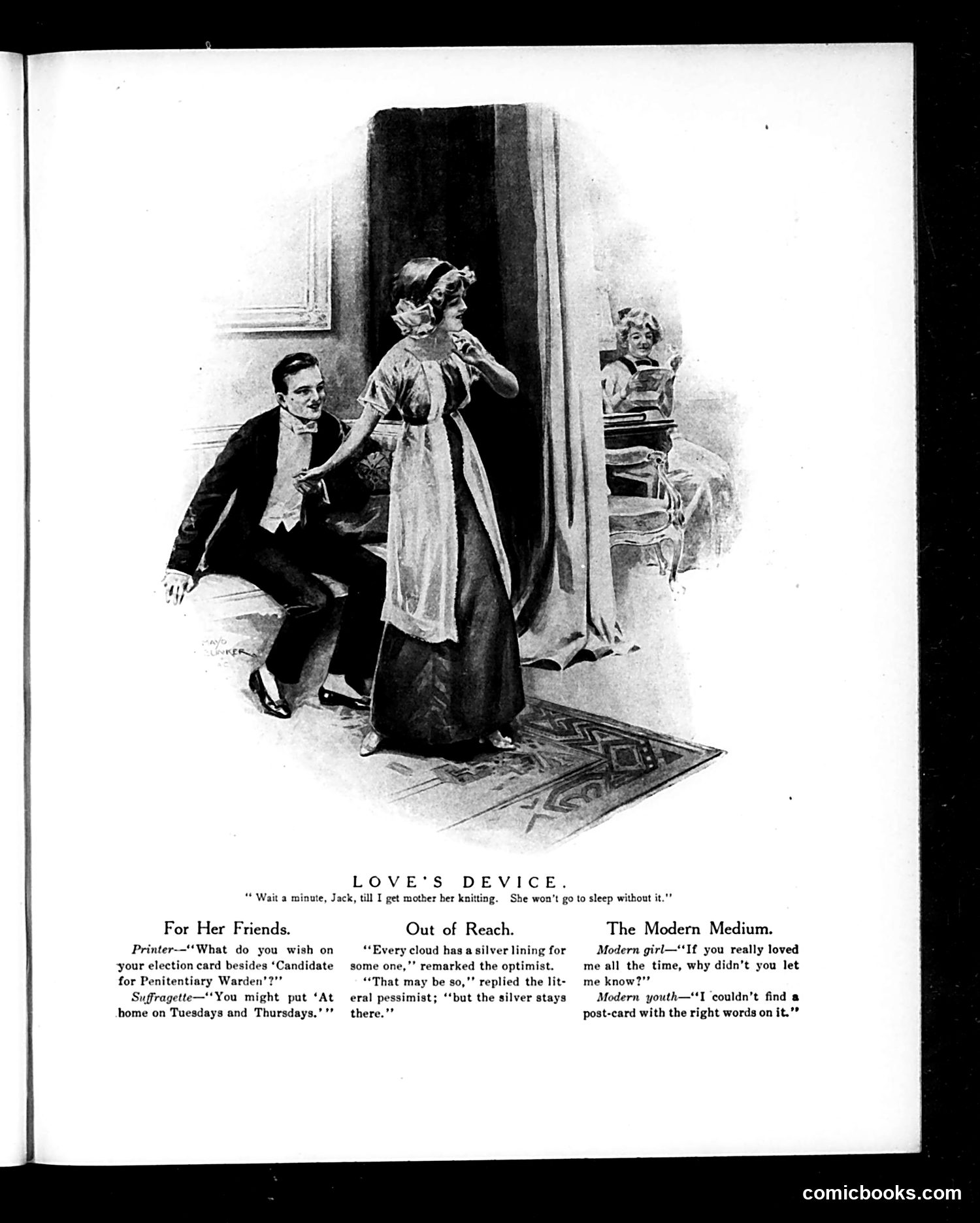
This page contains three separate joke cartoons mocking early 20th-century social trends: **"Love's Device"** (main illustration): A man tries to delay his wife while she tends to her knitting—suggesting domestic entrapment and the constraints of married life. **"For Her Friends"**: A satirical exchange mocking the early women's suffrage movement. A printer asks a candidate what to print on election cards; a suffragette suggests adding "At home on Tuesdays and Thursdays," implying female politicians would be unavailable—a dismissive jab at women's political competence. **"Out of Reach" and "The Modern Medium"**: Brief philosophical and romantic gags about pessimism and modern courtship using postcards—poking fun at contemporary communication methods and romantic conventions. The overall tone reflects Judge's satirical stance against progressive movements, particularly women's suffrage, which was actively debated during this era.
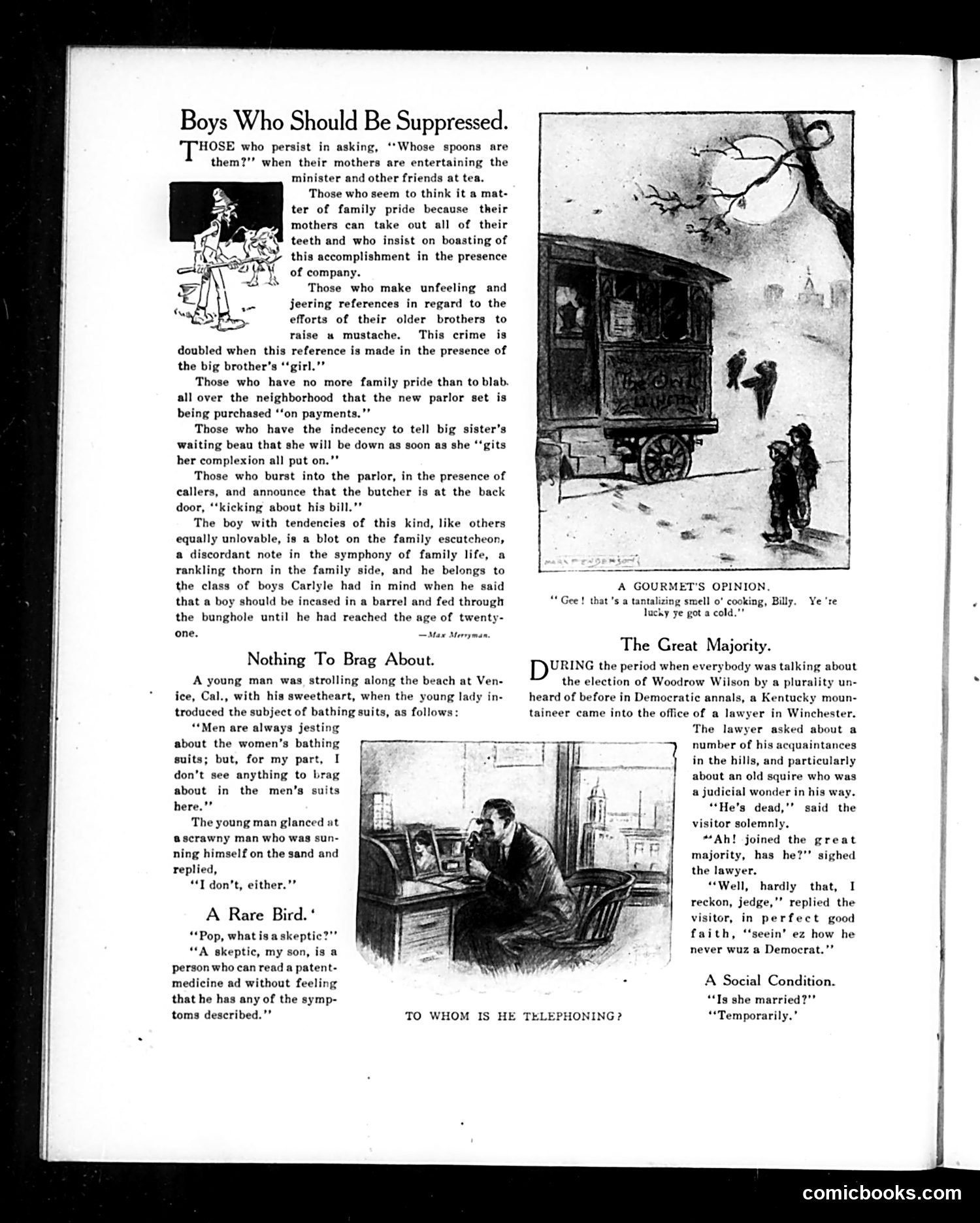
This page from *Judge* contains several short humorous pieces satirizing early 20th-century American social behavior: **"Boys Who Should Be Suppressed"** mocks children who embarrass their families through tactlessness—asking about spoons at tea, boasting about mothers' false teeth, mocking older brothers' mustache attempts, or announcing financial embarrassments like furniture bought "on payments." The piece uses exaggerated rhetoric (comparing such boys to Carlyle's barrel-incased children) to satirize Victorian-era concerns with propriety and family reputation. **The remaining anecdotes** offer mild social comedy: a beach conversation about bathing suits, a definition joke about patent-medicine skepticism, a Kentucky dialect story about Woodrow Wilson's 1912 election victory (referencing the unusually large Democratic plurality), and a quip about temporary marriage. The cartoons are simple illustrations supporting these text pieces rather than standalone political commentary. The satire targets petit bourgeois anxieties about respectability and social standing rather than political figures.
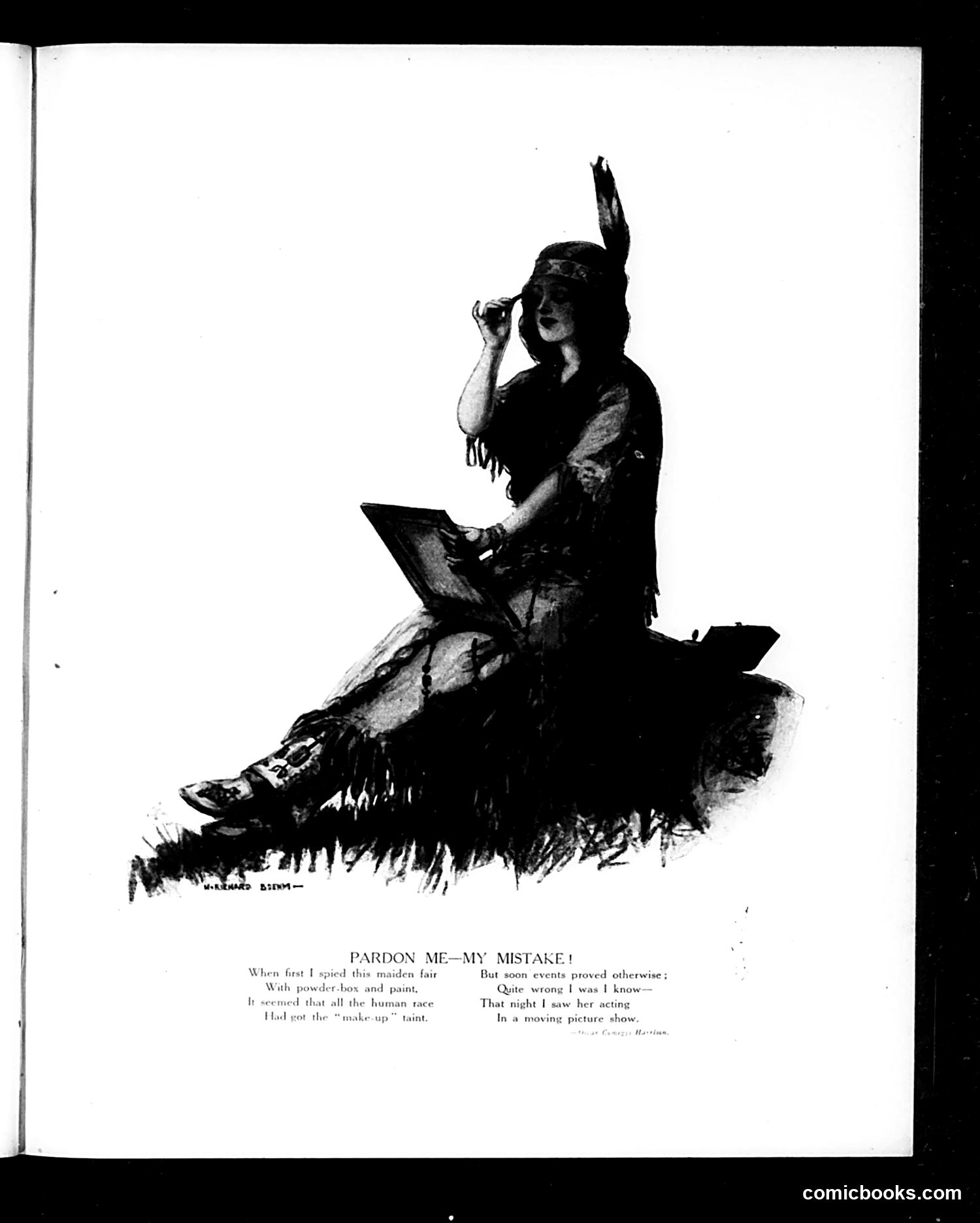
This appears to be a satirical illustration from *Judge* magazine depicting a figure in Native American costume (feathered headdress, fringed clothing) sitting and looking at what seems to be a laptop or portable device—an anachronistic detail that makes no historical sense. The caption "PARDON ME—MY MISTAKE!" suggests the cartoon is mocking someone's misjudgment. The text references being "wrong" about identifying "this maiden fair" based on "powder-box and paint," then realizing the mistake after seeing "her acting / In a moving picture show." This likely satirizes either a specific early-cinema personality or critiques the deceptive nature of theatrical makeup and film performance—the joke being that appearance deceived the observer about the subject's true identity or character.
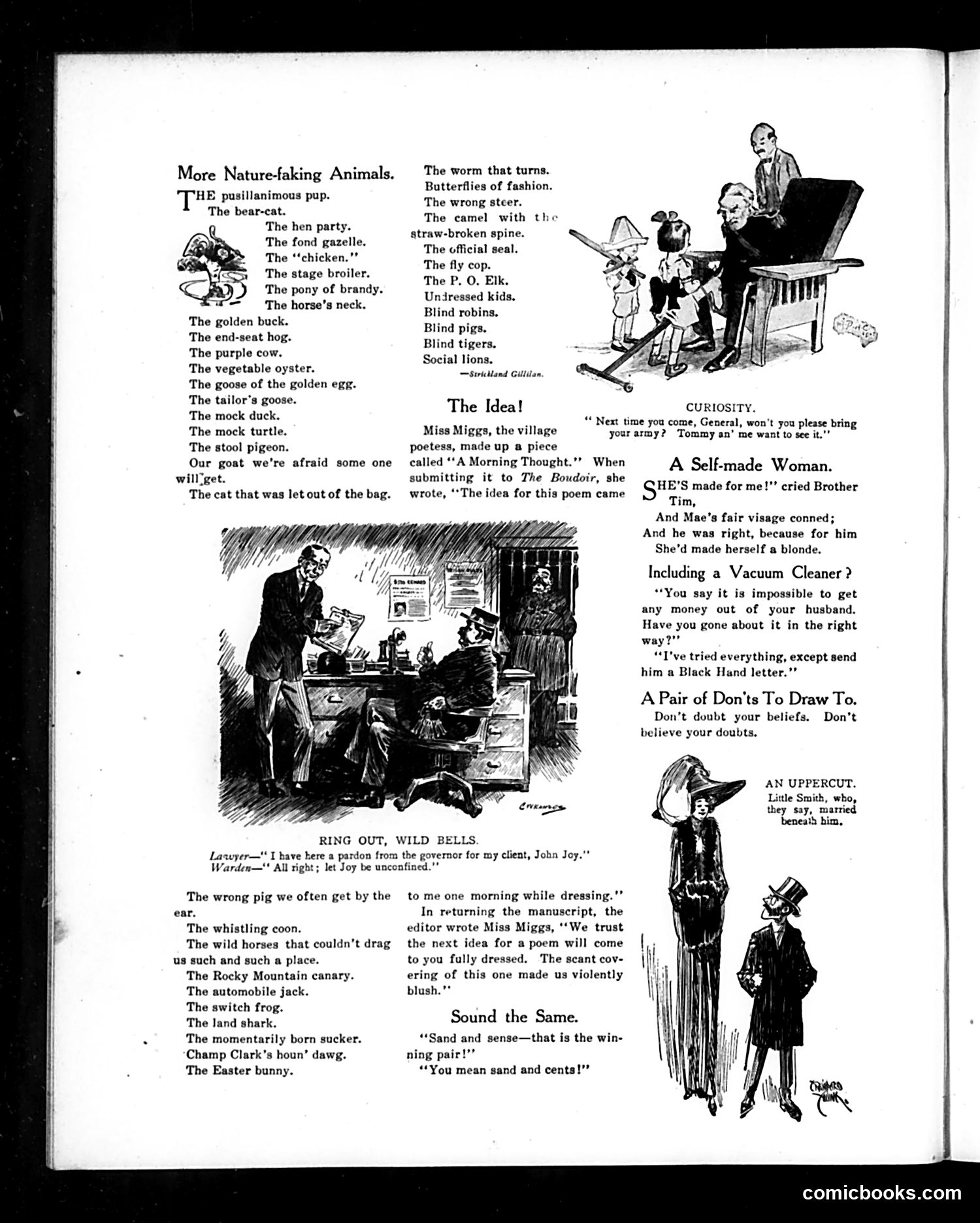
This page from *Judge* contains multiple satirical pieces mocking contemporary society and language: **"More Nature-faking Animals"** ridicules absurd compound phrases (like "purple cow," "mock turtle," "social lions") that were fashionable slang or literary conceits of the era. The joke targets pretentious or nonsensical terminology. **"Ring Out, Wild Bells"** is a legal pun: a lawyer's wordplay about releasing his client "Joy" from confinement plays on the phrase "let joy be unconfined." **The remaining short pieces** satirize domestic life: a village poetess submitting indecently scanty poem, marriage dynamics (a self-made woman who literally "made herself a blonde"), marital financial disputes, and class anxieties ("married beneath him"). The cartoons and jokes collectively mock early 20th-century affectations, linguistic pretension, gender relations, and social climbing—typical *Judge* magazine fare targeting middle-class American foibles.
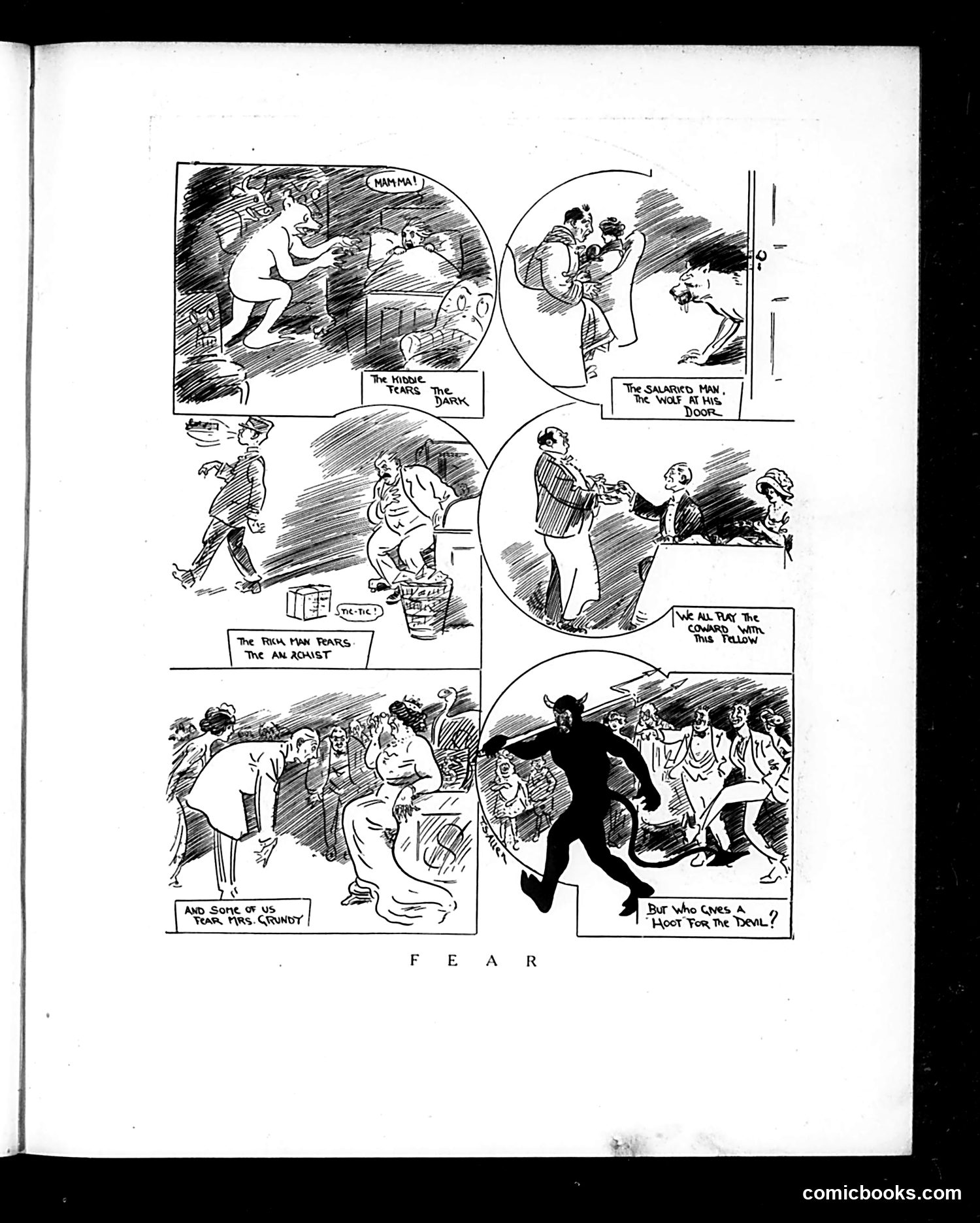
This single-page political cartoon uses traditional fairy tales and folklore to satirize contemporary fears. The sequential panels reference: 1. "The Invisible Years in the Dark" - depicts someone cowering 2. "The Salesman, Man the Wolf at His Door" - represents economic anxiety 3. "The Irish Bull Dares the Alchemist" - unclear reference 4. "We All the Coward with Our Fellow" - appears to show social pressure 5. The final panel shows a dark silhouette (possibly representing the Devil or a feared figure) among a crowd, captioned "But Who Gives a Hoot For the Devil?" The overall theme suggests how common people harbor various fears—supernatural, financial, social—yet paradoxically dismiss ultimate danger. This likely critiques either public paranoia or apathy toward genuine threats. The "FEAR" title emphasizes the psychological subject matter of Judge magazine's satirical commentary.
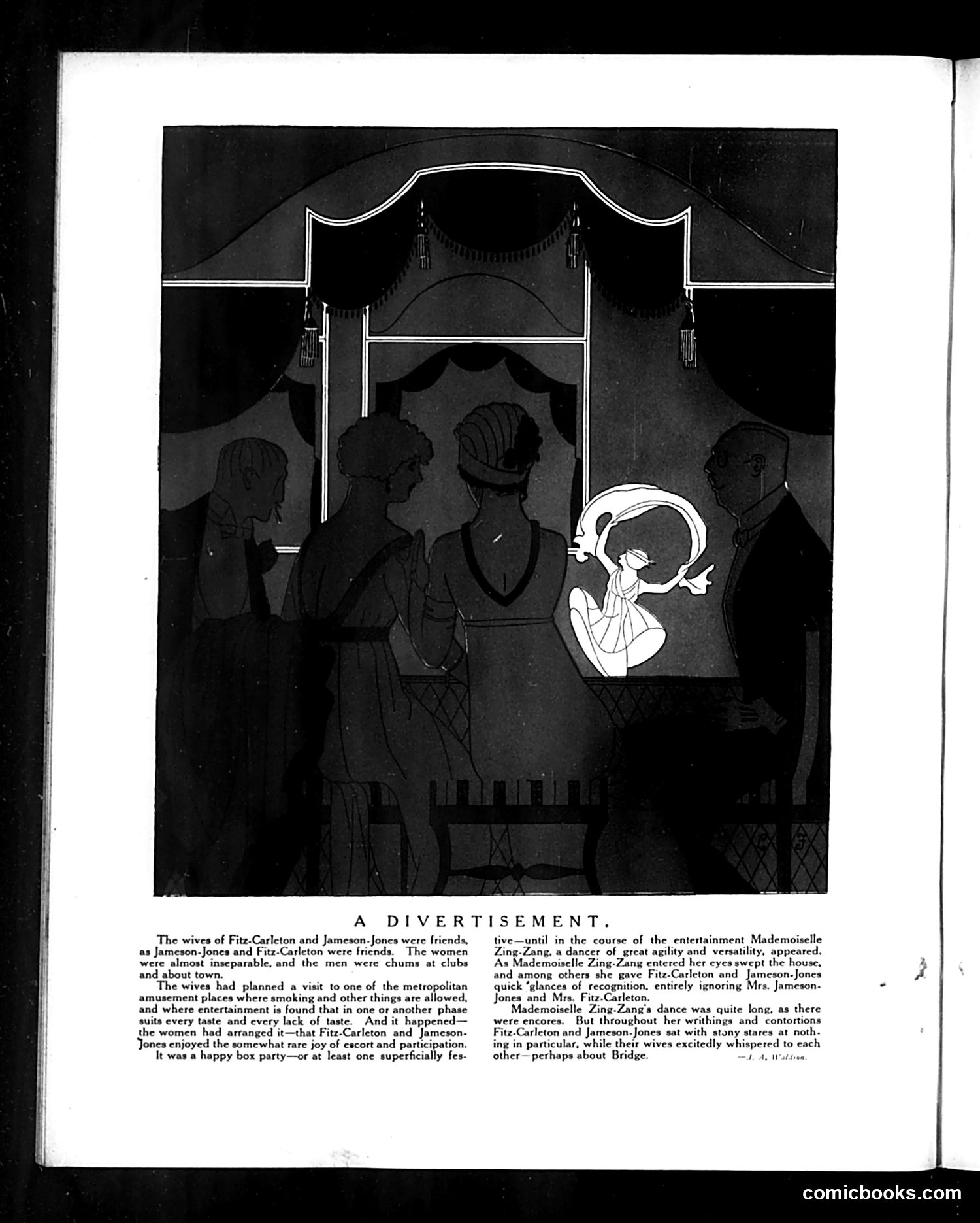
This Judge story-cartoon satirizes upper-class marriage and masculine propriety. Two married couples—the Fitz-Carltons and Jameson-Joneses—attend a theatrical entertainment together. During the show, a performer called Mademoiselle Zing-Zang (depicted in white, drawing all eyes) gives "quick glances of recognition" to the two husbands while pointedly ignoring their wives. The satire lies in the contrast: the husbands maintain "stony stares," feigning indifference, while their wives "excitedly whispered to each other—perhaps about Bridge," oblivious to (or pretending ignorance of) the performer's flirtation. The piece mocks the performative facade of respectable marriages—husbands must pretend disinterest in attractive entertainers while their wives maintain polite ignorance, all while attending venues notorious for moral laxity.
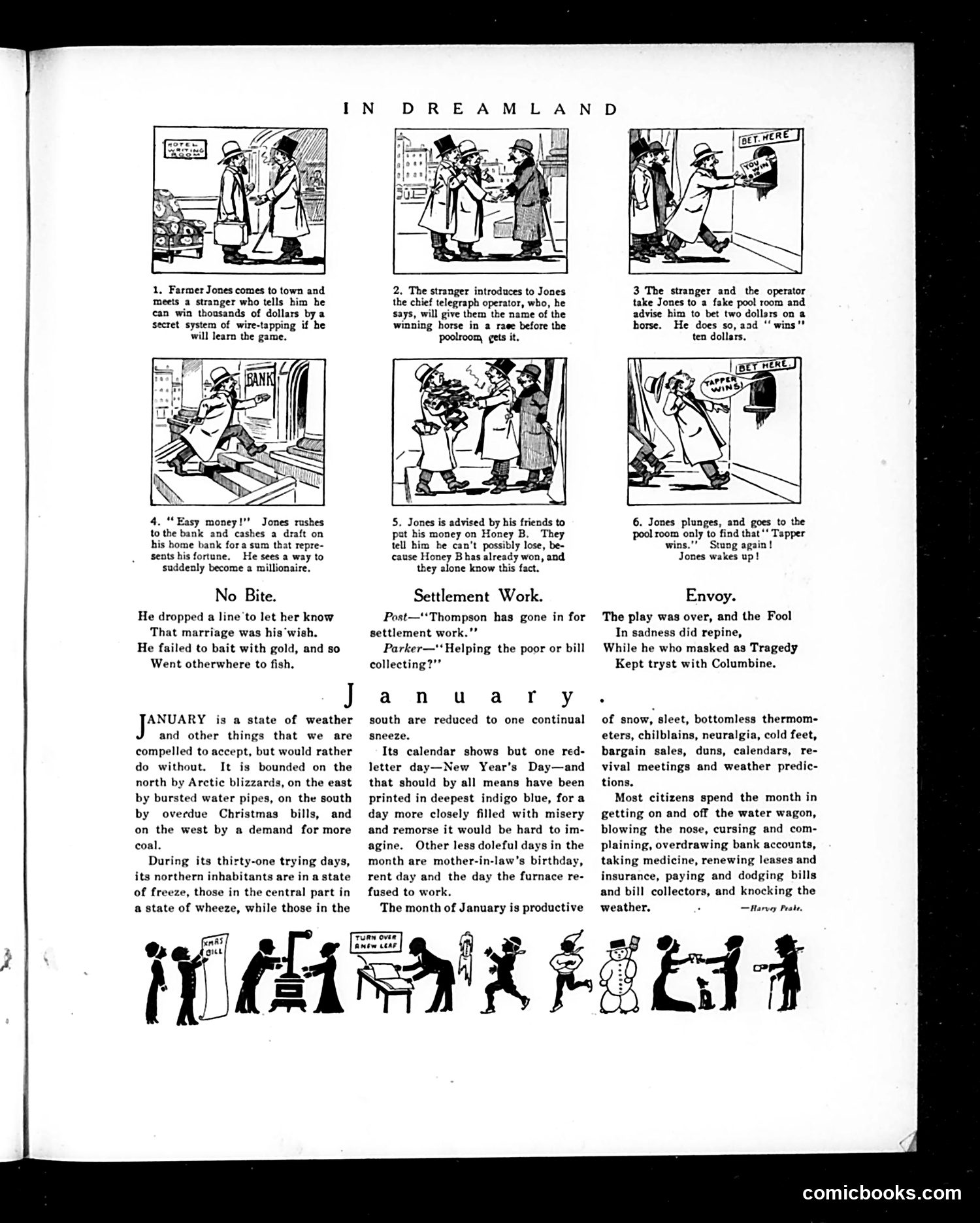
This six-panel cartoon illustrates a classic "wire-tapping" confidence scam targeting a naive farmer. Farmer Jones is lured by a stranger promising easy money through insider knowledge of horse races. The con works in stages: a fake telegraph operator confirms the scheme's legitimacy, Jones wins small on a rigged bet, then invests his entire fortune expecting guaranteed returns. The scam collapses when he loses everything on "Tapper," a horse the con artists claimed couldn't lose. The satire targets both the gullibility of rural Americans and the prevalence of betting schemes exploiting telegraph technology and poolroom gambling in the early 1900s. The final "Envoy" moralizes the fool's downfall, while accompanying jokes about January's miseries (bills, bad weather, family obligations) round out the satirical commentary on American life.
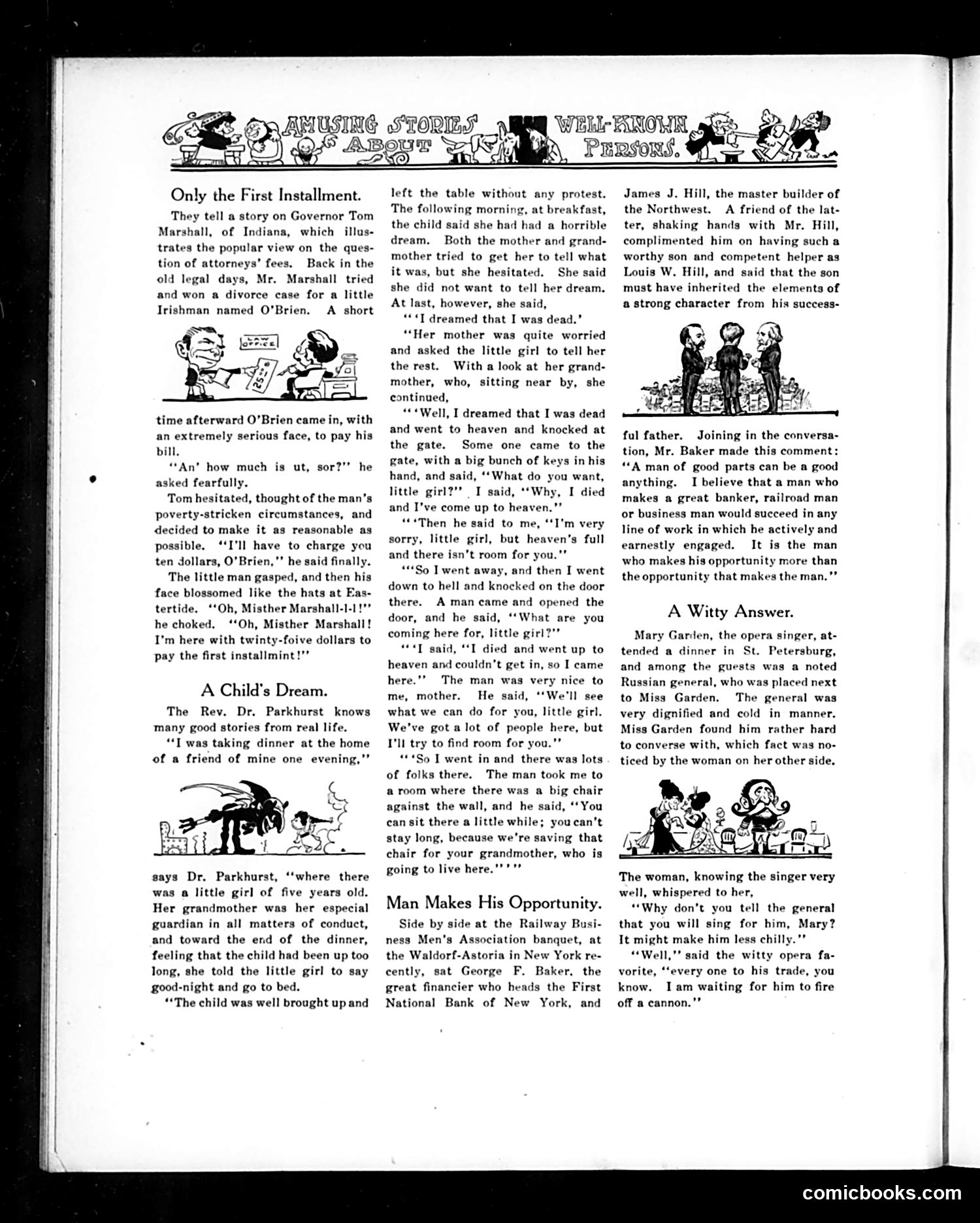
This page contains three humorous anecdotes rather than political cartoons: 1. **"Only the First Installment"**: A joke about Governor Tom Marshall of Indiana and an Irish client named O'Brien. The humor lies in O'Brien's misunderstanding—he arrives with $25 to pay the *first installment* of a $10 legal fee, suggesting he expects the bill to be so large it requires multiple payments. It satirizes both working-class financial anxiety and the high cost of legal services. 2. **"A Child's Dream"**: Rev. Dr. Parkhurst recounts a child's dream where heaven is full but hell has room. The joke targets grandmother's strict discipline—even hell would welcome the child more readily than heaven, implying the grandmother is so stern she's worse than damnation itself. 3. **"Man Makes His Opportunity"**: An anecdote about financier George F. Baker and railroad magnate James J. Hill at a banquet, celebrating individual merit and opportunity in business. The page reflects early-20th-century American attitudes about class, Irish immigrants, religious hypocrisy, and capitalist success.
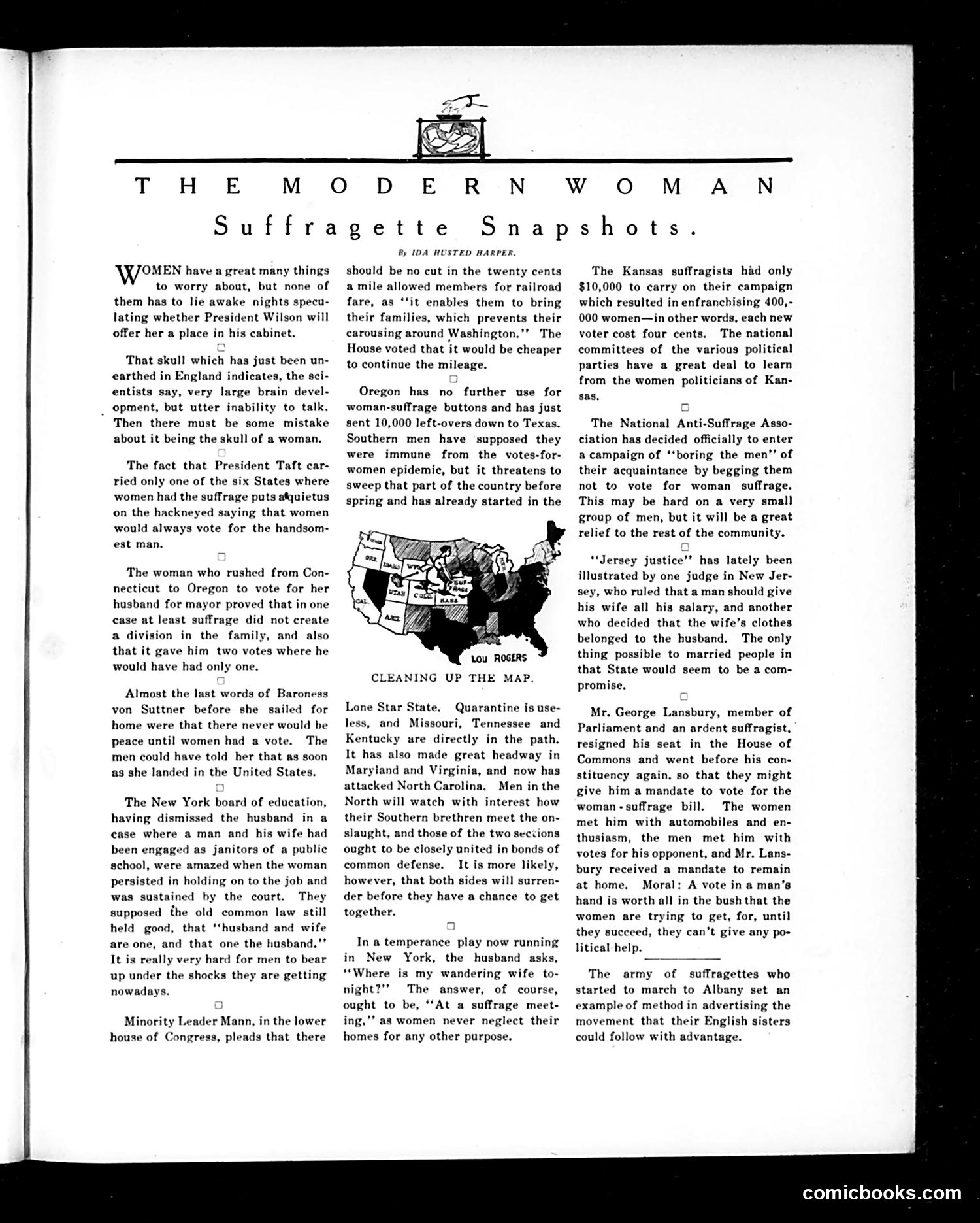
This is a satirical column by Ida Husted Harper mocking anti-suffrage arguments and celebrating women's voting progress. The accompanying map titled "Cleaning Up the Map" shows states where women have won suffrage, depicted as spreading infection-like across the country. The satire targets male anxieties about women voting: Harper skewers claims that women lack intelligence (the "skull" joke), that wives will divide families politically (disproven by a Connecticut woman voting for her husband's mayoral campaign), and that granting suffrage will disrupt homes (the temperance play joke suggesting women neglect domestic duties for suffrage meetings). The column celebrates concrete wins—Kansas suffragists enfranchising 400,000 women cheaply—while mocking anti-suffrage efforts and men's discomfort with female political power. References to President Taft losing states with women's suffrage and male congressmen defending railroad expenses suggest women voters are becoming a consequential political force. The overall message: women's suffrage is inevitable and expanding, and men's resistance is both futile and ridiculous.
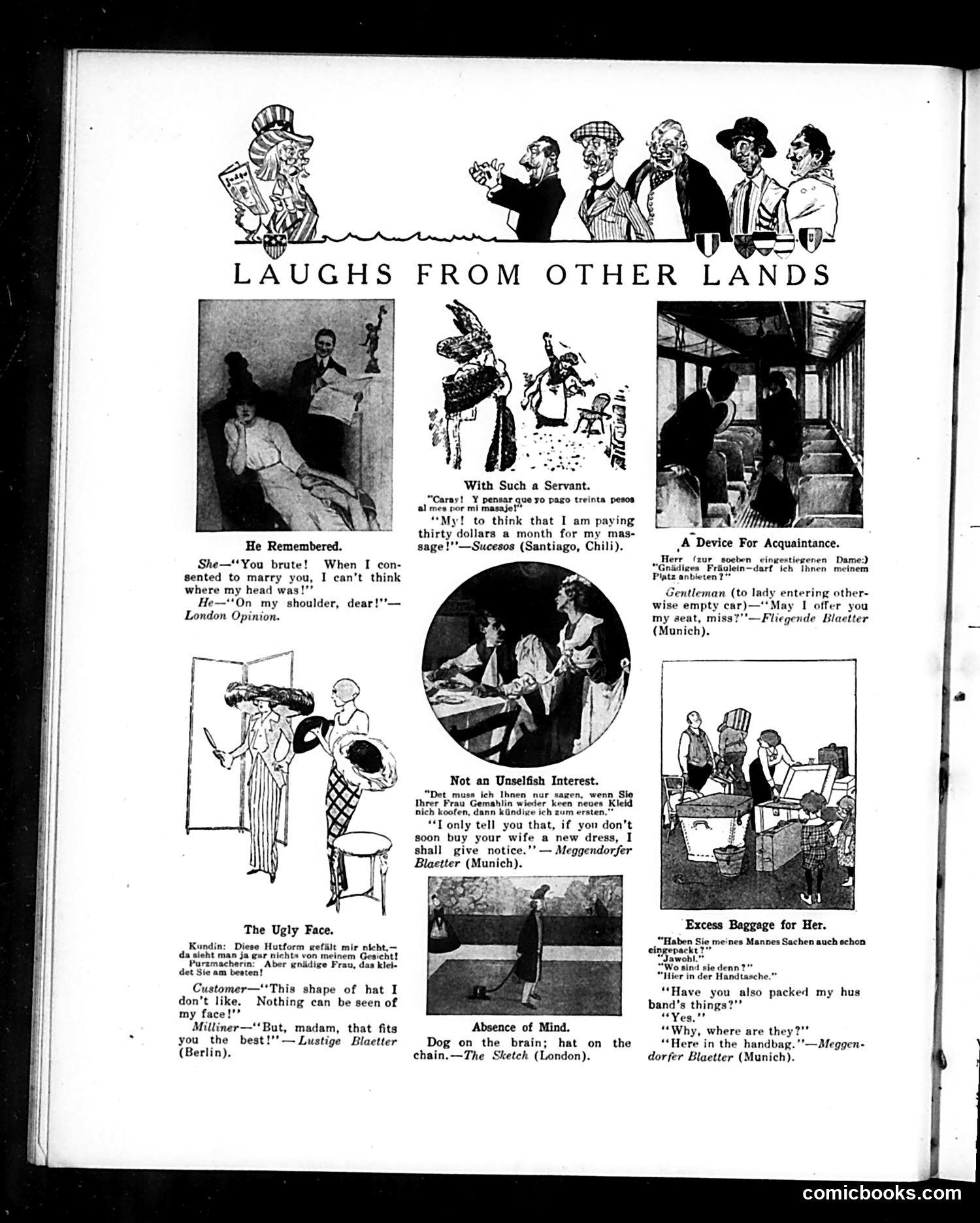
This page collects brief humorous anecdotes translated from European satirical publications (London Opinion, Berlin's Lustige Blätter, Munich's Fliegende Blätter, etc.), presenting international jokes for American readers. The humor relies on domestic and social stereotypes: a husband's cruel memory of his wife's wedding day ("On my shoulder"); a milliner's backhanded compliment about an ugly customer; a servant threatening to quit unless his employer buys his wife a dress; a man absurdly putting his hat on a dog's chain; a gentleman offering his seat to a woman in a train car. These are gentle, observational comedies about marriage dynamics, class relations, and absent-mindedness—typical of early 20th-century "safe" humor. The satire targets human foibles rather than politics, suggesting Judge aimed to amuse rather than provoke its readers with international perspectives on universal domestic situations.
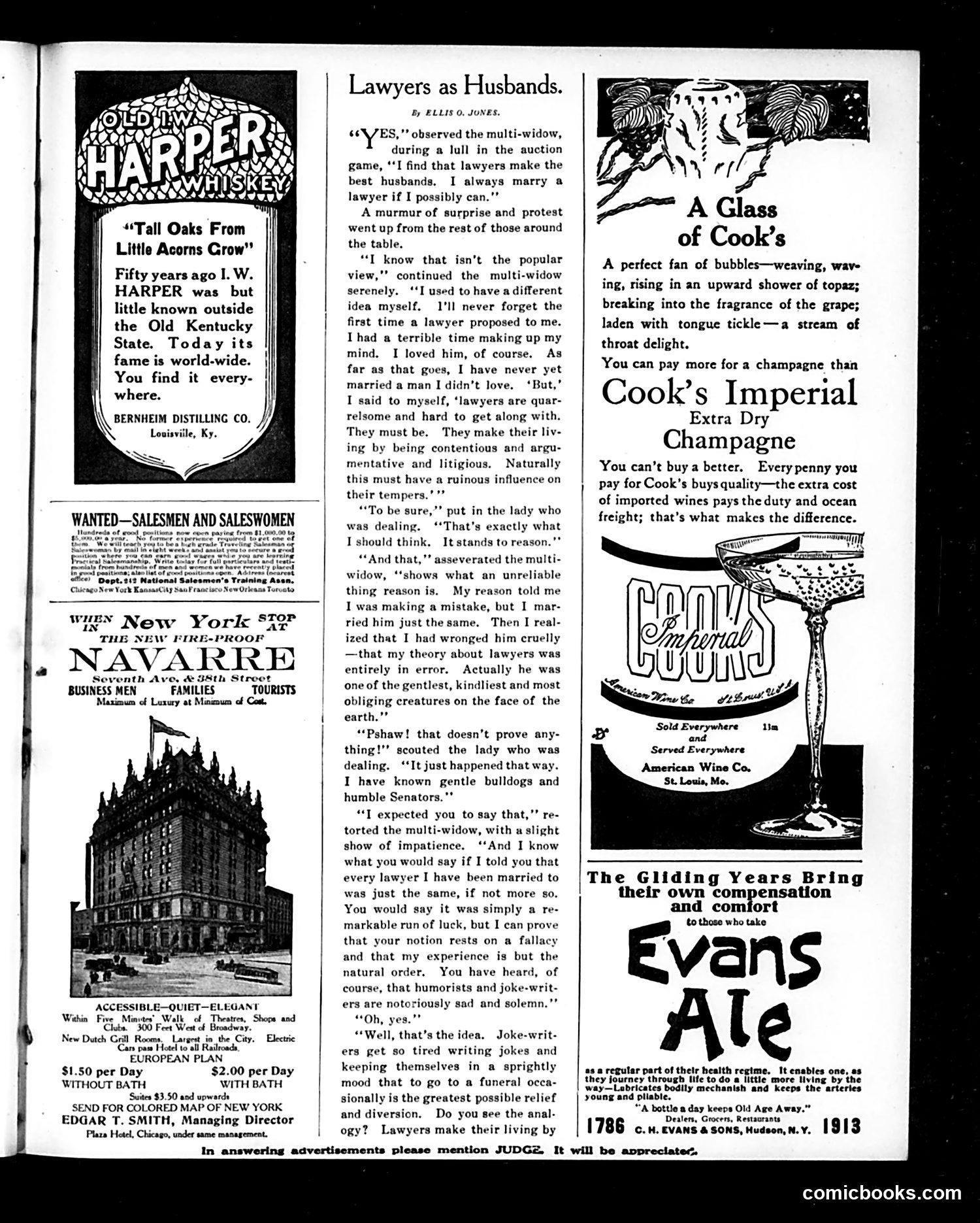
This page features a humorous essay by Ellis O. Jones satirizing assumptions about lawyers' temperaments. A wealthy, repeatedly-married woman defends her choice to marry lawyers, arguing they make excellent husbands—contrary to popular belief that their contentious profession makes them quarrelsome. Her counterintuitive argument: just as joke-writers become sad from constant humor-writing, lawyers become *gentle* from constant arguing. Their professional combativeness exhausts their capacity for domestic conflict, leaving them surprisingly kind at home. The satire mocks both lawyers (stereotyped as argumentative) and the woman's dubious logic—her analogy is clearly flawed, yet she presents it as irrefutable proof. The piece humorously exposes how people rationalize choices through convenient reasoning. The page is primarily advertisement-driven, surrounding the story with promotions for whiskey, hotels, and champagne typical of Judge's commercial model.
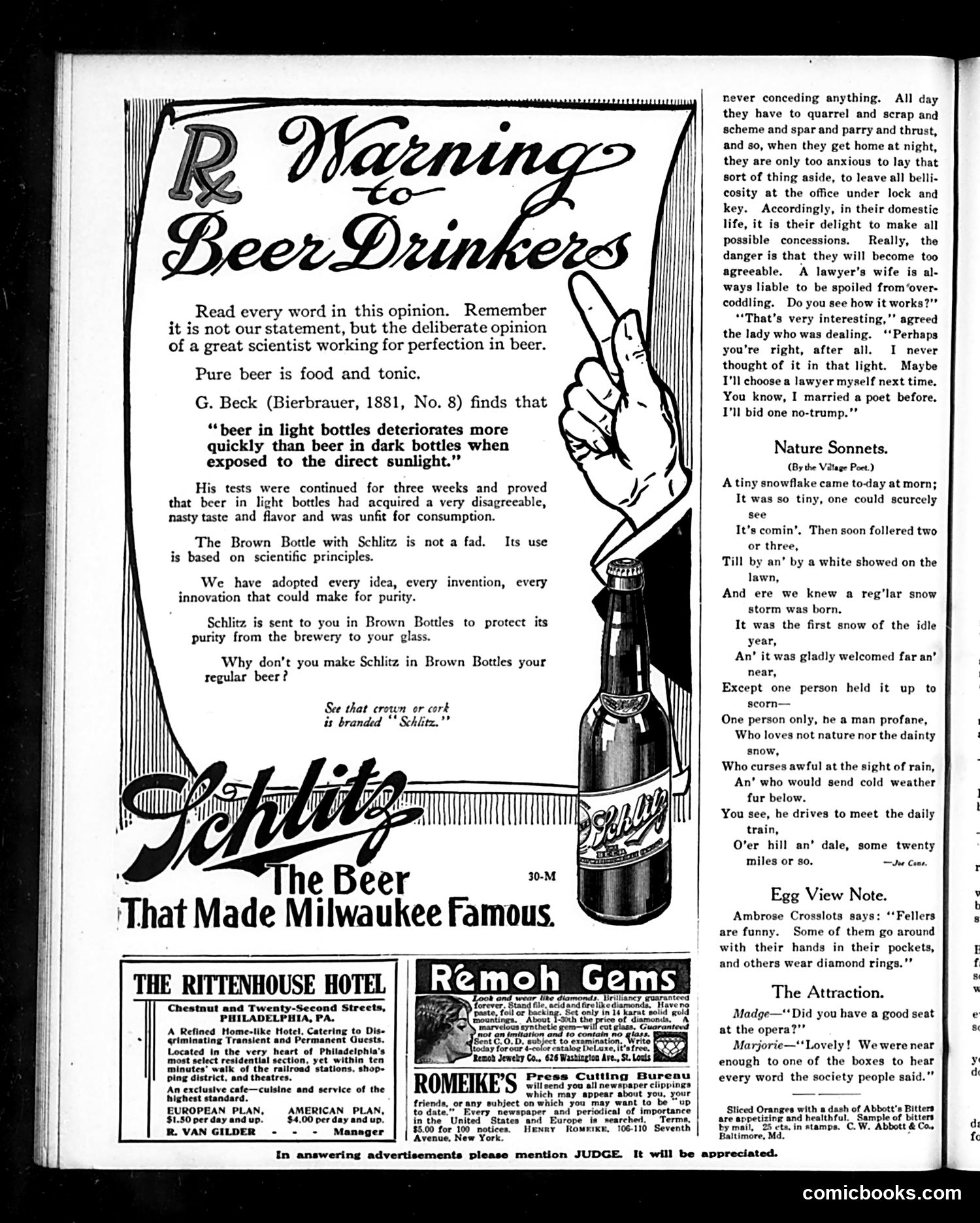
This page is dominated by a **Schlitz beer advertisement** disguised as scientific endorsement. The central image shows a beer bottle held aloft like a trophy or religious relic. The ad's argument: citing a German scientist ("G. Beck, Bierbrauer, 1881"), it claims beer in **light bottles deteriorates faster than dark bottles** when exposed to sunlight. Therefore, Schlitz's brown bottles protect purity—positioning the packaging choice as scientifically proven rather than marketing. This represents early **advertising strategy using pseudo-scientific authority** to justify product features. The repeated rhetorical question "Why don't you make Schlitz in Brown Bottles your regular beer?" transforms a technical claim into brand loyalty. The tagline—"The Beer That Made Milwaukee Famous"—leverages Milwaukee's actual dominance in American beer production during this era. The page's remaining content (hotel ads, poetry, society notes) is typical Judge magazine filler, but the Schlitz ad occupies premium space, reflecting beer's cultural prominence and advertising investment in this period.
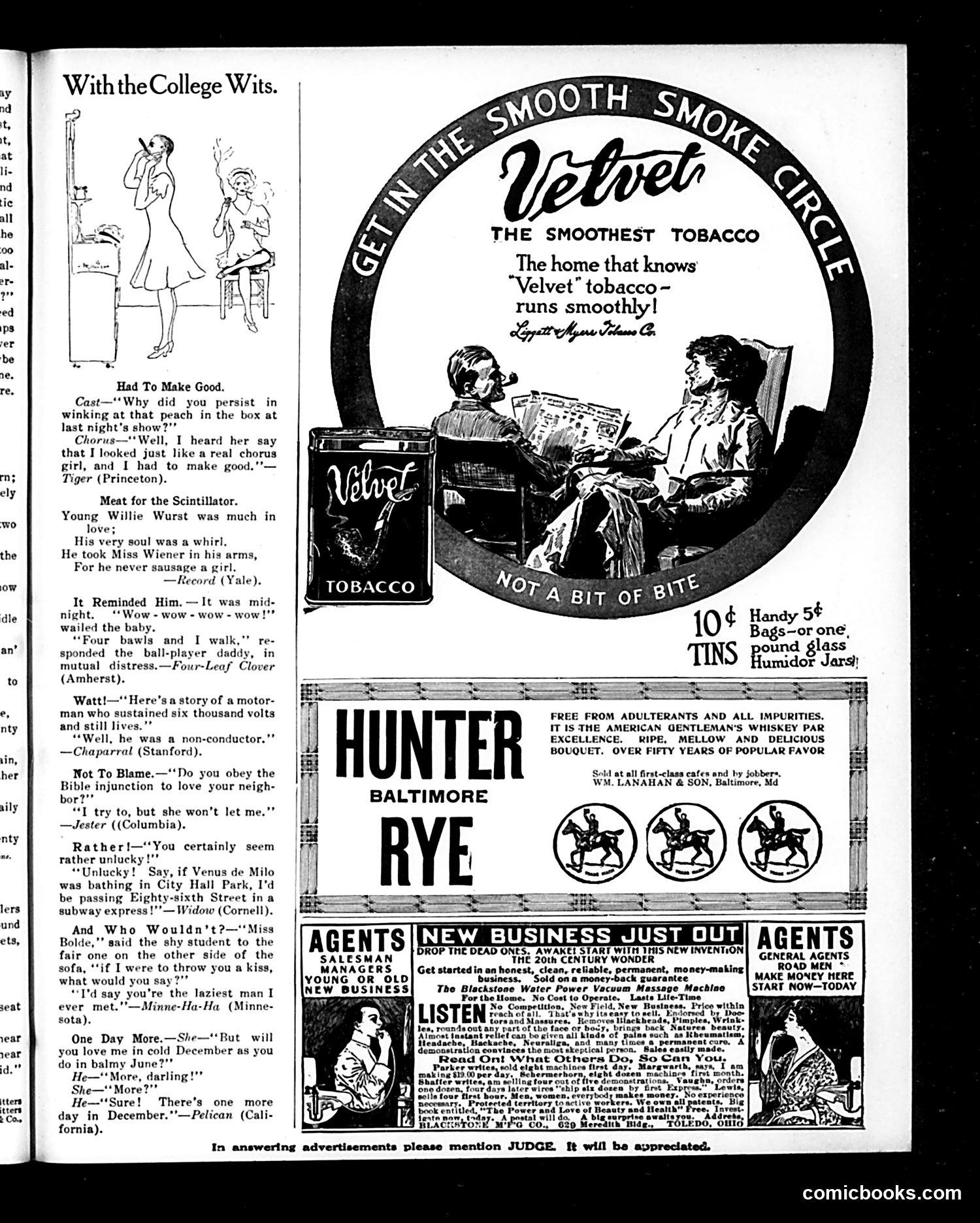
This page consists primarily of **college humor** and **advertisements** rather than political satire. The left section features "With the College Wits"—short jokes sourced from various college humor publications (Princeton's *Tiger*, Yale's *Record*, etc.). These are lighthearted puns and wordplay: a chorus girl joke, puns on "Wurst/Wiener" (sausage names), a baseball daddy joke, and romantic mishaps. They're examples of the genteel, campus-based humor popular in early 20th-century American college magazines. The right side contains **product advertisements**—Velvet tobacco, Hunter Baltimore Rye whiskey, and the "Blackstone Water Power Vacuum Massage Machine." These represent typical Judge magazine advertising: consumer goods marketed through illustrated scenes of domestic comfort or commercial opportunity. There is **no political cartoon or satire** on this page. It's a standard magazine layout mixing collegiate humor with period advertising—reflective of Judge's role as both satirical publication and advertising vehicle for the era's products.
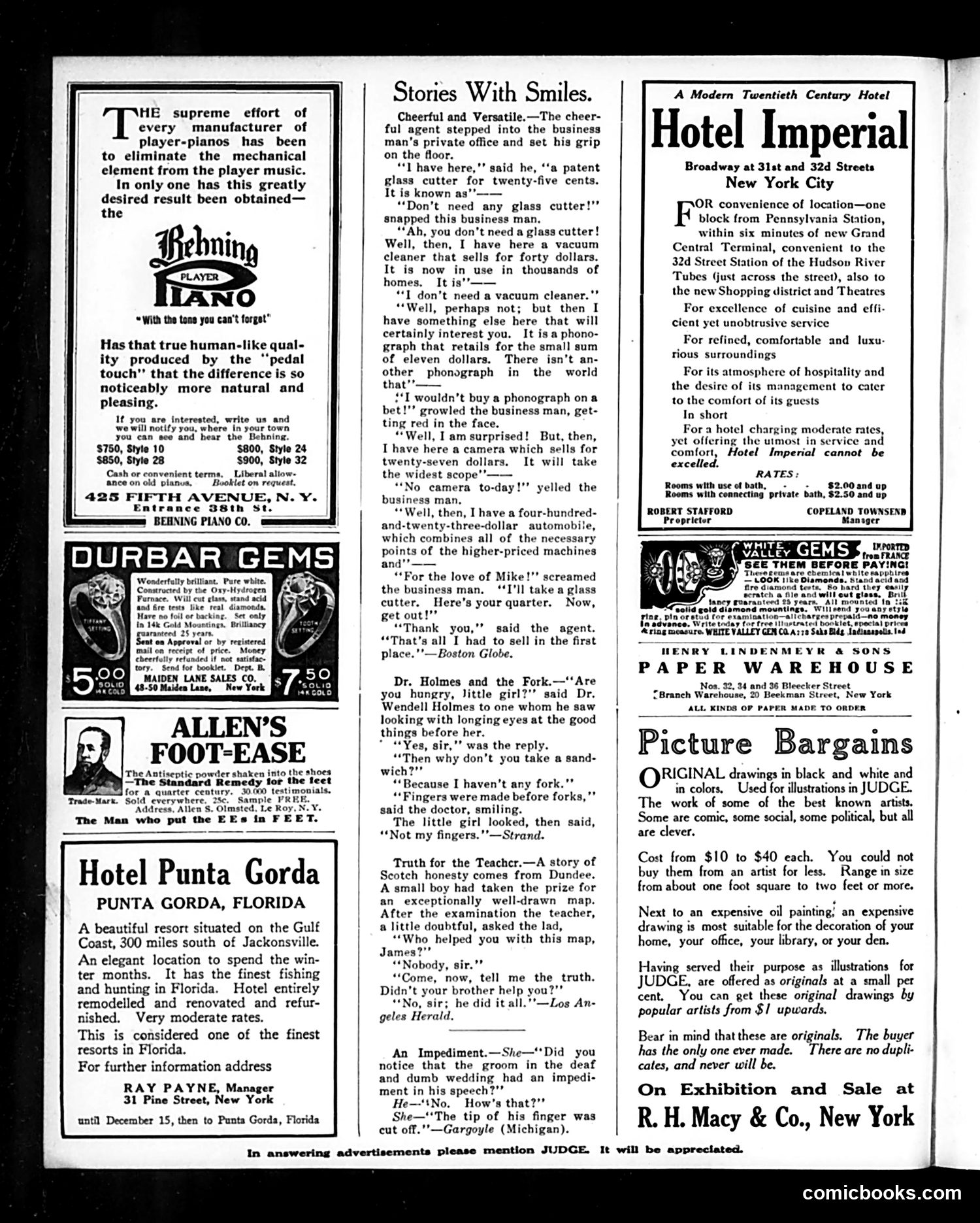
This is primarily an **advertising page** from Judge magazine, not political satire. The page contains multiple product advertisements (Behning pianos, Durbar Gems jewelry, Allen's Foot-Ease powder, hotels) alongside a section titled "Stories With Smiles"—lighthearted comic anecdotes with punchlines. The three brief jokes are gentle humor about everyday situations: a persistent salesman who finally sells a glass cutter after rejecting everything else; a doctor telling a hungry girl she doesn't need a fork; and a setup about Scotch honesty (text cuts off). These are situational comedies rather than political commentary—typical filler content for magazines of this era, designed to entertain readers between advertisements. The page reflects early 20th-century consumer culture and advertising practices.
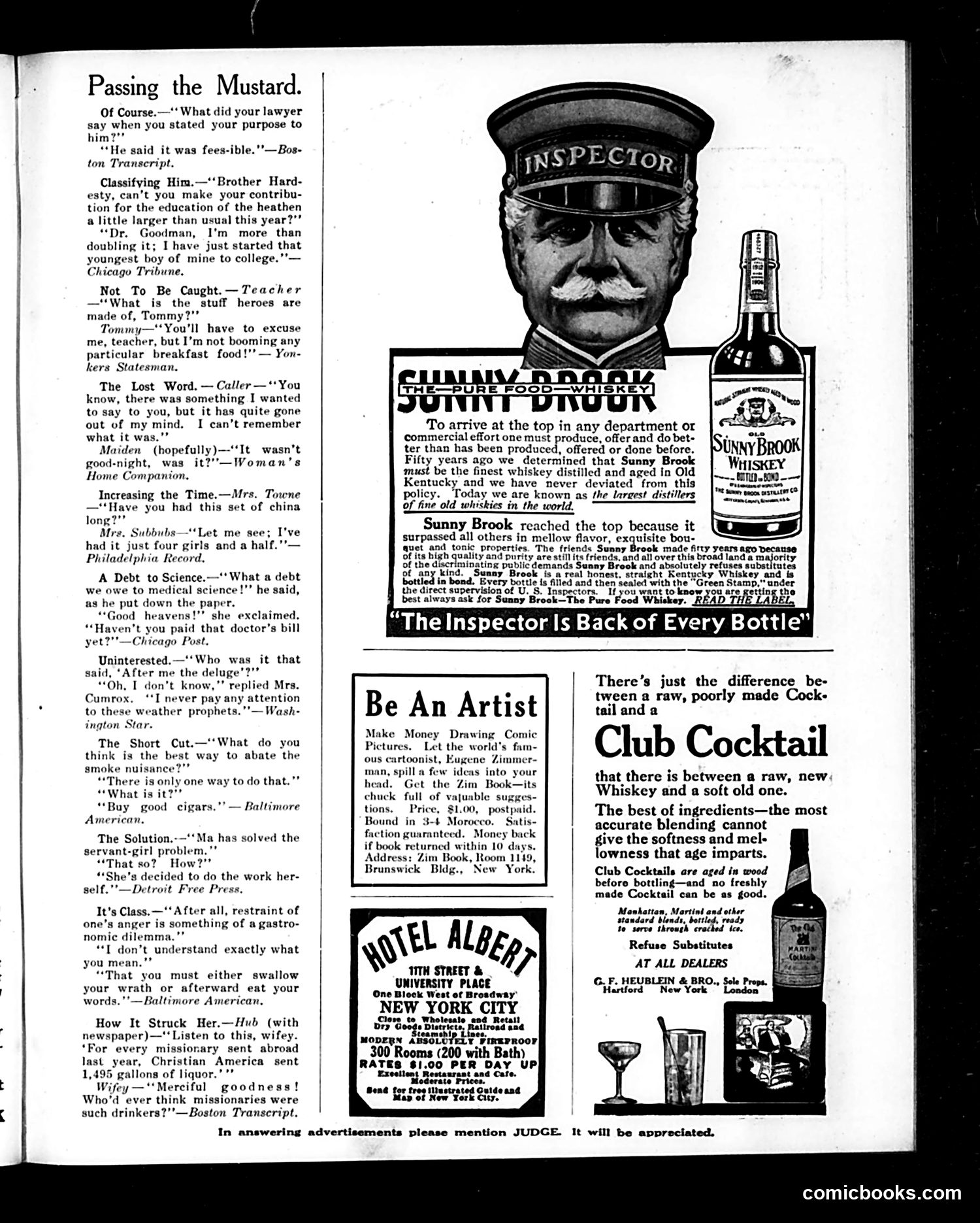
This page from *Judge* (a satirical magazine) contains primarily **short humorous anecdotes** rather than political cartoons. The jokes target common Americana themes: - **Legal satire**: A lawyer's pun about fees being "feasible" - **Religious hypocrisy**: A man donating more to "educate the heathen" after his son starts college—implying the son needs "civilizing" - **Advertising satire**: A child refusing to discuss what "heroes are made of" because he won't promote breakfast cereals - **Gender humor**: A young woman hopefully suggesting a man forgot to say "good-night" The page is dominated by **period advertisements** for Sunny Brook Whiskey (emphasizing 50 years of quality and U.S. Inspector approval) and Club Cocktail whiskey—reflecting Prohibition-era marketing strategies that stressed legitimacy and purity. There's also an ad for cartooning instruction and the Hotel Albert in New York. The satire is gentle, focusing on domestic life, commerce, and American social pretensions rather than sharp political critique.
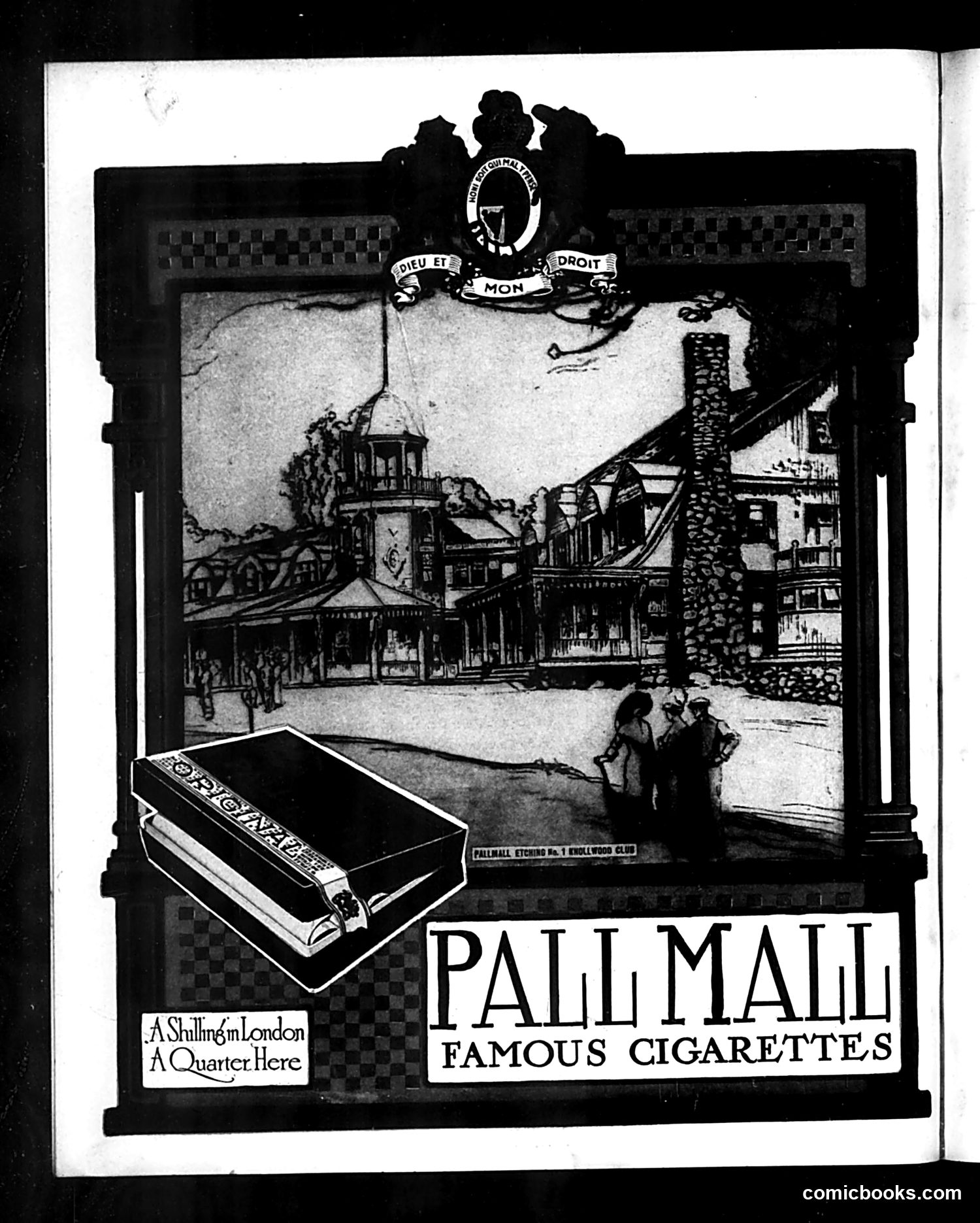
This is a full-page advertisement for Pall Mall Famous Cigarettes, not a political cartoon. The image depicts an idealized street scene in what appears to be a British colonial or exotic location, featuring architectural elements like a tower, palm tree, and period buildings with figures in the foreground. The advertisement's tagline reads "A Shilling in London, A Quarter Here," suggesting that Pall Mall cigarettes cost less in America than in Britain—a sales pitch emphasizing value for American consumers. The heraldic emblem at the top appears to be a quality or authenticity mark. This represents early 20th-century cigarette marketing that used aspirational imagery and comparative pricing to appeal to consumers.