
Judge, 1913-01-11 · page 17 of 24
Judge — January 11, 1913 — page 17: what you’re looking at
What you’re looking at
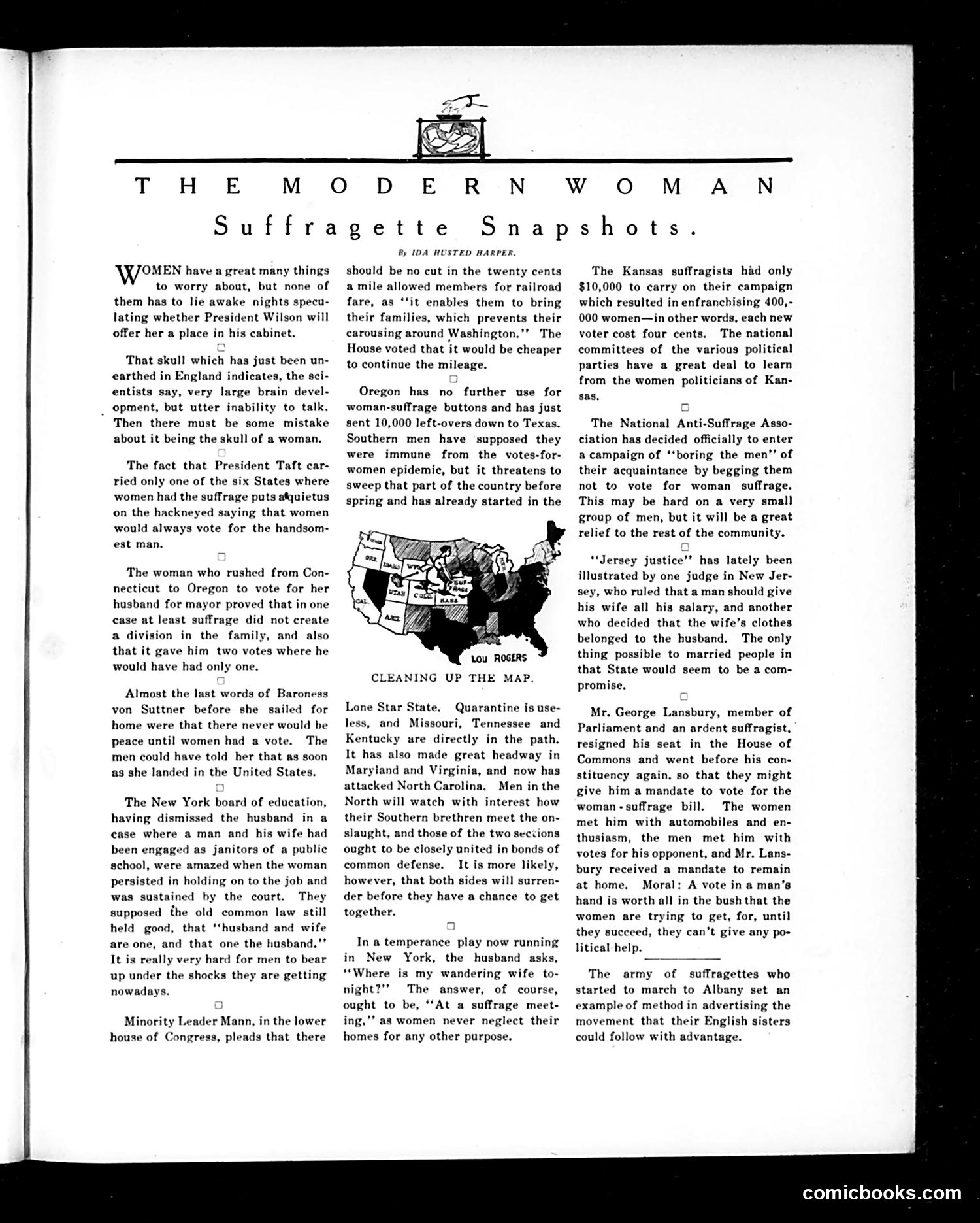
This is a satirical column by Ida Husted Harper mocking anti-suffrage arguments and celebrating women's voting progress. The accompanying map titled "Cleaning Up the Map" shows states where women have won suffrage, depicted as spreading infection-like across the country. The satire targets male anxieties about women voting: Harper skewers claims that women lack intelligence (the "skull" joke), that wives will divide families politically (disproven by a Connecticut woman voting for her husband's mayoral campaign), and that granting suffrage will disrupt homes (the temperance play joke suggesting women neglect domestic duties for suffrage meetings). The column celebrates concrete wins—Kansas suffragists enfranchising 400,000 women cheaply—while mocking anti-suffrage efforts and men's discomfort with female political power. References to President Taft losing states with women's suffrage and male congressmen defending railroad expenses suggest women voters are becoming a consequential political force. The overall message: women's suffrage is inevitable and expanding, and men's resistance is both futile and ridiculous.
📄 Transcribed text from this page (OCR, searchable)
Machine-transcribed from the original scan — historical spelling and the odd misread are preserved.
T H E Suffragette WOMEN have a great many things to worry about, but none of them has to lie awake nights specu- lating whether President Wilson will offer her a place in his cabinet. That skull which has just been un- earthed in England indicates, the sci- entists say, very large brain devel- _ Opment, but utter inability to talk. Then there must be some mistake about it being the skull of a woman. The fact that President Taft car- ried only one of the six States where women had the suffrage puts alquietus on the hackneyed saying that women would always vote for the handsom- est man. The woman who rushed from Con- necticut to Oregon to vote for her husband for mayor proved that in one case at least suffrage did not create a division in the family, and also that it gave him two votes where he would have had only one. Almost the last words of Baroness von Suttner before she sailed for home were that there never would be peace until women had a vote. The men could have told her that as soon as she landed in the United States. The New York board of education, having dismissed the husband in a case where a man and his wife had been engaged as janitors of a public school, were amazed when the woman persisted in holding on to the job and was sustained by the court. They supposed the old common law still held good, that “husband and wife are one, and that one the husband.”’ It is really very hard for men to bear up under the shocks they are getting nowadays. Minority Leader Mann, in the lower house of Congress, pleads that there M ODE N By IDA HUSTED HARPER. should be no cut in the twenty cents a mile allowed members for railroad fare, as ‘‘it enables them to bring their families, which prevents their carousing around Washington." The House voted that it would be cheaper to continue the mileage. Oregon has no further use for woman-suffrage buttons and has just sent 10,000 left-overs down to Texas. Southern men have ‘supposed they were immune from the votes-for- women epidemic, but it threatens to sweep that part of the country before spring and has already started in the CLEANING UP THE MAP. Lone Star State. Quarantine is use- less, and Missouri, Tennessee and Kentucky ure directly in the path. It has also made great headway in Maryland and Virginia, and now has attacked North Carolina, Men inthe North will watch with interest how their Southern brethren meet the on- slaught, and those of the two seccions ought to be closely united in bonds of common defense. It is more likely, however, that both sides will surren- der before they have a chance to get together. In a temperance play now running in New York, the husband asks, “Where is my wandering wife to- night?” The answer, of course, ought to be, ‘At a suffrage meet- ing," as women never neglect their homes for any other purpose. WwW OM A N Snapshots. The Kansas suffragists had only $10,000 to carry on their campaign which resulted in enfranchising 400,- 000 women—in other words, each new voter cost four cents. The national committees of the various political parties have a great deal to learn from the women pol ans of Kan- sas, The National Anti-Suffrage Asso- ciation has decided officially to enter a campaign of ‘‘boring the men”’ of their acquaintance by begging them not to vote for woman suffrage. This may be hard on a very small group of men, but it will be a great relief to the rest of the community. “Jersey justice’ has lately been illustrated by one judge in New Jer- sey, who ruled that a man should give his wife all his salary, and another who decided that the wife’s clothes belonged to the husband. The only thing possible to married people in that State would seem to be a com- promise. Mr. George Lansbury, member of Parliament and an ardent suffragist, resigned his seat in the House of Commons and went before his con- stituency again, so that they might give him a mandate to vote for the woman -suffrage bill. The women met him with automobiles and en- thusiasm, the men met him with votes for his opponent, and Mr. Lans- bury received a mandate to remain at home. Moral: A vote in a man’s hand is worth all in the bush that the women are trying to get, for, until they succeed, they can’t give any po- litical-help. The army of suffragettes who started to march to Albany set an example of method in advertising the movement that their English sisters could follow with advantage. comicbooks.com