
Judge, 1913-01-11 · page 16 of 24
Judge — January 11, 1913 — page 16: what you’re looking at
What you’re looking at
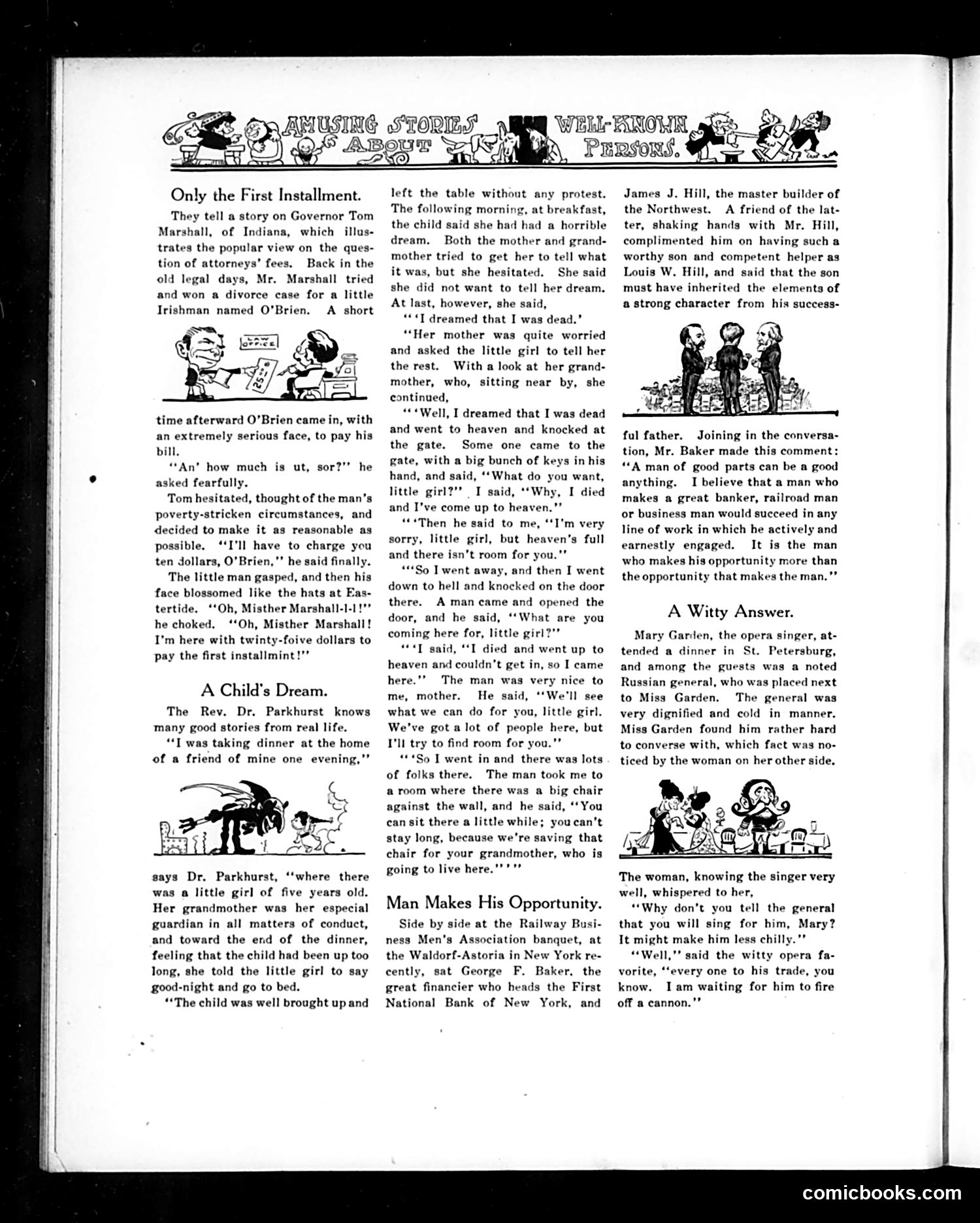
This page contains three humorous anecdotes rather than political cartoons: 1. **"Only the First Installment"**: A joke about Governor Tom Marshall of Indiana and an Irish client named O'Brien. The humor lies in O'Brien's misunderstanding—he arrives with $25 to pay the *first installment* of a $10 legal fee, suggesting he expects the bill to be so large it requires multiple payments. It satirizes both working-class financial anxiety and the high cost of legal services. 2. **"A Child's Dream"**: Rev. Dr. Parkhurst recounts a child's dream where heaven is full but hell has room. The joke targets grandmother's strict discipline—even hell would welcome the child more readily than heaven, implying the grandmother is so stern she's worse than damnation itself. 3. **"Man Makes His Opportunity"**: An anecdote about financier George F. Baker and railroad magnate James J. Hill at a banquet, celebrating individual merit and opportunity in business. The page reflects early-20th-century American attitudes about class, Irish immigrants, religious hypocrisy, and capitalist success.
📄 Transcribed text from this page (OCR, searchable)
Machine-transcribed from the original scan — historical spelling and the odd misread are preserved.
Only the First Installment. They tell a story on Governor Tom Marshall, of Indiana, which illus- trates the popular view on the ques- tion of attorneys’ f Back in the old legal da Mr. Marshall tried and won a divorce case for a little Irishman named O’Brien. A _ short time afterward O’Brien came in, with an extremely serious face, to pay his bill. “‘An’ how much is ut, sor?’’ he asked fearfully. Tom hesitated, thought of the man’s poverty-stricken circumstances, and decided to make it as reasonable as possible. ‘‘I’ll have to charge you ten dollars, O’Brien,’’ he said finally. The little man gasped, and then his face blossomed like the hats at Eas- tertide. ‘‘Oh, Misther Marshall-I-1!"” he choked. ‘‘Oh, Misther Marshall! I'm here with twinty-foive dollars to pay the first installmint!"’ A Child's Dream. The Rev. Dr. Parkhurst knows many good stories from real life. “‘T was taking dinner at the home of a friend of mine one evening,” says Dr. Parkhurst, ‘‘where there was a little girl of five years old. Her grandmother was her especial guardian in all matters of conduct, and toward the end of the dinner, feeling that the child had been up too long, she told the little girl to say good-night and go to bed. “The child was well brought up and left the table without any protest. The following morning, at breakfast, the child said she had had a horrible dream. Both the mother and grand- mother tried to get her to tell what it was, but she hesitated. She said she did not want to tell her dream. At last, however, she said, “**T dreamed that I was dead.’ “Her mother was quite worried and asked the little girl to tell her the rest. With a look at her grand- mother, who, sitting near by, she continued, “**Well, I dreamed that I was dead and went to heaven and knocked at the gate. Some one came to the gate, with a big bunch of keys in his hand, and said, ‘‘What do you want, little girl?” I said, ‘Why, I died and I’ve come up to heaven." “**Then he said to me, ‘I'm very sorry, little girl, but heaven’s full and there isn’t room for you.’? “So I went away, and then I went down to hell and knocked on the door there. A mancame and opened the door, and he said, ‘What are you coming here for, little girl?’’ “*T said, ‘I died and went up to heaven and couldn't get in, so I came here.” The man was very nice to me, mother. He said, ‘‘We'll see what we can do for you, little girl. We've got a lot of people here, but I'll try to find room for you.” “**So I went in and there was lots of folks there. The man took me to a room where there was a big chair against the wall, and he said, ‘* You can sit there a little while; youcan’t stay long, because we're saving that chair for your grandmother, who is going to live here.""""” Man Makes His Opportunity. Side by side at the Railway Busi- ness Men's Association banquet, at the Waldorf-Astoria in New York re- cently, sat George F. Baker, the great financier who heads the First National Bank of New York, and James J. Hill, the master builder of the Northwest. A friend of the lat- ter, shaking hands with Mr. Hill, complimented him on having such a worthy son and competent helper as Louis W. Hill, and said that the son must have inherited the elements of a strong character from his success- ful father. Joining in the conversa- tion, Mr. Baker made this comment: “A man of good parts can be a good anything. I believe that a man who makes a great banker, railroad man or business man would succeed in any line of work in which he actively and earnestly engaged. It is the man who makes his opportunity more than the opportunity that makes the man.”” A Witty Answer. Mary Garden, the opera singer, at- tended a dinner in St. Petersburg, and among the guests was a noted Russian general, who was placed next to Miss Garden. The general was very dignified and cold in manner. Miss Garden found him rather hard to converse with, which fact was no- ticed by the woman on her other side. The woman, knowing the singer very well, whispered to her, “Why don’t you tell the general that you will sing for him, Mary? It might make him less chilly."? “Well,”’ said the witty opera fa- vorite, ‘‘every one to his trade, you know. Iam waiting for him to fire off a cannon."’ comicbooks.com