
Judge, 1913-01-11 · page 4 of 24
Judge — January 11, 1913 — page 4: what you’re looking at
What you’re looking at
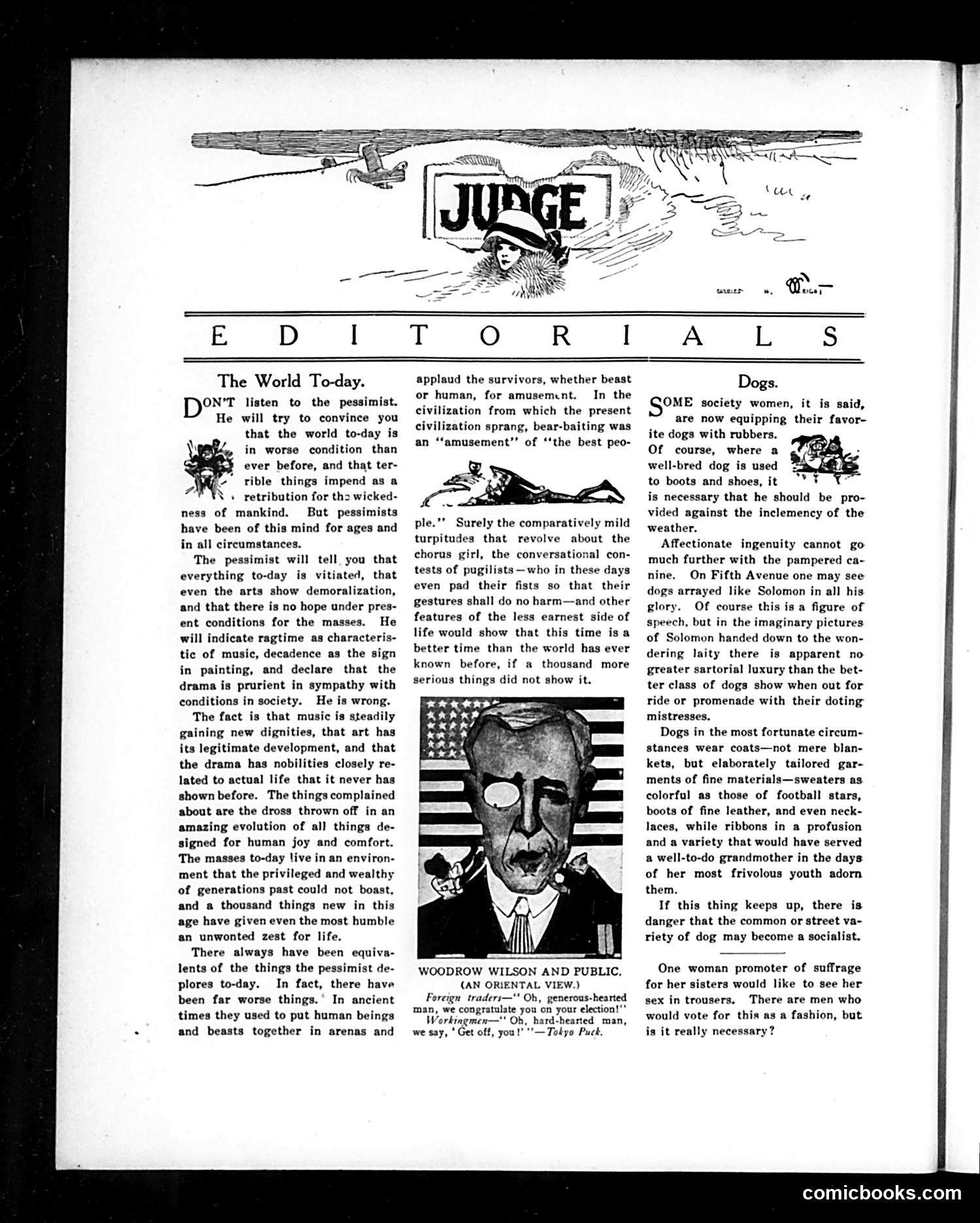
The main illustration depicts **Woodrow Wilson** (labeled "An Oriental View"), caricatured with exaggerated features in a style associating him with Asian stereotypes. The caption quotes foreign traders congratulating Wilson on his election, sarcastically contrasting Western democratic ideals with Oriental despotism. The left editorial "The World To-day" argues against pessimism about civilization's progress, countering claims that modern conditions are worse than historical barbarism. The right column "Dogs" satirizes wealthy society women equipping lap dogs with elaborate clothing and accessories—comparing their indulgence to historical decadence. It concludes with gentle mockery of women's suffrage advocates, questioning whether such fashion priorities demonstrate readiness for serious political participation. The overall tone is conservative social satire.
📄 Transcribed text from this page (OCR, searchable)
Machine-transcribed from the original scan — historical spelling and the odd misread are preserved.
waeer E D A The World To-day. ON’T listen to the pessimist. He will try to convince you that the world to-day is in worse condition than ever before, and that ter- é rible things impend as a \ s retribution for th> wicked- ness of mankind. But pessimists have been of this mind for ages and in all circumstances. The pessimist will tell. you that everything to-day is vitiated, that even the arts show demoralization, and that there is no hope under pres- ent conditions for the masses. He will indicate ragtime as characteris- tic of music, decadence as the sign in painting, and declare that the drama is prurient in sympathy with conditions in society. He is wrong. The fact is that music is steadily gaining new dignities, that art has its legitimate development, and that the drama has nobilities closely re- lated to actual life that it never has shown before. The things complained about are the dross thrown off in an amazing evolution of all things de- signed for human joy and comfort. The masses to-day live in an environ- ment that the privileged and wealthy of generations past could not boast, and a thousand things new in this age have given even the most humble an unwonted zest for life. There always have been equiva- lents of the things the pessimist de- plores to-day. In fact, there have been far worse things.* In ancient times they used to put human beings and beasts together in arenas and applaud the survivors, whether beast or human, for amusement. In the civilization from which the present civilization sprang, bear-baiting was an ‘‘amusement’’ of ‘‘the best peo- ple.’* Surely the comparatively mild turpitudes that revolve about the chorus girl, the conversational con- tests of pugilists —who in these days even pad their fists so that their gestures shall do no harm—and other features of the less earnest side of life would show that this time isa better time than the world has ever known before, if a thousand more serious things did not show it. WOODROW WILSON AND PUBLIC. (AN ORIENTAL VIEW.) Foreign traders—'* Oh, generous-hearted man, we congratulate you on your election!" Workingmen—" Ob, bard-hearted man, we say, ‘Get off, you!""’—Tokyo Puck. Dogs. Some society women, it is said, are now equipping their favor- ite dogs with rubbers. Of course, where a well-bred dog is used % to boots and shoes, it ** ¥ is necessary that he should be pro- vided against the inclemency of the weather. Affectionate ingenuity cannot go much further with the pampered ca- nine. On Fifth Avenue one may see dogs arrayed like Solomon in all his glory. Of course this is a figure of speech, but in the imaginary pictures of Solomon handed down to the won- dering laity there is apparent no greater sartorial luxury than the bet- ter class of dogs show when out for ride or promenade with their doting mistresses. Dogs in the most fortunate circum- stances wear coats—not mere blan- kets, but elaborately tailored gar- ments of fine materials—sweaters as colorful as those of football stars, boots of fine leather, and even neck- laces, while ribbons in a profusion and a variety that would have served a well-to-do grandmother in the days of her most frivolous youth adorn them. If this thing keeps up, there is danger that the common or street va- riety of dog may become a socialist. One woman promoter of suffrage for her sisters would like to see her There are men who would vote for this as a fashion, but it really necessary? sex in trousers. comicbooks.com