
A complete issue · 26 pages · 1912
Judge — November 30, 1912
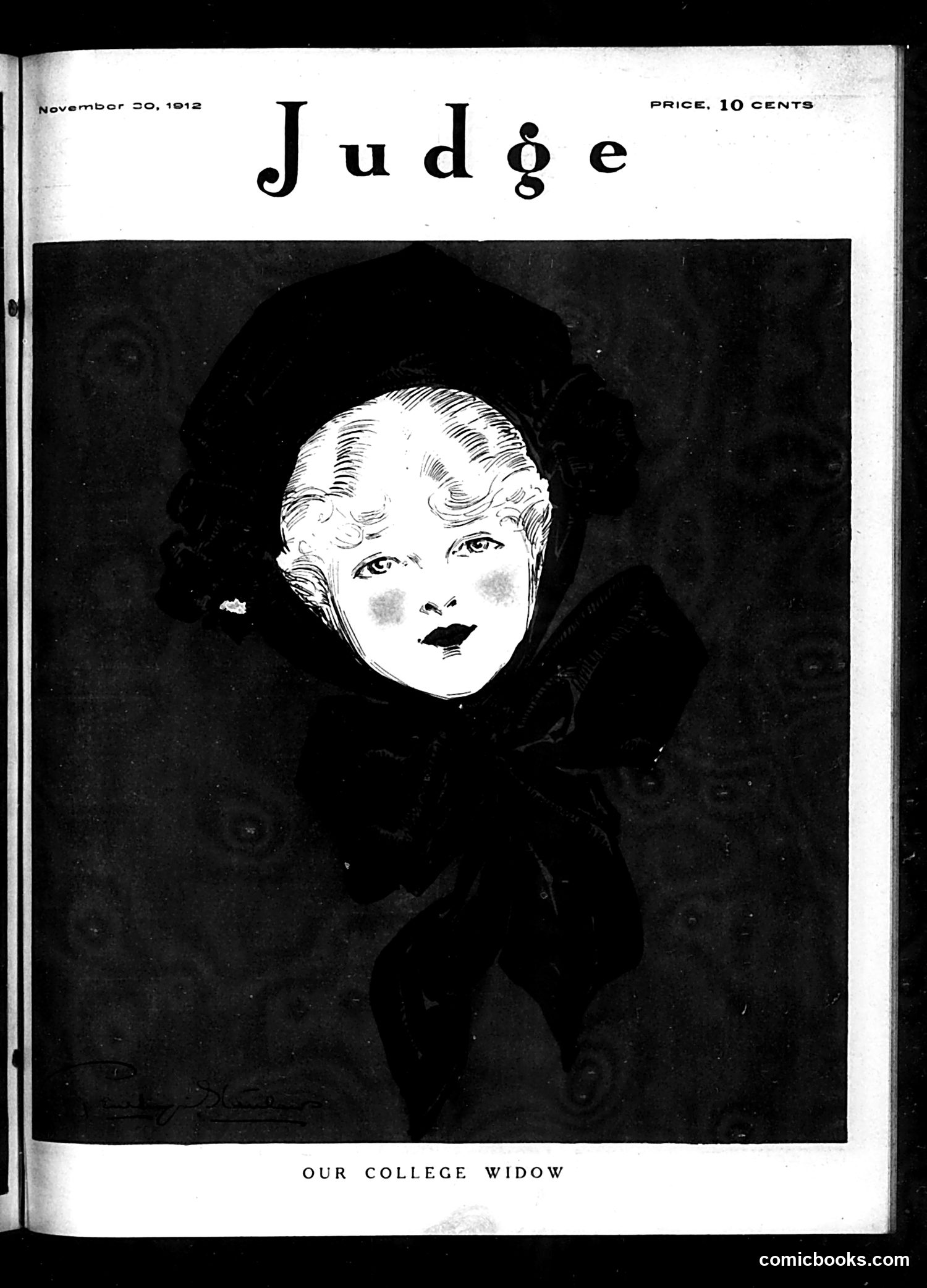
This cover features a stylized portrait of a woman in dark clothing with distinctive 1912-era styling—finger waves, pale makeup, and defined features. The caption reads "Our College Widow." The "College Widow" was a specific cultural type in early 20th-century American humor: an attractive woman associated with college life, often depicted as sophisticated and somewhat worldly. This satirical magazine cover appears to be commenting on contemporary social attitudes toward educated or college-affiliated women during the Progressive Era. Without additional context from the magazine's interior, the specific satirical intent remains unclear—whether this mocks college women, celebrates them, or comments on their social role in 1912 society. The stark, somewhat severe artistic style suggests social commentary rather than simple admiration.
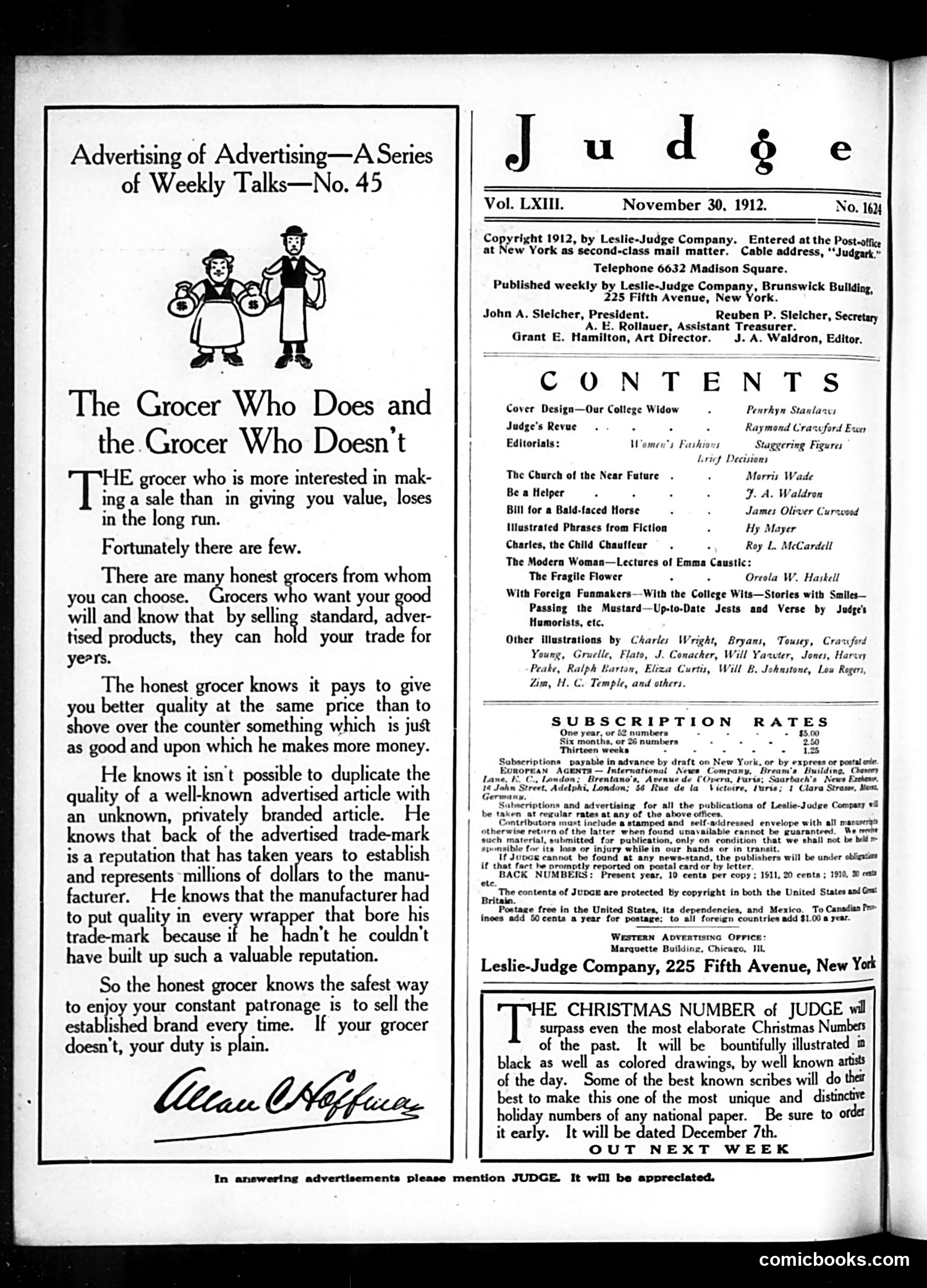
This page contains an **advertising article** rather than political satire. The left side features "The Grocer Who Does and the Grocer Who Doesn't," signed by what appears to be a prominent advertiser or columnist. The piece argues that honest grocers benefit from selling quality, advertised brand-name products rather than unknown private-label goods. It emphasizes that established brands represent manufacturer reputation built over years, making them safer and more trustworthy than cheaper alternatives. The accompanying illustration shows a family (woman, child, and man) holding grocery items, symbolizing the consumer benefit of brand loyalty. This reflects early 1900s advertising's emerging focus on **brand trust and quality assurance**—novel concepts when many grocers still sold unmarked bulk goods. The article is essentially promotional content for established manufacturers.
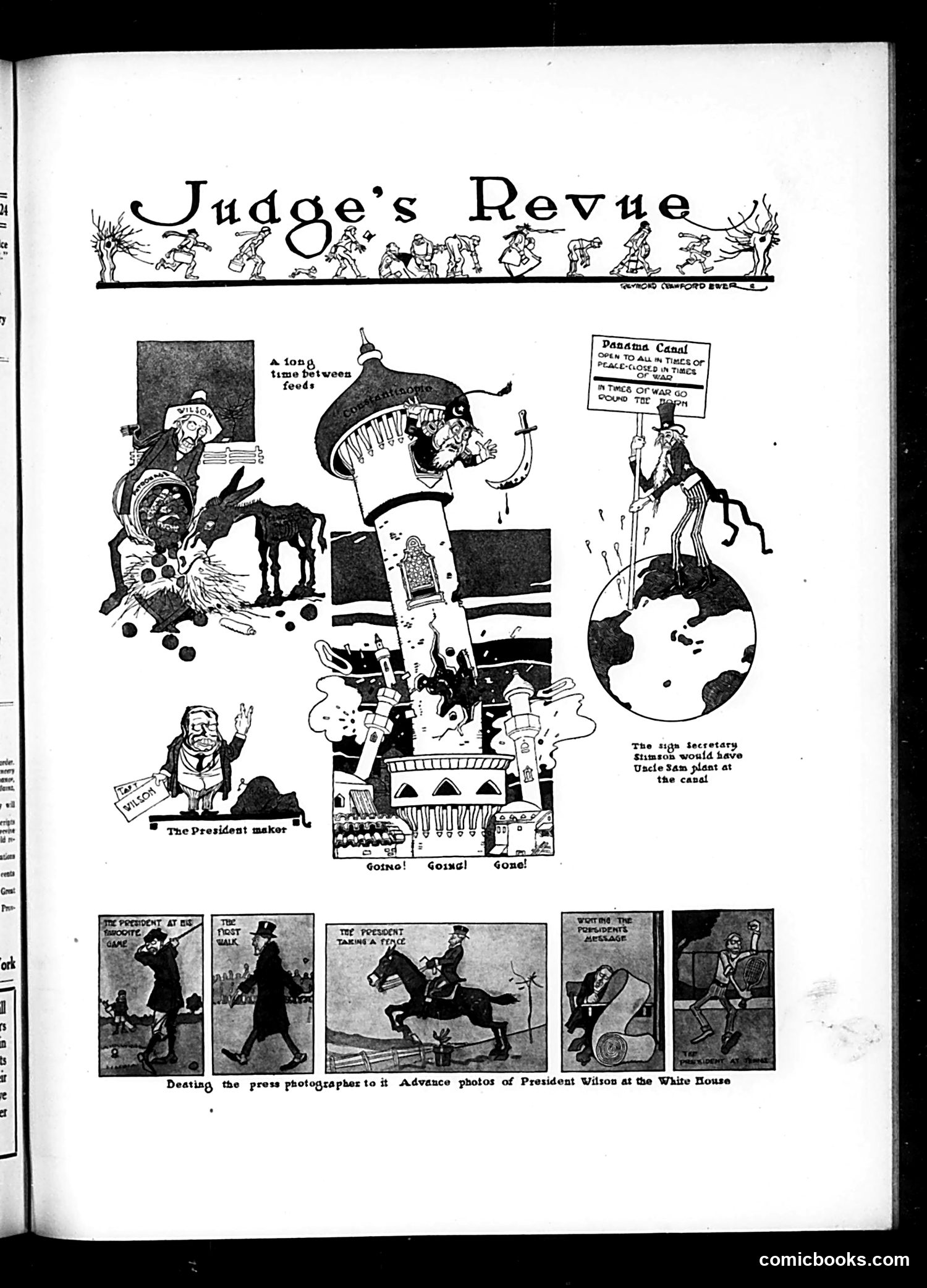
This satirical page mocks President Wilson's administration through exaggerated imagery. The central figure appears to be Wilson himself depicted as a large vessel or container, with various caricatured officials and situations surrounding him. Key elements include: - **"The President maker"** (lower left), suggesting someone manipulates Wilson - References to the **Panama Canal** (upper right), a major political issue - **Press photographers** documenting Wilson's activities at the White House - Chaotic scenes labeled "Going! Going! Going!" implying things are spiraling out of control The satire criticizes Wilson's administration as disorganized or controlled by hidden forces, while the focus on photography suggests media manipulation or staged presidential image-making—common critiques of early 20th-century Progressive politics.
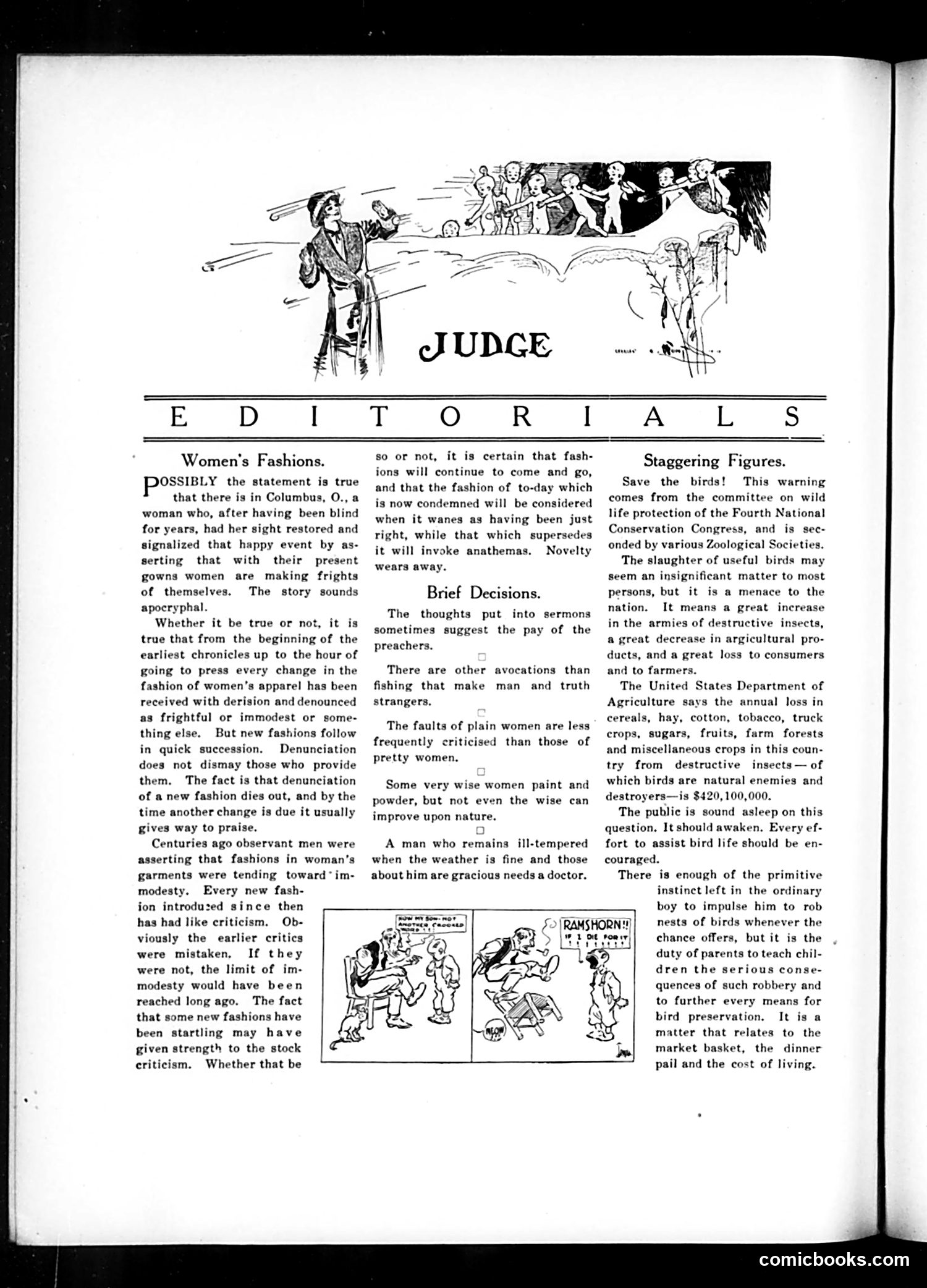
This page presents editorials and small cartoons addressing early 20th-century social concerns: **"Women's Fashions"** critiques changing fashion trends, noting that despite constant denunciation of new styles, they persist anyway. The editorial observes that fashion criticism has a long history but questions whether past critics were actually right. **"Brief Decisions"** contains short satirical observations: preachers deserve better pay, plain women face less criticism than pretty ones, and makeup cannot improve upon nature. **"Staggering Figures"** advocates for bird protection, warning that insectivorous bird slaughter damages agriculture significantly. The Department of Agriculture estimates annual losses at $420,100,000 from destructive insects. The piece appeals to parents' duty teaching children consequences of wildlife destruction. The small cartoon illustrations appear to depict domestic or humorous scenes related to these themes.
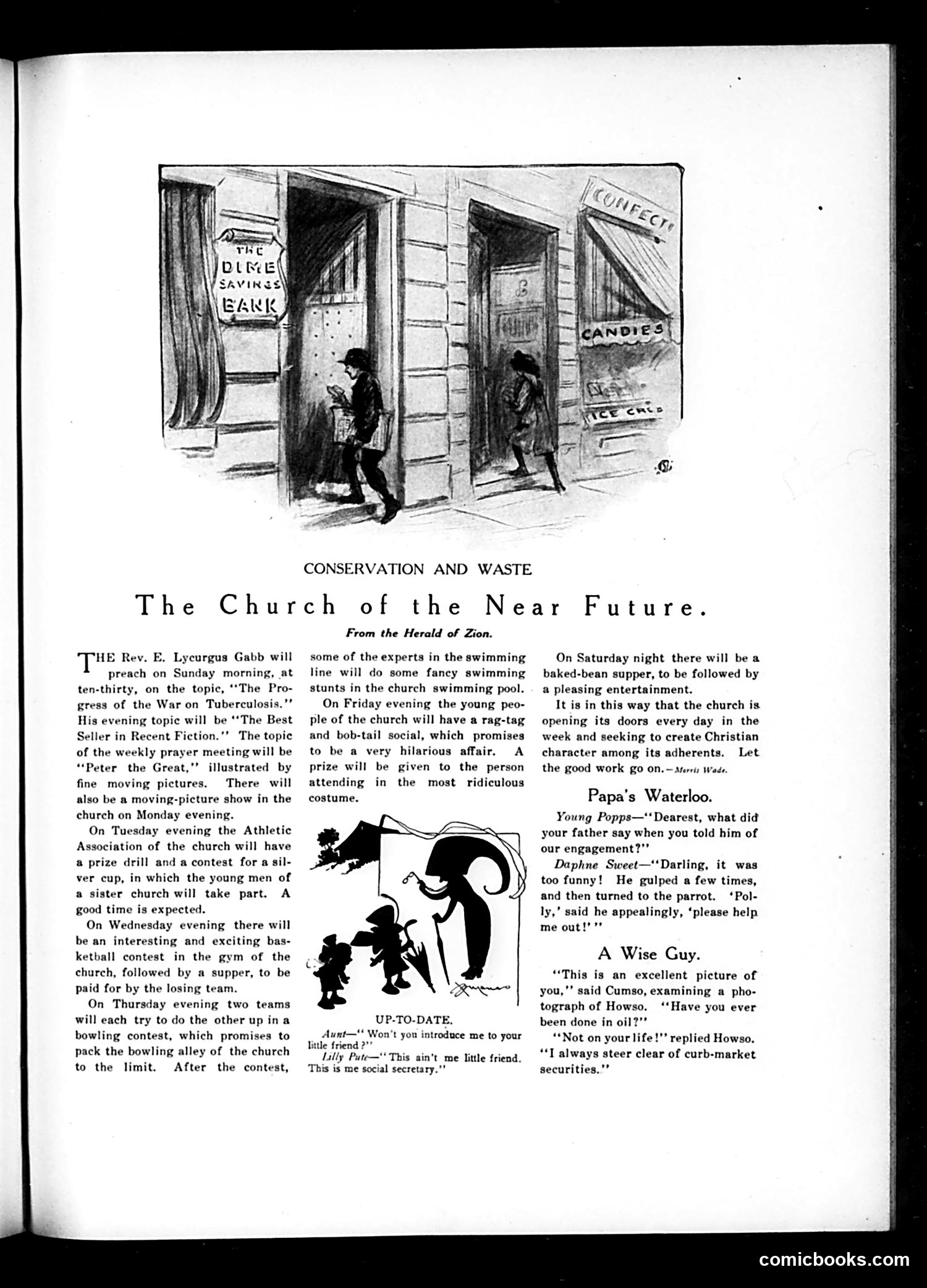
The top cartoon satirizes urban commercialism versus spiritual values. It shows storefronts for "The Dime Savings Bank," "Confectionery," "Candies," and "Ice Cream" alongside a church entrance—suggesting materialistic businesses compete with religion for public attention and devotion. The article below mocks "The Church of the Near Future," describing absurd modernized activities: swimming pools, rag-tag socials, basketball contests, and bowling—treating the church as a recreation center rather than a spiritual institution. This reflects early-20th-century anxieties about secularization and whether churches were abandoning traditional religious purpose for entertainment. The smaller cartoons ("Papa's Waterloo," "Up-to-Date," "A Wise Guy") appear to be unrelated humor pieces typical of Judge's format.
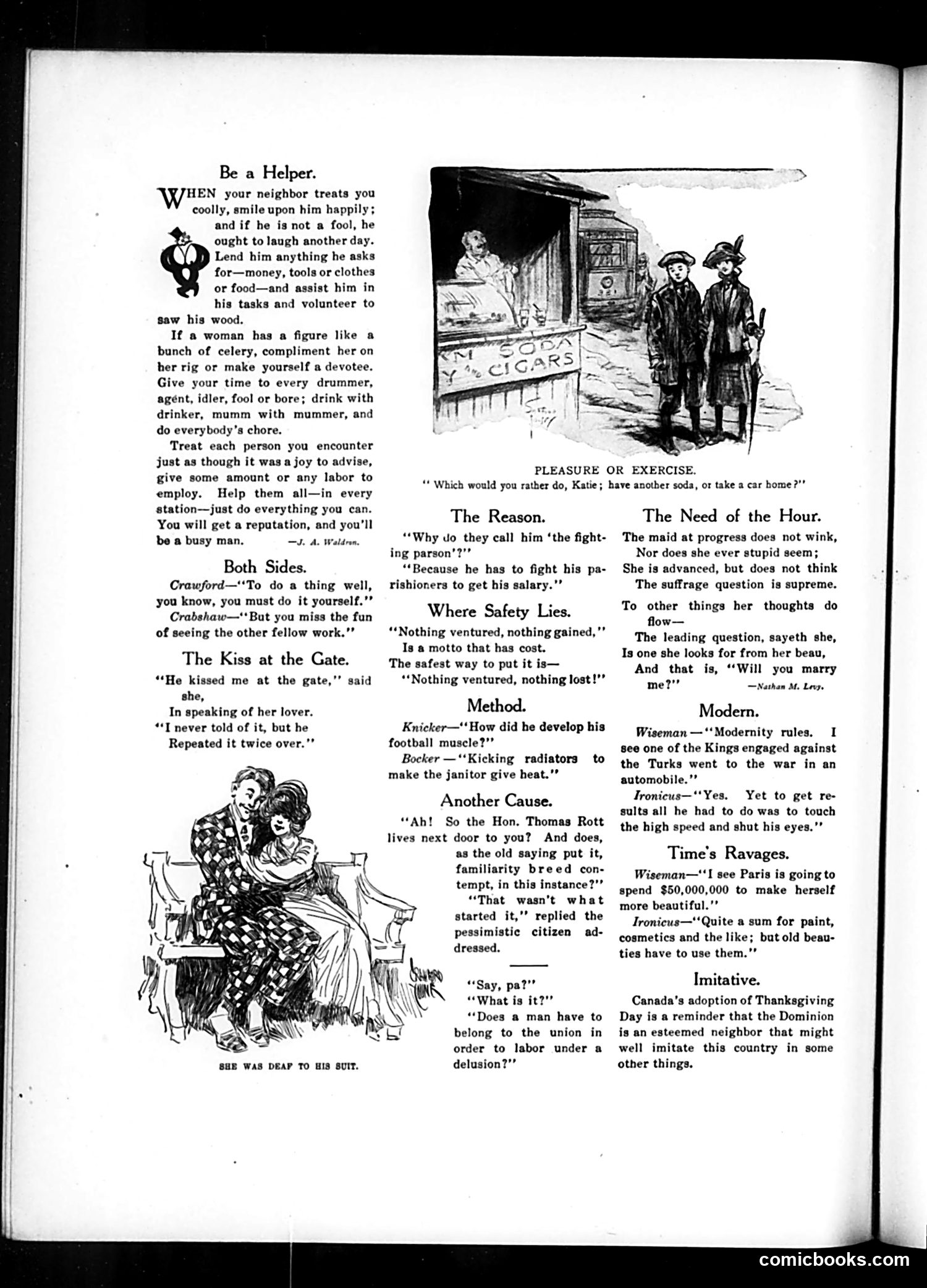
This page contains satirical humor pieces typical of early 20th-century American magazines. The main cartoons mock social pretensions and gender dynamics of the era: **"The Kiss at the Gate"** plays on Victorian courtship rituals—a woman mentions being kissed by her suitor, then reveals he repeated it, suggesting either his forwardness or her deafness to social propriety. **"Pleasure or Exercise"** depicts a working-class scene where a young woman must choose between an affordable soda or a car ride home—likely satirizing new consumer choices available to working women. **"The Need of the Hour"** mocks suffragettes by suggesting educated, "advanced" women prioritize marriage proposals over voting rights—reflecting anti-feminist attitudes of the period. Other pieces joke about labor disputes ("fighting parson"), modern warfare ("Kings...went to war in an automobile"), and Franco-American relations ("Paris spending money on beauty"). The overall tone reflects Judge's conservative, often dismissive humor toward progressive causes and social change.
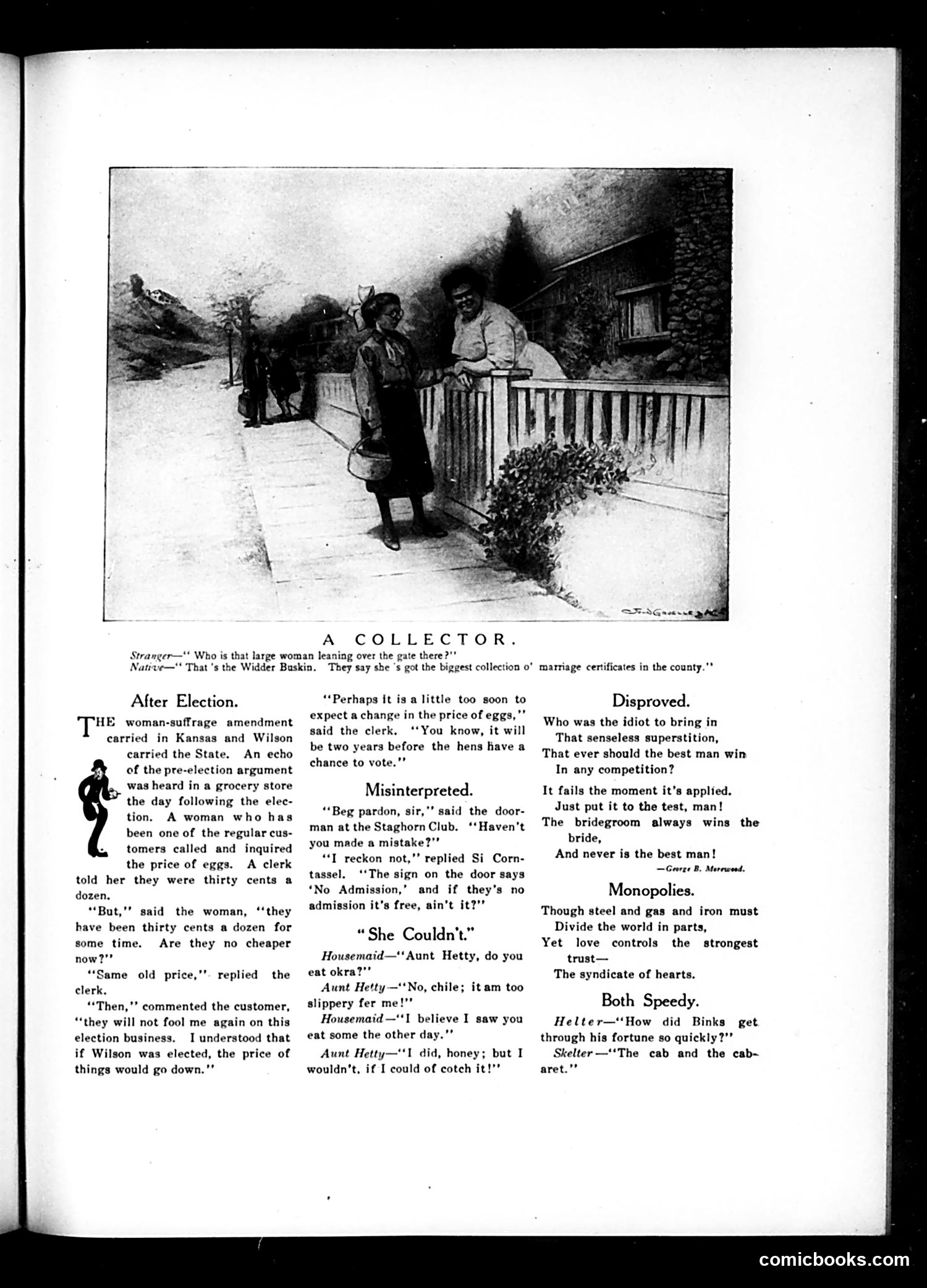
**Top Cartoon ("A Collector"):** A photograph-style illustration shows a woman at a gate. The joke plays on the double meaning of "collection"—the Widow Baskin allegedly has the largest collection of marriage certificates in the county, implying she's been married many times. **"After Election" (main text story):** References the 1912 election when Kansas approved women's suffrage and Woodrow Wilson won the presidency. A female voter expects egg prices to drop post-election, reflecting pre-election campaign promises. The clerk's joke—"it will be two years before the hens have a chance to vote"—mocks women's newfound voting power as insignificant and absurd. **Other brief jokes:** Scattered one-liners satirize class attitudes ("Misinterpreted"), marriage conventions ("Disproved"), and social behavior ("Both Speedy"). The page reflects early 20th-century skepticism toward women's suffrage, treating newly enfranchised female voters as naive or ridiculous rather than legitimate political participants.
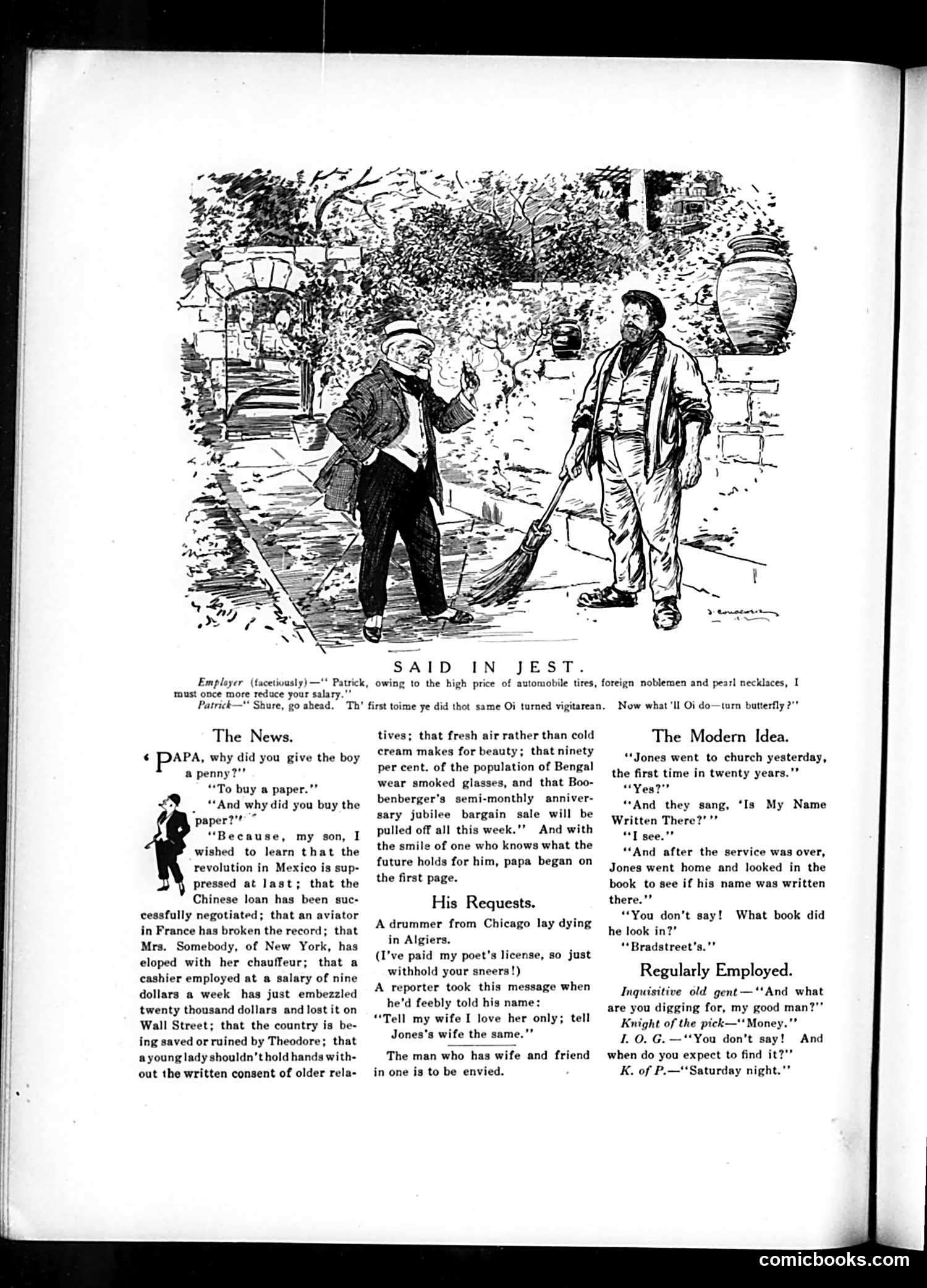
This page contains several satirical humor pieces typical of Judge magazine: **"Said in Jest"** (top cartoon): An employer jokes with his Irish worker Patrick about cutting his salary due to expenses on "automobile tires, foreign noblemen and pearl necklaces"—mocking the nouveau riche's frivolous spending habits. Patrick's Irish dialect ("Shure") suggests working-class humor common in the era. **"The News"**: A father explains to his son why he bought a newspaper, then ironically catalogs the trivial, sensational, and contradictory stories inside—satirizing journalism's obsession with gossip, financial scandals, and political drama rather than substantive reporting. References to Theodore (likely Roosevelt) suggest early 20th century dating. **Other brief pieces**: "His Requests," "The Modern Idea," and "Regularly Employed" are quick joke formats poking fun at human nature—infidelity, religious hypocrisy, and working-class aspirations. The overall tone mocks contemporary American society: wealthy excess, yellow journalism, and social pretension.
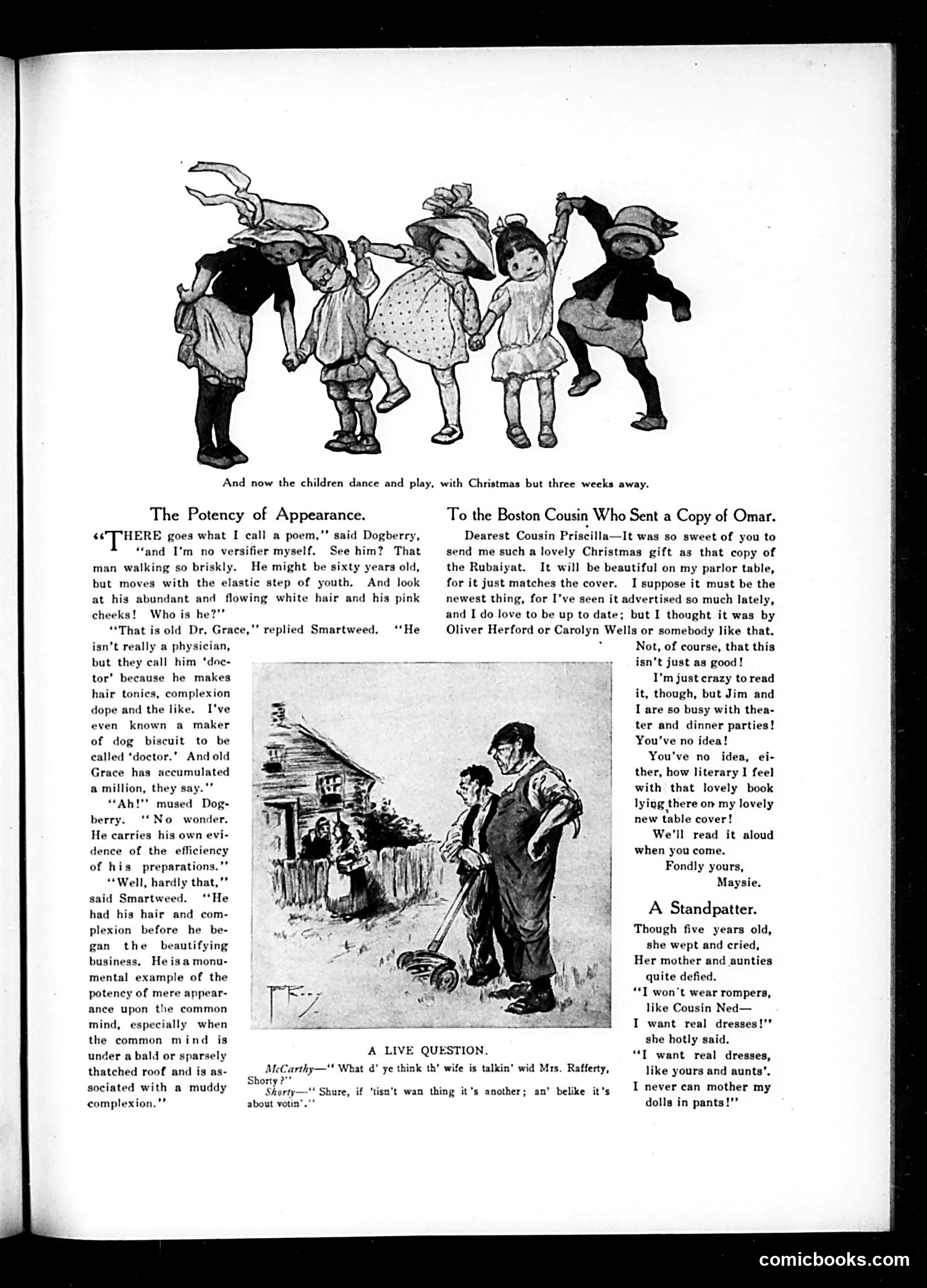
This page contains three separate satirical pieces typical of early 1900s American humor: **"The Potency of Appearance"**: Two characters discuss Dr. Grace, a con artist who sells beauty tonics and hair products. The satire mocks consumer gullibility—Grace appears youthful and vigorous, so people buy his products believing they work, when in fact he simply had good looks before entering the business. The joke exposes how superficial appearance manipulates "the common mind," especially among those with "a bald or sparsely thatched roof and...muddy complexion." **"A Live Question"**: Irish immigrants (McCarthy and Shorty) discuss wives gossiping. The humor relies on ethnic dialect stereotyping common to the era. **"To the Boston Cousin"** and **"A Standpatter"**: Light domestic humor about gift-giving pretension and a child rejecting old-fashioned clothing for modern styles. The page's core message: appearance deceives, consumerism thrives on vanity, and social status is performative—themes that resonate across eras despite the period-specific delivery.
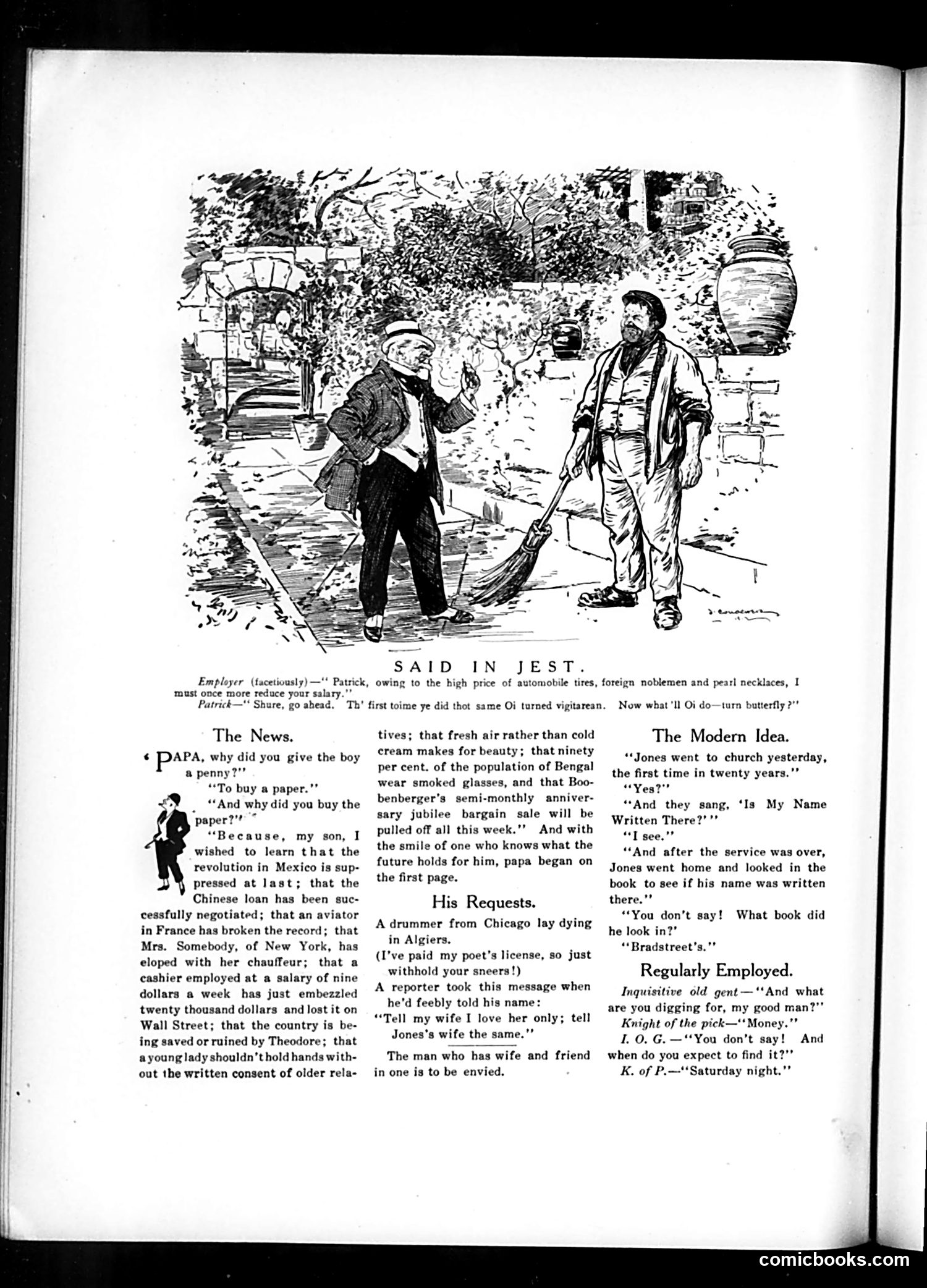
**"Said in Jest" (main cartoon):** An employer tells an Irish worker named Patrick he must take a salary cut due to expensive luxuries (automobile tires, foreign noblemen, pearl necklaces). Patrick responds that the last time he reduced his diet that way, he became vegetarian. The joke plays on Irish immigrant stereotypes and class resentment—the working poor bear economic costs for the wealthy's extravagances. **"The News":** A satirical piece mocking newspaper obsession. A father explains to his son that newspapers report trivial, contradictory, or sensational stories (Mexican revolution, embezzlement, Theodore Roosevelt, gossip about eloping socialites). The satire critiques how newspapers fill space with frivolous content. **Other brief items** include humorous anecdotes about a dying drummer's message, church attendance humor, and a laborer's sardonic expectation of finding money "Saturday night"—likely referring to payday. The page exemplifies Judge's satirical approach to labor, class tensions, and media criticism circa early 1900s.
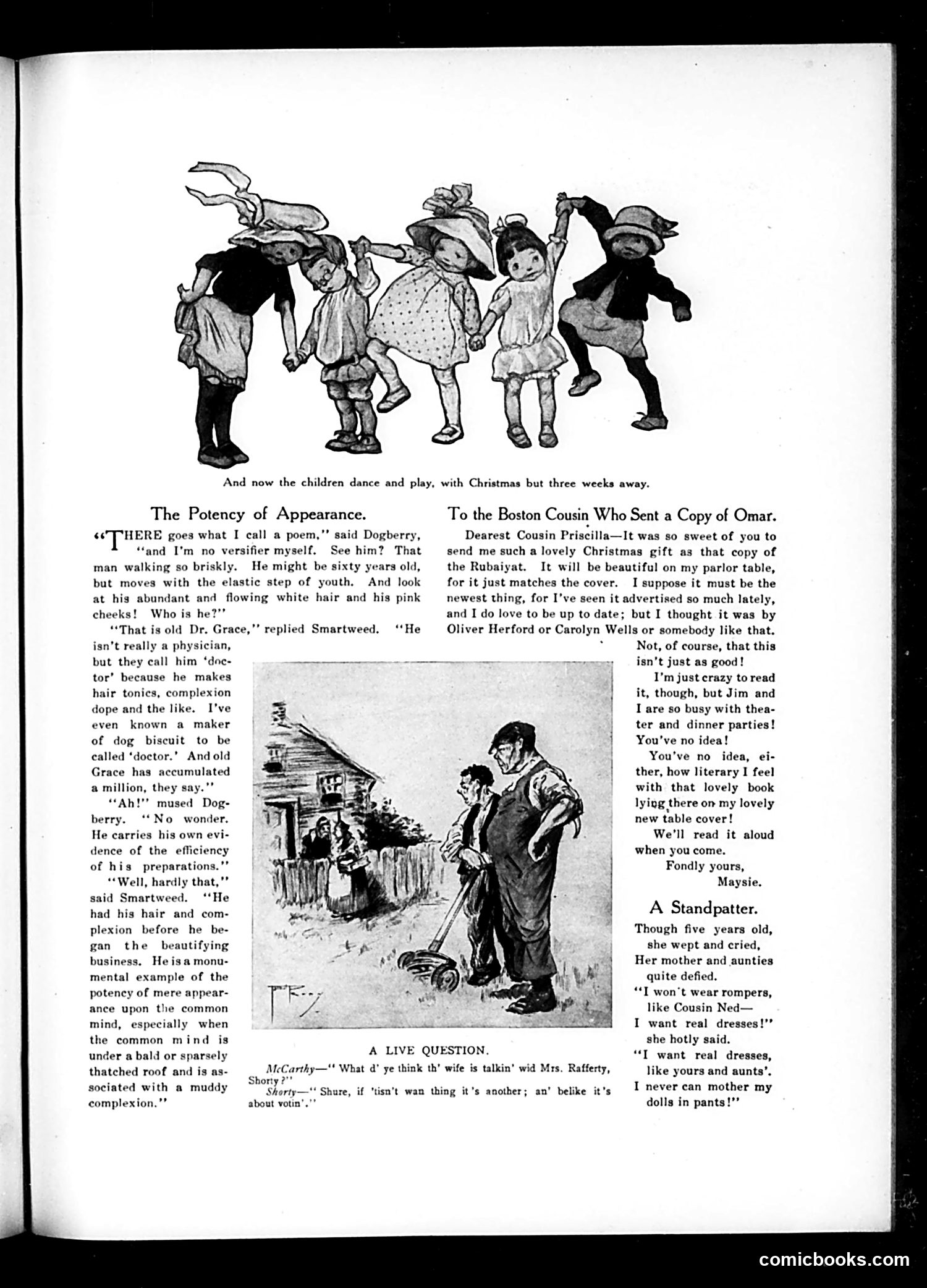
**"The Potency of Appearance"** satirizes consumer gullibility. Dr. Grace, a charlatan hair-tonic and complexion salesman, has become wealthy despite being a fake physician. The joke: his success depends entirely on his *own* youthful appearance—white hair and pink cheeks that prove his products "work." Smartweed explains the irony: Grace had his good looks *before* selling beauty products, yet customers assume his appearance proves his tonics' efficacy. This mocks how ordinary people ("the common mind") are duped by superficial evidence into buying worthless remedies. **"A Live Question"** features two working-class Irish men (McCarthy and Shorty, indicated by dialect) gossiping about their wives' conversation, unable to identify the topic but assuming it's trivial. **"To the Boston Cousin"** parodies a wealthy, pretentious woman who received the *Rubaiyat of Omar Khayyam* (a famous Persian poetry collection) as a Christmas gift but displays it as a fashionable decoration, confusing its authorship and admitting she's too busy with social obligations to actually read it. **"A Standpatter"** depicts a stubborn five-year-old girl refusing rompers, demanding "real dresses" like adult women wear—satirizing rigid gender expectations.
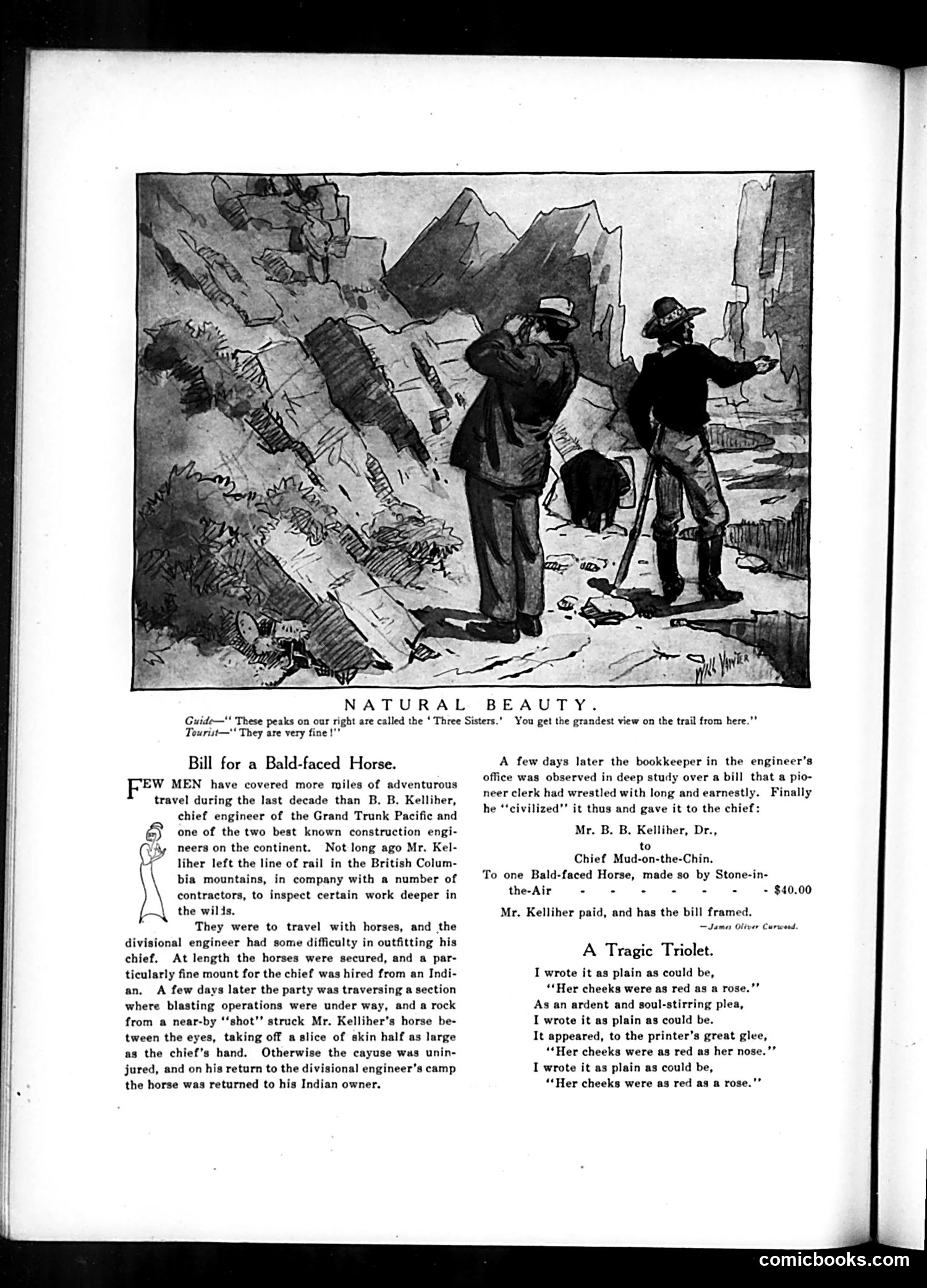
The page contains three separate pieces of humor: **"Natural Beauty"** (top cartoon): A guide shows tourists mountain peaks called "The Three Sisters," a straightforward joke about scenic tourism. **"Bill for a Bald-faced Horse"**: The main story concerns B.B. Kelliher, a real chief engineer of the Grand Trunk Pacific Railway, inspecting remote Canadian construction sites. A horse hired from a Native American owner gets struck in the face by a rock during blasting operations, creating a permanent bald patch. The humor lies in the creative billing: the engineer humorously invoices the horse's original owner for a horse that is now "bald-faced" (marked by a white blaze), naming it after the incident's cause ("Stone-in-the-Air") and charging $40. The joke mocks both bureaucratic absurdity and the ironic situation of billing someone for their own damaged property. **"A Tragic Triolet"**: A brief poem about a printer's error—a writer repeatedly describes cheeks as "red as a rose," but the printer changes it to "red as her nose," creating unintended comedy.
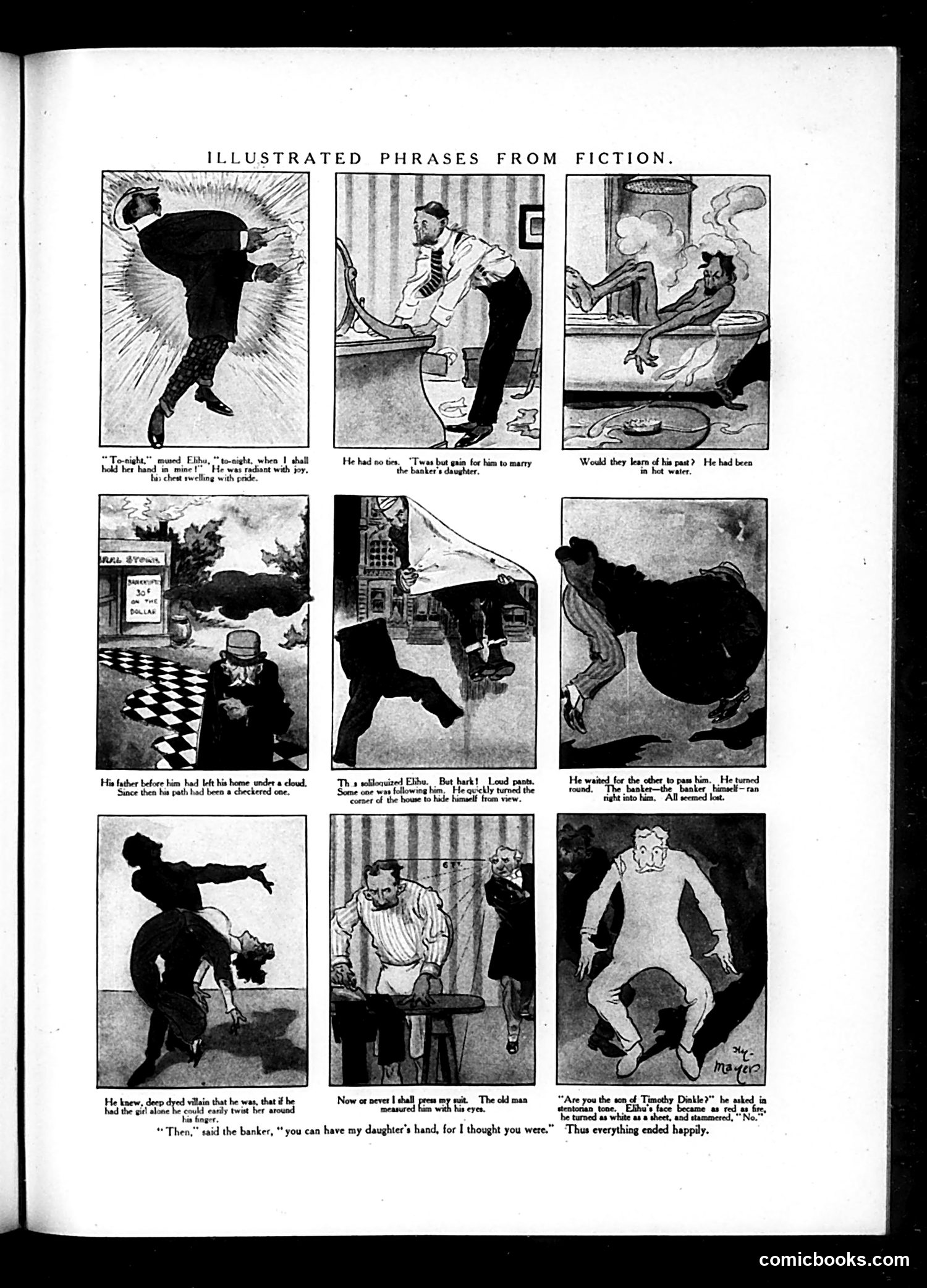
This page presents nine sequential comic panels illustrating melodramatic literary scenarios, likely from popular serialized fiction of the era. The scenes depict exaggerated emotional moments: a man's proud declaration of love, a baker's daughter, someone hiding from view, dramatic confrontations, and a banker offering his daughter's hand in marriage. The satire mocks the overwrought, clichéd tropes of contemporary romantic fiction—the breathless declarations, implausible plot twists, convenient revelations, and tidy "happily ever after" endings. By visually depicting these stock scenarios side-by-side, the cartoonist ridicules the formulaic, predictable nature of popular serial stories that readers consumed voraciously. The humor lies in the recognition that such saccharine narratives were absurdly common and repetitive.
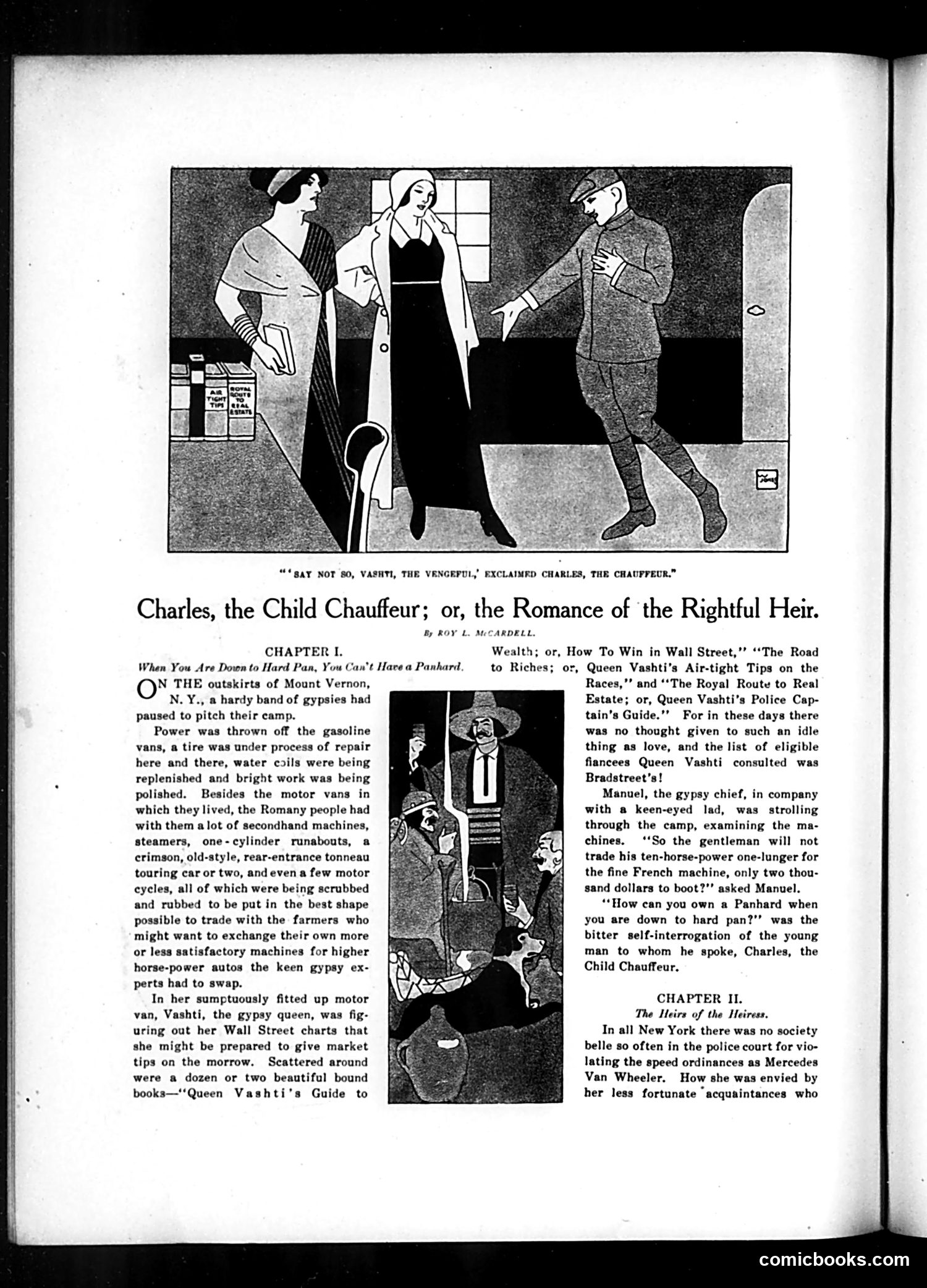
This is the opening of a serialized comic story by Roy L. McCardell satirizing early 1900s American wealth obsession and the automobile craze. **The Setup:** Gypsies camped near Mount Vernon, New York trade used automobiles. Vashti, the "gypsy queen," consults stock tips and real estate guides (Bradstreet's financial records) instead of seeking romance—mocking how wealth-chasing has replaced traditional values. The joke "How can you own a Panhard when you are down to hard pan?" plays on the Panhard automobile brand while punning on financial ruin. **The Satire:** The story ridicules nouveau-riche Americans desperately pursuing wealth and status symbols (cars, stocks, real estate). Mercedes Van Wheeler—named after a luxury automobile brand—is a society belle constantly violating speed laws, embodying reckless wealthy excess. **Context:** This reflects 1910s-era anxieties about materialism, automobiles as status symbols, and the tension between "proper" society and those climbing its ranks.
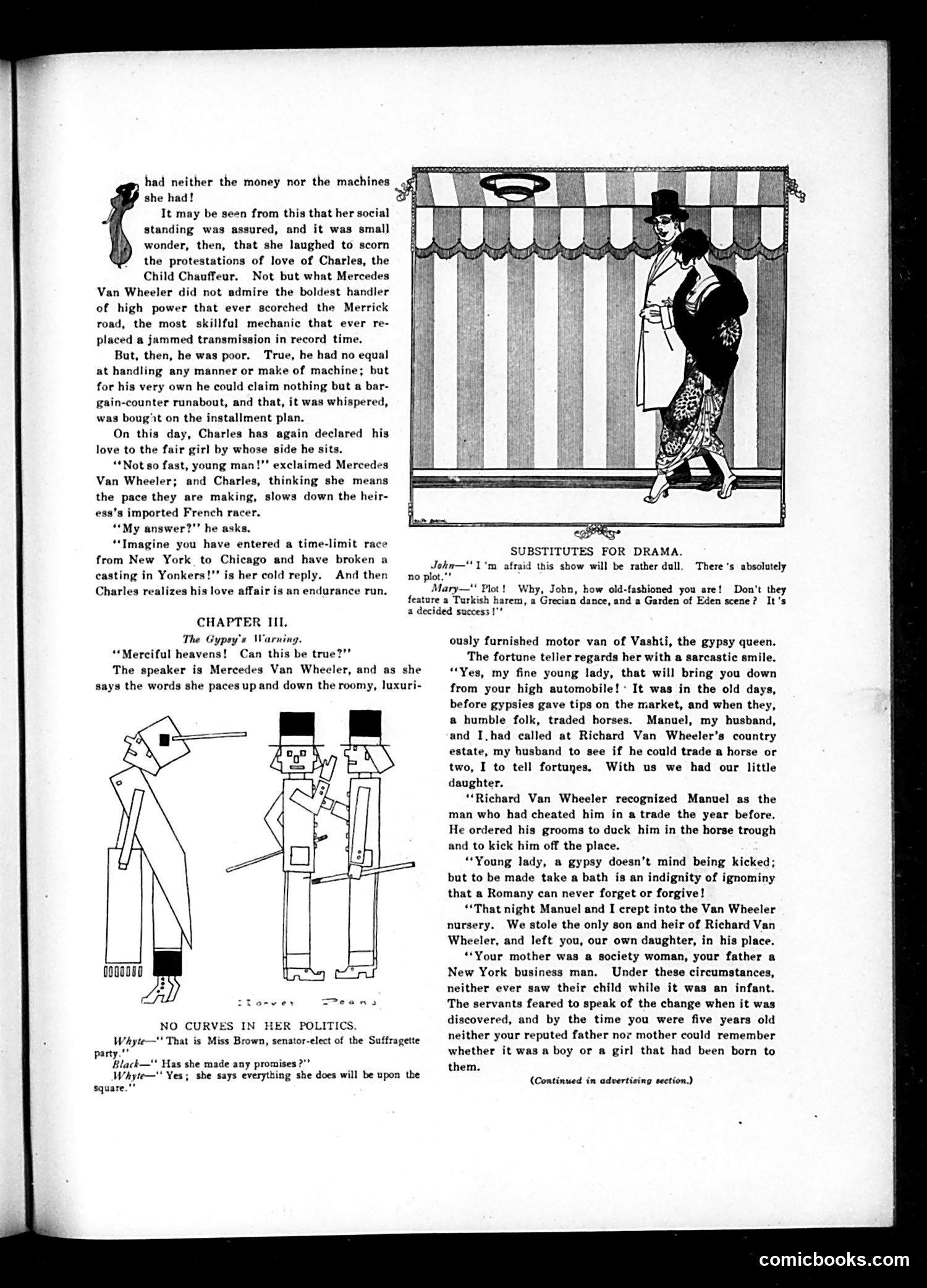
This page contains two separate satirical pieces from Judge magazine: **"The Child Chauffeur" narrative** mocks class barriers in courtship. Mercedes Van Wheeler, a wealthy heiress, rejects Charles's romantic advances not because he's unskilled (he's actually an excellent mechanic), but because he's poor and can only afford a cheap, installment-plan car. The satire critiques how wealth determines social worth and romantic eligibility, even when ability and character don't align with economic status. **"No Curves in Her Politics"** is a brief joke about a female suffragette politician. The pun plays on "curves" (female body shape/femininity) versus "square" (honest, straightforward). It suggests women politicians might conduct themselves with rigid propriety, sarcastically implying suffragettes are humorless and operate "by the book." Both pieces reflect early-20th-century Judge concerns: class anxiety, automotive culture, and ambivalence toward women's expanding political roles.
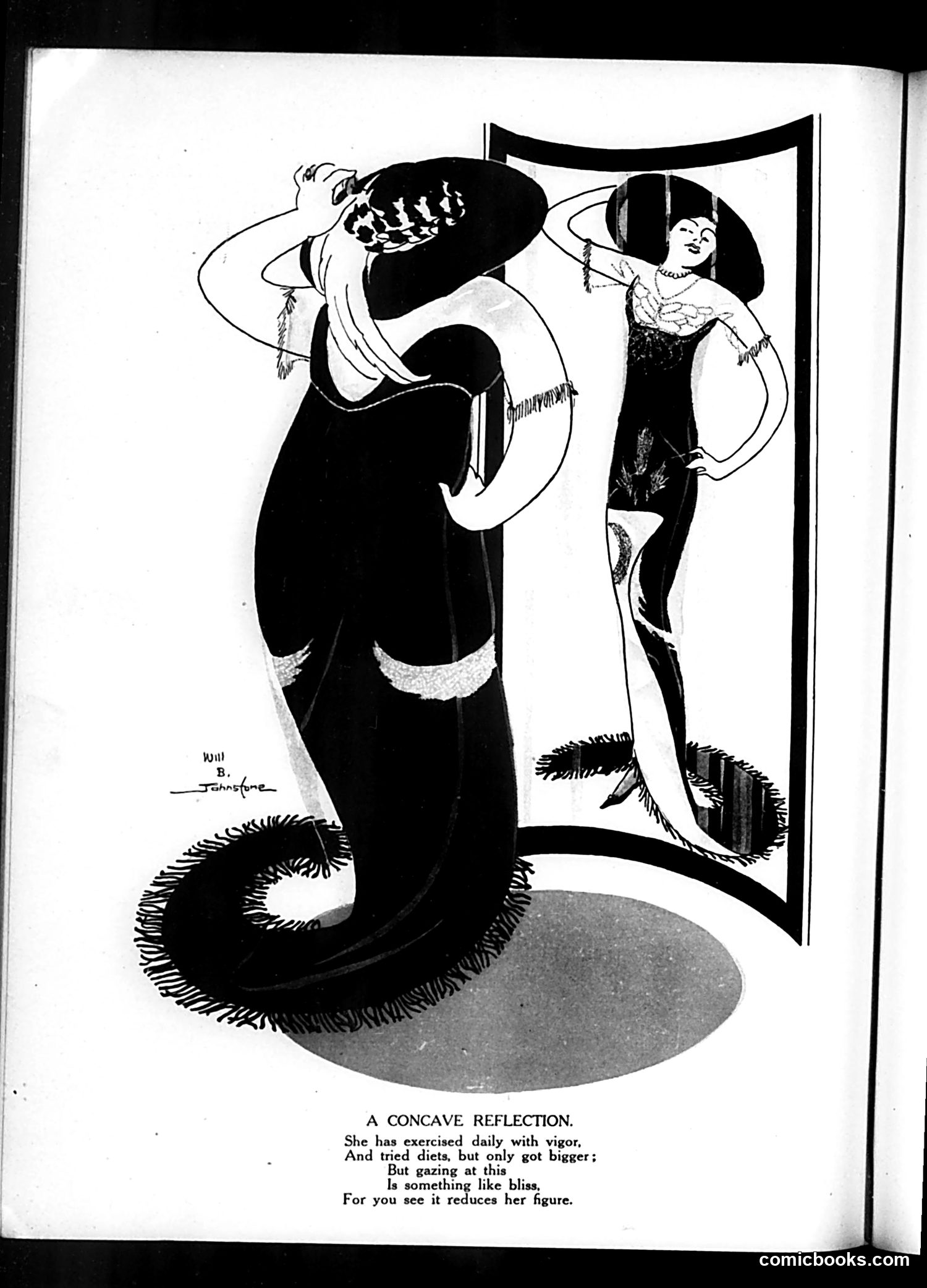
This cartoon satirizes women's body image and diet culture anxieties. A woman gazes into a concave mirror—which optically compresses and slims reflections—finding it gratifying because it makes her appear thinner than she actually is. The accompanying limerick jokes that despite rigorous exercise and dieting, she's gained weight. The mirror offers psychological comfort through optical illusion rather than actual results. The satire targets the gap between effort and outcomes in weight loss, and women's vulnerability to false reassurances about appearance. The cartoon reflects early-20th-century anxieties about female body image and commercial diet schemes, while mocking the self-deception involved in seeking flattering rather than accurate reflections of reality. The figure in the mirror serves as the punchline—literal distortion replacing honest self-assessment.
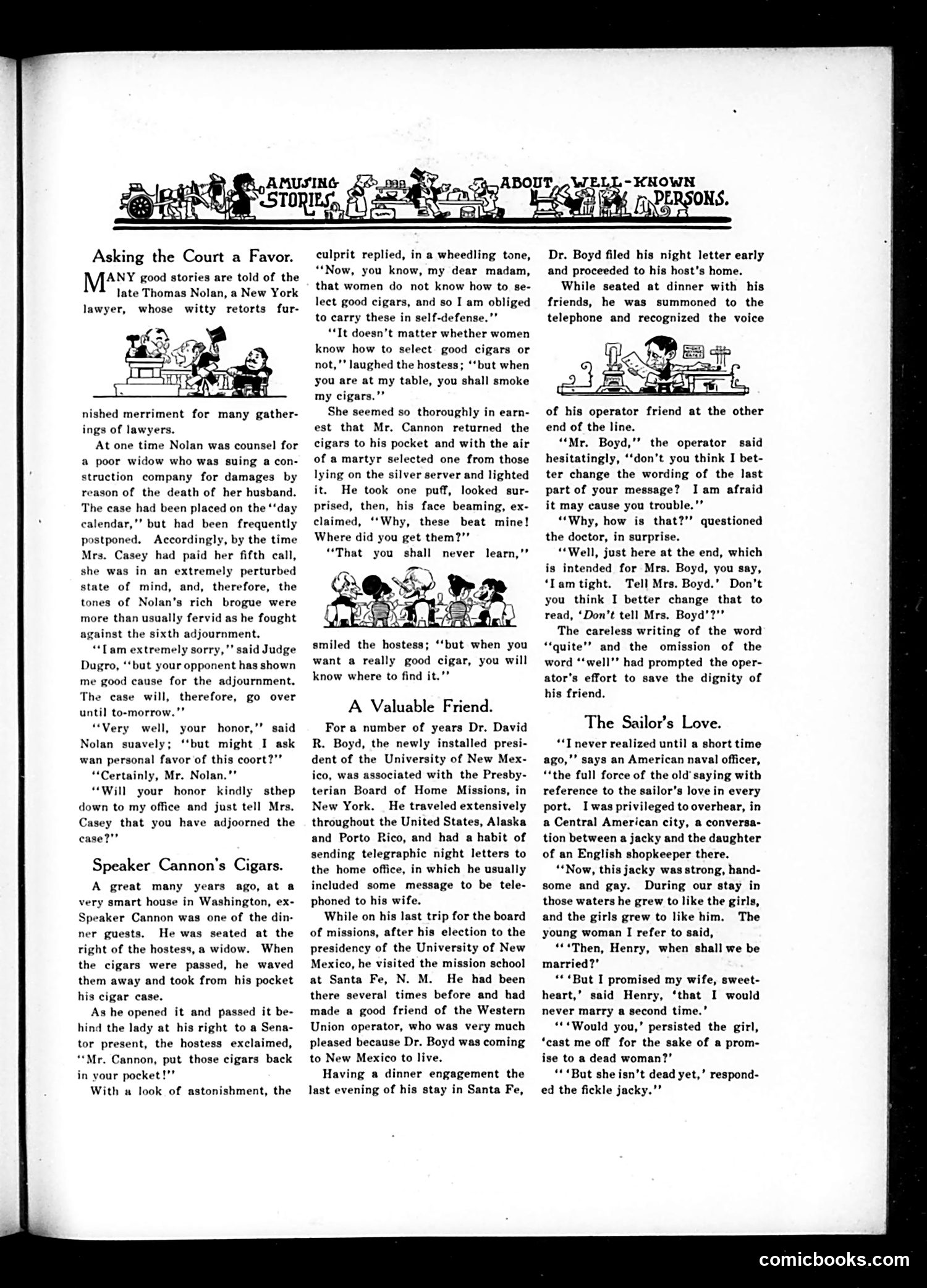
This page contains three humorous anecdotes about prominent figures, likely from the early 1900s. **"Asking the Court a Favor"** satirizes courtroom delays through lawyer Thomas Nolan's wit. A widow's case keeps being postponed; Nolan sarcastically asks the judge to personally explain the adjournment to his frustrated client—mocking the legal system's inefficiency. **"Speaker Cannon's Cigars"** features ex-Speaker Joseph Cannon (identifiable as a prominent political figure of the era). The joke: Cannon smugly insists on smoking his own cigars because women lack taste, only to discover the hostess's cigars are superior. It's gentle satire on male pretension and the folly of dismissing others' judgment. **"A Valuable Friend"** depicts Dr. David R. Boyd (newly installed University of New Mexico president) and a loyal Western Union operator. The operator alerts Boyd that his night letter contains wording that might cause trouble—showing genuine friendship transcending professional duty. These are anecdotal humor pieces typical of Judge's social commentary, celebrating wit, human nature, and character through real (or realistic) scenarios.
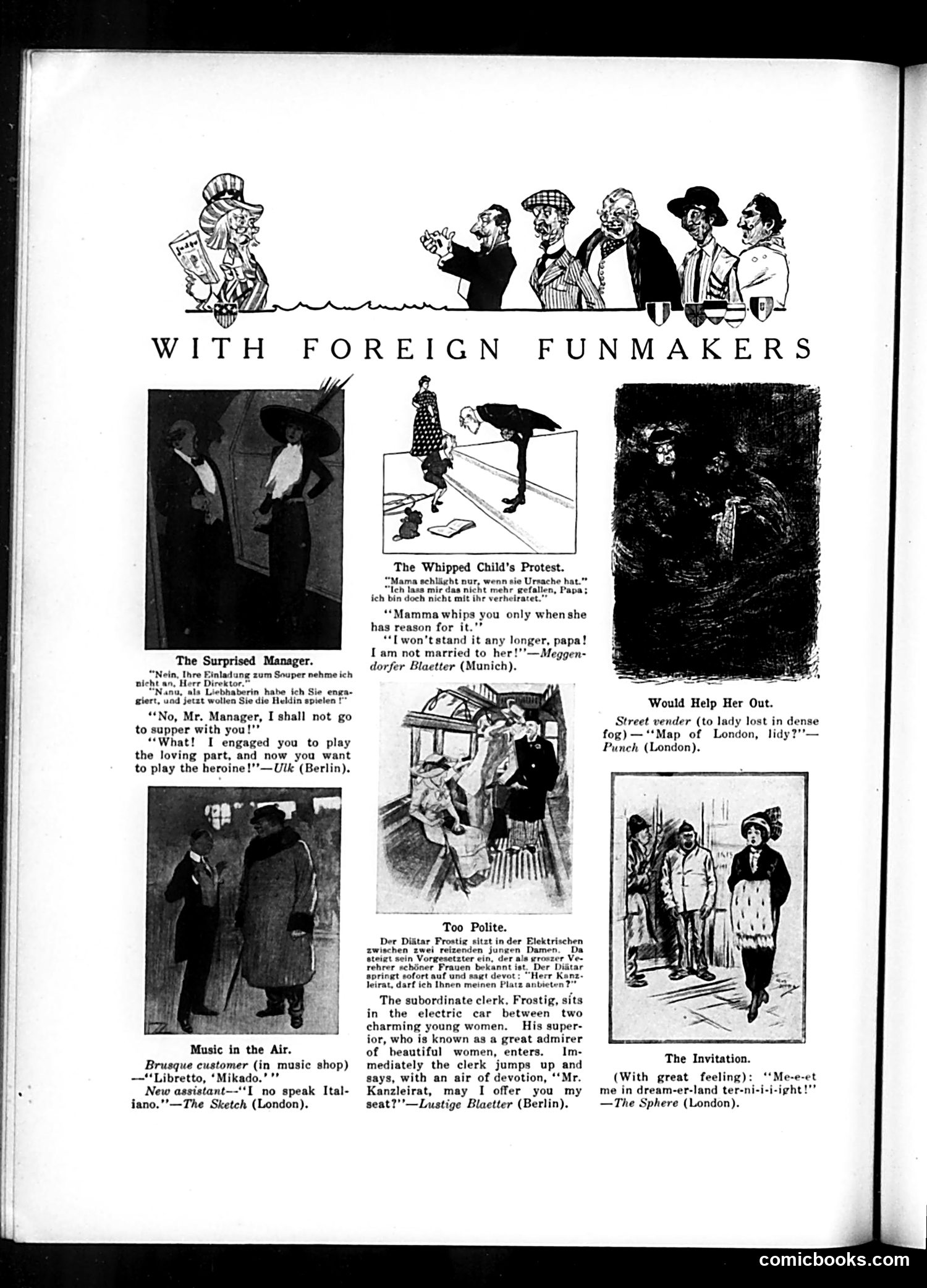
This Judge page collects humorous anecdotes from European satirical magazines, presented to American readers as examples of foreign wit. Each cartoon illustrates a social embarrassment or comedic misunderstanding: **"The Surprised Manager"** depicts a theatrical director shocked when an actress he hired for a romantic role refuses to play the "heroine," asserting professional boundaries—a comment on workplace power dynamics. **"The Whipped Child's Protest"** shows a child refusing parental discipline, claiming only spouses must tolerate such treatment—satirizing family authority. **"Too Polite"** features an office clerk absurdly jumping up to offer his seat to his superior, even at the cost of decorum. Other sketches play on language barriers ("Music in the Air") and urban confusion ("Would Help Her Out"). The page's framing suggests Judge's audience found European humor quaint or instructively different. The German and German-adjacent publications cited (Lustige Blaetter, Megendorfer Blaetter) indicate this reflects actual international magazine circulation among educated American readers.
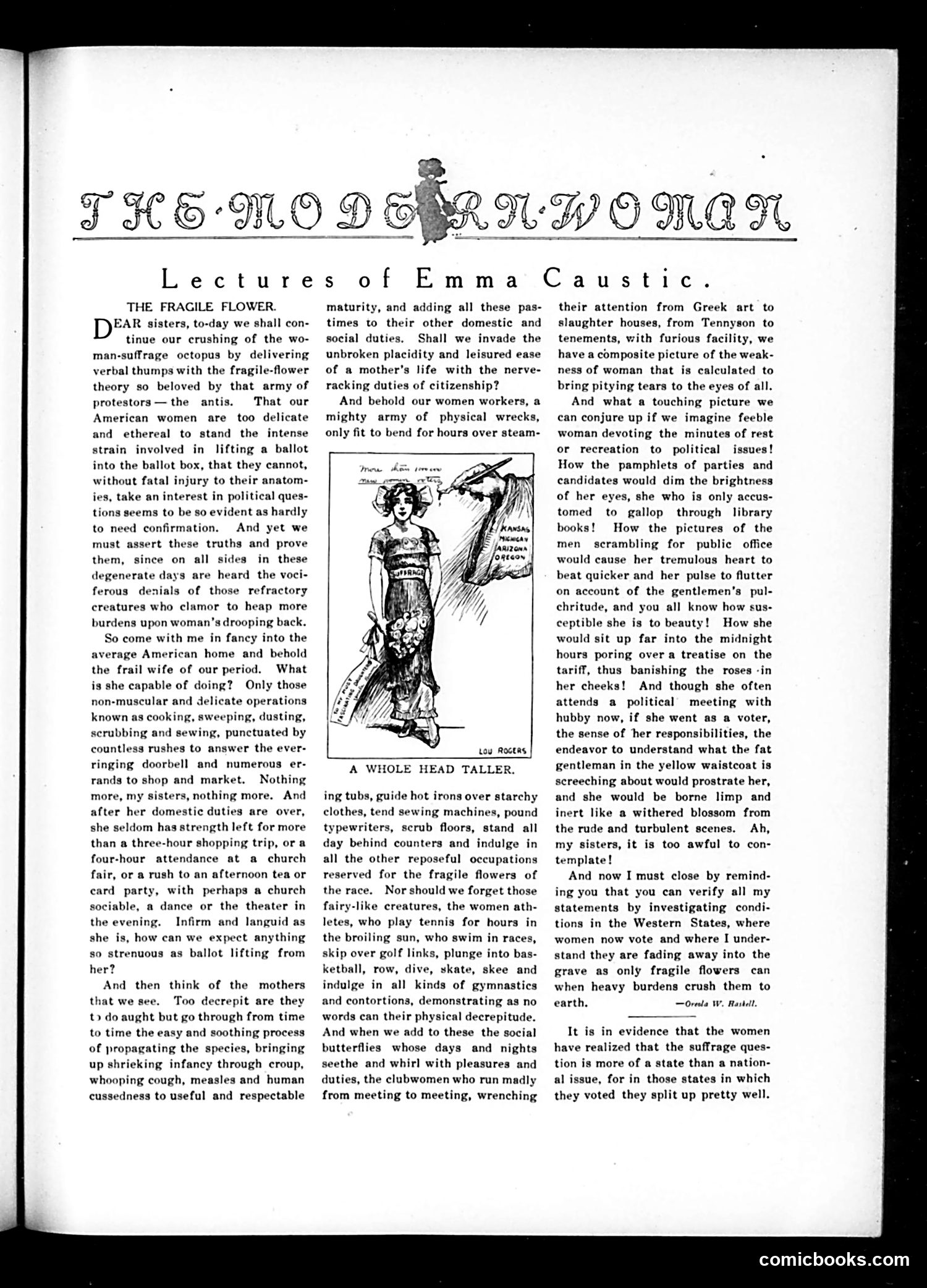
This is **satire supporting women's suffrage**. Emma Caustic sarcastically catalogs the arguments anti-suffrage activists ("the antis") used to deny women voting rights: that women were too delicate and physically weak for political participation. The cartoon by Loy Rogers shows a tall, robust woman labeled "A WHOLE HEAD TALLER," visually contradicting the "fragile flower" rhetoric. Caustic's text then systematically dismantles the anti-suffrage position by ironically listing all the physically demanding work women actually performed—factory labor, domestic drudgery, athletics, social organizing—proving they were hardly fragile. The satire's point: if women could handle exhausting manual labor, childcare, and complex social duties, the claim they were too delicate to vote was transparently false. This piece advocates for women's political equality by exposing the hypocrisy of opponents' arguments.
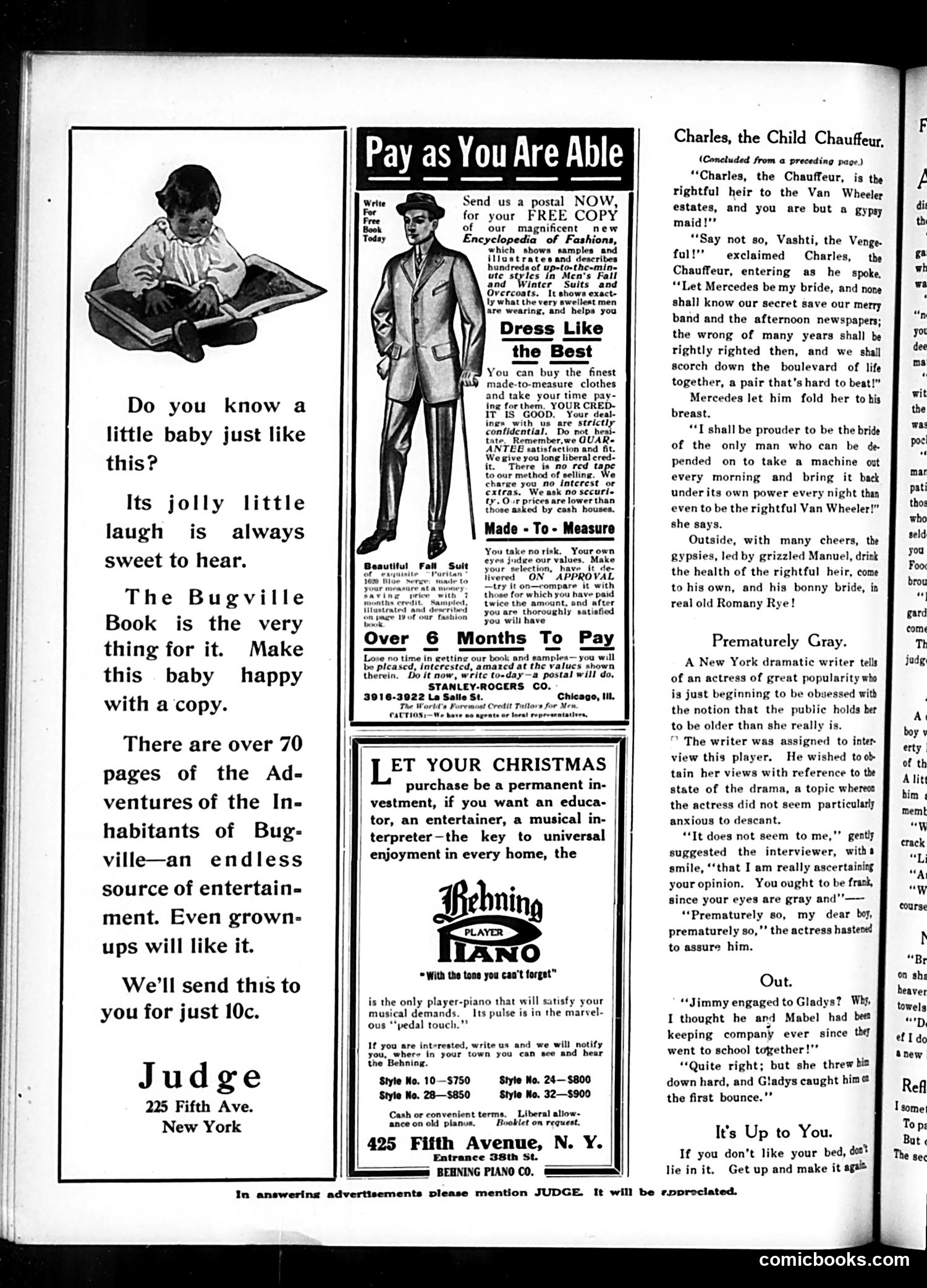
This page consists primarily of **period advertisements** rather than satirical cartoons. The main content includes: **Advertisements:** - Judge magazine promoting "The Bugville Book" (children's entertainment) - A men's clothing company offering made-to-measure suits with extended payment plans ("Pay as You Are Able") - A Behning player piano marketed as a Christmas investment **Story Continuation:** "Charles, the Child Chauffeur" is a serialized melodrama about a chauffeur revealed to be an heir to the Van Wheeler estate, who wins the hand of Mercedes. This appears to be **parody or satire of overwrought romantic serials** popular in period magazines—the purple prose ("scorch down the boulevard of life") and absurd plot twists mock cheap serialized fiction. **Brief Story Items:** Short humor pieces about actresses worrying over gray hair and romantic entanglements. The page reflects early 1900s consumer culture: installment buying, player pianos as status symbols, and the magazine's dual function as both satirical publication and advertising vehicle.
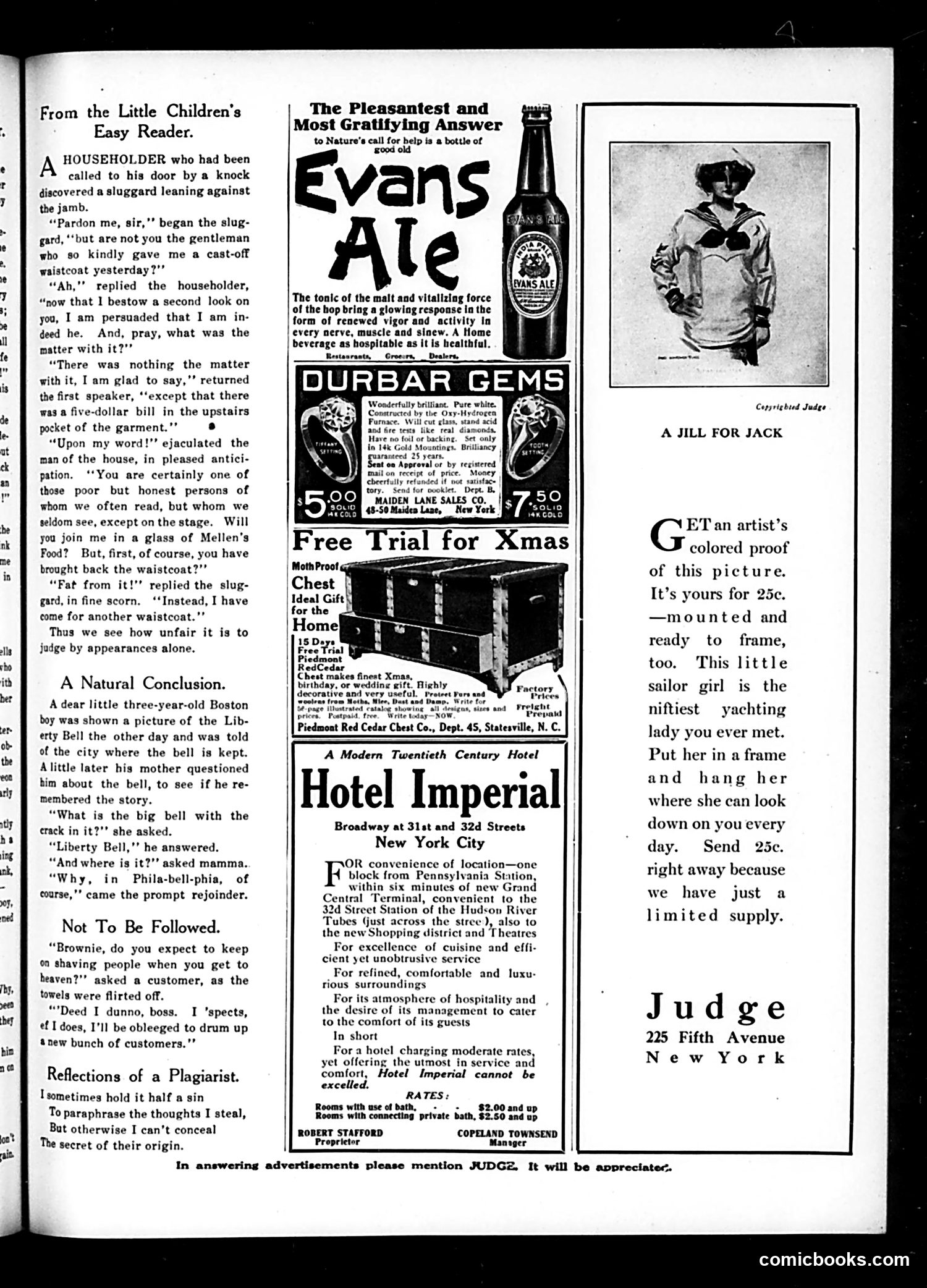
This page contains mostly **humorous short stories and advertisements** rather than political cartoons. The stories satirize human nature and logic: 1. **"From the Little Children's Easy Reader"** — A moral tale mocking naive charity. A householder gives a vagrant a used waistcoat; the vagrant returns claiming he found a five-dollar bill in it, then asks for *another* waistcoat. The punchline: "Thus we see how unfair it is to judge by appearances alone" — ironically suggesting the vagrant was dishonest, not honest. 2. **"A Natural Conclusion"** — A child's joke playing on the pun "Phila-bell-phia" (Philadelphia + bell). 3. **"Not To Be Followed"** — A barber jokes that in heaven he'd still need new customers because he'd keep shaving them. 4. **"Reflections of a Plagiarist"** — Self-aware verse about stealing others' ideas. The page is primarily filled with period **product advertisements** (Evans Ale, Durbar Gems diamonds, Hotel Imperial, etc.), typical of Judge's revenue model.
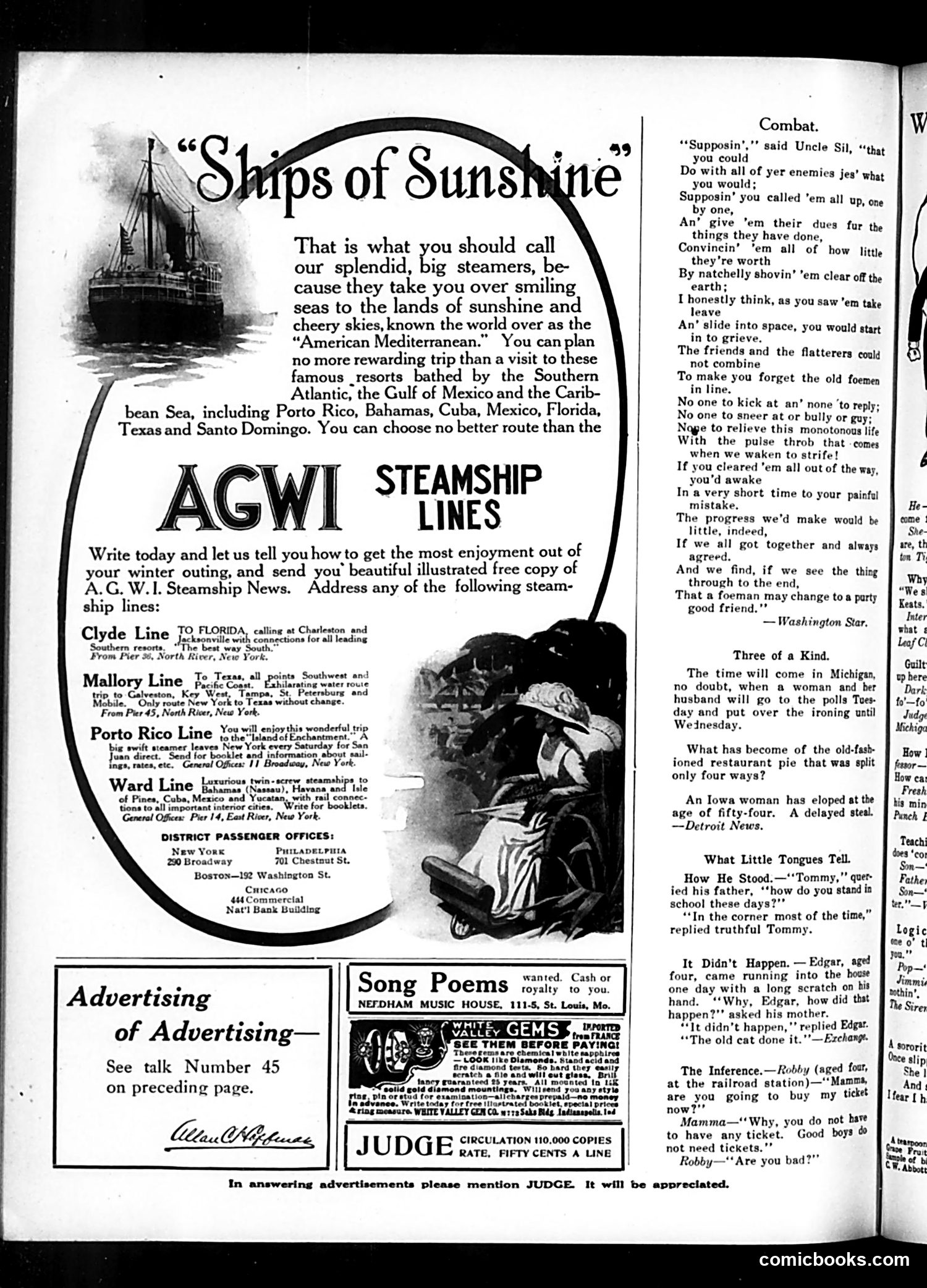
This page is primarily a **steamship advertising spread** for AGWI Steamship Lines promoting Caribbean and Gulf Coast vacations—not political satire. The main visual is a dramatic engraving of a steamship labeled "Ships of Sunshine." The only satirical content appears on the right side: a poem titled "Combat" attributed to the Washington Star. It's a folk-style verse (supposedly from "Uncle Sil") arguing that people need enemies and conflict to feel alive—that eliminating all opposition would lead to existential emptiness. The sentiment appears to reflect early 20th-century social commentary on the value of struggle and competition, though the specific historical reference is unclear without more context. The remaining right-column items ("Three of a Kind," "What Little Tongues Tell") are brief humorous anecdotes about women voting, restaurant pie portions, and elopement—typical Judge magazine filler. The page is primarily **commercial advertising**, not political commentary.
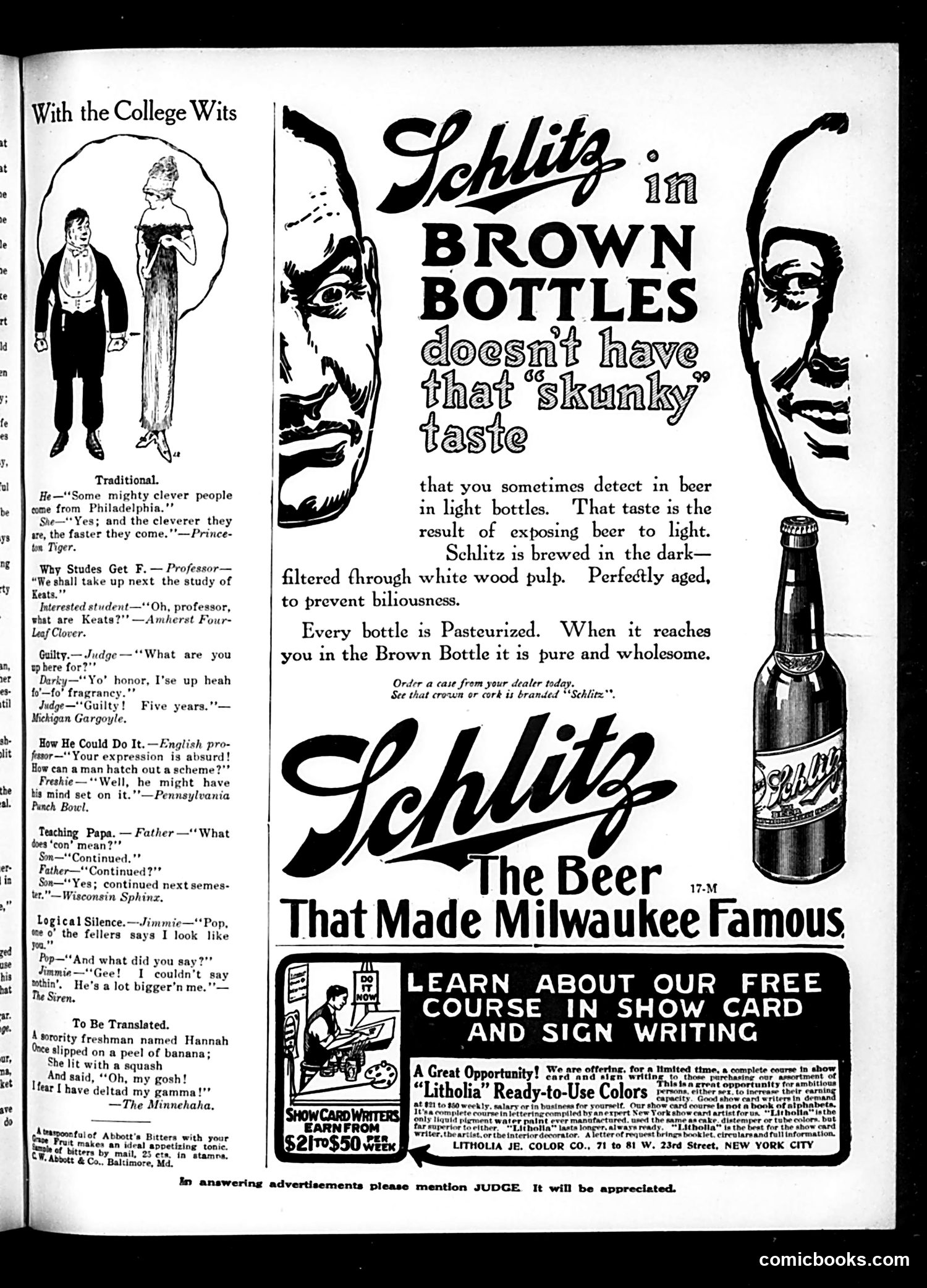
This Judge magazine page contains two distinct elements: **Left side: "College Wits"** — A collection of brief satirical jokes about college students and professors, mocking academic pretension and student behavior. Examples include jokes about Philadelphia students, misunderstanding Keats, a student facing legal trouble, and miscommunication between fathers and sons. These represent typical early-20th-century collegiate humor. **Right side: Schlitz Beer advertisement** — A major commercial advertisement claiming that Schlitz brown bottles protect beer from developing a "skunky" taste caused by light exposure. The ad emphasizes that the beer is brewed in darkness, filtered through white wood pulp, and pasteurized for purity. The page also includes a smaller ad at bottom promoting a mail-order course in showcard and sign writing. This is primarily an **advertising-heavy magazine page** with padding of college humor to fill space — typical of Judge's format mixing satire with commercial content. The Schlitz ad dominates the page's real estate and intent.
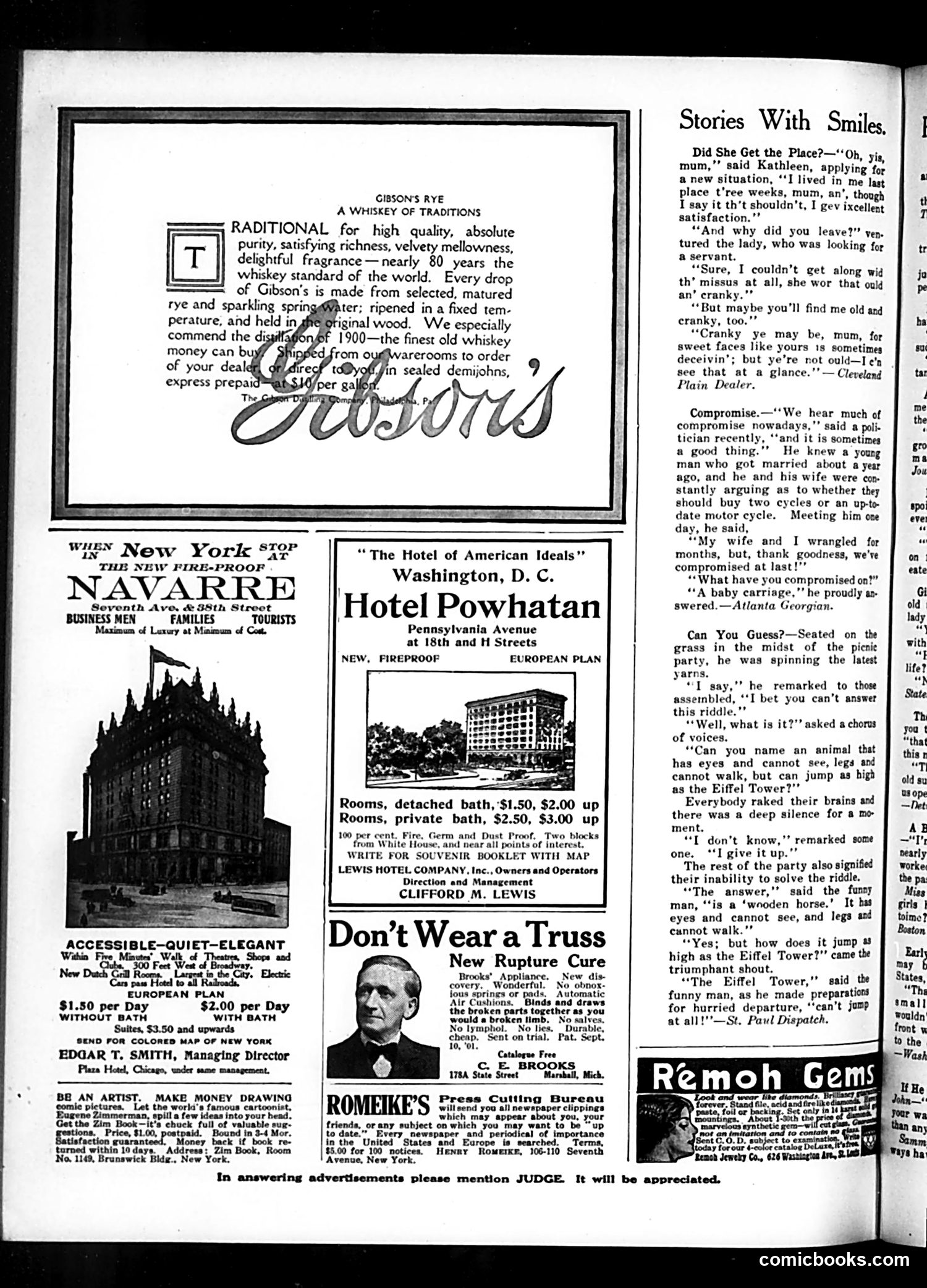
This is primarily an **advertisements page** from Judge magazine, with short humorous anecdotes in the "Stories With Smiles" column. The main content includes ads for hotels (Navarre, Hotel Powhatan), Gibson's Rye whiskey, and various services. The Gibson's ad emphasizes the whiskey's 80-year tradition and "natural" production methods—appealing to early 1900s consumer preferences for "authentic" products. The three brief humorous stories use **Irish immigrant servant-girl dialect** ("t'ree weeks," "cranky") for comedic effect—common ethnic humor of the era. "Did She Get the Place?" jokes about a maid's flattery toward her potential employer; "Compromise" satirizes newlyweds choosing a baby carriage as marital compromise; "Can You Guess?" begins a riddle (cut off). The humor relies on class dynamics, Irish stereotypes, and domestic situations typical of Judge's audience. This was standard satirical magazine content mixing advertising with light comedic vignettes.
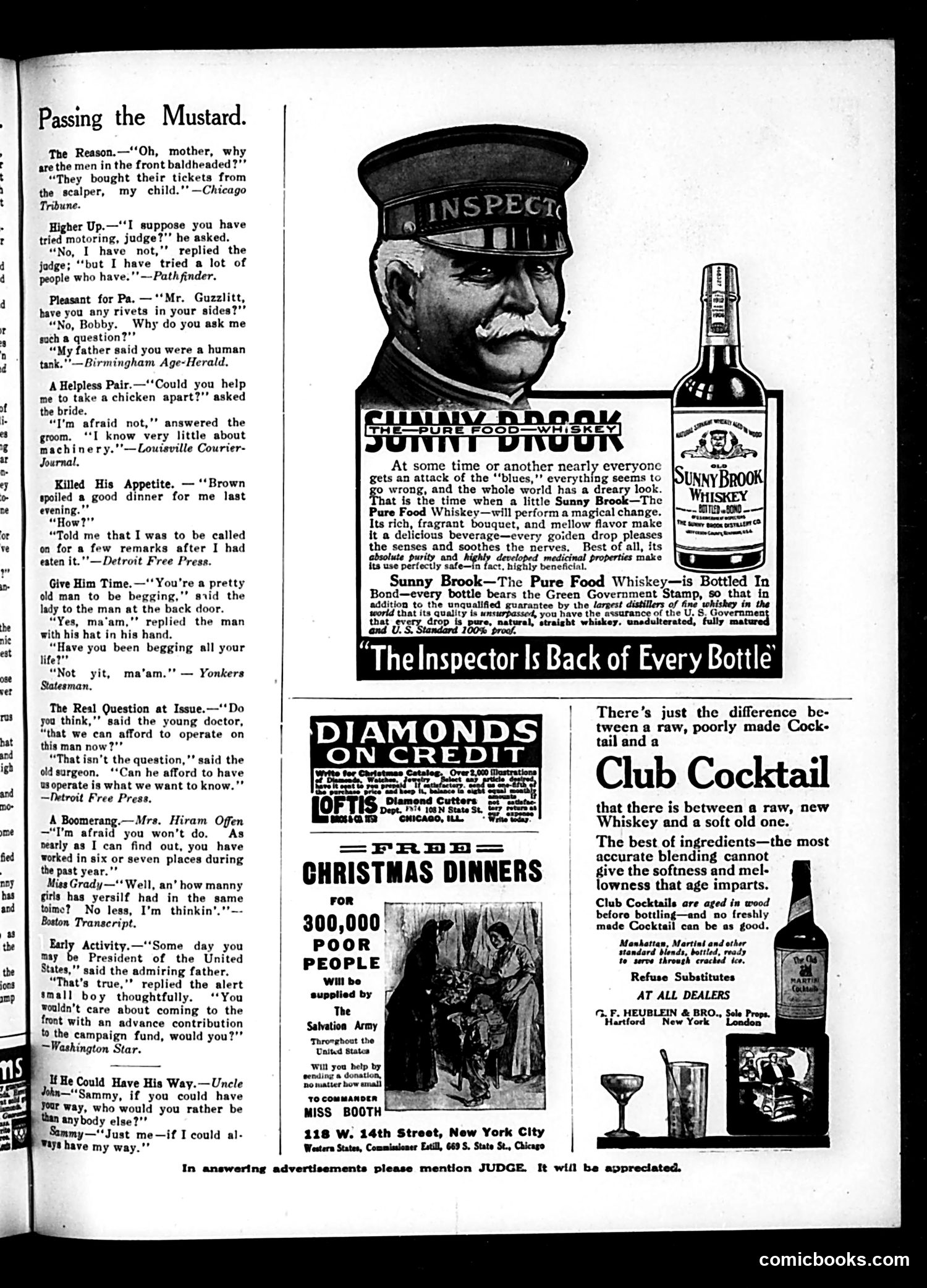
This page from *Judge* magazine contains primarily brief humorous anecdotes ("Passing the Mustard" section) and several advertisements, rather than political cartoons. The anecdotes are short jokes on everyday topics: scalpers selling theater tickets, judges dealing with motoring cases, children misunderstanding adult language ("human tank"), and professional situations (doctors, surgeons, servants). They mock contemporary American life—particularly emerging social anxieties around new technologies (automobiles), wealth inequality, and changing social dynamics. The major advertisements are for **Sunny Brook Whiskey** and **Club Cocktail**, both promoting alcohol as medicinal tonics for "the blues." This reflects pre-Prohibition attitudes (the page predates the 18th Amendment) where whiskey was marketed as health-promoting rather than merely recreational. The Salvation Army Christmas dinner advertisement seeks donations to feed 300,000 poor people—indicating significant poverty during this era. Overall, this is a commercial magazine page reflecting early 20th-century American consumer culture and social concerns.
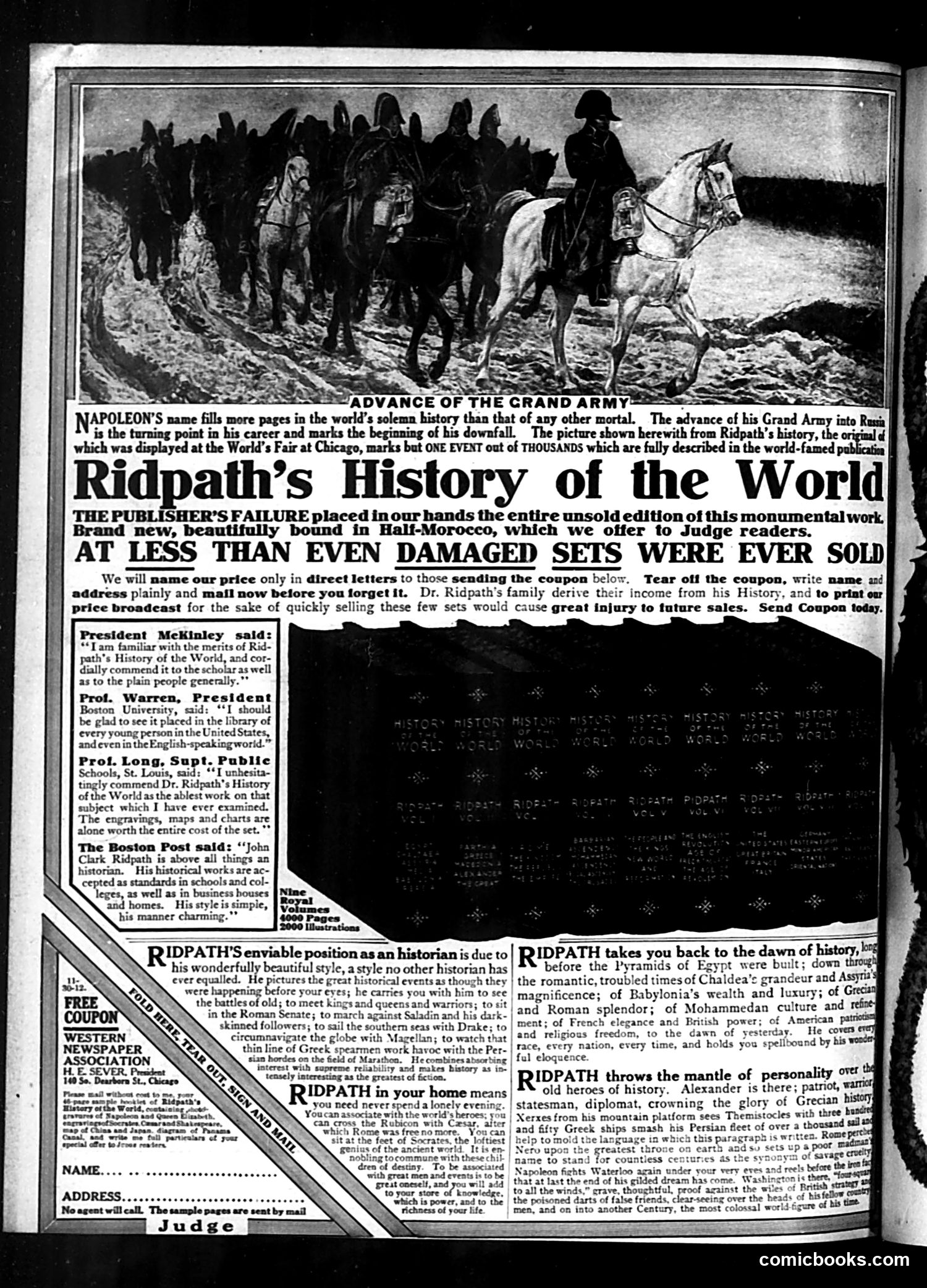
This page is primarily a **direct-mail advertisement** disguised as editorial content, not political satire. The top features a historical engraving labeled "Advance of the Grand Army"—depicting Napoleon's military campaign—used to promote *Ridpath's History of the World*, a comprehensive historical encyclopedia. The advertisement exploits endorsements from President McKinley and prominent educators to establish credibility. The sales pitch emphasizes urgency ("send coupon today") while claiming the publisher's "failure" created unsold inventory sold at exceptional prices. The satirical *angle*—typical of Judge's style—lies in the **transparent marketing tactics**: borrowing presidential prestige, manufacturing scarcity, and using prestigious institutional endorsements to move inventory. Judge readers would recognize this as heavy-handed commercial manipulation dressed in respectable language, poking gentle fun at aggressive American advertising practices of the era while still carrying the full advertisement.