
Judge, 1912-11-30 · page 10 of 26
Judge — November 30, 1912 — page 10: what you’re looking at
What you’re looking at
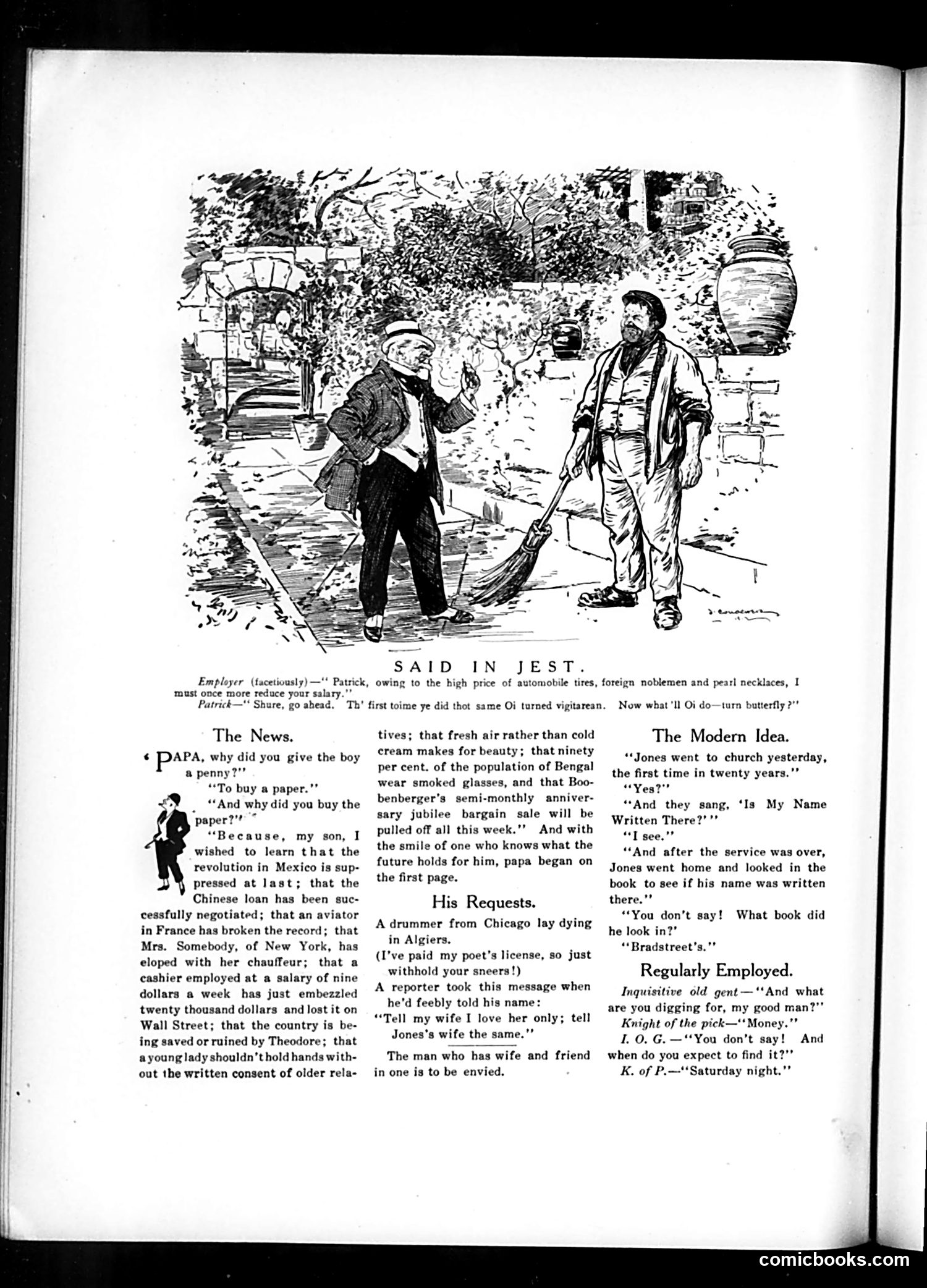
**"Said in Jest" (main cartoon):** An employer tells an Irish worker named Patrick he must take a salary cut due to expensive luxuries (automobile tires, foreign noblemen, pearl necklaces). Patrick responds that the last time he reduced his diet that way, he became vegetarian. The joke plays on Irish immigrant stereotypes and class resentment—the working poor bear economic costs for the wealthy's extravagances. **"The News":** A satirical piece mocking newspaper obsession. A father explains to his son that newspapers report trivial, contradictory, or sensational stories (Mexican revolution, embezzlement, Theodore Roosevelt, gossip about eloping socialites). The satire critiques how newspapers fill space with frivolous content. **Other brief items** include humorous anecdotes about a dying drummer's message, church attendance humor, and a laborer's sardonic expectation of finding money "Saturday night"—likely referring to payday. The page exemplifies Judge's satirical approach to labor, class tensions, and media criticism circa early 1900s.
📄 Transcribed text from this page (OCR, searchable)
Machine-transcribed from the original scan — historical spelling and the odd misread are preserved.
must once more reduce your salary.”’ Patrick—"* Shure, go ahead. The News. ‘ APA, why did you give the boy @ penny?” “To buy a paper.’’ __ “And why did you buy the paper?” ~ “Because, my son, I wished to learn that the revolution in Mexico is sup- pressed at last; that the Chinese loan has been suc- cessfully negotiated; that an aviator in France has broken the record; that Mrs. Somebody, of New York, has eloped with her chauffeur; that a cashier employed at a salary of nine dollars a week has just embezzled twenty thousand dollars and lost it on Wall Street; that the country is be- ing saved or ruined by Theodore; that a young lady shouldn't hold hands with- out the written consent of older rela- SAID IN JEST. Employer (facetiously)—‘* Patrick, owing to the high price of automobile tires, foreign noblemen and pearl necklaces, I Th’ first toime ye did thot same Oi turned vigitarean. tives; that fresh air rather than cold cream makes for beauty; that ninety per cent. of the population of Bengal wear smoked glasses, and that Boo- benberger’s semi-monthly anniver- sary jubilee bargain sale will be pulled off all this week.’’ And with the smile of one who knows what the future holds for him, papa began on the first page. His Requests. A drummer from Chicago lay dying in Algiers. (I've paid my poet’s license, so just withhold your sneers!) A reporter took this message when he'd feebly told his name: “Tell my wife I love her only; tell Jones's wife the same."’ The man who has wife and friend in one is to be envied. Now what'll Oi do: The Modern Idea. “‘Jones went to church yesterday, the first time in twenty years.’” “Yes?” “And they sang, ‘Is My Name Written There?’"’ “T see.” “And after the service was over, Jones went home and looked in the book to see if his name was written there."’ “You don’t say! he look in?’ “‘Bradstreet’s."’ Regularly Employed. Inquisitive old gent—‘*And what are you digging for, my good man?"’ Knight of the pick—'‘ Money. I. 0. G.—‘*You don’t say! when do you expect to find it?’’ K. of P.—**Saturday night."” turn butterfly 2"” What book did And comicbooks.com