
Judge, 1912-11-30 · page 17 of 26
Judge — November 30, 1912 — page 17: what you’re looking at
What you’re looking at
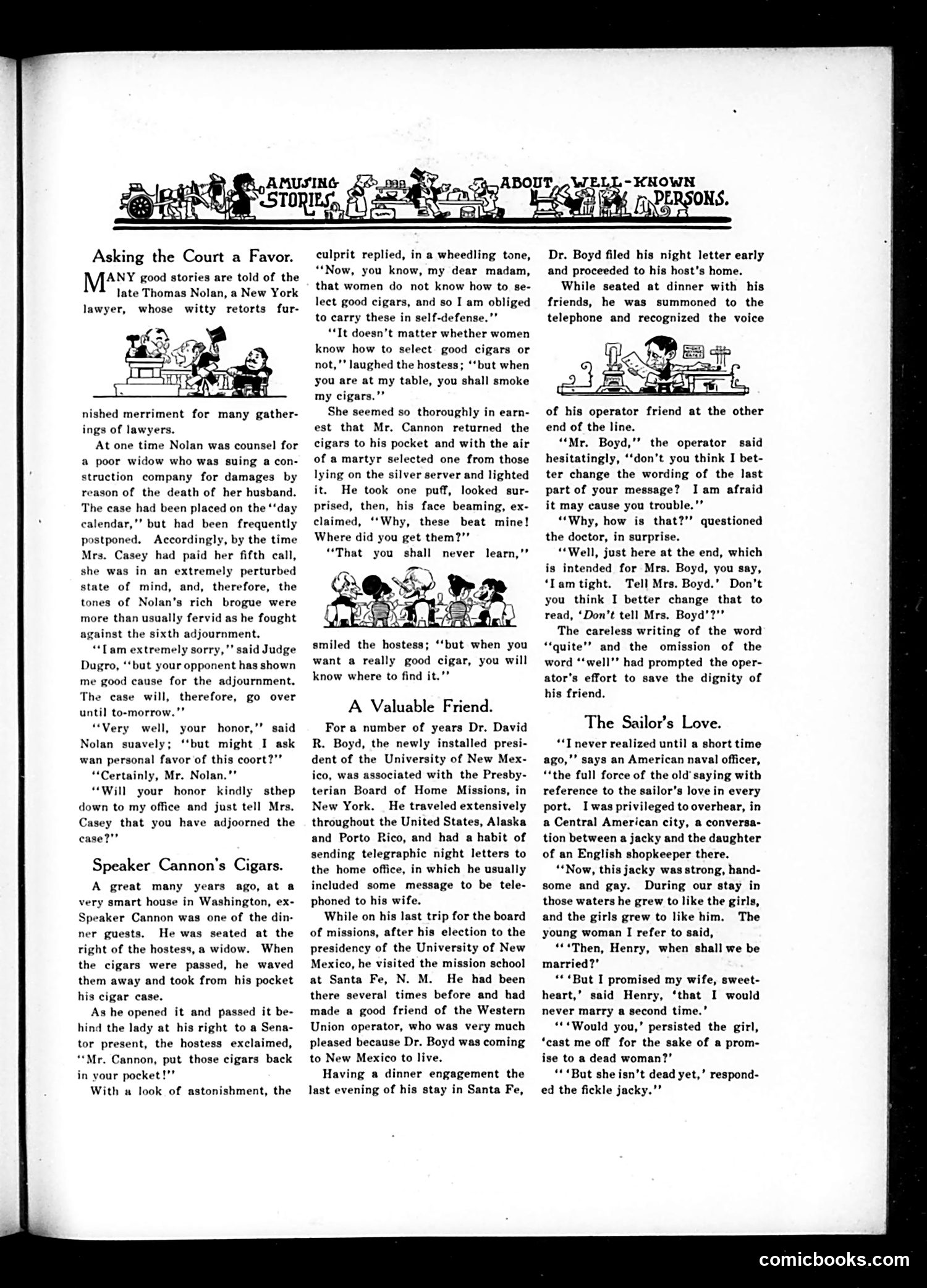
This page contains three humorous anecdotes about prominent figures, likely from the early 1900s. **"Asking the Court a Favor"** satirizes courtroom delays through lawyer Thomas Nolan's wit. A widow's case keeps being postponed; Nolan sarcastically asks the judge to personally explain the adjournment to his frustrated client—mocking the legal system's inefficiency. **"Speaker Cannon's Cigars"** features ex-Speaker Joseph Cannon (identifiable as a prominent political figure of the era). The joke: Cannon smugly insists on smoking his own cigars because women lack taste, only to discover the hostess's cigars are superior. It's gentle satire on male pretension and the folly of dismissing others' judgment. **"A Valuable Friend"** depicts Dr. David R. Boyd (newly installed University of New Mexico president) and a loyal Western Union operator. The operator alerts Boyd that his night letter contains wording that might cause trouble—showing genuine friendship transcending professional duty. These are anecdotal humor pieces typical of Judge's social commentary, celebrating wit, human nature, and character through real (or realistic) scenarios.
📄 Transcribed text from this page (OCR, searchable)
Machine-transcribed from the original scan — historical spelling and the odd misread are preserved.
Asking the Court a Favor. MaAs* good stories are told of the late Thomas Nolan, a New York lawyer, whose witty retorts fur- nished merriment for many gather- ings of lawyers. At one time Nolan was counsel for a poor widow who was suing a con- struction company for damages by reason of the death of her husband. The case had been placed on the ‘‘day calendar,’’ but had been frequently postponed. Accordingly, by the time Mrs. Casey had paid her fifth call, she was in an extremely perturbed state of mind, and, therefore, the tones of Nolan's rich brogue were more than usually fervid as he fought against the sixth adjournment. “Lam extremely sorry,’’ said Judge Dugro, ‘‘but your opponent has shown me good cause for the adjournment. The case will, therefore, go over until to-morrow."’ “Very well, your honor,’’ said Nolan suavely; ‘‘but might I ask wan personal favor of this coort?’’ “Certainly, Mr. Nolan.’’ “Will your honor kindly sthep down to my office and just tell Mrs. Casey that you have adjoorned the case?"’ Speaker Cannon's Cigars. A great many years ago, at a very smart house in Washington, ex- Speaker Cannon was one of the din- ner guests, He was seated at the right of the hostess, a widow. When the cigars were passed, he waved them away and took from his pocket his cigar case. As he opened it and passed it be- hind the lady at his right to a Sena- tor present, the hostess exclaimed, 1r. Cannon, put those cigars back in your pocket !’" With a look of astonishment, the culprit replied, in a wheedling tone, “Now, you know, my dear madam, that women do not know how to se- leet good cigars, and so I am obliged to carry these in self-defense."’ “It doesn’t matter whether women know how to select good cigars or not,’’ laughed the hostess; ‘‘but when you are at my table, you shall smoke my cigars.’’ She seemed so thoroughly in earn- est that Mr. Cannon returned the cigars to his pocket and with the air of a martyr selected one from those lying on the silver server and lighted it. He took one puff, looked sur- prised, then, his face beaming, ex- claimed, ‘*Why, these beat mine! Where did you get them?”’ “That you shall never learn,’ smiled the hostess; ‘‘but when you want a really good cigar, you will know where to find it.’’ A Valuable Friend. For a number of years Dr. David R. Boyd, the newly installed presi- dent of the University of New Mex- ico, was associated with the Presby- terian Board of Home Missions, in New York. He traveled extensively throughout the United States, Alaska and Porto Rico, and had a habit of sending telegraphic night letters to the home office, in which he usually included some message to be tele- phoned to his wife. While on his last trip for the board of missions, after his election to the presidency of the University of New Mexico, he visited the mission school at Santa Fe, N. M. He had been there several times before and had made a good friend of the Western Union operator, who was very much pleased because Dr. Boyd was coming to New Mexico to live. Having a dinner engagement the last evening of his stay in Santa Fe, Dr. Boyd filed his night letter early and proceeded to his host’s home. While seated at dinner with his friends, he was summoned to the telephone and recognized the voice of his operator friend at the other end of the line. “Mr. Boyd,’’ the operator said hesitatingly, ‘‘don’t you think I bet- ter change the wording of the last part of your message? Iam afraid it may cause you trouble.’’ “Why, how is that?’’ questioned the doctor, in surprise. “Well, just here at the end, which is intended for Mrs. Boyd, you say, ‘lamtight. Tell Mrs. Boyd.’ Don’t you think I better change that to read, ‘Don’t tell Mrs. Boyd’?"’ The careless writing of the word “‘quite’’ and the omission of the word ‘‘well’’ had prompted the oper- ator’s effort to save the dignity of his friend. The Sailor’s Love. “T never realized until a short time ago,’’ says an American naval officer, the full force of the old’ saying with reference to the sailor’s love in every port. I was privileged to overhear, in a Central American city, a conversa- tion between a jacky and the daughter of an English shopkeeper there. “‘Now, this jacky was strong, hand- some and gay. During our stay in those waters he grew to like the girls, and the girls grew to like him. The young woman I refer to said, “*Then, Henry, when shall we be married?’ “**But I promised my wife, sweet- heart,’ said Henry, ‘that I would never marry a second time.’ ***Would you,’ persisted the girl, ‘cast me off for the sake of a prom- ise to a dead woman?’ “**But she isn’t dead yet,’ respond- ed the fickle jacky.”” comicbooks.com