
Judge, 1912-11-30 · page 15 of 26
Judge — November 30, 1912 — page 15: what you’re looking at
What you’re looking at
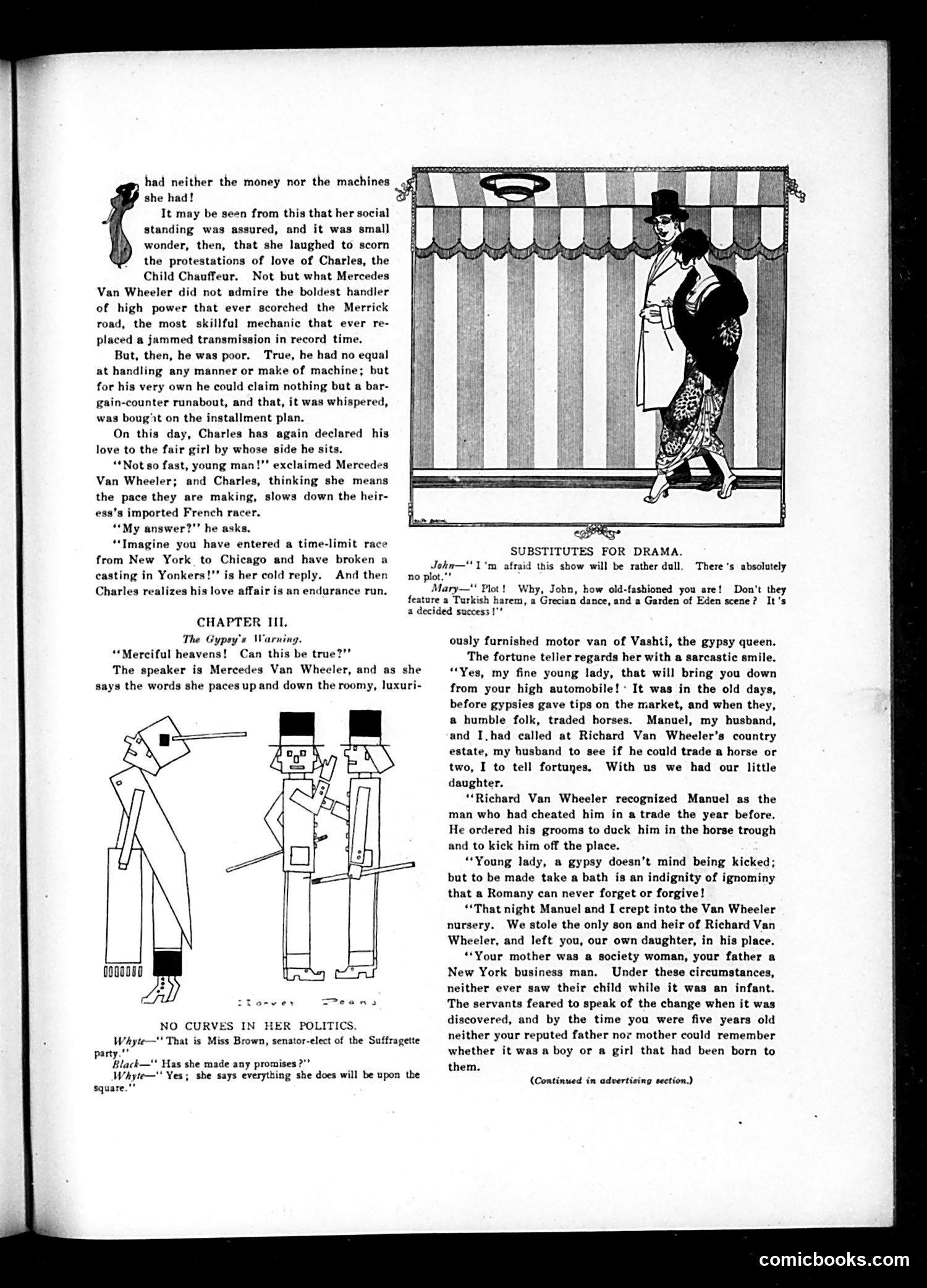
This page contains two separate satirical pieces from Judge magazine: **"The Child Chauffeur" narrative** mocks class barriers in courtship. Mercedes Van Wheeler, a wealthy heiress, rejects Charles's romantic advances not because he's unskilled (he's actually an excellent mechanic), but because he's poor and can only afford a cheap, installment-plan car. The satire critiques how wealth determines social worth and romantic eligibility, even when ability and character don't align with economic status. **"No Curves in Her Politics"** is a brief joke about a female suffragette politician. The pun plays on "curves" (female body shape/femininity) versus "square" (honest, straightforward). It suggests women politicians might conduct themselves with rigid propriety, sarcastically implying suffragettes are humorless and operate "by the book." Both pieces reflect early-20th-century Judge concerns: class anxiety, automotive culture, and ambivalence toward women's expanding political roles.
📄 Transcribed text from this page (OCR, searchable)
Machine-transcribed from the original scan — historical spelling and the odd misread are preserved.
had neither the money nor the machines she had! It may be seen from this that her social standing was assured, and it was small wonder, then, that she laughed to scorn the protestations of love of Charles, the Child Chauffeur. Not but what Mercedes Van Wheeler did not admire the boldest handler of high power that ever scorched the Merrick road, the most skillful mechanic that ever re- placed a jammed transmission in record time. But, then, he was poor. True, he had no equal at handling any manner or make of machine; but for his very own he could claim nothing but a bar- gain-counter runabout, and that, it was whispered, was boug it on the installment plan. On this day, Charles has again declared his love to the fair girl by whose side he sits. “Not so fast, young man!’’ exclaimed Mercedes Van Wheeler; and Charles, thinking she means the pace they are making, slows down the heir- ess’s imported French racer. “My answer?"’ he asks. “Imagine you have entered a time-limit race from New York to Chicago and have broken a casting in Yonkers!” is her cold reply. And then Charles realizes his love affair is an endurance run. SUBSTITUTES FOR DRAMA. John—‘'1'm afraid this show will be rather dull. There's absolutely no plot.’ Mary—"* Plot ! feature a Turkish harem, a Grecian dance, and a Garden of Eden scene? It's Why, Jobn, how old-fashioned you are! Don't they a decided success !"" CHAPTER III. The Gypsy’s Warning. “Merciful heavens! Can this be true?’’ The speaker is Mercedes Van Wheeler, and as she says the words she paces up and down the roomy, luxuri- 0000080 Tosvey SPeans NO CURVES IN HER POLITICS. Whyte—‘ That is Miss Brown, senator-elect of the Suffragette party.’" Black—" Has she made any promises ?"’ Whyte—' Yes; she says everything she does will be upon the square."" ously furnished motor van of Vashti, the gypsy queen. The fortune teller regards her with a sarcastic smile. “Yes, my fine young lady, that will bring you down from your high automobile! ~ It was in the old days, before gypsies gave tips on the market, and when they, a humble folk, traded horses. Manuel, my husband, and I,had called at Richard Van Wheeler’s country estate, my husband to see if he could trade a horse or two, I to tell fortunes. With us we had our little daughter. “Richard Van Wheeler recognized Manuel as the man who had cheated him in a trade the year before. He ordered his grooms to duck him in the horse trough and to kick him off the place. “Young lady, a gypsy doesn’t mind being kicked; but to be made take a bath is an indignity of ignominy that a Romany can never forget or forgive! “That night Manuel and I crept into the Van Wheeler nursery. We stole the only son and heir of Richard Van Wheeler, and left you, our own daughter, in his place. ‘*Your mother was a society woman, your father a New York business man. Under these circumstances, neither ever saw their child while it was an infant. The servants feared to speak of the change when it was discovered, and by the time you were five years old neither your reputed father nor mother could remember whether it was a boy or a girl that had been born to them. (Continued in advertising section.) comicbooks.com