
Judge, 1912-11-30 · page 9 of 26
Judge — November 30, 1912 — page 9: what you’re looking at
What you’re looking at
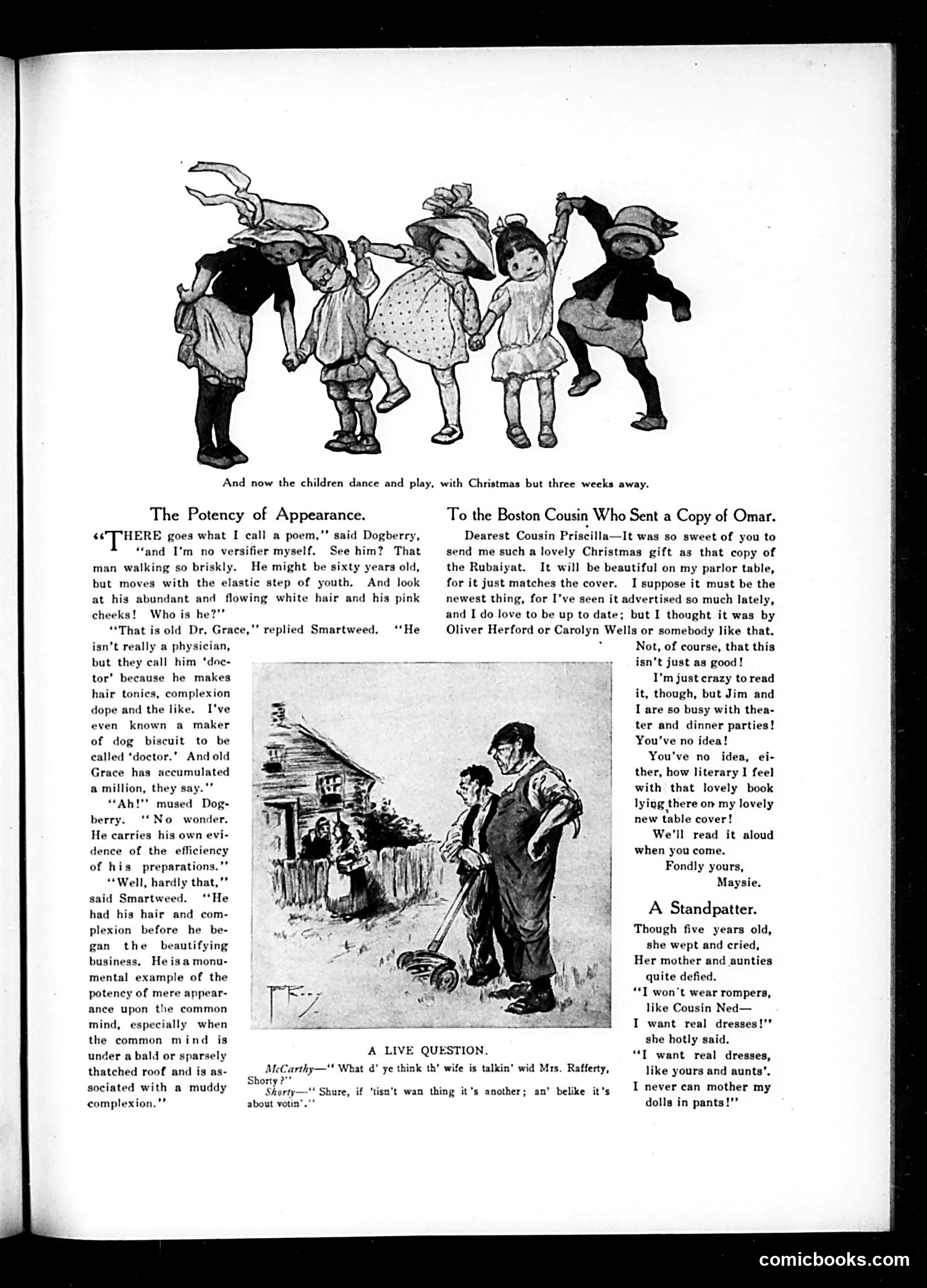
This page contains three separate satirical pieces typical of early 1900s American humor: **"The Potency of Appearance"**: Two characters discuss Dr. Grace, a con artist who sells beauty tonics and hair products. The satire mocks consumer gullibility—Grace appears youthful and vigorous, so people buy his products believing they work, when in fact he simply had good looks before entering the business. The joke exposes how superficial appearance manipulates "the common mind," especially among those with "a bald or sparsely thatched roof and...muddy complexion." **"A Live Question"**: Irish immigrants (McCarthy and Shorty) discuss wives gossiping. The humor relies on ethnic dialect stereotyping common to the era. **"To the Boston Cousin"** and **"A Standpatter"**: Light domestic humor about gift-giving pretension and a child rejecting old-fashioned clothing for modern styles. The page's core message: appearance deceives, consumerism thrives on vanity, and social status is performative—themes that resonate across eras despite the period-specific delivery.
📄 Transcribed text from this page (OCR, searchable)
Machine-transcribed from the original scan — historical spelling and the odd misread are preserved.
And now the children dance and play, with Christmas but three weeks away. The Potency of Appearance. «6"THERE goes what I call a poem,’’ said Dogberry, “and I'm no versifier myself. See him? That man walking so briskly. He might be sixty years old, but moves with the elastic step of youth. And look at his abundant and flowing white hair and his pink 3! Who is he?’’ ‘That is old Dr. Grace,”’ replied Smartweed. ‘‘He isn’t really a physician, but they call him ‘doc- tor’ because he makes hair tonics, complexion dope and the like. I've even known a maker of dog biscuit to be called ‘doctor.’ And old Grace has accumulated a million, they say."" “Ah! mused Dog- berry. ‘‘No wonder. He carries his own evi- dence of the efficiency of his preparations.”” “Well, hardly that,”” said Smartweed. ‘‘He had his hair and com- plexion before he be- gan the beautifying business. He isa monu- mental example of the potency of mere appear- ance upon the common mind, especially when the common mind is under a bald or sparsely thatched roof and is as- sociated with a muddy complexion.”” Shorty ?”" Shorty about votin’."’ A LIVE QUESTION. McCarthy—‘* What a’ ye think th’ wife is talkin’ wid Mrs. Rafferty, “Shure, if ‘tisn't wan thing it's another; an’ belike it's To the Boston Cousin Who Sent a Copy of Omar. Dearest Cousin Priscilla—It was so sweet of you to send me such a lovely Christmas gift as that copy of the Rubaiyat. It will be beautiful on my parlor table, for it just matches the cover. I suppose it must be the newest thing, for I've seen it advertised so much lately, and I do love to be up to date; but I thought it was by Oliver Herford or Carolyn Wells or somebody like that. Not, of course, that this weet isn’t just as good! I'm just crazy to read it, though, but Jim and I are so busy with thea- ter and dinner parties! You've no idea! You've no idea, ei- ther, how literary I feel with that lovely book lying there on my lovely new table cover! We'll read it aloud when you come. Fondly yours, Maysie. A Standpatter. Though five years old, she wept and cried, Her mother and aunties quite defied. “I won't wear rompers, like Cousin Ned— I want real dresses!"’ she hotly said. “TI want real dresses, like yours and aunts’. I never can mother my dolls in pants!"" comicbooks.com