
A complete issue · 24 pages · 1912
Judge — October 26, 1912
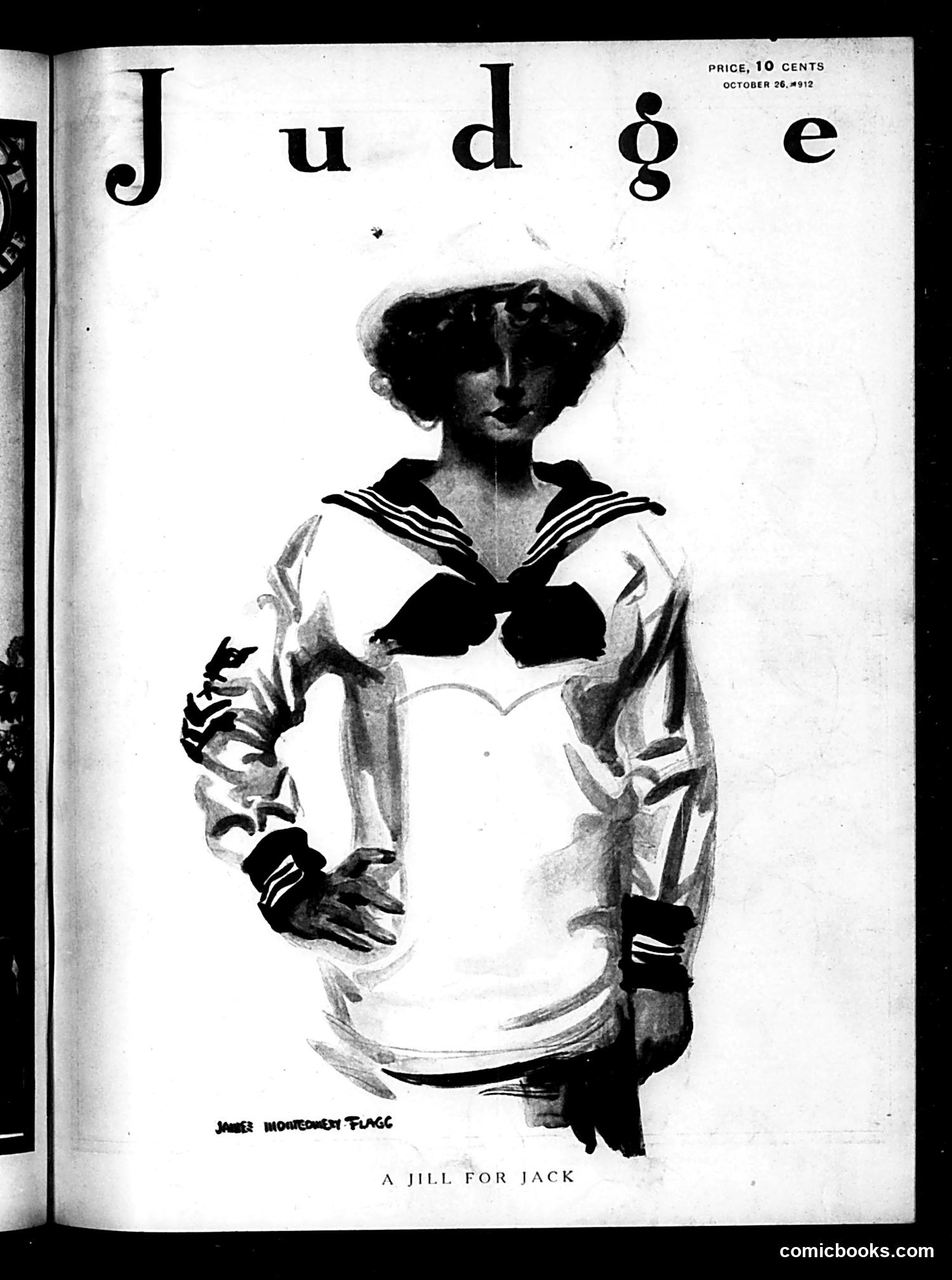
This October 1912 *Judge* cover satirizes the presidential election through a gendered lens. The illustration, credited to James Montgomery Flagg, depicts a woman in a sailor outfit labeled "A Jill for Jack." The phrase plays on "Jack" (likely referring to a sailor or everyman) and introduces "Jill" as a female counterpart. Given the 1912 date, this appears to reference debates about women's roles during that election year, possibly alluding to women's suffrage activism or the unconventional political moment (the split Republican ticket with Taft, Roosevelt, and Wilson). The sailor costume suggests working-class or populist appeal. The satire likely mocks either progressive women's political involvement or criticizes candidates' attempts to court female voters—though the precise target remains unclear without additional context.
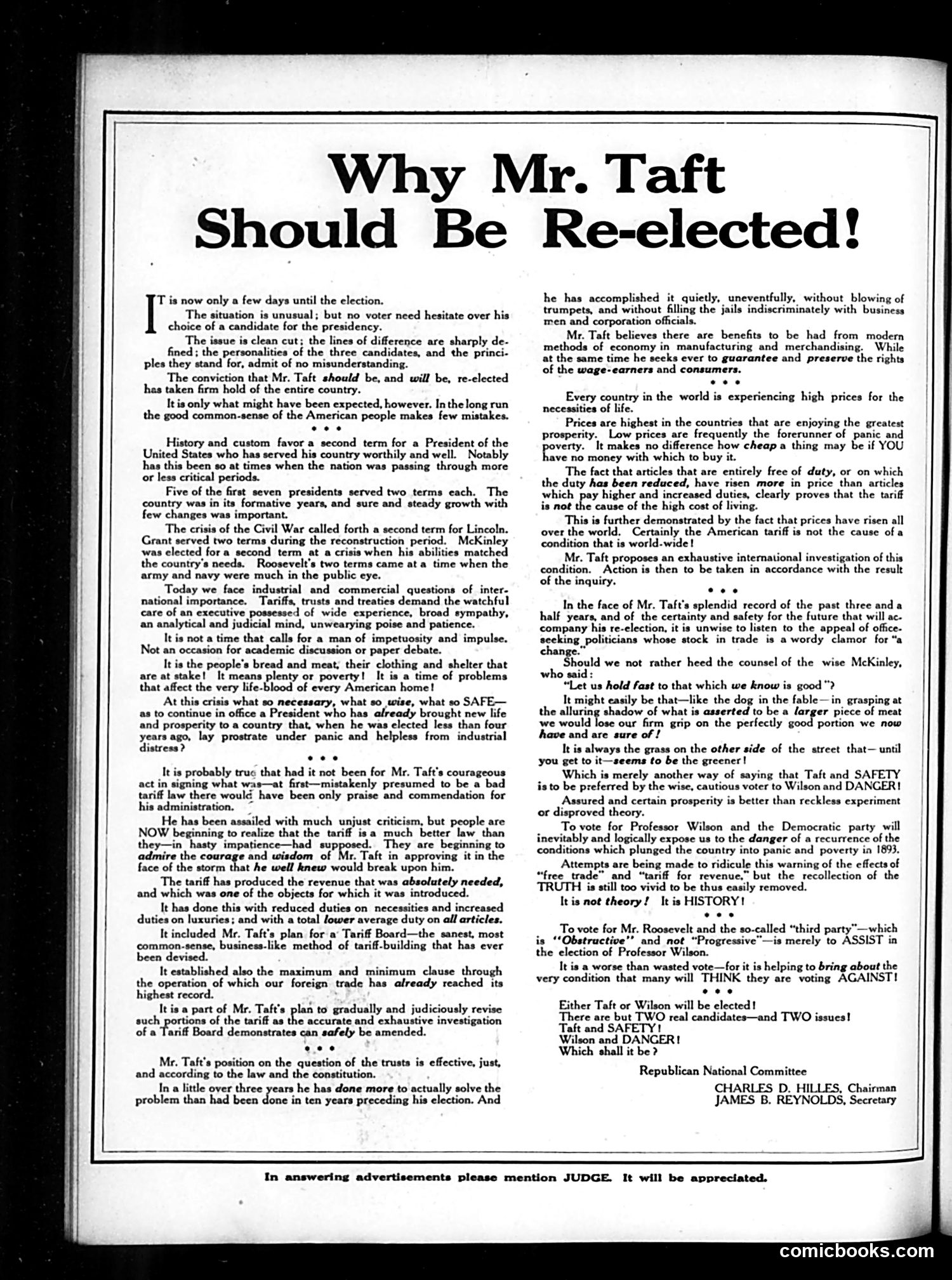
This is a **political advertisement**, not a cartoon. The Republican National Committee argues for President Taft's re-election, presenting his record as stable and beneficial. The piece defends Taft against criticism regarding high prices and tariffs, attributing these to global conditions rather than his policies. The advertisement contrasts Taft with two opponents: Professor Wilson (Democrat) and Roosevelt (representing a "third party"). It characterizes Roosevelt's "Progressive" movement as merely assisting Wilson's election. The rhetoric emphasizes Taft's cautious, steady approach versus perceived dangers of change. The final argument presents a binary choice: "Taft and SAFETY" versus "Wilson and DANGER." This reflects the historic **1912 three-way presidential race** where Roosevelt's Bull Moose Party split Republican votes.
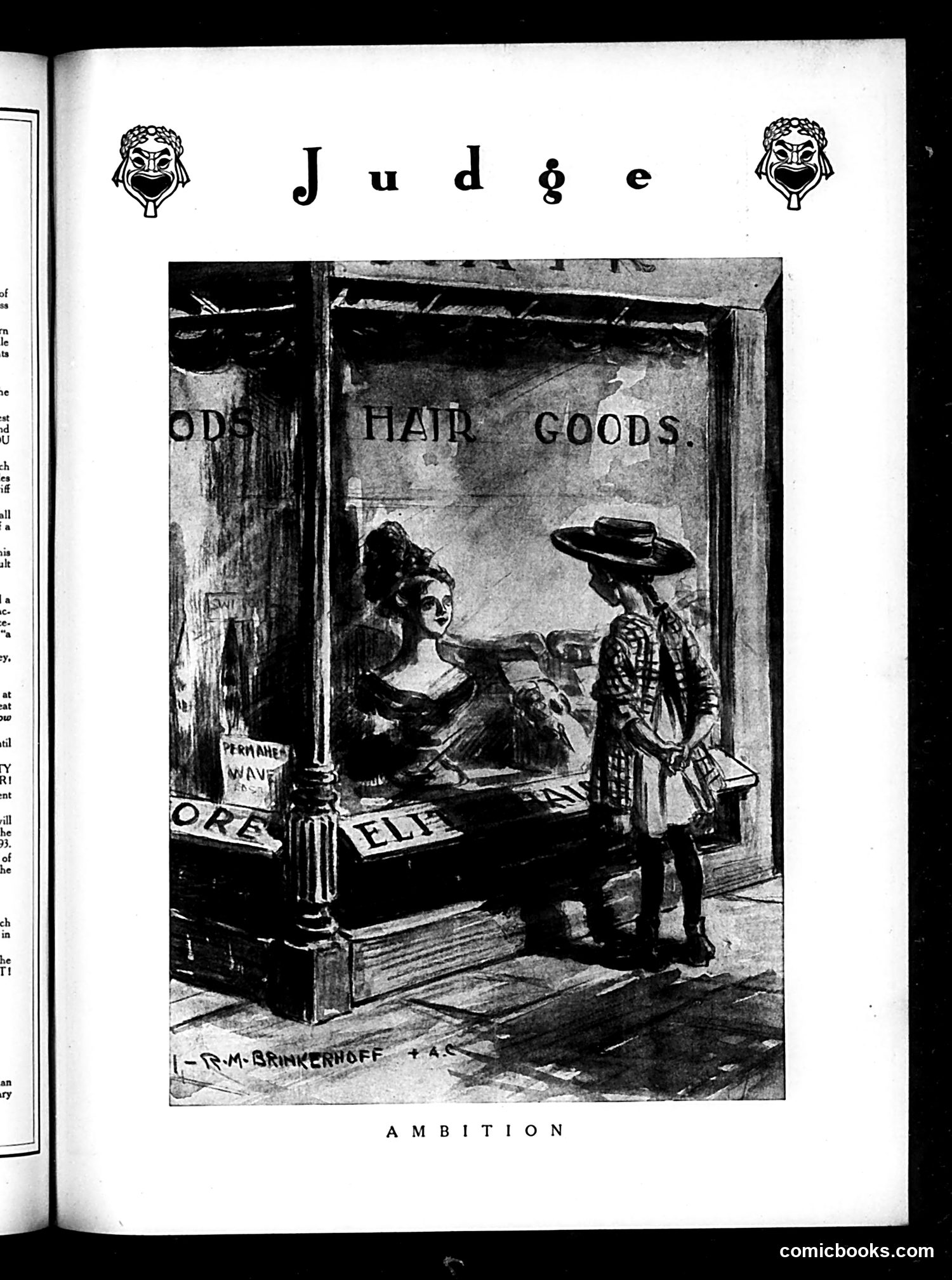
This cartoon satirizes class aspiration and social climbing. The illustration shows a woman gazing at a fashionable hat in a shop window labeled "HAIR GOODS" and "ORDE" (likely "Ordered"). A well-dressed woman inside the shop appears to be a saleswoman or proprietor, while a working-class figure stands outside looking in. The title "AMBITION" suggests the satire targets someone's desire to acquire luxury goods beyond their social station. The contrast between the elegantly dressed shopkeeper and the figure outside critiques either frivolous consumer desire or the unrealistic aspirations of the working poor. The artwork is credited to R.M. Brinkerhoff, a known Judge cartoonist. This reflects Gilded Age anxieties about consumption, class boundaries, and social mobility through material goods.
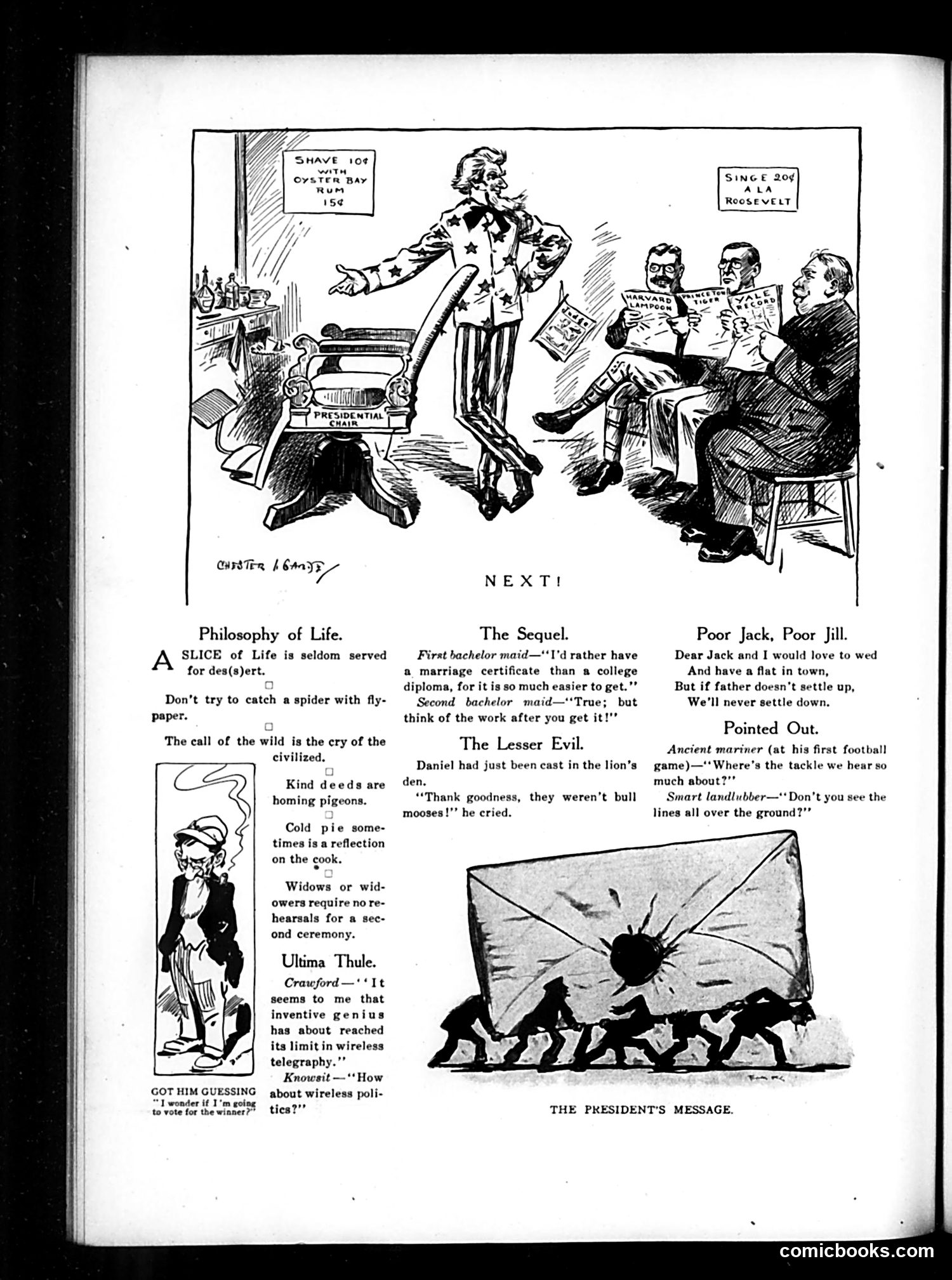
This page contains political humor and social commentary typical of early 20th-century satirical journalism. The top cartoon depicts Uncle Sam (identifiable by his star-spangled outfit) addressing three men, likely political figures or businessmen, with a sign reading "SHAVE 10¢ WITH CYCLONE BAY RUM 15¢" visible—a joke about Roosevelt-era pricing or commercial practices. "The Sequel" jokes about bachelor reluctance regarding marriage and work obligations. "Poor Jack, Poor Jill" mocks marriage prospects among the wealthy. "The Lesser Evil" references Daniel in the lion's den, applying biblical comparison to contemporary political situations. "The President's Message" cartoon shows figures struggling with a large envelope, suggesting commentary on presidential communications or policies, though the specific message remains unclear without additional context.
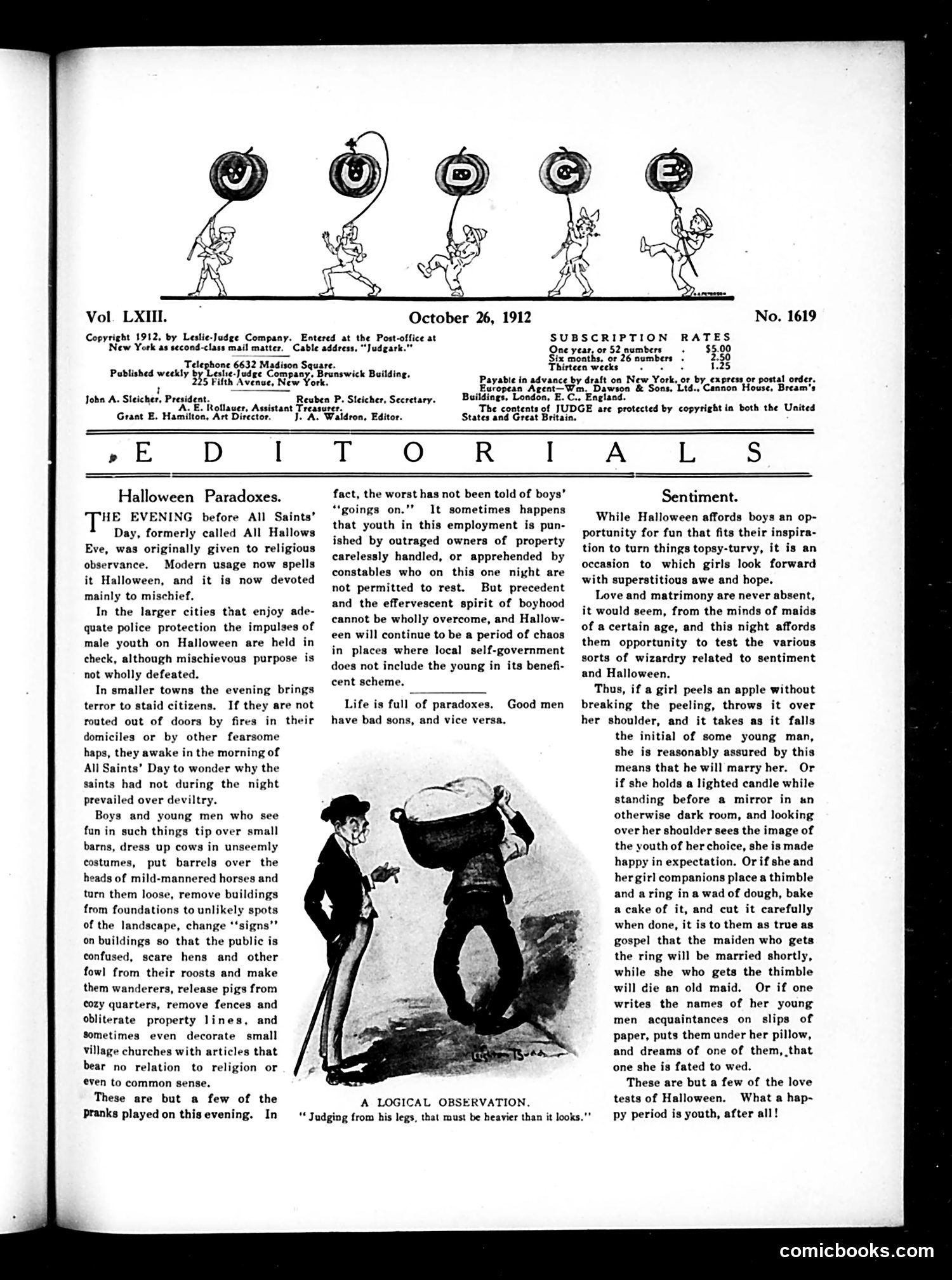
This page features Halloween-themed editorial content rather than political satire. The main cartoon, titled "A Logical Observation," depicts two figures in Halloween costumes—one dressed as a cow being held by a man in formal attire. The caption reads: "Judging from his legs, that must be braver than it looks." The joke relies on visual humor: the "cow's" spindly human legs protruding beneath the costume undermine any intimidating appearance, suggesting the person inside is less formidable than their disguise implies. The accompanying articles discuss Halloween traditions, pranks, and superstitions (apple-peeling, candle rituals, ring-baking) used by young people to divine romantic futures. This reflects early 20th-century folk customs surrounding the holiday, presented here as period curiosities for Judge's readers.
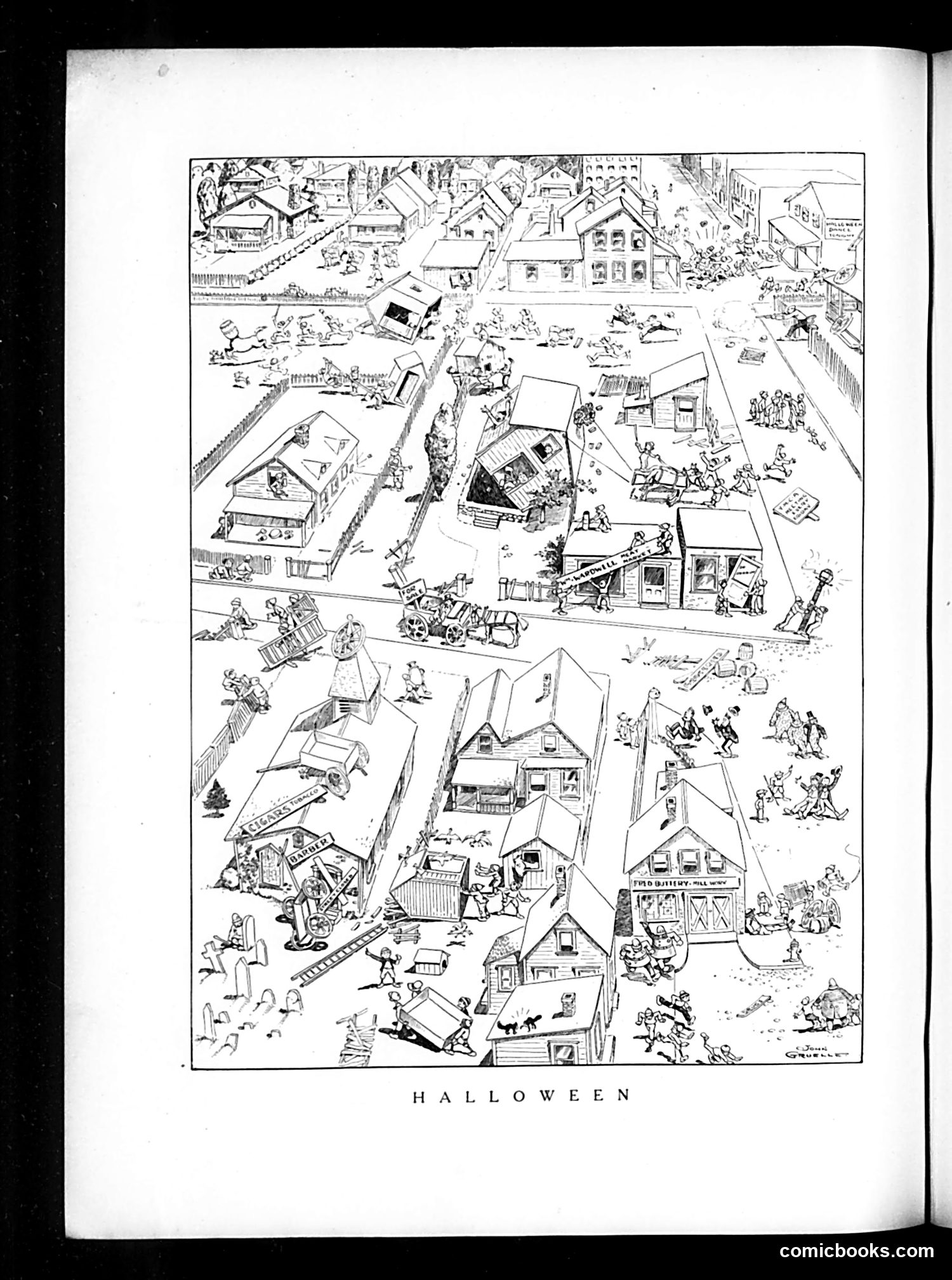
This is an aerial view illustration of a residential neighborhood celebrating Halloween. The cartoon depicts typical early-20th-century Halloween activities: children in costumes trick-or-treating, pranks being played on houses, jack-o'-lanterns displayed, and general neighborhood mischief and chaos. The satire appears to gently mock the widespread mayhem of the holiday—overturned furniture, vandalism, and general pandemonium affecting the entire community. Rather than targeting a specific political figure or event, this is social satire about how Halloween transforms an orderly suburban neighborhood into organized chaos, with residents young and old participating in pranks, costumes, and festivities that temporarily suspend normal decorum. The humor lies in the comprehensive disorder depicted across all the properties.
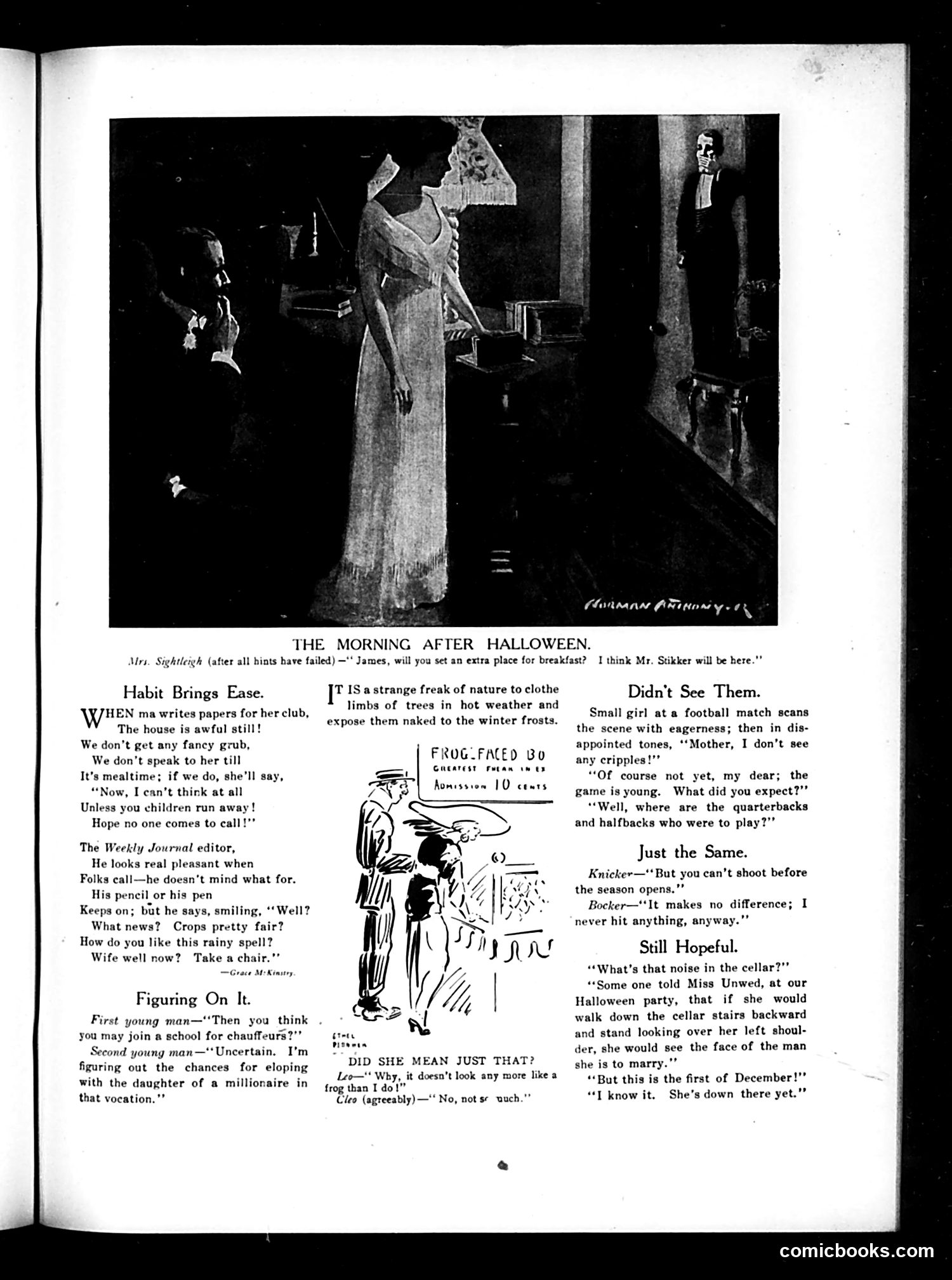
This page contains several satirical vignettes typical of early 20th-century American humor: **"The Morning After Halloween"** (top): A domestic scene where a husband hints at inviting a guest, suggesting the wife's Halloween party overextended hospitality. **"Habit Brings Ease"**: Contrasts a distracted club-writing mother who demands silence with a cheerful newspaper editor who welcomes interruptions while working—satirizing different professional temperaments. **"Figuring On It"**: A young man considers chauffeur school primarily to elope with a wealthy employer's daughter—mocking fortune-hunting schemes. **"Didn't See Them"**: Dark humor: a child at a football game expects injuries, disappointed the game hasn't yet produced casualties. **"Just the Same"** and **"Still Hopeful"**: Brief comic dialogues about hunting season and romantic fortune-telling superstitions. The page satirizes domestic life, class dynamics, and courtship customs of the era through relatable situations rather than specific political figures.
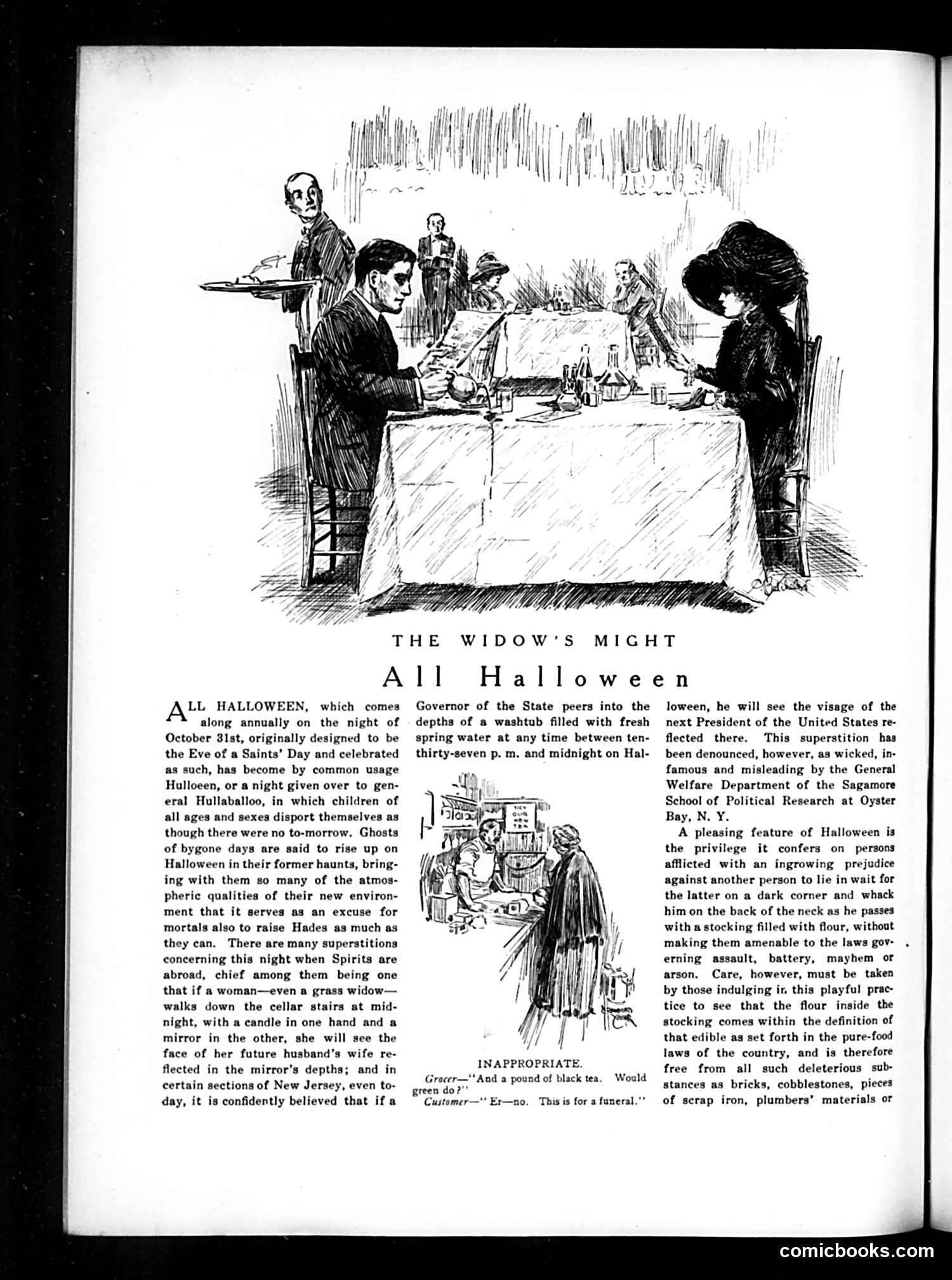
This page satirizes Halloween superstitions and contains two distinct elements: **Main Article**: A tongue-in-cheek essay debunking Halloween folklore. The satire peaks with a jab at Theodore Roosevelt: it claims New Jersey residents believe that if the State Governor peers into a washtub at midnight on Halloween, he'll see the next U.S. President reflected there. The text then sarcastically notes this superstition has been "denounced...as wicked, infamous and misleading by the General Welfare Department of the Sagamore School of Political Research at Oyster Bay, N.Y." (Roosevelt's home)—a pointed mockery suggesting Roosevelt's political machinations or presidential ambitions. **Small Comic**: The bottom illustration shows a grocer and customer discussing black tea "for a funeral," which the customer clarifies isn't green tea. This is a mild joke about funeral propriety or possibly class/taste distinctions. The page's overall tone ridicules both superstition and political pretension, with Roosevelt as the implicit target.
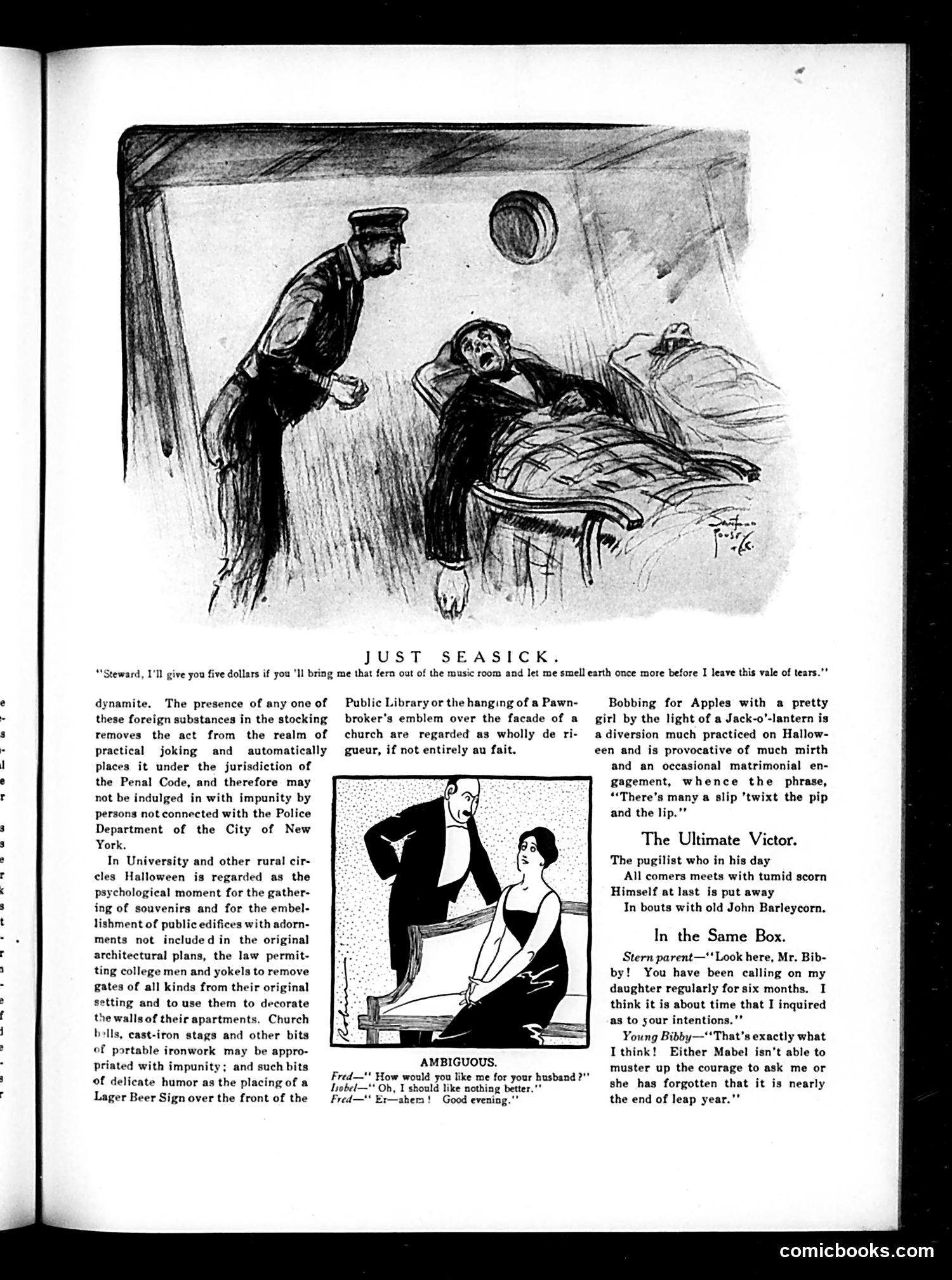
The top cartoon, "Just Seasick," depicts a naval or ship setting where a sailor offers a passenger five dollars to retrieve a fern from the music room so he can "smell earth once more before I leave this vale of tears"—satirizing the exaggerated melodrama of seasickness sufferers. The text below discusses Halloween pranks, distinguishing between college pranks (stealing gates, church bells, pawnbroker signs) deemed socially acceptable versus dynamite-rigged stockings, which cross into criminal territory under New York's Penal Code. The remaining comics are brief social jokes: "Ambiguous" plays on misunderstanding romantic proposals; "The Ultimate Victor" uses the boxer John Barleycorn (personified alcohol) to mock drinking; and "In the Same Box" satirizes a nervous suitor's fumbled marriage proposal. The page combines gentle social satire typical of Judge magazine's humor—poking fun at male anxieties, class distinctions, and Victorian courtship customs.
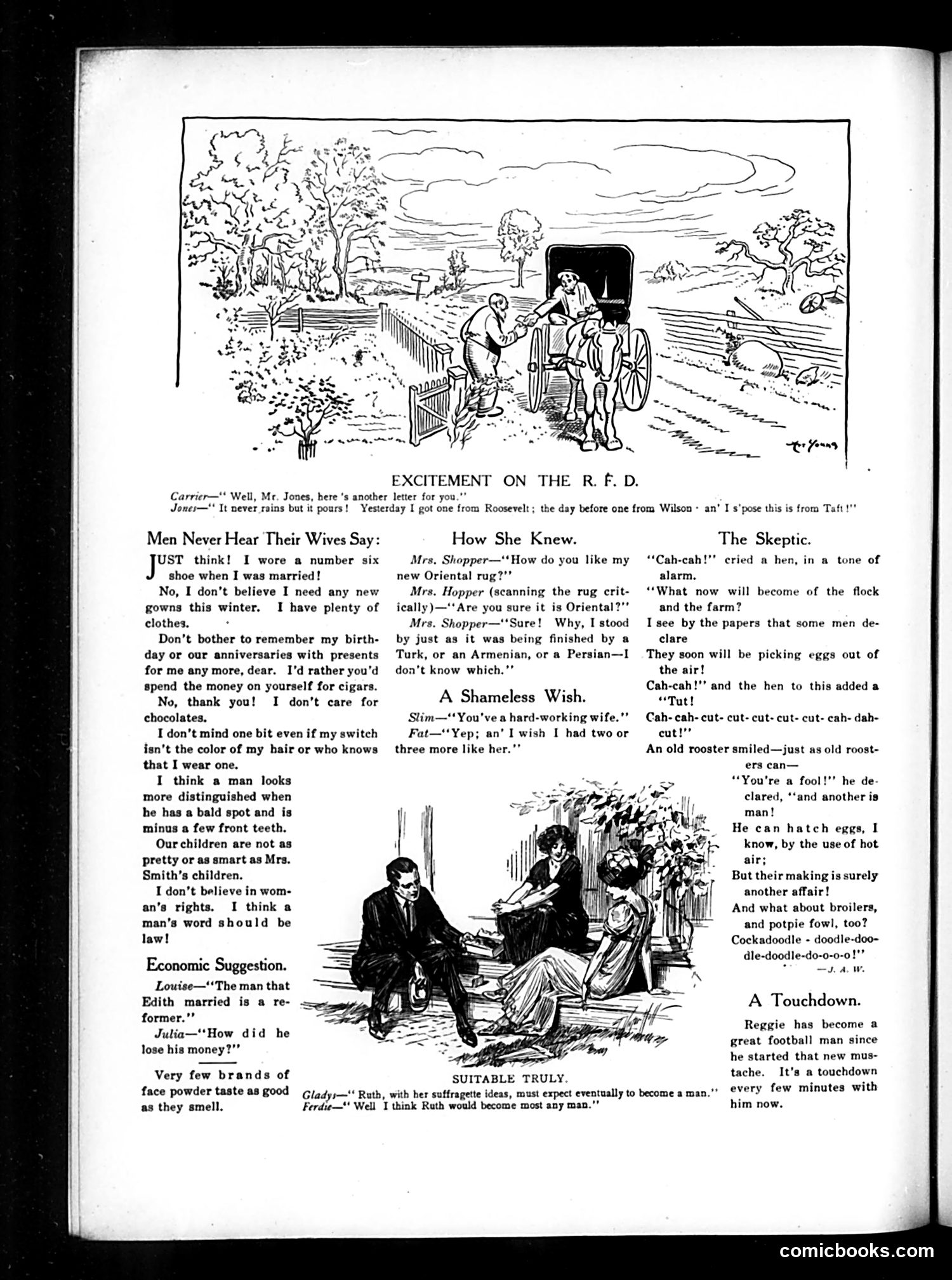
This Judge magazine page contains multiple satirical pieces typical of early 20th-century humor: **"Excitement on the R.F.D."** (top cartoon): A rural mail carrier delivers multiple letters to Mr. Jones, who jokes that "it never rains but it pours." The satire likely references the volume of presidential correspondence—the text mentions letters from Roosevelt, Wilson, and Taft, suggesting political mail saturation during an election period. **"Men Never Hear Their Wives Say"** mocks the gap between what wives actually want and what husbands assume. The pieces satirize women's materialism, vanity, and acceptance of male dominance—reflecting anxieties about women's evolving roles and the suffrage movement. **Other sections** include domestic humor ("Economic Suggestion," "A Shameless Wish") and a dialogue about a skeptical hen dismissing the idea of artificial egg-incubation—mocking contemporary scientific optimism. The overall tone reflects 1910s-era gender stereotypes and anti-progressive sentiment, presenting women as inherently inconsistent while poking fun at technological boosterism.
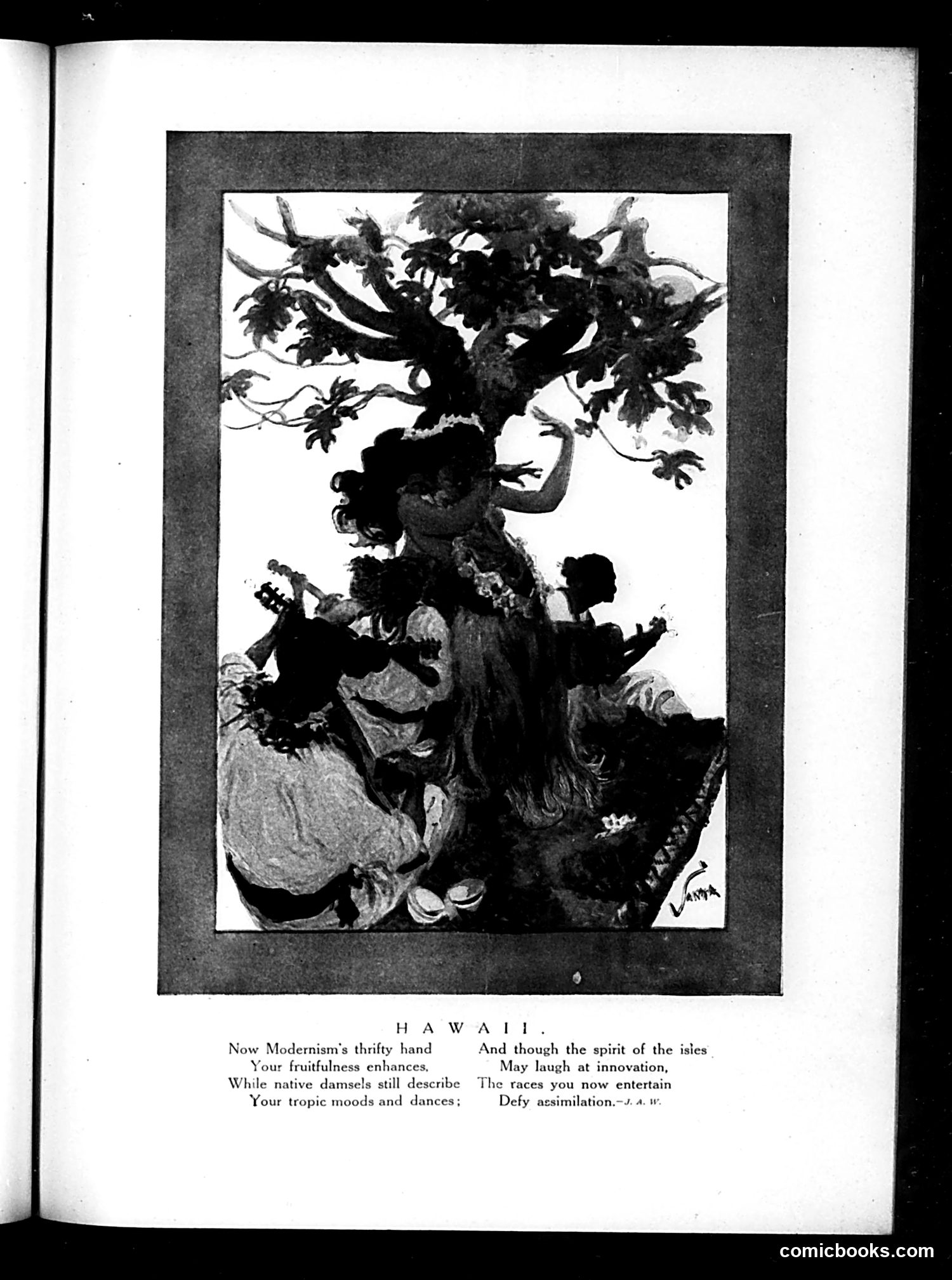
This illustration depicts Hawaii undergoing modernization ("Modernism's thrifty hand") while the poem expresses anxiety about cultural preservation. The image shows a central female figure surrounded by flowing tropical imagery and what appear to be attendants or dancers, representing Hawaiian culture. The accompanying verse suggests tension between economic development and native Hawaiian identity. The phrase "races you now entertain / Defy assimilation" indicates concern that despite modernization, Hawaiian and other Pacific Island peoples resist being absorbed into Western culture. The poem critiques how commercialization co-opts "tropic moods and dances" for profit while native populations maintain distinct cultural identity—a commentary on early 20th-century American colonialism and cultural commodification in Hawaii.
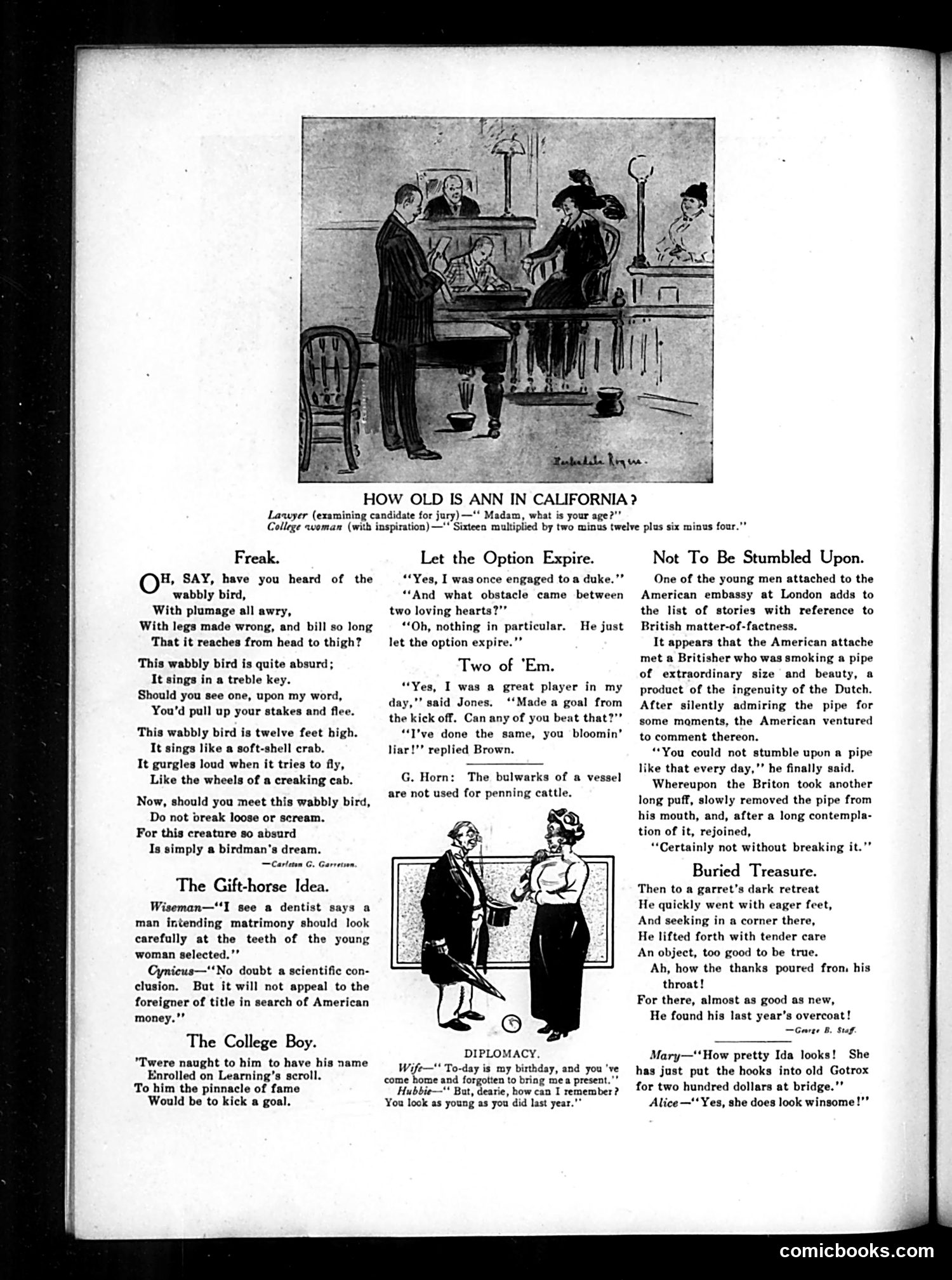
The top cartoon mocks women's suffrage and education. A lawyer asks a female juror her age; she responds with an absurdly complex mathematical formula ("Sixteen multiplied by two minus twelve plus six minus four"), suggesting that college-educated women are impractical and overly intellectual—a contemporary anti-suffrage stereotype implying women shouldn't serve on juries. The remaining content consists of humorous short pieces and verses typical of Judge's format: - "Freak" is nonsense verse about an imaginary bird - "The Gift-horse Idea" satirizes wealthy American heiresses marrying European nobility for prestige rather than love - "The College Boy" mocks college athletes who care only about sports, not academics - Other pieces joke about engagements, diplomacy, and marital life with gentle domestic humor The magazine targeted educated, middle-class readers with social commentary wrapped in light comedic form.
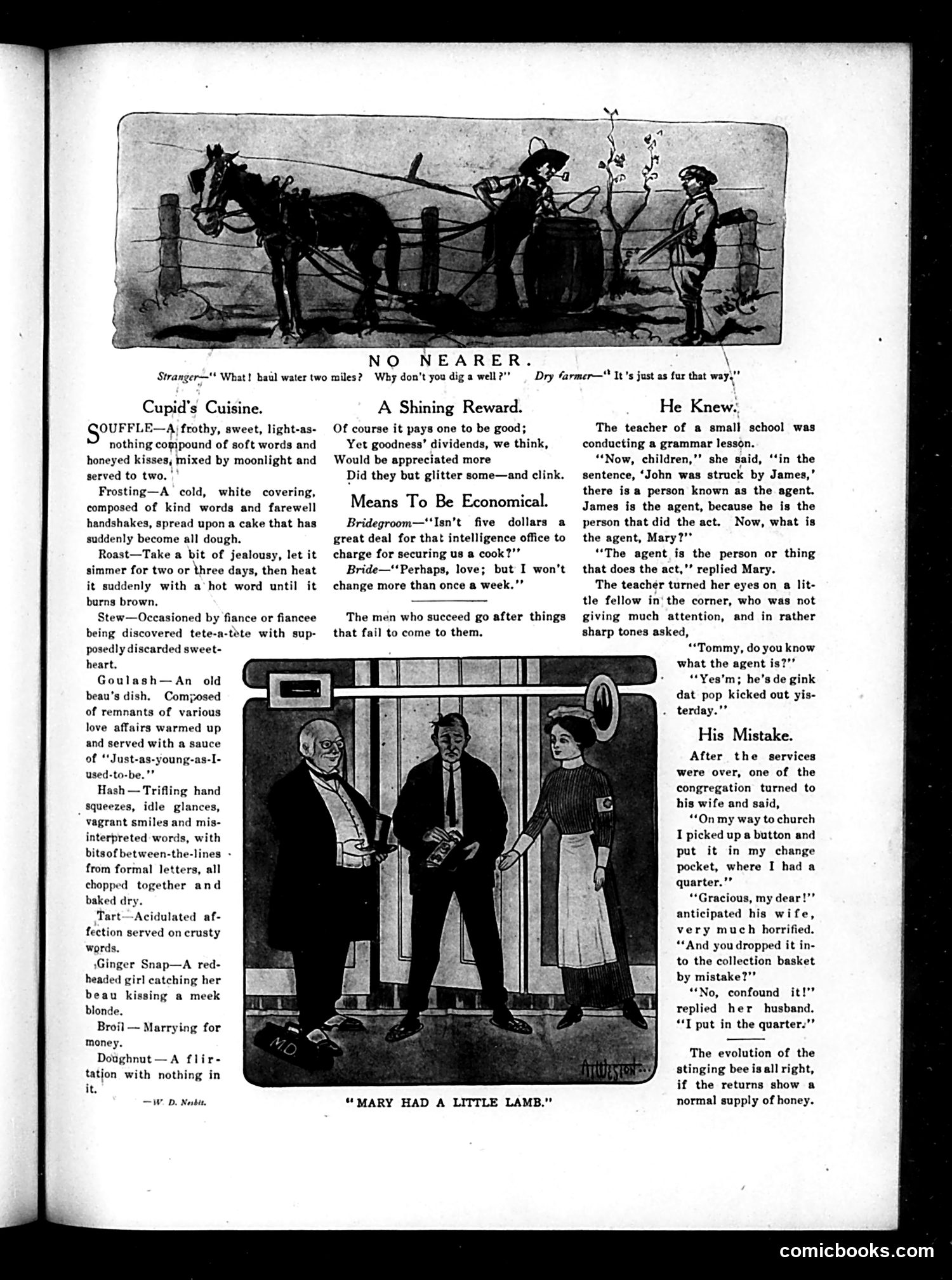
This page contains **multiple unrelated satirical pieces** typical of Judge's format: **Top cartoon:** "No Nearer" depicts a rural water-hauling scene where a stranger suggests digging a well instead of carrying water two miles. The dry farmer replies "It's just as fur that way"—satire on rural stubbornness or lack of initiative. **Middle section:** "Cupid's Cuisine" (by W.D. Nesbit) is a humorous recipe list treating romantic relationships as dishes—"Soufflé" of kisses, "Roast" of jealousy, "Stew" of discovered infidelity. It mocks sentimental courtship language through culinary metaphor. **Bottom illustration:** "Mary Had a Little Lamb" (captioned but content unclear from text alone) appears to show church or formal scene. **Right column stories:** Short humor pieces on economical brides, grammar lessons, and church collection mistakes—gentle domestic satire with no apparent political content. The page exemplifies Judge's mix of romantic/domestic humor and light social commentary targeting middle-class American life.
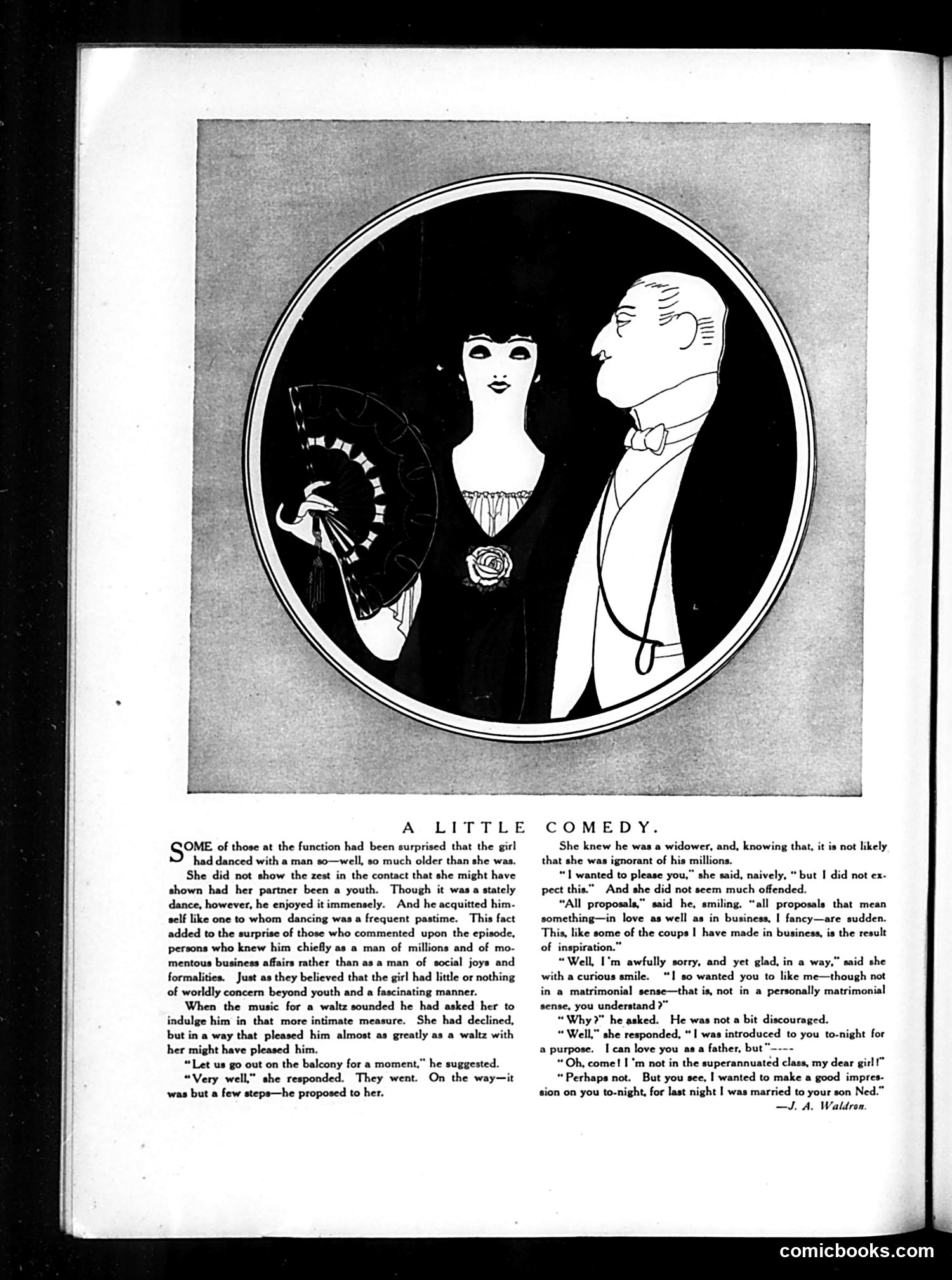
This is a satirical story rather than a political cartoon, illustrating early 20th-century social attitudes about wealth and marriage. **The Setup:** A wealthy, older widower dances with a young woman at a society function. Observers are surprised—both that she dances with an elderly man and that he seems socially graceful despite being known primarily as a businessman. **The Joke:** On the balcony, he impulsively proposes marriage. She accepts but then reveals her actual purpose: she was introduced to him specifically to make a good impression because *she married his son Ned the night before*. **The Satire:** The piece mocks: - Young women's calculated pursuit of wealthy men - Wealthy men's vanity and susceptibility to flattery - The transactional nature of upper-class courtship - How money blinds men to obvious manipulation The humor derives from the woman's success in charming him through transparent flattery, and his surprise at discovering her real agenda was securing his approval for her marriage to his son.
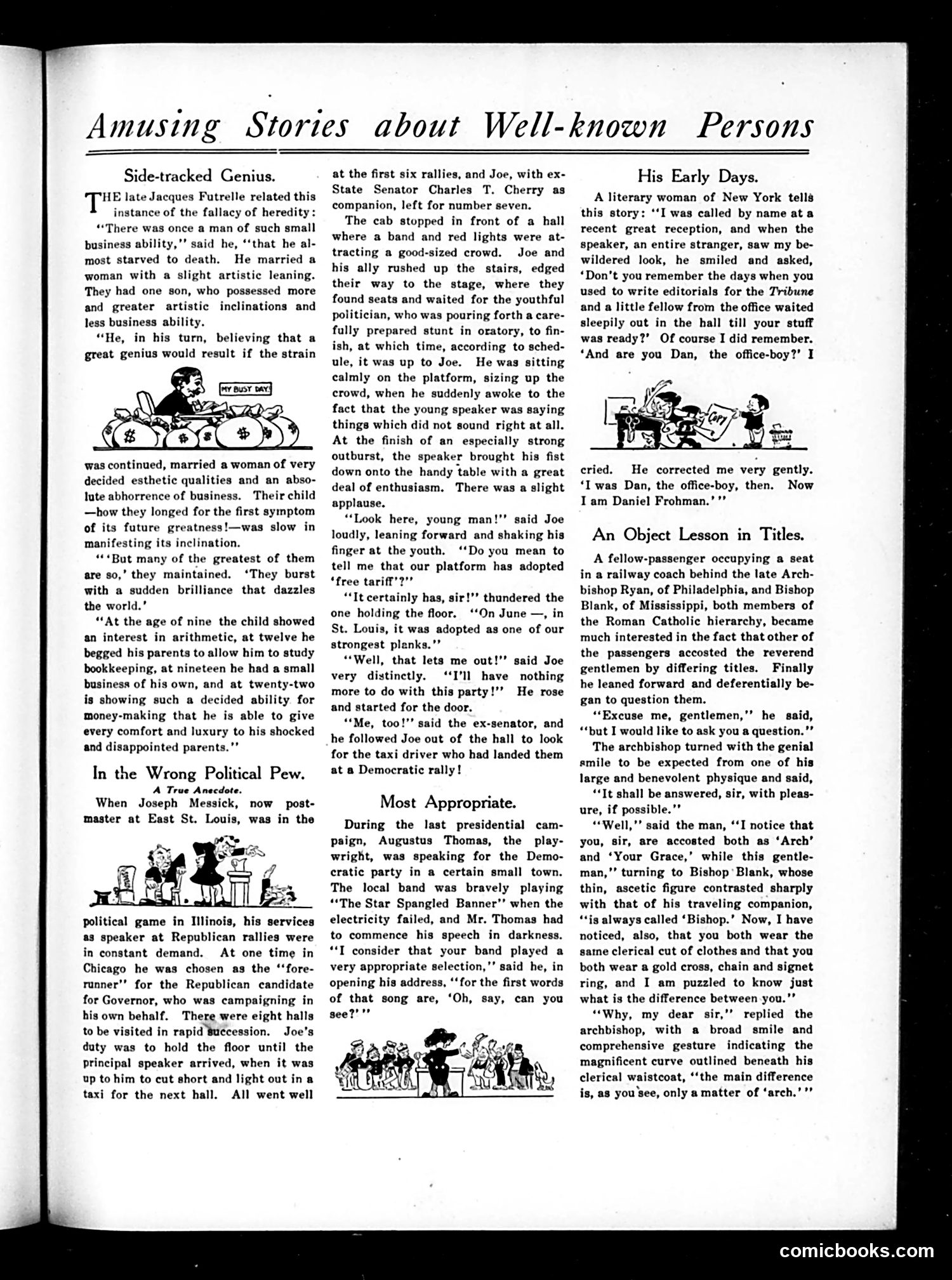
This page contains three humorous anecdotes about prominent figures, illustrated with small cartoons. **"Side-tracked Genius"** tells a story attributed to writer Jacques Futrelle: parents with poor business sense marry artistically-gifted spouses hoping their child will be a genius, but the boy becomes—disappointingly—a successful businessman. **"In the Wrong Political Pew"** recounts how Joseph Messick, a Republican speaker, was sent to campaign at what he thought was a GOP rally. Mid-event, he discovered the politician advocating "free tariff"—a Democratic position. Messick immediately walked out in protest, realizing he'd entered a *Democratic* rally by mistake. **"Most Appropriate"** jokes that playwright Augustus Thomas, speaking for Democrats, began his speech in darkness after the electricity failed—and he quipped that the band's selection of "The Star Spangled Banner" was "very appropriate," implying Democrats operate in darkness. These anecdotes mock political party identity and the tariff debate that divided Republicans and Democrats in the early 20th century.
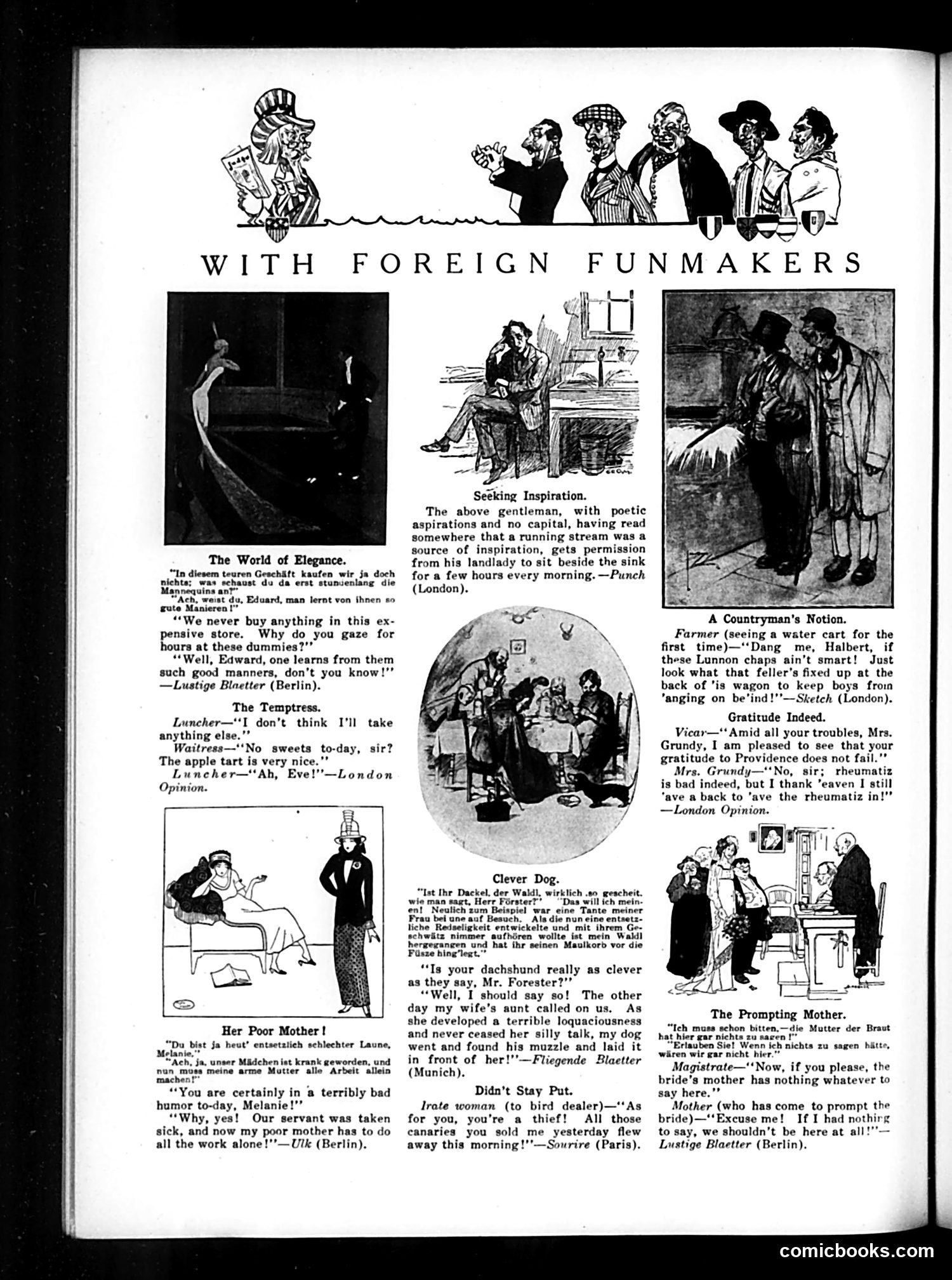
This page collects humorous anecdotes translated from European satirical magazines (Berlin's *Lustige Blätter*, London's *Punch*, Paris's *Sourire*, and Munich's *Fliegende Blätter*). Rather than political cartoons, these are comic vignettes satirizing social behavior and class dynamics. The humor targets: servants as status symbols ("Her Poor Mother"), middle-class pretension ("The World of Elegance"), romantic stereotyping ("The Temptress"), and domestic absurdities (a dachshund using his muzzle to stop an aunt's chatter). One piece mocks rural simplicity—a farmer misidentifies a water cart's spray mechanism as anti-loitering equipment. The consistent theme is gentle mockery of human folly across class lines: both aristocratic affectation and working-class confusion. The inclusion of foreign sources suggests *Judge* positioned itself as cosmopolitan, sharing sophisticated European satire with American readers. The cartoons reinforce early 20th-century gender and class stereotypes without advancing political argument.
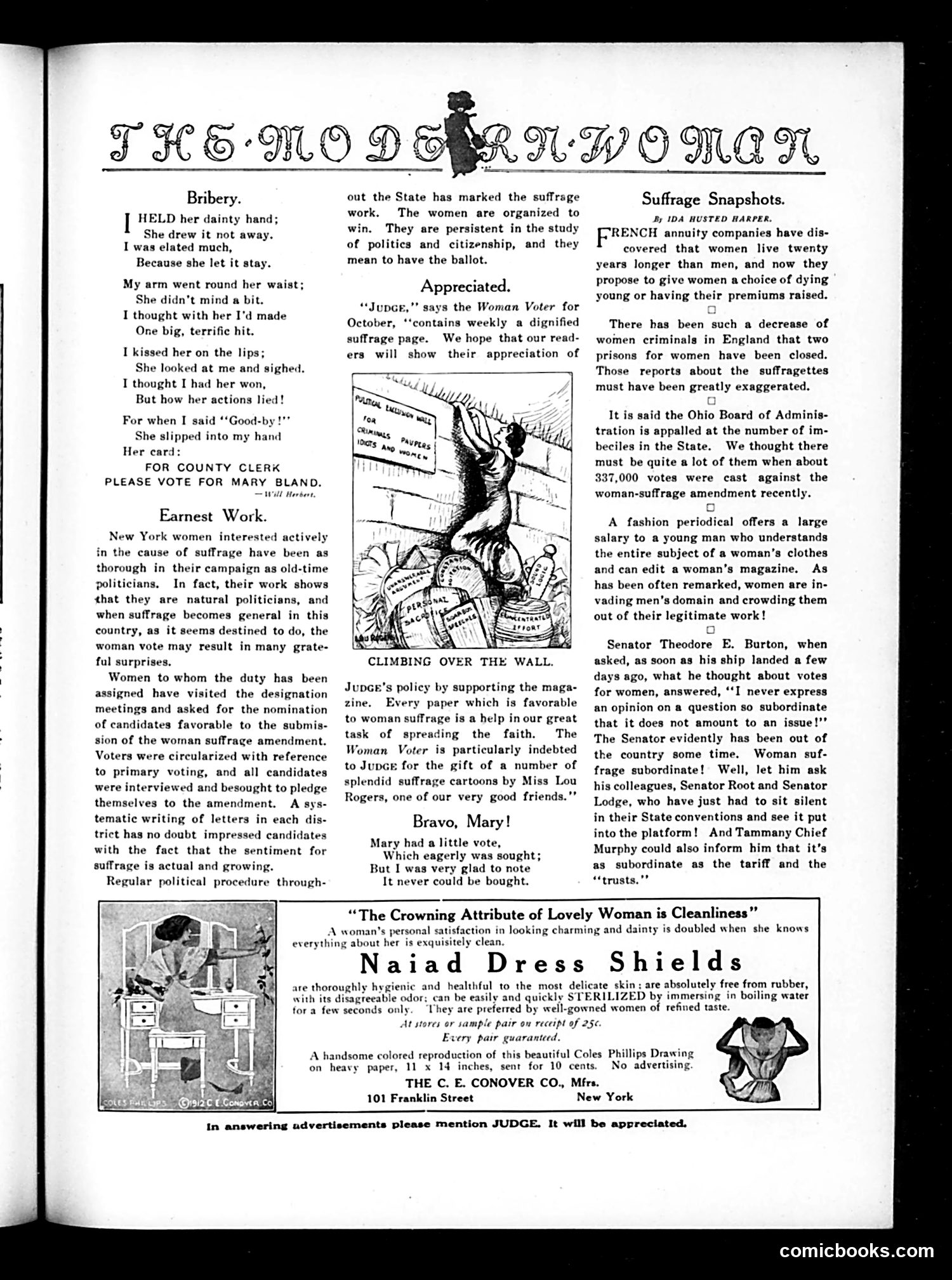
This Judge magazine page satirizes women's suffrage activism circa 1910s. The main cartoon "Climbing Over the Wall" depicts a woman suffragette scaling an obstacle—likely representing legal/political barriers to voting rights. The opening poem "Bribery" jokes that a man's romantic advances are rebuffed when the woman hands him a campaign card for "Mary Bland for County Clerk," suggesting suffragists strategically used personal interactions to promote pro-suffrage candidates. The "Earnest Work" article praises New York women suffragists for employing sophisticated political organizing—meeting candidates, circularizing voters, and systematic letter-writing—treating them as serious political operatives. The "Suffrage Snapshots" section contains sarcastic quips mocking anti-suffrage arguments: Ohio voting against women's suffrage proves Ohio voters are "imbeciles"; Senator Burton's evasion about women voting as "subordinate" is ridiculed since suffrage is clearly consuming political attention. The overall tone is surprisingly supportive of women's suffrage, portraying activists as competent and their cause as politically inevitable.
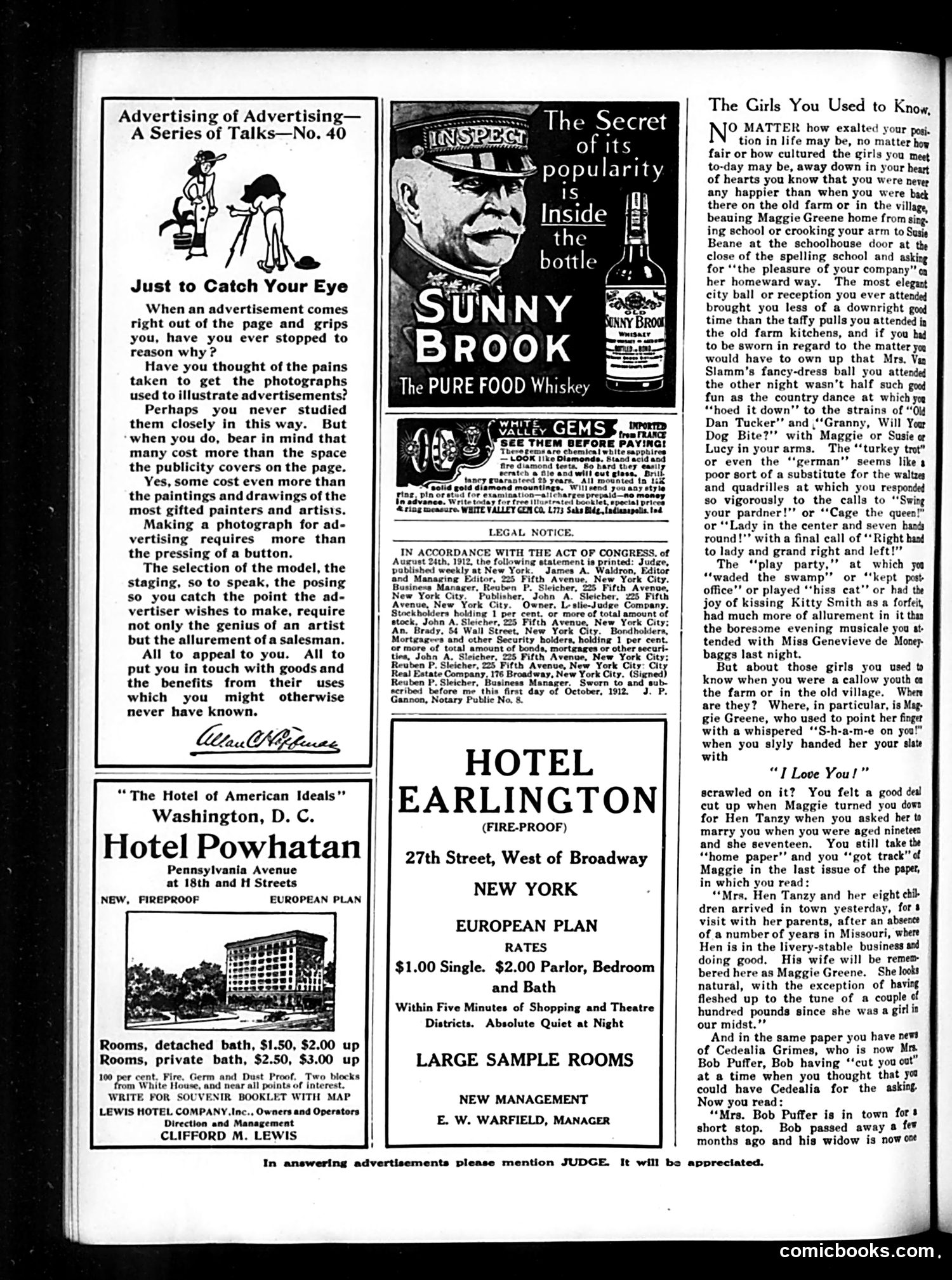
This page is primarily **advertising and filler content** rather than political satire. The main editorial piece, "Advertising of Advertising—No. 40," discusses **photography costs in commercial advertisements**—explaining that professional photo shoots for ads require skilled staging, model selection, and artistic direction, often costing more than the ad space itself. This reflects early 20th-century advertising industry practices. The **Sunny Brook whiskey advertisement** features a mustachioed man in a bowler hat—a generic "gentleman" figure typical of the era's marketing imagery, with no specific political reference. The right column's nostalgic piece, "The Girls You Used to Know," sentimentalizes rural American life and courtship, contrasting idealized farm memories with modern city society—reflecting common contemporary themes about rural versus urban living. The remaining content consists of **hotel advertisements** (Powhatan, Earlington) and a legal notice. **No specific political satire or caricature is evident** on this page. It represents standard Judge magazine filler and advertising content from approximately 1912.
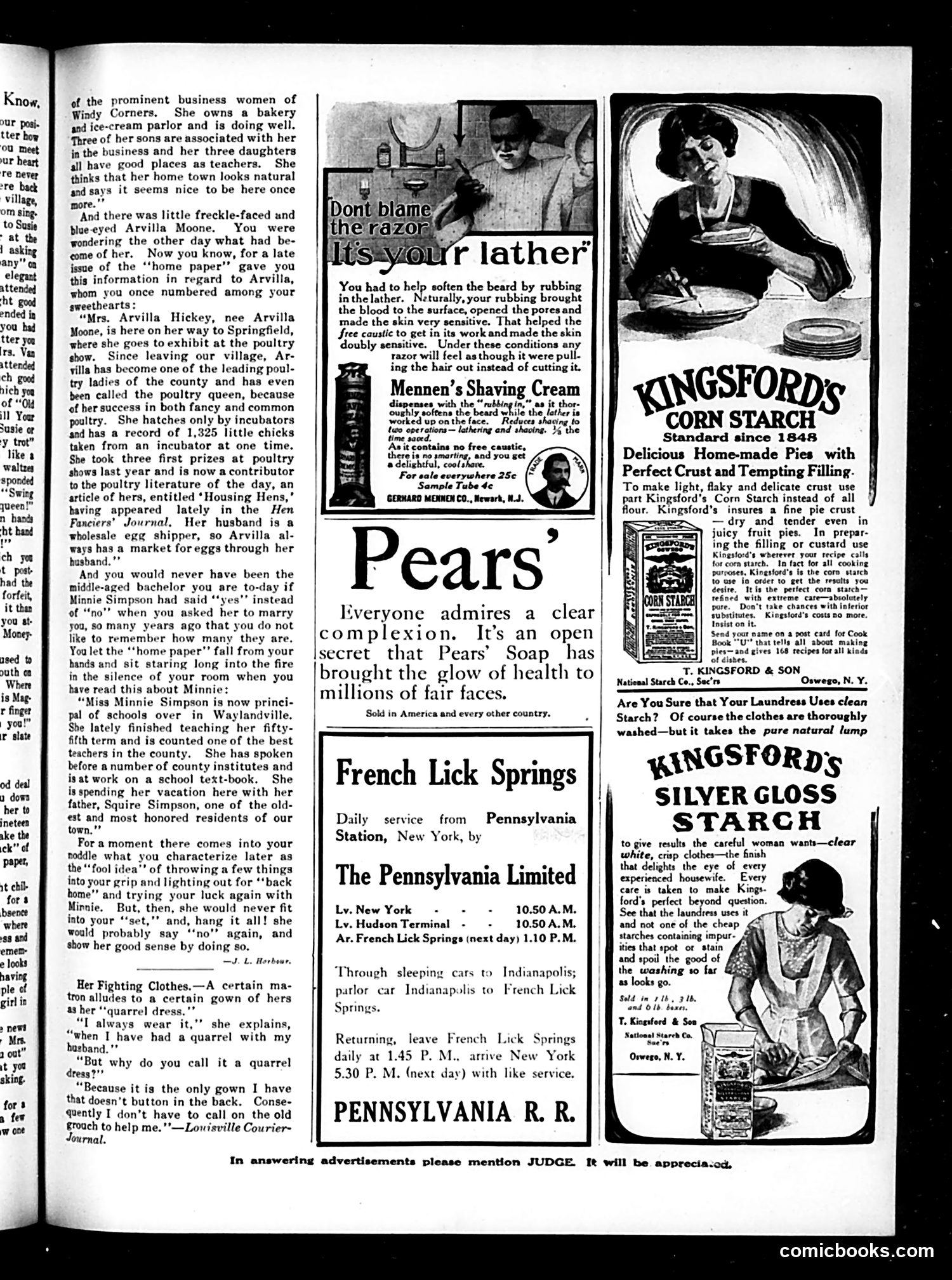
This page is primarily **advertisements** interspersed with short prose pieces about small-town life. The left column contains sentimental vignettes about former neighbors—Arvilla Moone (now successful in poultry farming) and Minnie Simpson (now a school principal)—written to evoke nostalgia for a small hometown called "Windy Corners." The advertisements dominate: **Mennen's Shaving Cream** (center-left) uses a mock-scientific pitch about lather softening beards and protecting sensitive skin. **Pears' Soap** (center) promotes complexion care. **Kingsford's Corn Starch** (right, two ads) advertises both for pie-making and laundry use, with images of housewives. **The satire**: These ads represent the era's obsession with manufactured solutions to everyday problems—shaving, skincare, cooking, laundry—marketed through pseudoscience and appeals to respectability. The contrast between sincere small-town nostalgia and aggressive commercial messaging satirizes American consumer culture's encroachment on traditional life.
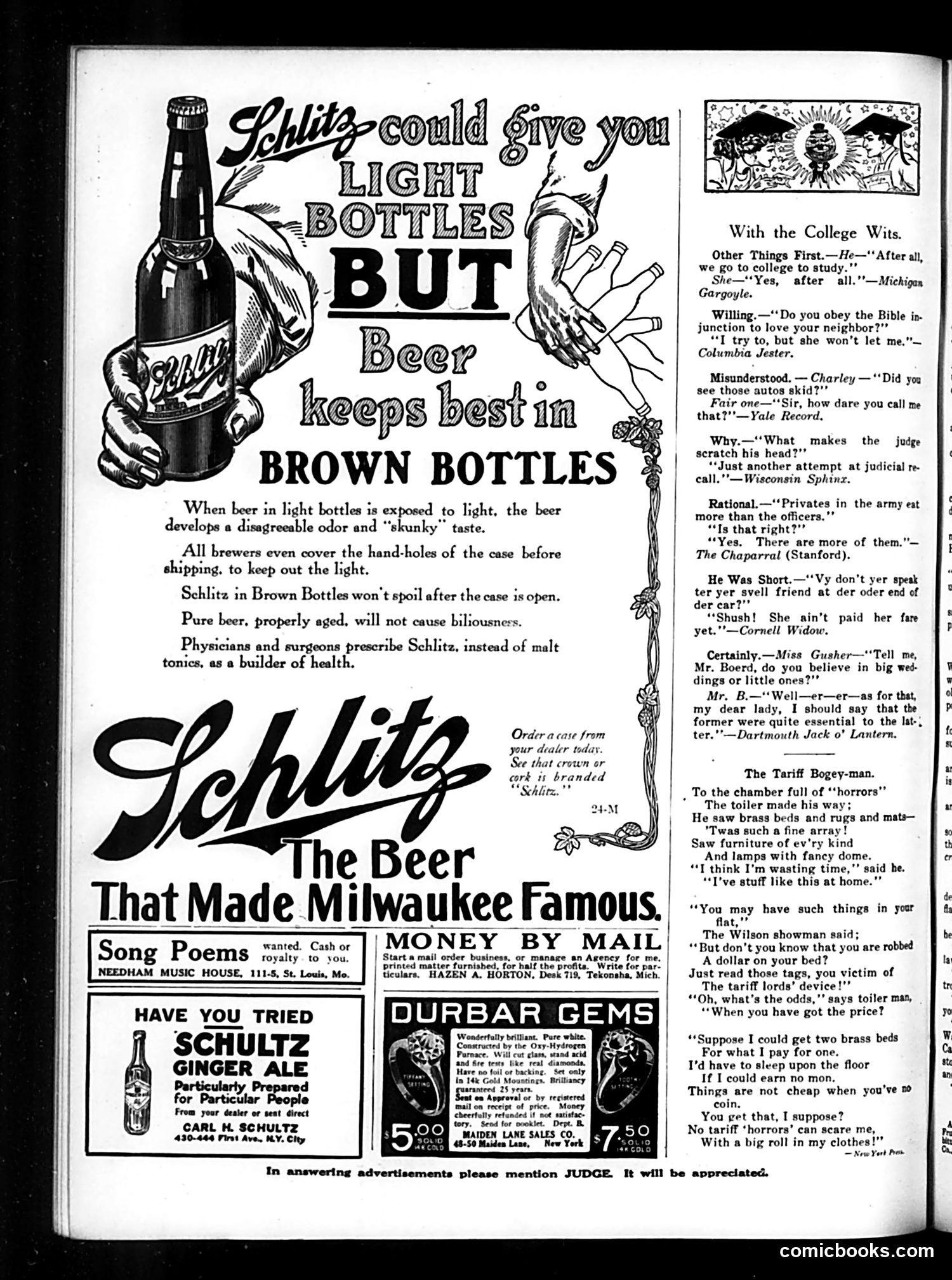
This page is primarily **advertising** for Schlitz beer, with smaller ads for ginger ale, song poems, mail-order schemes, and fake diamonds. The main cartoon content consists of **college humor jokes** (right column)—brief, punny one-liners from various university publications mocking romantic mishaps and social awkwardness. Below that is a longer poem called "The Tariff Bogey-man," which is **political satire**. It depicts a working-class man touring a showroom where a "Wilson showman" tries frightening him about tariffs raising prices on household goods. The joke: the toiler dismisses the argument because he's broke anyway—he can't afford cheap goods *or* expensive ones without money in his pocket. The satire mocks Wilson-era **protectionist tariff arguments** as meaningless to poor workers who lack purchasing power regardless. The overall page reflects *Judge* magazine's mix of consumer advertising, campus humor, and light political commentary typical of the 1910s-1920s era.
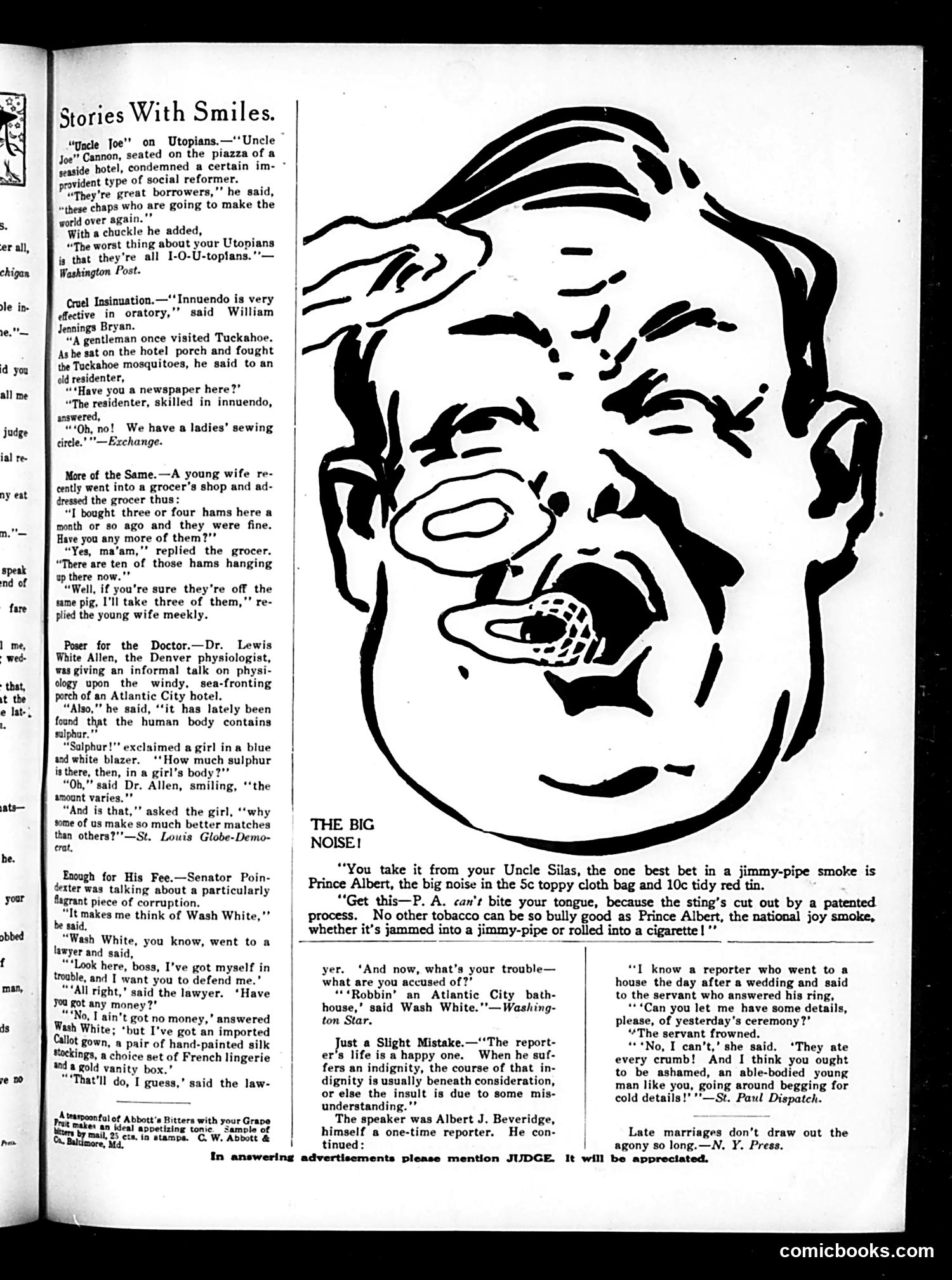
This page from *Judge* magazine contains several humorous anecdotes satirizing American social types and foibles circa early 1900s: **"Utopians"** mocks social reformers as deadbeats ("I-O-U-topians"—a pun on owing money). **"Cruel Insinuation"** jokes about mosquitoes and newspaper gossip in rural areas. **"Poser for the Doctor"** features a girl asking a physiologist why some women make "better matches" than others—a playful double entendre suggesting both romantic desirability and chemical composition. **"Enough for His Fee"** depicts a Black client offering jewelry and lingerie instead of money to a lawyer—reflecting period racist stereotypes about African Americans and materialism. The page also contains a large advertisement for **Prince Albert tobacco**, featuring a jovial face promoting the product's qualities. The humor relies on wordplay, social pretension, and period stereotypes that would register differently to modern readers.
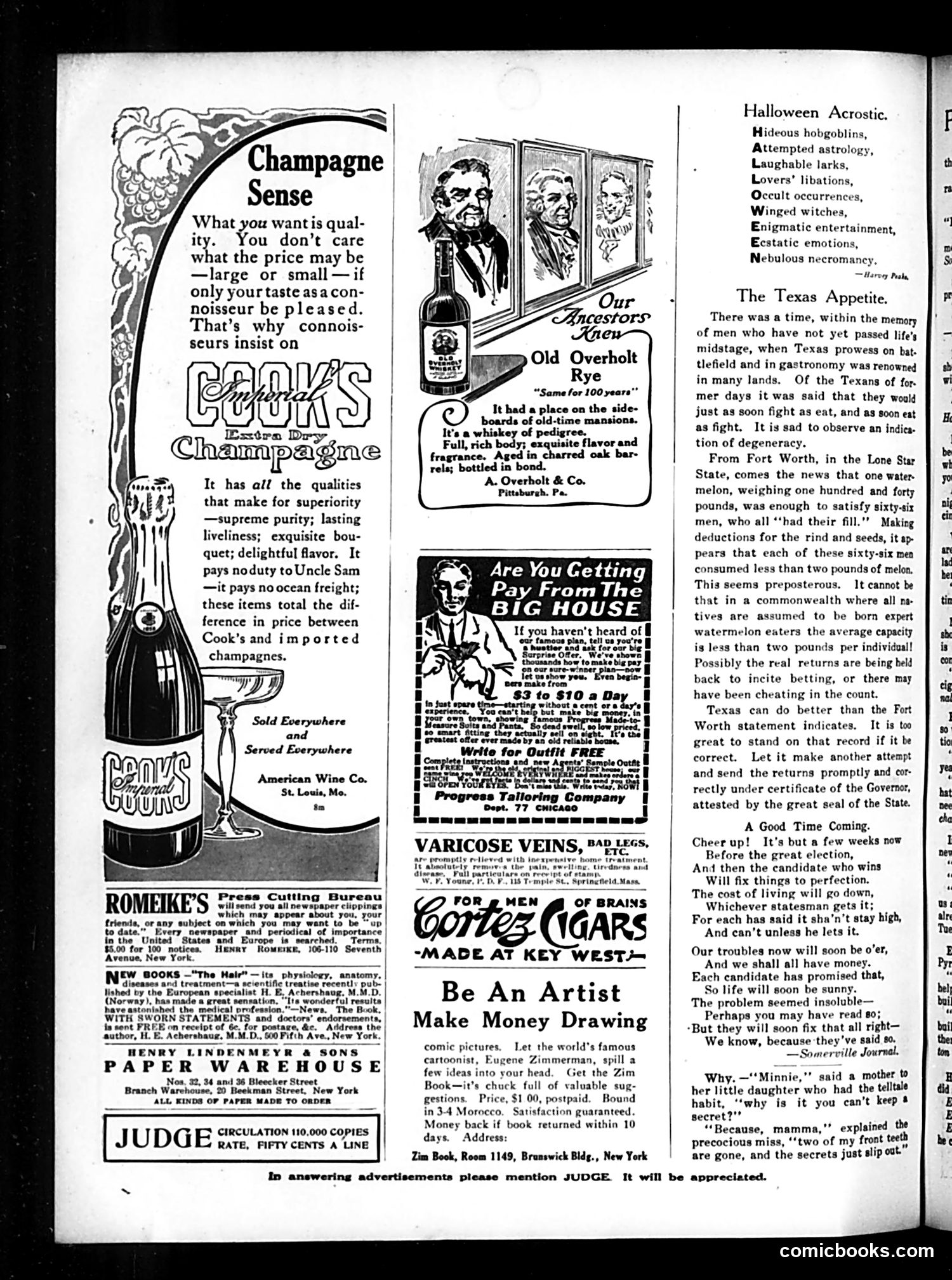
This page is primarily **advertising** with some light satirical content interspersed. The main advertisements promote luxury goods—champagne (Cook's brand), whiskey (Old Overholt), cigars, and services like press clipping bureaus and art instruction courses. The satirical content appears in two pieces: "Halloween Acrostic," a humorous poem about Halloween themes, and "The Texas Appetite," which **mocks Texans' declining eating capacity**. The piece claims that 66 men collectively consumed only one 140-pound watermelon (less than 2 pounds per person), suggesting Texans have lost their legendary appetite and toughness. It sarcastically challenges Texas pride by demanding they recount properly "under certificate of the Governor." "A Good Time Coming" is cynical political verse mocking the upcoming election, suggesting the winning candidate will promise to "fix things to perfection" but implicitly won't deliver. The page reflects Judge's typical mix of advertising revenue and light satirical commentary on American culture and politics.
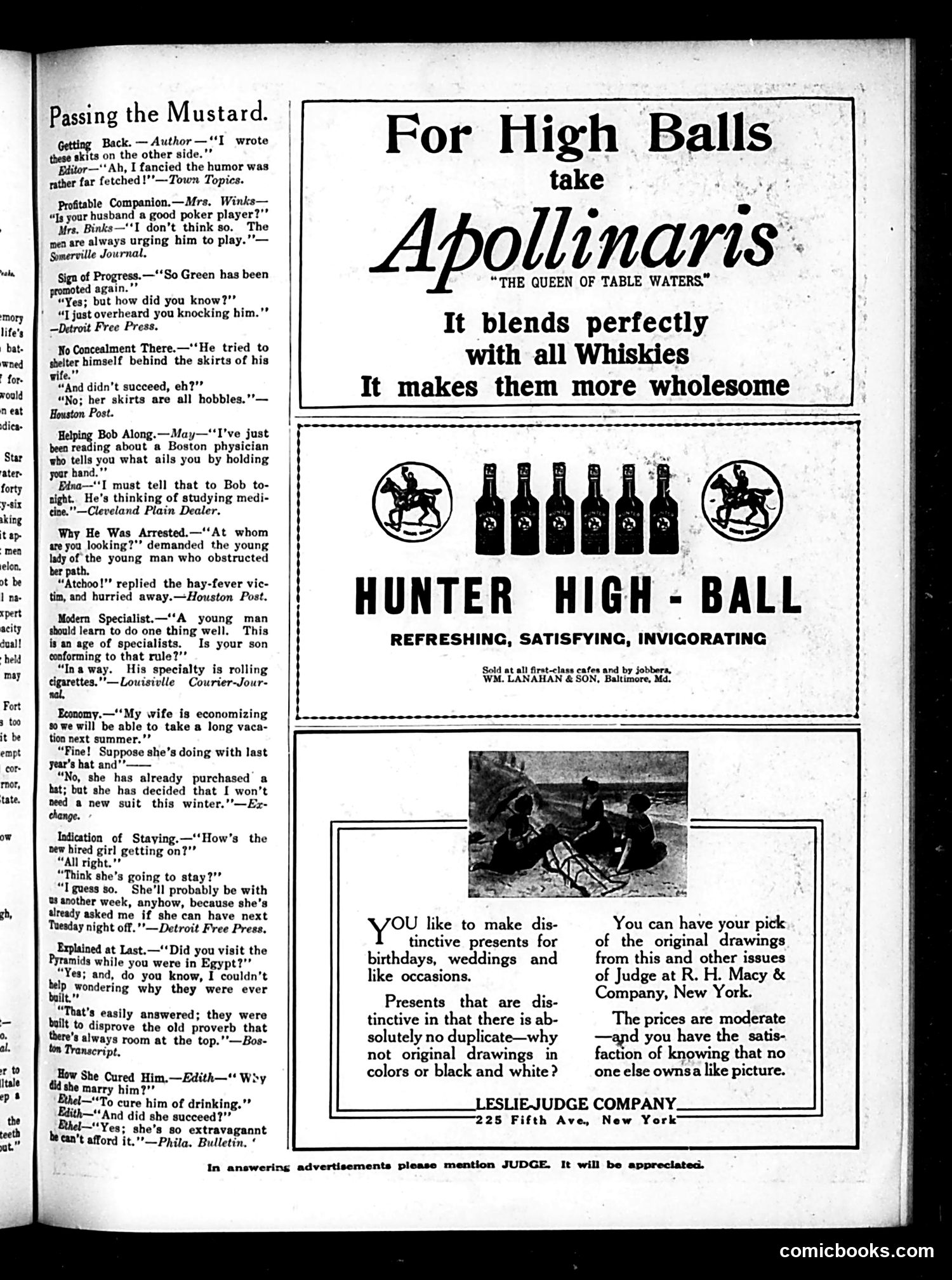
This page from *Judge* (a satirical weekly) consists primarily of **short joke columns** rather than political cartoons. The humor targets everyday domestic and social situations typical of early 20th-century American life. Notable jokes mock: - **Marital dynamics** (wives' spending, husbands' hobbies) - **Social pretension** (the "modern specialist" who only does one thing) - **Class and gender** (the hired girl's negotiating power; wives' fashion choices) - **Medical quackery** (the Boston physician claiming to diagnose by holding hands) The page is dominated by **advertisements**, particularly for "Hunter High-Ball" whiskey and "Apollinaris" table water—products marketed as making alcohol consumption "wholesome." This reflects pre-Prohibition attitudes toward drinking. A Leslie-Judge Company ad offers original cartoon drawings as distinctive gifts, targeting affluent readers. The humor is gentle, observational satire aimed at *Judge's* educated, middle-to-upper-class audience, poking fun at foibles rather than addressing serious political issues.
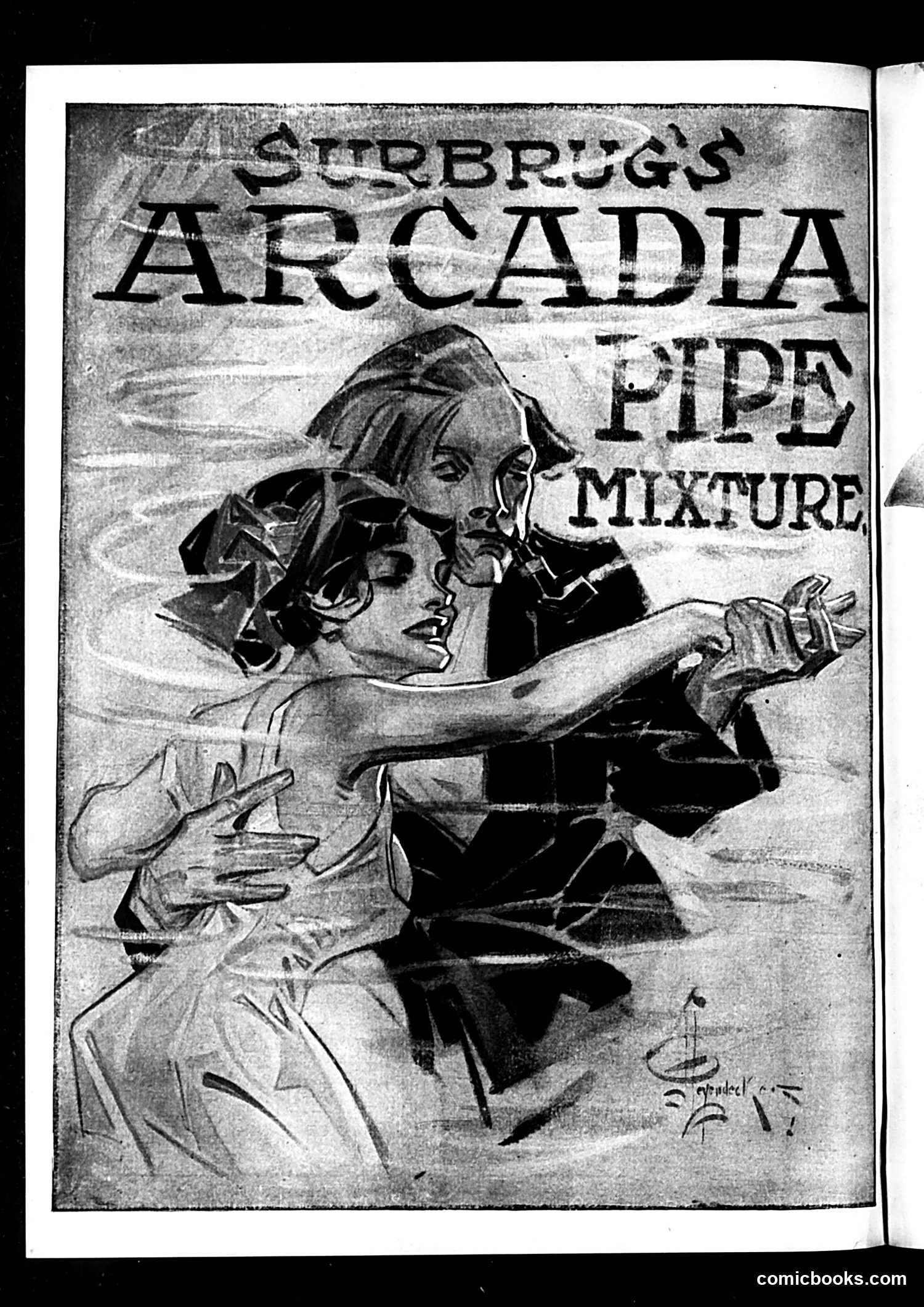
This appears to be an advertisement for pipe tobacco rather than a political cartoon. The image shows two figures in theatrical or fantastical costume—one appears to be a cherub or cupid-like character, the other a woman in classical dress—both gesturing expressively. The title "Arcadia Pipe Mixture" references Arcadia, a classical literary/mythological setting associated with pastoral romance and idealized beauty. The ad uses classical imagery to market the tobacco product by associating it with refinement, romance, and escapism. The theatrical style and whimsical figures suggest this product appeals to leisure and sophistication. The artist's signature appears in the lower right. This is typical late 19th or early 20th-century advertising that leveraged classical allusions to sell consumer goods.