
Judge, 1912-10-26 · page 2 of 24
Judge — October 26, 1912 — page 2: what you’re looking at
What you’re looking at
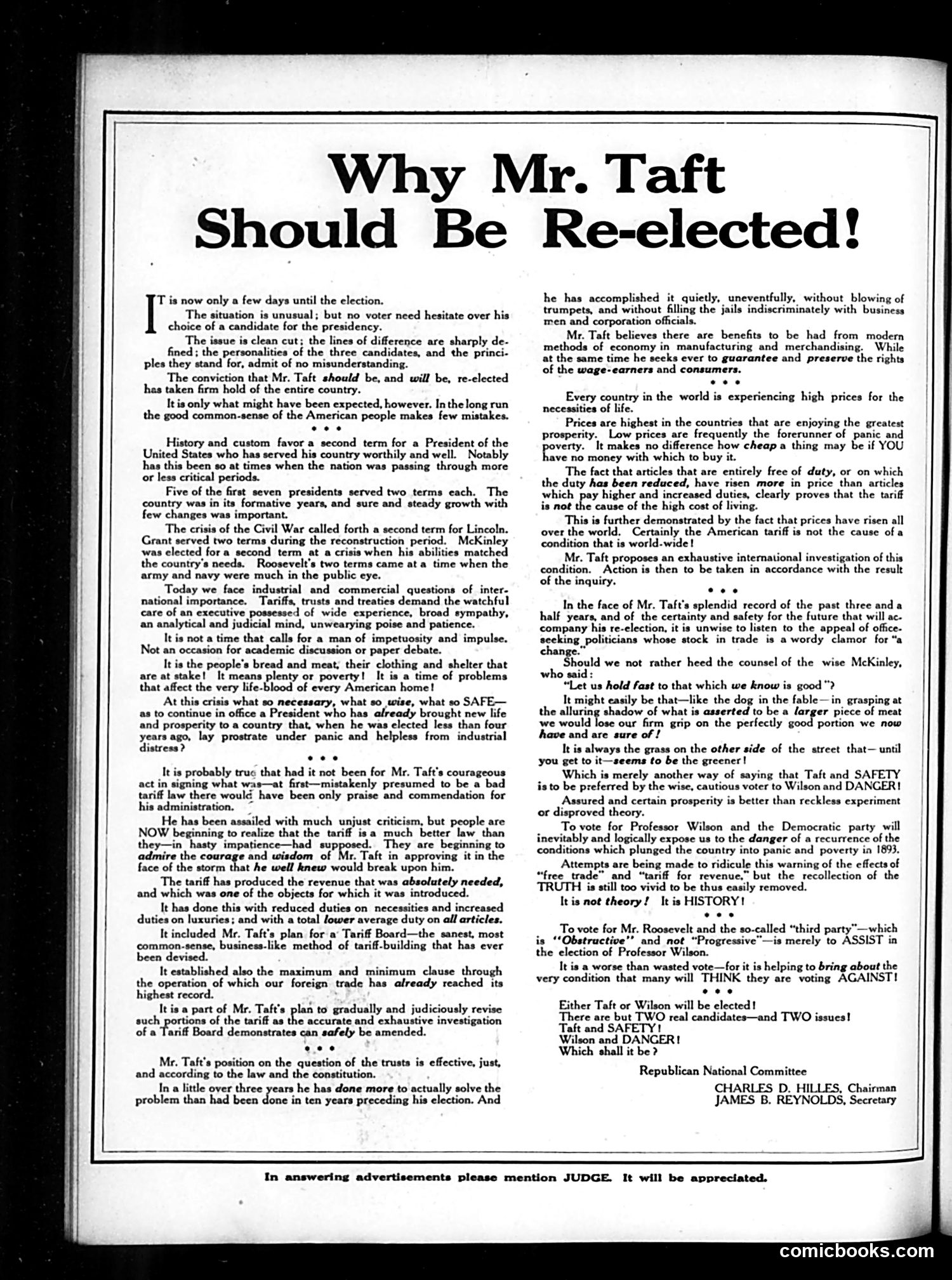
This is a **political advertisement**, not a cartoon. The Republican National Committee argues for President Taft's re-election, presenting his record as stable and beneficial. The piece defends Taft against criticism regarding high prices and tariffs, attributing these to global conditions rather than his policies. The advertisement contrasts Taft with two opponents: Professor Wilson (Democrat) and Roosevelt (representing a "third party"). It characterizes Roosevelt's "Progressive" movement as merely assisting Wilson's election. The rhetoric emphasizes Taft's cautious, steady approach versus perceived dangers of change. The final argument presents a binary choice: "Taft and SAFETY" versus "Wilson and DANGER." This reflects the historic **1912 three-way presidential race** where Roosevelt's Bull Moose Party split Republican votes.
📄 Transcribed text from this page (OCR, searchable)
Machine-transcribed from the original scan — historical spelling and the odd misread are preserved.
Why Mr. Taft Should Be The situation is unusual; but no voter need hesitate over his choice of a candidate for the presidency. The issue is clean cut; the lines of difference are sharply de- fined ; the personalities of the three candidates, and the princi- ples they stand for, admit of no misunderstanding. The conviction that Mr. Taft should be, and will be, re-elected has taken firm hold of the entire country. It is only what might have been expected, however. Inthe long run the good common-sense of the American people makes few mistakes. eee [ is now only a few days until the election. History and custom favor a second term for a President of the United States who has served his country worthily and well. Notably has this been so at times when the nation was passing through more or less critical periods. Five of the first seven presidents served two terms each. The country was in its formative years, and sure and steady growth with few changes was important. The crisis of the Civil War called forth a second term for Lincoln. Grant served two terms during the reconstruction period. McKinley was elected fora second term at a crisis when his abilities matched the country's ne Roosevelt's two terms came at a time when the army and navy were much in the public eye. Today we face industrial and commercial questions of inter- national importance. Tariffs, trusts and treaties demand the watchful care of an executive possessed of wide experience, broad sympathy, an analytical and judicial mind, unwearying poise and patience. It is not a time that calls for a man of impetuosity and impulse. Not an occasion for academic discussion or paper de! It is the people's bread and meat, their clothing = shelter that are at stake! It means plenty or poverty! It is a time of problems that affect the very life-blood of every American home! At this crisis what so necessary, what so wise, what so SAFE— as to continue in office a President who has already brought new life and prosperity to a country that, when he was elected less than four years ago, lay prostrate under panic and helpless from industrial distress > eee It is probably truc that had it not been for Mr. Taft's courageous t in signing what was—at first—mistakenly presumed to be a bad iff law there would have been only praise and commendation for his administration. He has been assailed with much unjust criticism, but people are NOW beginning to realize that the tariff isa much better law than they—in hasty impatience—had sup They are beginning to admire the courage and wisdom of Mr. Taft in approving it in the face of the storm that he well knew would break upon hi: The tariff has produced the revenue that was absolutely needed, and which was one of the objects for which it was introduced. It has done this with reduced duties on necessities and increased duties on luxuries; and with a total lower average duty on all articles. It included Mr. Taft's plan for a’ Tariff Board—the sanest, most common-sense, business-like method of tariff-building that has ever been devised. It established also the maximum and imum clause through the operation of which our foreign trade has already reached its highest record. It is a part of Mr. Taft's plan to gradually and judiciously revise such portions of the tariff as ce accurate and exhaustive investigation ofa Fanff Board demonstrates can safely be amended. eee Mr. Taft's position on the question of the trusts is effective, just, and according to the law and the constitution. In a little over three years he has done more to actually solve the problem than had been done in ten years preceding his election. And Re-elected! he has accomplished it quietly, uneventfully, without blowing of trumpets, and without filling the jails indiscriminately with business men and corporation officials. Mr. Taft believes there are benefits to be had from modern methods of economy in manufacturing and merchandising. While at the same time he seeks ever to guarantee and preserve the rights of the wage-earners and consumers. eee Every country in the world is experiencing high prices for the necessities of life. Prices are highest in the countries that are enjoying the greatest prosperity. Low prices are frequently the forerunner of panic and erty. It makes no difference how cheap a thing may be if YOU | ate no money with which to buy it. The fact that articles that are entirely free of duty, or on which the duty Aas been reduced, have risen more in price than articles which pay higher and increased duties, clearly proves that the tariff is not ke cause of the high cost of living. This is further demonstrated by the fact that prices have risen all over the world, Certainly the American tariff is not the cause of a condition that is world-wide! Mr. Taft proposes an exhaustive international investigation of this condition. Action is then to be taken in accordance with the result of the inquiry. eee In the face of Mr. Taft's splendid record of the past three anda half years, and of the certainty and safety for the future that will ac- company his re-election, it is unwise to listen to the appeal of office- seeking politicians whose stock in trade is a wordy clamor for “a Should we not rather heed the counsel of the wise McKinley, who said: “Let us hold fast to that which we know is good"? It might easily be that—like the dog in the fable—in_ grasping at the alluring shadow of what is asserted to be a larger piece of meat ‘we would Tose lose our firm grip on the perfectly g portion we now have and are sure of ! It is always the grass on the other side of the street that— until you get to ems to be the greener! Which is merely another way of saying that Taft and SAFETY is to be preferred by the wise, cautious voter to Wilson and DANGER! Assured and certain prosperity is better than reckless experiment or disproved theory. To vote for Professor Wilson and the Democratic party will inevitably and logically expose us to the danger of a recurrence of the conditions which plunged the country into panic and poverty in 1893. Attempts are being made to ridicule this warning of the effects of “free trade” and “tariff for revenue,” but the recollection of the TRUTH is still too vivid to be thus easily removed. It is not theory! It is HISTORY! eee To vote for Mr. Roosevelt and the so-called “third party”—which is ‘‘Obstractive’’ and not “Progressive”—is merely to ASSIST in the election of Professor Wilson. It is a worse than wasted vote—for it is helping to bring about the very condition that many will THINK they are voting AGAINST! eee Either Taft or Wilson will be elected! There are but TWO real candidates—and TWO issues! Taft and SAFETY! Wilson and DANGER! Which shall it be ? Republican National Committee CHARLES D. HILLES, Chairman JAMES B. REYNOLDS, Secretary In answering advertisements please mention JUDGE. It will be appreciated. comicbooks.com