
Judge, 1912-10-26 · page 16 of 24
Judge — October 26, 1912 — page 16: what you’re looking at
What you’re looking at
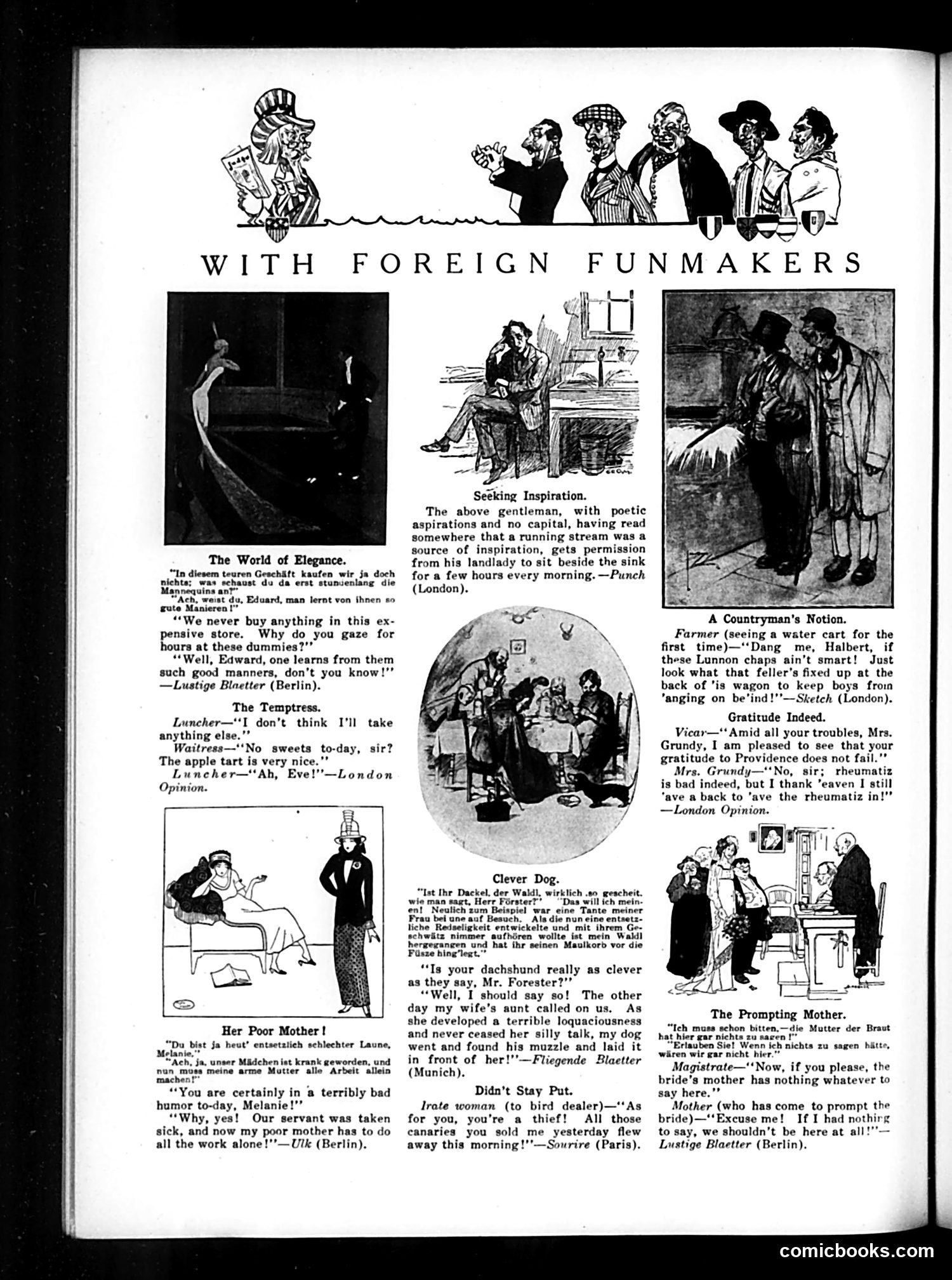
This page collects humorous anecdotes translated from European satirical magazines (Berlin's *Lustige Blätter*, London's *Punch*, Paris's *Sourire*, and Munich's *Fliegende Blätter*). Rather than political cartoons, these are comic vignettes satirizing social behavior and class dynamics. The humor targets: servants as status symbols ("Her Poor Mother"), middle-class pretension ("The World of Elegance"), romantic stereotyping ("The Temptress"), and domestic absurdities (a dachshund using his muzzle to stop an aunt's chatter). One piece mocks rural simplicity—a farmer misidentifies a water cart's spray mechanism as anti-loitering equipment. The consistent theme is gentle mockery of human folly across class lines: both aristocratic affectation and working-class confusion. The inclusion of foreign sources suggests *Judge* positioned itself as cosmopolitan, sharing sophisticated European satire with American readers. The cartoons reinforce early 20th-century gender and class stereotypes without advancing political argument.
📄 Transcribed text from this page (OCR, searchable)
Machine-transcribed from the original scan — historical spelling and the odd misread are preserved.
The World of Elegance. “In diesem teuren Geschitt kaufen wir ja doch nichts; was schaust du da erst stunvenlang die 49. Edvard, man lernt von thnen so “‘We never buy anything in this ex- pensive store. Why do you gaze for hours at these dummies?”’ “Well, Edward, one learns from them such good manners, don’t you know!’’ —Lustige Blaetter (Berlin). The Temptress. Luncher—‘'I don’t think I'll anything else.”” Waitress—'‘No sweets to-day, sir? The apple tart is very nice.’ Lunecher—‘Ah, Eve! Opinion. take —London Her Poor Mother! us Du bist Ja heut’ entactatich sehlechter Laune, Tach, Ja, unser Miidchen ist krank geworden, und pun moss meine arme Mutter alle Arbeit allein machen!” : “You are certainly in a terribly bad humor to-day, Melanie! “Why, yes! Our servant was taken sick, and now my poor mother has to do all the work alone !’’—Utk (Berlin). Seeking Inspiration. The above gentleman, with poetic aspirations and no capital, having read somewhere that a running stream was a source of inspiration, gets permission from his landlady to sit beside the sink for a few hours every morning. —Punch (London). lich .20 gescheit. xP? “Das will ich mein- war eine Tante meiner Als die nun eine entsetz~ Frau bei une auf Besuch, he Redseligkeit entwickelte und mit ihrem Ge- schwiitz nimmer aufhdren wollte ist mein Wald! hergegangen und hat thr seinen Maulkorb vor die PUsze bing’legt.” “Ig your dachshund really as clever as they say, Mr. Forester?” “Well, I should say so! The other day my wife’s aunt called on us, As she developed a terrible loquaciousness and never ceased her silly talk, my dog went and found his muzzle and laid it in front of her!’'—Fliegende Blaetter (Munich). Didn't Stay Put. Irate woman (to bird dealer)—'‘As for you, you're a thief! All those canaries you sold me yesterday flew away this morning!''—Sourire (Paris). Farmer (seeing a water cart for the first time)—‘‘Dang me, Halbert, if these Lunnon chaps ain’t smart! Just look what that feller’s fixed up at the back of 'is wagon to keep boys fron "anging on be'ind!’’—Sketch (London). Gratitude Indeed. Vicar—‘‘ Amid all your troubles, Mrs. Grundy, I am pleased to see that your gratitude to Providence does not fail.”” Mrs. Grundy—‘No, sir; rheumatiz is bad indeed, but I thank ’eaven I still ‘ave a back to ‘ave the rheumatiz in!" —London Opinion. The Prompting Mother. “Ich muss schon bitten,—die Mutter der Braut hat hier gar nichts zu sagen I" “Erlauben Sie! Wenn ich nichts zu sagen hitte, wiiren wir gar nicht hier.” Magistrate—‘Now, if you please, the bride’s mother has nothing whatever to say here.”” Mother (who has come to prompt the bride)—‘‘Excuse me! If I had nothirg to say, we shouldn’t be here at all !"’"— Lustige Blaetter (Berlin). comicbooks.com