
Judge, 1912-10-26 · page 15 of 24
Judge — October 26, 1912 — page 15: what you’re looking at
What you’re looking at
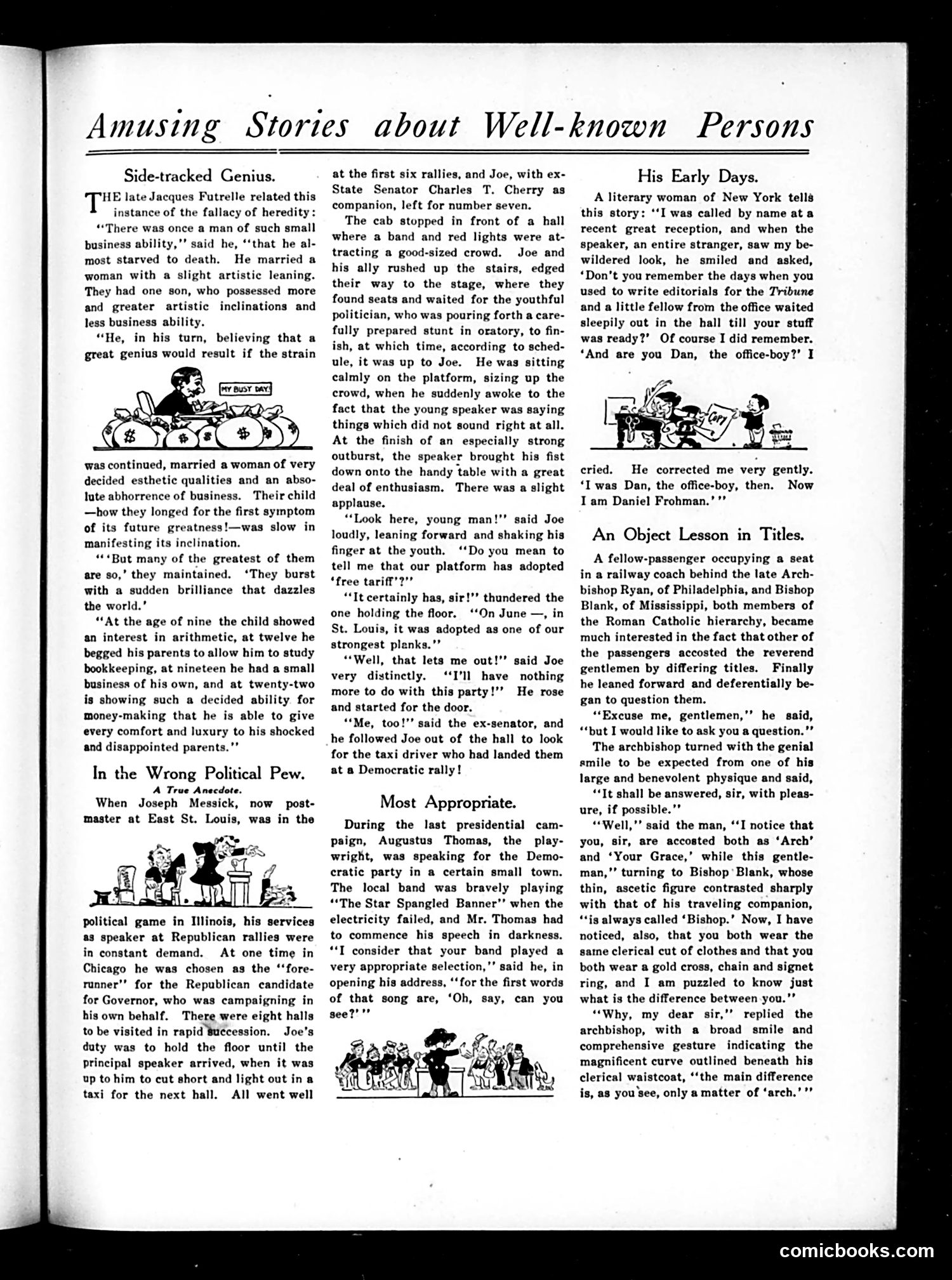
This page contains three humorous anecdotes about prominent figures, illustrated with small cartoons. **"Side-tracked Genius"** tells a story attributed to writer Jacques Futrelle: parents with poor business sense marry artistically-gifted spouses hoping their child will be a genius, but the boy becomes—disappointingly—a successful businessman. **"In the Wrong Political Pew"** recounts how Joseph Messick, a Republican speaker, was sent to campaign at what he thought was a GOP rally. Mid-event, he discovered the politician advocating "free tariff"—a Democratic position. Messick immediately walked out in protest, realizing he'd entered a *Democratic* rally by mistake. **"Most Appropriate"** jokes that playwright Augustus Thomas, speaking for Democrats, began his speech in darkness after the electricity failed—and he quipped that the band's selection of "The Star Spangled Banner" was "very appropriate," implying Democrats operate in darkness. These anecdotes mock political party identity and the tariff debate that divided Republicans and Democrats in the early 20th century.
📄 Transcribed text from this page (OCR, searchable)
Machine-transcribed from the original scan — historical spelling and the odd misread are preserved.
Amusing Stories about Well-known Persons Side-tracked Genius. HE late Jacques Futrelle related this instance of the fallacy of heredity: “There was once a man of such small business ability,’’ said he, ‘‘that he al- most starved to death. He married a woman with a slight artistic leaning. They had one son, who possessed more and greater artistic inclinations and less business ability. “He, in his turn, believing that a great genius would result if the strain was continued, married a woman of very decided esthetic qualities and an abso- lute abhorrence of business. Their child —how they longed for the first symptom of its future greatness!—was slow in manifesting its inclination. “«*But many of the greatest of them are so,’ they maintained. ‘They burst with a sudden brilliance that dazzles the world.’ “At the age of nine the child showed an interest in arithmetic, at twelve he begged his parents to allow him to study bookkeeping, at nineteen he had a small business of his own, and at twenty-two is showing such a decided ability for money-making that he is able to give every comfort and luxury to his shocked and disappointed parents.’’ In the Wrong Political Pew. A True Anecdote. When Joseph Messick, now post- master at East St. Louis, was in the political game in Illinois, his services as speaker at Republican rallies were in constant demand. At one time in Chicago he was chosen as the ‘‘fore- runner”? for the Republican candidate for Governor, who was campaigning in his own behalf. There were eight halls to be visited in rapid Buccession. Joe's duty was to hold the floor until the principal speaker arrived, when it was up to him to cut short and light out ina taxi for the next hall. All went well at the first six rallies, and Joe, with ex- State Senator Charles T. Cherry as companion, left for number seven. The cab stopped in front of a hall where a band and red lights were at- tracting a good-sized crowd. Joe and his ally rushed up the stairs, edged their way to the stage, where they found seats and waited for the youthful politician, who was pouring forth a care- fully prepared stunt in oratory, to fin- ish, at which time, according to sched- ule, it was up to Joe. He was sitting calmly on the platform, sizing up the crowd, when he suddenly awoke to the fact that the young speaker was saying things which did not sound right at all. At the finish of an especially strong outburst, the speaker brought his fist down onto the handy table with a great deal of enthusiasm. There was a slight applause. “Look here, young man!" said Joe loudly, leaning forward and shaking his finger at the youth. ‘‘Do you mean to tell me that our platform has adopted ‘free tariff’?"’ “It certainly has, sir!’ thundered the one holding the floor. ‘On June —, in St. Louis, it was adopted as one of our strongest planks.’ ‘‘Well, that lets me out!’ said Joe very distinctly. ‘I'll have nothing more to do with this party!’’ He rose and started for the door. “Me, too!’ said the ex-senator, and he followed Joe out of the hall to look for the taxi driver who had landed them at a Democratic rally! Most Appropriate. During the last presidential cam- paign, Augustus Thomas, the play- wright, was speaking for the Demo- cratic party in a certain small town. The local band was bravely playing “The Star Spangled Banner’’ when the electricity failed, and Mr. Thomas had to commence his speech in darkness. “I consider that your band played a very appropriate selection,’’ said he, in opening his address, ‘‘for the first words of that song are, ‘Oh, say, can you see?’”” Sass His Early Days. A literary woman of New York tells this story: ‘‘I was called by name ata recent great reception, and when the speaker, an entire stranger, saw my be- wildered look, he smiled and asked, ‘Don’t you remember the days when you used to write editorials for the Tribune and a little fellow from the office waited sleepily out in the hall till your stuff was ready?’ Of course I did remember. ‘And are you Dan, the office-boy?’ I cried. He corrected me very gently. ‘I was Dan, the office-boy, then. Now Iam Daniel Frohman.’ ”’ An Object Lesson in Titles. A fellow-passenger occupying a seat in a railway coach behind the late Arch- bishop Ryan, of Philadelphia, and Bishop Blank, of Mississippi, both members of the Roman Catholic hierarchy, became much interested in the fact that other of the passengers accosted the reverend gentlemen by differing titles. Finally he leaned forward and deferentially be- gan to question them. “Excuse me, gentlemen,’’ he said, “but I would like to ask you a question.”” The archbishop turned with the genial smile to be expected from one of his large and benevolent physique and said, “It shall be answered, sir, with pleas- ure, if possible.’’ ““Well,’’ said the man, ‘‘I notice that you, sir, are accosted both as ‘Arch’ and ‘Your Grace,’ while this gentle- man,’’ turning to Bishop’ Blank, whose thin, ascetic figure contrasted sharply with that of his traveling companion, “is always called ‘Bishop.’ Now, I have noticed, also, that you both wear the same clerical cut of clothes and that you both wear a gold cross, chain and signet ring, and I am puzzled to know just what is the difference between you.”” “Why, my dear sir,’’ replied the archbishop, with a broad smile and comprehensive gesture indicating the magnificent curve outlined beneath his clerical waistcoat, ‘‘the main difference is, as you see, only a matter of ‘arch.’ ”” comicbooks.com