
Judge, 1912-10-26 · page 18 of 24
Judge — October 26, 1912 — page 18: what you’re looking at
What you’re looking at
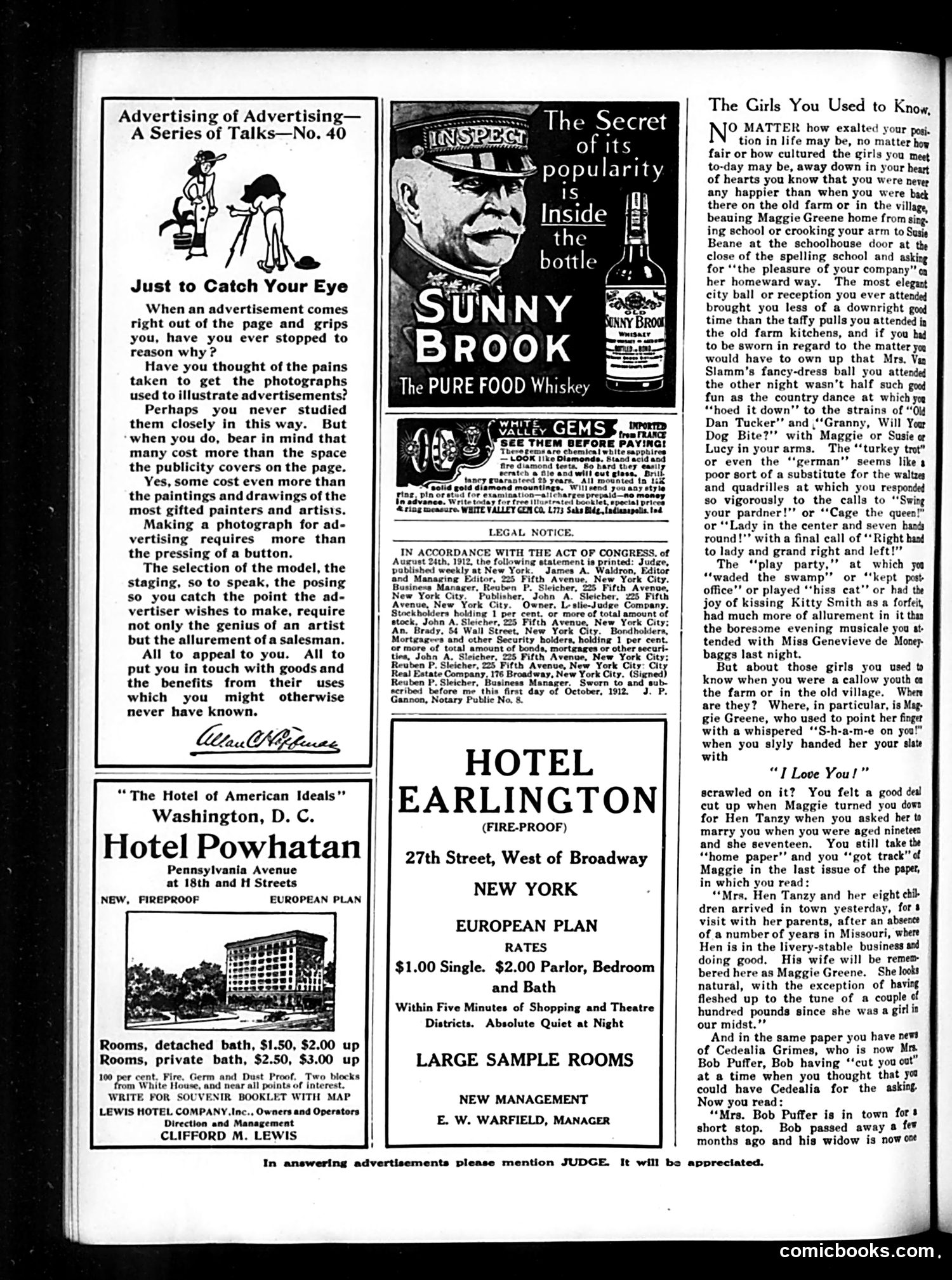
This page is primarily **advertising and filler content** rather than political satire. The main editorial piece, "Advertising of Advertising—No. 40," discusses **photography costs in commercial advertisements**—explaining that professional photo shoots for ads require skilled staging, model selection, and artistic direction, often costing more than the ad space itself. This reflects early 20th-century advertising industry practices. The **Sunny Brook whiskey advertisement** features a mustachioed man in a bowler hat—a generic "gentleman" figure typical of the era's marketing imagery, with no specific political reference. The right column's nostalgic piece, "The Girls You Used to Know," sentimentalizes rural American life and courtship, contrasting idealized farm memories with modern city society—reflecting common contemporary themes about rural versus urban living. The remaining content consists of **hotel advertisements** (Powhatan, Earlington) and a legal notice. **No specific political satire or caricature is evident** on this page. It represents standard Judge magazine filler and advertising content from approximately 1912.
📄 Transcribed text from this page (OCR, searchable)
Machine-transcribed from the original scan — historical spelling and the odd misread are preserved.
Advertising of Advertising— A Series of Talks—No. 40 Sd Just to Catch Your Eye When an advertisement comes right out of the page and grips you, have you ever stopped to reason why ? Have you thought of the pains taken to get the photographs used to illustrate advertisements? Perhaps you never studied them closely in this way. But when you do, bear in mind that many cost more than the space the publicity covers on the page. Yes, some cost even more than the paintings and drawings of the most gifted painters and artists. Making a photograph for ad- vertising requires more than the pressing of a button. The selection of the model, the staging, so to speak, the posing so you catch the point the ad- vertiser wishes to make, require not only the genius of an artist but the allurement of a salesman. All to appeal to you. All to put you in touch with goods and the benefits from their uses which you might otherwise never have known. ktaN Yipee “The Hotel of American Ideals” Washington, D. C. Hotel Powhatan Pennsylvania Avenue at 18th and H Streets NEW, FIREPROOF EUROPEAN PLAN Rooms, detached bath, $1.50, $2.00 up Rooms, private bath, $2.50, $3.00 up Jerm and Dust Proo ‘0 blocks WRITE FOR SOUVENIR BOOKLE’ LEWIS HOTEL COMPANY, |Inc., Owners and Operators Direction and Management CLIFFORD M. LEWIS of its. pularity S P WHITE VALLEY BEFORE PAYING! | jerntcal white sapphires 1¢ Diamonds. Stand | LEGAL NOTICE. IN ACCORDANCE WITH TI CT OF CONGRESS. of August 2éth, 1912, the following published weekly at New York. . and Managing Editor, 225 Fifth Avenue. New York City. Business Manager, Reuben P. Sleicher, 225 Fifth Avenue, New York City. “Publisher, John A." Sleicher, 225 Fifth Avenue, New York City. Owner, L-stie-Judge Company. Stockholders holding 1 per cent. or more of total amount of stock. John A. Sleicher, 225 Fifth Avenue, New York City; An. Brady, 64 Wall Street, New York City. Bondholders, Mortgagees and other Security holders, holding 1 per cent. of more of total amount of bonds, mortgages or other securi- tiea, John eicher, 225 Fifth Avenue, New York City; Reuben P. Sleicher, 225 Fifth Avenue, New York City: Cit Real Estate Company, 176 Broadway, New York City. (Signed Reuben P. Sleicher, Business Manager. Sworn to and sub- scribed before me this first day of October, 1912. J. P. Gannon, Notary Public No. 8. EARLINGTON (FIRE-PROOF) 27th Street, West of Broadway NEW YORK EUROPEAN PLAN RATES $1.00 Single. $2.00 Parlor, Bedroom and Bath Within Five Minutes of Shopping and Theatre Districts. Absolute Quiet at Night LARGE SAMPLE ROOMS NEW MANAGEMENT E. W. WARFIELD, MANAGER The Girls You Used to Know, N° MATTER how exalted your pogj. tion in life may be, no matter how fair or how cultured the girls you meet to-day may be, away down in your heart of hearts you know that you were never any happier than when you were back there on the old farm or in the village, beauing Maggie Greene home from sing. ing school or crooking your arm to Susie Beane at the schoolhouse door at the close of the spelling school and asking for *‘the pleasure of your company" oy her homeward way. The most elegant city ball or reception you ever attended brought you less of a downright goo time than the taffy pulls you attended ip the old farm kitchens, and if you had to be sworn in regard to the matter yoo would have to own up that Mrs. Vaz Slamm’s fancy-dress ball you attended the other night wasn’t half such good fun as the country dance at which yoo “thoed it down’’ to the strains of “OM Dan Tucker”’ and ‘Granny, Will You Dog Bite?’’ with Maggie or Susie oe Lucy in your arms. The “turkey trot” or even the ‘‘german’’ seems likes poor sort of a substitute for the waltzes and quadrilles at which you responded so vigorously to the calls to ‘Swing your pardner!’’ or ‘‘Cage the queen!” or ‘*Lady in the center and seven hands round!"’ with a final call of “Right hand to lady and grand right and left!” The ‘‘play party,’’ ich yoo “waded the swamp” or ‘kept pos office’’ or played ‘‘hiss cat'’ or had the joy of kissing Kitty Smith as a forfeit, had much more of allurement in it tha the boresome evening musicale you at- tended with Miss Genevieve de Money baggs last night. But about those girls you used t know when you were a callow youth @ the farm or in the old village. Wher are they? Where, in particular, is Mag- gie Greene, who used to point her finger with a whispered ‘‘S-h-a-m-e on you!” when you slyly handed her your slate with “T Love You!” scrawled on it? You felt a good del cut up when Maggie turned you dows for Hen Tanzy when you asked her to marry you when you were aged nineteet and she seventeen. You still take the “home paper’’ and you ‘‘got track” of Maggie in the last issue of the paper, in which you read: “Mrs, Hen Tanzy and her eight chit dren arrived in town yesterday, for’ visit with her parents, after an absence of a number of years in Missouri, where Hen is in the livery-stable business and doing good. His wife will be remem bered here as Maggie Greene. She looks natural, with the exception of havitg fleshed up to the tune of a couple of hundred pounds since she was a girl is our midst.’’ And in the same paper you have news of Cedealia Grimes, who is now Mrs. Bob Puffer, Bob having ‘‘cut you oat at a time when you thought that yoo could have Cedealia for the asking Now you read: “Mrs. Bob Puffer is in town for’ short stop. Bob passed away a fer months ago and his widow is now om In answering advertisements please mention JUDGE. It will bo appreciated. comicbooks.com,