
Judge, 1912-10-26 · page 14 of 24
Judge — October 26, 1912 — page 14: what you’re looking at
What you’re looking at
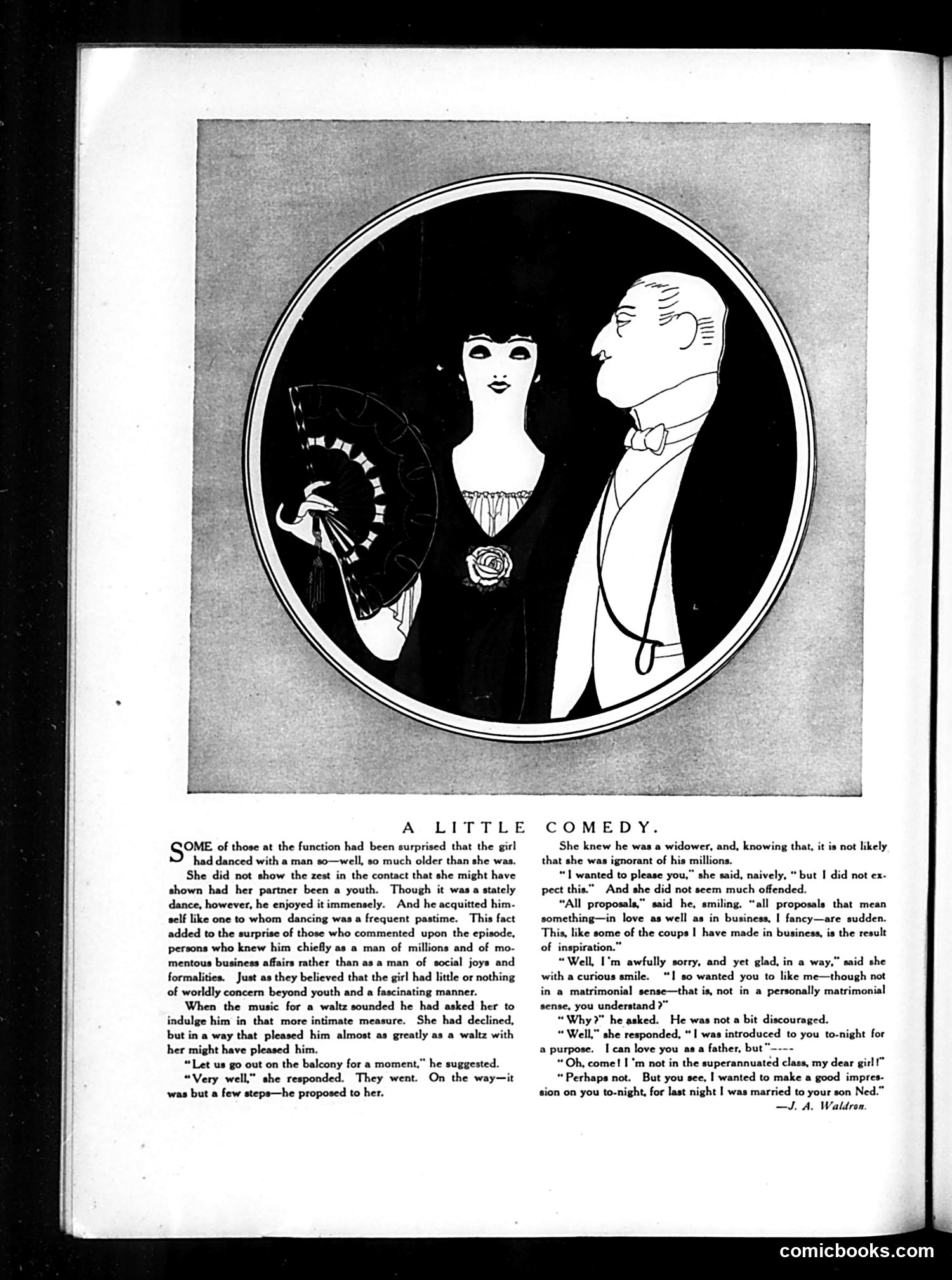
This is a satirical story rather than a political cartoon, illustrating early 20th-century social attitudes about wealth and marriage. **The Setup:** A wealthy, older widower dances with a young woman at a society function. Observers are surprised—both that she dances with an elderly man and that he seems socially graceful despite being known primarily as a businessman. **The Joke:** On the balcony, he impulsively proposes marriage. She accepts but then reveals her actual purpose: she was introduced to him specifically to make a good impression because *she married his son Ned the night before*. **The Satire:** The piece mocks: - Young women's calculated pursuit of wealthy men - Wealthy men's vanity and susceptibility to flattery - The transactional nature of upper-class courtship - How money blinds men to obvious manipulation The humor derives from the woman's success in charming him through transparent flattery, and his surprise at discovering her real agenda was securing his approval for her marriage to his son.
📄 Transcribed text from this page (OCR, searchable)
Machine-transcribed from the original scan — historical spelling and the odd misread are preserved.
A LITTLE COMEDY. OME of those at the function had been surprised that the girl had danced with a man so—well, so much older than she was. She did not show the zest in the contact that she might have shown had her partner been a youth. Though it was a stately dance, however, he enjoyed it immensely. And he acquitted him- self like one to whom dancing was a frequent pastime. This fact added to the surprise of those who commented upon the episode, persons who knew him chiefly as a man of millions and of mo- mentous business affairs rather than as a man of social joys and formalities. Just as they believed that the girl had little or nothing of worldly concern beyond youth and a fascinating manner. When the music for a waltz sounded he had asked her to indulge him in that more intimate measure. She had declined, but in a way that pleased him almost as greatly as a waltz with her might have pleased him. “Let us go out on the balcony for a moment,” he suggested. “Very well,” she responded. They went. On the way—it was but a few steps—he proposed to her. She knew he was a widower, and, knowing that, it is not likely that she was ignorant of his millions. “| wanted to please you,” she said, naively, “ but | did not ex- pect this.” And she did not seem much offended. “All proposals,” said he, smiling. “all proposals that mean something—in love as well as in business, | fancy—are sudden. This, like some of the coups | have made in business, is the result of inspiration.” Well, I'm awfully sorry, and yet glad, in a way,” said she with a curious smile. “1 so wanted you to like me—though not in a matrimonial sense—that is, not in a personally matrimonial sense, you understand ?” “Why?” he asked. He was not a bit discouraged. “ Well,” she responded, “| was introduced to you to-night for a purpose. I can love you asa father, but "---- “Oh, come! I ‘m not in the superannuated class, my dear girl!” “Perhaps not. But you see, | wanted to make a good impres- sion on you to-night, for last night | was married to your son Ned.” —J. A. Waldron. comicbooks.com