
A complete issue · 26 pages · 1912
Judge — October 5, 1912
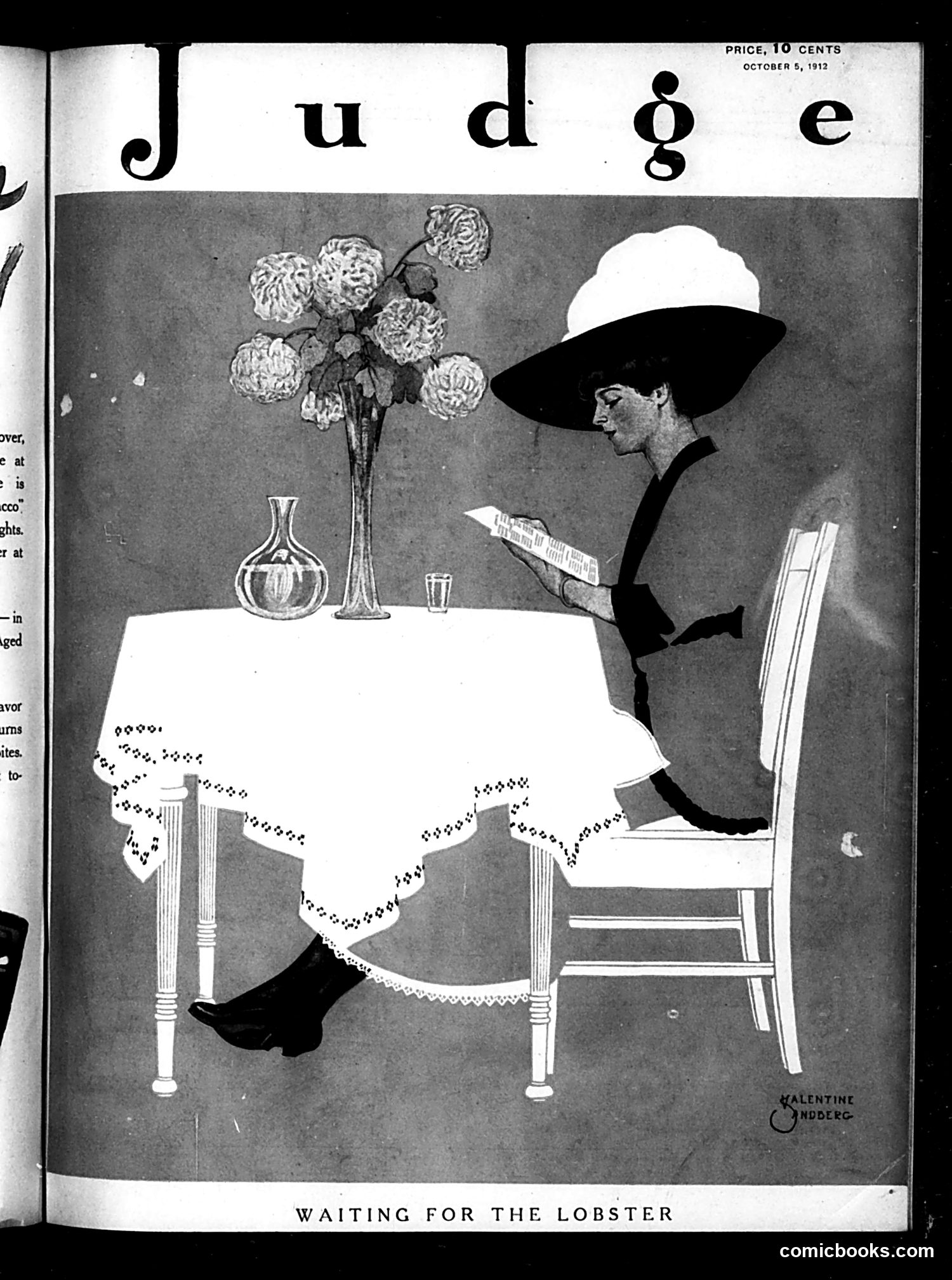
This 1912 *Judge* cartoon depicts a fashionably dressed woman in an extravagant wide-brimmed hat, seated at a table with flowers and an empty place setting. The title "Waiting for the Lobster" suggests she's anticipating an expensive meal at a restaurant. The satire appears to target upper-class women's indulgence and materialism during the Gilded Age. Her elaborate hat—comically oversized—symbolizes wasteful extravagance. The empty lobster plate implies she's kept waiting, possibly satirizing the pretensions of wealthy diners or the vanity of women who prioritize fashion over substance. The cartoon likely critiques conspicuous consumption among the wealthy elite, a common *Judge* theme. The artist is credited as Valentine (signature visible).
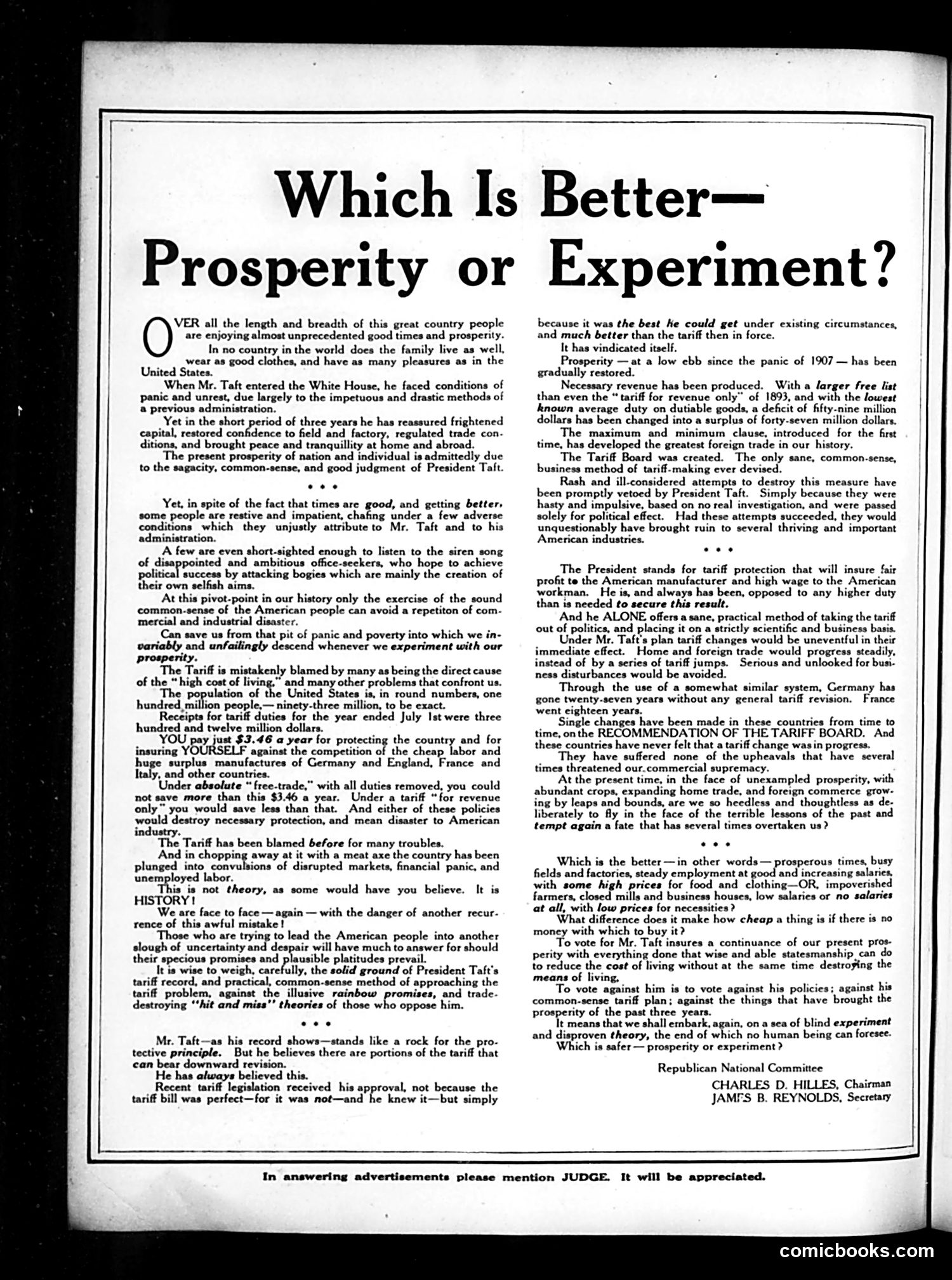
This page is primarily **political advocacy text**, not a cartoon. It's a Republican National Committee advertisement arguing **for protective tariffs under President Taft** versus free trade. The piece defends Taft's tariff policies against critics who blamed them for economic troubles. It argues that tariffs ensure "fair profits" for American manufacturers and workers, contrasting this with "absolute free trade," which it claims would devastate American industry by allowing cheap imports from Germany, England, and France. The text presents Taft as standing firm on principle, opposing "experiment" (free trade) in favor of maintaining American prosperity through protectionism. It concludes by asking voters to support Taft's tariff record. This reflects early 20th-century American political debates over trade policy.
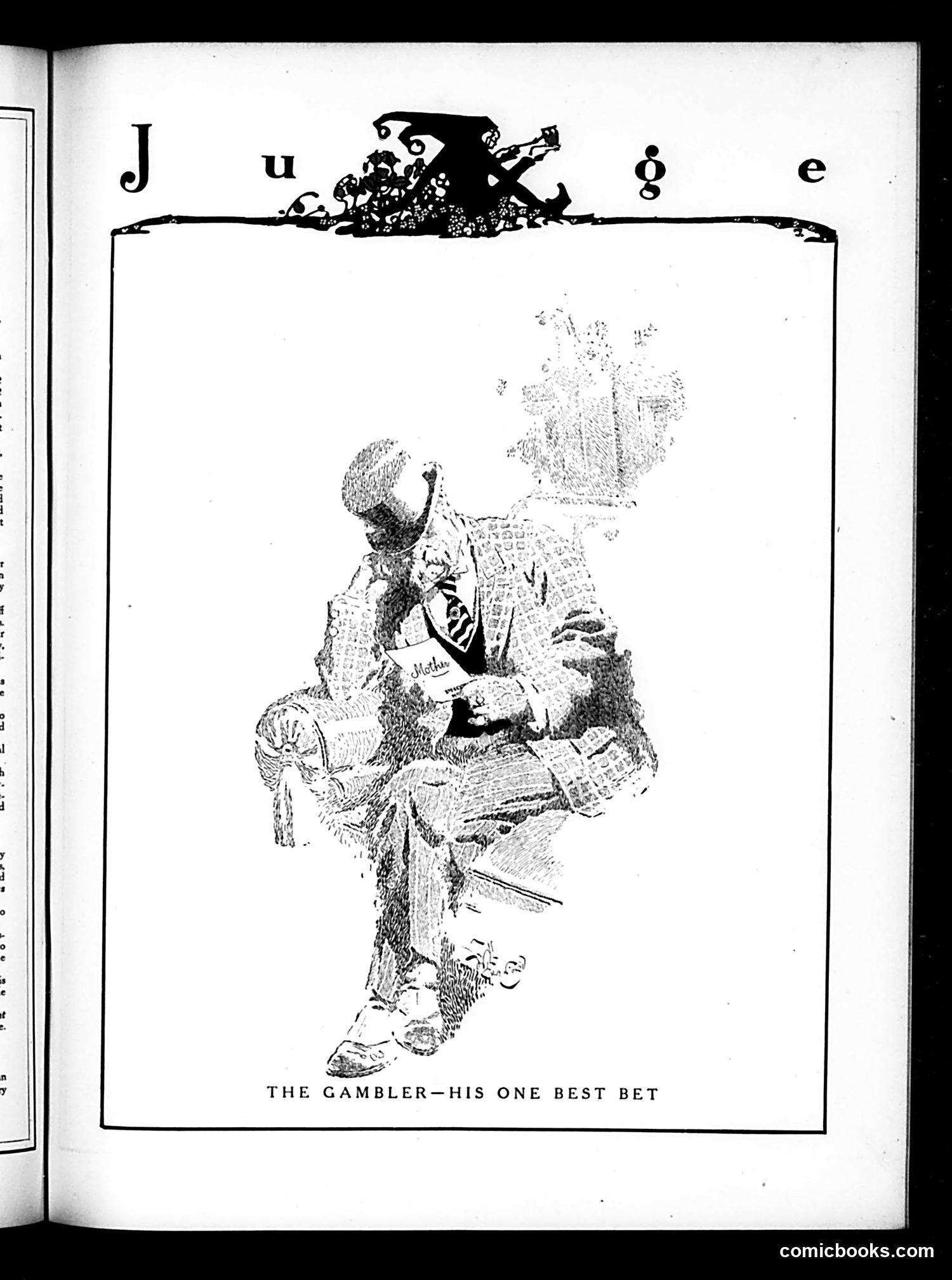
This illustration depicts a man in formal attire, seated and smoking, holding what appears to be a playing card or betting slip marked "Midas." The cartoon's title suggests commentary on gambling behavior. The central figure represents a gambler—likely a commentary on wealthy or upper-class Americans who engaged in recreational betting. The "one best bet" appears to reference his supposed sure thing, represented by the card or document he holds. The caricatured style and exaggerated features were typical of Judge magazine's satirical approach. Without additional context about the specific date or event, the broader satirical point seems to mock the gambler's overconfidence in his odds or his belief in a "guaranteed" winning strategy—a timeless critique of gambling culture's false promises and delusions.
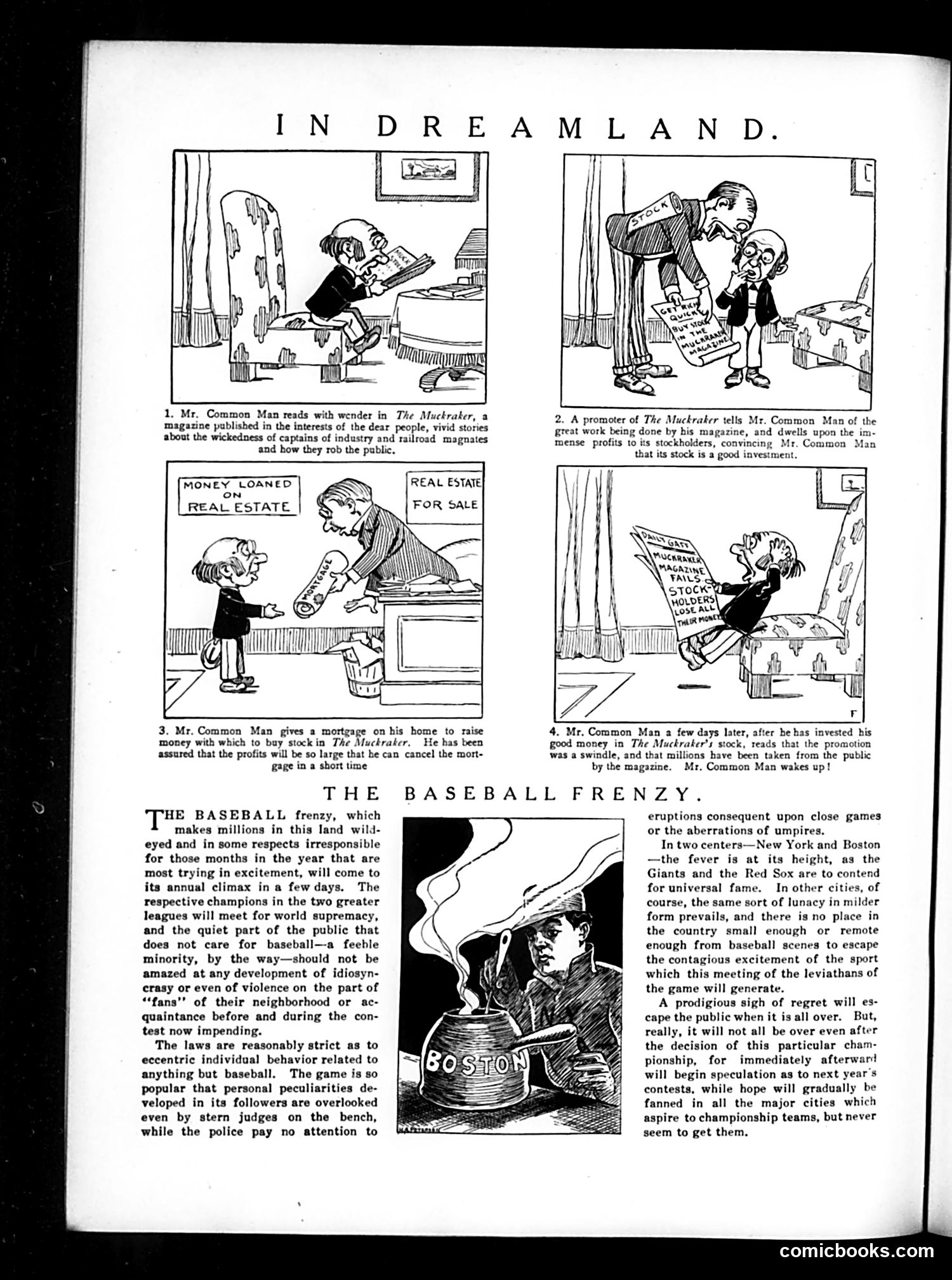
The top section satirizes Mr. Common Man's financial naivety. Panel 1 shows him reading *The Muckraker* magazine (likely referencing Upton Sinclair-era investigative journalism). Panel 2 depicts an advertiser pitching the magazine's credibility. Panels 3-4 reveal the irony: Common Man mortgages his home based on the magazine's stock recommendations, only to lose his investment when the stock crashes. The satire targets both gullible investors who trust magazine endorsements and the financial press's profit-driven promotion of speculative investments. "The Baseball Frenzy" below criticizes baseball's cultural obsession. The text describes championship fever gripping major cities (New York, Boston), comparing it to dangerous public mania. It warns the sport's "crass" excitement and violence contradict civilized behavior, though admiringly notes baseball's popularity transcends class boundaries. The Boston player illustration suggests contemporary championship competition.
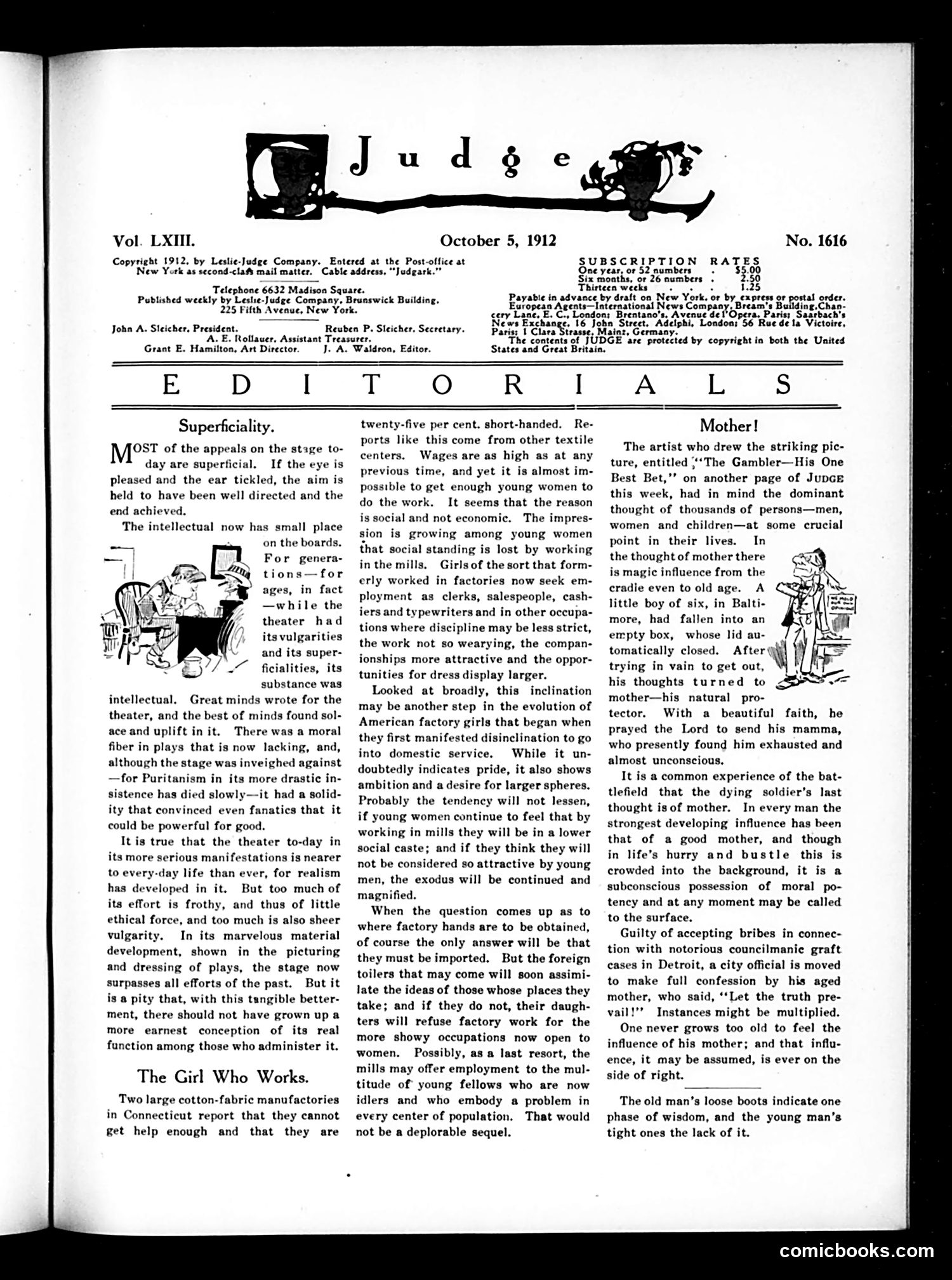
This editorial page critiques superficiality in American theater and labor practices. The main article argues that stage appeal has replaced intellectual merit, with producers prioritizing entertainment over substance—a concern reflecting early 20th-century anxieties about commercialization and "lowbrow" culture. "The Girl Who Works" addresses a genuine social problem: Connecticut textile factories reportedly cannot find enough young women workers despite competitive wages. The editorial suggests factory work carries social stigma, with working-class girls preferring less respectable but more glamorous occupations as clerks or salespeople. The piece implies class prejudice determines career choices, while mothers' influence shapes these decisions, reflecting period concerns about labor shortages and social mobility during rapid industrialization.
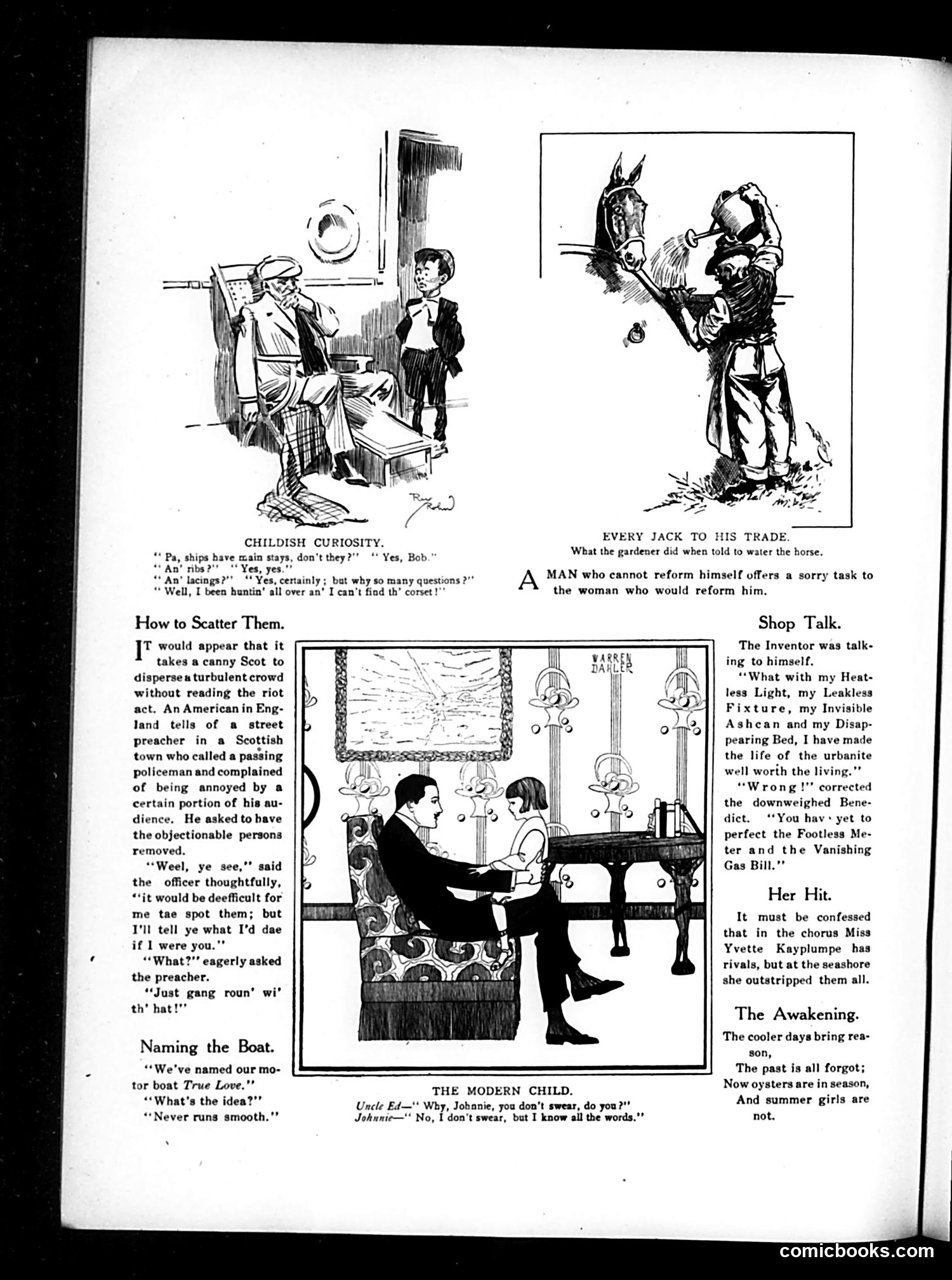
This page collects brief humorous sketches reflecting turn-of-the-century American social attitudes: **"Childish Curiosity"** plays on a child's innocent misunderstanding of ship terminology (stays, ribs, lacings) as corset parts—humor derived from the Victorian preoccupation with women's undergarments. **"How to Scatter Them"** presents a Scottish policeman's practical solution to dispersing a street preacher's hecklers: pass the collection hat. The joke relies on ethnic Scottish stereotype (frugality) and anti-religious sentiment. **"Every Jack to His Trade"** shows absurdist humor: a gardener waters a horse as instructed, literally rather than intelligently—mocking working-class literalism. **"The Modern Child"** depicts a child claiming ignorance of swearing while knowing "all the words"—satirizing children's precocious knowledge and hypocrisy. **"Shop Talk"** and other sketches mock urban inventions and marital dynamics typical of period light comedy. The page represents *Judge's* accessible, class-conscious humor targeting middle-class readers through relatable domestic and social scenarios.
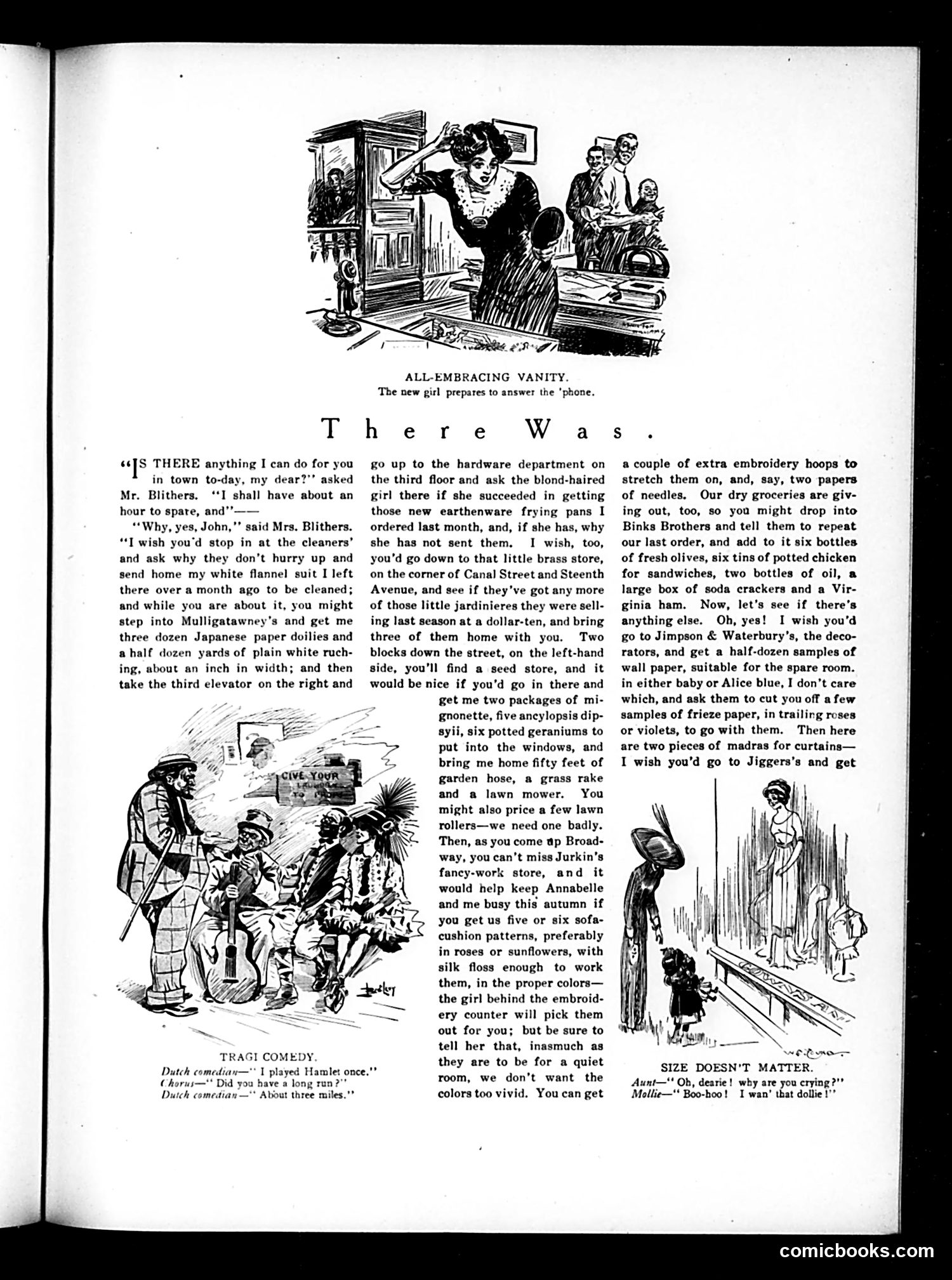
This page satirizes the "all-embracing vanity" of married women who exploit their husbands' spare time with endless, trivial shopping errands. The main cartoon shows Mrs. Blithers presenting Mr. Blithers with an absurdly long list of tasks—visiting cleaners, hardware stores, seed shops, fancy-work stores, decorators, and grocers for items ranging from embroidery hoops to Virginia ham. The humor lies in the escalating ridiculousness of her requests and her casual assumption he'll complete them all. The satire targets both female consumerism and domestic manipulation. The accompanying sketches ("Tragic Comedy" and "Size Doesn't Matter") reinforce themes of domestic absurdity and female materialism. The cartoon critiques how women's supposed "vanity" and shopping obsessions reduce men to errand boys while highlighting the triviality of their concerns (wall paper colors, cushion patterns). It's early 20th-century satire of gender roles and consumer culture.
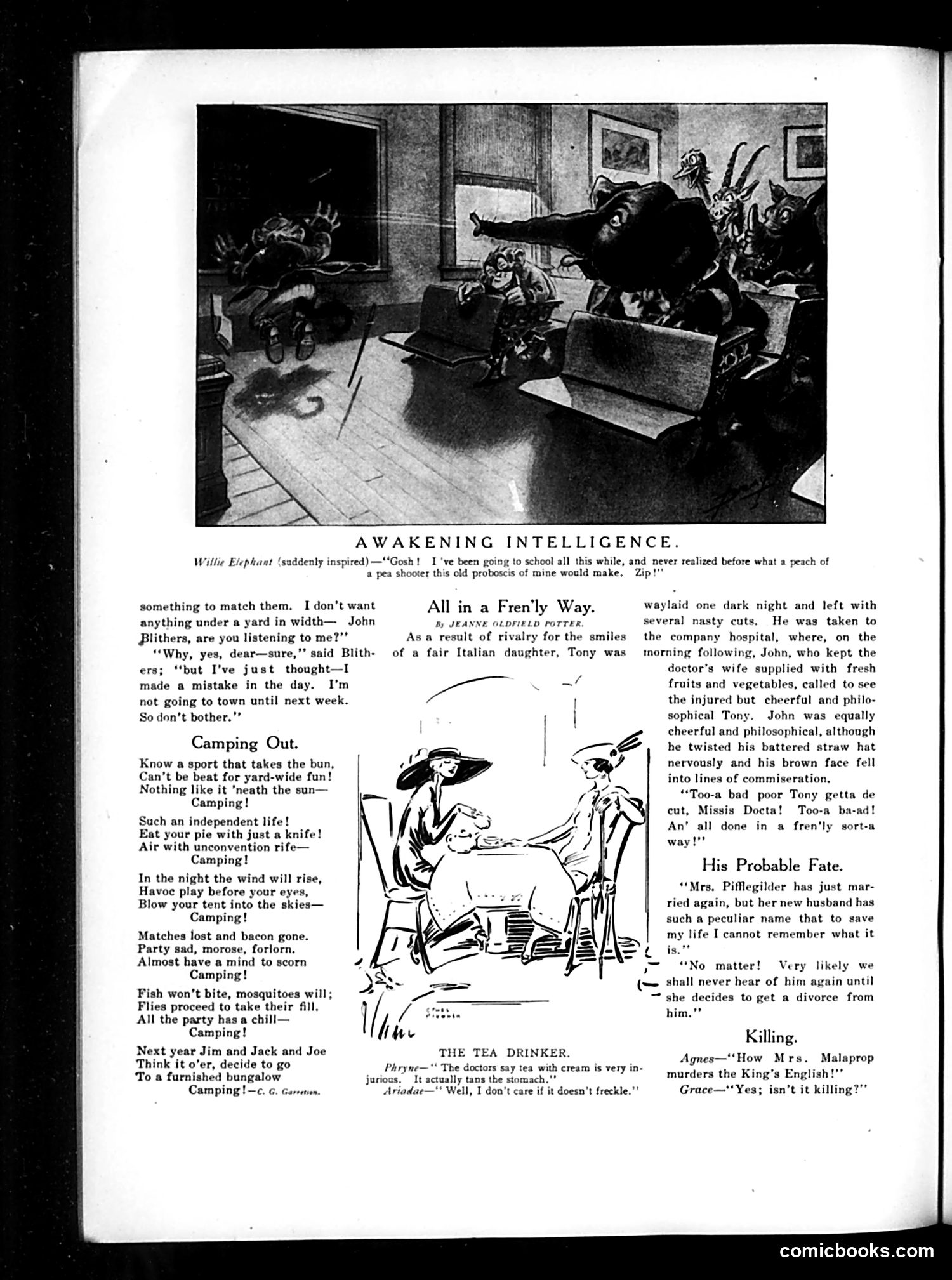
This page contains several humorous sketches typical of early 20th-century American satirical humor: **"Awakening Intelligence"** (top): A domestic scene where Mr. Blithers complains about pea shooters while his wife tries to discuss household matters—satirizing husbands' inattentiveness and obliviousness to their wives' concerns. **"Camping Out"** (poem): A lengthy joke in verse mocking camping's romanticized appeal. It catalogs the actual miseries—lost matches, mosquitoes, cold, destroyed tents—that lead campers to eventually abandon tents for "furnished bungalows." This satirizes outdoorsy enthusiasm versus urban comfort-seeking reality. **"All in a Fren'ly Way"**: An Italian immigrant narrative about Tony getting beaten in a "friendly" rivalry over a girl. The humor relies on ethnic dialect ("fren'ly") and the ironic contrast between violent assault and Tony's cheerful, philosophical acceptance of it. **Minor sketches** include tea-drinking humor and a joke about serial divorce, reflecting period attitudes toward women's remarriage. The page targets domestic relationships, leisure-class pretensions, and ethnic stereotypes common to Judge's satirical approach.
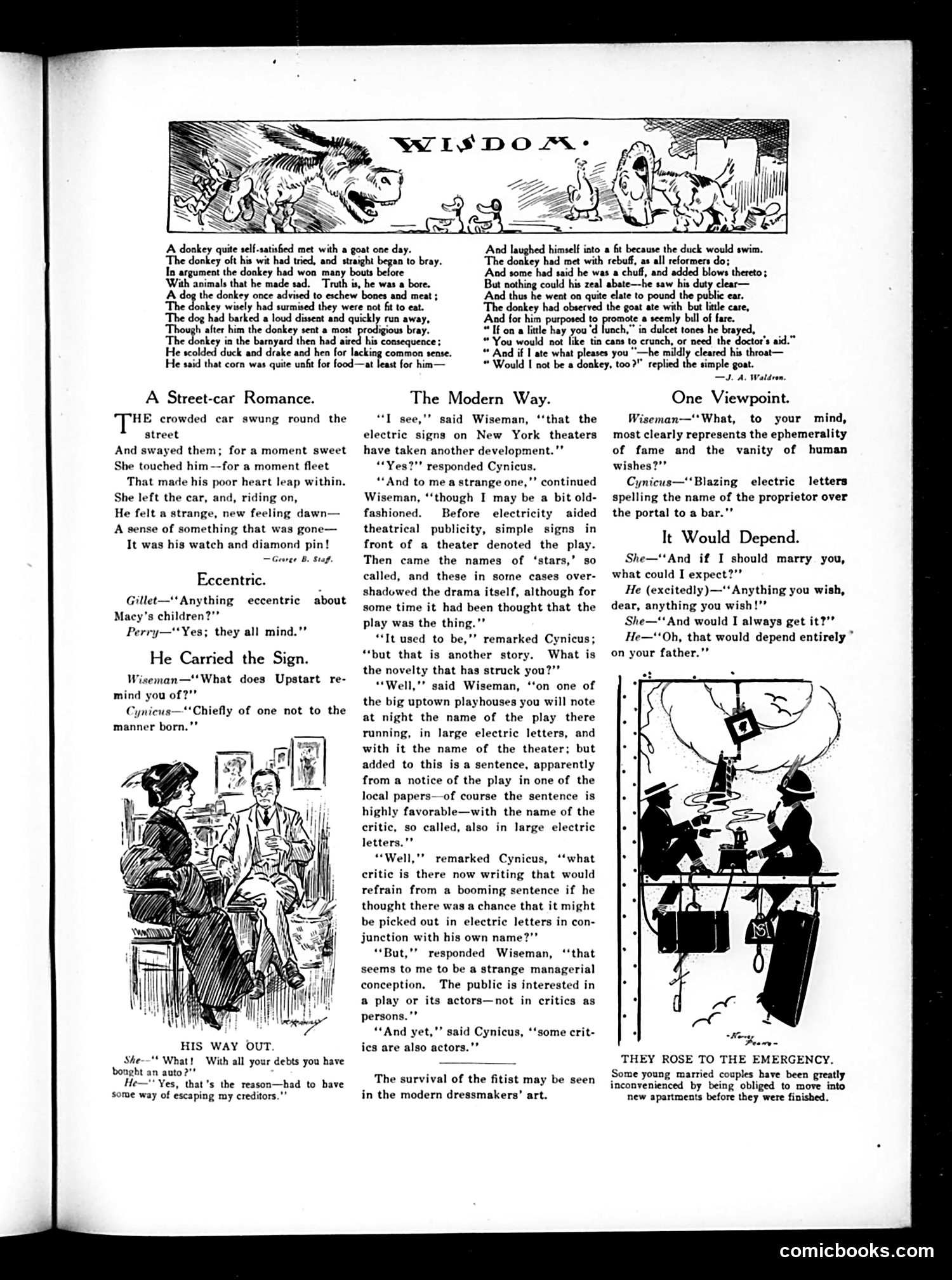
This page contains several satirical pieces mocking self-righteous reformers and critics: **"Wisdom" (top):** The lengthy poem ridicules a donkey who relentlessly preaches dietary reform to other animals—telling a dog to avoid bones, advising ducks to reject corn—despite universal rejection. The donkey represents tedious, preachy reformers who ignore evidence their advice isn't wanted. The goat's final retort ("Would I not be a donkey, too?") mocks the reformer's logical inconsistency. **"The Modern Way":** Wiseman and Cynicus discuss theater marquees now displaying critics' favorable quotes in electric letters alongside the theater name. The satire critiques how this appeals to critics' vanity—they'll write glowing reviews hoping to see their names in lights. Cynicus cynically notes "some critics are also actors," suggesting they perform enthusiasm for publicity. **Other short pieces** mock eccentricity, pretension, and financial desperation (the auto-buying debtor). The page's theme: modern vanity, whether reformers' self-importance or critics' hunger for recognition, produces absurdity.
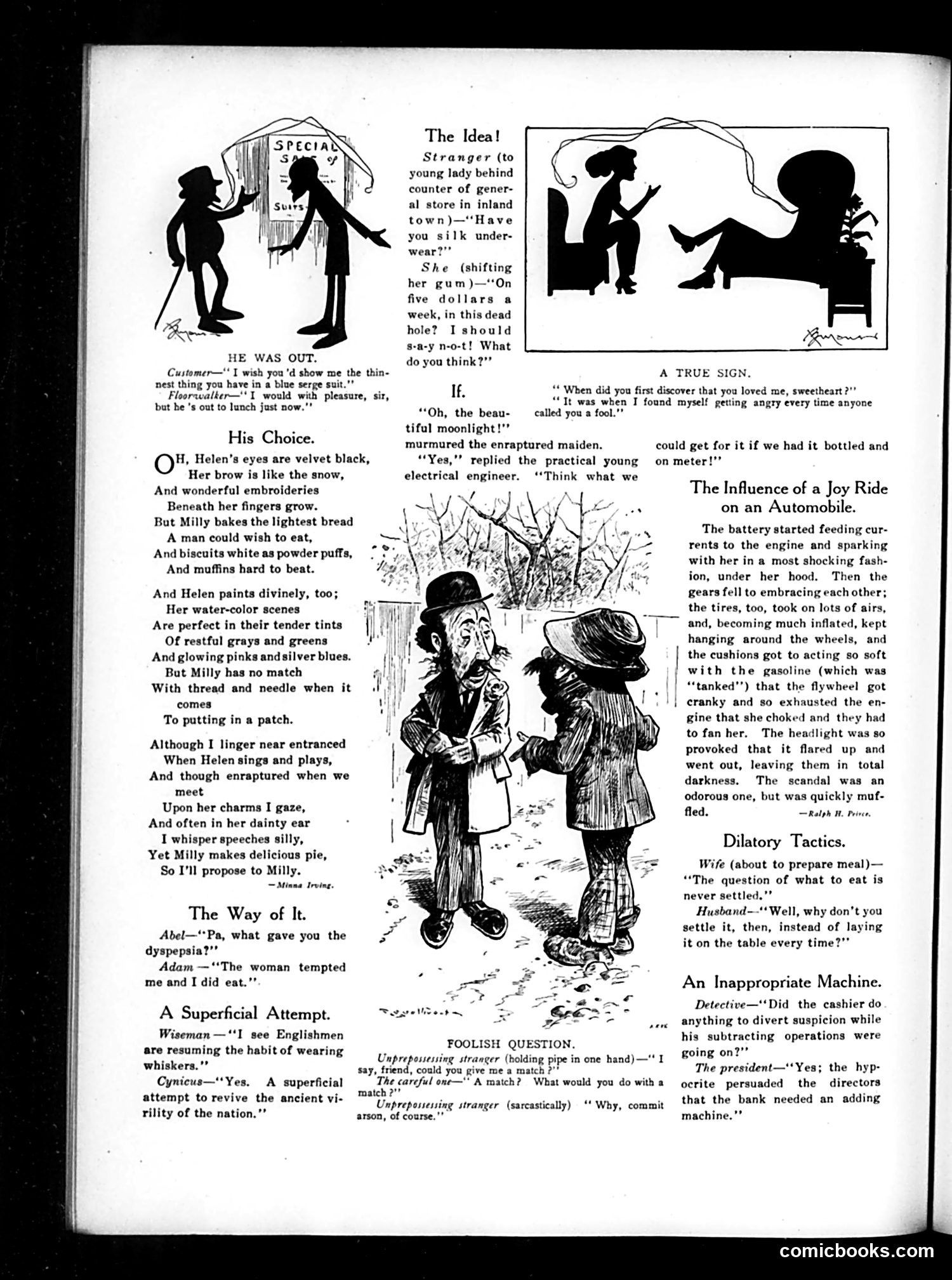
This page contains multiple humor pieces satirizing early 20th-century American life: **"He Was Out"** mocks small-town retail culture—a floorwalker claims the only suitable suit is "out to lunch," suggesting inadequate inventory in rural stores. **"His Choice"** presents a common matrimonial dilemma: Helen possesses artistic talents (painting, music), but the narrator proposes to Milly for practical domestic skills (baking, sewing). The satire critiques men prioritizing utility over romance. **"The Influence of a Joy Ride"** anthropomorphizes an automobile's mechanical failure after being driven recklessly with a woman passenger, personifying car parts (gears "embracing," headlight "provoked"). This mocks both the novelty of automobiles and romantic recklessness. **"An Inappropriate Machine"** jokes that a bank president used an adding machine purchase to distract directors from discovering embezzlement—suggesting corporate dishonesty masked by technological advancement. Overall, the page satirizes rural commercialism, romantic compromise, automotive danger, and white-collar crime through period-specific references.
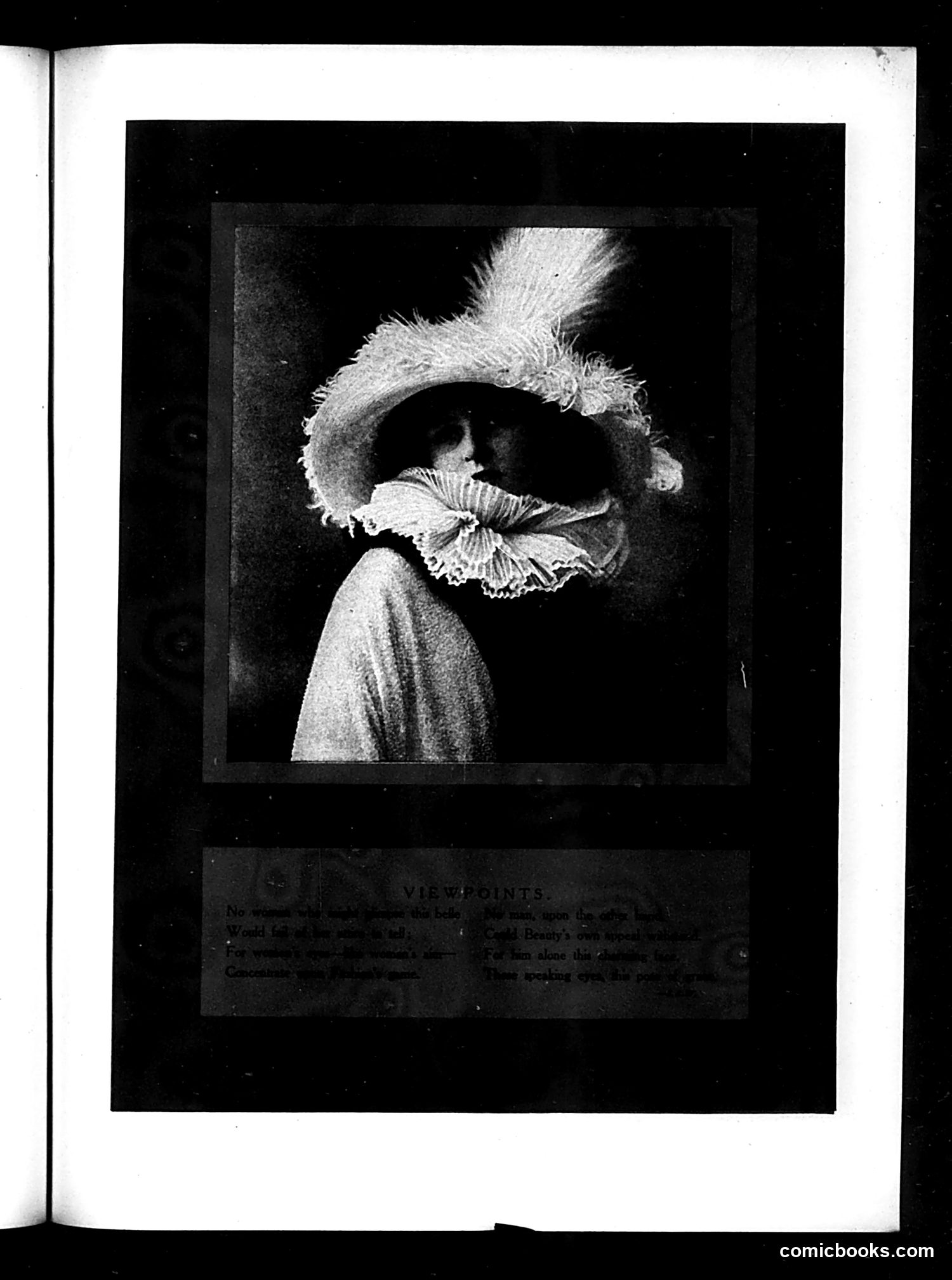
This page from *Judge* magazine displays a single portrait photograph rather than a traditional cartoon. The image shows a woman in profile wearing an elaborate early 20th-century hat with prominent ostrich plumes and a large decorative collar or ruffle. The heading reads "VIEWPOINTS" (partially legible), suggesting this is a commentary piece. The accompanying text below the image is too blurred to read accurately in this reproduction. Based on the styling and *Judge*'s satirical nature, this likely critiques women's extravagant fashion—particularly the excessive use of feathered hats popular during this era. Such hats were expensive and associated with conspicuous consumption and wasteful luxury. The exaggerated plumage suggests the satire targets the absurdity of high-fashion trends among wealthy women. However, without readable text, the specific social or political point remains unclear.
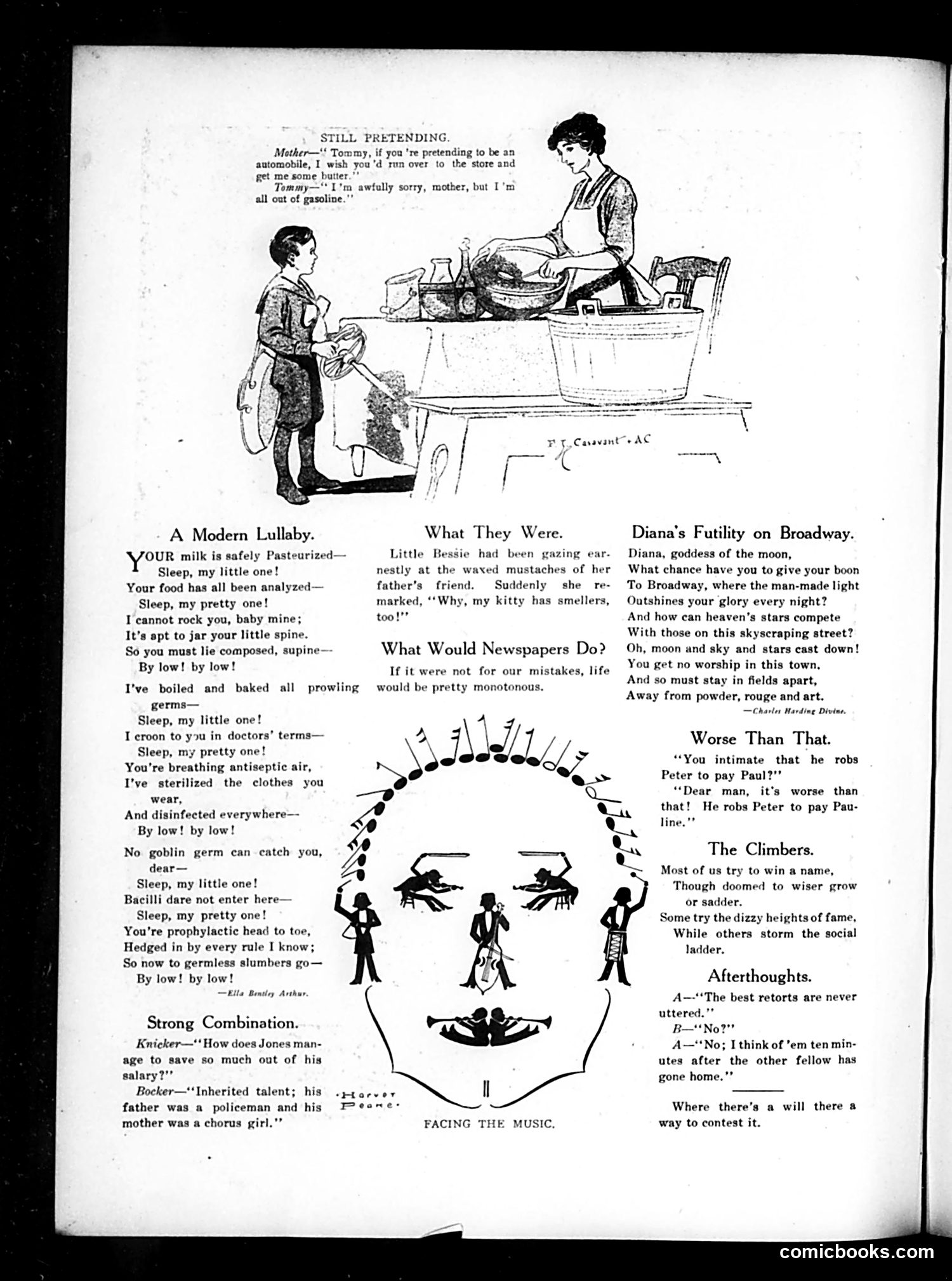
This page contains several short satirical pieces typical of early 20th-century American humor: **"Still Pretending"** mocks children's play and automobile culture—Tommy pretends to be a car but uses "out of gasoline" as an excuse to avoid chores. **"A Modern Lullaby"** satirizes obsessive sanitization and scientific parenting trends of the era. The mother over-sterilizes everything, speaks in medical jargon, and forbids normal physical comfort (rocking), reflecting contemporary anxiety about germs and "scientific" child-rearing. **"Strong Combination"** jokes that Jones's savings ability comes from inherited talent—his father was a corrupt policeman and mother a chorus girl (implying both made illicit money). **"Diana's Futility on Broadway"** contrasts the moon goddess with electric city lights, lamenting that modern urban life has replaced nature worship with artificial spectacle. The remaining pieces are brief wordplay jokes about newspapers, mistaken identity, and social climbing—typical light fare for the magazine's miscellaneous humor section.
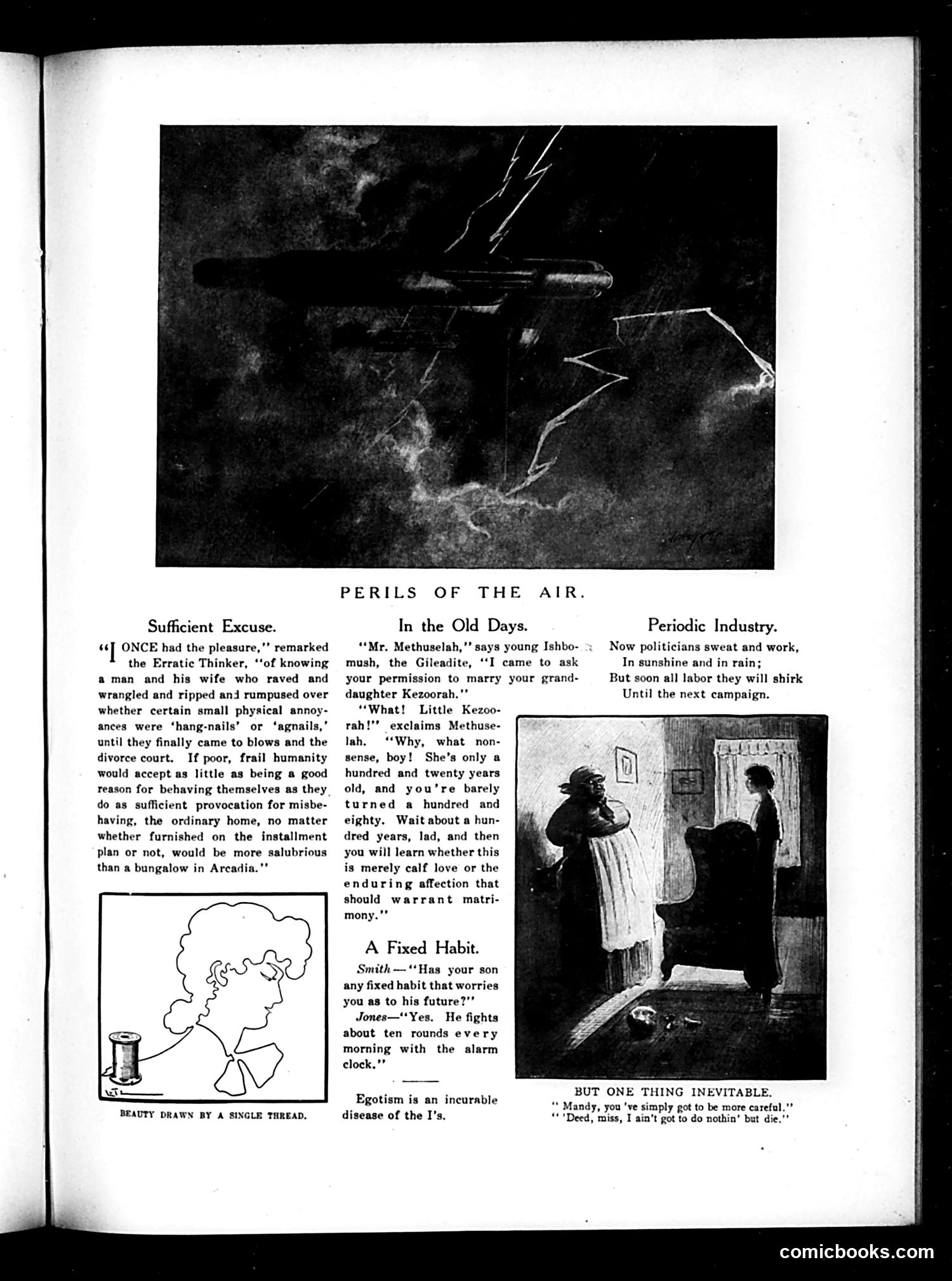
This Judge magazine page contains four unrelated humorous pieces typical of early 20th-century American satire: **"Sufficient Excuse"** mocks trivial marital disputes—a couple divorces over whether a skin irritation is a "hang-nail" or "agnail," satirizing how petty grievances destroy homes. **"In the Old Days"** is a biblical-era joke where young Ishbomush seeks permission to marry Methuselah's granddaughter, only to be told they're too young (both under 200 years old)—absurdist humor playing on pre-modern lifespans. **"Periodic Industry"** criticizes politicians as lazy workers who labor only during election campaigns ("the next campaign"), then abandon effort. **"But One Thing Inevitable"** features a Black maid asserting her existential freedom—"I ain't got to do nothin' but die"—a darkly comic assertion of human autonomy despite social constraints. The maid's dialect reflects period conventions for representing working-class Black characters. The cartoons are largely workplace/domestic humor with no apparent connection between them—typical of miscellaneous magazine filler content.
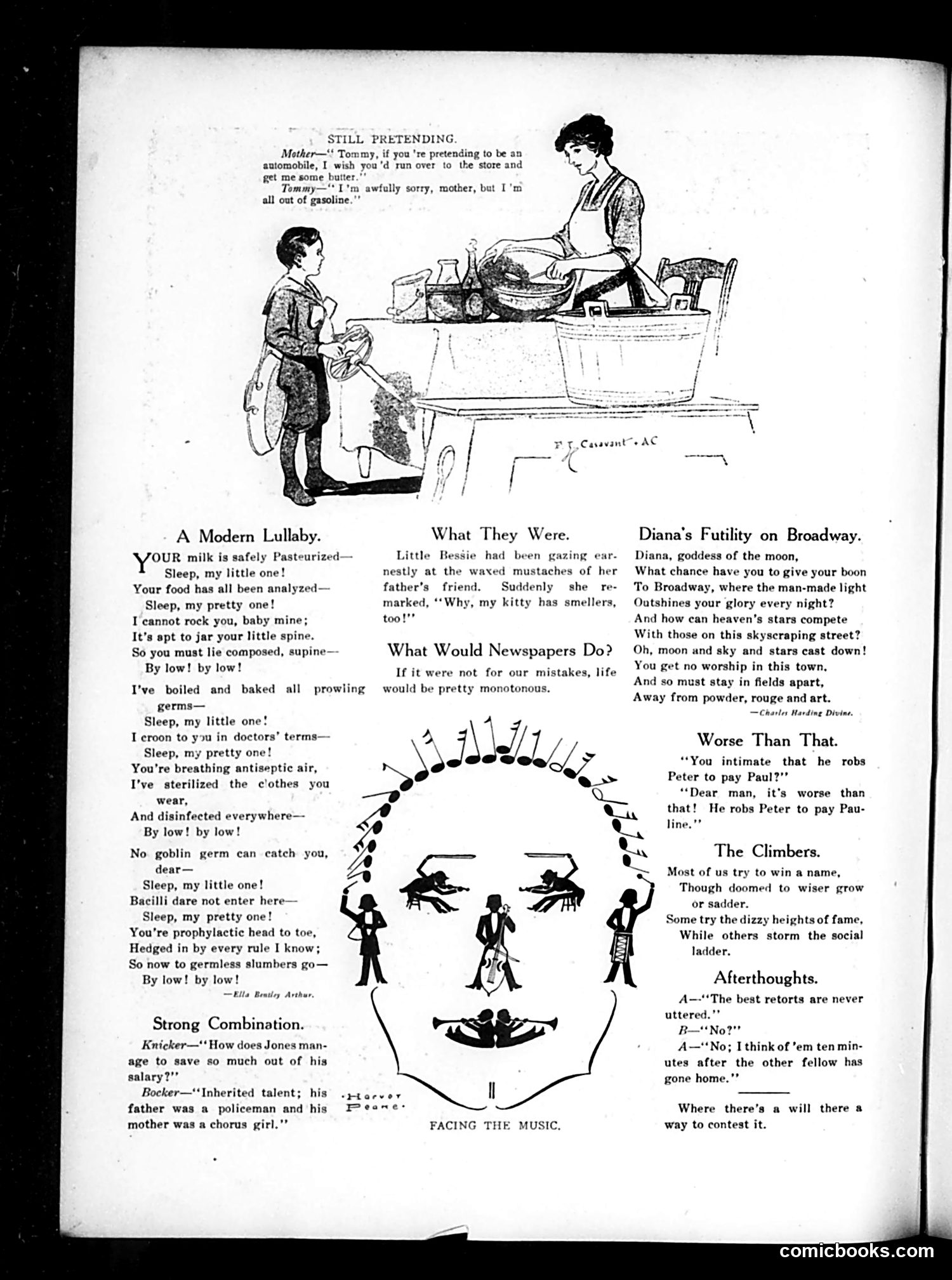
This Judge magazine page (date unclear from image) contains several satirical pieces reflecting early 20th-century American anxieties: **"Still Pretending"**: A boy playing with a toy automobile claims he's "out of gasoline," mocking how quickly automobiles became culturally dominant—children mimicked adult car ownership problems in play. **"A Modern Lullaby"**: Satirizes obsessive sanitization and medical anxiety. The poem parodies mothers who over-sterilize everything (pasteurized milk, analyzed food, disinfected clothes), treating childhood hygiene like a scientific protocol. The repetition mocks how germ-theory consciousness had become almost neurotic. **"Strong Combination"**: A brief joke implying that a man's ability to save money comes from inherited traits—his policeman father (corrupt, taking bribes) and chorus-girl mother (poor). The humor relies on stereotypes about these professions' dishonesty or financial instability. The remaining pieces are light verse about urban life, romance, and social climbing—typical magazine filler addressing Broadway culture and romantic disappointments.
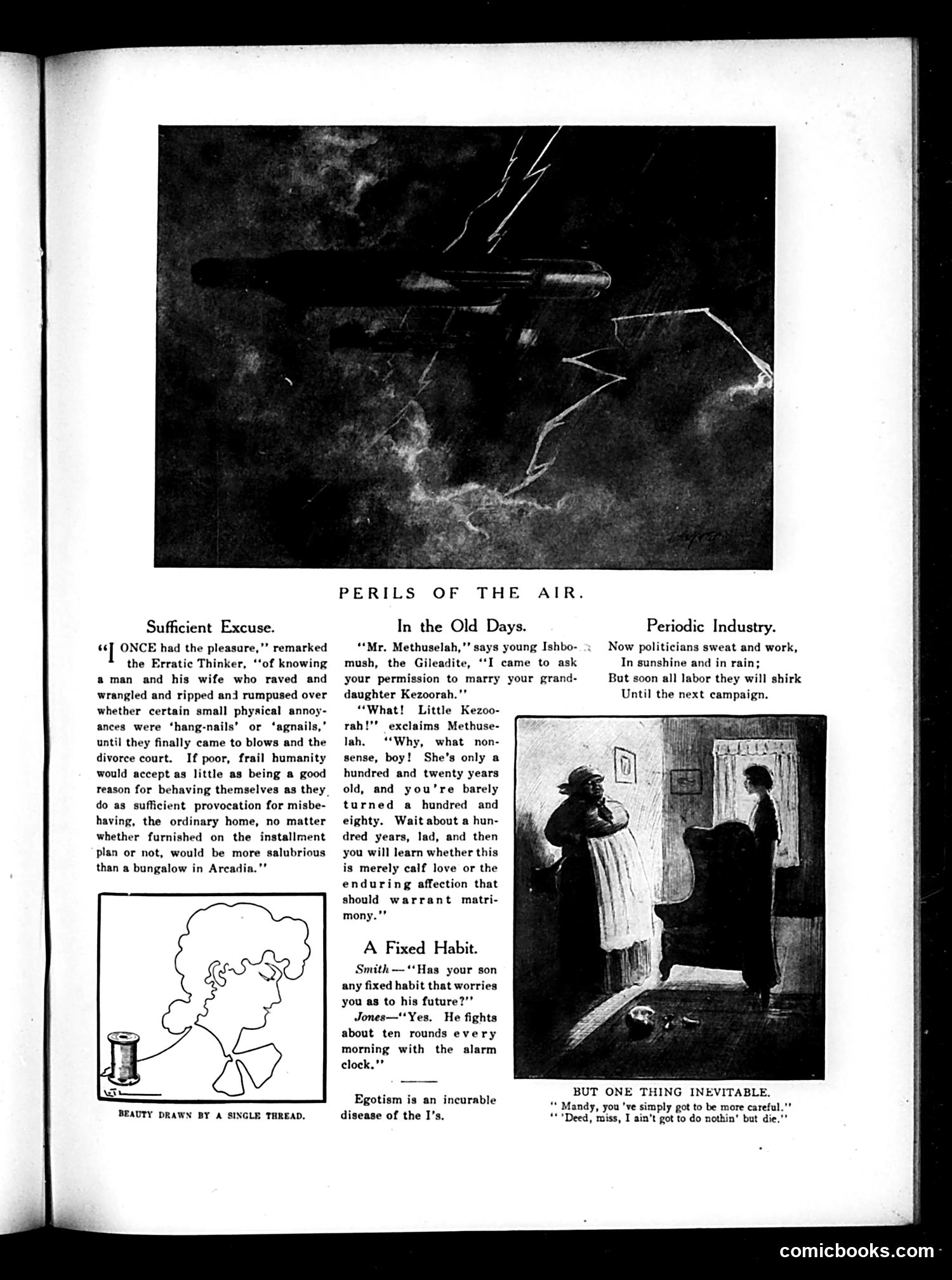
This page contains three unrelated humorous sections typical of satirical magazines: **"Sufficient Excuse"** mocks marital discord—a couple divorced over debating whether a skin condition was a "hang-nail" or "agnail," satirizing how trivial disputes escalate in marriage. **"In the Old Days"** is a biblical-era joke contrasting ancient lifespans with modern courtship customs. An elderly suitor is told to wait another hundred years before marrying his young girlfriend (only 120), treating extremely long biblical lives as comedic fodder. **"Periodic Industry"** directly satirizes American politicians, claiming they work energetically between elections but abandon labor during campaign season—a timeless critique of political opportunism. The bottom cartoon appears to feature a Black domestic worker ("Mandy") resisting an employer's demands with dry wit: "I ain't got to do nothin' but die"—reflecting both period racial attitudes and working-class sass. These sections collectively showcase Judge's blend of domestic humor, religious parody, political commentary, and workplace comedy.
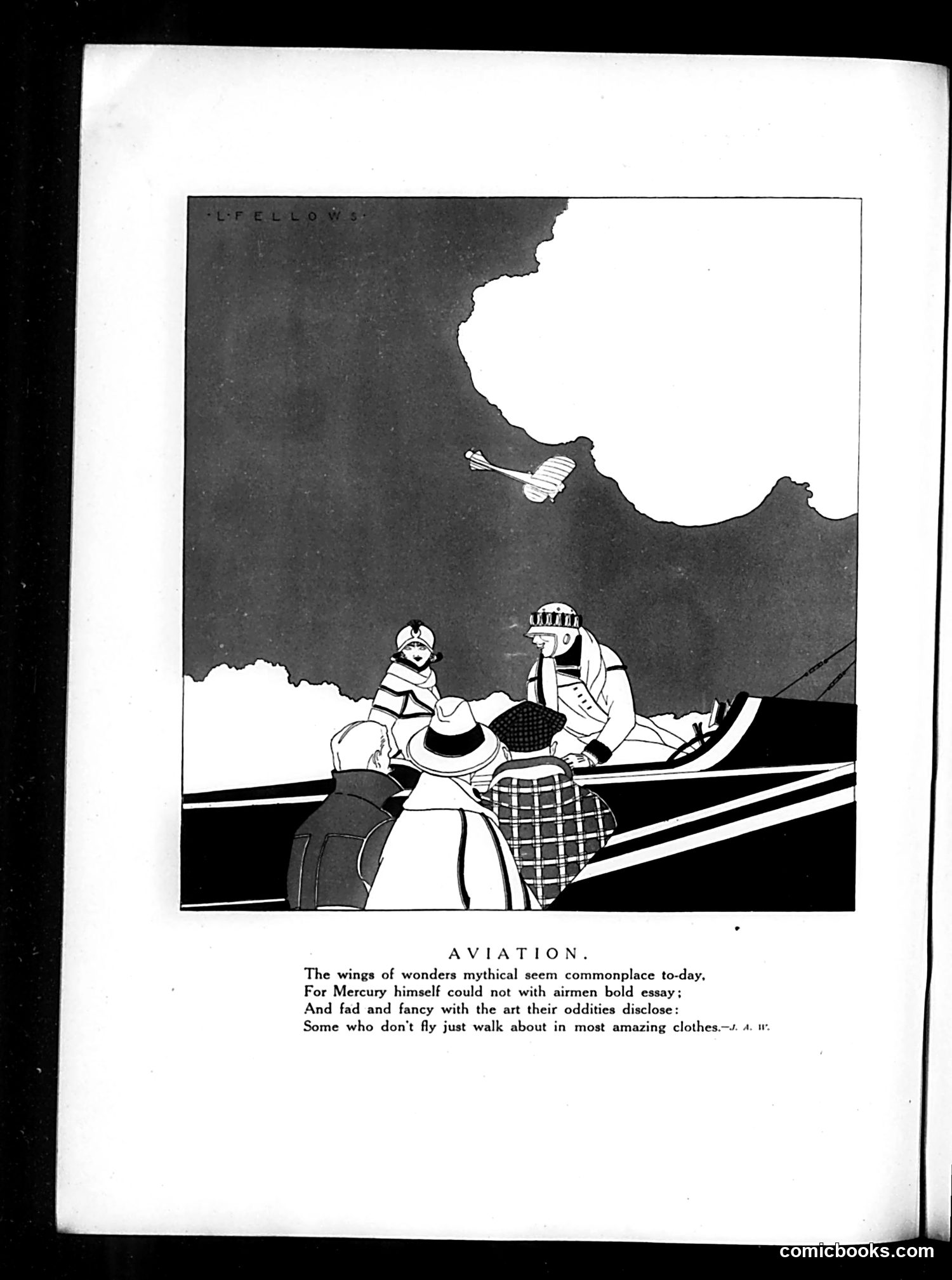
This cartoon satirizes early aviation's fashion obsession. The illustration shows fashionably dressed people on an airfield, with planes visible in the background. The accompanying verse mocks aviators who prioritize elaborate, "amazing clothes" over actual flying skill. The joke targets how aviation—still a novel marvel—had become a status symbol attracting people more interested in looking the part than genuinely piloting aircraft. References to Mercury (the winged Roman god) emphasize the mythical wonder of flight now made mundane. The satire suggests that some aviation enthusiasts are all style and no substance: they "don't fly just walk about in most amazing clothes," implying they're fashionable poseurs rather than serious aviators. This reflects early 20th-century anxiety about new technologies becoming trendy status symbols among the wealthy and fashionable.
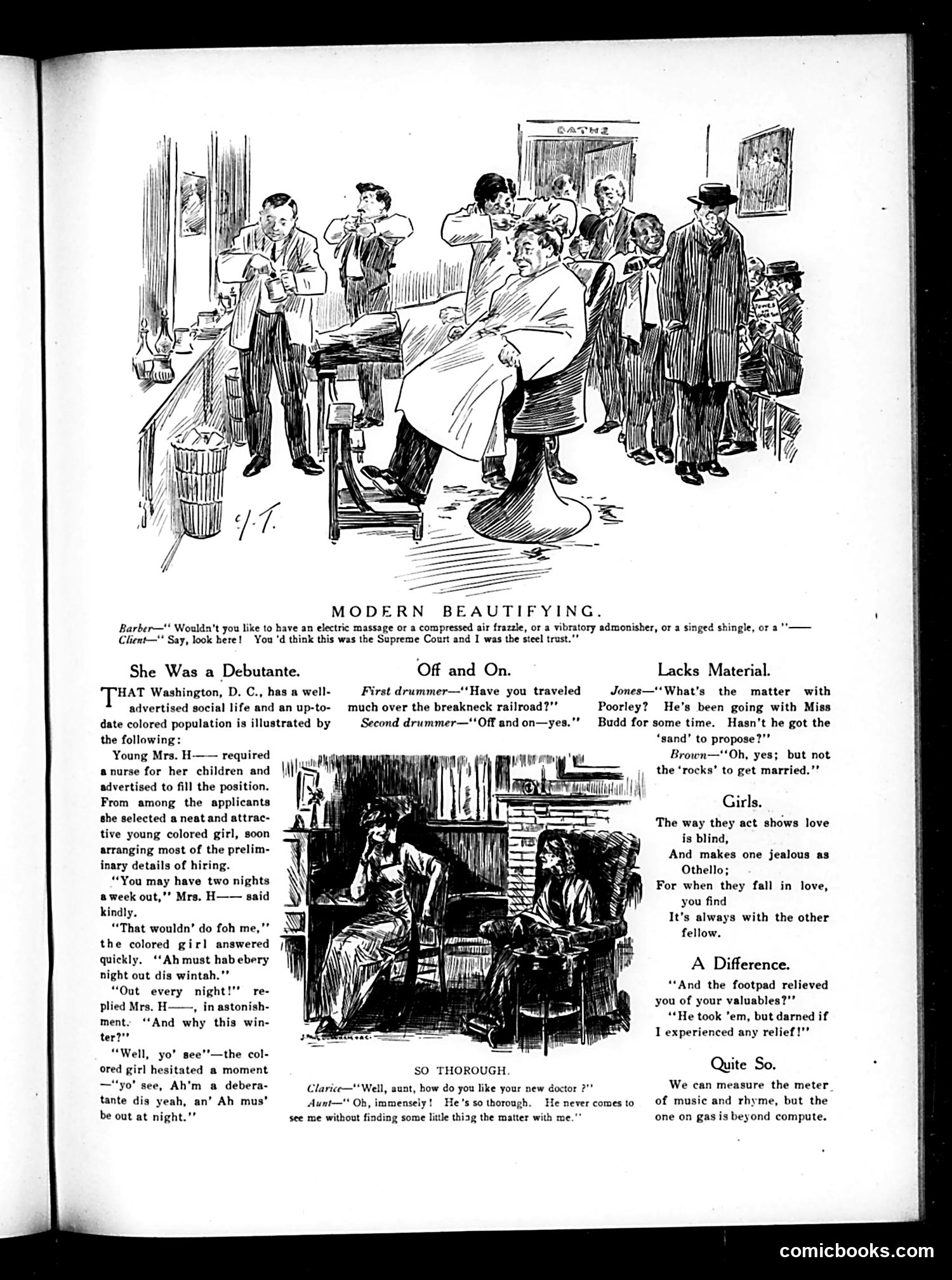
The top cartoon satirizes excessive, trendy beauty treatments. A barber promotes newfangled gadgets ("electric massage," "compressed air frazzle," "vibratory admonisher") to a client who sarcastically compares the sales pitch to the Supreme Court's aggressive antitrust case against U.S. Steel—suggesting the barber is being as forceful and annoying as that famous legal action. Below are several humorous short pieces: **"She Was a Debutante"** mocks Washington D.C. society by showing a young Black maid demanding every night off because she's now a "debutante"—satirizing how African American servants mimicked upper-class social aspirations. **Other brief jokes** play on double meanings: "off and on" railroad travel, a doctor who always finds something wrong, a suitor without enough money ("rocks") to marry, and a gas meter beyond calculation. The satire targets social pretension, particularly among African Americans imitating white society's status-seeking behavior—reflecting the era's problematic racial attitudes.
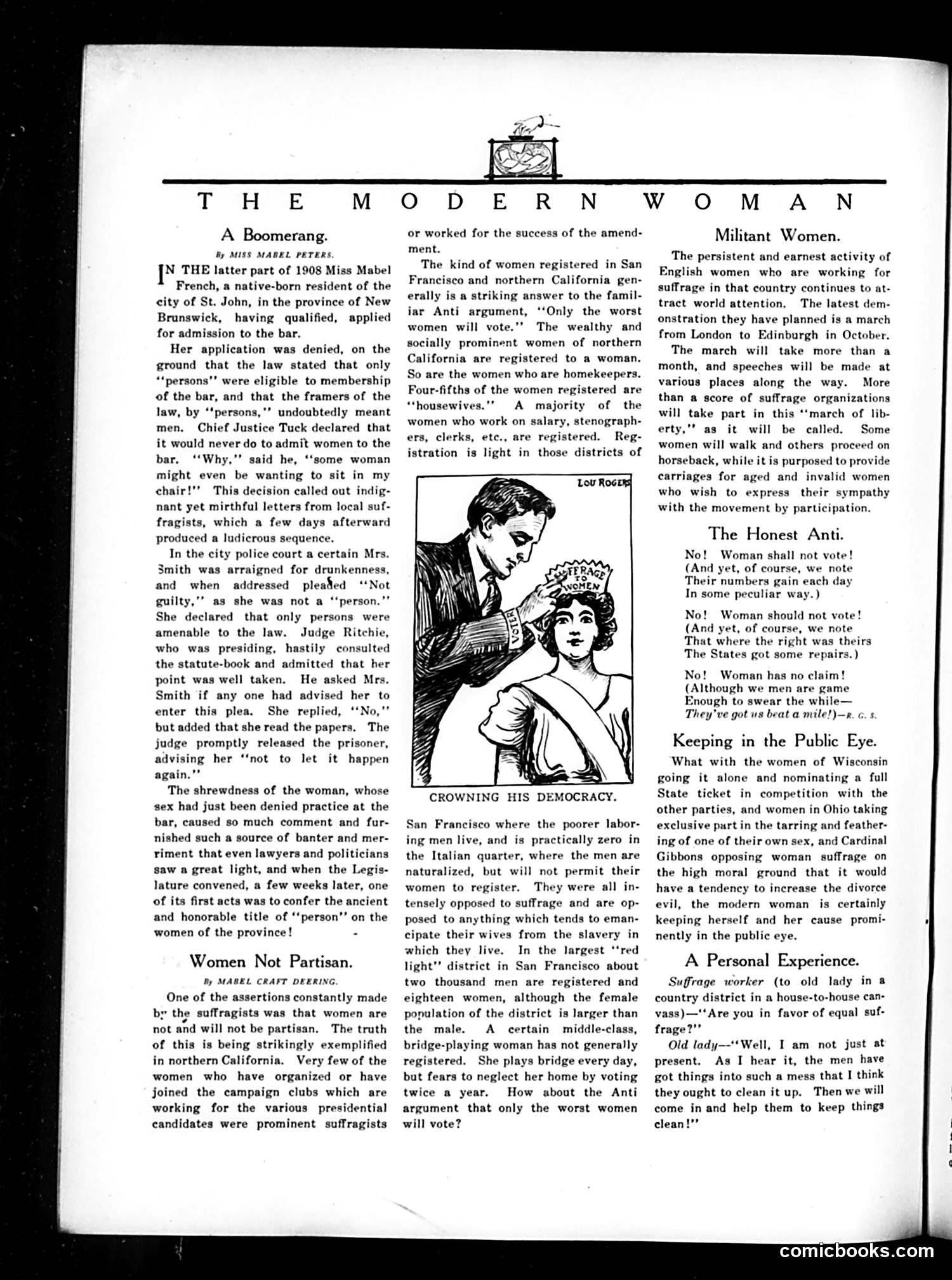
This cartoon satirizes the hypocrisy of male democratic ideals. The image shows a man placing a crown on a woman's head, likely referencing recent women's suffrage victories in California (1911) or similar jurisdictions. The satire works on multiple levels: The caption "Crowning His Democracy" is ironic—the man's gesture appears magnanimous, but the surrounding text reveals women achieved voting rights *despite* male resistance, not through male benevolence. The accompanying articles document how women had to exploit legal loopholes (the "boomerang" of the first story) and overcome explicit male opposition to gain recognition as legal "persons" eligible to vote. The cartoon mocks men who claim to champion "democracy" while having previously denied women basic political rights. Their "crowning" of women appears less like democratic principle and more like grudging acceptance of inevitable change—women forced their way in, rather than being graciously admitted to the democratic process.
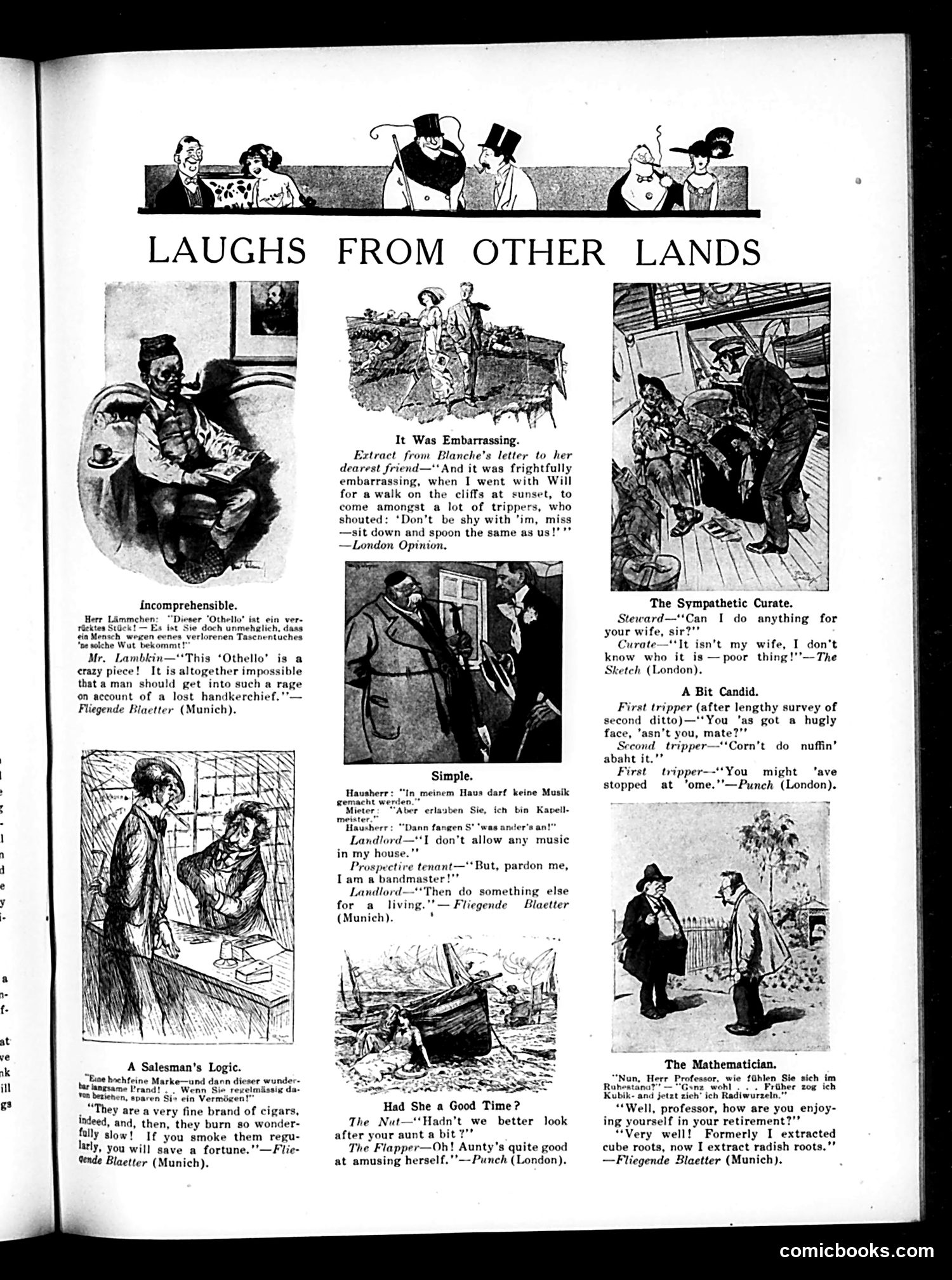
This page collects humorous anecdotes translated from European satirical magazines (German *Fliegende Blätter*, British *Punch* and *The Sketch*). The jokes rely on cultural misunderstandings and class humor typical of early 20th-century publications. The cartoons illustrate absurd logic: a German finds Shakespeare's *Othello* implausibly emotional over a handkerchief; a cigar salesman argues that slow-burning cigars save money (paradoxically); a landlord refuses to hire a bandmaster because he bans music in his house. Other sketches mock social pretension—embarrassment among working-class "trippers" (tourists), a clergyman mistaken for a married man, a retired professor making puns about trading "cube roots" for "radish roots." The humor depends on observing human contradiction and linguistic wordplay rather than sophisticated satire, appealing to readers amused by everyday foolishness across cultures.
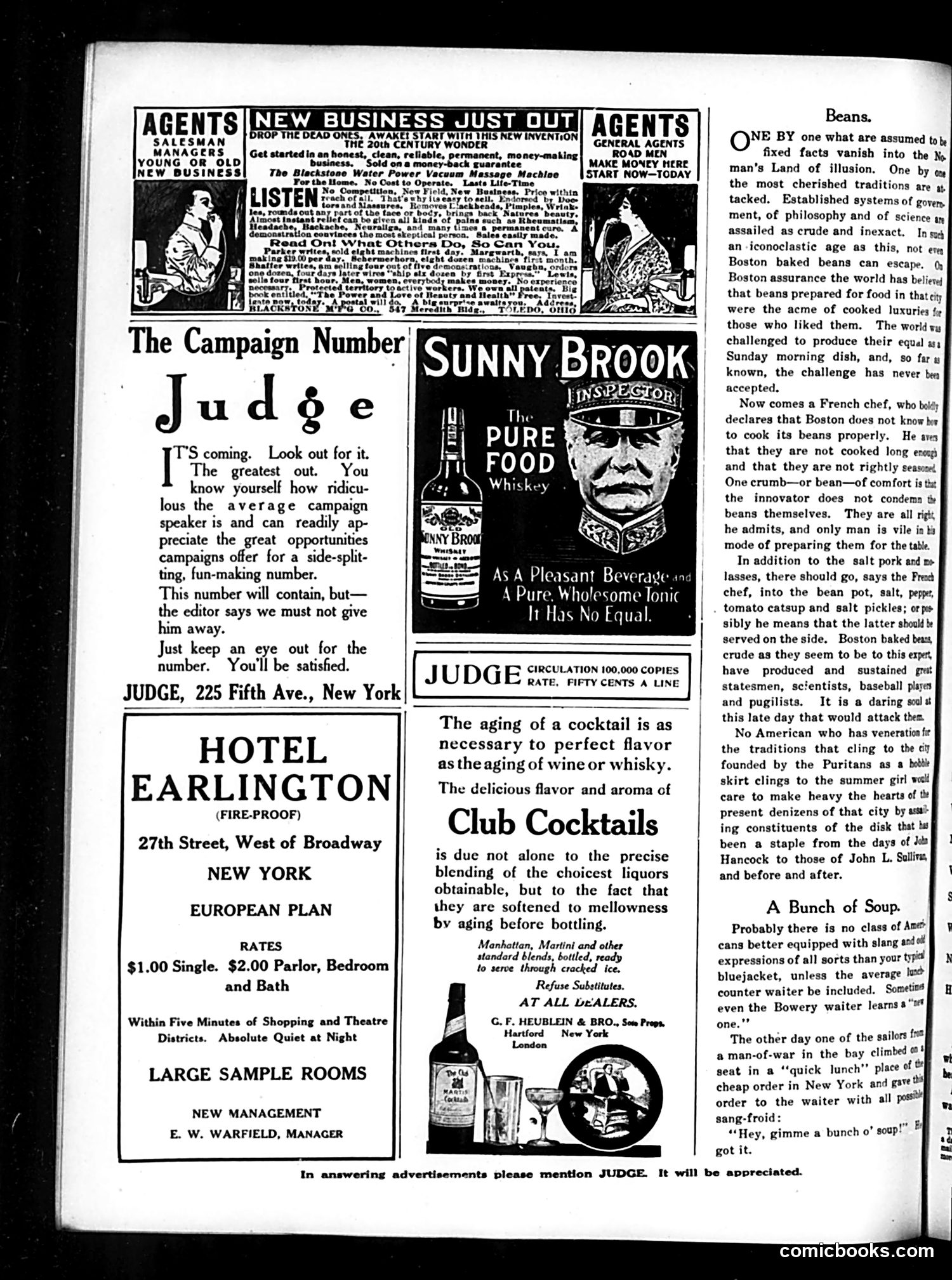
This page from *Judge* (a major American satirical weekly) is primarily **advertising and promotional content** rather than political cartoons. The main editorial content is "The Campaign Number" announcement—*Judge* is promoting an upcoming special issue mocking political campaign speakers, whom the editor considers inherently ridiculous and ripe for satire. The promise is humorous coverage of campaign season absurdities. The bulk of the page contains period advertisements (Blackstone Water Power Vacuum Massage Machine, Sunny Brook whiskey, Hotel Earlington, Club Cocktails by Heublein & Bros.) and two essay columns: one about Boston baked beans being challenged by a French chef who claims they're undercooked, and another about sailors' colorful slang vocabulary. The page reflects early 20th-century American consumer culture and *Judge*'s role as a humor magazine mixing political commentary with lifestyle and product advertising—a common magazine format of that era.
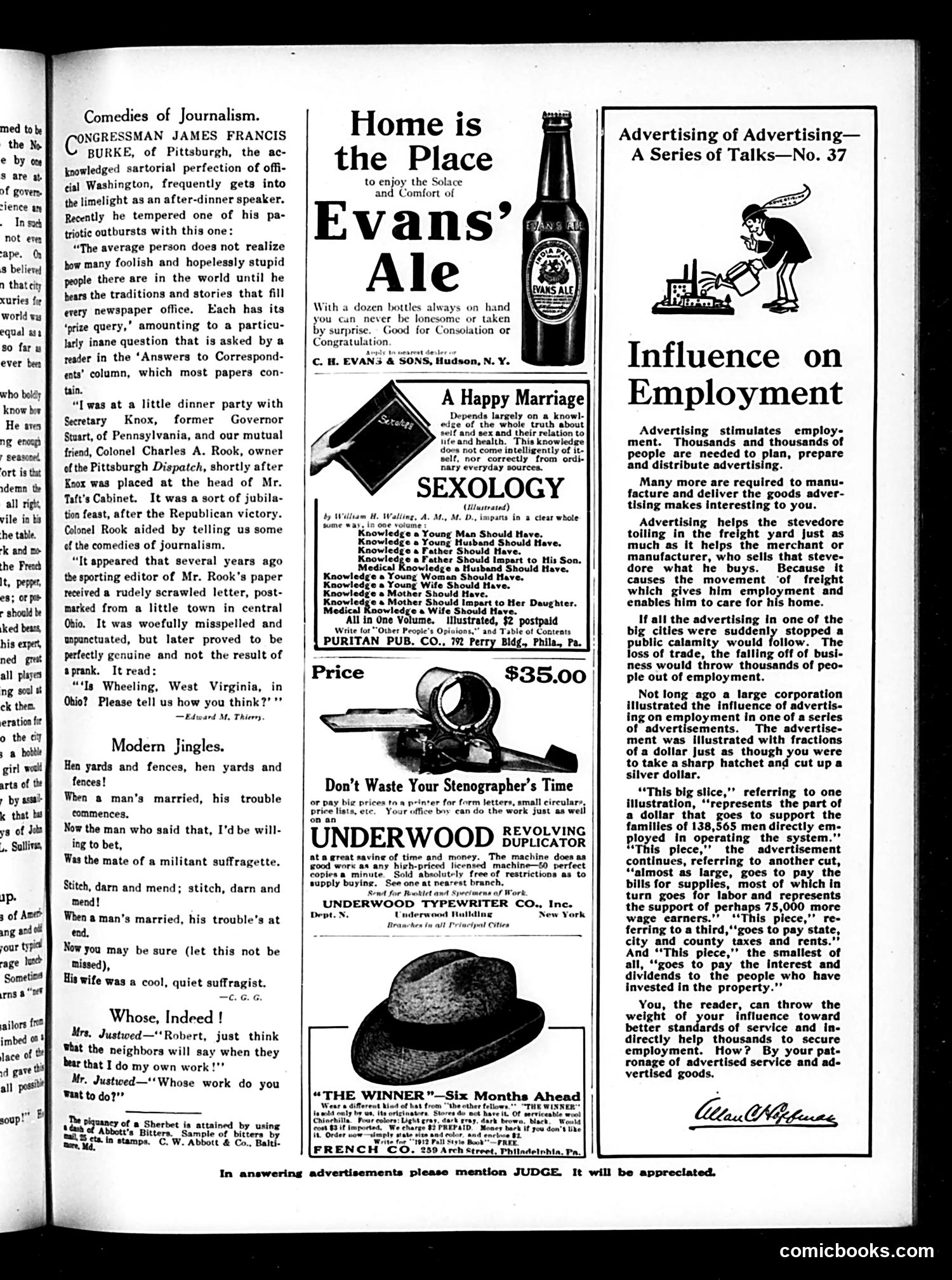
This page from *Judge* magazine contains mostly **advertising and humor columns**, not political cartoons. The "Comedies of Journalism" section reports an anecdote: Congressman James Francis Burke (a Pittsburgh politician known for fine clothes) tells a story about a newspaper's "prize query"—a hilariously stupid reader question. A small-town Ohio reader asked whether Wheeling, West Virginia, is actually in Ohio, demonstrating the absurd inquiries newspapers received. The "Modern Jingles" mock **suffragette politics** through domestic humor. One jingle jokes that marrying a militant suffragette causes trouble; another claims a quiet suffragist wife makes married life easy. This reflects early 1900s anxieties about women's rights activism. The page is otherwise filled with **advertisements** for Evans' Ale, sexology books, typewriter duplicators, and hats—typical commercial content of the era. No major political figures or events are caricatured here.
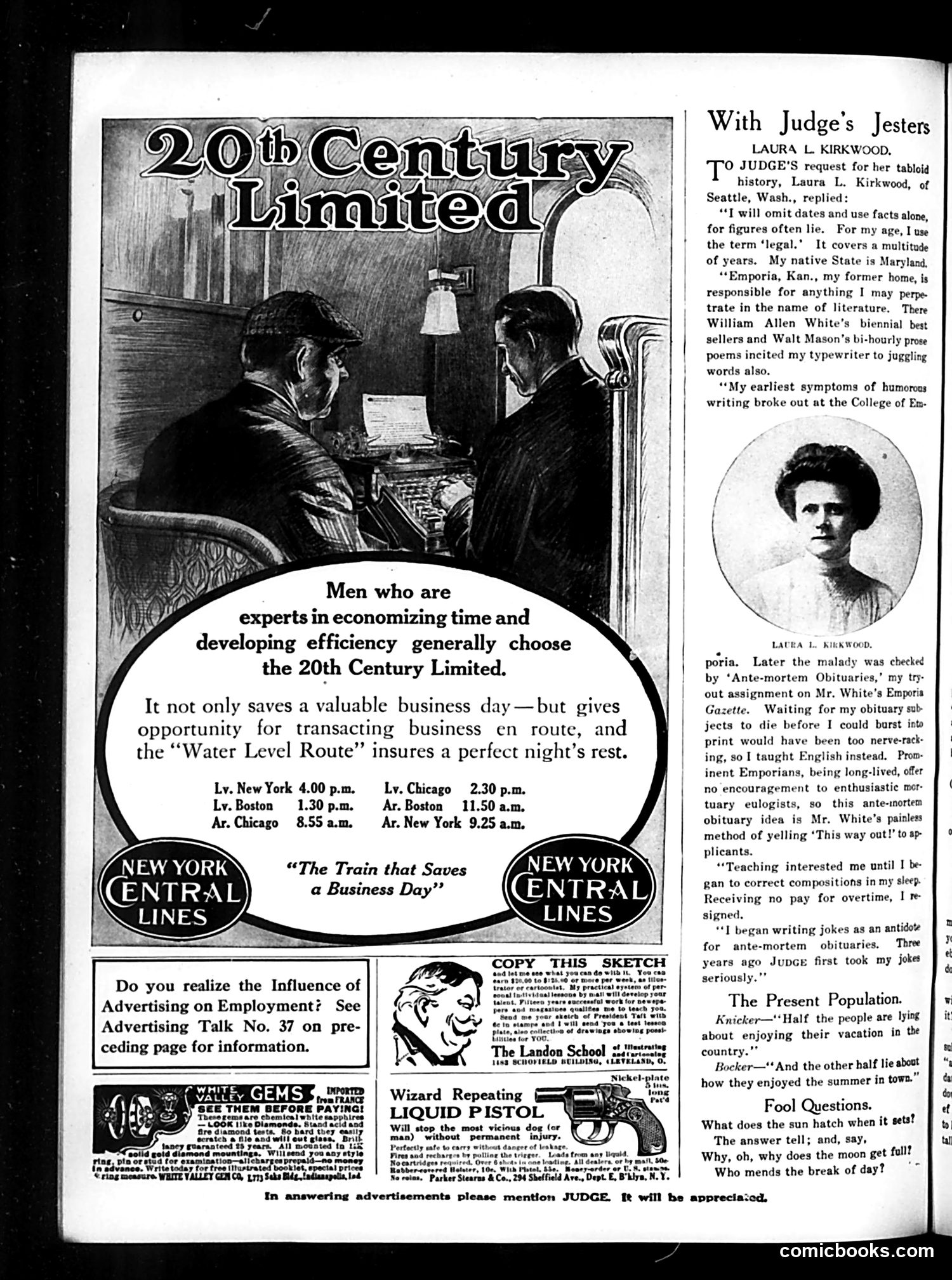
This page consists primarily of **advertising and biographical content** rather than political satire. The dominant advertisement promotes the **"20th Century Limited" train** by the New York Central Lines—marketed as "The Train that Saves a Business Day." The accompanying illustration depicts businessmen conducting work aboard the train, appealing to early-20th-century efficiency culture and the growing emphasis on time management in corporate America. The main editorial content is a biographical interview with **Laura L. Kirkwood**, a humor writer from Seattle. She describes her path to becoming a contributor to Judge, including early attempts at "ante-mortem obituaries" and teaching English. Her comments reference **William Allen White** and other Kansas literary figures, establishing her regional literary credentials. The page also includes minor humorous segments ("Fool Questions," "The Present Population") and various smaller advertisements. No significant political satire or caricature is evident on this particular page.
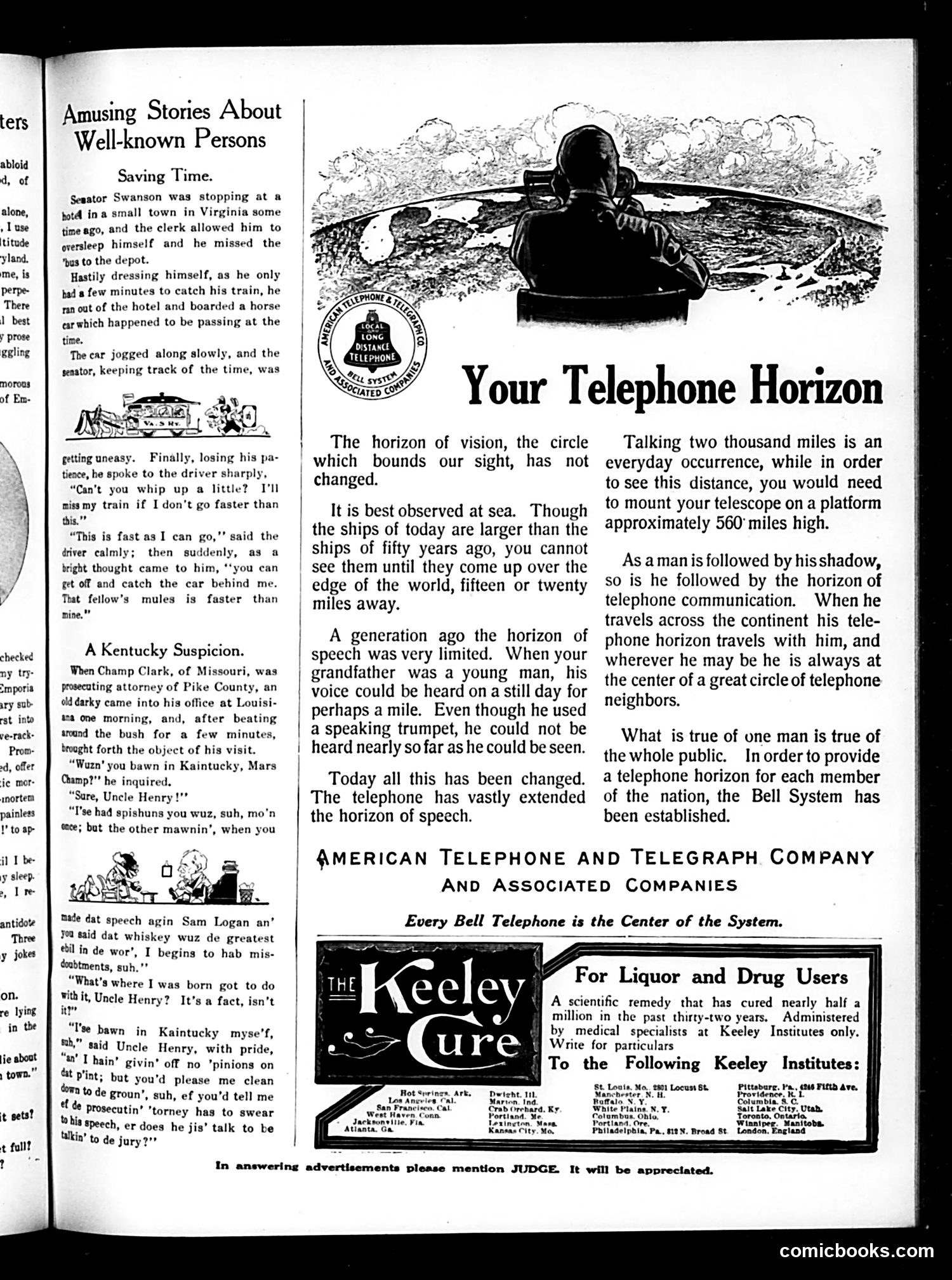
This page contains two brief humorous anecdotes and a Bell Telephone advertisement. **"Saving Time"** satirizes Senator Swanson's impatience: he misses his train, borrows a slow horse-drawn cart, and complains to the driver about speed. The driver's absurd response—suggesting Swanson simply "catch the car behind me" whose mules are faster—mocks the senator's unreasonable demands and the futility of his impatience. **"A Kentucky Suspicion"** depicts a Black man expressing doubt about Champ Clark's (a real Missouri politician) birthplace. The man claims Clark's recent anti-alcohol speech contradicts being born in Kentucky, implying Kentuckians wouldn't take such a stance. The humor relies on period racial dialect stereotyping. The **Bell Telephone ad** uses the anecdotes' theme of distance and communication to promote telephone service's expanding reach—a metaphorical "horizon" extending human connection across the continent. A **Keeley Cure advertisement** for alcohol and drug treatment appears at bottom, typical of era medical advertising.
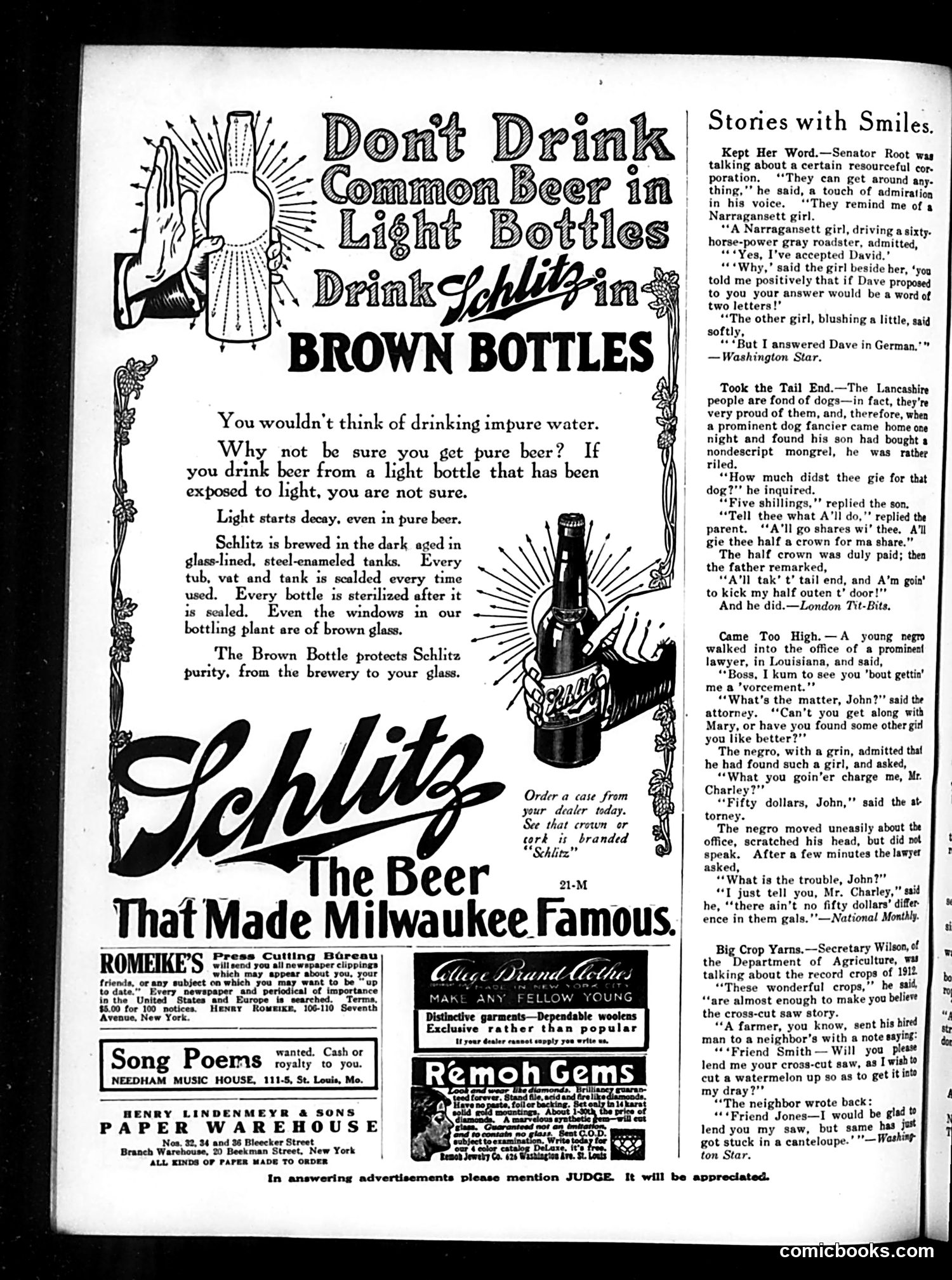
This page is dominated by a **beer advertisement** for Schlitz, "The Beer That Made Milwaukee Famous." The ad uses a scientific/purity argument: it warns against drinking beer from light bottles because light causes decay, even in pure beer. Schlitz claims superiority by using **brown bottles** that protect the product from light exposure during storage and delivery. The ad emphasizes manufacturing controls—dark aging tanks, sterilization, even brown windows in the bottling plant—to assure consumers of purity and quality. This reflects early 20th-century marketing that leveraged scientific claims to build brand trust. The page also contains several **humorous anecdotes** in a "Stories with Smiles" column, typical of *Judge* magazine's satirical content, plus classifieds and smaller advertisements.
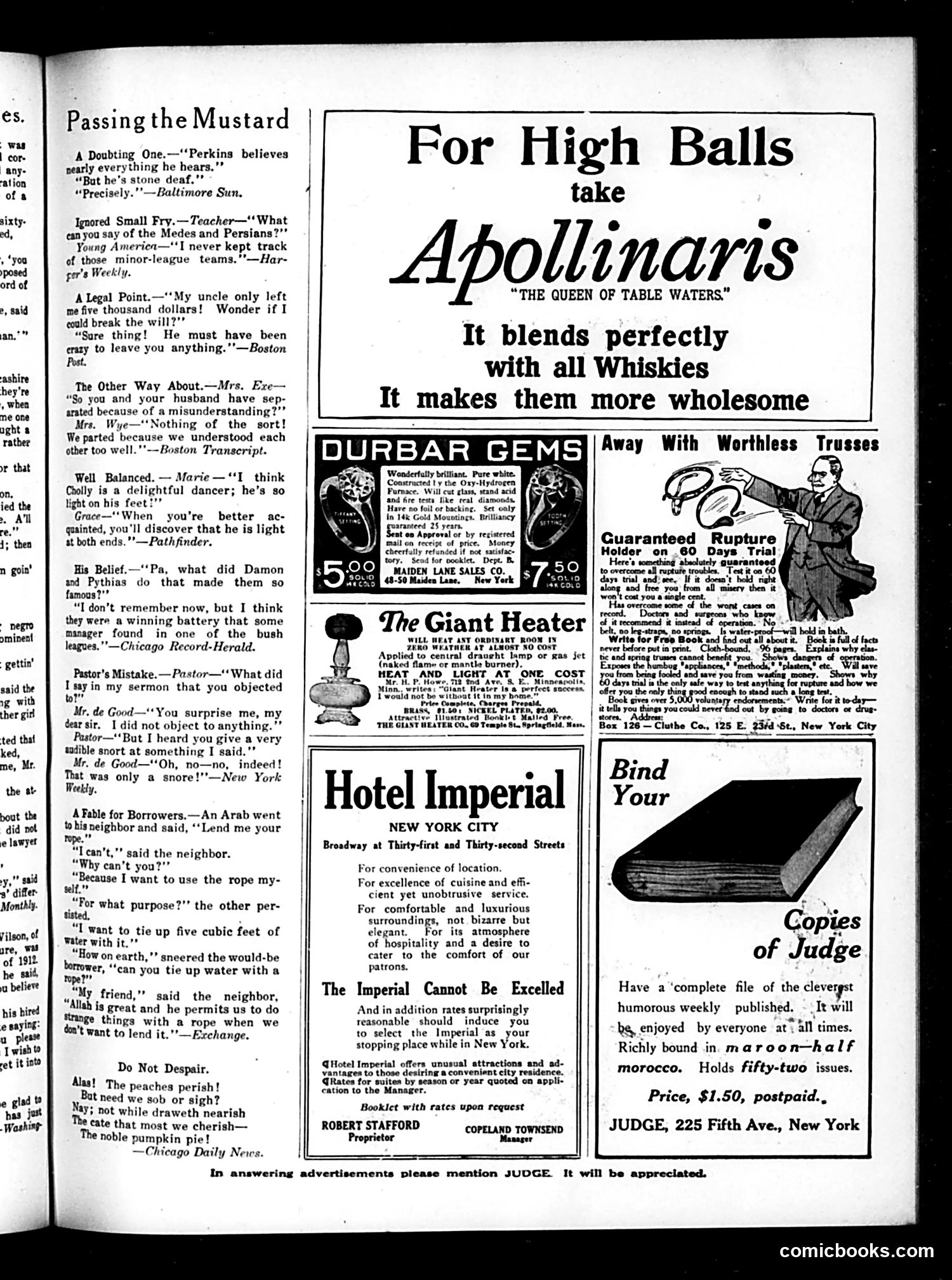
This page is primarily **advertising**, with small humorous columns on the left titled "Passing the Mustard." The main content consists of period advertisements, including: - **Apollinaris water** ("Queen of Table Waters") — promoted as blending with whiskeys and making them "wholesome" - **Durbar Gems** — jewelry - **A rupture truss** — a medical device - **The Giant Heater** — heating appliance - **Hotel Imperial** — New York hotel - **Copies of Judge** — the magazine itself, offering bound back-issues The left-side jokes are brief, typical early-1900s humor: a student confusing baseball teams with ancient history; a woman's uncle's bad will; observations about dancing partners. They reflect contemporary concerns (inheritance law, education) but require no specific political context. The page represents **Judge magazine's business model**: satirical content supporting commercial advertising to affluent urban readers. The "wholesome whiskey" ad is particularly notable—openly promoting alcohol before Prohibition.
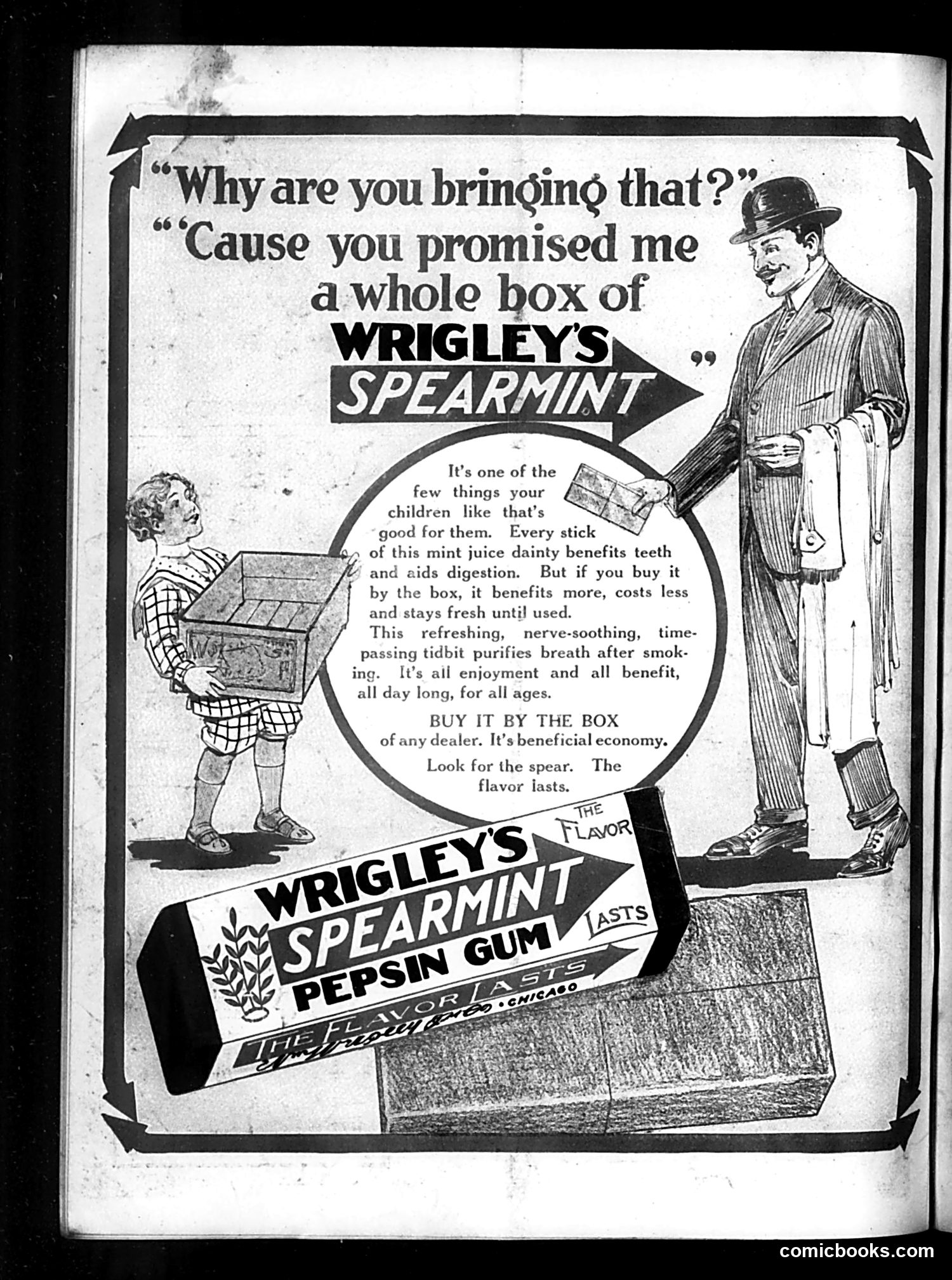
This is a **Wrigley's Spearmint gum advertisement**, not political satire. The "cartoon" depicts a domestic scene where a child holds a box of gum while an adult (likely a parent) enters carrying a single stick—apparently having broken a promise to bring a full box. The ad uses this relatable scenario to pitch bulk purchasing: buying by the box is cheaper, keeps gum fresher, and provides better value than individual sticks. The copy emphasizes health benefits typical of early 20th-century advertising—claims that gum aids digestion, benefits teeth, and "purifies breath after smoking." The humor is mild domestic comedy meant to resonate with parents and children, not political commentary. This represents the type of commercial content mixed with editorial material common in Judge magazine.