
Judge, 1912-10-05 · page 18 of 26
Judge — October 5, 1912 — page 18: what you’re looking at
What you’re looking at
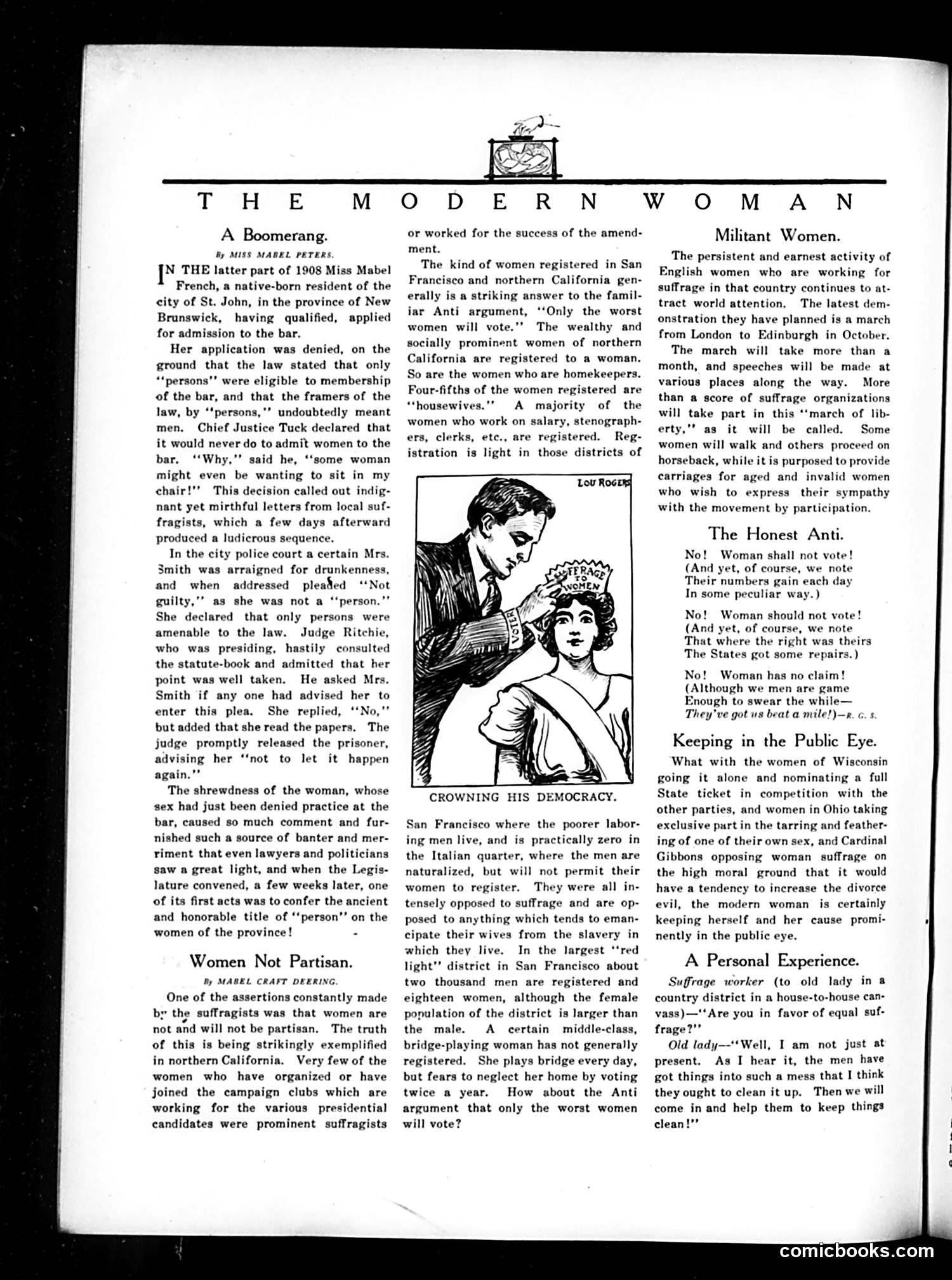
This cartoon satirizes the hypocrisy of male democratic ideals. The image shows a man placing a crown on a woman's head, likely referencing recent women's suffrage victories in California (1911) or similar jurisdictions. The satire works on multiple levels: The caption "Crowning His Democracy" is ironic—the man's gesture appears magnanimous, but the surrounding text reveals women achieved voting rights *despite* male resistance, not through male benevolence. The accompanying articles document how women had to exploit legal loopholes (the "boomerang" of the first story) and overcome explicit male opposition to gain recognition as legal "persons" eligible to vote. The cartoon mocks men who claim to champion "democracy" while having previously denied women basic political rights. Their "crowning" of women appears less like democratic principle and more like grudging acceptance of inevitable change—women forced their way in, rather than being graciously admitted to the democratic process.
📄 Transcribed text from this page (OCR, searchable)
Machine-transcribed from the original scan — historical spelling and the odd misread are preserved.
T HE A Boomerang. By MISS MABEL PETERS. IX THE latter part of 1908 Miss Mabel French, a native-born resident of the city of St. John, in the province of New Brunswick, having qualified, applied for admission to the bar. Her application was denied, on the ground that the law stated that only “‘persons’* were eligible to membership of the bar, and that the framers of the law, by ‘‘persons,’’ undoubtedly meant men, Chief Justice Tuck declared that it would never do to admit women to the bar. ‘‘Why,”’ said he, ‘‘some woman might even be wanting to sit in my chair!'’ This decision called out indig- nant yet mirthful letters from local suf- fragists, which a few days afterward produced a ludicrous sequence. In the city police court a certain Mrs. Smith was arraigned for drunkenness, and when addressed plea§ed ‘‘Not guilty,’’ as she was not a ‘‘person.’’ She declared that only persons were amenable to the law. Judge Ritchie, who was presiding, hastily consulted the statute-bock and admitted that her point was well taken. He asked Mrs. Smith if any one had advised her to enter this plea. She replied, ‘‘No,"’ but added that she read the papers. The judge promptly released the prisoner, advising her ‘‘not to let it happen again."” The shrewdness of the woman, whose sex had just been denied practice at the bar, caused so much comment and fur- nished such a source of banter and mer- riment that even lawyers and politicians saw a great light, and when the Legis- lature convened, a few weeks later, one of its first acts was to confer the ancient and honorable title of ‘‘person’’ on the women of the province! - Women Not Partisan. By MABEL CRAFT DEERING. One of the assertions constantly made by the suffragists was that women are not and will not be partisan. The truth of this is being strikingly exemplified in northern California. Very few of the women who have organized or have joined the campaign clubs which are working for the various presidential candidates were prominent suffragists M O D E RN or worked for the success of the amend- ment. The kind of women registered in San Francisco and northern California gen- erally is a striking answer to the famil- iar Anti argument, ‘‘Only the worst women will vote.” The wealthy and socially prominent women of northern California are registered to a woman. So are the women who are homekeepe Four-fifths of the women registered are ‘housewives.’ A majority of the women who work on salary, stenograph- ers, clerks, etc., are registered. Reg- istration is light in those districts of CROWNING HIS DEMOCRACY. San Francisco where the poorer labor- ing men live, and is practically zero in the Italian quarter, where the men are naturalized, but will not permit their women to register. They were all in- tensely opposed to suffrage and are op- posed to anything which tends to eman- cipate their wives from the slavery in which they live. In the largest ‘red light’’ district in San Francisco about two thousand men are registered and eighteen women, although the female population of the district is larger than the male. A _ certain middle-class, bridge-playing woman has not generally registered. She plays bridge every day, but fears to neglect her home by voting twice a year. How about the Anti argument that only the worst women will vote? W OM AN Militant Women. The persistent and earnest activity of English women who are working for suffrage in that country continues to at- tract world attention. The latest dem- onstration they have planned is a march from London to Edinburgh in October, The march will take more than a month, and speeches will be made at various places along the way. More than a score of suffrage organizations will take part in this ‘‘march of lib- erty,’ as it will be called. Some women will walk and others proceed on horseback, while it is purposed to provide carriages for aged and invalid women who wish to express their sympathy with the movement by participation, The Honest Anti. No! Woman shall not vote! (And yet, of course, we note Their numbers gain each day In some peculiar way.) No! Woman should not vote! (And yet, of course, we note That where the right was theirs The States got some repairs.) No! Woman has no claim! (Although we men are game Enough to swear the while— They've got us beat a mile!)—r. c. s Keeping in the Public Eye. What with the women of Wisconsin going it alone and nominating a full State ticket in competition with the other parties, and women in Ohio taking exclusive part in the tarring and feather- ing of one of their own sex, and Cardinal Gibbons opposing woman suffrage on the high moral ground that it would have a tendency to increase the divorce evil, the modern woman is certainly keeping herself and her cause promi- nently in the public eye. A Personal Experience. Suffrage worker (to old lady in a country district in a house-to-house can- vass)—‘‘Are you in favor of equal suf- frage? Old lady—‘‘Well, I am not just at present. As I hear it, the men have got things into such a mess that I think they ought to clean it up. Then we will come in and help them to keep things clean!"" comicbooks.com