
Judge, 1912-10-05 · page 2 of 26
Judge — October 5, 1912 — page 2: what you’re looking at
What you’re looking at
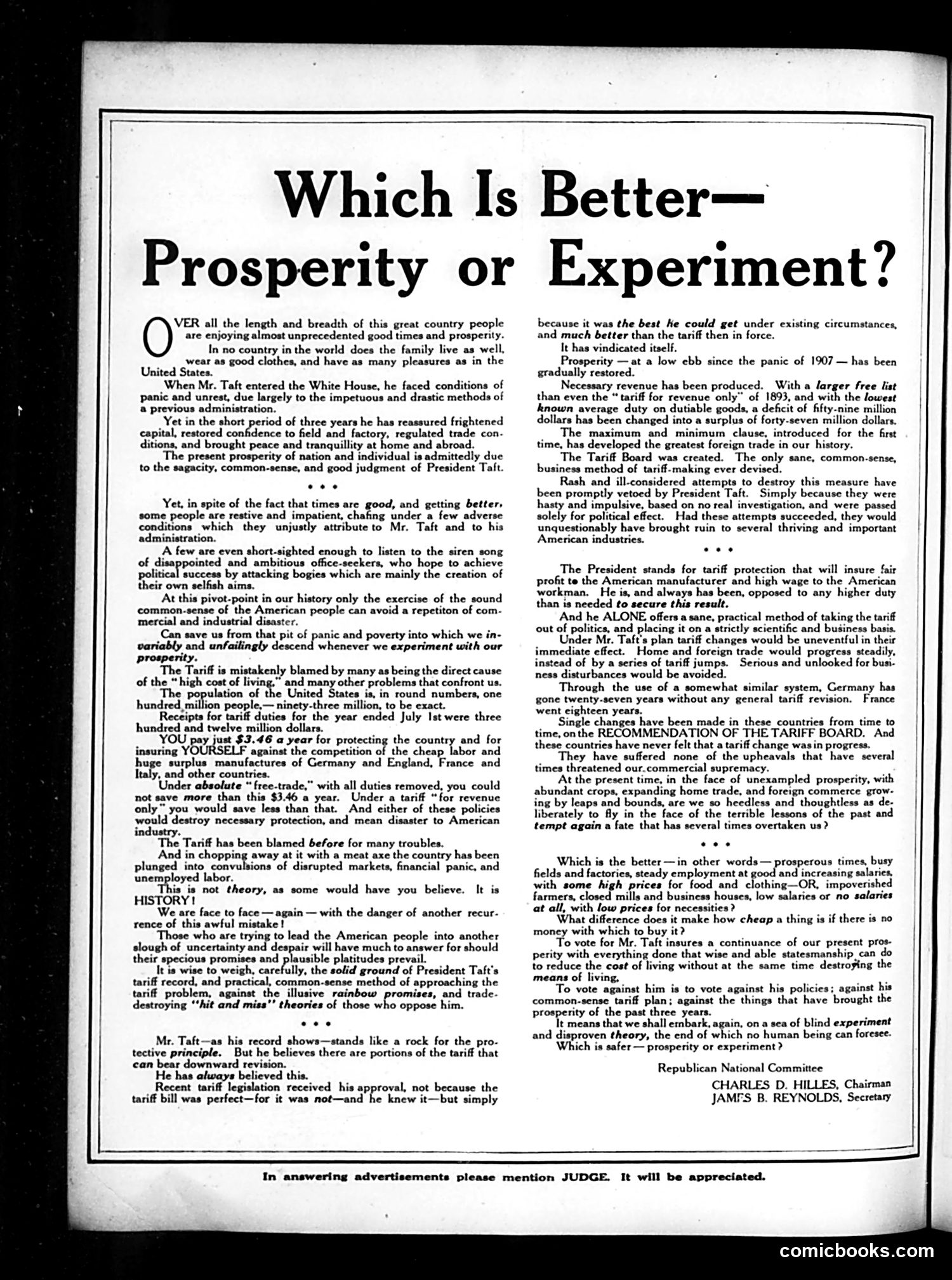
This page is primarily **political advocacy text**, not a cartoon. It's a Republican National Committee advertisement arguing **for protective tariffs under President Taft** versus free trade. The piece defends Taft's tariff policies against critics who blamed them for economic troubles. It argues that tariffs ensure "fair profits" for American manufacturers and workers, contrasting this with "absolute free trade," which it claims would devastate American industry by allowing cheap imports from Germany, England, and France. The text presents Taft as standing firm on principle, opposing "experiment" (free trade) in favor of maintaining American prosperity through protectionism. It concludes by asking voters to support Taft's tariff record. This reflects early 20th-century American political debates over trade policy.
📄 Transcribed text from this page (OCR, searchable)
Machine-transcribed from the original scan — historical spelling and the odd misread are preserved.
Which Is Better— Prosperity or Experiment? | are enjoying almost unprecedented good times and prosperity. In no country in the world does the family live as well, wear as good clothes, and have as many pleasures as in the United State: When Mr. Taft entered the White House, he faced conditions of panic and unrest, due largely to the impetuous and drastic methods of a previous administration. Yet in the short period of three years he has reassured frightened capital, restored confidence to field and factory, regulated trade con- ditions, and brought peace and tranquillity at home and abroad. The present prosperity of nation and individual is admittedly due to the sagacity, common-sense, and good judgment of President Taft. eee O™ all the length and breadth of this great country people Yet, in spite of the fact that times are good, and getting better, some people are restive and impatient, chafing under a few adverse conditions which they unjustly attribute to Mr. Taft and to his administration. A few are even short-sighted enough to listen to the siren song of disappointed and ambitious office-seekers, who hope to achieve political success by attacking bogies which are mainly the creation of their own selfish aims. At this pivot-point in our history only the exercise of the sound common-sense of the American people can avoid a repetiton of com- mercial and industrial disaster. Can save us from that pit of panic and poverty into which we in- variably and unfailingly descend whenever we experiment with our prosperity. The Tariff is mistakenly blamed by many as being the direct cause of the “high cost of living,” and many other problems that confront us. ‘The population of the United Sates tain round numbers, one hundred million people,— ninety-three million, to be exact. Receipts for tariff duties for the year ended July Ist were three hundred and twelve million dollars. YOU pay just $3.46 a year for protecting the country and for insuring YOURSELF against the competition of the cheap labor and huge surplus manufactures of Germany and England, France and Italy, and other countries. Under absolut: free-trade,” with all duties removed, you could not save more than this $3.46 a year. Under a tariff “for revenue only” you would save less than that. And cither of these policies bares destroy necessary protection, and mean disaster to American industry. The Tariff has been blamed before for many troubles. And in chopping away at it with a meat axe the country has been plunged into convulsions of disrupted markets, financial panic, and unemployed labor. This je not theory, as some would have you believe. It is HISTORY! We are face to face — again — with the danger of another recur- rence of this awful mistake! Those who are trying to | the American people into another slough of uncertainty and des; will have much to answer for should their specious promises and plausible platitudes prevail. It is wise to weigh, carefully, the solid ground of President Taft's tariff record, and practical, common-sense method of approaching the tariff problem, against the illusive rainbow promises, and trade- destroying ‘‘hit and miss"’ theories of those who oppose him. Mr. Taft his record shows—stands like a rock for the pro- tective principle. But he believes there are portions of the tariff that can bear downward revision. He has always believed this. Recent tariff legislation received his approval, not because the tariff bill was perfect—for it was not—and he knew it—but simply because it was the best Ke could get under existing circumstances, and much better than the tariff then in force. It has vindicated itself. Prosperity — at a low ebb since the panic of 1907 — has been gradually restored. Necessary revenue has been produced. With a larger free list than even the “tariff for revenue only” of 1893, and with the lowest known average duty on dutiable goods, a deficit of fifty-nine million dollars has been changed into a surplus of forty-seven million dollars. The maximum and minimum clause, introduced for the first time, has developed the greatest foreign trade in our history. The Tariff Board was created. The only sane, common-sense, business method of tariff-making ever devised. Rash and ill-considered 10 destroy this measure have been promptly vetoed by President Taft. Simply because they were hasty and impulsive, based on no real investigation, and were passed solely for political effect. Had these attempts succeeded, they would unquestionably have brought ruin to several thriving and important American industries. The President stands for tariff protection that will insure fair profit te the American manufacturer and high wage to the American workman. He is, and always has been, opposed to any higher duty than is needed to secure this result. And he ALONE offers a sane, practical method of taking the tariff out of politics, and placing it on a strictly scientific and business basis. Under Mr. Taft's plan tariff changes would be uneventful in their immediate effect. Home and foreign trade would progress steadily, instead of by a series of tariff jumps. Serious and unlooked for busi- ness disturbances would be avoided. Through the use of a somewhat similar system, Germany has gone twenty-seven years without any general tariff revision. France went eighteen years. Single changes have been made in these countries from time to time, on the RECOMMENDATION OF THE TARIFF BOARD. And these countries have never felt that a tariff change was in progress. They have suffered none of the upheavals that have several times threatened our.commercial supremacy. At the present time, in the face of unexampled prosperity, with abundant crops, expanding home trade, and foreign commerce grow- ing by leaps and bounds, are we so heedless and thoughtless as de- liberately to Ay in the face of the terrible lessons of the past and tempt again a fate that has several times overtaken us? Which is the better—in other words— prosperous times, busy fields and factories, steady employment at g: and increasing salaries, with some high prices for food and clothing—OR, impoverished farmers, closed mills and business houses, low salaries or no salaries at all, with low prices for necessities ? What difference does it make how cheap a thing is if there is no money with which to buy it? To vote for Mr. Taft insures a continuance of our present pros- perity with everything done that wise and able statesmanship can to reduce the cost of living without at the same time destroying the means of living, ‘ To vote against him i: vote against his policies; against his common-sense tariff plan inst the things that have brought the prosperity of the past three years. . It means that we shall enbark, again, on a sea of blind experiment and disproven theory, the end of which no human being can foresee. Which is safer — prosperity or experiment ? Republican National Committee CHARLES D. HILLES, Chairman JAMFS B. REYNOLDS, Secretary In answering advertisements please mention JUDGE. It will be appreciated. comicbooks.com