
Judge, 1912-10-05 · page 9 of 26
Judge — October 5, 1912 — page 9: what you’re looking at
What you’re looking at
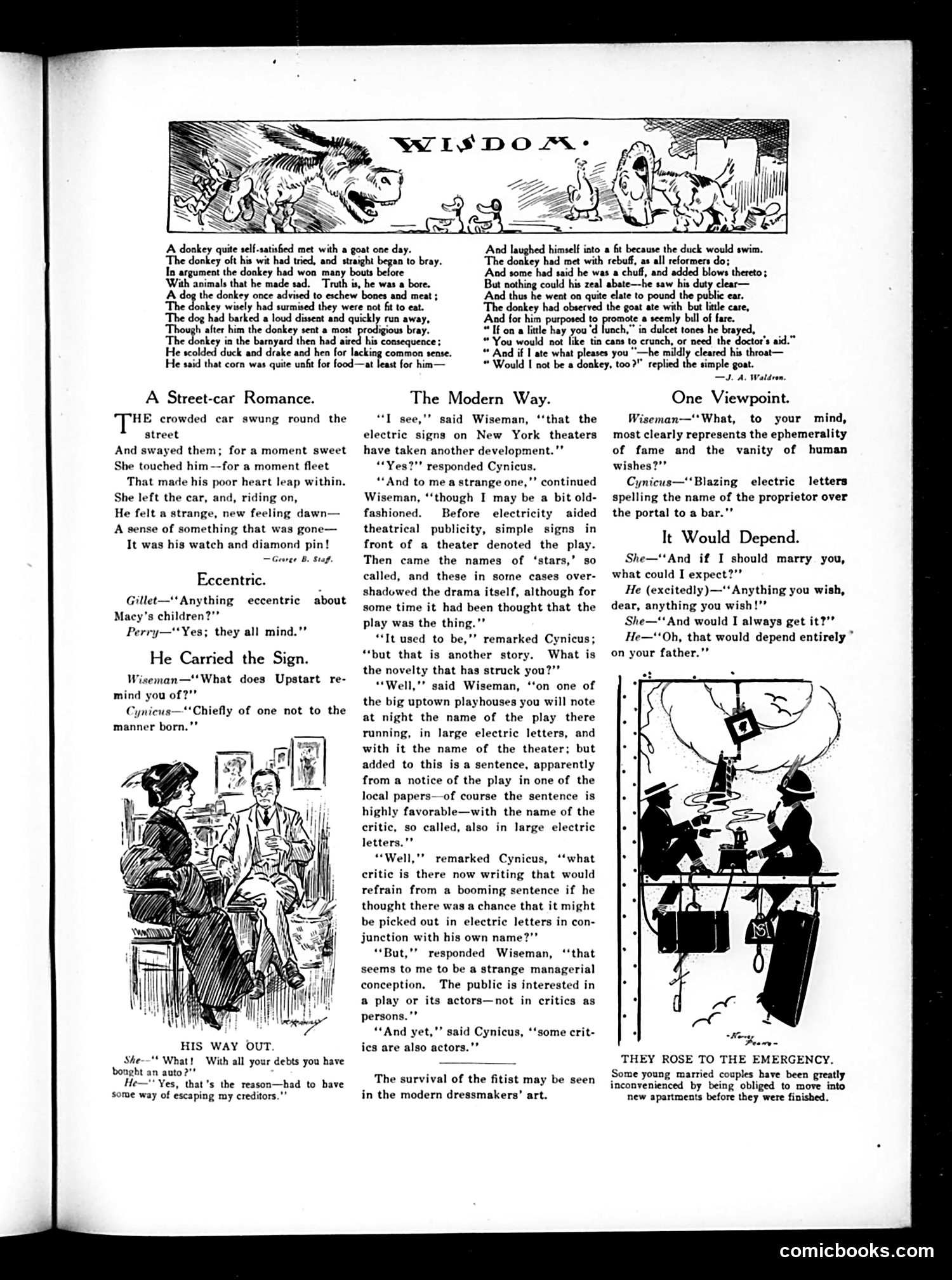
This page contains several satirical pieces mocking self-righteous reformers and critics: **"Wisdom" (top):** The lengthy poem ridicules a donkey who relentlessly preaches dietary reform to other animals—telling a dog to avoid bones, advising ducks to reject corn—despite universal rejection. The donkey represents tedious, preachy reformers who ignore evidence their advice isn't wanted. The goat's final retort ("Would I not be a donkey, too?") mocks the reformer's logical inconsistency. **"The Modern Way":** Wiseman and Cynicus discuss theater marquees now displaying critics' favorable quotes in electric letters alongside the theater name. The satire critiques how this appeals to critics' vanity—they'll write glowing reviews hoping to see their names in lights. Cynicus cynically notes "some critics are also actors," suggesting they perform enthusiasm for publicity. **Other short pieces** mock eccentricity, pretension, and financial desperation (the auto-buying debtor). The page's theme: modern vanity, whether reformers' self-importance or critics' hunger for recognition, produces absurdity.
📄 Transcribed text from this page (OCR, searchable)
Machine-transcribed from the original scan — historical spelling and the odd misread are preserved.
A donkey quite self-satisfied met with a goat one day. The donkey oft his wit had tried, and straight began to bray. In argument the donkey had won many bouts before ‘With animals that he made sad. Truth is, he was a bore. ; And laughed himself into a fit because the duck would swim. The donkey had met with rebuff, as all reformers do; And some had said he was a chuff, and added blows thereto; But nothing could his zeal abate—he saw his duty clear— And thus he went on quite elate to pound the public ear. A dog the donkey once advised to eschew bones and meat ; The donkey wisely had surmued they were not ft to eat The dog had barked a loud dissent and quickly run awa: Though after him the donkey sent a most The Joakey in the barnyard then had air He scolded duck and drake and hen for lacki He said that corn was quite unfit for food—at A Street-car Romance. THE crowded car swung round the street And swayed them; for a moment sweet She touched him—for a moment fleet That made his poor heart leap within. She left the car, and, riding on, He felt a strange, new feeling dawn— A sense of something that was gone— It was his watch and diamond pin! —Gearee B. Staf. Eccentric. Gillet—“Anything eccentric about Macy's children?’’ Perry—‘‘Yes; they all mind.” He Carried the Sign. Wiseman—‘‘What does Upstart re- mind you of Cynicus—“‘Chiefly of one not to the manner born.’’ HIS WAY OUT. She" What! With all your debts you have bought an auto?’ He—"* Yes, that's the reason—had to have some way of escaping my creditors."’ And for him purposed to igious bra; his consequence: common sense. rast for him— The Modern Way. “T see,’’ said Wiseman, ‘that the electric signs on New York theaters have taken another development.” “*Yes?"’ responded Cynicus. “And to me a strange one,” continued Wiseman, ‘though I may be a bit old- fashioned. Before electricity aided theatrical publicity, simple signs in front of a theater denoted the play. Then came the names of ‘stars,’ so called, and these in sorne cases over- shadowed the drama itself, although for some time it had been thought that the play was the thing.”” “It used to be,’’ remarked Cynicus; “‘but that is another story. What is the novelty that has struck you?”’ “*Well,’’ said Wiseman, ‘‘on one of the big uptown playhouses you will note at night the name of the play there running, in large electric letters, and with it the name of the theater; but added to this is a sentence, apparently from a notice of the play in one of the local papers—of course the sentence is highly favorable—with the name of the critic, so called, also in large electric letters."’ “Well,"’ remarked Cynicus, ‘‘what critic is there now writing that would refrain from a booming sentence if he thought there was a chance that it might be picked out in electric letters in con- junction with his own name?” **But,’’ responded Wiseman, ‘‘that seems to me to be a strange managerial conception. The public is interested in a play or its actors—not in critics as persons. ’” “And yet,"’ said Cynicus, ‘‘some crit- ics are also actors.’” The survival of the fitist may be seen in the modern dressmakers’ art. The donkey had observed the goat ate with but little care, ote a seemly bill of fare. “ If on a little hay you'd lunch,” in dulcet tones he brayed, “ You would not like tin cans to crunch, or . “ And if I ate what pleases you "—he mildly cleared his throat— “ Would I not be a donkey, too?" replied need the doctor’ simple goat. J. A, Waldron. One Viewpoint. Wiseman—‘*What, to your mind, most clearly represents the ephemerality of fame and the vanity of human wishes?’’ Cynicus—‘Blazing electric letters spelling the name of the proprietor over the portal to a bar."’ It Would Depend. She—‘‘And if I should marry you, what could I expect?’’ He (excitedly)—‘‘ Anything you wish, dear, anything you wish!’’ She—‘‘And would I always get it?” He—‘‘Oh, that would depend entirely ” on your father.’’ THEY ROSE TO THE EMERGENCY. Some young married couples have been greatly inconvenienced by being obliged to move into new apartments before they were finished. comicbooks.com