
Judge, 1912-10-05 · page 24 of 26
Judge — October 5, 1912 — page 24: what you’re looking at
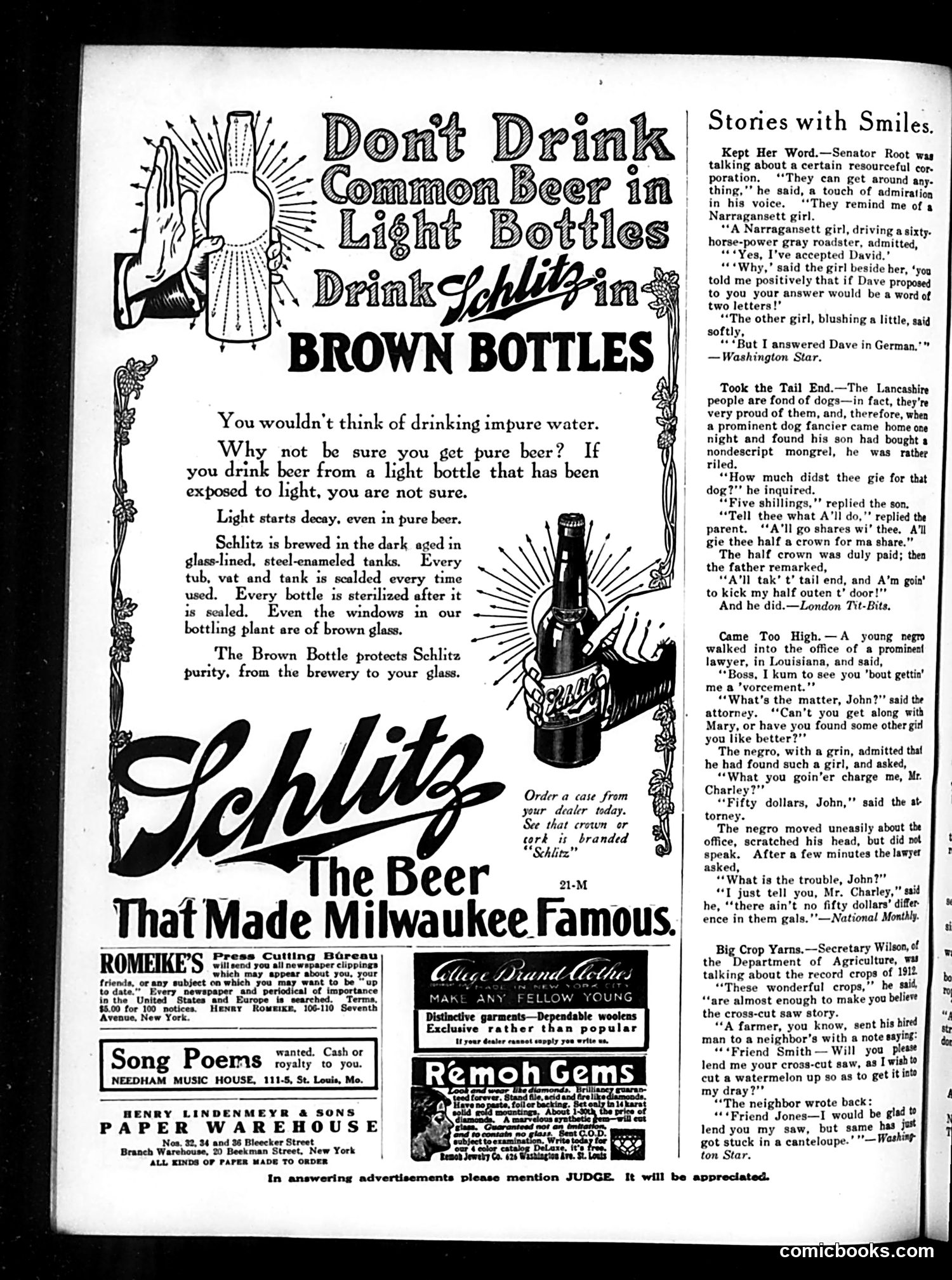
What you’re looking at
This page is dominated by a **beer advertisement** for Schlitz, "The Beer That Made Milwaukee Famous." The ad uses a scientific/purity argument: it warns against drinking beer from light bottles because light causes decay, even in pure beer. Schlitz claims superiority by using **brown bottles** that protect the product from light exposure during storage and delivery. The ad emphasizes manufacturing controls—dark aging tanks, sterilization, even brown windows in the bottling plant—to assure consumers of purity and quality. This reflects early 20th-century marketing that leveraged scientific claims to build brand trust. The page also contains several **humorous anecdotes** in a "Stories with Smiles" column, typical of *Judge* magazine's satirical content, plus classifieds and smaller advertisements.
📄 Transcribed text from this page (OCR, searchable)
Machine-transcribed from the original scan — historical spelling and the odd misread are preserved.
, Donit Drink | Common nee im = Light ottles ‘Drinks gAlFi BROWN BOTTLES You wouldn't think of drinking impure water. Why not be sure you get pure beer? If you drink beer from a light bottle that has been exposed to light, you are not sure. Light starts decay, even in pure beer, Schlitz is brewed in the dark aged in glass-lined, steel-enameled tanks. Every tub, vat and tank is scalded every time used. Every bottle is sterilized after it is sealed. Even the windows in our bottling plant are of brown glass. The Brown Bottle protects Schlitz purity, from the brewery to your glass. Order a case from your dealer today, See that crown or cork is branded “Schlitz” heBeer That Made M ifvauseel Fambus Press Cutting Bareau will send you all newspaper clippings rope is searched. Terms, $8.00 for 100 notices. Henny Roweike, 106-110 Seventh Avenue, New York. wanted. Cash or Song Poems Syalty wo you NEEDHAM MUSIC HOUSE, 111-5, St. Louis, Mo. em Sareea teers | HENRY LINDENMEYR & SONS PAPER WAREHOUSE Nos, 32, 34 and 36 Bleecker Street Branch Warehouse, 20 Beekman Street, New York ALL KINDS OF PAPER MADE TO ORDER In answering advertisements pl: mention JUDGE. It will be appreciated. Stories with Smiles, Kept Her Word.—Senator Root wag talking about a certain resourceful cor. poration. ‘They can get around any- thing," he said, a touch of admiration in his voice. ‘They remind me of a Narragansett girl. “A Narragansett girl, driving a sixty. horse-power gray roadster, admitted, “**Yes, I've accepted David.’ “**Why,’ said the girl beside her, ‘you told me positively that if Dave proposed to you your answer would be a word of two letters!’ “The other girl, blushing a little, said softly, “**But I answered Dave in German,’” —Washington Star. Took the Tail End.—The Lancashire people are fond of dogs—in fact, they're very proud of them, and, therefore, when a prominent dog fancier came home one night and found his son had bought s nondescript mongrel, he was rather riled. “How much didst thee gie for that dog?’ he inquired. “Five shillings,"’ replied the son, “Tell thee what A’ll do,”’ replied the parent. ‘‘A’Il go shares wi’ thee. A’ll gie thee half a crown for ma share.” The half crown was duly paid; then the father remarked, “A'll tak’ t’ tail end, and A’m goin’ to kick my half outen t’ door!"” And he did.—London Tit-Bits. Came Too High.—A_ young negro walked into the office of a prominent lawyer, in Louisiana, and said, “Boss, I kum to see you ‘bout gettin’ me a ’vorcement.’” “‘What’s the matter, John?” said the attorney. ‘‘Can’t you get along with Mary, or have you found some other girl you like better?’” The negro, with a grin, admitted thal he had found such a gi ind asked, “‘What you goin’er charge me, Mr. Charley?” “Fifty dollars, John,”’ said the ab torney. The negro moved uneasily about the office, scratched his head, but did not speak. After a few minutes the lawyer asked, “What is the trouble, John?” just tell you, Mr. Charley,” said he, ‘‘there ain’t no fifty dollars’ differ ence in them gals.’"—National Monthly. Big Crop Yarns,—Secretary Wilson, of the Department of Agriculture, wa talking about the record crops of 1912 “These wonderful crops,”” he said “tare almost enough to make you believe gr a ah F the cross-cut saw story. “A farmer, you know, sent his bird J man to a neighbor’s with a note saying: er «Friend Smith — Will you pless lend me your cross-cut saw, as I wish! cut a watermelon up so as to get it into my dray?”” 1 “The neighbor wrote back: “*Friend Jones—I would be glad lend you my saw, but same has got stuck in a canteloupe- 11 Washing ton Star. comicbooks.com