
A complete issue · 24 pages · 1912
Judge — September 14, 1912
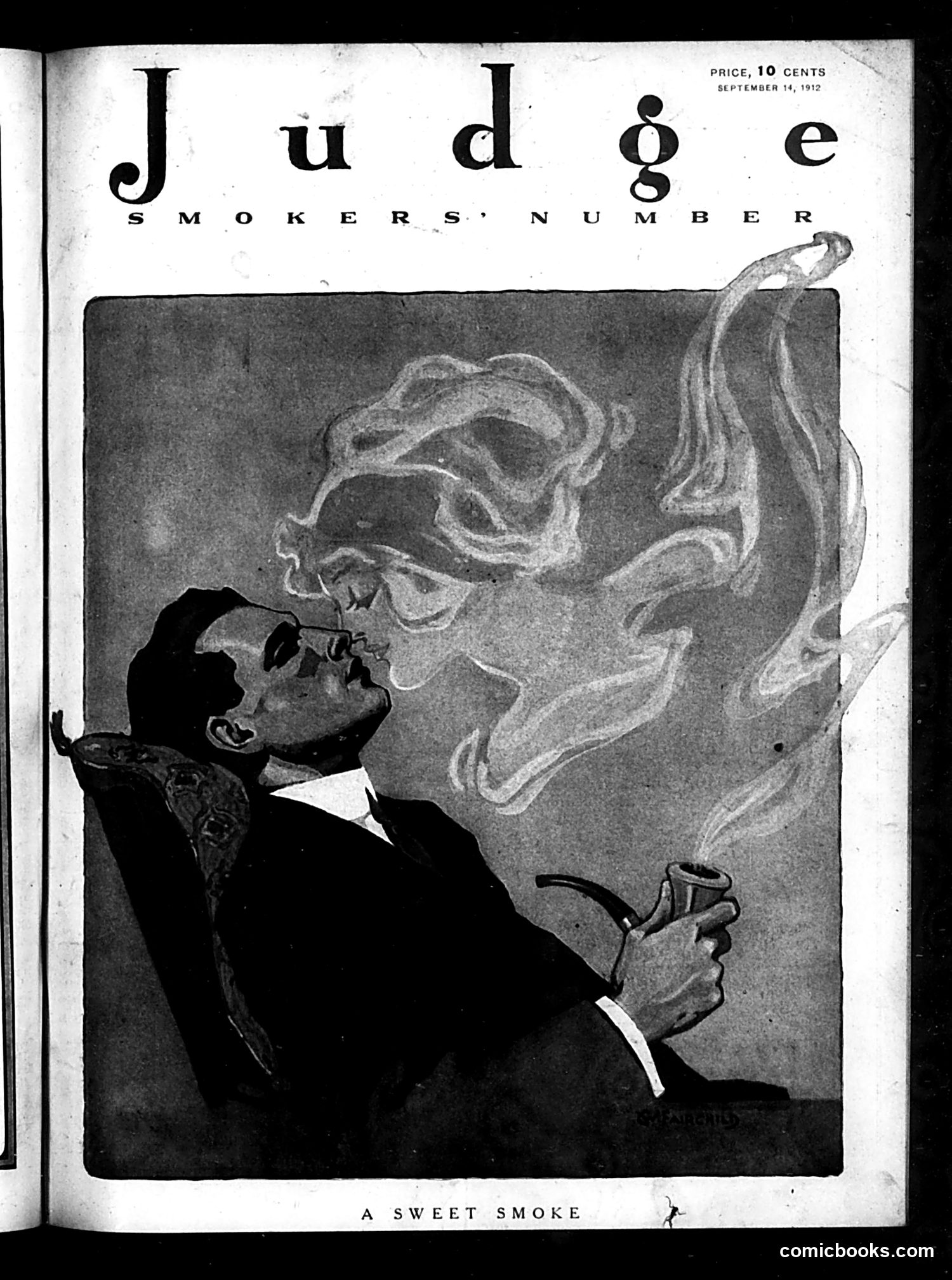
This cover satirizes smoking through an exaggerated caricature of a man in formal dress enjoying a pipe, with elaborate smoke clouds forming decorative swirls above his head. The title "A Sweet Smoke" plays on the pleasures of tobacco consumption. The illustration appears to be a straightforward celebration of smoking rather than political satire—likely appealing to Judge's male, upper-class readership during an era when smoking was socially prestigious and uncontroversial. The 1912 date predates widespread anti-smoking campaigns. The artistic style emphasizes refinement and leisure, presenting cigar/pipe smoking as a sophisticated gentleman's pleasure. No specific political figures or events appear to be referenced here—this is primarily lifestyle commentary typical of early 20th-century magazine cover art.
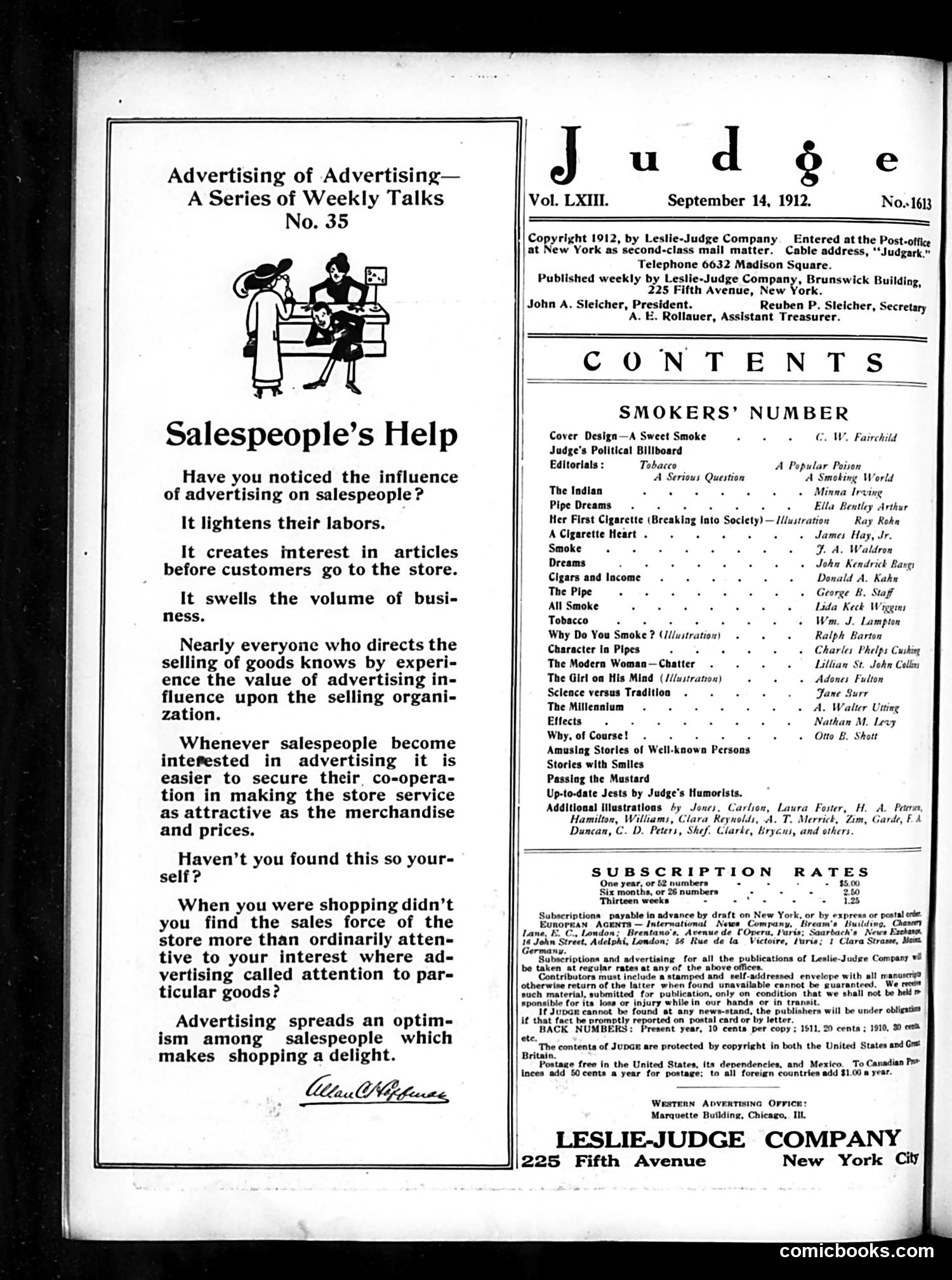
This page is primarily **advertising and editorial content** rather than political satire. The left side features "Salespeople's Help," an article arguing that advertising influences shoppers and improves salespeople's morale—a straightforward business argument for the era. The right side shows this is a "Smokers' Number" special issue, with a contents list featuring articles about smoking, cigars, and pipes (titles like "The Indian Pipe Dreams" and "A Cigarette Heart"). The cover design reference mentions "A Sweet Smoke." The magazine's masthead indicates this is Vol. LXIII from September 1912. The page lacks significant political cartoons or satirical commentary—it's primarily **commercial and lifestyle-focused content** typical of early 20th-century humor magazines.
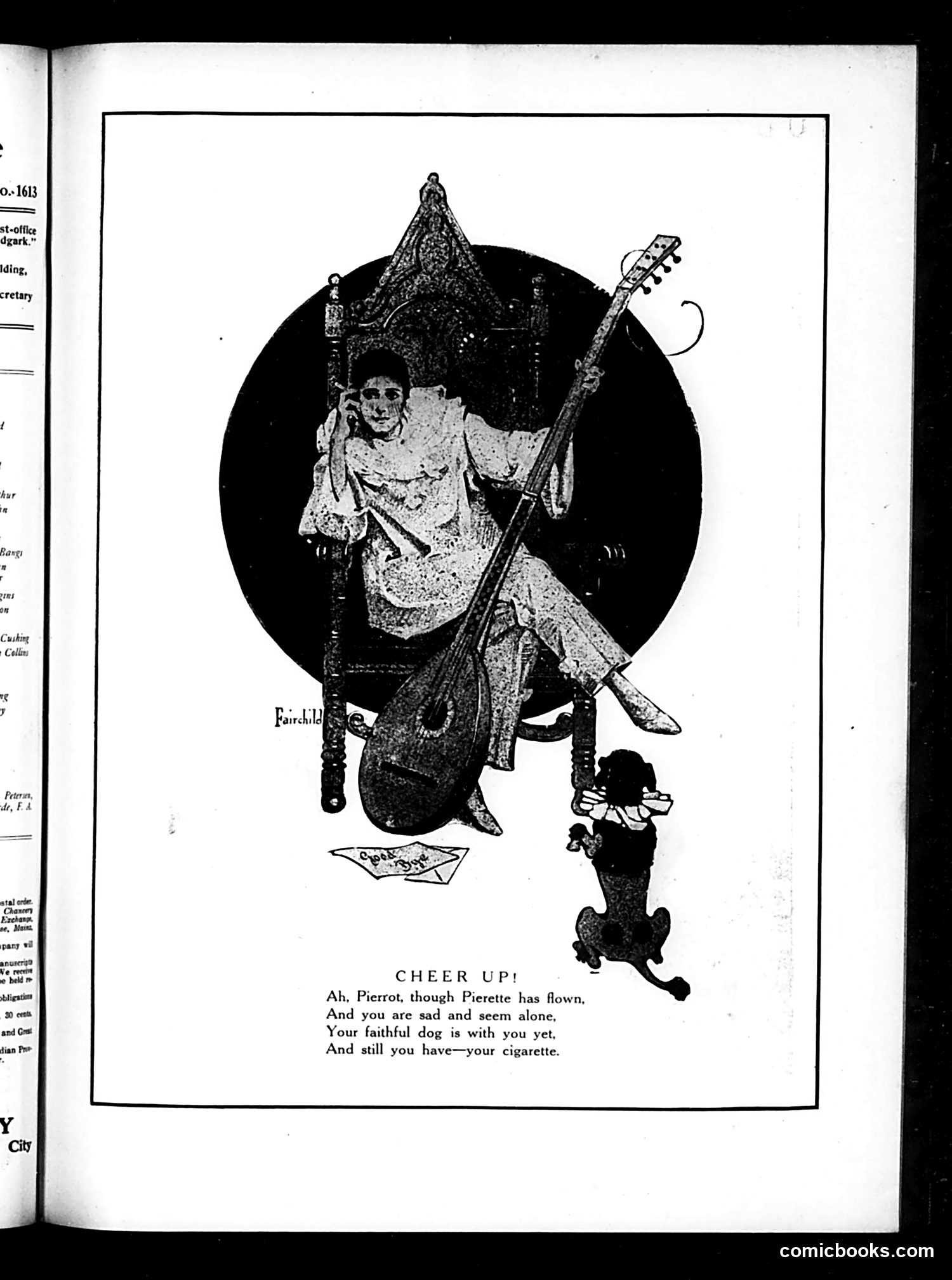
This illustration depicts a **Pierrot** (the sad clown character from commedia dell'arte tradition), identifiable by his spotted costume and pointed hat. He holds a large stringed instrument—likely a lute or similar period piece—and sits with a small dog beside him. The accompanying verse reads: "Ah, Pierrot, though Pierette has flown, / And you are sad and seem alone, / Your faithful dog is with you yet, / And still you have—your cigarette." The satire appears to mock **romantic disappointment** while celebrating the consolations of loyal companionship and tobacco. It's a lighthearted commentary on finding comfort in life's simple pleasures during emotional hardship—typical of Judge magazine's witty, somewhat cynical humor aimed at adult readers.
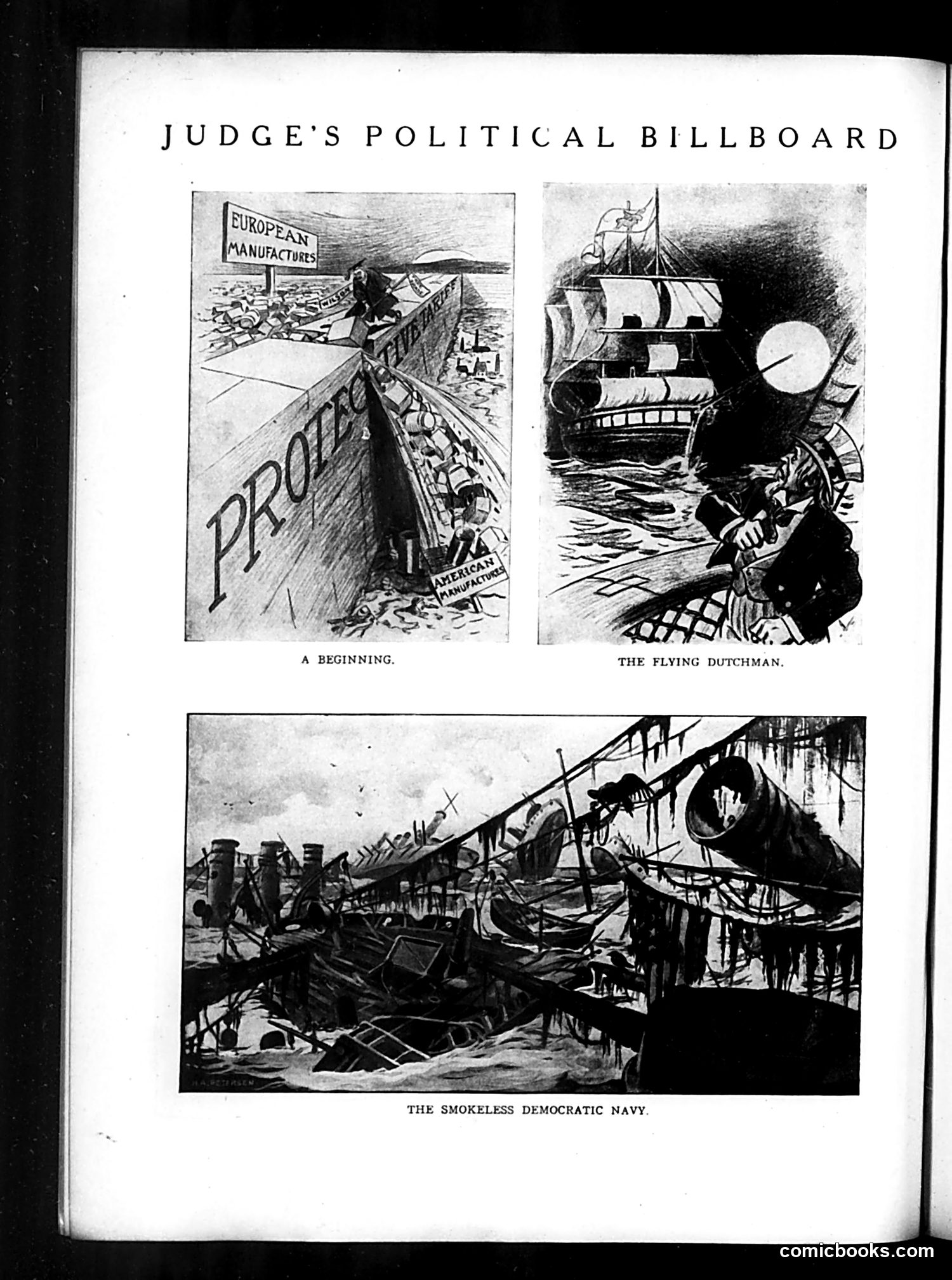
This page presents three anti-Democratic satirical cartoons from Judge magazine: **"A Beginning"** depicts a figure labeled "Prohibition" being thrown overboard from a ship marked "American Manufactures," with "European Manufactures" visible in the background—likely criticizing Democrats for abandoning protective tariff policies. **"The Flying Dutchman"** shows a ghostly ship, referencing the legendary cursed vessel. This appears to mock Democratic naval or defense policies as insubstantial or doomed. **"The Smokeless Democratic Navy"** illustrates a destroyed, wreckage-filled harbor scene, sarcastically mocking what the cartoonist views as a weakened Democratic military capability or failed naval strategy. The cartoons collectively attack Democratic economic and defense policies through maritime imagery, suggesting incompetence or abandonment of American interests.
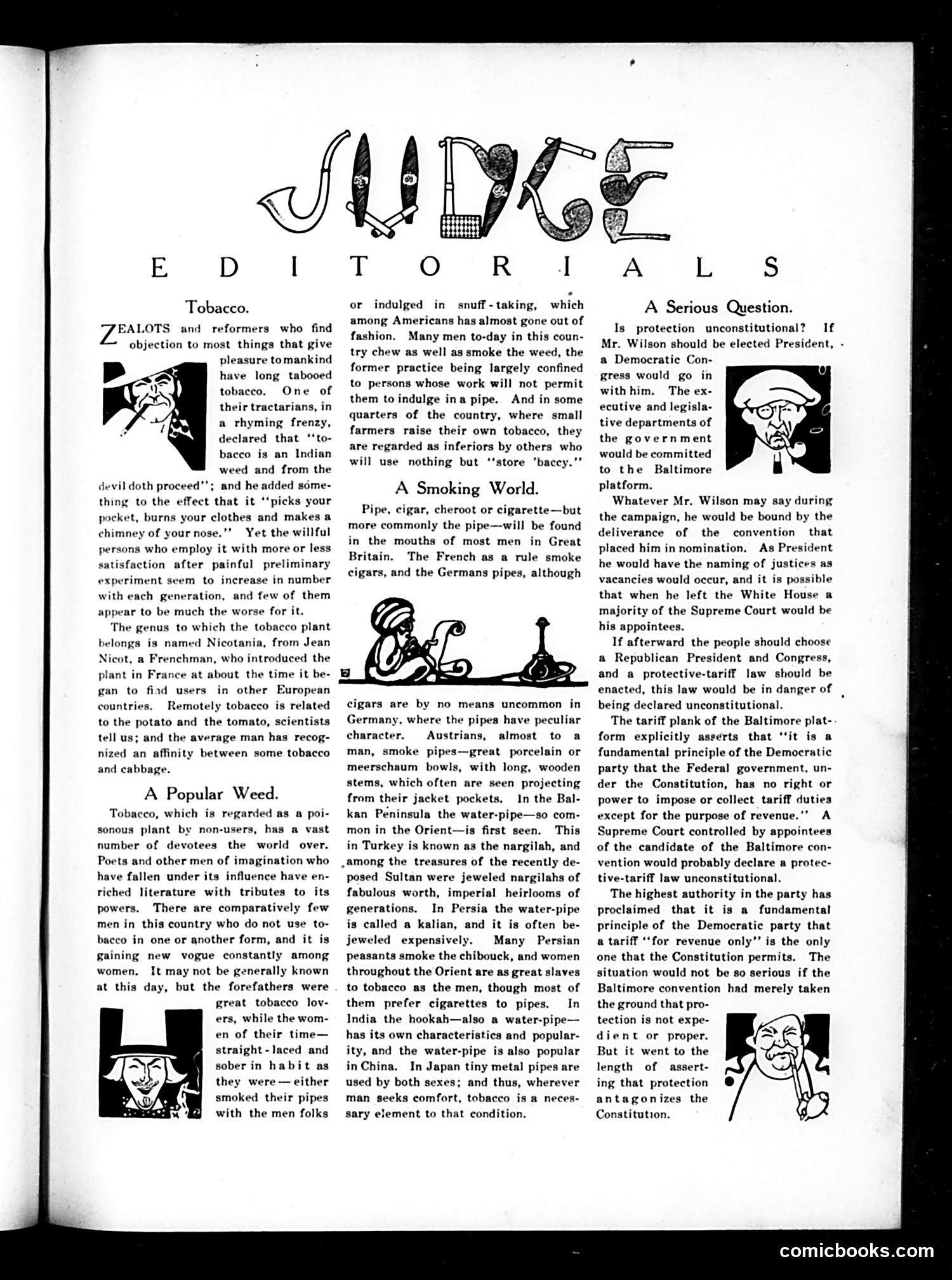
This **Judge** magazine page satirizes tobacco use through three illustrated sections ("Tobacco," "A Popular Weed," and "A Smoking World"). The cartoons feature caricatured faces—some with exaggerated features typical of period satirical art—apparently representing tobacco users or advocates. The text discusses tobacco's prevalence among Americans, Europeans, and various cultures, noting its use in pipes, cigars, and cigarettes. It also includes a section titled "A Serious Question" discussing whether Mr. Wilson (likely President Woodrow Wilson) should be elected, with concerns about Democratic policies and constitutional protections. The satirical angle appears to be mocking both widespread tobacco consumption and political debates of the era, using grotesque facial caricatures to emphasize the perceived absurdity of both subjects.
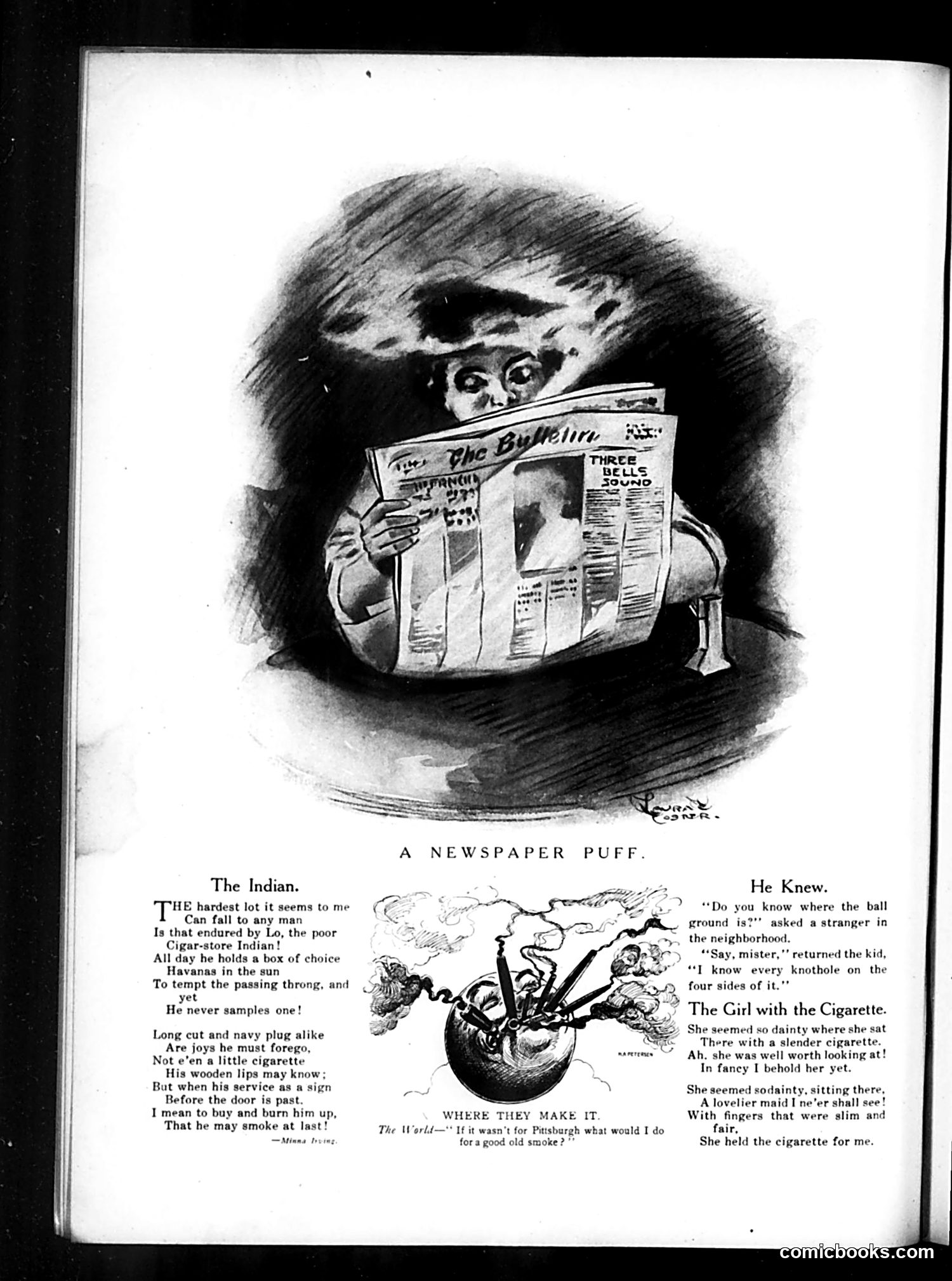
This page satirizes tobacco advertising and consumption through three pieces: **"The Indian"** mocks the cigar-store Indian—a wooden statue used as storefront advertising for tobacconists. The poem's irony: this figure exists solely to promote cigars yet cannot smoke them. The joke plays on "Lo" (a generic term for Native Americans) and the absurdity of the statue's eternal, unfulfilled purpose. **"Where They Make It"** appears to be a brief advertisement or notice, likely referencing Pittsburgh's industrial prominence in tobacco manufacturing. **"The Girl with the Cigarette"** romanticizes a woman smoking, treating it as an elegant, desirable sight—reflecting early 20th-century attitudes when women's smoking was becoming fashionable but still somewhat scandalous. The narrator's admiration emphasizes the cigarette as accessory to feminine appeal. The page's overall title, "A Newspaper Puff," is a pun: a "puff" means both promotional advertising and the act of smoking. These pieces collectively critique how tobacco is marketed through imagery and social aspiration.
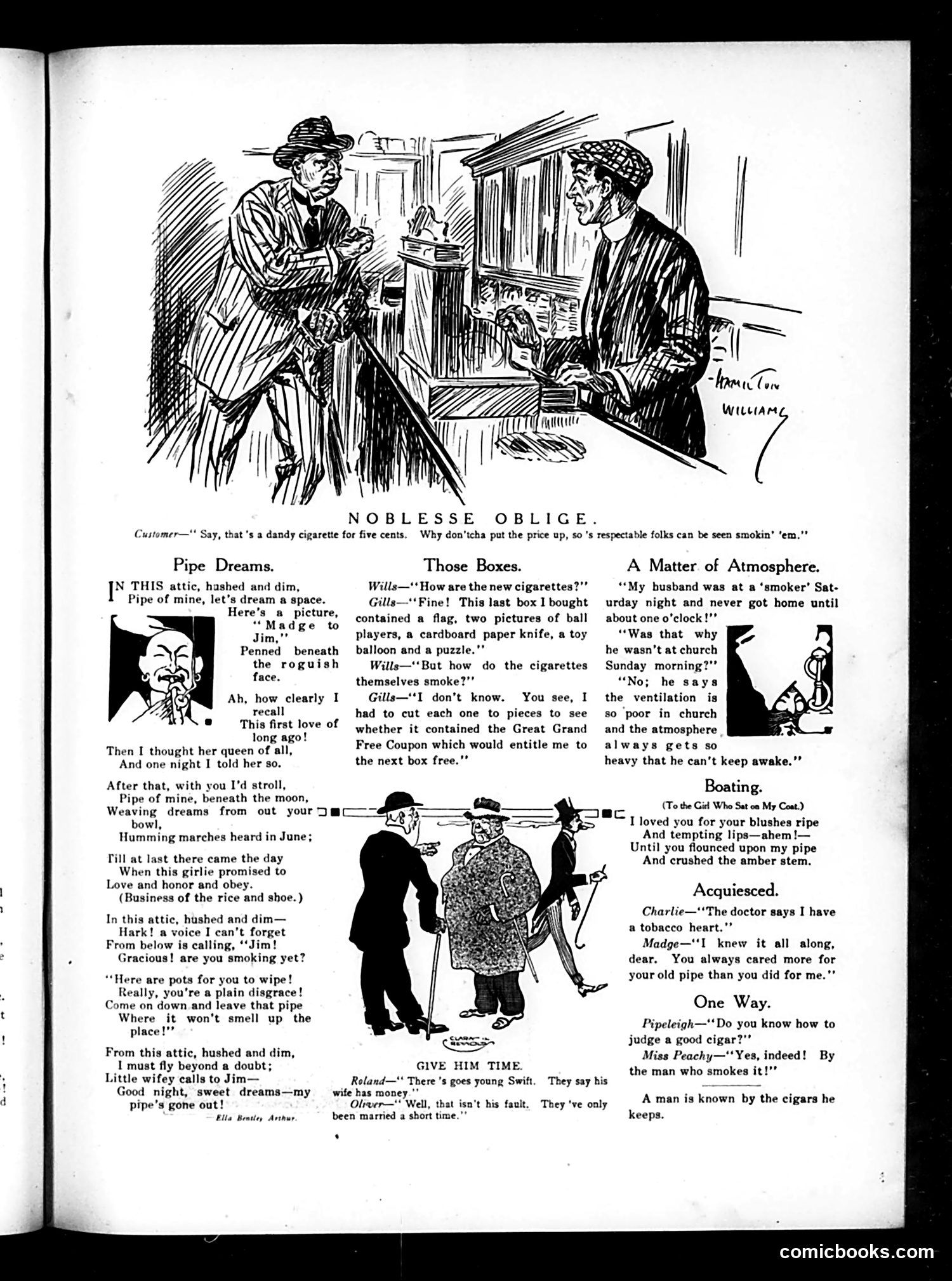
This page from the satirical magazine *Judge* contains multiple humorous pieces centered on smoking—a major cultural preoccupation of the era. **Top cartoon:** "Noblesse Oblige" depicts a customer suggesting cigarette prices be raised so "respectable folks" can be seen smoking them—satirizing class anxieties about mass-market products and social respectability. **"Pipe Dreams"** is a sentimental poem about a man reminiscing over his pipe about lost love, interrupted by his wife calling him downstairs—mocking romantic nostalgia. **"Those Boxes"** jokes about cigarette premiums (flags, pictures, toys, coupons) that smokers valued more than the actual cigarettes themselves—critiquing consumer marketing tactics. **Other sketches** humorously present tobacco use as central to male identity and relationships: wives complaining about smoking husbands, a woman crushing a man's pipe stem, and observations that "a man is known by the cigars he keeps." The overall tone satirizes both smoking culture's prevalence and the era's gender dynamics around domestic life.
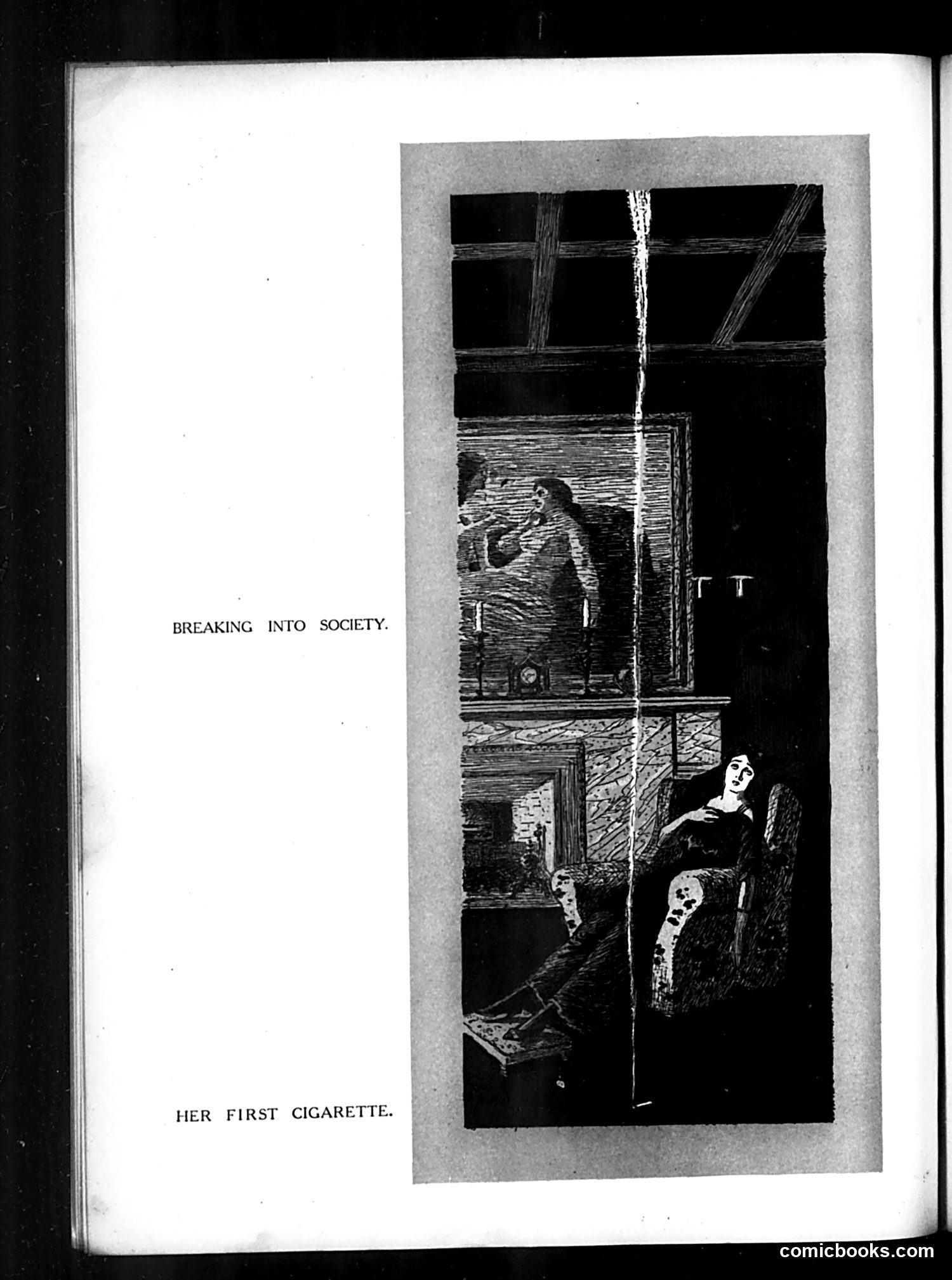
This satirical cartoon critiques the social rebellion of young women, likely from the early 20th century. The image shows a woman smoking a cigarette—depicted as a shocking transgression titled "Her First Cigarette" and "Breaking into Society." The cartoon's point is ironic: what society considers a woman's proper "debut" or entry into respectable circles is instead represented as her brazenly violating social norms by smoking. The figure visible through the window above appears to be a scandalized observer, emphasizing that this behavior was seen as improper or immoral for women of the era. The satire targets both changing female behavior and rigid social conventions that deemed such independence unseemly. Smoking was associated with loose morality and masculinity, making it a potent symbol of women's defiance of Victorian propriety.
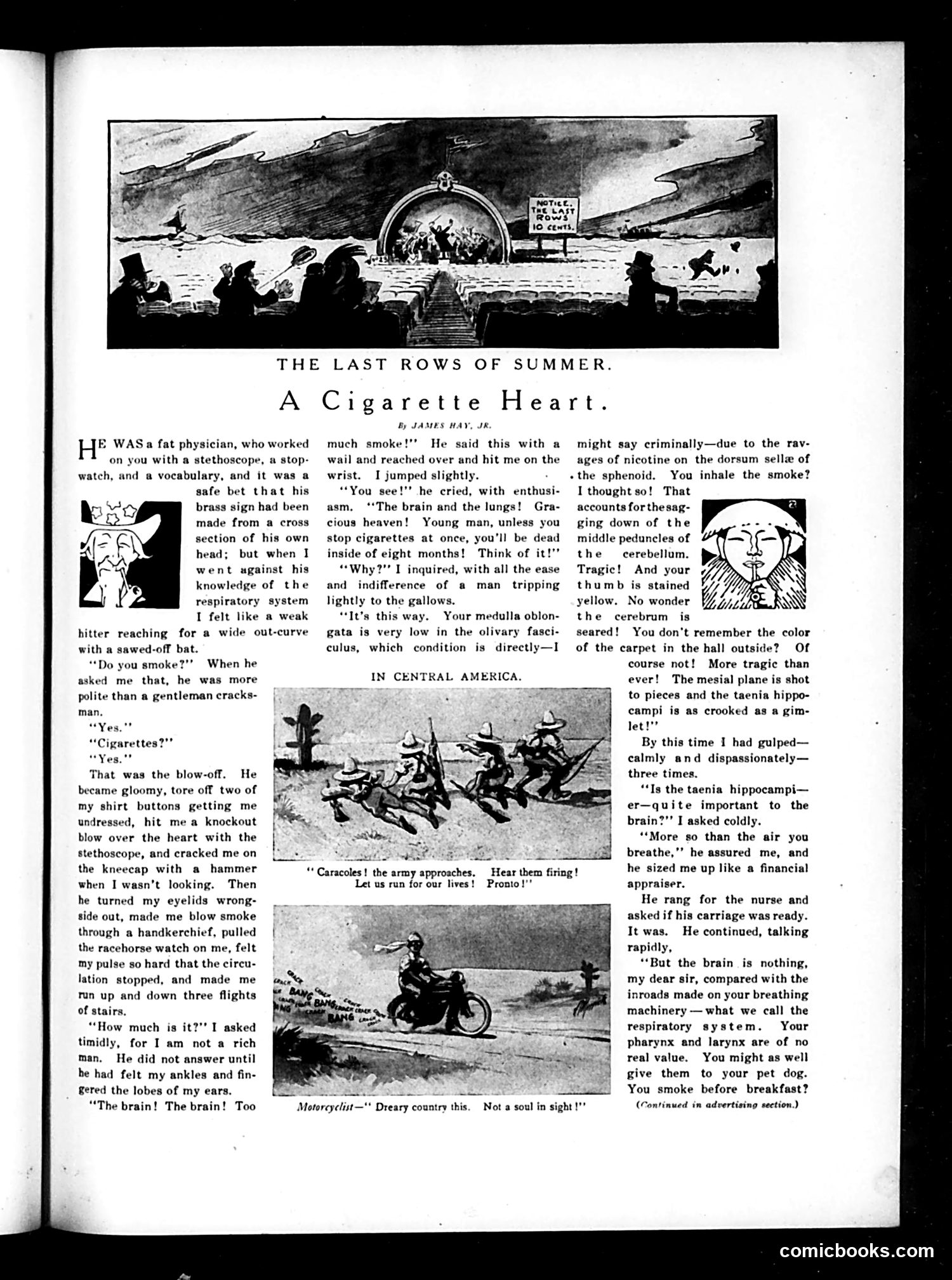
This is a humorous story by James Hay Jr. mocking both pompous physicians and anti-smoking hysteria. A fat doctor delivers an absurdly overwrought diagnosis to a patient who admits smoking cigarettes, invoking pseudo-scientific medical terminology ("medulla oblongata," "taenia hippocampi") to claim cigarettes will kill him within eight months. The satire targets the doctor's pretentious bluffing—he physically abuses the patient during examination, makes vague medical pronouncements, and ultimately cares only about payment. The narrator's deadpan responses ("with all the ease and indifference of a man tripping lightly to the gallows") highlight the doctor's theatrical panic over smoking versus actual medical concern. The page includes unrelated cartoons about Central America and a motorcyclist, typical of Judge's mixed-content format. The satire reflects early 20th-century skepticism toward medical alarmism about cigarettes.
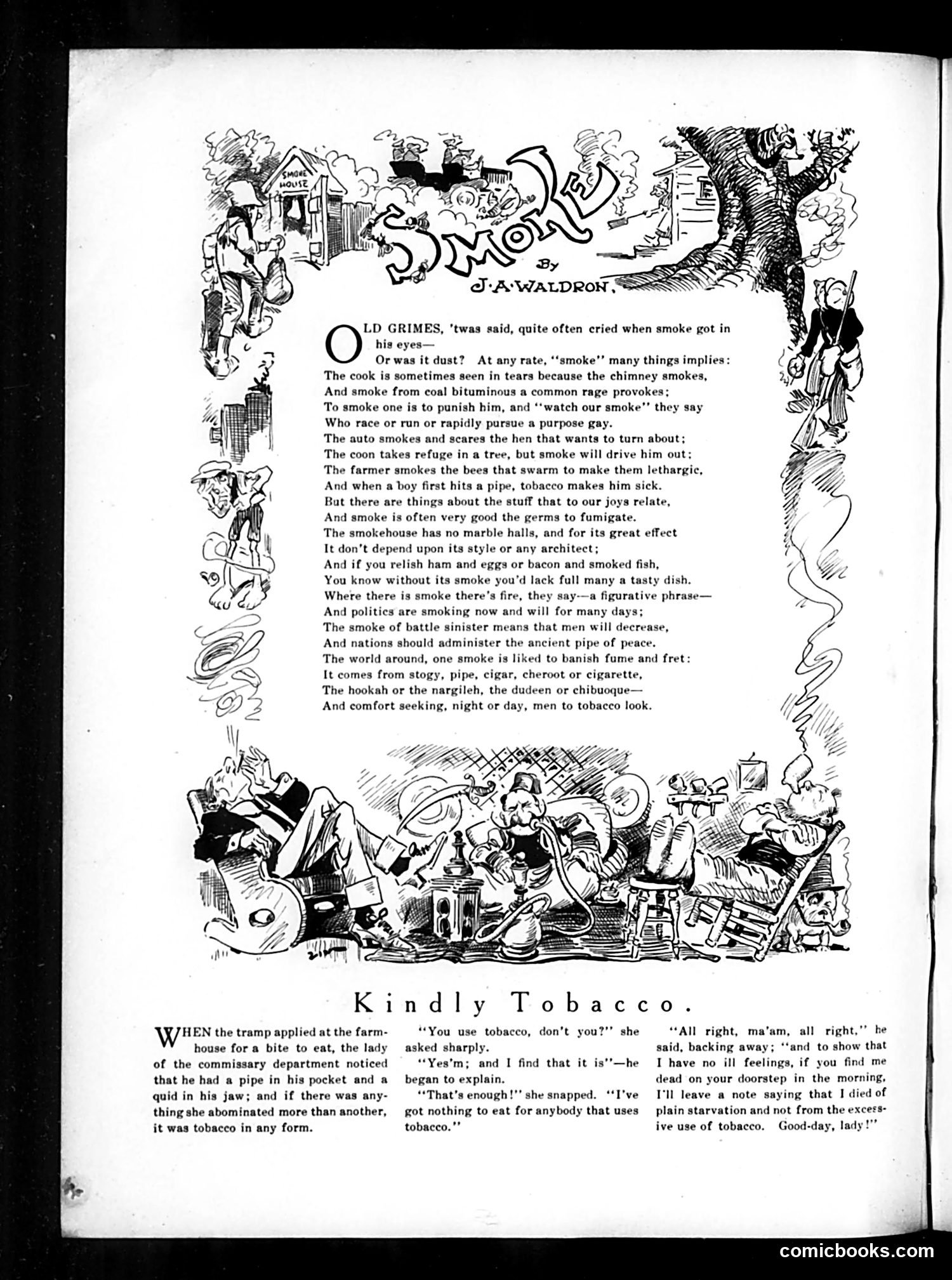
This page presents a dual satire on tobacco use. The upper poem by S.A. Waldron defends smoking as beneficial and harmless—listing practical uses (fumigating bees, preserving food) and philosophical ones (promoting peace, providing comfort). It's written as earnest advocacy. The lower cartoon undermines this. A vagrant asks a farm lady for food. She refuses because he uses tobacco, viewing it as morally corrupting. He politely accepts, then sarcastically promises to die on her doorstep and leave a note blaming "plain starvation" rather than tobacco excess. The satire targets anti-tobacco crusaders of the era—portrayed as hypocritically cruel and self-righteous. The vagrant's gentle sarcasm exposes the absurdity: the lady's moral stance literally threatens his survival. The cartoon mocks the temperance-era moralizing against tobacco by showing its advocates as unreasonable and unkind, suggesting such purity movements cause more harm than the vice they oppose.
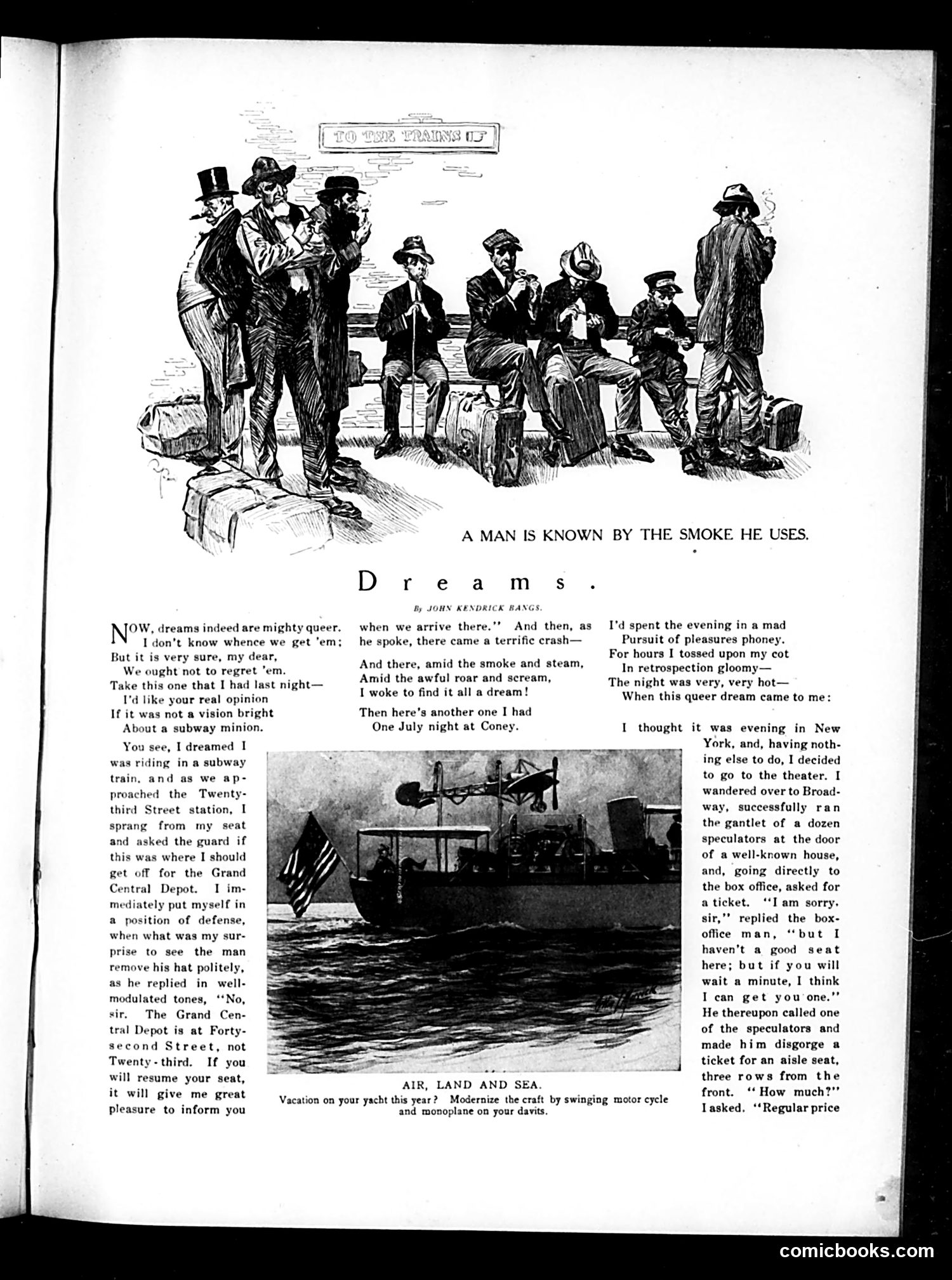
This humorous essay uses dream sequences to satirize **urban rudeness and commercial dishonesty** in early 20th-century America. The first dream mocks **NYC subway culture**: the narrator expects a rude guard but instead receives polite, helpful directions—treated as so absurd it must be a dream, suggesting New York transit workers were notoriously impolite in reality. The second dream (illustrated with a steamship image) critiques **theater ticket scalping**. The narrator goes to buy a legitimate ticket but the box office clerk shamefully admits he has no good seats—then cynically calls over a *scalper* to provide one at "regular price." This exposes the collusion between theaters and speculators who bought tickets to resell them. The headline "A MAN IS KNOWN BY THE SMOKE HE USES" (likely a tobacco advertisement) frames these satirical glimpses of everyday dishonesty, suggesting character is revealed through choices—here, through society's tolerance of fraud.
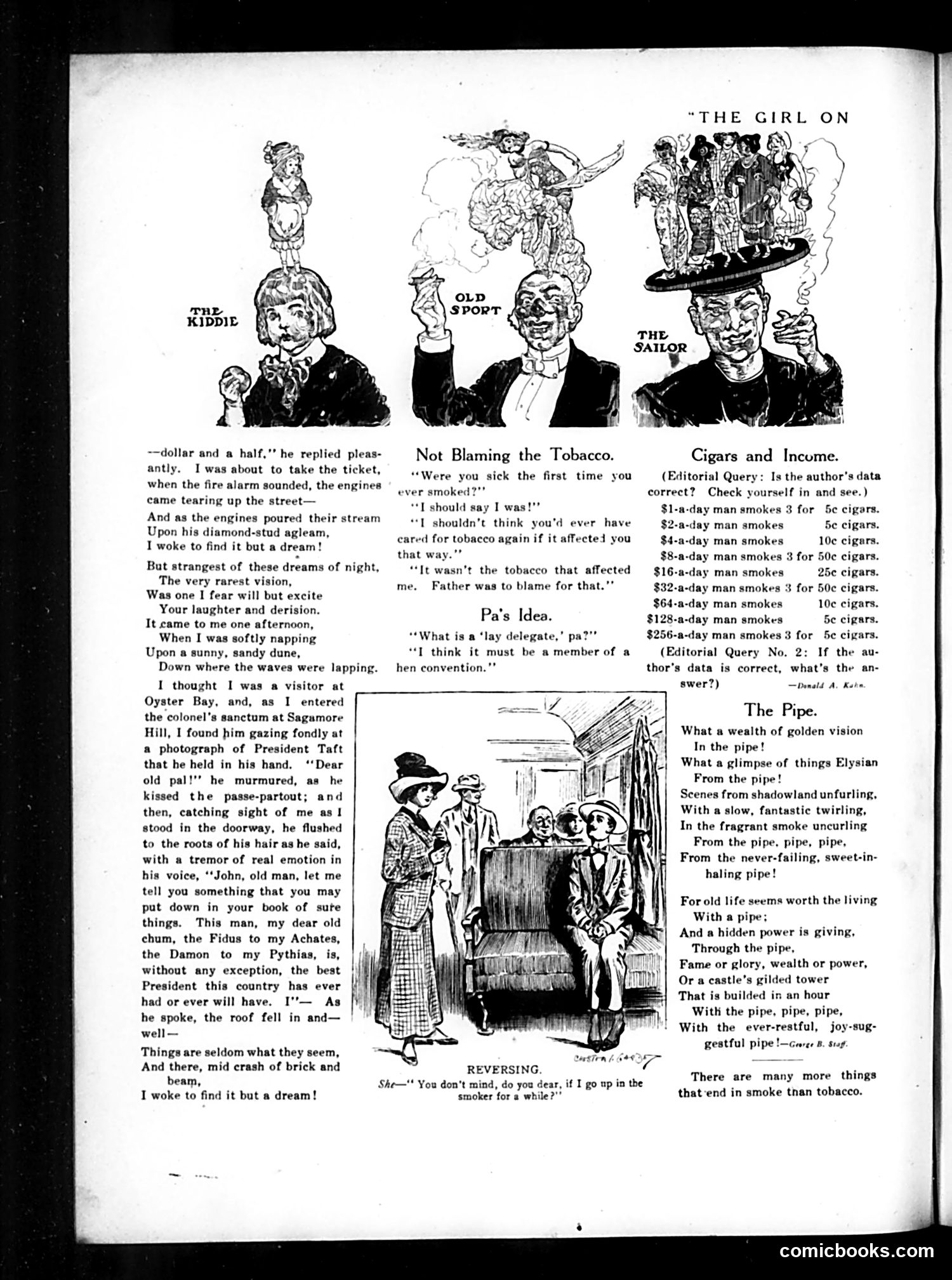
This page contains multiple satirical pieces targeting early 20th-century American life: **"The Riddle," "Old Sport," and "The Girl on the Sailor"** are brief character sketches with dream-narrative framing, appearing to mock various social types through exaggerated caricature. **"Not Blaming the Tobacco"** and **"Pa's Idea"** are joke columns. The first implies a father's poor parenting caused a child's tobacco sickness (not the tobacco itself). The second plays on misunderstanding "lay delegate" as a poultry convention member. **"Cigars and Income"** is editorial satire questioning whether cigar consumption actually correlates with income as claimed—a commentary on class consumption habits and/or financial irresponsibility. **"Reversing"** depicts a woman asking permission to enter the men's smoking car, satirizing gender norms of smoking segregation. **"The Pipe"** is romantic verse celebrating pipe-smoking, typical of the era's tobacco advertising disguised as literature. The final line—"There are many more things that end in smoke than tobacco"—provides cynical editorial commentary, likely critiquing wasted money, broken dreams, or failed plans.
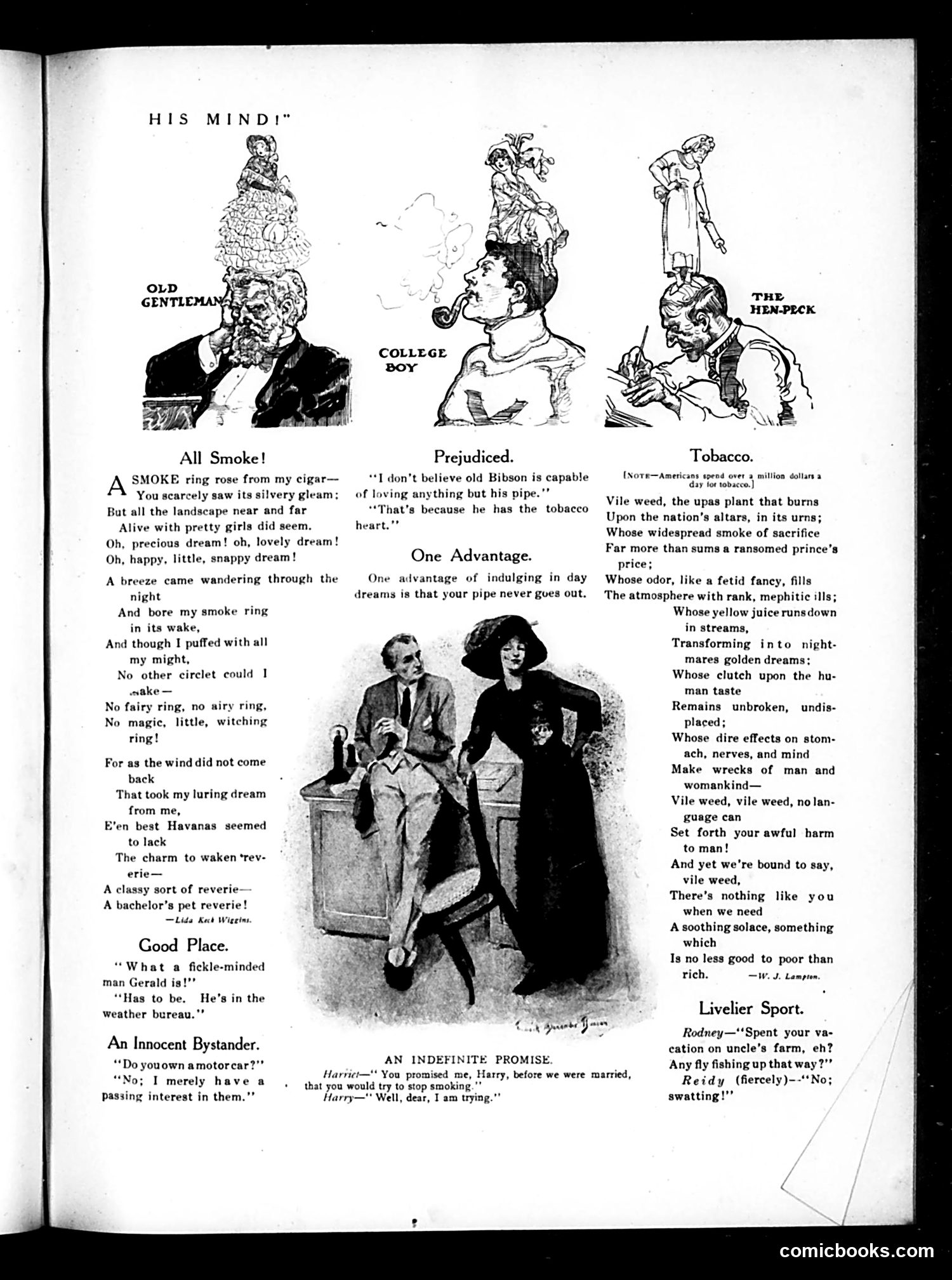
This satirical page attacks smoking through multiple vignettes and poetry, reflecting early-20th-century anti-tobacco sentiment. The three caricatured heads at top represent archetypal smokers: an old gentleman, college boy, and fashionable woman—mocked for their pipe, cigarette, and tobacco habits respectively. The jokes mock smokers' self-deception: a bachelor romanticizes smoke rings while ignoring their emptiness; a husband promises his wife he's "trying" to quit while clearly continuing; a man obsesses over his pipe as his sole passion. W.J. Lampton's lengthy poem frames tobacco as a "vile weed" causing physical and moral harm, yet paradoxically admits its comfort—capturing the era's conflicted view of smoking as simultaneously seductive and destructive. The final joke about "fly swatting" on a farm is unrelated humor filler. Overall, the page reflects Progressive-Era concerns about tobacco's grip on Americans (noted spending over 2 million dollars daily), presenting smoking as weakness and delusion rather than manly virtue.
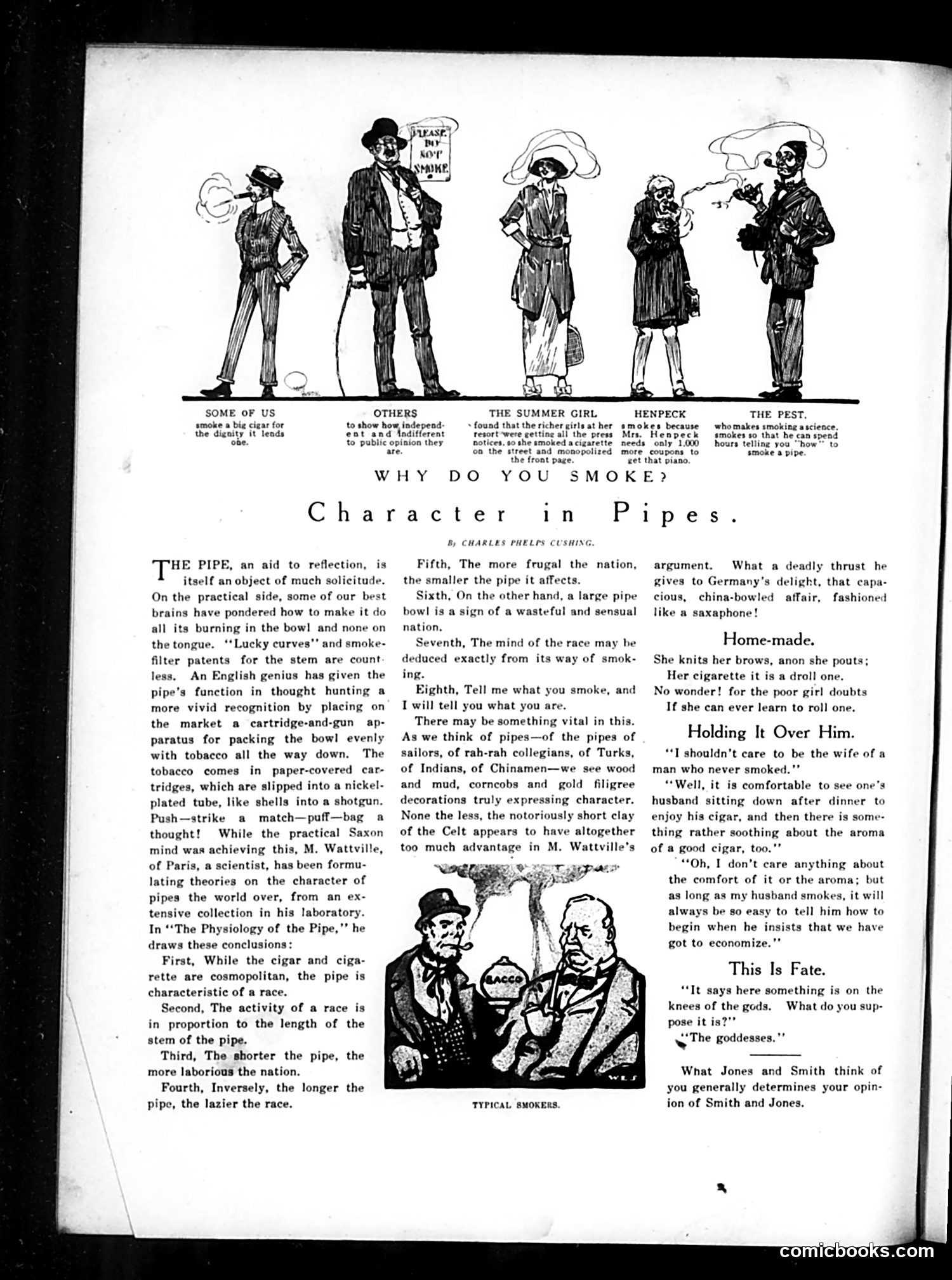
This 1910s Judge magazine piece satirizes both pseudo-scientific racism and gender stereotypes through smoking habits. The five illustrated figures at top represent social archetypes: "Some of Us" smoke cigars for dignity; "Others" do it to appear independent; "The Summer Girl" smokes cigarettes for publicity; "Henpeck" (a hen-pecked husband) smokes to earn piano coupons; and "The Pest" smokes to irritate others. The main article parodies a French scientist (M. Wattville) who claims pipe *length* and *bowl size* reveal national character and industriousness—shorter pipes = harder-working races, larger bowls = wasteful nations. This mock-scientific approach reflects period racial hierarchies. The sidebars mock women's smoking: the "Home-made" woman struggles to roll cigarettes; "Holding It Over Him" shows wives using husbands' smoking as leverage for household control. The humor targets both pretentious pseudo-science and changing gender roles around the still-novel phenomenon of women smoking publicly.
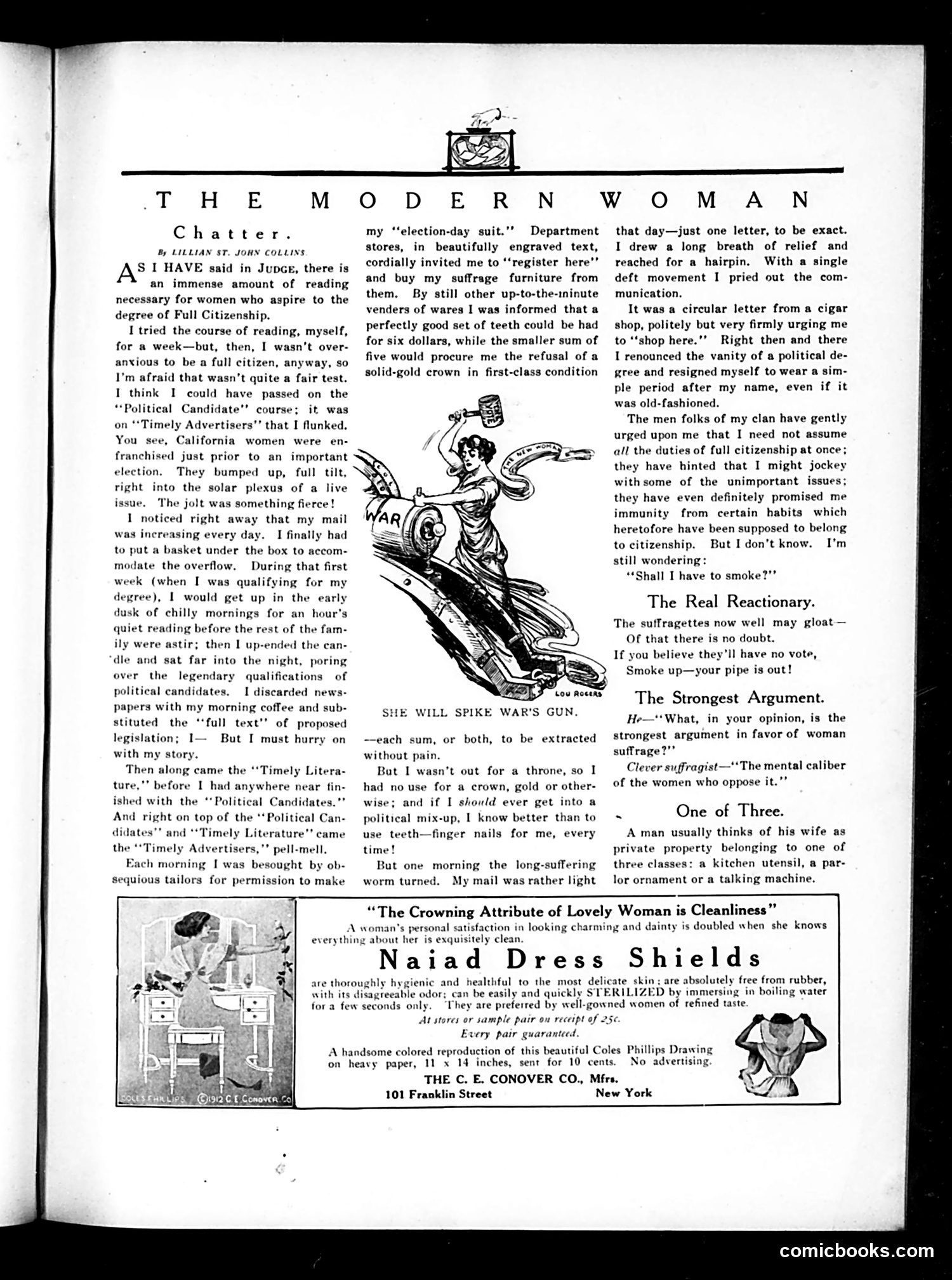
This page satirizes the newly enfranchised woman voter in early 20th-century America (California granted women's suffrage in 1911). The main article, "Chatter" by Lillian St. John Collins, mocks women's supposed need to educate themselves for citizenship through reading about "Political Candidates," "Timely Advertisers," and legislation. The author describes the overwhelming mail she received after registering to vote—merchants and vendors bombarding her with advertisements for "suffrage furniture," teeth, and other goods. The humor targets both the commercialization of women's voting rights and the implication that women voters were unprepared consumers easily manipulated by advertisers. The cartoon showing a woman on what appears to be a war machine labeled "War" alongside text "She Will Spike War's Gun" suggests satirical commentary on suffragists' claims about women's political power. The page mocks the idea that voting women would immediately transform society or stop wars, while simultaneously ridiculing the avalanche of commercial exploitation following enfranchisement.
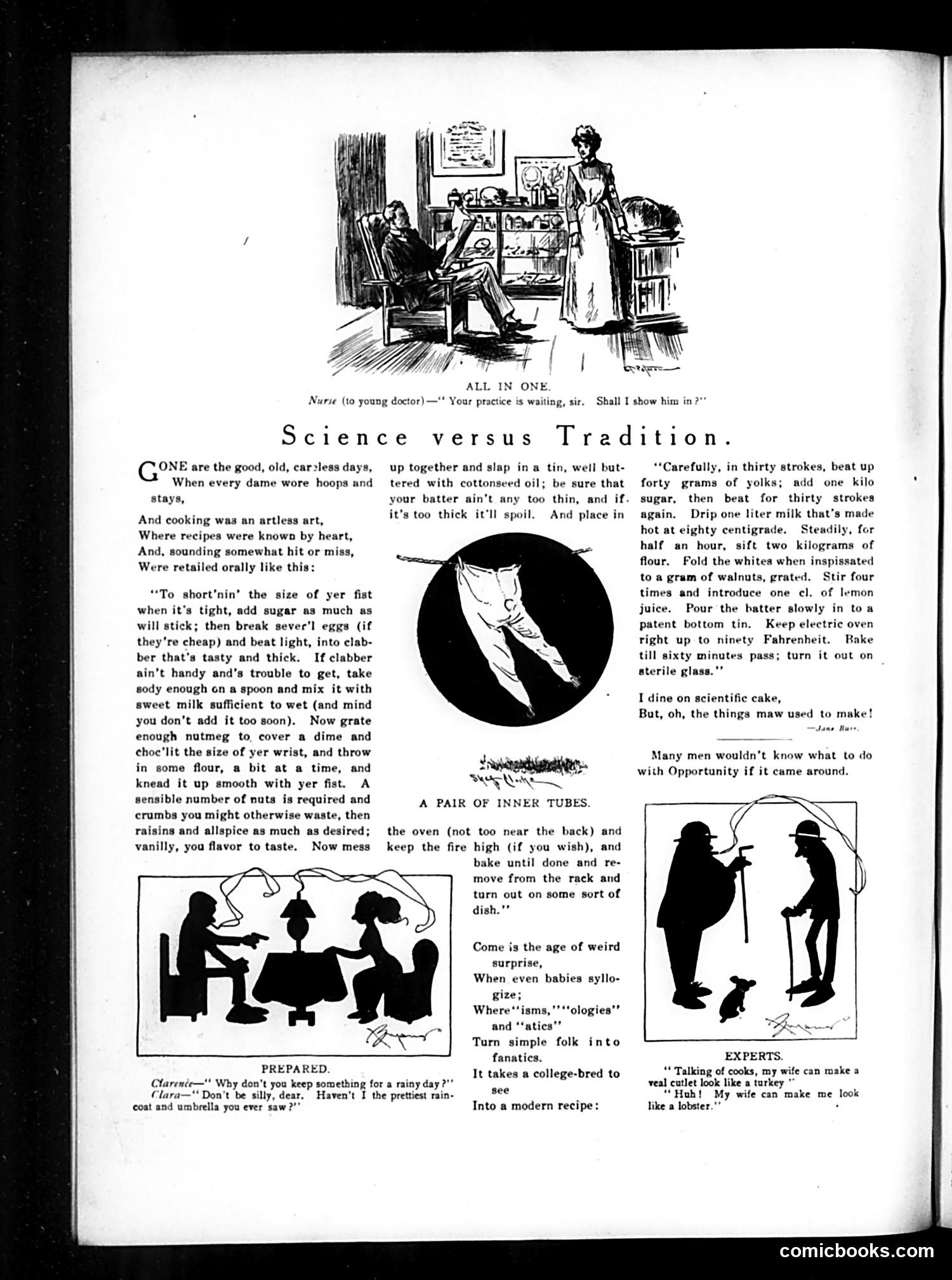
This page satirizes the clash between old-fashioned, intuitive cooking methods and modern "scientific" approaches. The left column presents traditional recipe language—vague measurements like "size of yer fist" and "choc'lit the size of yer wrist"—spoken in dialect, emphasizing how recipes were memorized and passed orally among ordinary people. The right column mocks contemporary "scientific" cooking with absurdly precise, jargon-heavy instructions using metric measurements, temperatures in centigrade, and technical terms like "inspissated" (thickened). A poem muses that this modern age turns "simple folk into fanatics" through excessive specialization. The cartoons show domestic life: a nurse announcing a young doctor's patients; a couple discussing rainy-day preparedness; two men discussing their wives' cooking abilities. The satire targets educated pretension—how the professional class uses complicated language and "scientific" methods to mystify ordinary tasks, making cooking unnecessarily complex. The repeated joke is that modern expertise often obscures rather than improves everyday knowledge.
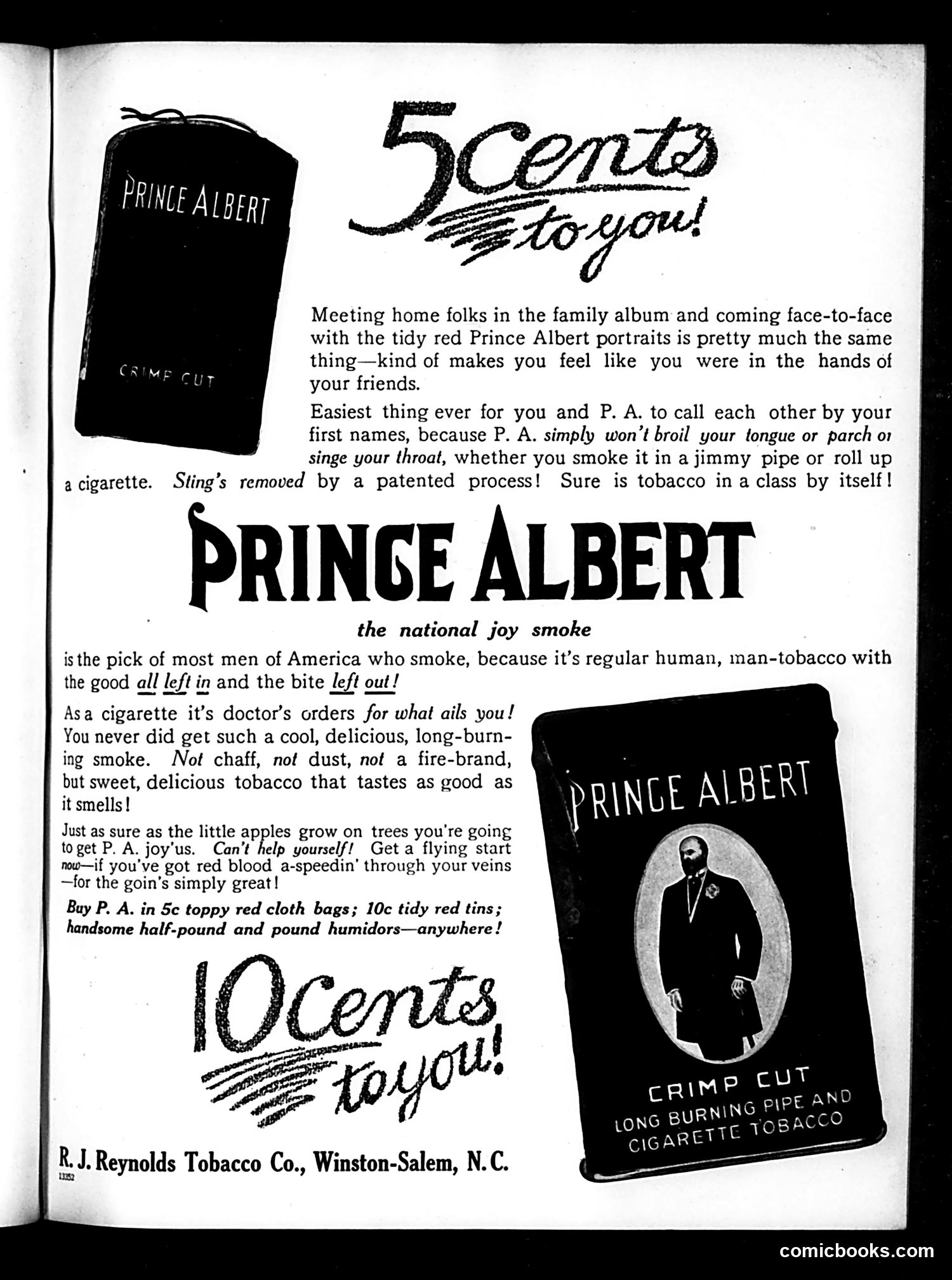
This is a **tobacco advertisement**, not political satire. It promotes Prince Albert brand tobacco, manufactured by R.J. Reynolds. The ad uses a portrait of Prince Albert (the historical figure, Queen Victoria's husband) as a brand mascot and endorsement device. The copy emphasizes that smoking P.A. tobacco won't irritate the throat—claiming a "patented process" removes the "sting." It appeals to masculine identity ("red blood"), affordability (5-10 cents), and social connection ("call each other by your first names"). The language is deliberately folksy and casual ("the goin's simply great!"), marketing smoking as a friendly, health-conscious choice ("doctor's orders"). This reflects early 20th-century advertising before tobacco's health dangers were widely acknowledged. The page is primarily commercial promotion rather than satirical commentary.
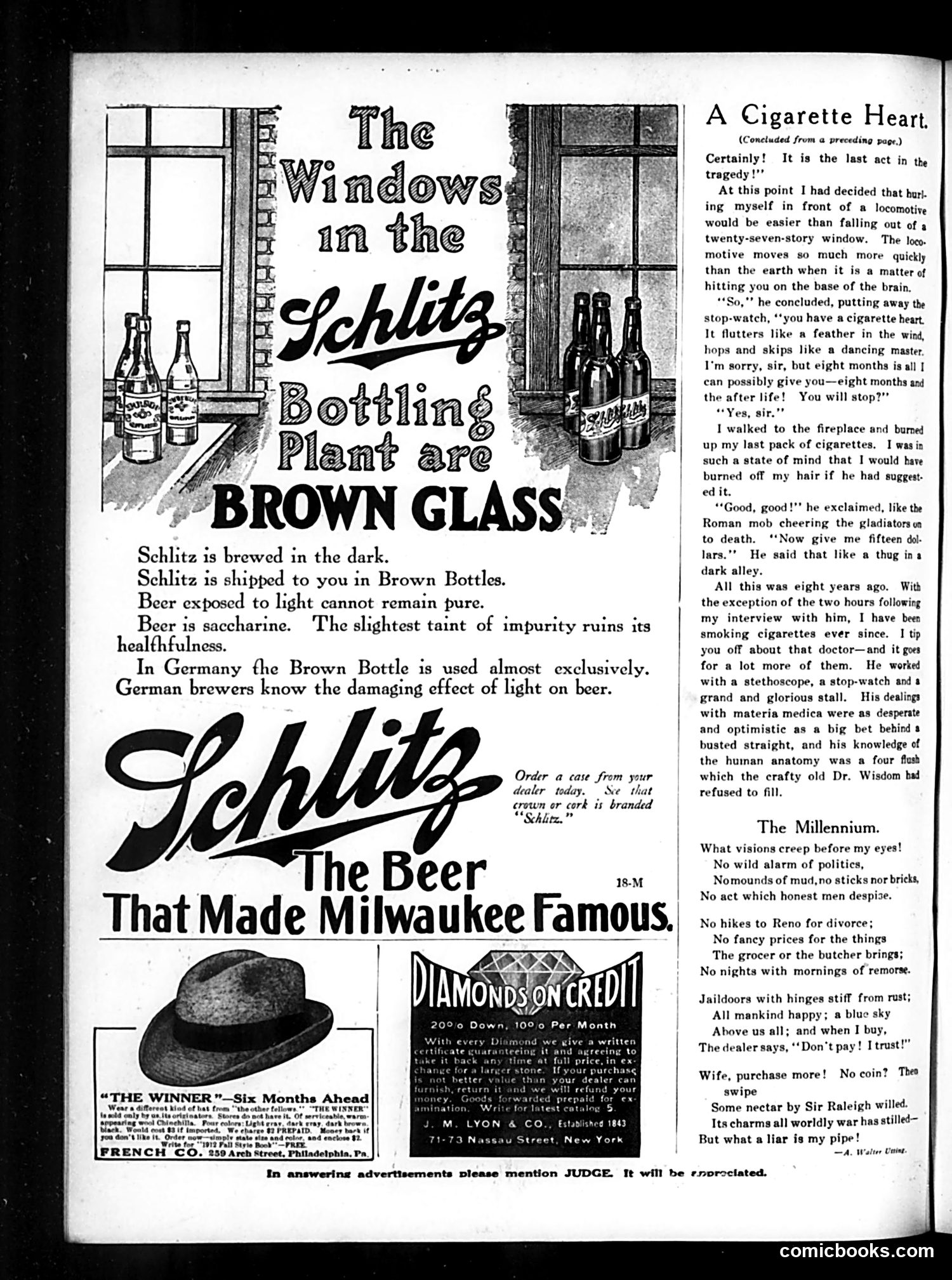
This page contains primarily **advertisements** rather than editorial satire. The dominant content is a Schlitz beer ad emphasizing that brown glass bottles protect beer from light damage—a legitimate brewing concern of the era. The ad references German brewing practices to establish credibility. The right column features a serialized fiction piece titled "A Cigarette Heart," a morality tale about a man warned by a doctor that smoking will kill him within eight months. The narrator ignores this advice and continues smoking for years, suggesting the story critiques both quack medical diagnoses and smokers' denial. Below that is a poem called "The Millennium" offering utopian social commentary—imagining a future without political corruption, poverty, or divorce—before ending with self-deprecating humor about pipe smoking. The page also advertises diamond jewelry and a hat, typical of Judge's commercial revenue model.
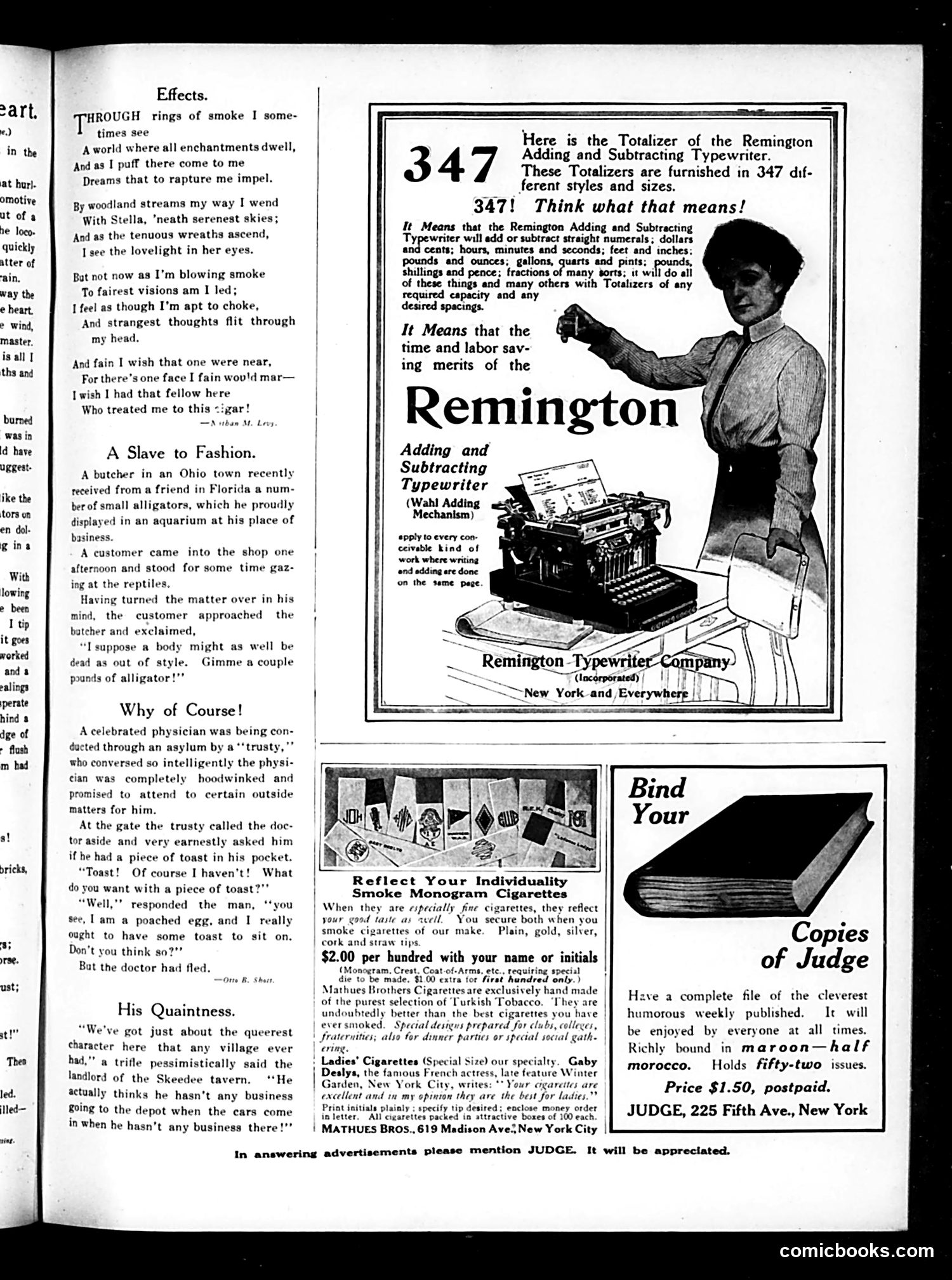
This page from Judge magazine contains primarily **advertisements** interspersed with humorous short stories typical of early 20th-century satirical magazines. The main content includes: **"Effects"** — A sentimental poem about romantic daydreams ruined by a bad cigar, ending with the speaker wishing he could find who gave it to him. **"A Slave to Fashion"** — A joke about a butcher's customer who sees alligators in an aquarium and immediately wants to buy them as food, suggesting fashion/trend-following trumps logic. **"Why of Course!"** — A dark humor piece where a physician at an asylum is tricked by a patient who convinces him he's sane, then asks if the doctor carries toast (implying the "patient" believes he's a poached egg). The doctor flees in embarrassment. **"His Quaintness"** — A brief joke about an eccentric villager with illogical thinking. The **advertisements** promote Remington typewriters with adding functions, monogram cigarettes, and Judge magazine bindings — typical products marketed to middle-class readers of the era.
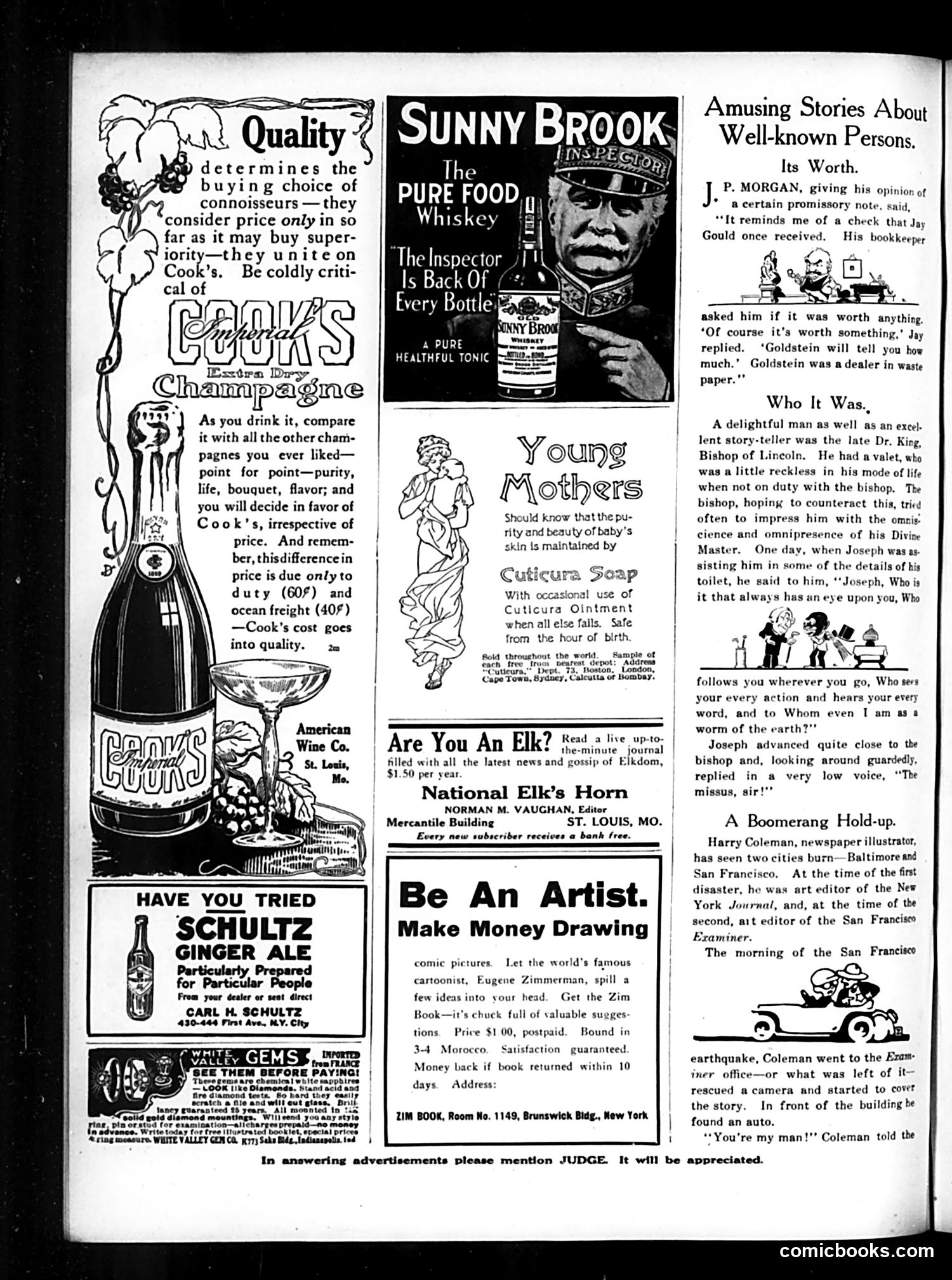
This page is primarily **advertisements and humor stories** rather than political satire. The content reflects early 20th-century American consumer culture and social humor. The **ads** promote luxury goods (Cook's Champagne, Sunny Brook Whiskey, Schultz Ginger Ale, Cuticura Soap) targeting affluent readers—typical of Judge's audience. A notable ad features "The Inspector" overseeing Sunny Brook Whiskey, playing on Pure Food and Drug Act compliance concerns from that era. The **humor stories** mock wealthy industrialists: J.P. Morgan's anecdote ridicules his stinginess (a check from Jay Gould so worthless only a waste-paper dealer would accept it). The Bishop of Lincoln story uses a servant's innocent misunderstanding for comedy. The Harry Coleman story about photographing the San Francisco earthquake commandeering an auto plays on post-disaster chaos. These pieces reflect Judge's satirical approach to American society—poking fun at the wealthy and powerful through gossip and comedic anecdotes rather than pointed political commentary.
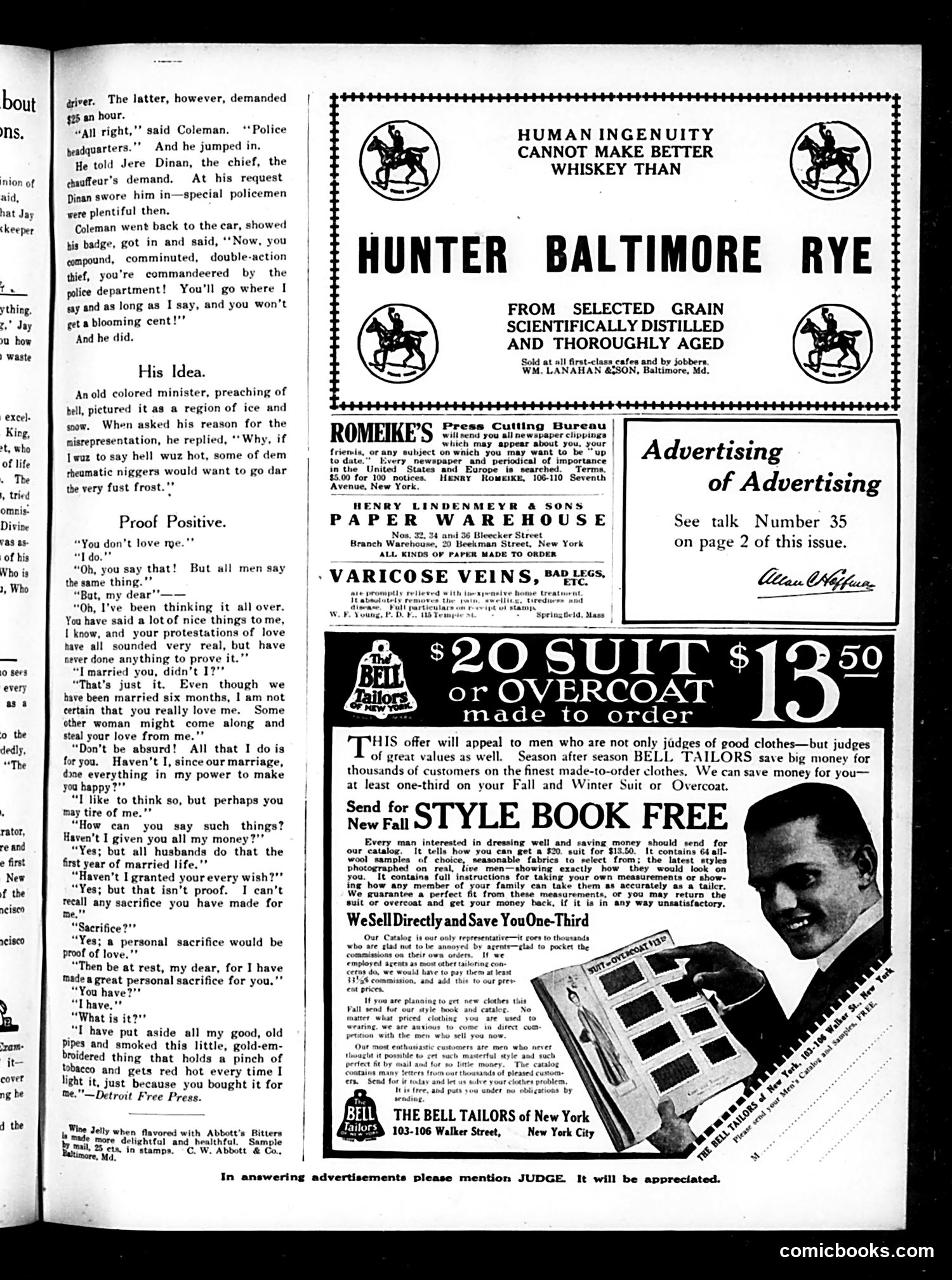
This page is primarily **advertising and humor pieces**, not political cartoons. The main content includes: **Humor Sketches:** - "His Idea": A racial stereotype joke about a Black minister describing hell as icy (so parishioners won't want to go there) - "Proof Positive": A domestic comedy about a husband trying to convince his skeptical wife of his love by sacrificing his favorite pipe **Advertisements:** - Hunter Baltimore Rye whiskey (prominent) - Bell Tailors suit/overcoat ($13.50, made-to-order) - Press Cutting Bureau service - Varicose veins treatment - Paper warehouse The page reflects early-20th-century Judge magazine's mix of light domestic humor and commercial advertisements. The racial humor represents period attitudes now considered offensive. There are no identifiable political figures or satirical commentary visible on this particular page.
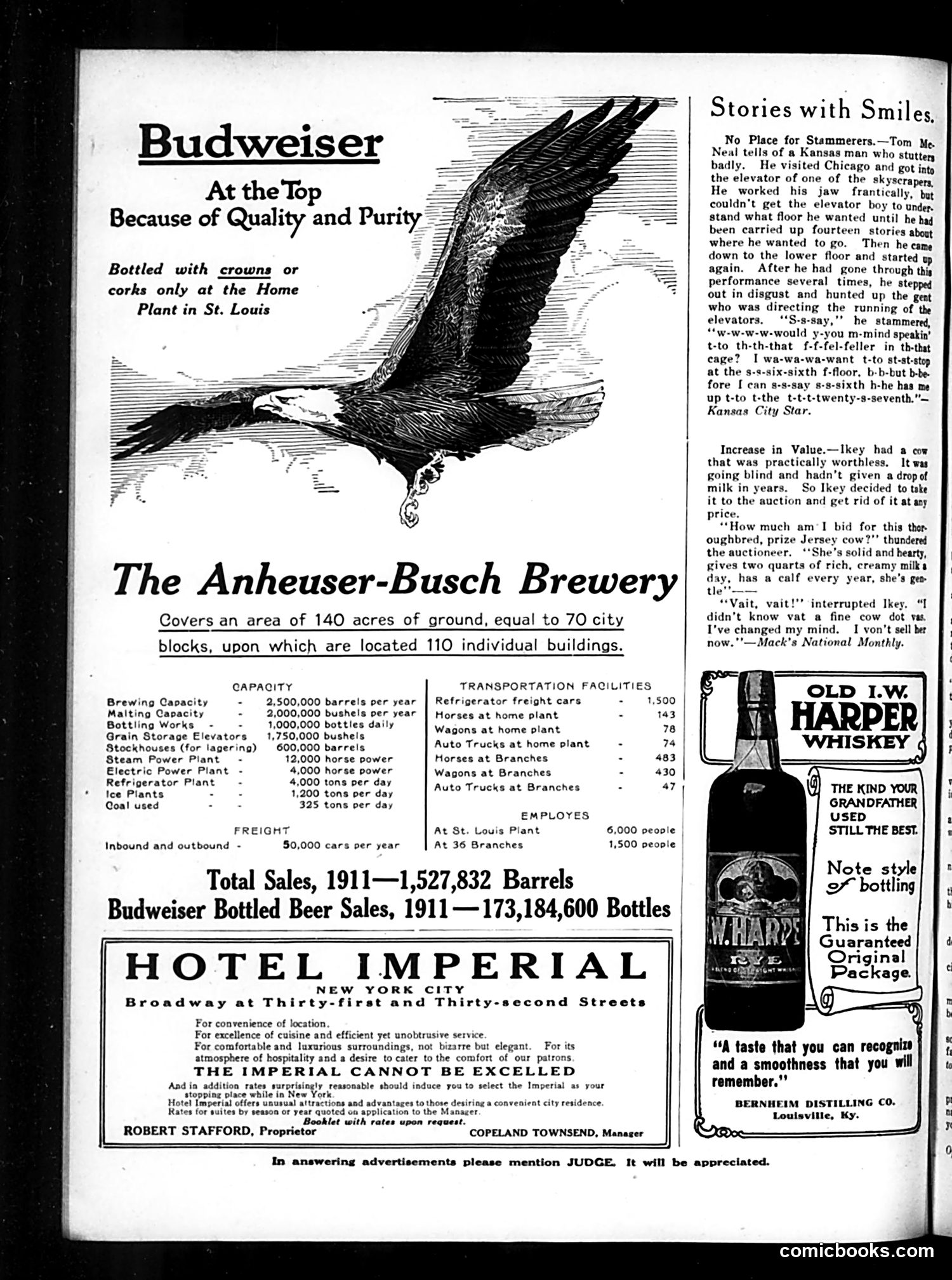
This page is primarily **advertising**, not satire or editorial cartoons. It contains: **Main Content:** - Large Budweiser advertisement featuring an eagle logo, emphasizing the brewery's massive scale (140 acres, 110 buildings, 6,500 employees, producing 1.5 million barrels annually in 1911) - Hotel Imperial advertisement for a New York City luxury hotel - Old I.W. Harper Whiskey advertisement **"Stories with Smiles" Section** (right column): Three brief humorous anecdotes unrelated to the ads: 1. A stammering man unable to communicate his desired floor to an elevator operator 2. A man with a worthless cow who changes his mind after the auctioneer's sales pitch 3. (Partially visible) **Historical Context:** This appears to be from **1912** (referencing 1911 sales figures). There is **no political satire** on this page—it's a commercial publication displaying period advertising and light humor pieces typical of Judge magazine's format.
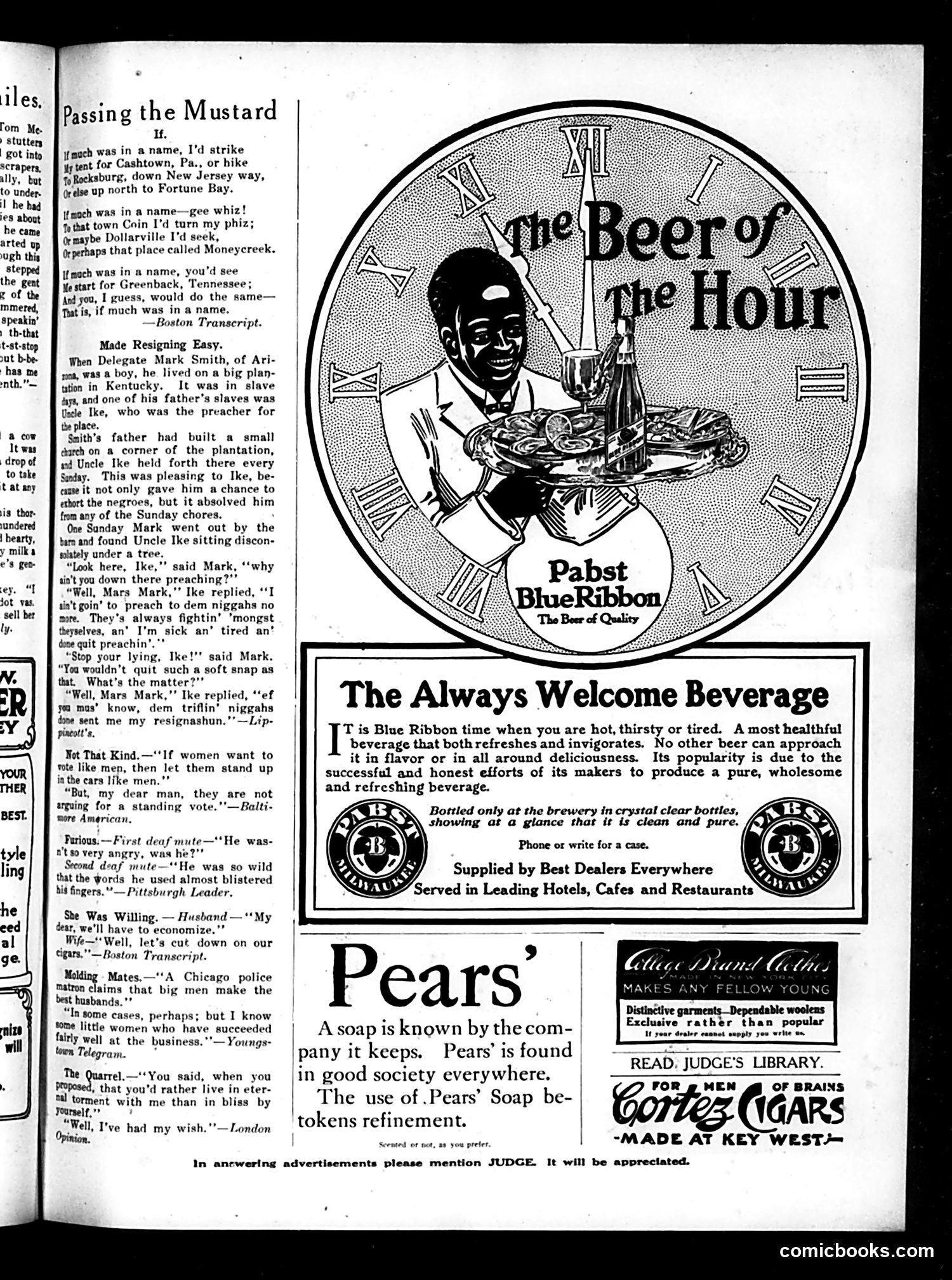
This page contains primarily **short humor pieces and advertisements** rather than political cartoons. The left column features brief jokes on various topics: a poem about town names ("Passing the Mustard"), an anecdote about a slave preacher named Uncle Ike resigning his position, and several one-liner quips about women's suffrage, economics, and marriage. The **significant historical element** is a joke involving a formerly enslaved preacher character ("Uncle Ike"), presented in dialect. This reflects early 20th-century Judge magazine's casual use of racist caricature and minstrelsy-style humor that was then socially acceptable but is now recognized as deeply offensive. The right side features **period advertisements**: Pabst Blue Ribbon beer ("The Beer of the Hour"), Pears' soap, and other consumer goods typical of early American magazines. The page reflects Judge's formula of mixing satirical commentary on contemporary social issues (women's suffrage, workplace dynamics) with entertainment and advertising—not focused political critique.
This appears to be a **title page or advertisement** from *Judge* magazine rather than a political cartoon. The image shows a product shot of what looks like a **cigar box or tobacco package labeled "ORCIGNA"** (or similar—the text is difficult to read clearly in this reproduction). The photograph uses dramatic lighting against a dark background to showcase the product prominently. There's a publisher's emblem or seal visible in the lower right corner. Without clearer text or visual context explaining the satirical angle, I cannot definitively identify what social or political commentary this advertisement intends. It may be advertising a real product, or it may be satirizing consumer culture or a specific brand—but the page quality makes the exact target and meaning unclear.