
Judge, 1912-09-14 · page 5 of 24
Judge — September 14, 1912 — page 5: what you’re looking at
What you’re looking at
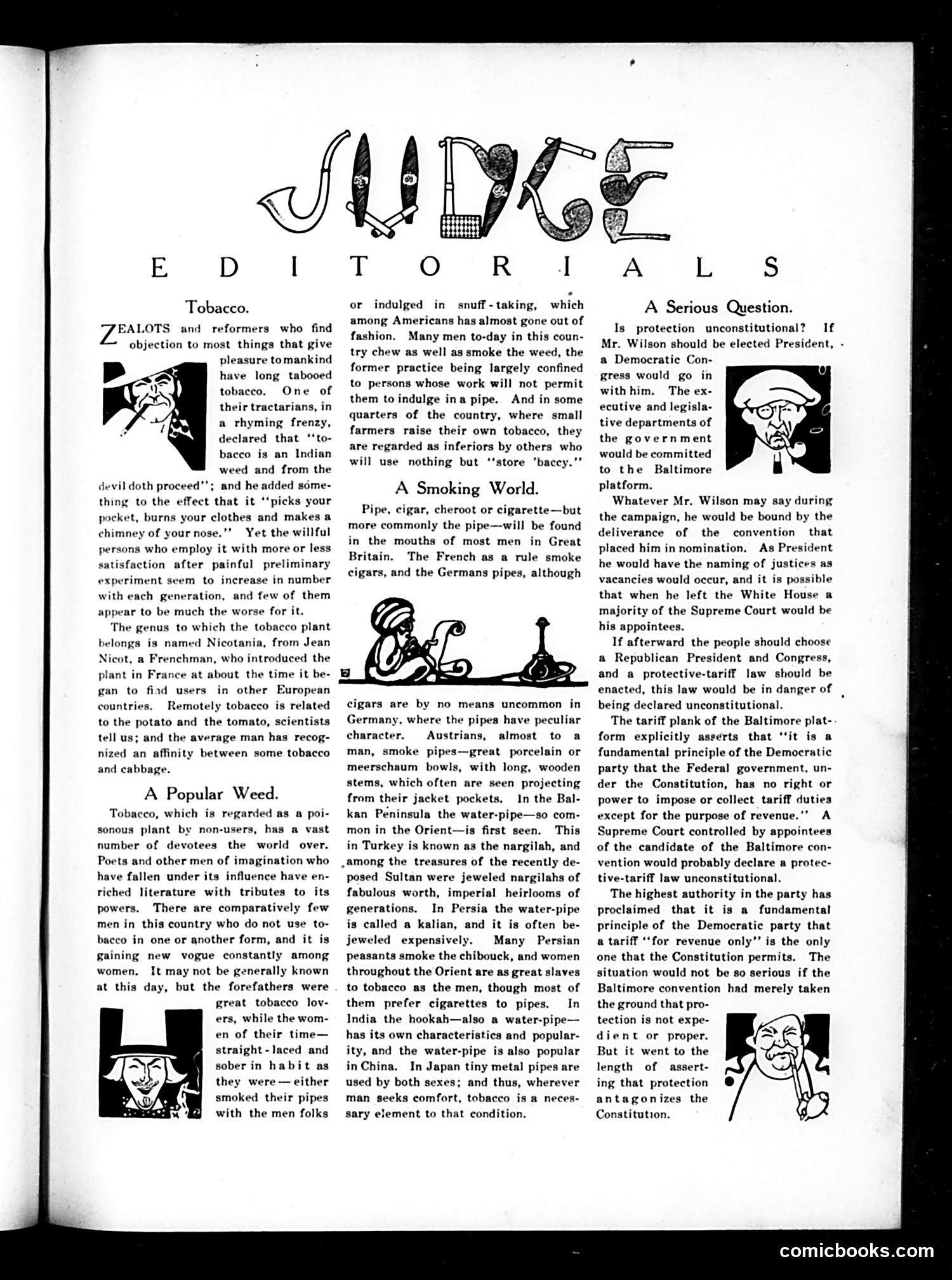
This **Judge** magazine page satirizes tobacco use through three illustrated sections ("Tobacco," "A Popular Weed," and "A Smoking World"). The cartoons feature caricatured faces—some with exaggerated features typical of period satirical art—apparently representing tobacco users or advocates. The text discusses tobacco's prevalence among Americans, Europeans, and various cultures, noting its use in pipes, cigars, and cigarettes. It also includes a section titled "A Serious Question" discussing whether Mr. Wilson (likely President Woodrow Wilson) should be elected, with concerns about Democratic policies and constitutional protections. The satirical angle appears to be mocking both widespread tobacco consumption and political debates of the era, using grotesque facial caricatures to emphasize the perceived absurdity of both subjects.
📄 Transcribed text from this page (OCR, searchable)
Machine-transcribed from the original scan — historical spelling and the odd misread are preserved.
E D Tobacco. EALOTS and reformers who find objection to most things that give pleasure tomankind have long tabooed tobacco. One of their tractarians, in a rhyming frenzy, declared that ‘‘to- bacco is an Indian weed and from the devil doth proceed’’; and he added séme- thing to the effect that it ‘‘picks your pocket, burns your clothes and makes a chimney of your nose."’ Yet the willful persons who employ it with more or less satisfaction after painful preliminary experiment seem to increase in number with each generation, and few of them appear to be much the worse for it. The genus to which the tobacco plant belongs is named Nicotania, from Jean Nicot, a Frenchman, who introduced the plant in France at about the time it be- gan to find users in other European countries. Remotely tobacco is related to the potato and the tomato, scientists tell us; and the average man has recog- nized an affinity between some tobacco and cabbage. A Popular Weed. Tobacco, which is regarded as a poi- sonous plant by non-users, has a vast number of devotees the world over. Poets and other men of imagination who have fallen under its influence have en- riched literature with tributes to its powers. There are comparatively few men in this country who do not use to- bacco in one or another form, and it is gaining new vogue constantly among women, It may not be generally known at this day, but the forefathers were great tobacco lov- ers, while the wom- en of their time— straight-laced and sober in habit as they were — either smoked their pipes with the men folks or indulged in snuff-taking, which among Americans has almost gone out of fashion. Many men to-day in this coun- try chew as well as smoke the weed, the former practice being largely confined to persons whose work will not permit them to indulge ina pipe. And in some quarters of the country, where small farmers raise their own tobacco, they are regarded as inferiors by others who will use nothing but ‘‘store ‘baccy.’’ A Smoking World. Pipe, cigar, cheroot or cigarette—but more commonly the pipe—will be found in the mouths of most men in Great Britain, The French as a rule smoke cigars, and the Germans pipes, although 38 cigars are by no means uncommon in Germany, where the pipes have peculiar character. Austrians, almost to a man, smoke pipes—great porcelain or meerschaum bowls, with long, wooden stems, which often are seen projecting from their jacket pockets. In the Bal- kan Peninsula the water-pipe—so com- mon in the Orient—is first seen. This in Turkey is known as the nargilah, and . among the treasures of the recently de- posed Sultan were jeweled nargilahs of fabulous worth, imperial heirlooms of generations. In Persia the water-pipe is called a kalian, and it is often be- jeweled expensively. Many Persian peasants smoke the chibouck, and women throughout the Orient are as great slaves to tobacco as the men, though most of them prefer cigarettes to pipes. In India the hookah—also a water-pipe— has its own characteristics and popular- ity, and the water-pipe is also popular in China. In Japan tiny metal pipes are used by both sexes; and thus, wherever man seeks comfort, tobacco is a neces- sary element to that condition. 5 A Serious Question. Is protection unconstitutional? If Mr. Wilson should be elected President, - a Democratic Con- gress would go in withhim. The ex- ecutive and legis! tive departments of the government would be committed to the Baltimore platform. Whatever Mr. Wilson may say during the campaign, he would be bound by the deliverance of the convention that placed him in nomination. As President he would have the naming of justices as vacancies would occur, and it is possible that when he left the White House a majority of the Supreme Court would be his appointees. If afterward the people should choose a Republican President and Congress, and a protective-tariff law should be enacted, this law would be in danger of being declared unconstitutional. The tariff plank of the Baltimore plat- form explicitly asserts that ‘‘it is a fundamental principle of the Democratic party that the Federal government, un- der the Constitution, has no right or power to impose or collect tariff duties except for the purpose of revenue.’’ A Supreme Court controlled by appointees of the candidate of the Baltimore con- vention would probably declare a protec- tive-tariff law unconstitutional. The highest authority in the party has proclaimed that it is a fundamental principle of the Democratic party that a tariff ‘‘for revenue only’’ is the only one that the Constitution permits. The situation would not be so serious if the Baltimore convention had merely taken the ground that pro- tection is not expe- dient or proper. But it went to the length of assert- ing that protection antagonizes the Constitution. comicbooks.com