
A complete issue · 24 pages · 1912
Judge — July 6, 1912
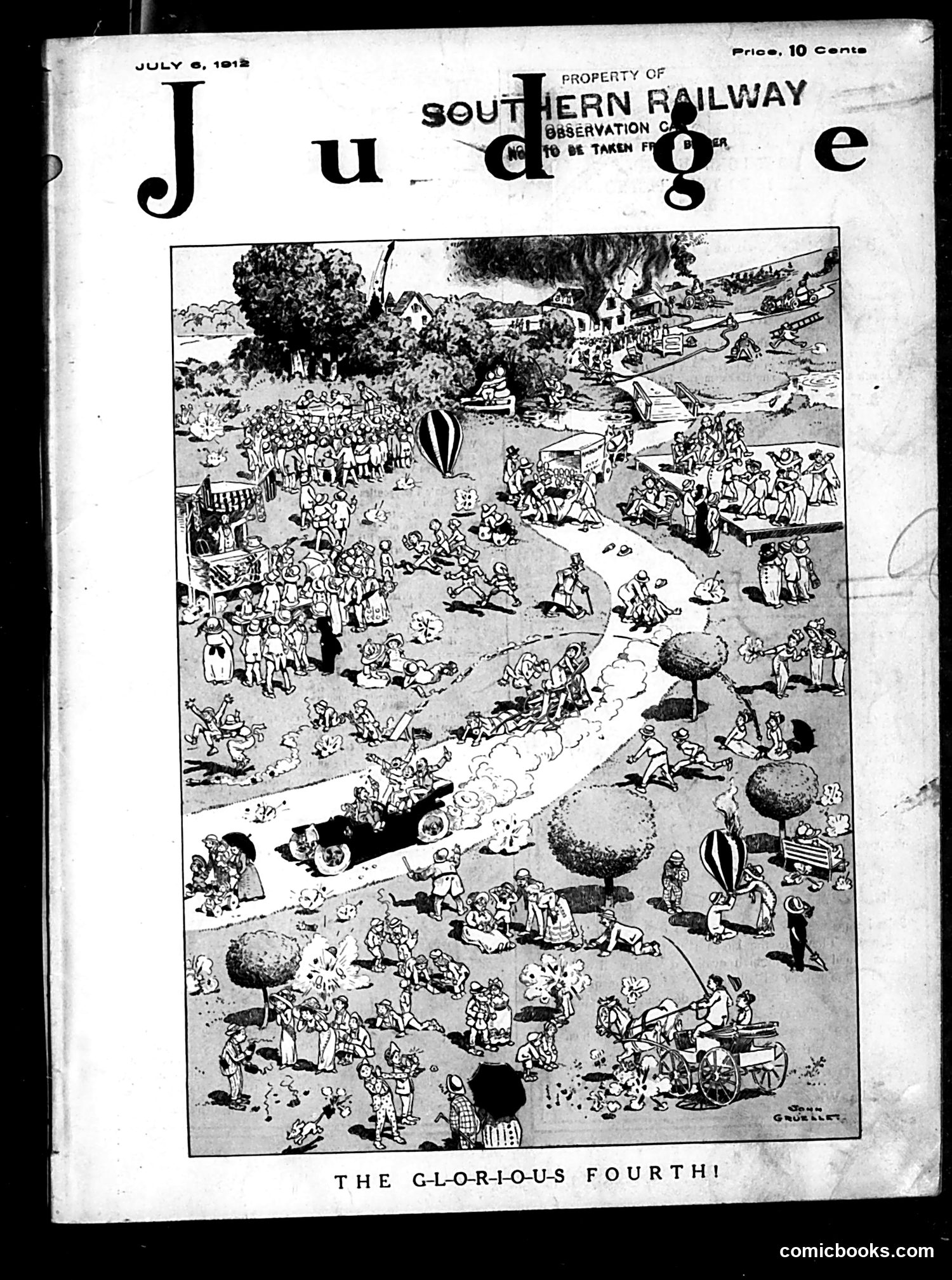
This is the cover of *Judge* magazine from July 6, 1918, titled "The Glorious Fourth!" It depicts a crowded Fourth of July celebration during World War I. The illustration is a busy, detailed scene showing Americans enjoying Independence Day festivities—picnicking, playing games, watching hot air balloons, and celebrating with flags visible. The "glorious" characterization appears ironic given the war context: while Americans celebrate freedom at home, the nation was actively involved in WWI (the U.S. entered in 1917). The juxtaposition of carefree holiday celebration with wartime suggests commentary on American patriotism, civilian life during wartime, or possibly tension between domestic leisure and national duty during the conflict.
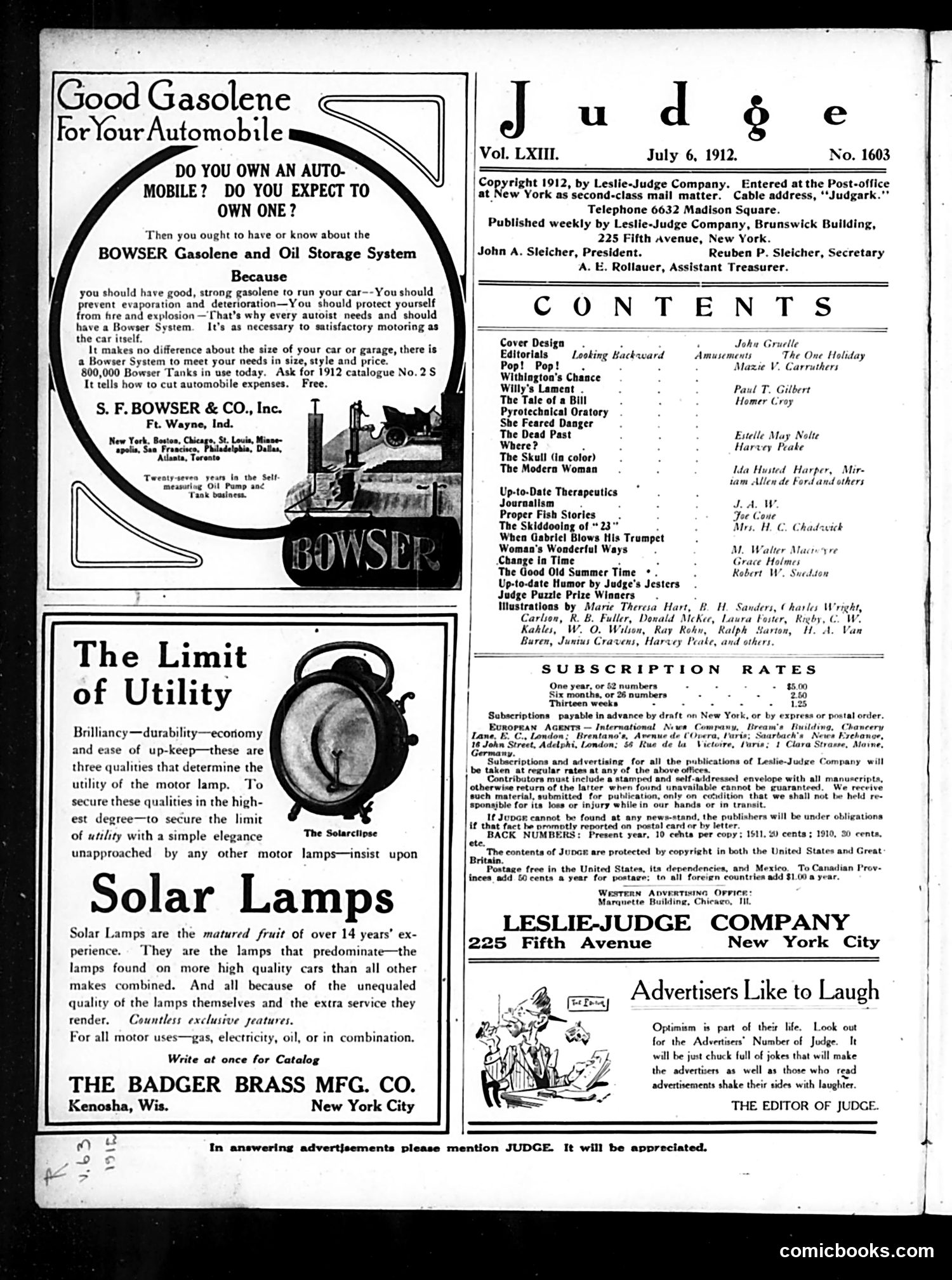
This is primarily a **contents and advertising page** rather than a satirical cartoon page. The main content listing indicates Judge featured humor pieces with titles like "Pop! Pop!", "The Tale of a Bill," and "She Feared Danger." The advertisements are straightforward product promotions: Bowser gasoline storage systems, Solar Lamps (motor lamps by Badger Brass), and a Selectine clock. The only satirical element is a small cartoon titled **"Advertisers Like to Laugh,"** which appears to mock advertisement culture itself—suggesting advertisers appreciate humor in their own promotional efforts. The page reflects Judge's dual nature as both satirical publication and advertising vehicle for early 1900s consumer products (automobiles, electricity, lighting).
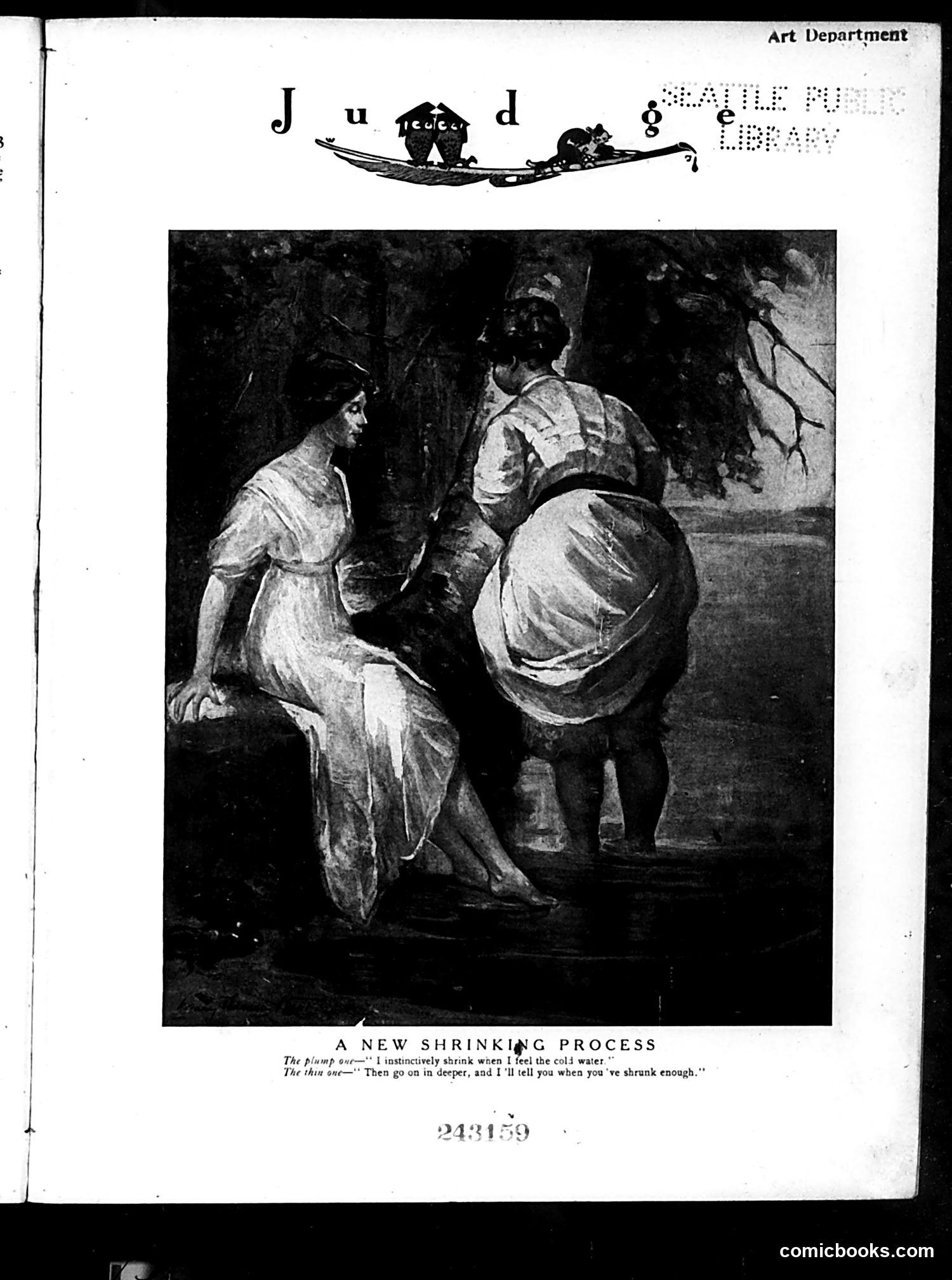
This satirical illustration depicts a woman in a white dress seated beside two figures in what appears to be a laundry or domestic setting. The caption reads: "The plump one—'I understand you call this cold water.' The thin one—'Then go on in deeper, and I'll tell you when you've shrank enough.'" The satire targets weight loss through water immersion or bathing treatments—likely a popular beauty trend of the era. The humor plays on the vanity of women seeking to reduce their body size through dubious "shrinking" methods. Judge is mocking both the ineffective beauty treatments marketed to women and women's pursuit of thinness. The domestic setting emphasizes how such concerns dominated household life and personal routines during this period.
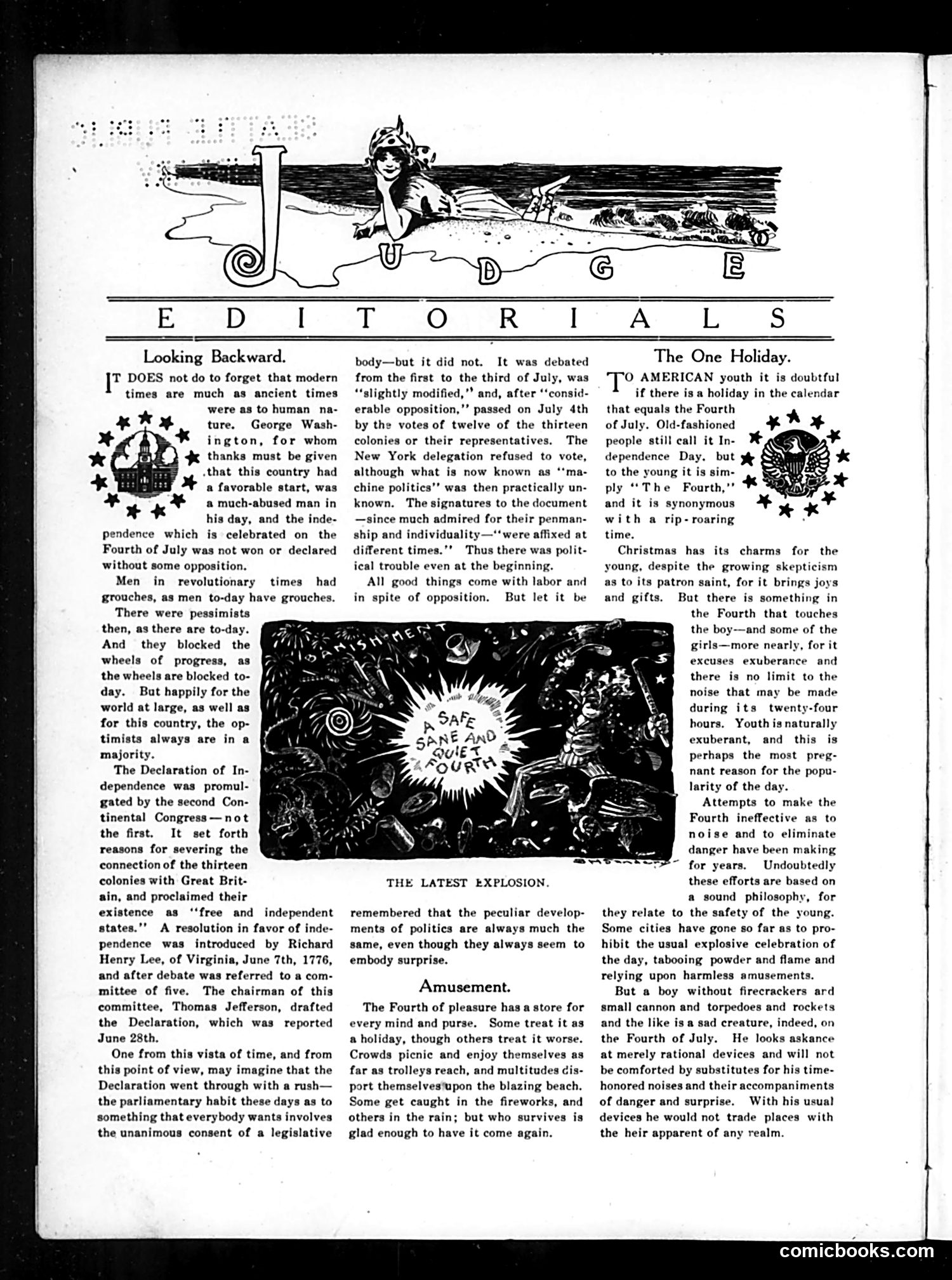
This page presents editorials celebrating American Independence Day. The left column, "Looking Backward," discusses the Declaration of Independence's contentious drafting—notably that the document was "slightly modified" before passage on July 4th, with New York's delegation initially refusing to vote. The right column, "The One Holiday," argues that the Fourth of July uniquely resonates with American youth despite growing skepticism about holidays generally. It defends the day's noise and chaos as inherent to youthful exuberance. The central cartoon, "The Latest Explosion," depicts fireworks with a starburst labeled "SAFE SANE AND SANE FOURTH"—satirizing contemporary safety campaigns attempting to regulate Fourth of July celebrations. The image suggests tension between reformers seeking to eliminate dangerous fireworks and those defending traditional, chaotic holiday traditions.
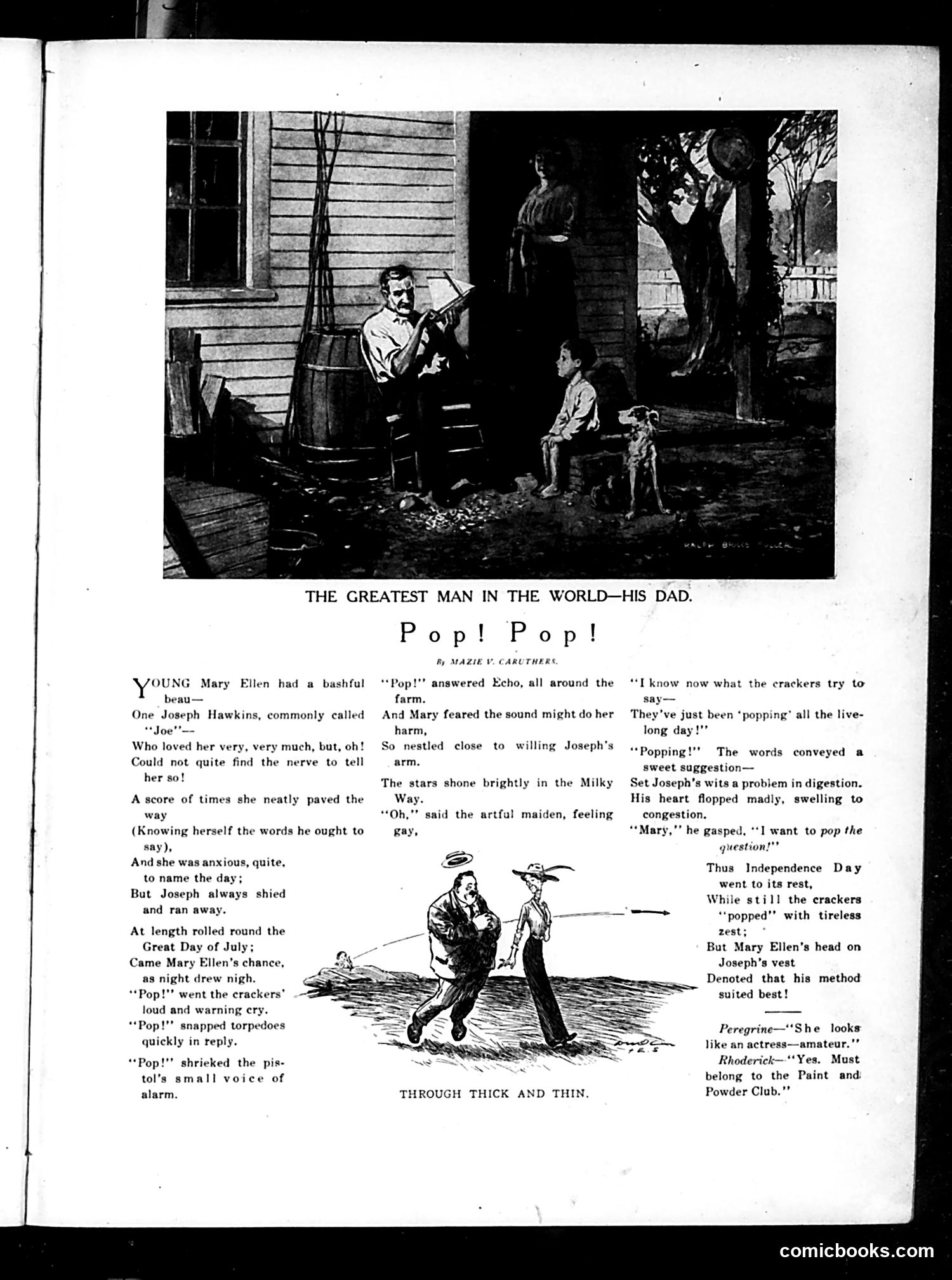
This page contains a short story by Marie V. Caruthers titled "Pop! Pop!" about a girl named Mary Ellen and a boy named Joseph Hawkins (nicknamed "Joe"). The narrative describes Mary Ellen's struggle to confess her feelings to Joseph, culminating in the Fourth of July when firecrackers' "popping" sounds startle them both. The accompanying illustrations show two cartoon scenes: the domestic setting mentioned in the story, and a sketch of two figures among exploding firecrackers ("Through Thick and Thin"). This appears to be lighthearted romantic fiction rather than political satire. The humor derives from the innocent comedy of young romance and the coincidental timing of the Independence Day celebrations with the characters' personal drama.
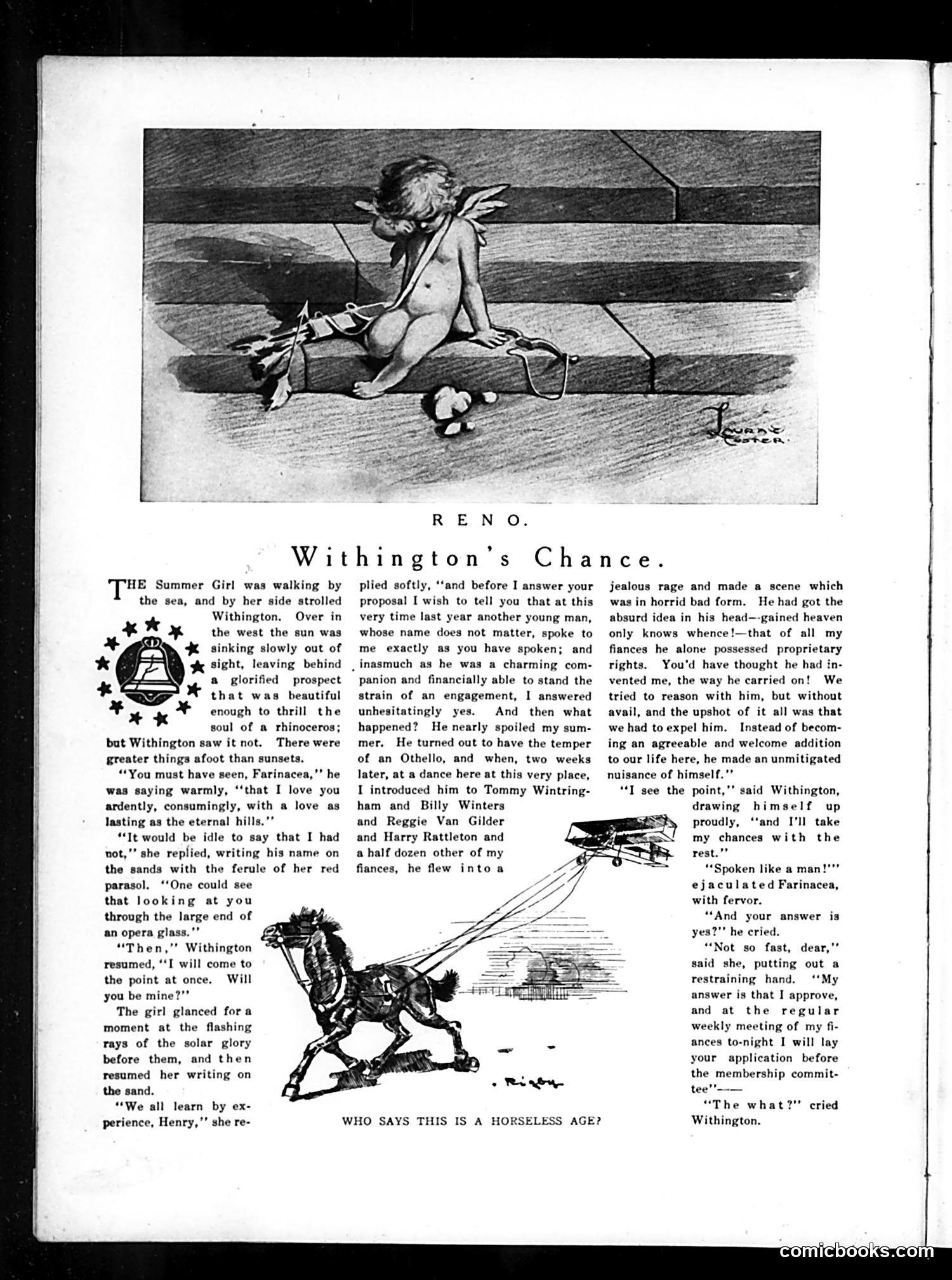
This page satirizes the "modern woman" and changing courtship customs of the early 20th century. The story mocks a young woman named Farinacea who maintains multiple simultaneous engagements like a business portfolio. The joke targets two things: first, the absurdity of a woman casually juggling multiple fiancés and holding formal "membership meetings" to evaluate them; second, the implicit criticism of men (like Withington) who naively accept such arrangements. The woman's casual mention of expelling a previous fiancé for jealous behavior—treating romantic exclusivity as an "absurd idea"—satirizes emerging attitudes about romantic freedom. The illustration above shows a cherub on a log, likely representing naive romance or youth, contrasting with the cynical matrimonial marketplace depicted in the text. The final punchline—Withington's shock at learning about the formal committee process—suggests that even progressive attitudes have limits. Judge presents this as ridiculous social excess.
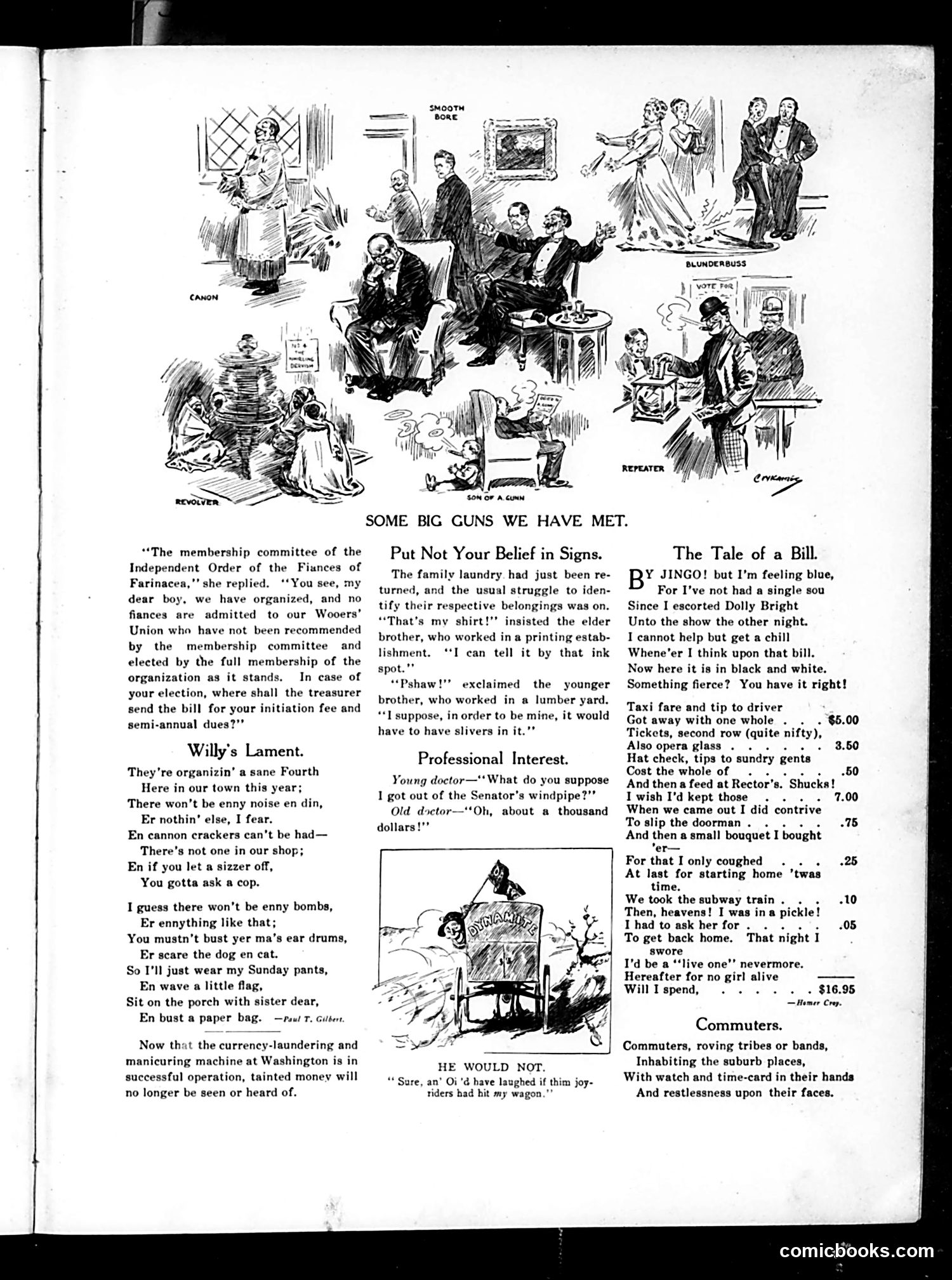
This page collects several satirical pieces mocking American social life. The cartoons at top ("Smooth Bore," "Blunderbuss," "Repeater," etc.) appear to caricature different social types—likely politicians or public figures of the era, though specific identities are unclear from the image alone. The accompanying text includes: - **"Willy's Lament"**: Mocks early Progressive-era efforts to sanitize Independence Day celebrations, replacing explosives and noise with respectable quiet—a jab at reformist busybodies. - **"Put Not Your Belief in Signs"**: A joke about laundry mix-ups based on occupational stains (ink, slivers). - **"Professional Interest"**: A cynical dig at doctors extracting money from wealthy patients (Senators specifically). - **"The Tale of a Bill"**: Catalogs a middle-class man's dating expenses ($16.95 total—substantial for the era), satirizing modern courtship costs. The satirical tone throughout targets both reformers and the newly conspicuous consumer economy of the early 20th century.
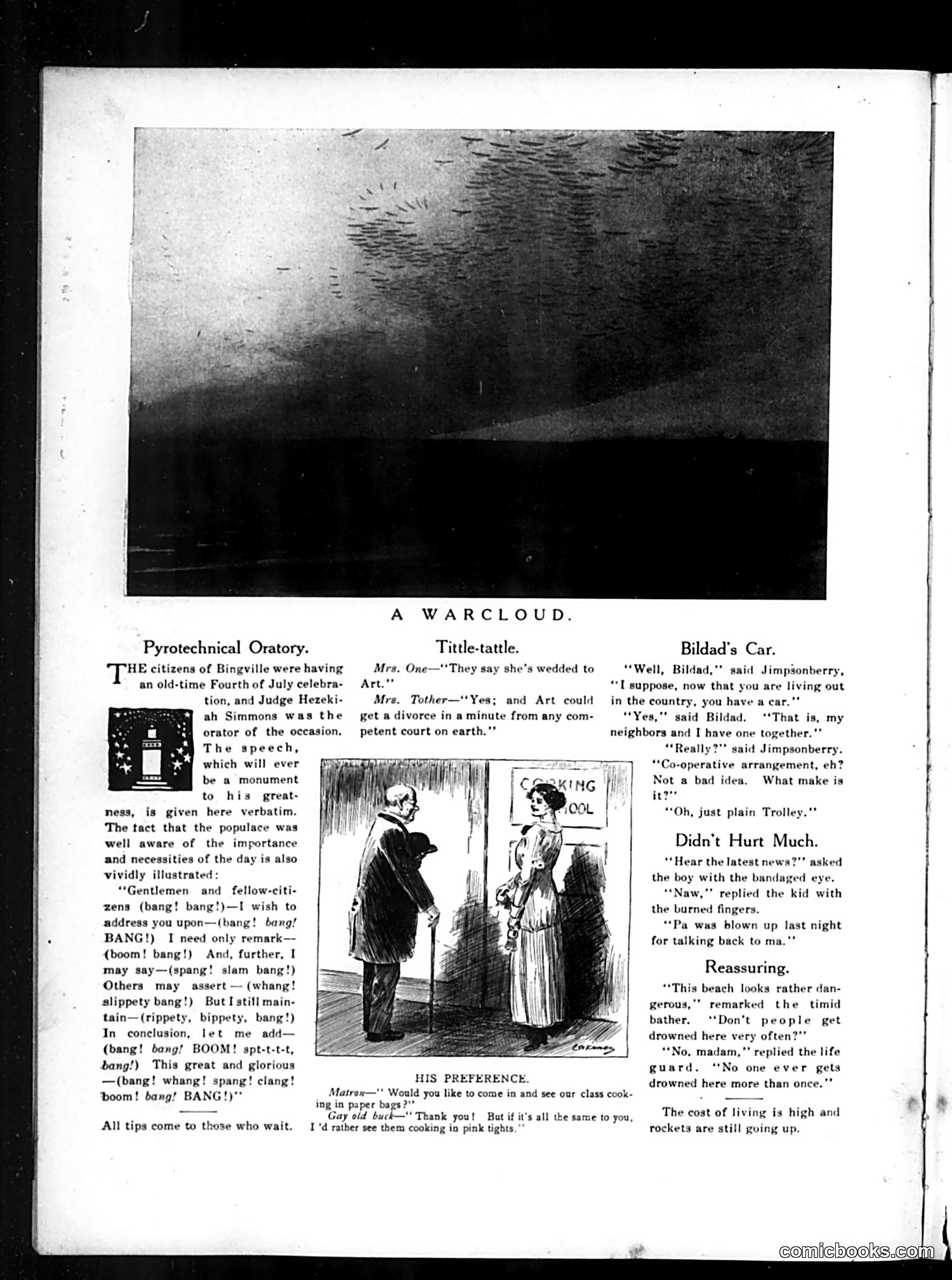
This page contains several short satirical pieces typical of early 20th-century American humor: **"Pyrotechnical Oratory"** mocks a small-town Fourth of July speech where the orator's words are completely drowned out by fireworks explosions—a joke about the absurdity of patriotic speechmaking being inaudible amid celebratory noise. **"Tittle-tattle"** is a quick joke about a woman devoted to "Art" (capitalized, suggesting affectation) whose marriage could easily end in divorce—satirizing pretentious artistic claims. **"Bildad's Car"** jokes about rural poverty through a co-operative car arrangement between neighbors, with the punchline being they share a trolley instead. The remaining vignettes are brief sight-gags: a preference joke about cooking methods, a boy's injury from fireworks, and a dark punchline about beach drownings. The "Warcloud" image at top appears unrelated to the text below it. Overall, this represents Judge's lighthearted social satire targeting small-town American life, pretension, and contemporary concerns.
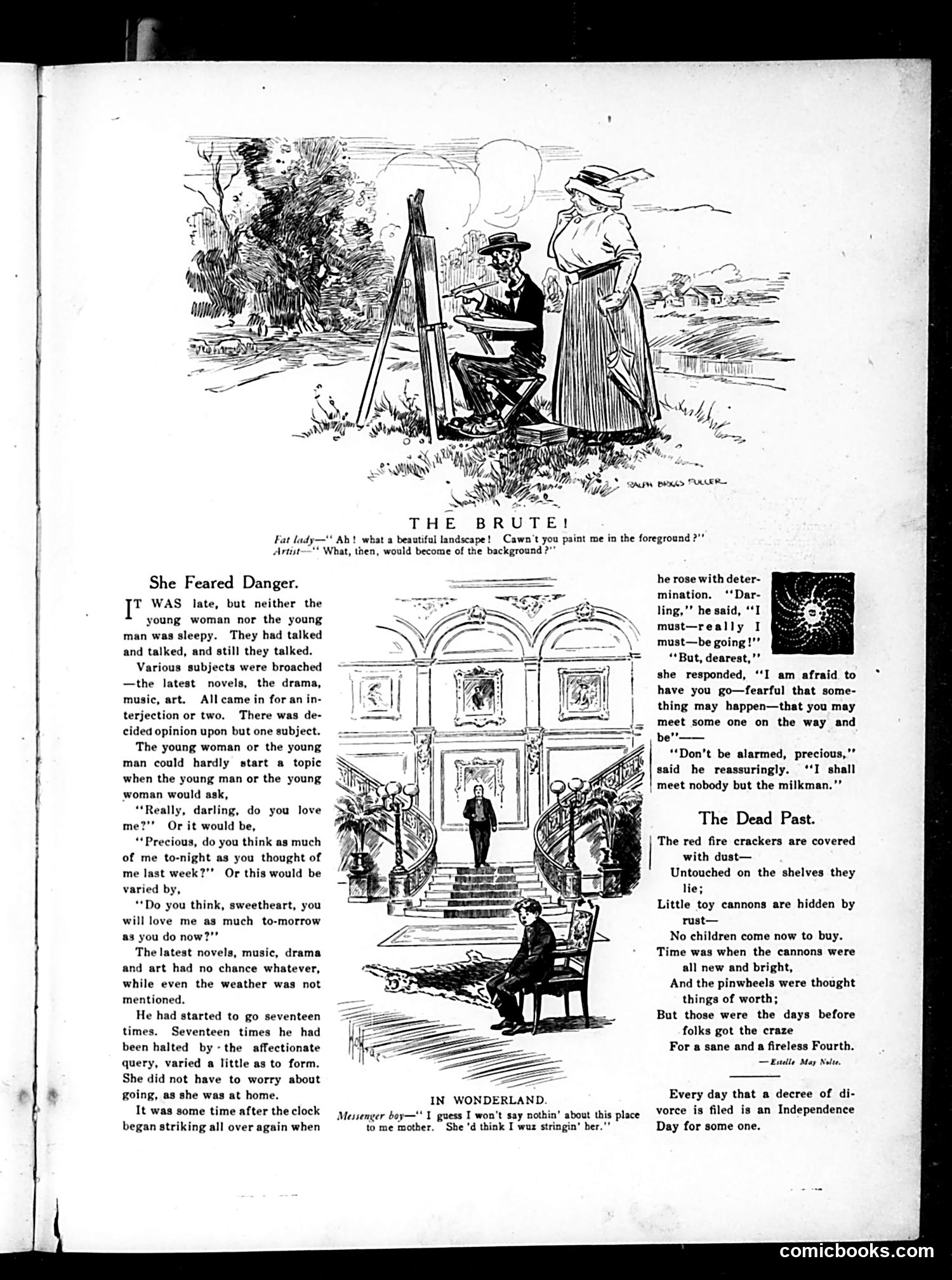
This page contains three distinct satirical pieces: **"The Brute!"** (top cartoon): A painter rebuffs a vain woman's request to be painted in the foreground, suggesting her appearance would ruin the landscape. The satire targets vanity and social pretension among wealthy women. **"She Feared Danger"** (main text story): A couple endlessly discusses their mutual affection late into the night, unable to part. The satire mocks sentimental romanticism and repetitive relationship talk of the era—the young man repeatedly attempts to leave but is detained by questions like "Do you love me?" The joke's point: excessive emotional reassurance and melodramatic courtship behavior. **"The Dead Past"** (poem): Nostalgia for pre-Civil War Independence Day celebrations (toy cannons, fireworks) before Americans adopted "sane and fireless" Fourth of July observances—likely referencing safety concerns or temperance movements. **"In Wonderland"** (bottom): A messenger boy encounters something shocking in a grand house, hinting at adultery or scandal. Overall, Judge satirizes contemporary manners, sentimentality, and social change.
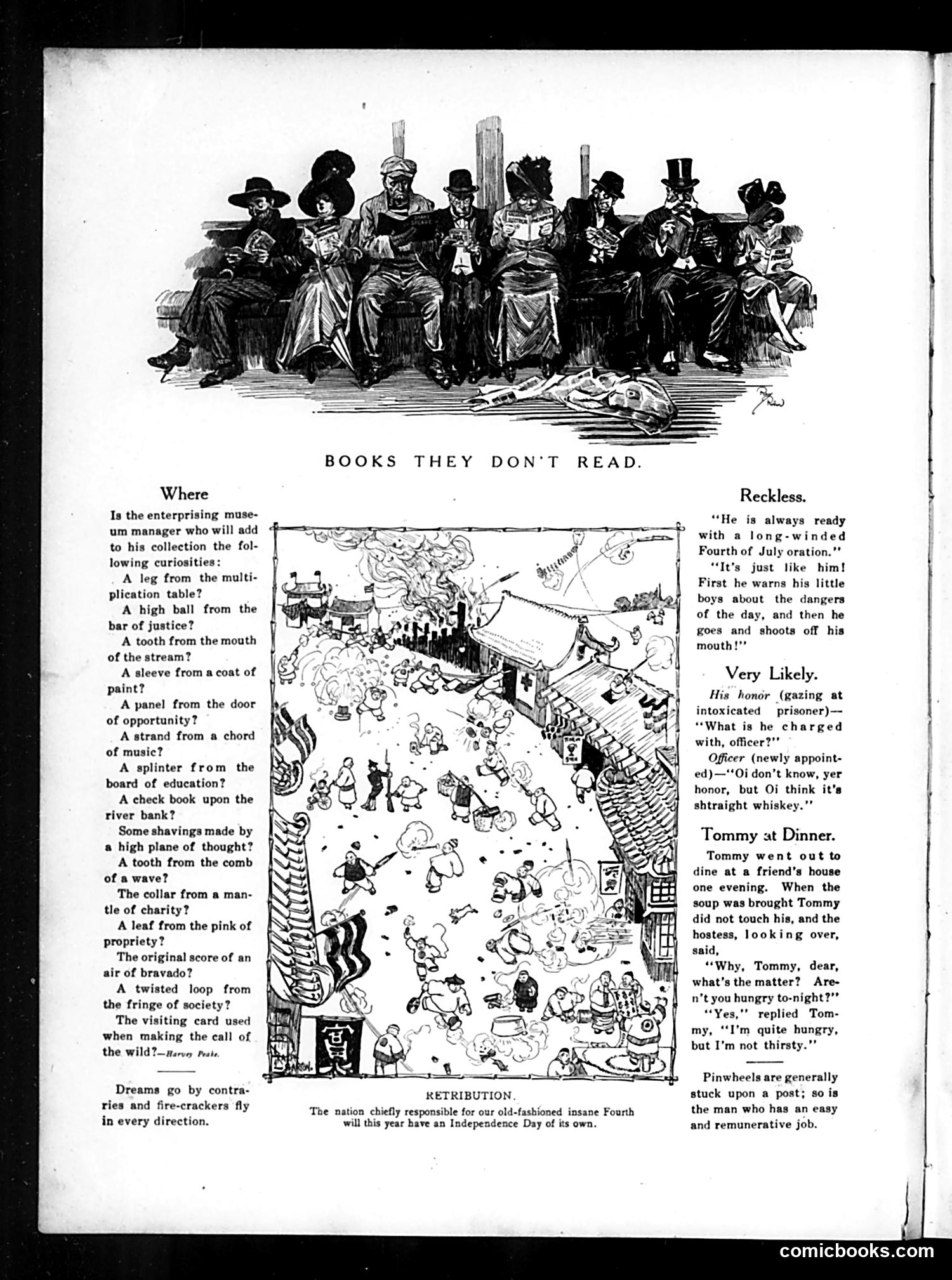
This page contains multiple satirical pieces typical of Judge magazine's humor: **"Books They Don't Read"** presents absurdist wordplay—a curator collecting impossible objects like "a leg from the multiplication table" or "a tooth from the mouth of the stream." The humor relies on treating metaphorical phrases as literal items. **The central illustration labeled "Retribution"** depicts a chaotic Fourth of July celebration, satirizing what appears to be reckless Independence Day festivities. The caption suggests the nation's "old-fashioned insane" celebration style will have consequences—likely commenting on dangerous fireworks practices or general disorder during the holiday. **Three short humorous anecdotes** follow, including jokes about a verbose politician, police incompetence, and a child's literal interpretation of hunger versus thirst. The page's overall theme mocks American social behaviors—pretension, foolishness, and absurdity—through wordplay and domestic scenarios. Without a visible date, the specific historical context remains unclear, though the Fourth of July focus suggests summer publication.
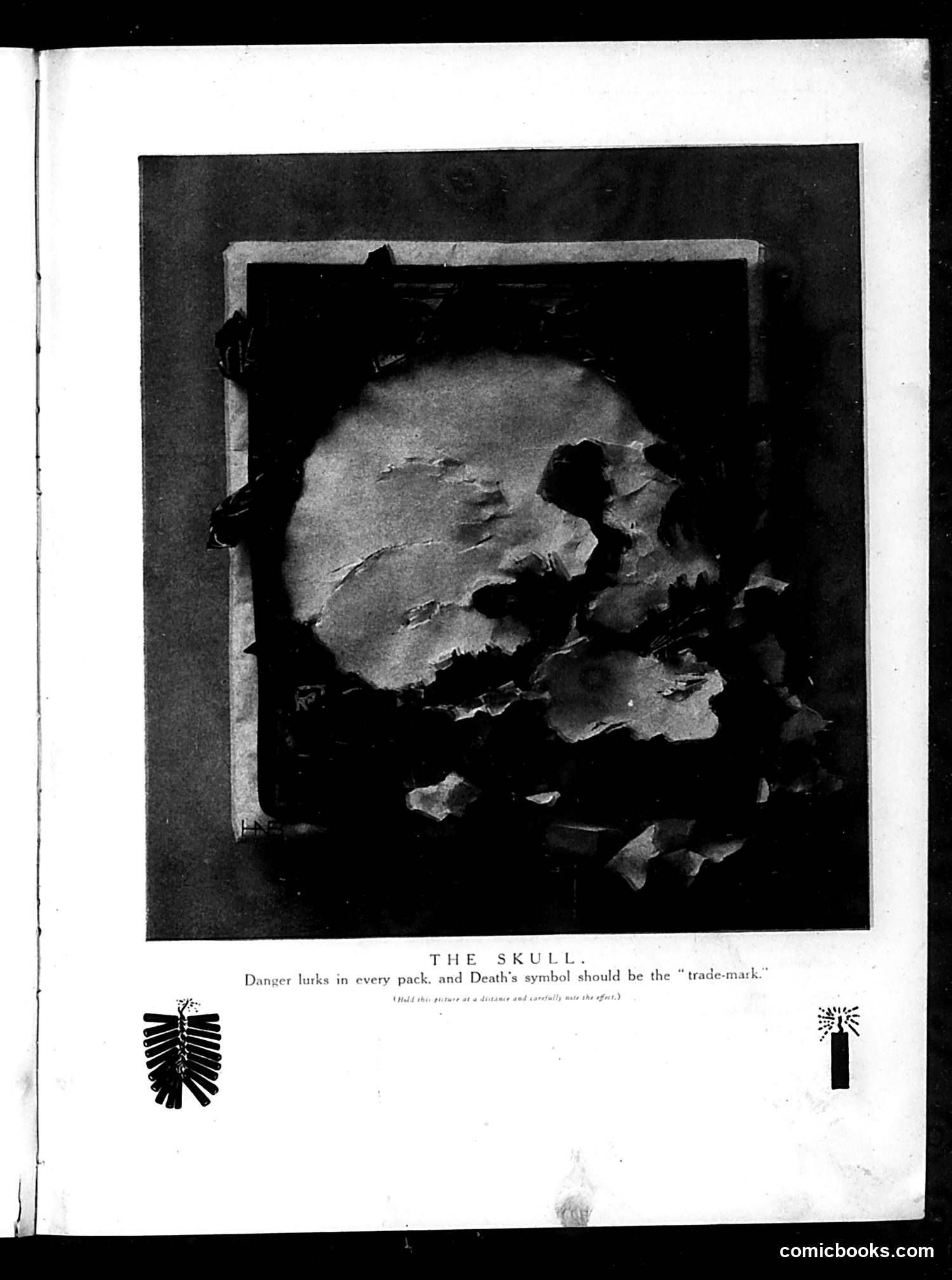
This appears to be a cautionary editorial image from *Judge* magazine warning about cigarettes. The central image shows a skull emerging from or composed of cigarette packs, with scattered cigarettes around it. The caption states: "Danger lurks in every pack, and Death's symbol should be the 'trade-mark.'" This is anti-smoking propaganda, suggesting that cigarette manufacturers should be required to display skulls as warning symbols, since smoking leads to death. The decorative symbols flanking the image—a skeletal leaf design and what appears to be a torch or plant—likely reinforce themes of danger and public health messaging. This reflects early 20th-century growing awareness of smoking's health risks, before such warnings became standard practice on cigarette packages.
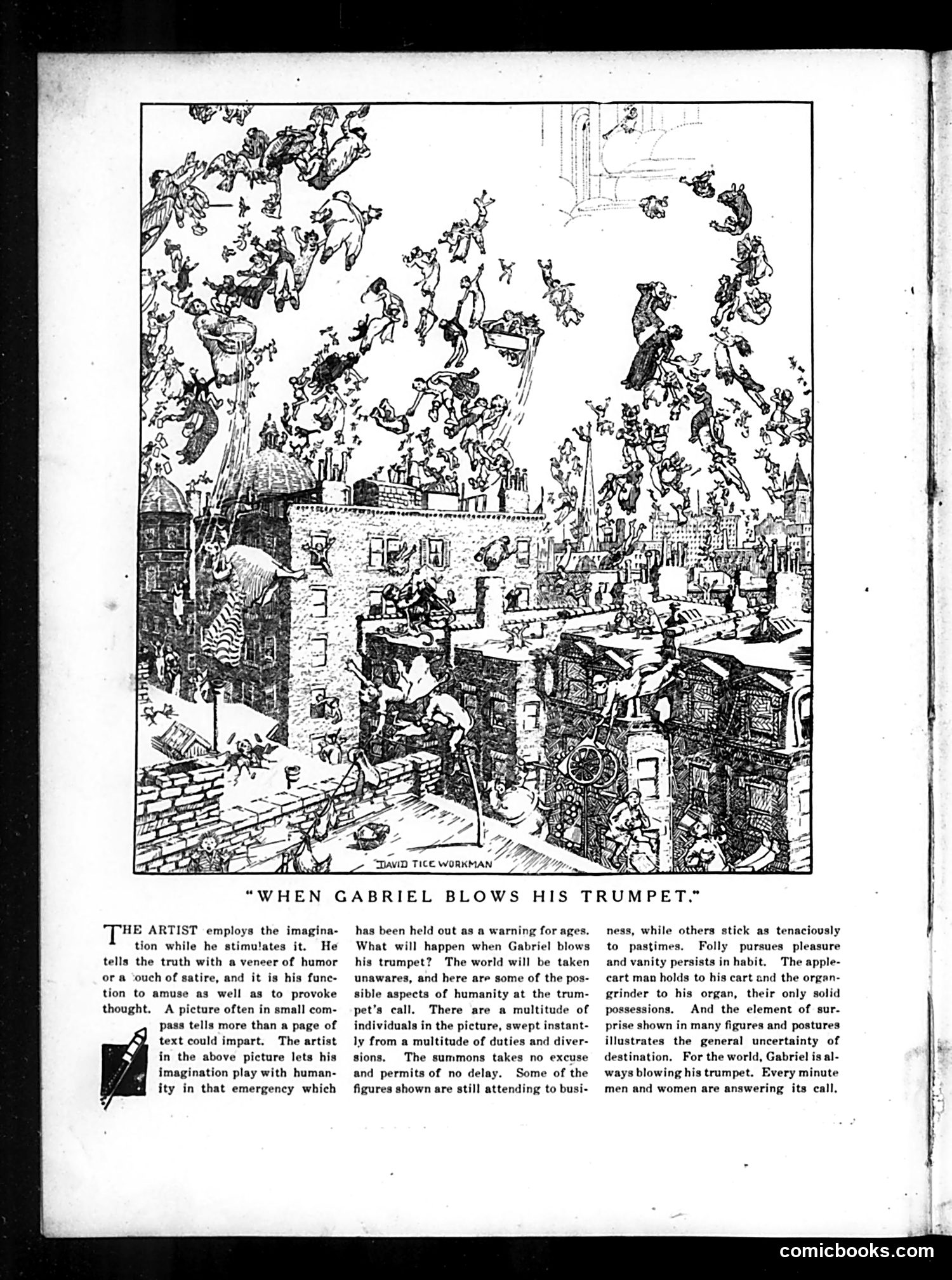
This satirical illustration by David T. Workman depicts the Christian apocalyptic moment when the Archangel Gabriel's trumpet signals the end times. The cartoon shows a crowded city scene with dozens of figures engaged in various activities—business, leisure, vanity—who are suddenly caught by the trumpet's call. The satire critiques human nature: people cling desperately to worldly possessions and habits (an apple-cart vendor, an organ-grinder) rather than spiritual preparation. The accompanying text explains the artist's point: that while most view Gabriel's trumpet as a distant warning, in reality death (life's "trumpet") calls people constantly, every minute. The cartoon mocks humanity's complacency and materialism in the face of mortality, suggesting people should prioritize spiritual concerns over earthly pursuits and possessions.
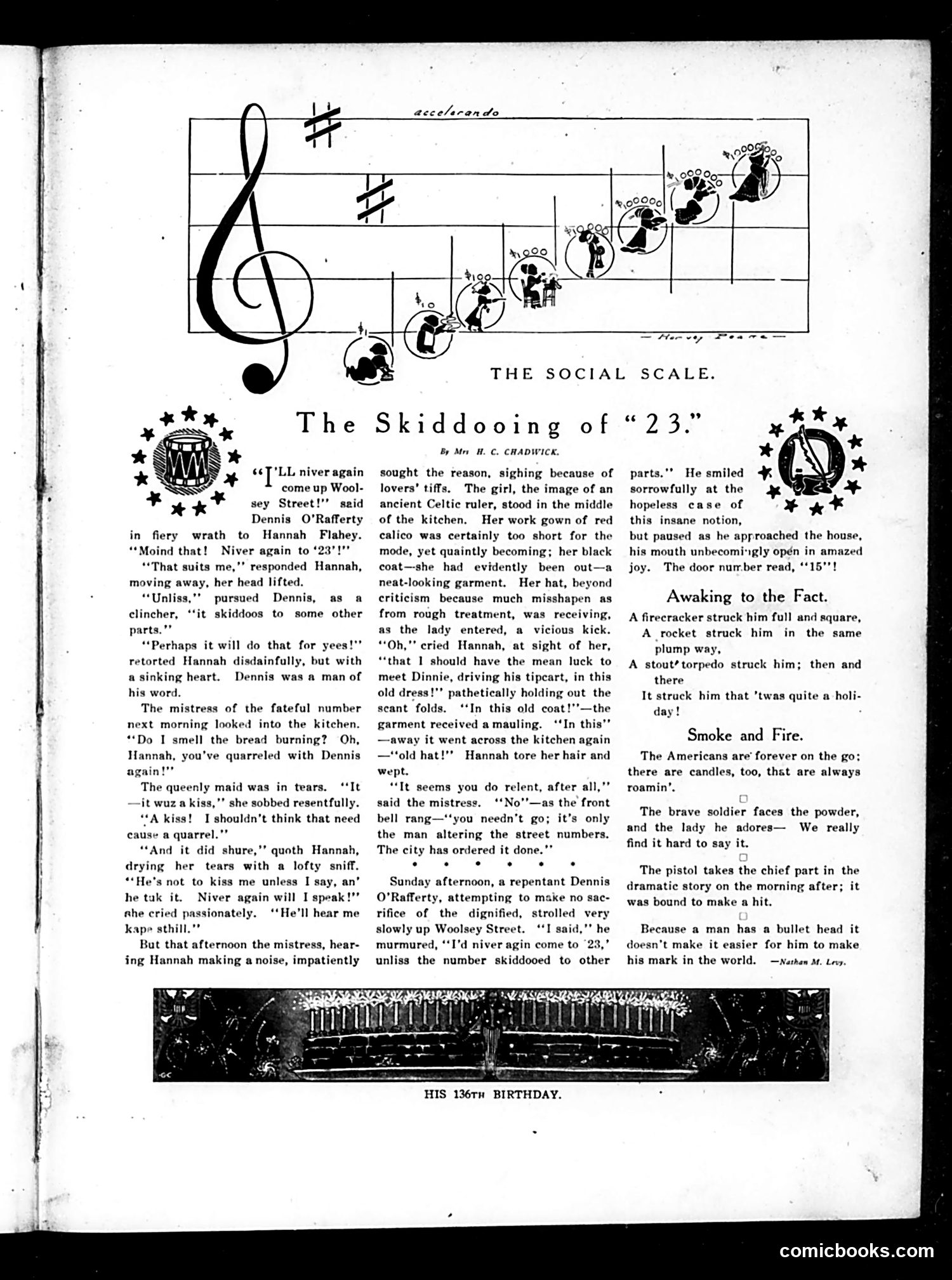
This story by H.C. Chadwick satirizes Irish domestic life through a lovers' quarrel over a kiss. Dennis O'Rafferty swears never to return to Woolsey Street (where his sweetheart Hannah lives) unless the street number itself "skiddoos" (moves/disappears)—an impossible condition he uses to punish her. The humor lies in the literal fulfillment of his impossible vow: when the city renumbers the streets, Hannah's house changes from "23" to "15." Dennis discovers this approaching the house and is delighted—the ridiculous loophole allows him to reconcile with Hannah without breaking his word or pride. The cartoon mocks both Irish stubbornness and the absurdity of legalistic reasoning in matters of the heart. The accompanying poems about fireworks and bullets appear unrelated filler content. The "Social Scale" musical staff at top likely connects to the magazine's satirical tone.
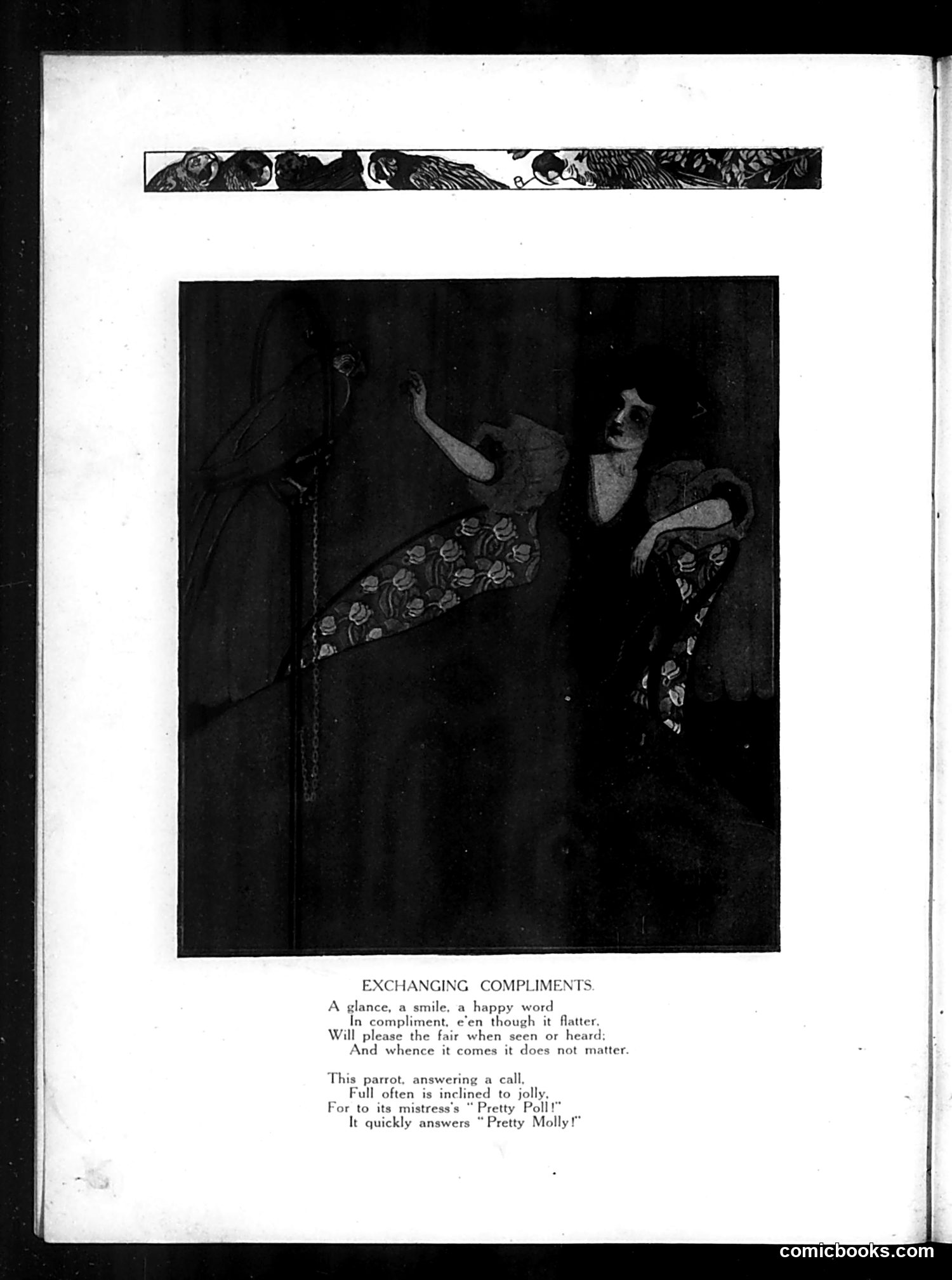
This is a social satire about flattery and superficial compliments. The image shows two elegantly dressed figures (appearing to be a man and woman in period attire) with a parrot on a chain between them. The joke operates on multiple levels: The poem suggests that compliments—even insincere ones—please women regardless of their source. The parrot serves as a metaphor for mindless repetition of flattery. When the mistress calls it "Pretty Poll," it mechanically responds "Pretty Molly"—suggesting that compliments are mere empty mimicry without genuine meaning. The satire targets both the superficiality of social courtship rituals and, implicitly, women's supposed susceptibility to hollow praise. It's typical of *Judge* magazine's cynical commentary on Gilded Age social conventions and gender relations.
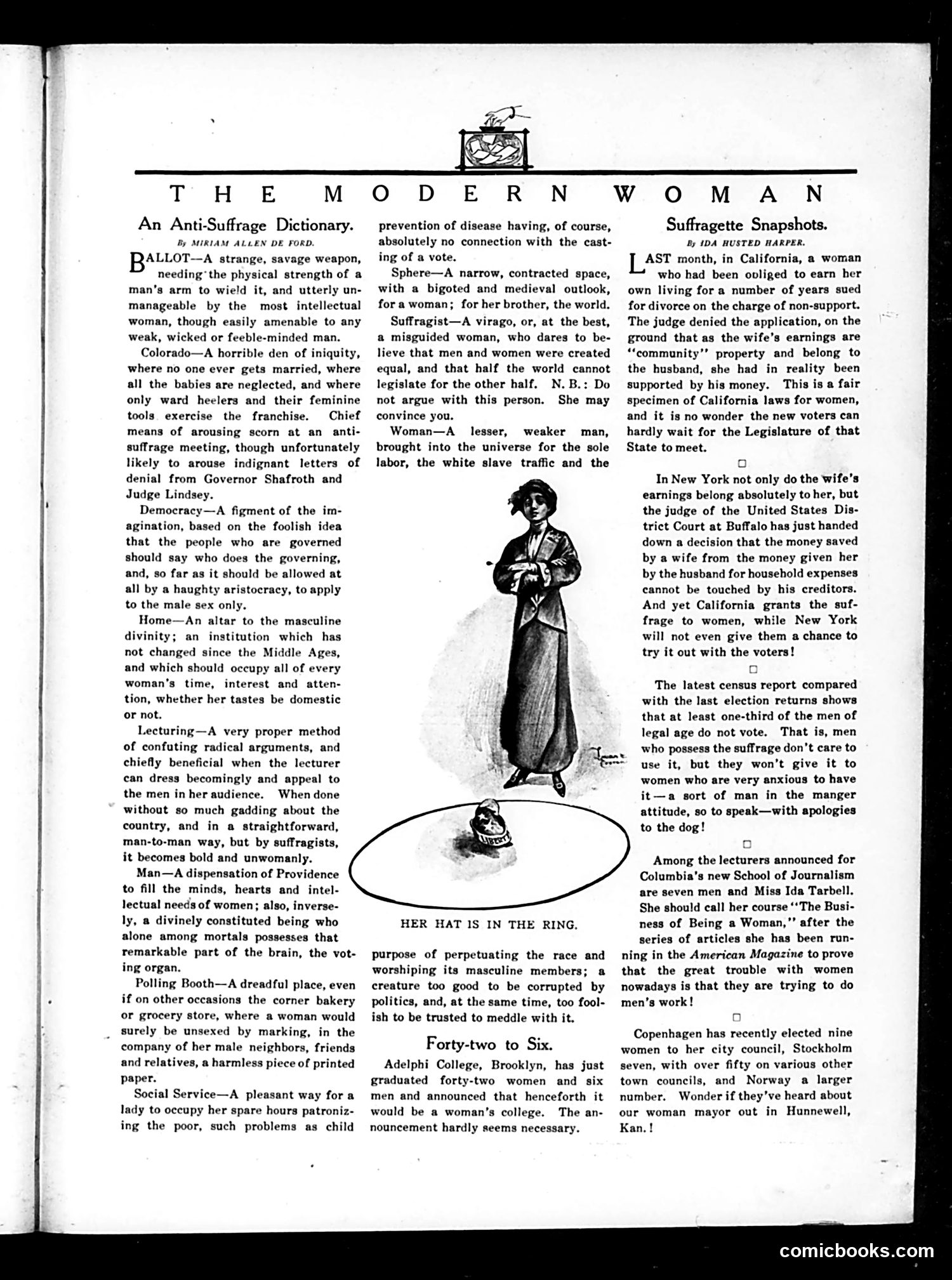
This page from *Judge* magazine presents anti-suffrage satire circa 1910s. **Left column:** "An Anti-Suffrage Dictionary" by Miriam Allen De Ford mockingly defines terms used by opponents of women's voting rights. Each definition exposes the logical contradictions and prejudices underlying anti-suffrage arguments—for example, defining "Woman" as simultaneously "too good to be corrupted by politics" yet "too foolish to be trusted to meddle with it." The satire highlights how anti-suffragists used paternalistic and circular reasoning to deny women the vote. **Center illustration:** "Her Hat Is in the Ring" depicts a woman in voting pose, using the boxing metaphor "hat in the ring" (meaning entering a contest) to suggest women's political participation. **Right column:** "Suffragette Snapshots" by Ida Husted Harper presents real legal injustices against women—a California divorce case where a judge denied support payments because the wife's earnings were deemed "community property" belonging to her husband, exemplifying why women needed political power to change discriminatory laws. The page advocates *for* women's suffrage by satirizing anti-suffrage arguments.
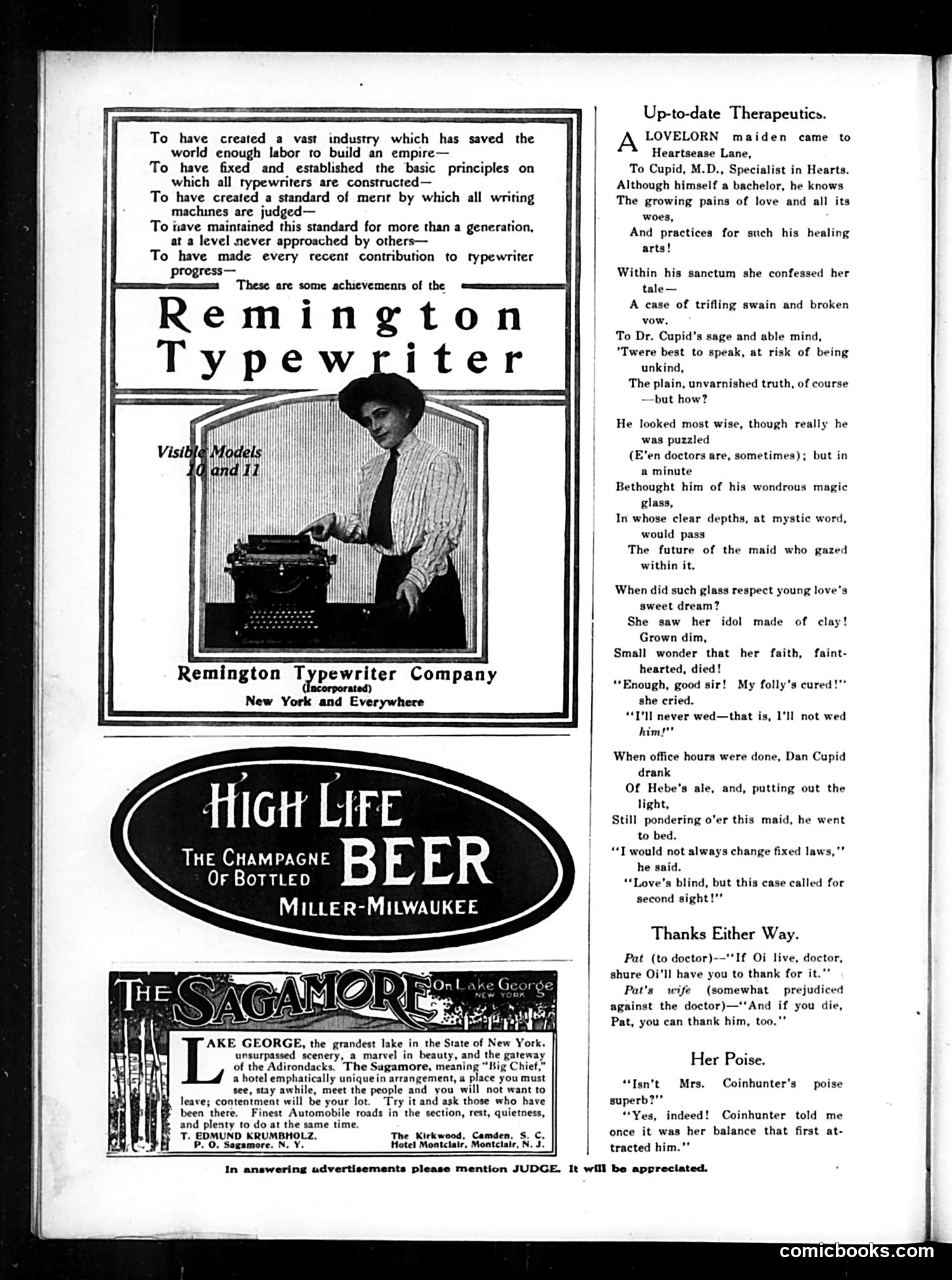
This page is primarily **advertising** rather than political satire. It contains: 1. **Remington Typewriter ad** (top): Lists the company's achievements in creating the typewriter industry and establishing manufacturing standards—a straightforward corporate advertisement with an image of a man using a typewriter. 2. **High Life Beer ad** (Miller-Milwaukee): Simple brand promotion. 3. **The Sagamore hotel ad** (Adirondacks): Tourism promotion for a resort. 4. **"Up-to-date Therapeutics"** (right column): A humorous poem about "Dr. Cupid," a romantic advisor. A lovelorn woman consults him; he uses a "magic glass" to show her future with her beloved, revealing he's made of "clay" (ordinary, disappointing). She decides never to marry him. The joke is romantic disillusionment presented as medical treatment. 5. **"Thanks Either Way"** and **"Her Poise"**: Brief humorous anecdotes about Irish dialect and marriage dynamics. The page reflects early 20th-century advertising conventions and light domestic humor rather than political commentary.
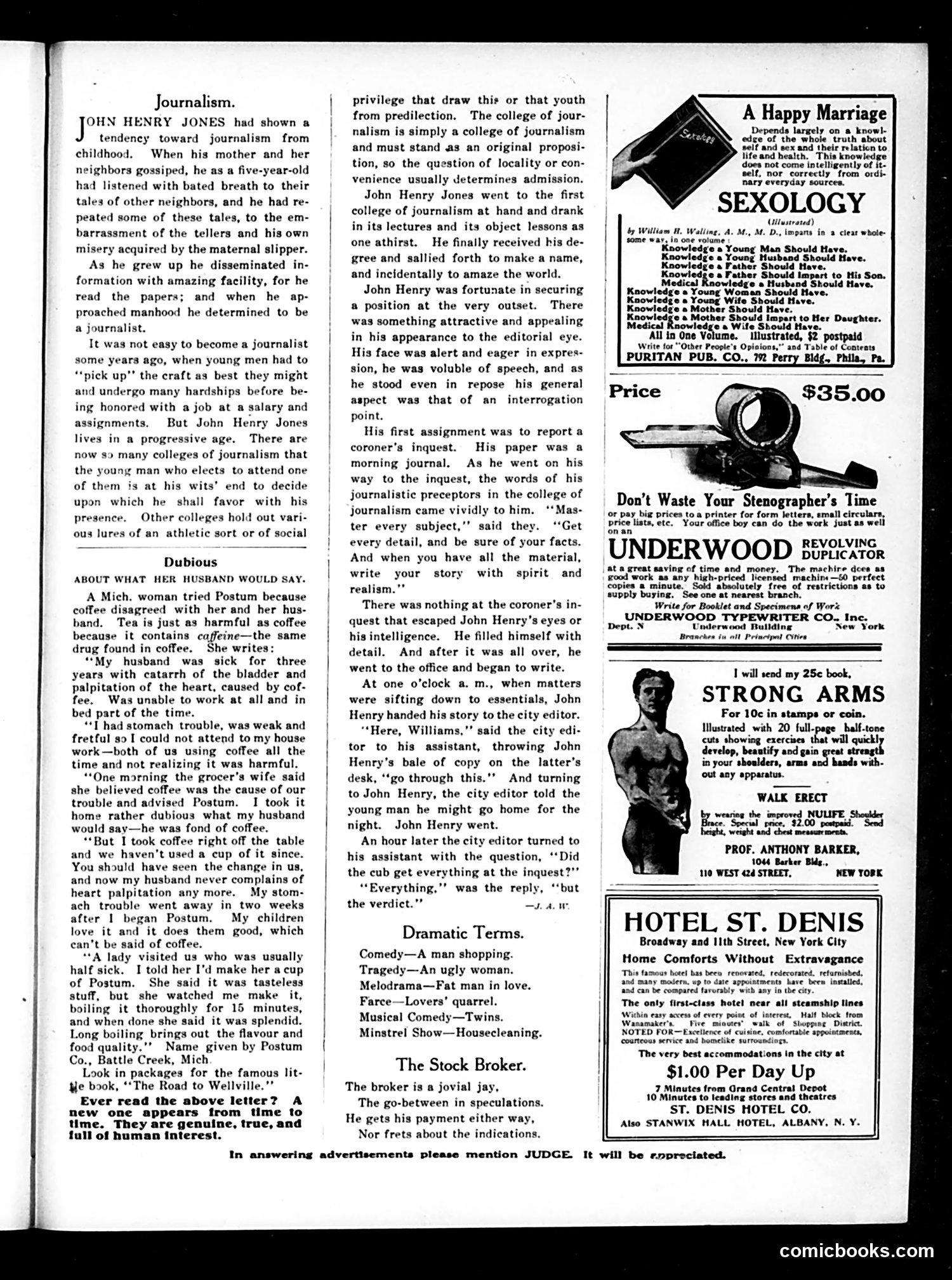
This page satirizes the newly professionalized field of journalism in early 20th-century America. The main story mocks the proliferation of "colleges of journalism" that allow young men like John Henry Jones to obtain credentials without genuine hardship or apprenticeship—a stark contrast to older journalism traditions requiring hands-on learning. The satire targets Jones himself, described as having an "interrogation point" appearance and an eagerness to gossip (traits inherited from childhood eavesdropping). His first assignment—reporting a coroner's inquest—suggests journalism was becoming accessible to eager but shallow personalities rather than serious observers. The humor lies in suggesting these new journalism schools are producing superficial reporters more interested in sensationalism than truth. The accompanying advertisements (Postum, Sexology books, typewriters) are period-typical but unrelated to the satire.
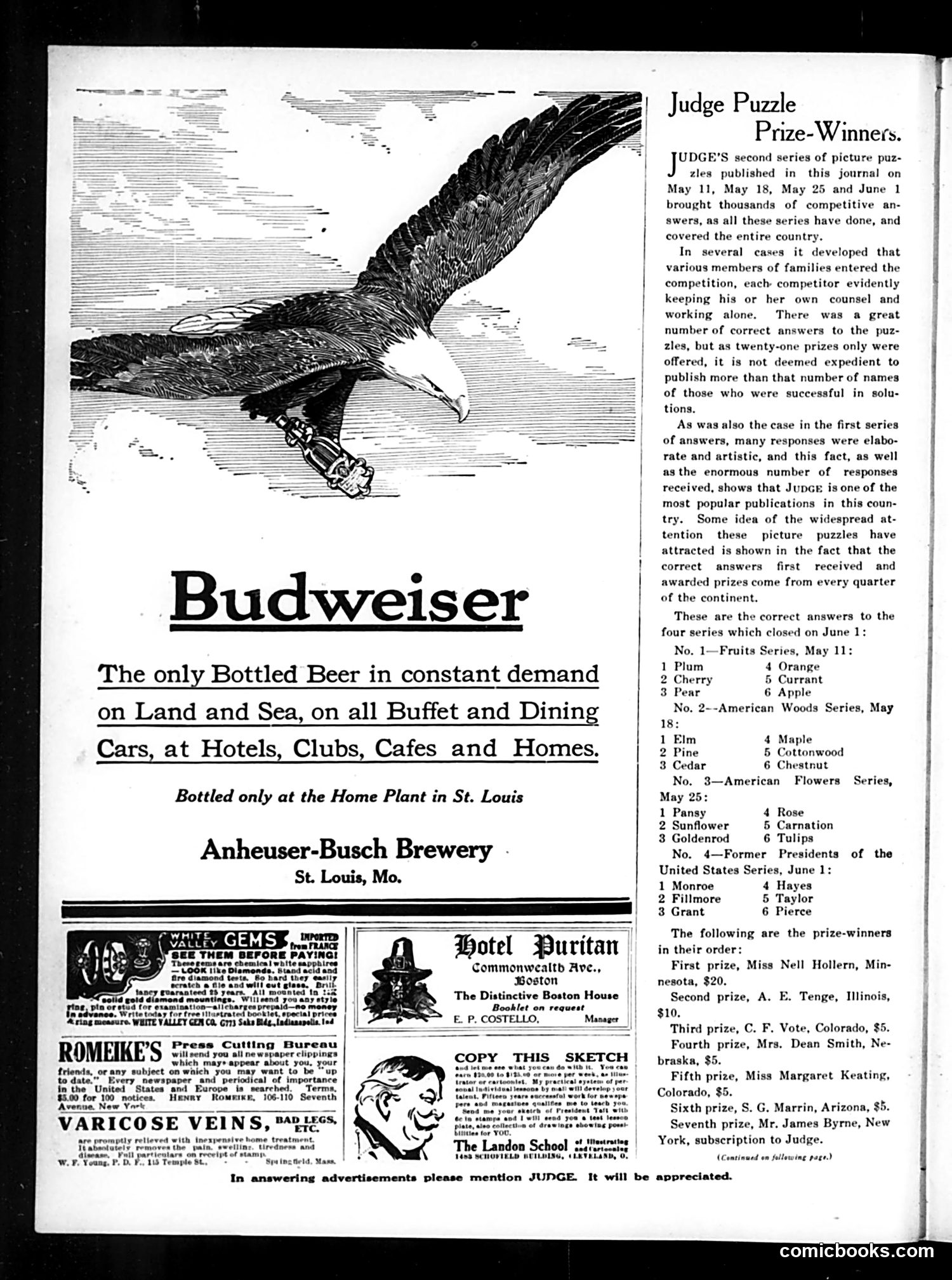
This page is primarily **advertising and puzzle results**, not political satire. The main image shows an **eagle carrying a beer bottle**—a Budweiser advertisement for Anheuser-Busch Brewery (St. Louis). The eagle, a symbol of American patriotism and quality, is used to promote beer as available everywhere: "on Land and Sea, on all Buffet and Dining Cars, at Hotels, Clubs, Cafes and Homes." The page's substantial content is **Judge's puzzle prize announcements**. The magazine ran four picture-puzzle series (May-June) involving identifying fruits, American woods, flowers, and U.S. presidents. Thousands entered nationwide. Judge announces the correct answers and lists seven prize-winners, ranging from $20 (first prize, Miss Nell Hollern, Minnesota) down to a Judge subscription. The remaining space contains **classified advertisements** for various services: press clipping bureaus, jewelry, hotels, medical treatments. No political commentary or satire is evident on this page.
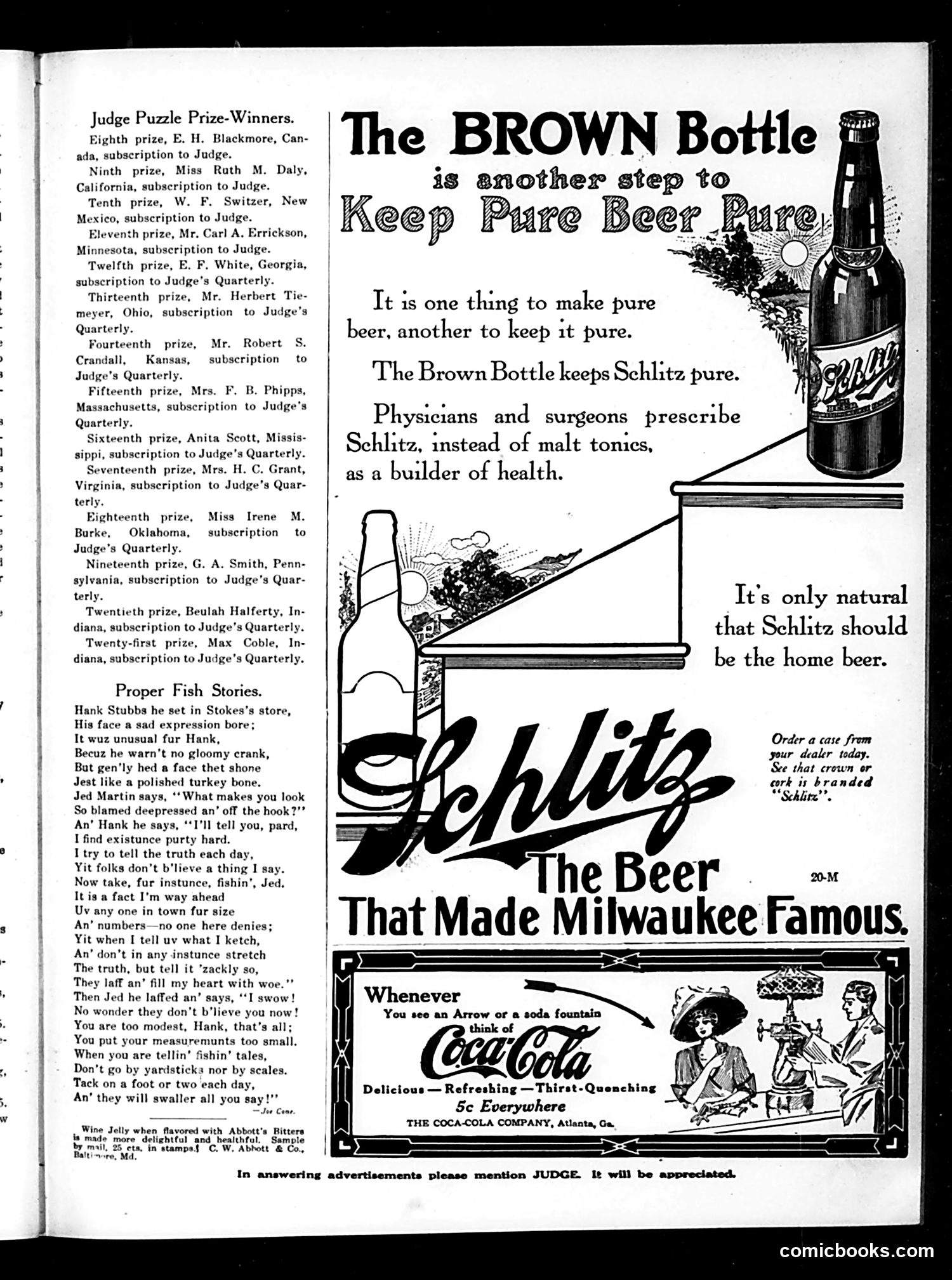
This Judge magazine page contains puzzle prize announcements, a humorous dialect poem about fishing tall tales, and two major advertisements. **"Proper Fish Stories"** satirizes the American tall-tale tradition. Hank Stubbs complains that nobody believes his fishing stories despite telling the truth, while his friend Jed advises him to exaggerate—"Tack on a foot or two each day"—to gain credibility. The joke inverts expectations: honesty fails where fabrication succeeds, mocking both the fishing-tale genre and human gullibility. **The advertisements** promote Schlitz beer and Coca-Cola. The Schlitz ad claims doctors prescribe it as a health tonic (common pre-Prohibition marketing), while the Coca-Cola ad emphasizes ubiquity and refreshment. These reflect early 20th-century advertising before strict FDA regulations on medicinal claims. The page is primarily **advertising and announcements** rather than political satire—typical filler content for Judge's commercial operation alongside its humor content.
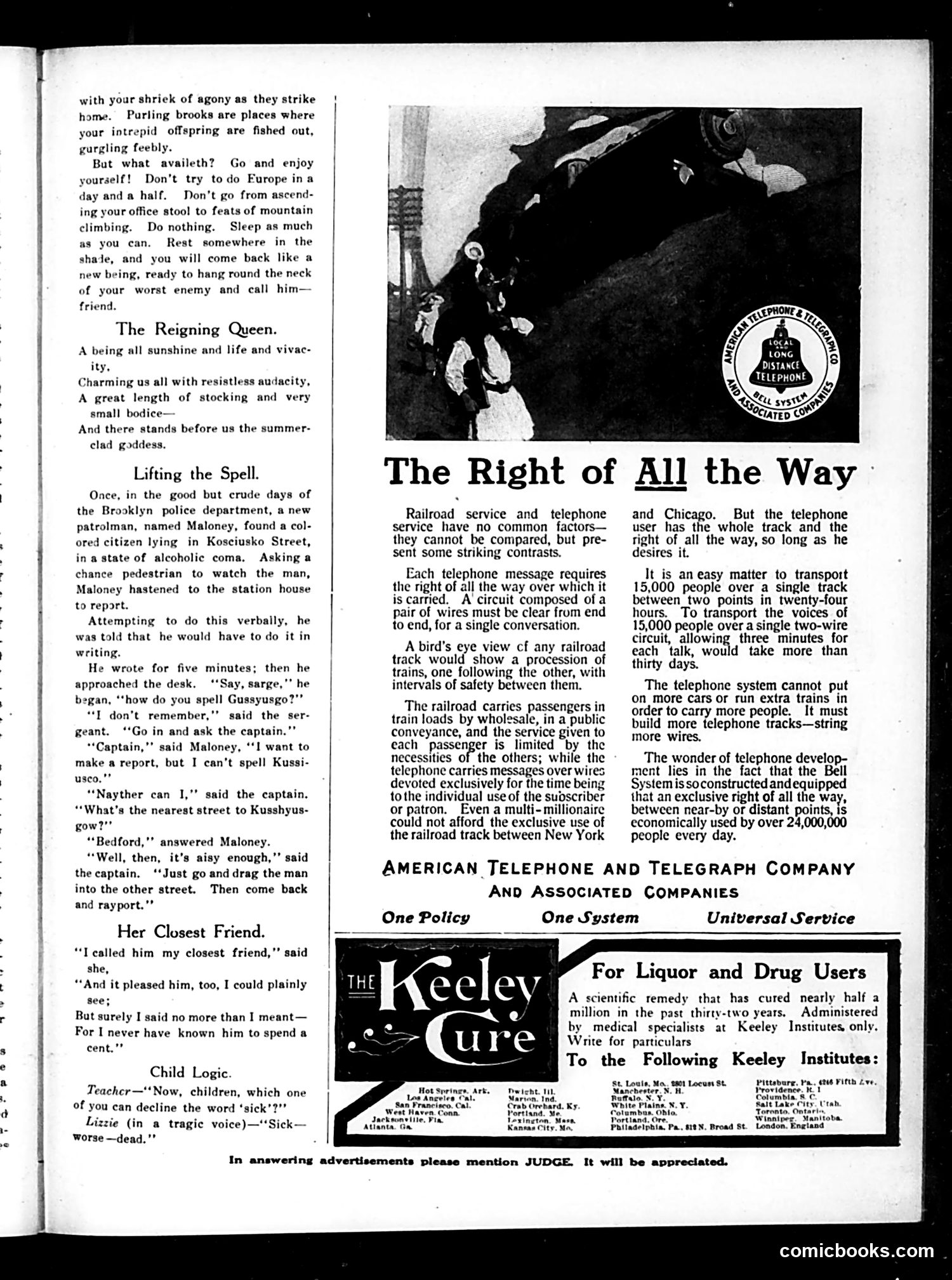
This page is primarily a corporate advertisement for AT&T, explaining the telephone system's superiority to railroads. The central argument compares infrastructure: railroads must share tracks among many trains sequentially, but telephone wires serve individual users exclusively during each call. The ad emphasizes that telephone service is more efficient and personalized than rail transport—a single caller gets "the right of all the way" over their circuit, whereas railroad passengers share conveyances with others. The text suggests this exclusive access is a marvel of modern engineering. The surrounding content—short humorous pieces like "Lifting the Spell" (a Brooklyn police anecdote) and "Child Logic"—appears to be typical Judge magazine filler material unrelated to the advertisement. This represents early-20th-century corporate messaging celebrating telephone infrastructure as a technological marvel worthy of public admiration.
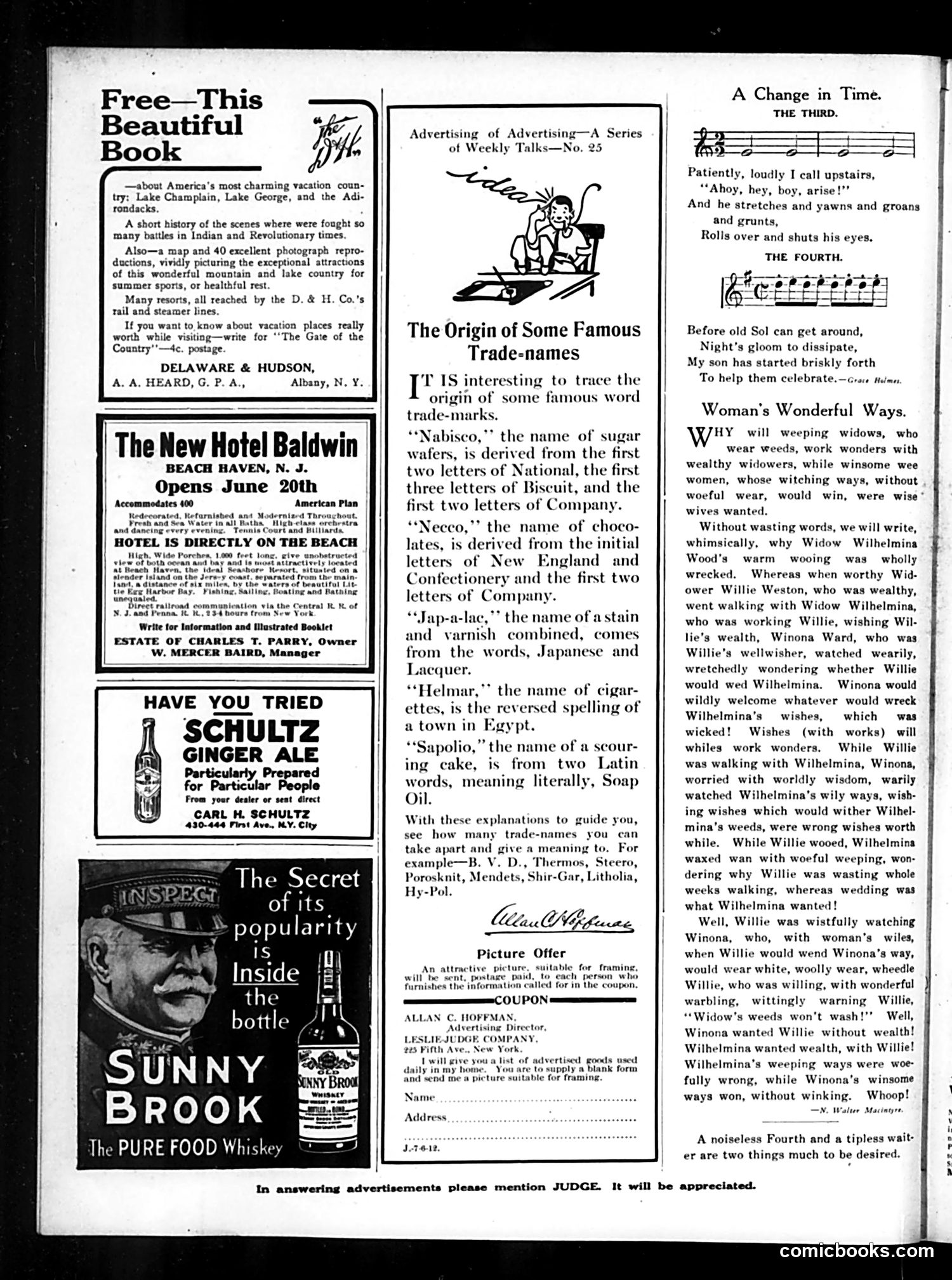
This page is primarily **advertising and light humor content** rather than political satire. The main features are: 1. **Advertisements** for vacation destinations (Delaware & Hudson railroad), a new hotel in Beach Haven, Schultz Ginger Ale, and Sunny Brook whiskey. 2. **"The Origin of Some Famous Trade-names"** — an educational piece explaining how brand names like Nabisco, Necco, and Sapolio were constructed from acronyms and word combinations. This appears instructional rather than satirical. 3. **"Woman's Wonderful Ways"** — a humorous short story using alliteration (repeatedly starting words with "W") about romantic rivalry between widows competing for a wealthy widower named Willie Weston. The joke relies on the tongue-twisting wordplay rather than social commentary. 4. **Musical verse** titled "A Change in Time," depicting a lazy son's contrasting behavior on weekdays versus holidays. The page contains **no clear political cartoons or satirical commentary** on current events. It's typical of Judge's lighter content balancing serious satire elsewhere in the magazine.
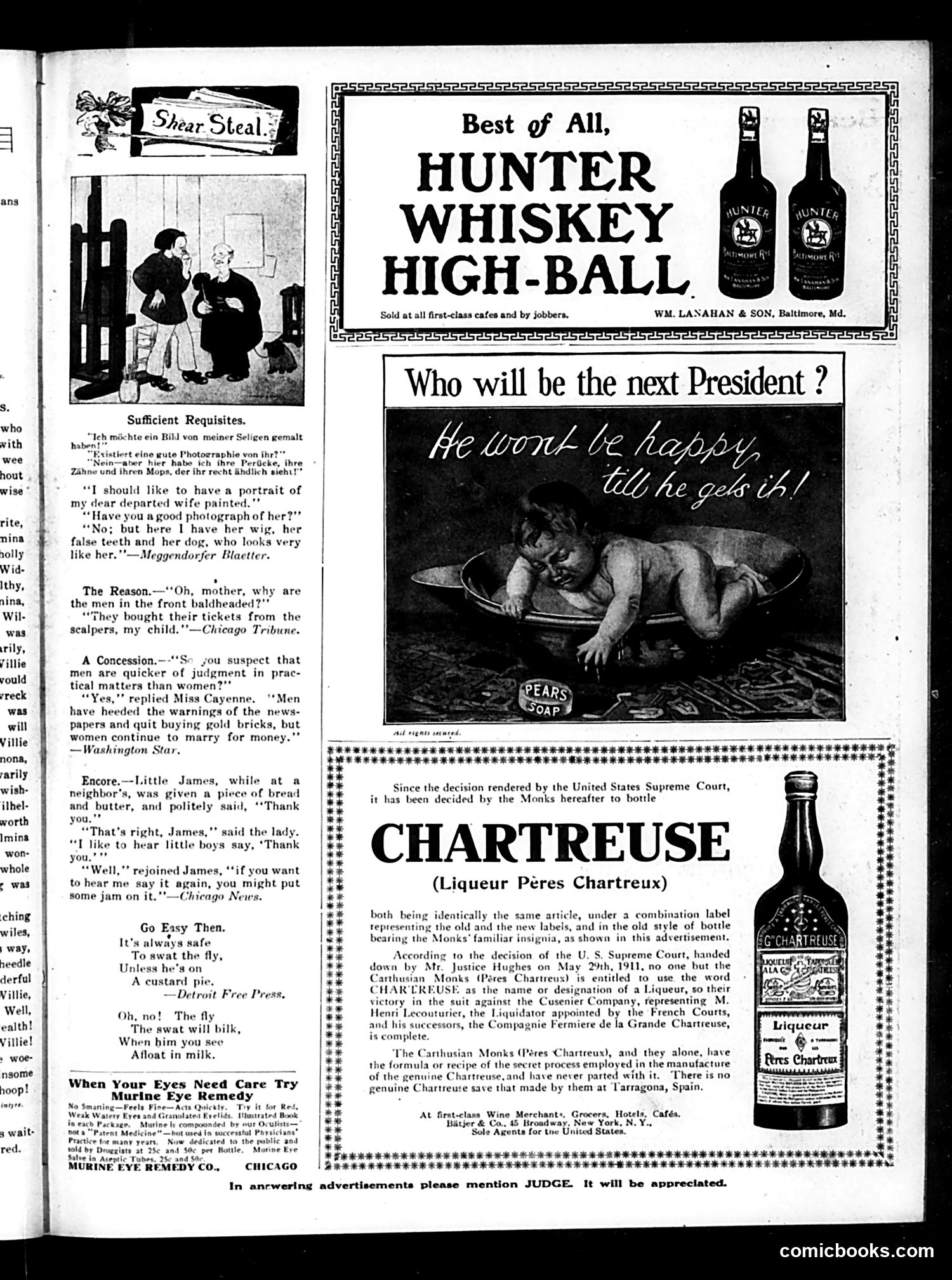
This page from Judge magazine (publication date unclear from image) contains **primarily advertisements** rather than political cartoons, though one notable image appears. ## The Presidential Cartoon The most prominent illustration shows a disheveled man with text asking "Who will be the next President?" with the caption "He won't be happy, till he gets it!" This appears to be **satirizing political ambition**—likely mocking a contemporary political figure's obsessive pursuit of the presidency, though the specific identity is not clearly indicated in the visible text. ## Advertisement Content The page is dominated by ads for: - **Hunter Whiskey High-Ball** - **Pears Soap** (featuring the presidential cartoon) - **Chartreuse Liqueur** (discussing a recent Supreme Court decision from 1911 regarding trademark rights) - **Marine Eye Remedy** The various humor pieces ("Sufficient Requisites," "The Reason," etc.) are short jokes, mostly unrelated to the advertisements or political content. **Without additional context or clearer imagery of the presidential figure, identifying the specific politician being satirized is not possible.**
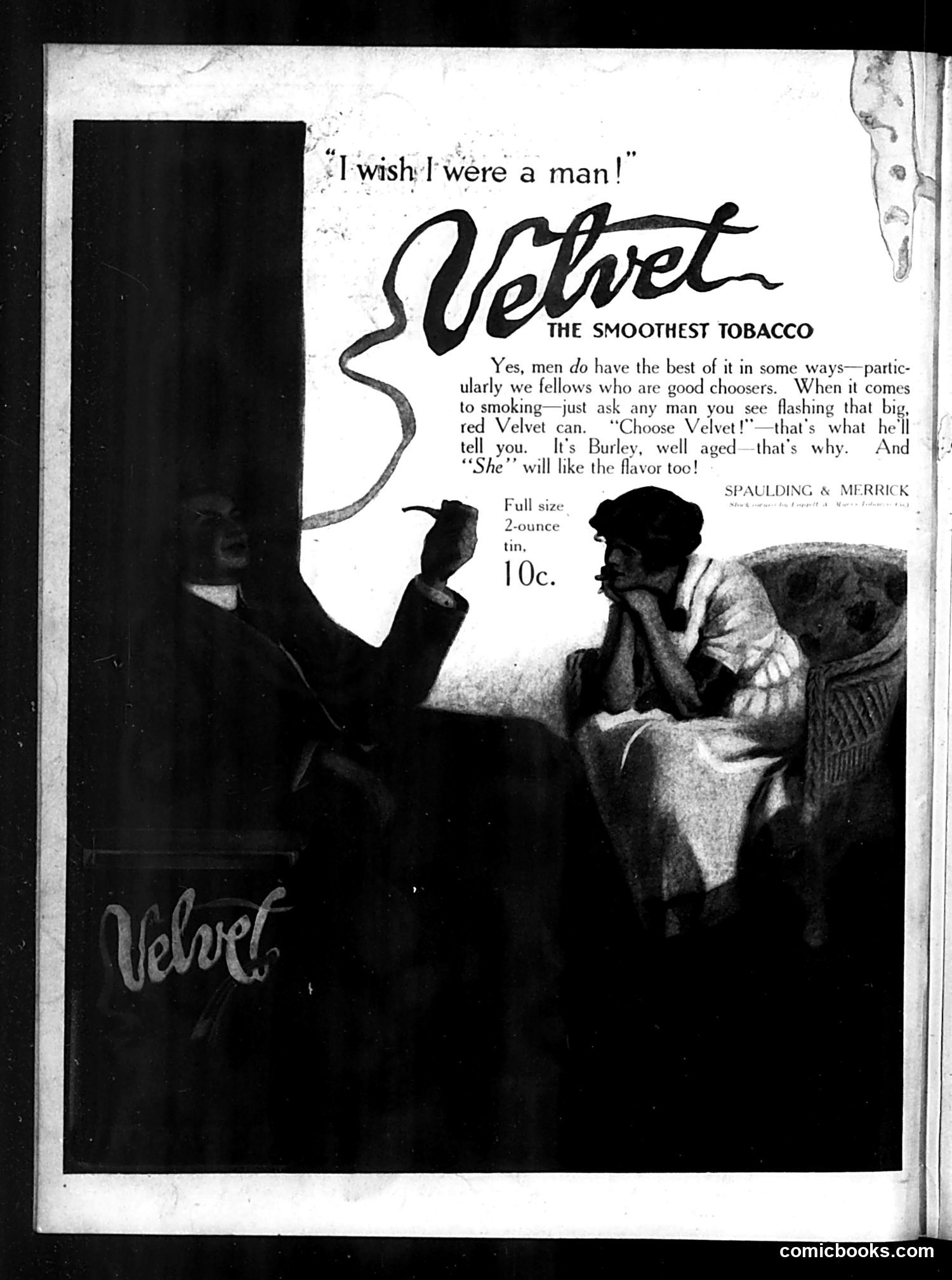
This is primarily a **tobacco advertisement** rather than political satire. The ad features a woman saying "I wish I were a man!" — a statement reflecting early 20th-century gender dynamics. The joke relies on the sexist premise that men enjoy superior pleasures unavailable to women, specifically high-quality tobacco smoking. The ad suggests that only men can properly appreciate Velvet's "smoothest tobacco," while women are positioned as envious outsiders to this masculine experience. The imagery shows a woman watching a man contentedly smoking, emphasizing her exclusion. The ad then offers a compromise: women can still enjoy Velvet's flavor vicariously ("She" will like the flavor too), implying secondary, derivative enjoyment rather than direct participation in male privilege. This reflects historical attitudes restricting women's public smoking and consumer choices, using gender envy as a marketing hook.