
Judge, 1912-07-06 · page 4 of 24
Judge — July 6, 1912 — page 4: what you’re looking at
What you’re looking at
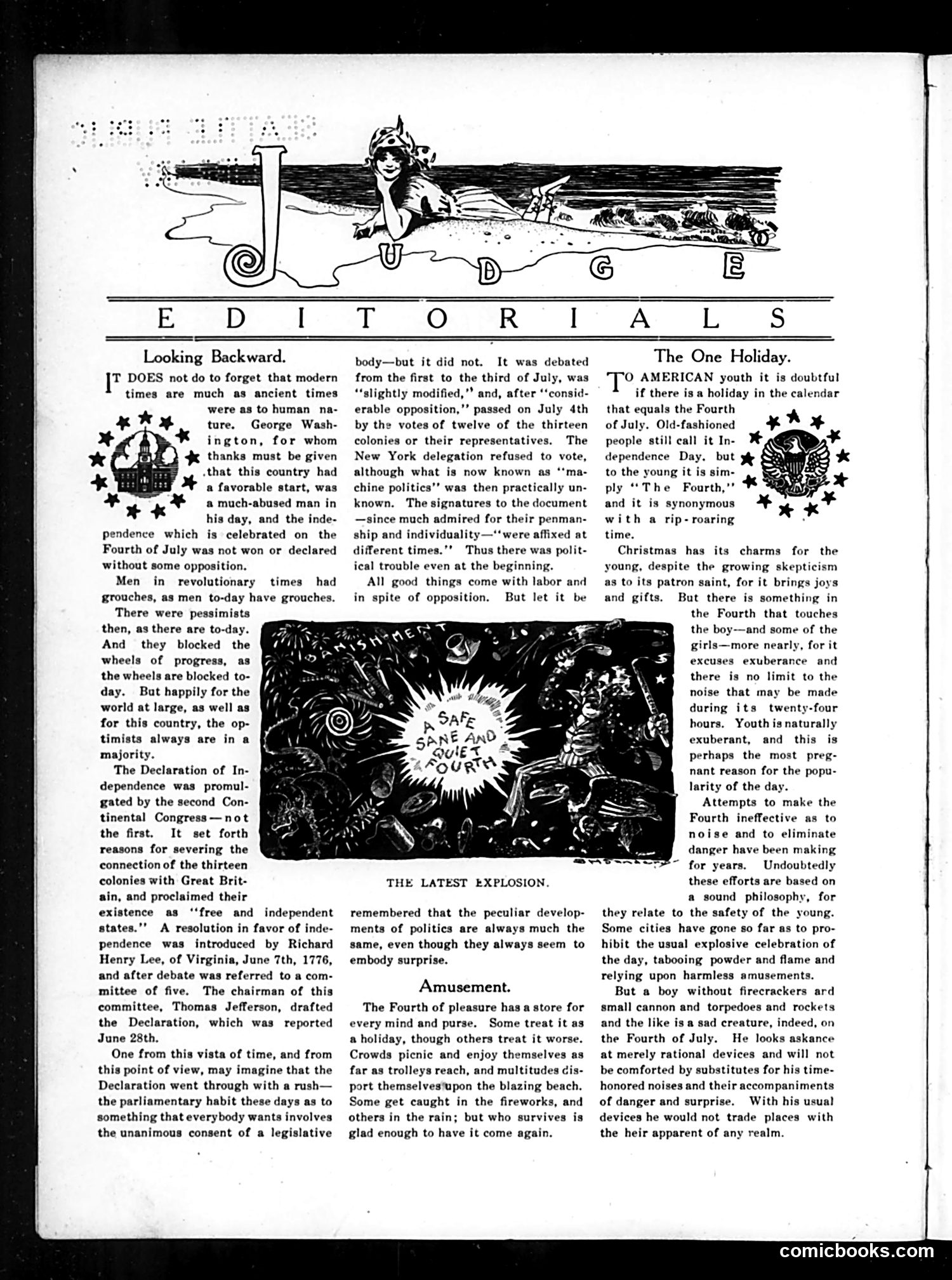
This page presents editorials celebrating American Independence Day. The left column, "Looking Backward," discusses the Declaration of Independence's contentious drafting—notably that the document was "slightly modified" before passage on July 4th, with New York's delegation initially refusing to vote. The right column, "The One Holiday," argues that the Fourth of July uniquely resonates with American youth despite growing skepticism about holidays generally. It defends the day's noise and chaos as inherent to youthful exuberance. The central cartoon, "The Latest Explosion," depicts fireworks with a starburst labeled "SAFE SANE AND SANE FOURTH"—satirizing contemporary safety campaigns attempting to regulate Fourth of July celebrations. The image suggests tension between reformers seeking to eliminate dangerous fireworks and those defending traditional, chaotic holiday traditions.
📄 Transcribed text from this page (OCR, searchable)
Machine-transcribed from the original scan — historical spelling and the odd misread are preserved.
Looking Backward. T DOES not do to forget that modern times are much as ancient times were as to human na- ture. George Wash- ington, for whom thanks must be given .that this country had a favorable start, was * Fa much-abused man in * * his day, and the inde- pendence which is celebrated on the Fourth of July was not won or declared without some opposition. Men in_ revolutionary times had grouches, as men to-day have grouches. There were pessimists then, as there are to-day. And they blocked the wheels of progress, as the wheels are blocked to- day. But happily for the world at large, as well as for this country, the op- timists always are in a majority. The Declaration of In- dependence was promul- gated by the second Con- tinental Congress—not the first. It set forth reasons for severing the connection of the thirteen colonies with Great Brit- ain, and proclaimed their existence as ‘‘free and independent states.’’ A resolution in favor of inde- pendence was introduced by Richard Henry Lee, of Virginia, June 7th, 1776, and after debate was referred to a com- mittee of five. The chairman of this committee, Thomas Jefferson, drafted the Declaration, which was reported June 28th, One from this vista of time, and from this point of view, may imagine that the Declaration went through with a rush— the parliamentary habit these days as to something that everybody wants involves the unanimous consent of a legislative body—but it did not. It was debated from the first to the third of July, was “slightly modified,’” and, after ‘‘consid- erable opposition,” passed on July 4th by the votes of twelve of the thirteen colonies or their representatives. The New York delegation refused to vote, although what is now known as ‘*ma- chine politics’? was then practically un- known. The signatures to the document —since much admired for their penman- ship and individuality—*‘were affixed at different times.’’ Thus there was polit- ical trouble even at the beginning. All good things come with labor and in spite of opposition. But let it be THE LATEST EXPLOSION. remembered that the peculiar develop- ments of politics are always much the same, even though they always seem to embody surprise. Amusement. The Fourth of pleasure has a store for every mind and purse. Some treat it as a holiday, though others treat it worse. Crowds picnic and enjoy themselves as far as trolleys reach, and multitudes cis- port themselves‘upon the blazing beach. Some get caught in the fireworks, and others in the rain; but who survives is glad enough to have it come again. The One Holiday. '0 AMERICAN youth it is doubtful if there is a holiday in the calendar that equals the Fourth of July, Old-fashioned people still call it In- dependence Day, but to the young it is sim- ply ‘The Fourth,’’ and it is synonymous with a rip-roaring time. Christmas has its charms for the young, despite the growing skepticism as to its patron saint, for it brings joys and gifts. But there is something in the Fourth that touches the boy—and some of the girls—more nearly, for it excuses exuberance and there is no limit to the noise that may be made during its twenty-four hours. Youth is naturally exuberant, and this is perhaps the most preg- nant reason for the popu- larity of the day. Attempts to make the Fourth ineffective as to noise and to eliminate danger have been making for years, Undoubtedly these efforts are based on a sound philosophy, for they relate to the safety of the young. Some cities have gone so far as to pro- hibit the usual explosive celebration of the day, tabooing powder and flame and relying upon harmless amusements. But a boy without firecrackers ard small cannon and torpedoes and rockets and the like is a sad creature, indeed, on the Fourth of July. He looks askance at merely rational devices and will not be comforted by substitutes for his time- honored noises and their accompaniments of danger and surprise. With his usual devices he would not trade places with the heir apparent of any realm. comicbooks.com